Daylight Saving Time: Why Keep It If It Costs Lives?

Why do we still change the clocks twice a year? Daylight saving time began as a wartime plan to conserve coal, not as a favor to farmers: agriculture was among its strongest opponents. When the public is asked, most people say the same thing: stop changing the clocks. The hard part is which hour to keep. Permanent daylight time gives brighter evenings but brings back the dark winter mornings the US lived through in 1974; permanent standard time, which the American Academy of Sleep Medicine favors, gives brighter mornings and earlier summer sunsets.
This video follows the idea from Benjamin Franklin's 1784 joke about candles, through George Vernon Hudson, William Willett and the First World War, to the energy studies (DOE 2008, Indiana, a 44-study meta-analysis), the week after the spring change (a shift in heart-attack admissions and a rise in fatal crashes), the EU's stalled 2018 plan and the US House vote of July 14, 2026 on H.R. 139. It also looks at British Columbia and Alberta, which are ending seasonal clock changes; Mexico (except some towns on the US border), Russia and Brazil, which ended them; and past experiments in South Korea, Japan and China. On November 1, 2026, Seattle falls back and Vancouver doesn't.
Some people search for "daylight savings time"; the official name is daylight saving time.
This article is the full narration of the video. Watch on YouTube
Why do we still change the clocks?
Why do we still change the clocks twice a year? It's called daylight saving time, though plenty of people say daylight savings. On November 1, 2026, at two in the morning, Seattle will set its clocks back one hour. Vancouver, just across the border to the north, will not.
For Vancouver and most of British Columbia, the clock change on March 8 was the last one. So this winter, Vancouver will be an hour ahead of Seattle. Europe falls back a week earlier: the UK and the European Union change on October 25. And yet, when people are asked, most say they want this to stop.
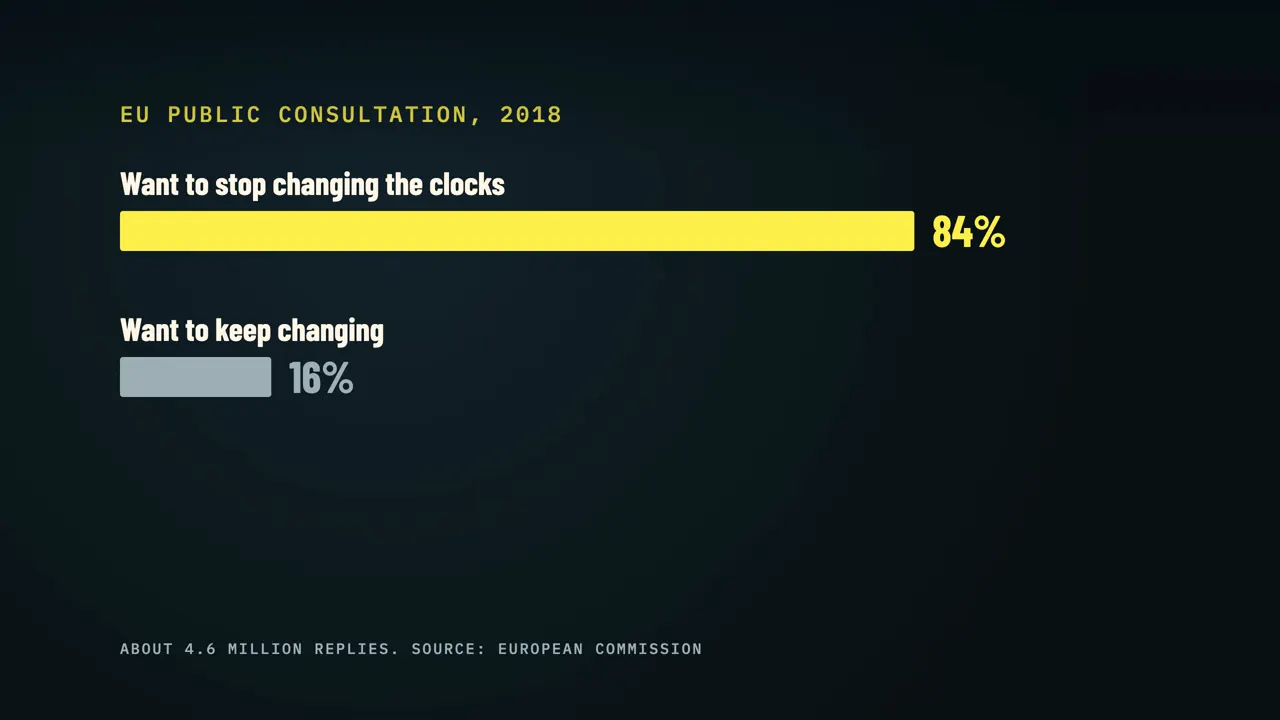
When the European Union asked the public in 2018, 84 percent of about 4.6 million replies said they wanted it to end. In July 2026, the US House voted 308 to 117 to make daylight saving time permanent. But the Senate hasn't voted on that bill. And passing just one chamber of Congress doesn't make a bill law.
So if you're wondering whether daylight saving time is now permanent across the United States, the answer is no. The US still falls back on the first Sunday in November, which this year is November 1. The short answer starts with something most people agree on, and ends with a choice people still can't settle. To see why, we need to go back to a joke, two wars and one very dark winter.
What the clock change actually does
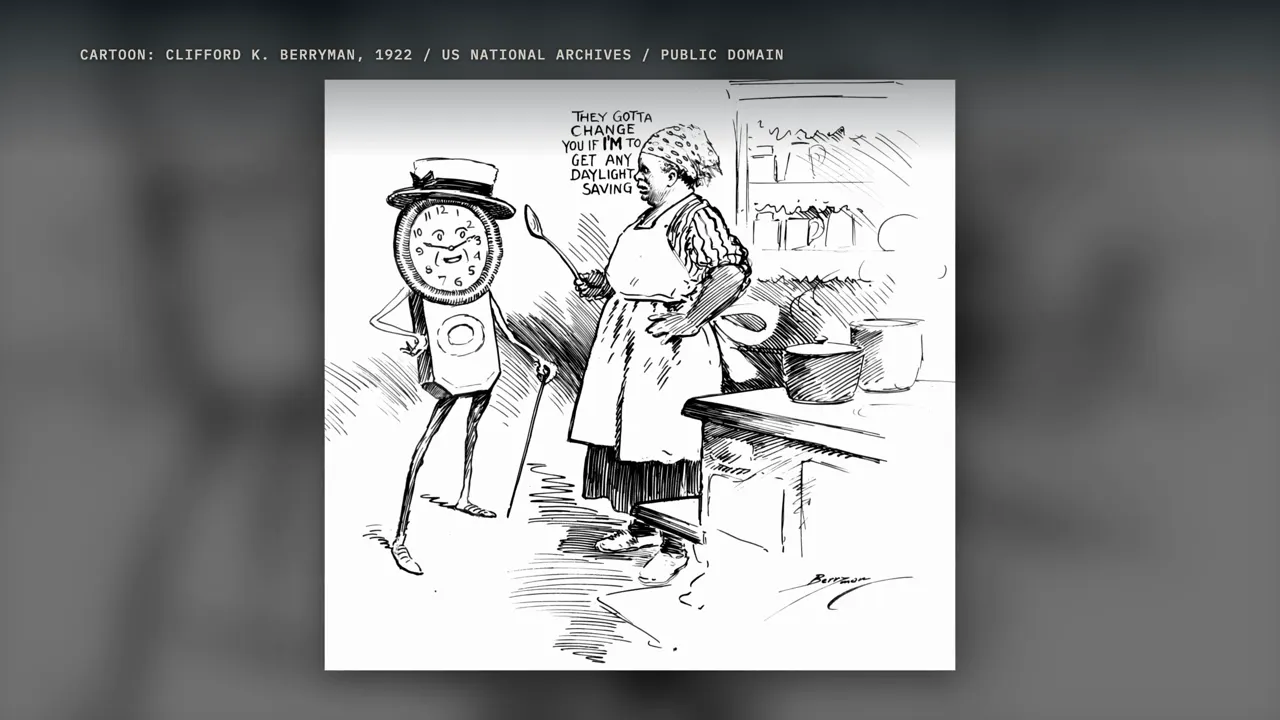
First, what is it, exactly? For part of the year, a country moves its clocks one hour ahead. The sun doesn't move, but our schedules do. Sunrise and sunset both arrive an hour later on the clock.
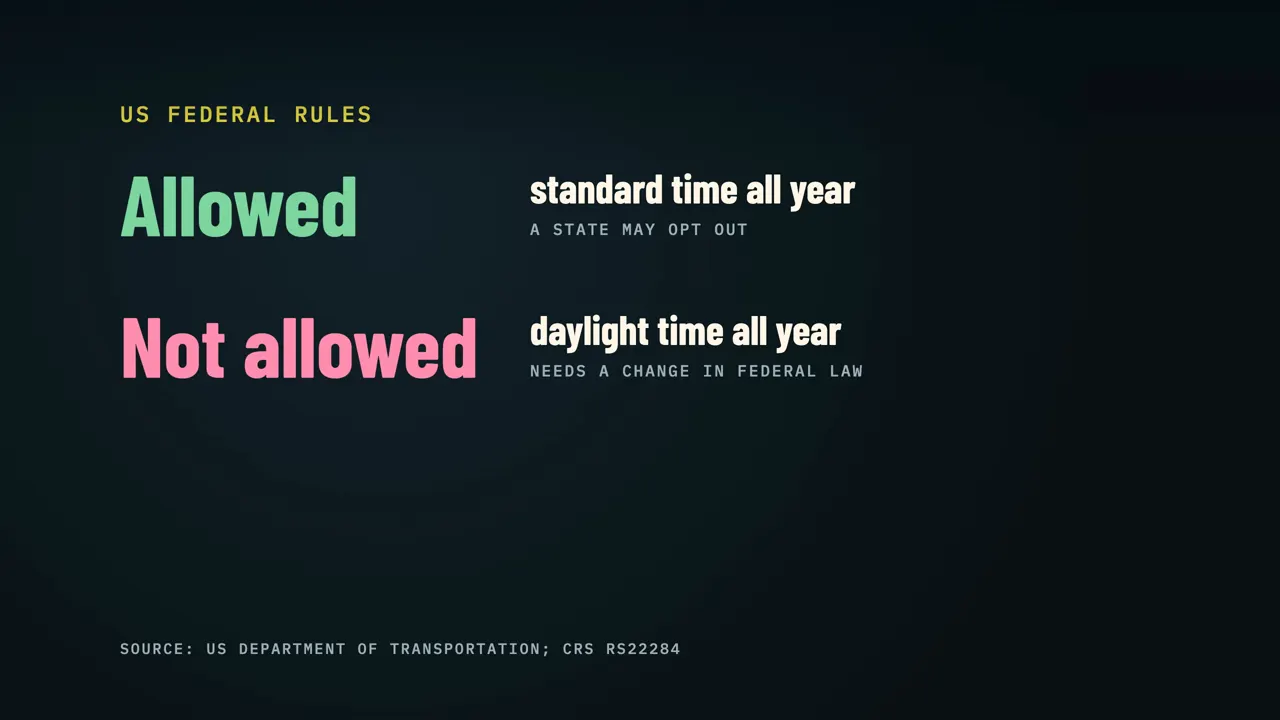
That means more light in the evening, and less in the morning. In the US, clocks spring forward on the second Sunday in March and fall back on the first Sunday in November. A state can keep standard time all year, but permanent daylight time would require a change in federal law. Hawaii and most of Arizona don't change at all.
Inside Arizona, the Navajo Nation does change its clocks. Many countries leave their clocks alone today, including India, Japan, China and Saudi Arabia. If you live in one of them, this twice-a-year ritual can look strange. It looks even stranger once you see where it came from.
Benjamin Franklin's joke
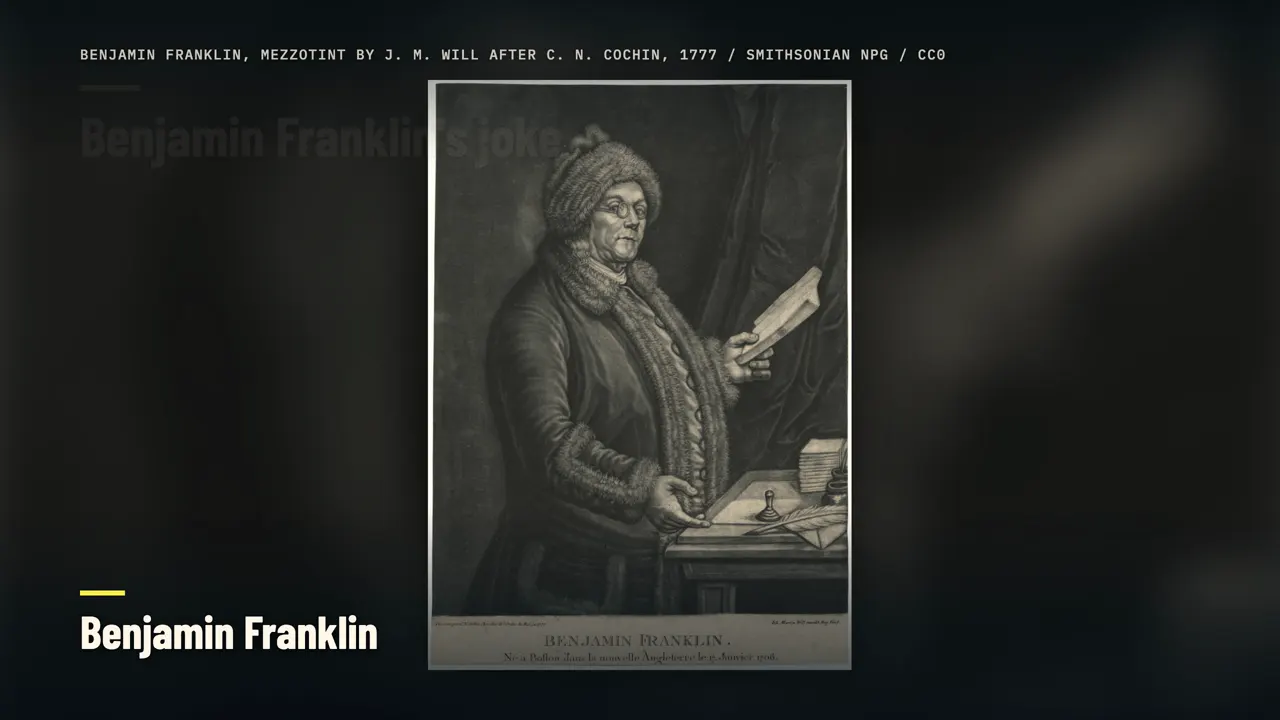
You may have heard that Benjamin Franklin invented daylight saving time. He didn't. On April 26, 1784, the front page of the Journal de Paris carried a letter signed only "a subscriber." The writer was Franklin.
On the surface, it was about a new oil lamp that Paris was arguing over. His real target was Parisians who slept through hours of free morning sunlight. He never suggested changing the clocks. He suggested changing the people.
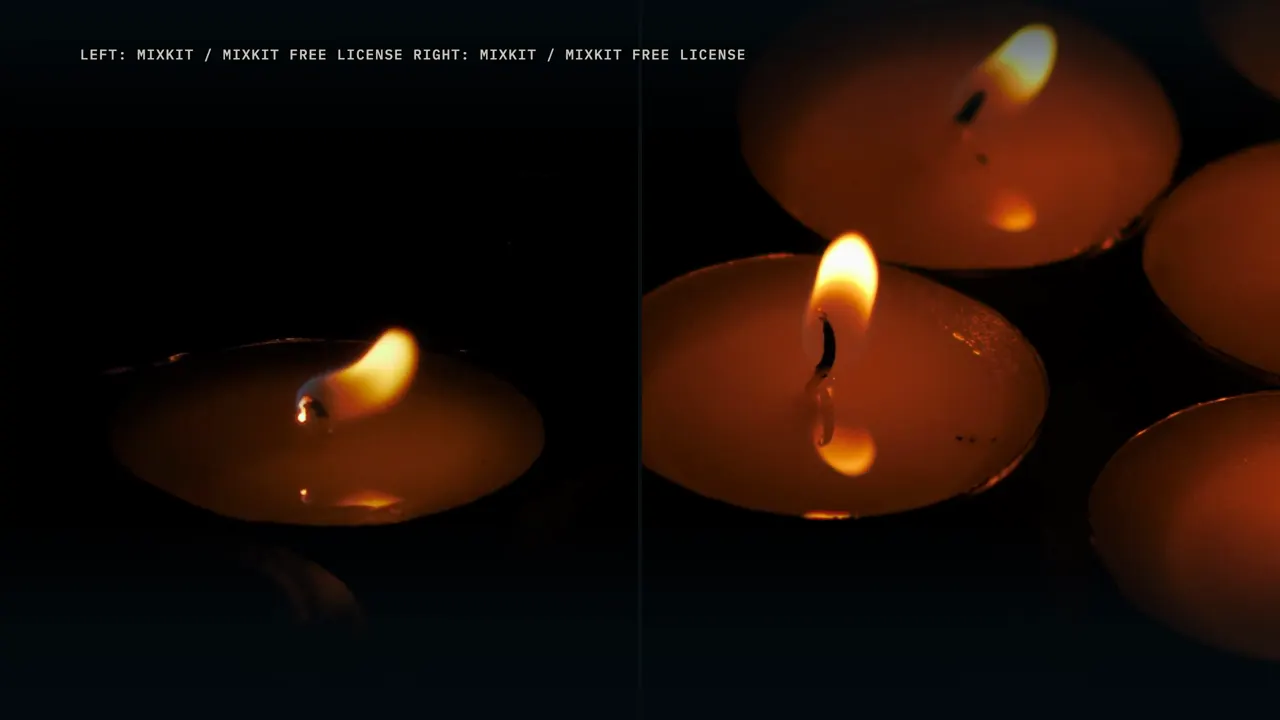
Put a tax of one louis on every window with shutters. Let no family buy more than one pound of candles a week. Ring the church bells at sunrise. And if that isn't enough, "let cannon be fired in every street."
He even did the math for 100,000 Paris families over 183 nights. By his count, they would save 64,050,000 pounds of wax and tallow. It was satire about candles, not a plan for clocks. But the idea underneath it would come back: daylight is being wasted while people sleep.
An insect collector and a builder

A real proposal to change the clocks came more than a century later, from New Zealand. George Vernon Hudson was an entomologist, a scientist who studies insects. On October 16, 1895, he presented a paper on daylight saving to the Wellington Philosophical Society. The idea was ridiculed by a number of society members.
Twelve years later, in 1907, a London builder named William Willett published a pamphlet. He called it The Waste of Daylight. His plan was gentle. Move the clocks forward 20 minutes on four Sundays in a row.
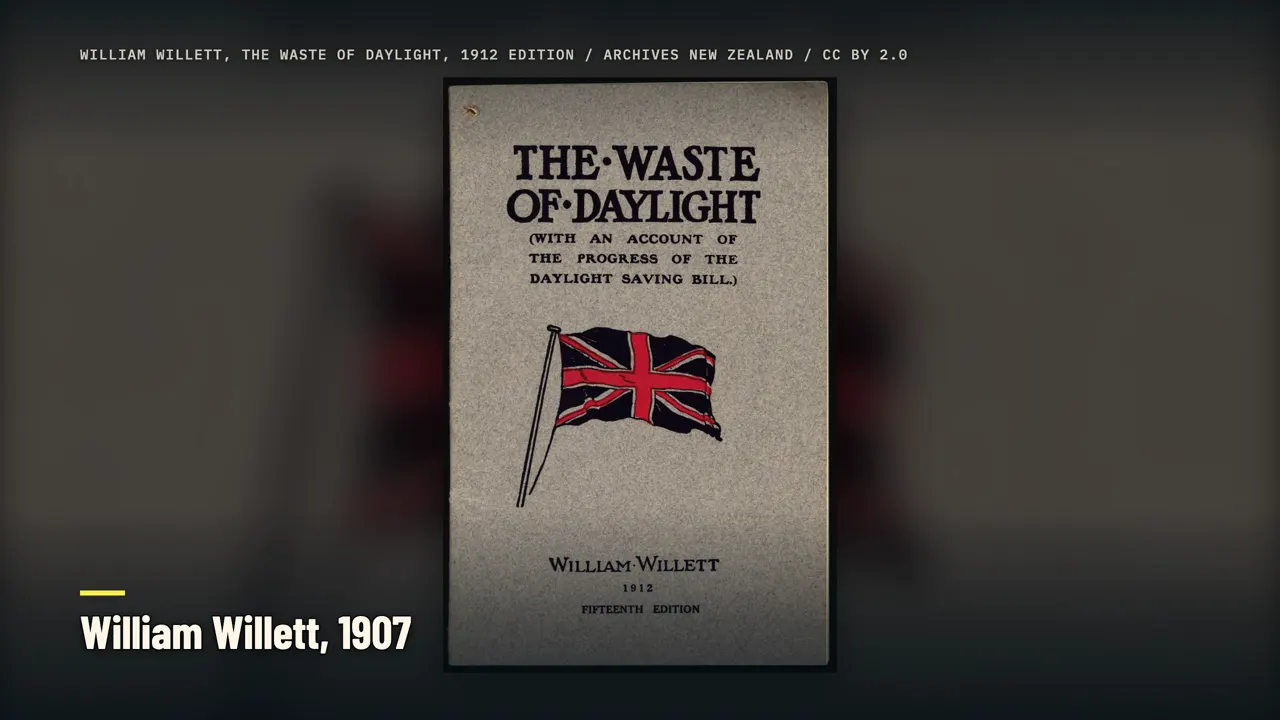
That adds up to 80 minutes. Willett died of flu in 1915, at the age of 58. Britain passed its summer time law the very next year. But what finally moved the clocks wasn't a love of sunlight.
It was war.
War changes the clocks
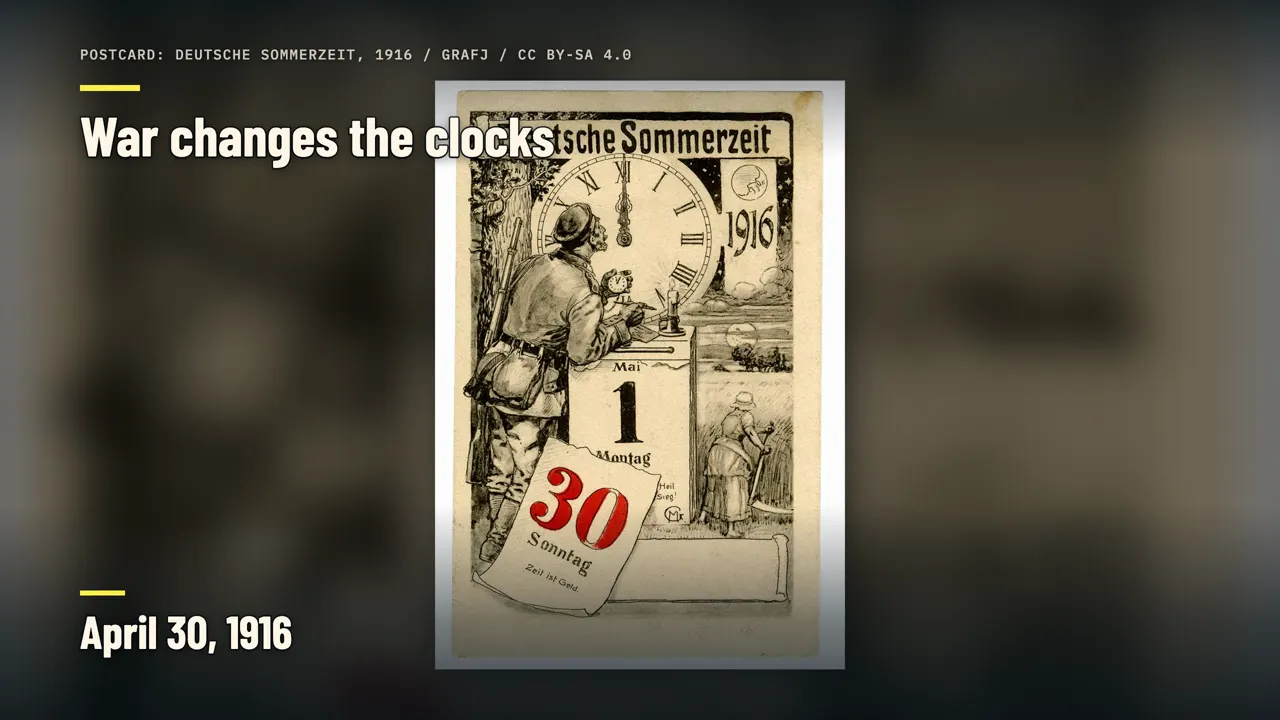
On April 30, 1916, in the middle of the First World War, Germany and Austria-Hungary moved their clocks forward. The reason was to conserve coal. In Germany, the switch came at 11 at night, and the clocks jumped straight to midnight. Britain passed its own law on May 17, and moved its clocks four days later, on May 21.
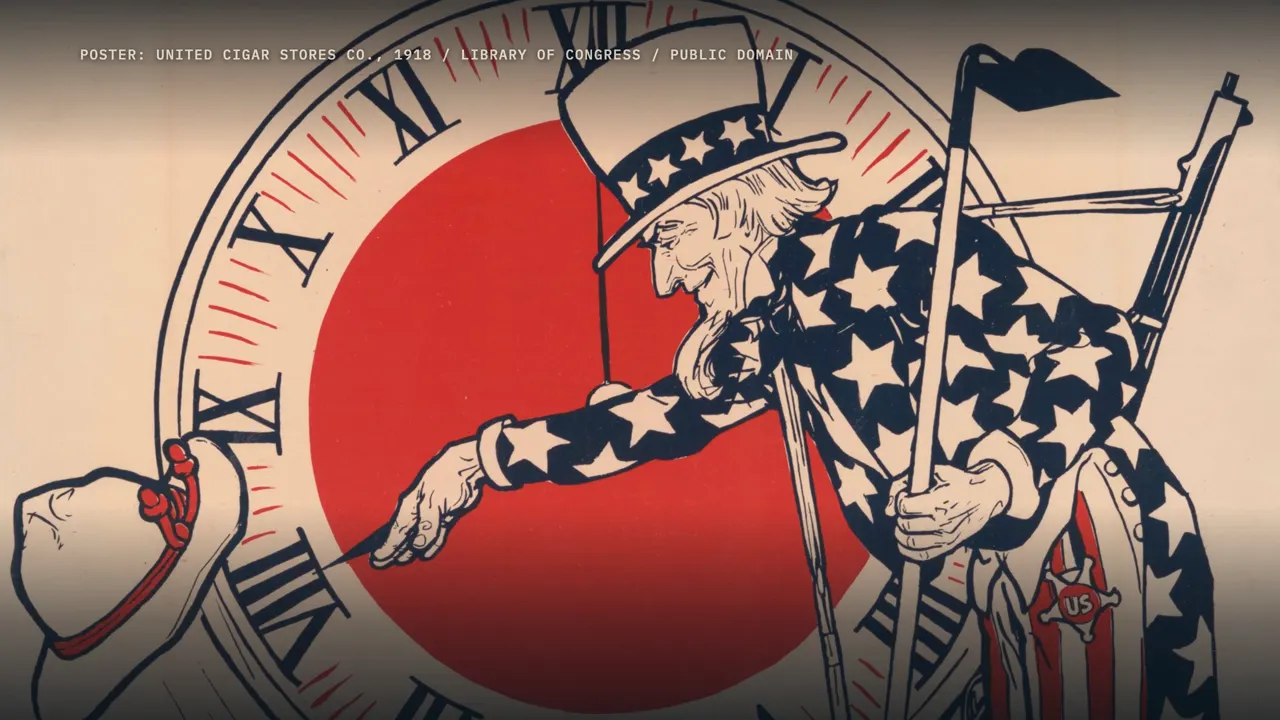
The United States followed in 1918. Its Standard Time Act became law on March 19, and daylight time began on March 31. The stated goal was to save electricity. And this is where the farmer story falls apart.
The Library of Congress calls the idea that daylight time was made for farmers "a common misconception." Farmers were among its strongest opponents. In the Library's words, agriculture "fervently opposed the measure." Farm work runs on the sun, and moving the clock doesn't move the cows.

In 1919, Congress repealed national daylight time, overriding President Woodrow Wilson's veto. Germany dropped it too, and had no daylight saving time from 1919 to 1939. Then war came again. From February 9, 1942, to the end of September 1945, the US stayed on daylight time all year.
It was called War Time. Germany used daylight time again from 1940 to 1949. For about seven weeks in 1947, it even ran two hours ahead. In 1966, the Uniform Time Act set common rules across the United States.
In 1968, Arizona opted out too. The next big push came from an oil crisis.
1974: America tries permanent daylight time
In December 1973, during the oil crisis, President Richard Nixon signed an emergency law. Starting January 6, 1974, the US would stay on daylight time through the winter. It was projected to save about 150,000 barrels of oil a day. At first, people liked the idea.
In December, 79 percent supported it, according to a University of Chicago survey. By February, support had fallen to 42 percent. The problem was the mornings. With the clocks an hour ahead in midwinter, sunrise came an hour later too.
In many places, children went to school in the dark. In Florida, eight schoolchildren were reported to have been killed in traffic accidents in the first weeks. Whether the dark mornings caused those deaths was never settled. A later review by the National Bureau of Standards found no significant difference in overall traffic deaths.

It found no significant energy savings either. A House committee report pointed to the public's "distaste" for daylight time in winter. Congress changed the law, and on October 27, 1974, the country went back to standard time for the winter. Keep that winter in mind.
The permanent daylight time the House just voted for would bring back the winter schedule America tested in 1974.
Does it save energy?

The original promise was always energy. Whether it delivers depends on whom you ask, and where you live. In 2007, the US stretched daylight time by about four weeks. The Department of Energy reported back to Congress on the result.
It found savings of about half a percent of electricity on each extra day. Across the whole year, that came to about 0.03 percent of US electricity use. Indiana offered a cleaner test. Before 2006, most of its counties didn't use daylight time at all.
Then a state law put every county on it. Economists Matthew Kotchen and Laura Grant compared more than seven million monthly power bills. They found that daylight time raised home electricity use by about 1 percent. In the fall, the increase was 2 to 4 percent.

They put the extra cost to Indiana households at about 9 million dollars a year. The reason is a trade-off. People use less lighting in the evening, but more heating and cooling. In 2016, three economists combined 44 studies, with 162 separate estimates.
Across those studies, the average estimated electricity saving was 0.34 percent on days with daylight time. Savings were larger in countries farther from the equator. In subtropical regions, daylight time tended to raise electricity use. Brazil found that out in practice.
Air conditioning had moved the peak in power demand to around 3 in the afternoon. Its energy secretary said that, for the power sector, the benefit was gone. In April 2019, Brazil ended daylight saving time. So the fair answer is that the average saving is small, and in some places it turns into a cost.
The week after the change
The switch itself has another kind of cost, and it shows up within days. Researchers in Michigan examined 42,060 hospital admissions for heart attacks that were treated with a coronary procedure, between 2010 and 2013. On the Monday after the spring change, those admissions were 24 percent higher than expected.
On the Tuesday after the fall change, they were 21 percent lower. But here's the catch. Across the whole week, the study found no significant change in the total number of admissions. So the spring change seems to shift heart attacks earlier in the week, rather than add new ones.
Roads show a clearer cost. A study of 732,835 fatal US crashes from 1996 to 2017 focused on the week after the spring change. The researchers estimated a 6 percent rise in fatal crashes during that workweek. That works out to roughly 28 extra fatal crashes a year.

One of the authors put it plainly: "These effects on fatal traffic accidents are real, and these deaths can be prevented." The American Academy of Sleep Medicine wants the changes to end. But it wants the US to stay on permanent standard time, not daylight time. Its reason is that standard time "aligns best with human circadian biology."
So ending the clock change can mean two very different things. Keep winter time all year, or keep summer time all year. And that choice is exactly where everything gets stuck.
Europe: 4.6 million replies, no decision

Europe made a major attempt to end seasonal clock changes. All EU countries change on the same days, under a directive adopted in 2001. That's the last Sunday of March and the last Sunday of October. In the summer of 2018, the European Commission opened a public consultation.
It got about 4.6 million replies, from all 28 member states at the time. 84 percent wanted to stop changing the clocks. That September, the Commission proposed ending seasonal time changes in 2019. In March 2019, the European Parliament voted for it, 410 to 192, with 51 abstentions.
The vote pushed the end date to 2021. Countries keeping summer time would make their last change in March 2021. Countries keeping winter time would change one last time that October. Then it stalled.
The law also needs approval from the member governments, which meet as the Council. The Council has not yet finalised its position. Governments couldn't agree on which time to keep. If each country chose for itself, Europe could end up with a patchwork of time zones.

Brexit added another problem, because Ireland and Northern Ireland could end up on different times. Support wasn't even universal: in Cyprus, Greece and Malta, fewer than half of respondents backed ending the change. Back in December 2018, governments had asked for an impact assessment before deciding. In October 2025, Spain's prime minister, Pedro Sánchez, tried to restart the push.
He argued that the energy savings no longer justified changing the clocks. The European Parliament debated the proposal again that month. The Commission decided to do a detailed study before the next step. As of February 2026, Parliament's own tracker labeled the proposal "blocked."
So Europe will fall back on October 25, as usual.
America: a bill that keeps passing halfway
Across the Atlantic, the US Senate passed the Sunshine Protection Act by unanimous consent in March 2022. It would have made daylight saving time permanent. "Why do we keep doing this?" asked its sponsor, Senator Marco Rubio. The House version never passed, and the bill went nowhere.
In July 2026, the roles reversed. On July 14, the House passed its version, H.R. 139, by 308 votes to 117. Republicans voted 193 to 22 in favor, and Democrats 114 to 95. Now the bill sits with the Senate Commerce Committee.
There, opponents can force supporters to find 60 votes just to end the debate. As of early October, no Senate vote had been scheduled. President Trump's own position has shifted. In December 2024, he posted that Republicans would try to eliminate daylight saving time, calling it inconvenient and costly.
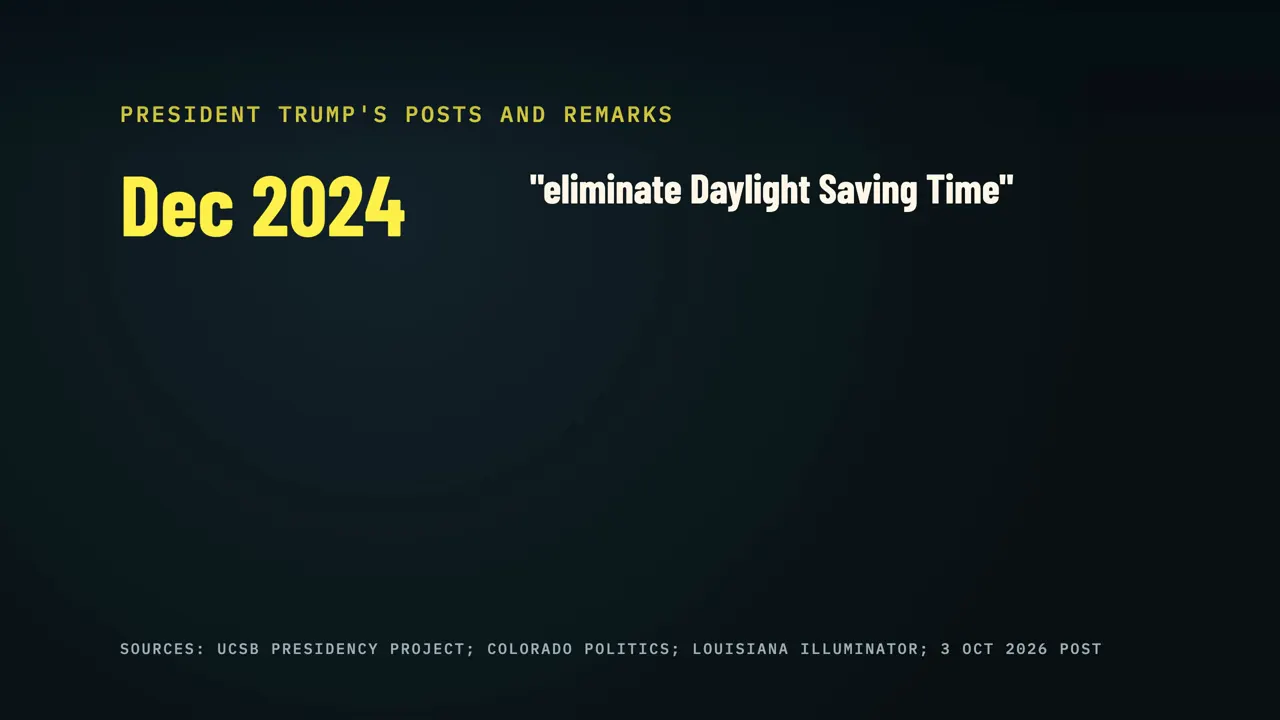
In March 2025, he called it "a 50-50 issue." He said some people don't want to take their kids to school in the dark. By August 2026, he was urging Republican senators to "release their holds." "People are sick and tired of having to change their clocks twice a year," he wrote.
On October 3, he pushed again, and blamed Senator Tom Cotton. Cotton's objection sounds a lot like 1974. He has said permanent daylight time would "push winter sunrises to an absurdly late hour." So here too, the argument is less about stopping the clock changes than about which hour to keep.
Other countries, other choices

Other places have already made their choice, some of them more than once. Start next door, in Canada. British Columbia chose permanent daylight time, after 93 percent backed it in a 2019 public survey. Premier David Eby said changing clocks twice a year "causes a significant amount of chaos."
Alberta will also stop changing its clocks, and move to permanent Alberta Time from November 2026. Manitoba and the Northwest Territories will skip the November change too, and Ontario has proposed the same for parts of its northwest. Most of Ontario, Quebec and the Maritimes still change. South Korea has tried it before, more than once.
It used daylight saving time from 1948 to 1951, and again from 1955 to 1960, for a few summer months each year. According to the National Archives of Korea, it was dropped after that because the frequent changes confused people. It came back in 1987 and 1988, around the Seoul Olympics. The aim was to line up better with the US and other countries.
It was dropped in 1989. Critics complained that it was hard to adjust to and made working hours longer, and many saw it as an Olympic measure timed for foreign TV. Japan had summer time from 1948 to 1951, during the American-led occupation. Critics in Japan's parliament said it intensified work and led to overwork.

China spans about 60 degrees of longitude, roughly four hours of sun time from east to west. Yet the whole country uses one standard time. China also tried daylight saving time from 1986 to 1991, then stopped in 1992. Russia tried permanent time in both directions.
In 2011, it moved its clocks forward in spring and didn't turn them back that fall. That left the country on summer time all year. In 2014, a new law moved most regions back one hour on October 26, and the seasonal change stayed abolished. In October 2022, Mexico's Senate voted 59 to 25 to end daylight saving time.
Its health secretary called for living by "God's clock." Towns along the US border were allowed to keep changing with their American neighbors. Brazil first tried it in 1931, used it every year from 1985, and ended it in 2019. In the Southern Hemisphere, the calendar flips.
Southeastern Australia moved its clocks forward on October 4 and falls back in April 2027. Queensland, Western Australia and the Northern Territory don't change at all. So as the US and Europe get ready to fall back, Sydney has just sprung forward.
Not whether, but which
So why do we still change the clocks twice a year? Not for farmers, and not because of Benjamin Franklin. It began as a wartime plan to save coal. And today, in the US and the EU, efforts to stop the changes remain stuck on which hour to keep.
The energy saving is small at best, and the week after the spring change has real costs. In a 2026 YouGov survey, most Americans said they wanted the clock changes to stop. The real question, once the changes stop, is which hour to keep. Permanent daylight time means brighter evenings, and the dark winter mornings of 1974.
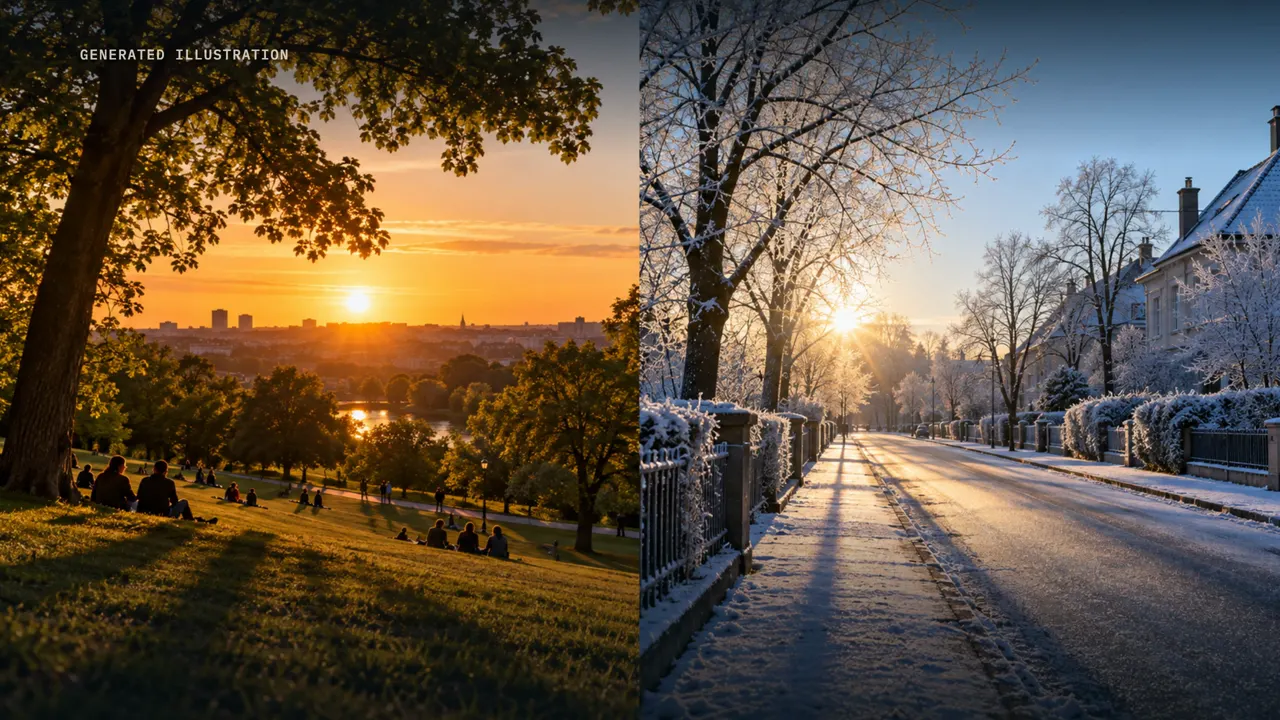
Permanent standard time means brighter mornings, which sleep doctors prefer, and summer sunsets an hour earlier than today. When neighbors choose differently, a new line appears on the map. On November 1, one of those lines opens between Vancouver and Seattle. Whatever happens next, it starts with one choice: which hour do we keep?
Watch on YouTube
Sources
- Franklin, letter to the Journal de Paris, 1784: founders.archives.gov/documents/Franklin/01-42-02-0063
- George Vernon Hudson: Te Ara, Dictionary of New Zealand Biography
- William Willett, The Waste of Daylight: National Museums Scotland
- 1916 in Germany and Britain: PTB (ptb.de); Western Front Association; Summer Time Act 1916 (legislation.gov.uk)
- US history: Congressional Research Service RS22284; Library of Congress WWI exhibition "Daylight Saving Time"; Hawaii Act 4 (1967)
- 1974 trial: History.com; Smithsonian Magazine; Ford Library legislative file; Congressional Record 1974
- Energy: US DOE Report to Congress 2008 (OSTI 949762); Kotchen and Grant, NBER w14429; Havranek, Herman and Irsova, MPRA 74518; Brazil 2019 (Panrotas)
- Heart attacks: Sandhu et al. 2014 (PubMed 25332784)
- Fatal crashes: Fritz et al. 2020, Current Biology, doi.org/10.1016/j.cub.2019.12.045
- Sleep medicine: AASM position statement, J Clin Sleep Med 2024;20(1):121-125
- EU: European Commission (Summertime); 2018 consultation; EP procedure 2018/0332(COD); EP Legislative Train (Feb 2026); Directive 2000/84/EC; La Moncloa, 20 Oct 2025
- US Congress: House Clerk Roll Call 238 (14 Jul 2026); Source NM (2022); GCSAA (Aug 2026); US Senate on cloture
- President Trump's posts: UCSB American Presidency Project (13 Dec 2024); Colorado Politics (Mar 2025); Louisiana Illuminator (Aug 2026); 3 Oct 2026 post
- Polling: YouGov, Feb 2026
- Canada: Government of British Columbia (2 Mar 2026); Government of Alberta; Manitoba (17 Sep 2026); Northwest Territories; Ontario
- South Korea: National Archives of Korea; korea.kr; IANA time zone database
- Japan: Summer Time Act 1948 and repeal 1952 (shugiin.go.jp); Diet record 28 Mar 1952
- China: 1986 government gazette; Beijing notice 1992; CAAC
- Russia: law on time calculation (consultant.ru); Mexico: AP, Oct 2022
- Australia and EU/UK dates: Universal Time Date
Images and video
- CC BY 2.0: William Willett, The Waste of Daylight, 1912 edition / Archives New Zealand
- CC BY 4.0: Timetable notice for summer time, 1917 / Landesarchiv Baden-Württemberg
- CC BY-SA 4.0: Postcard: Deutsche Sommerzeit, 1916 / Grafj
- CC0: Benjamin Franklin, mezzotint by J. M. Will after C. N. Cochin, 1777 / Smithsonian NPG
- La Moncloa, attribution: Pool Moncloa
- Public domain: "Saving Daylight!", c. 1918 / US National Archives; "Saving daylight!", c. 1918 / Library of Congress; Clifford K. Berryman, 1922 / US National Archives; Conquer by the Clock, RKO-Pathé, 1943 / Prelinger Archives; George Vernon Hudson / Royal Society of New Zealand; George Vernon Hudson, portrait by Mary Elizabeth Tripe / Te Papa; Journal de Paris, 26 April 1784; NASA, ISS Expedition 70; PH2 Sherrie De Long, US Navy, 1987 / US National Archives; Portrait of William Willett, artist unknown; US Senate; US Senate Photo Office; United Cigar Stores Co., 1918 / Library of Congress; United Cigar Stores Co., 1918 / Smithsonian NMAH
- Narration is synthetic. Illustrations marked "Generated illustration" on screen are AI-generated scenes, not records of real events.