Why Does Cilantro Taste Like Soap?

To some people cilantro tastes fresh and citrusy. To others it tastes like soap. The soap is real chemistry the leaf shares with soap, and a smell receptor gene near OR6A2 is involved, but that gene explains only about half a percent of the difference between people. Here is what the rest of the answer looks like, and what you can try if you're on the soap side.
This article is the full narration of the video. Watch on YouTube
The soap in the salsa
For most people, a handful of fresh cilantro tastes bright and green, a little like lemon peel. For other people, the same leaf tastes like a bite of soap. Not a hint of soap. A mouthful of it. Scientists took that complaint seriously, and went looking for its cause in human DNA.
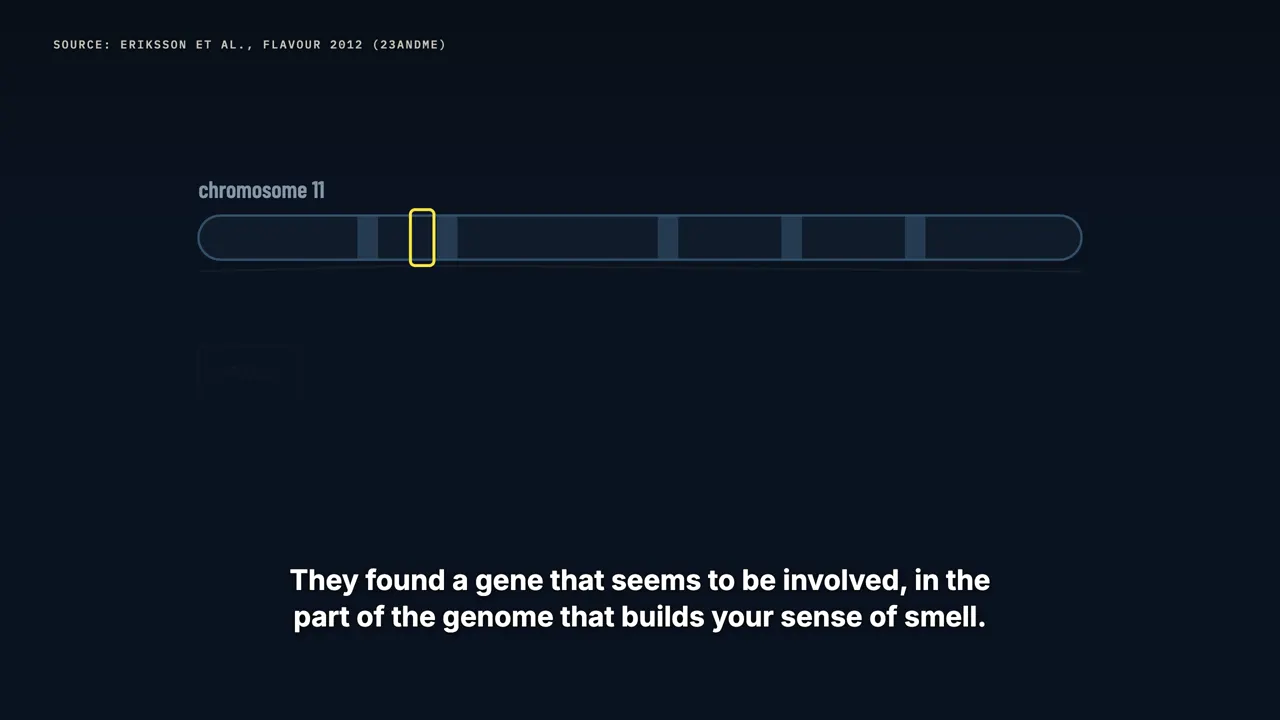
They found a gene that seems to be involved, in the part of the genome that builds your sense of smell. But when you look at the numbers, that gene explains only a tiny slice of who tastes soap. So why does one herb split people so sharply, and where is the rest of the answer hiding?
Who tastes soap

Start with a simple question: how many people are we talking about? In 2012, the genetics company 23andMe put a blunt question to its customers. Does fresh cilantro taste like soap to you? About 18,500 people answered yes or no.
Among customers with European ancestry, about 13% said yes, roughly one in eight. Women were more likely to say yes than men. In the smaller groups, the share was lower: around 8 or 9% of East Asian, Latino and African American customers, and about 4% of South Asian customers.
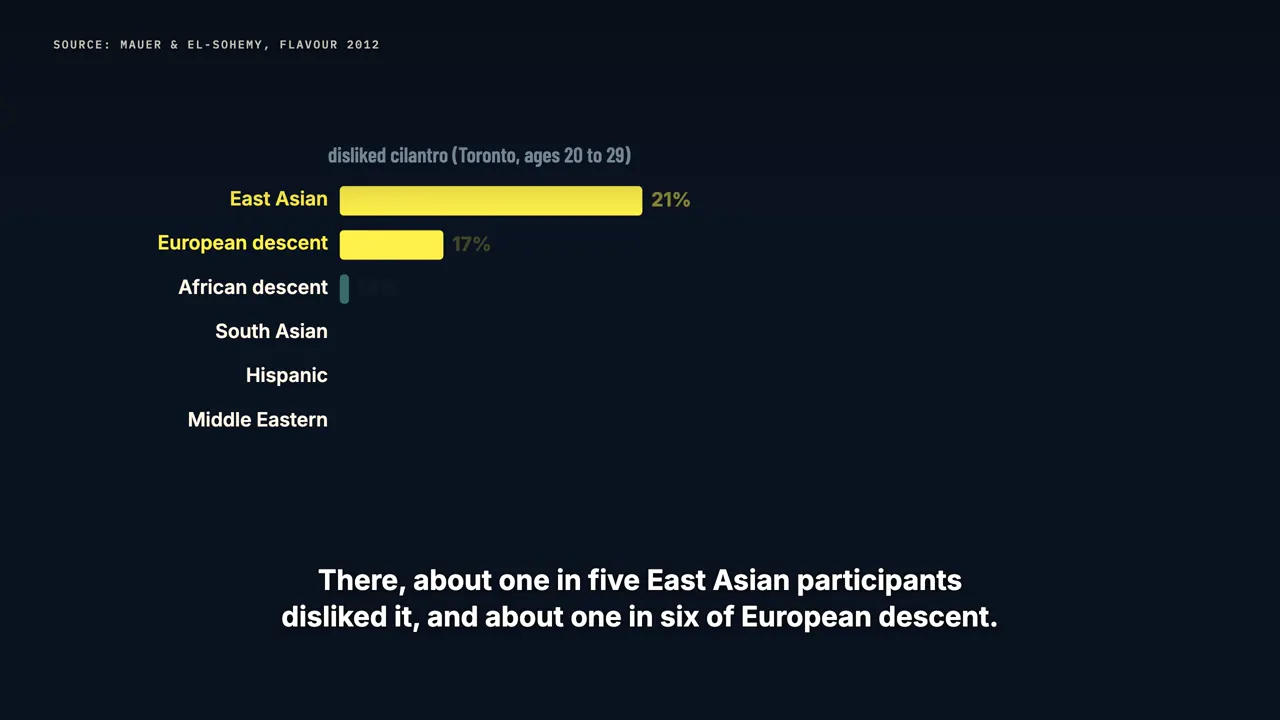
The same year, a team in Toronto asked about 1,600 young adults a softer question: do you like cilantro? There, about one in five East Asian participants disliked it, and about one in six of European descent. But among people with South Asian, Latin American or Middle Eastern backgrounds, only 3 to 7% disliked it. Those are the cuisines where cilantro turns up in almost everything.
Notice something odd. East Asian people were less likely than Europeans to call cilantro soapy in one study, and the most likely to dislike it in the other. The two surveys asked different people different questions, so they can't be compared directly. But they hint at something worth holding on to: tasting soap and disliking cilantro are related, but they are not the same thing.
What the soap is made of
So what in the leaf could possibly taste like soap? Crush a cilantro leaf and it releases a cloud of small molecules called aldehydes. The main ones have names like (E)-2-decenal and (E)-2-dodecenal. Flavor chemists describe them as fatty, waxy, and yes, soapy.
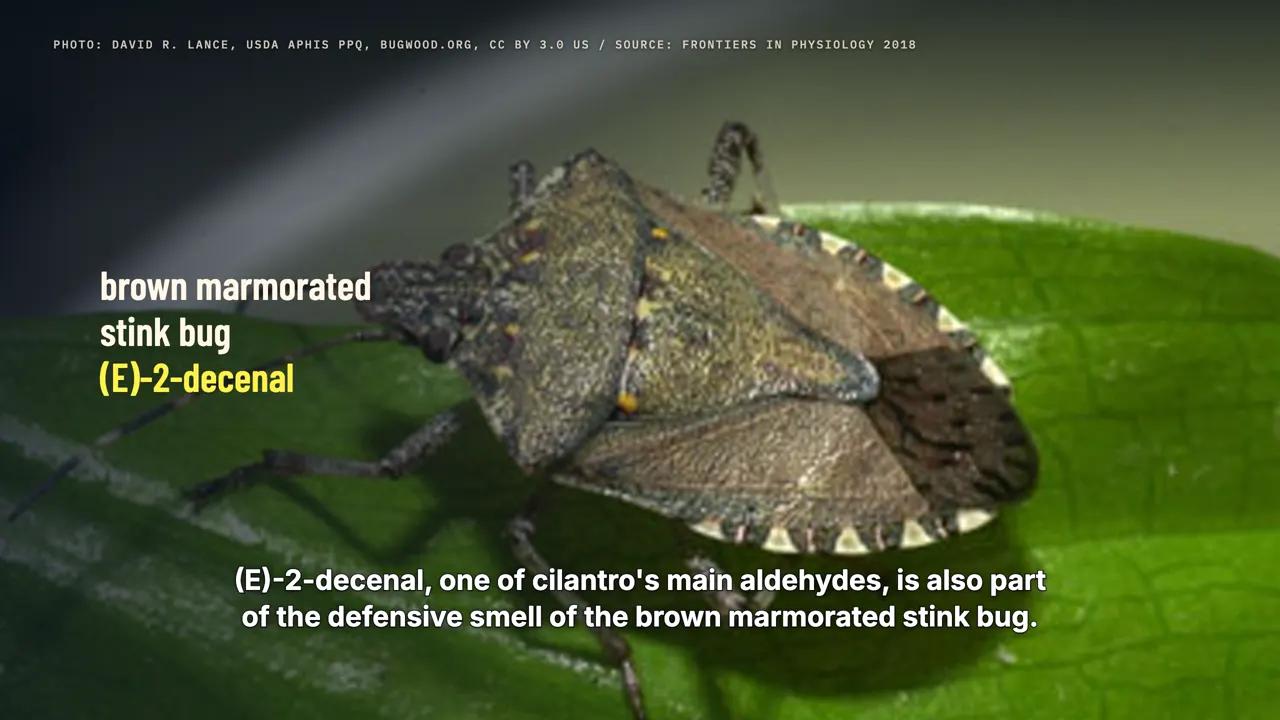
Perfumers use the same family of molecules to give soaps and detergents their clean, waxy smell. So when someone says cilantro smells like soap, they may be noticing chemistry that cilantro and soap really do share. The family has a less pleasant relative too. (E)-2-decenal, one of cilantro's main aldehydes, is also part of the defensive smell of the brown marmorated stink bug.
People made that connection long before anyone knew what a molecule was. The word coriander may come from the ancient Greek word for bedbug, a link that writers made 2,000 years ago and scholars still argue about. In 1597, the English herbalist John Gerard called it a very stinking herb. Oddly, the seeds of the same plant smell completely different.
Coriander seeds are mostly a molecule called linalool, with a floral, citrus-like smell. The soapy aldehydes are concentrated in the leaves.
Taste is mostly smell
Here is the next clue: the soap is not really a taste at all. Your tongue senses only a handful of things: sweet, salty, sour, bitter and savory. Almost everything else you call flavor is smell, rising from the back of your mouth into your nose as you chew. That's why food tastes flat when you have a blocked nose.
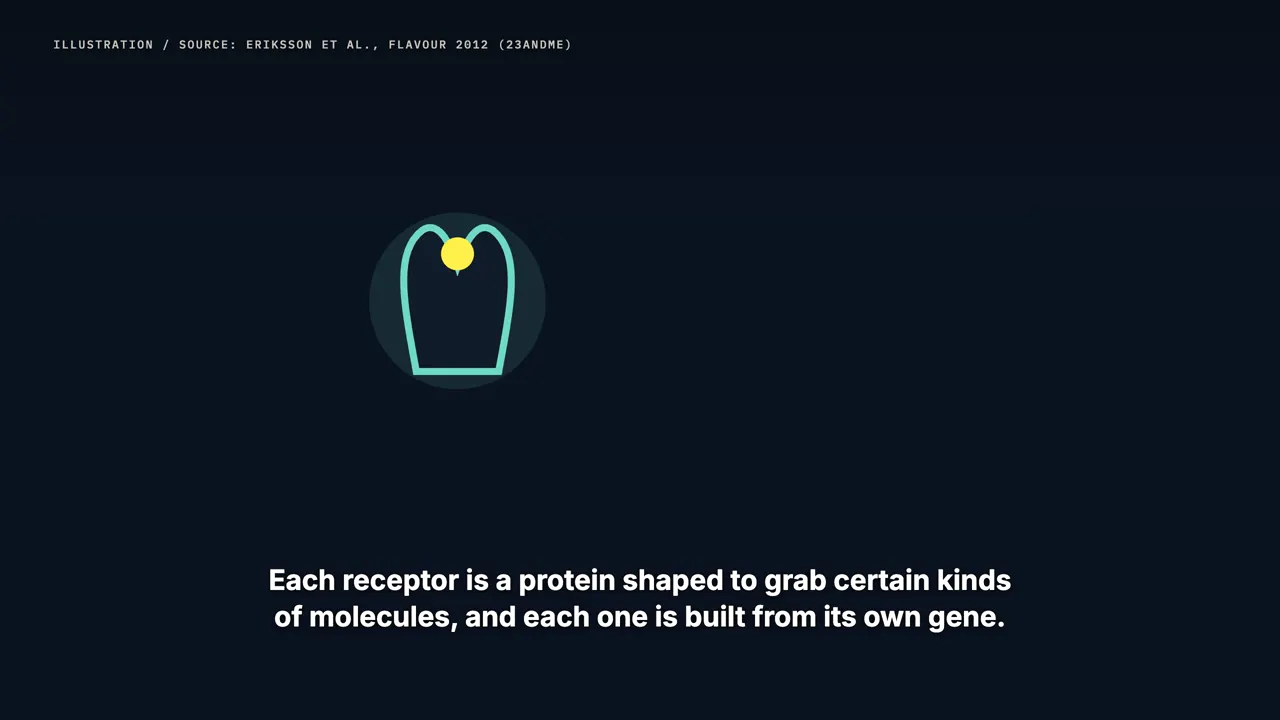
Your nose reads smells with about 400 different kinds of receptors. Each receptor is a protein shaped to grab certain kinds of molecules, and each one is built from its own gene. A smell is the pattern of receptors that switch on together, a bit like a chord on a piano. Because every receptor comes from a gene, small differences in those genes can change which molecules you notice, and how strongly.
So if some people pick up a soap note that others miss, the smell genes are the obvious place to look.
The gene hunt
That is exactly where the 23andMe team looked, without deciding in advance which gene to check. They took more than 14,000 customers of European ancestry and split them into two groups: soap and no soap. Then they scanned millions of single letters across the genome, looking for any letter that showed up more often in one group than the other. Most letters showed nothing.
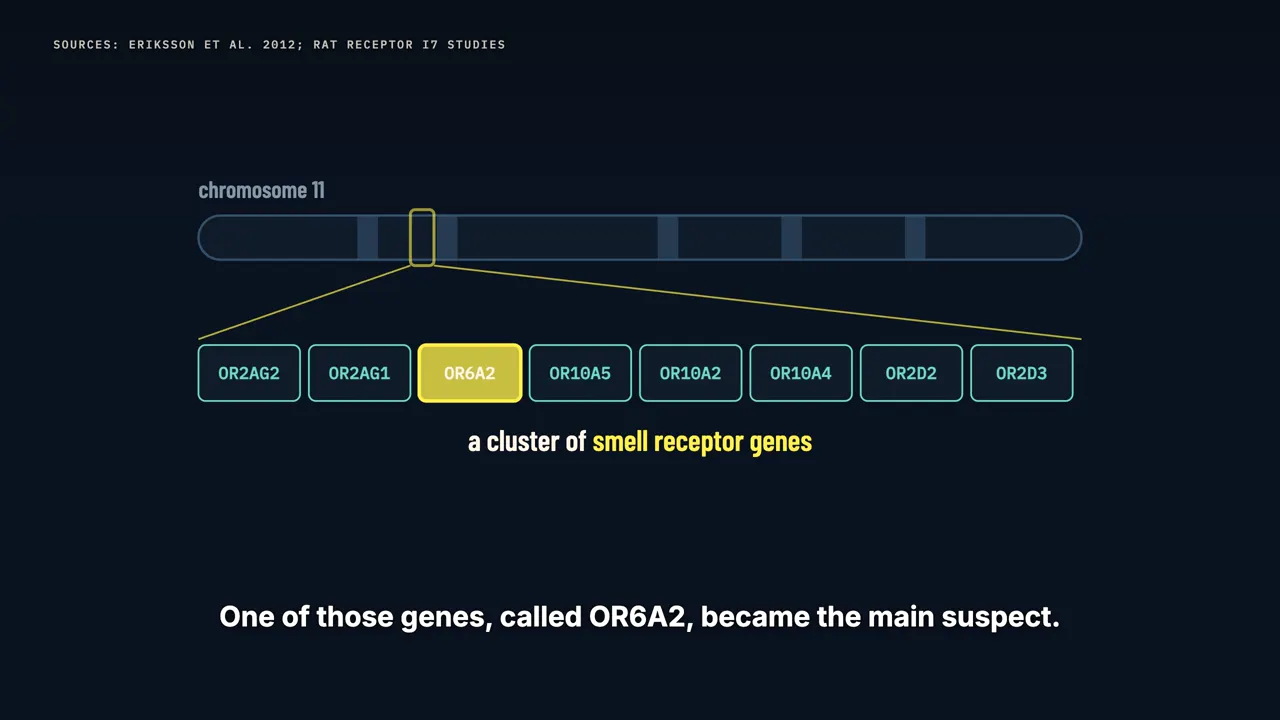
One spot stood out. The team then checked it in a separate group of nearly 12,000 people, who had only been asked whether they liked cilantro, and it held up there too. The spot sits on chromosome 11, in a cluster of eight smell receptor genes. One of those genes, called OR6A2, became the main suspect.
Its version in rats is one of the most studied smell receptors there is. Every molecule found to switch it on is an aldehyde. And it responds to several of the aldehydes that make up cilantro's smell, including (E)-2-decenal. So here is the tidy story.
Some people carry a version of the receptor that makes the soapy aldehydes jump out. Others carry a version that seems to pick them up less, and they just taste a fresh herb. It is a lovely story, and it is probably part of the truth. The numbers say it is a small part.
A very small gene effect
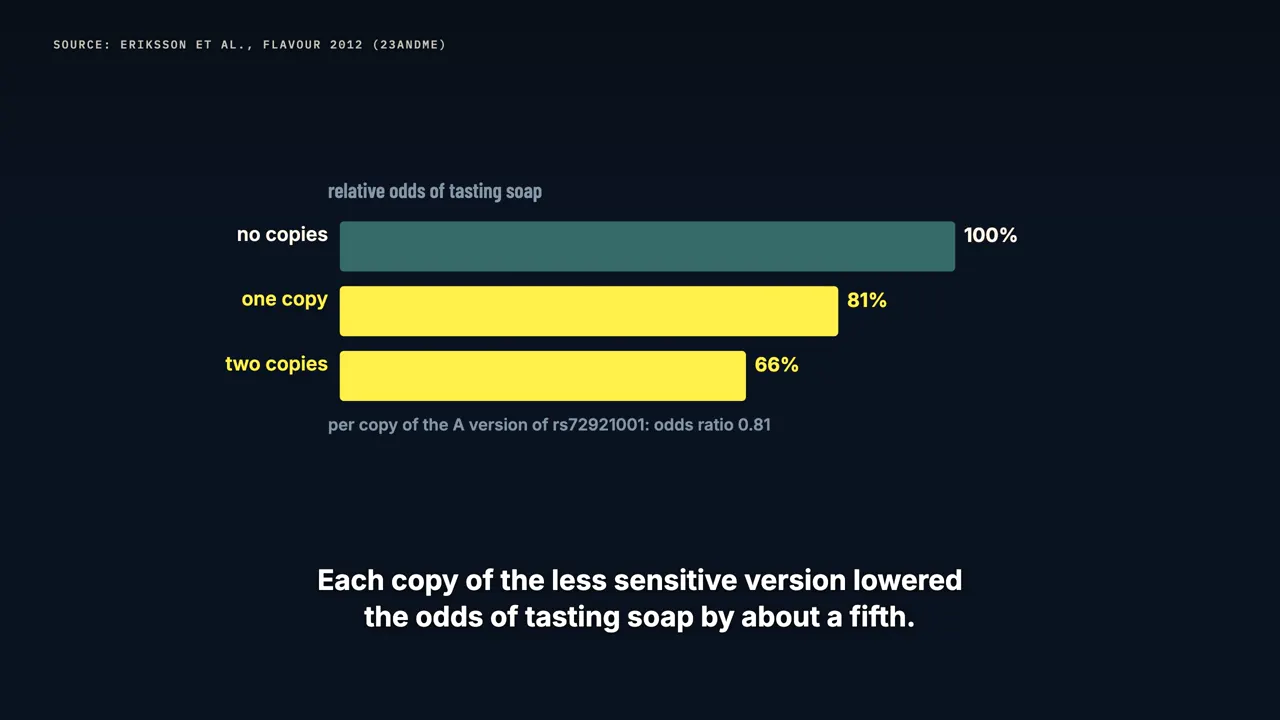
Look at the size of the effect. Each copy of the less sensitive version lowered the odds of tasting soap by about a fifth. That is real, but it is not a switch. Plenty of people with the soap-linked version don't taste soap, and plenty without it do.
The researchers calculated that this spot explains about 0.5% of the differences between people. 0.5%. All the common genetic variants they measured, added together, came to an estimate of only about 9%, with wide error bars. Twin studies point higher.
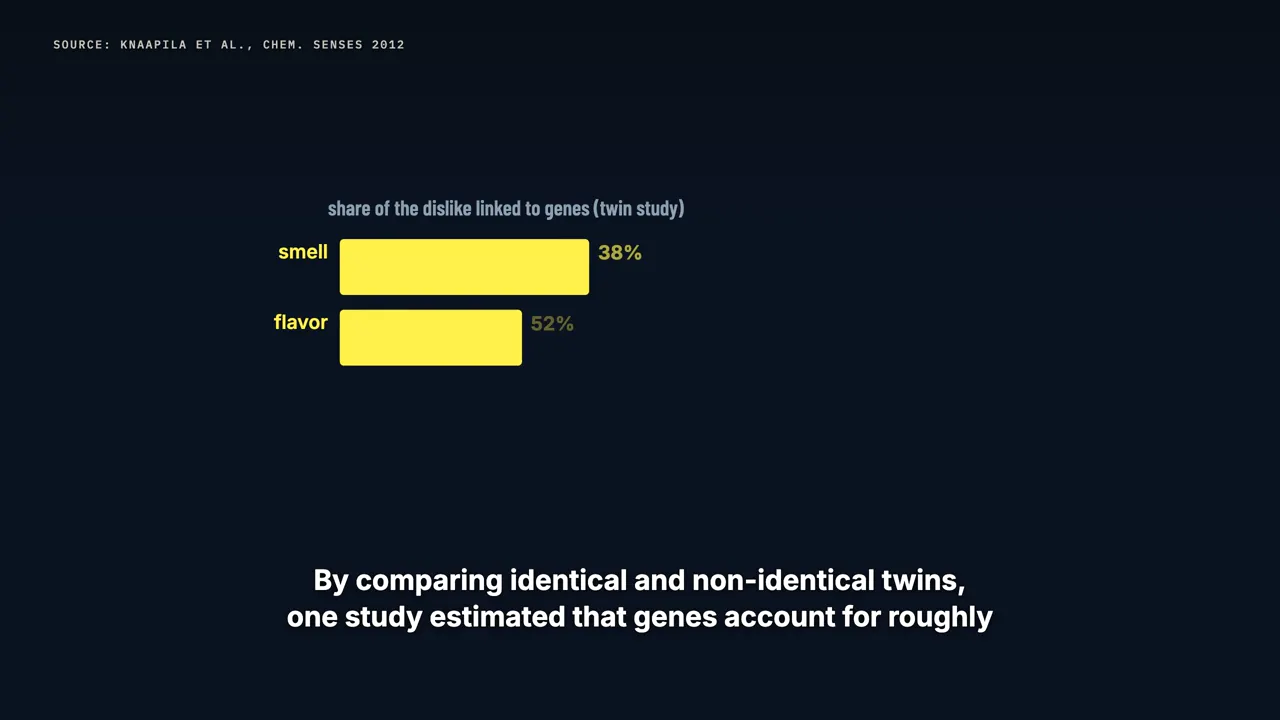
By comparing identical and non-identical twins, one study estimated that genes account for roughly 40% of the differences in disliking cilantro's smell, and about half for its flavor. So genes clearly matter. But the famous gene is only a sliver of that, and the rest may be spread thinly across many other genes that no study has pinned down yet.
Some consumer DNA tests now report a cilantro trait. What they are reading is one letter in a story that is mostly written somewhere else.
Learning to like it
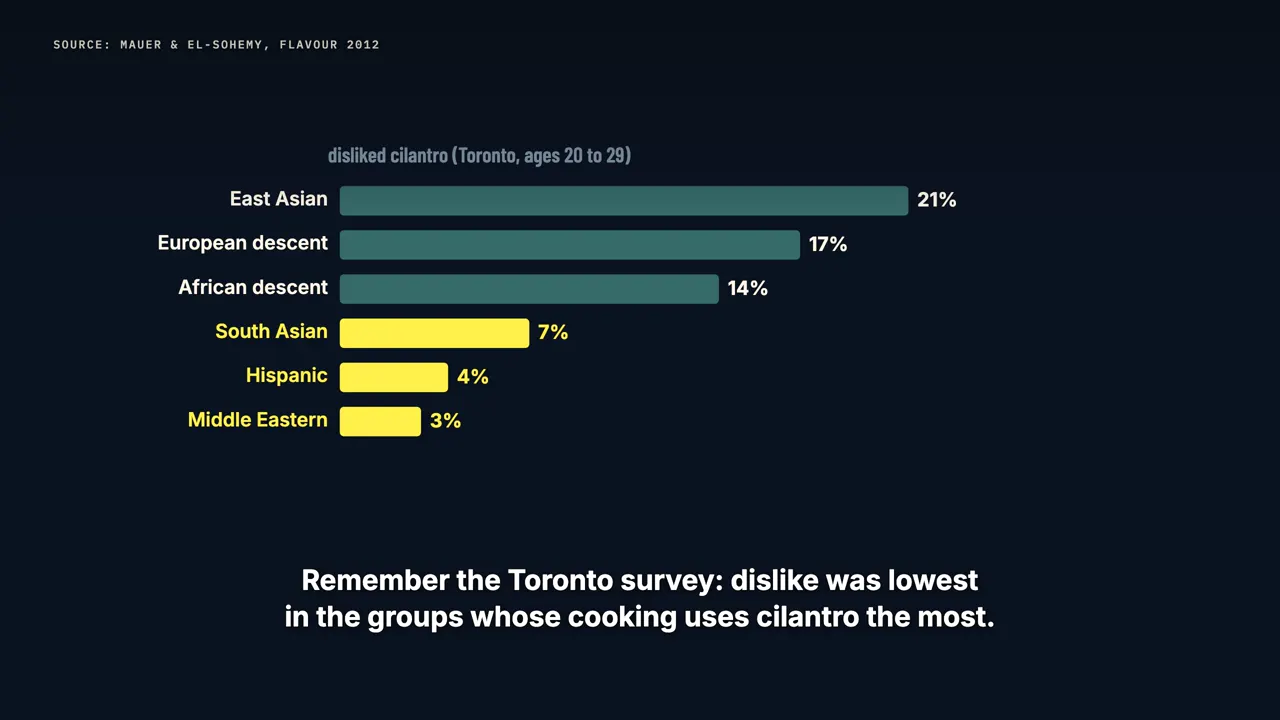
That leaves plenty of room for experience. Remember the Toronto survey: dislike was lowest in the groups whose cooking uses cilantro the most. The researchers couldn't separate genes from kitchens, but they suggested that eating it often could be part of the reason. Remember too that tasting soap and disliking cilantro were only loosely linked.
That means some people can notice the soapy note and still enjoy the herb, while others dislike it without ever calling it soap. The 23andMe researchers suggested that many people may dislike cilantro at first and come to like it later. That fits how smell works. Your nose detects the molecules, but your brain decides what they mean, and it learns from every meal.
A smell that first says soap can, after enough good dinners, start to mean salsa, pho or chutney. For some people, that never happens, and that is fine too.
Tricks for the soap side
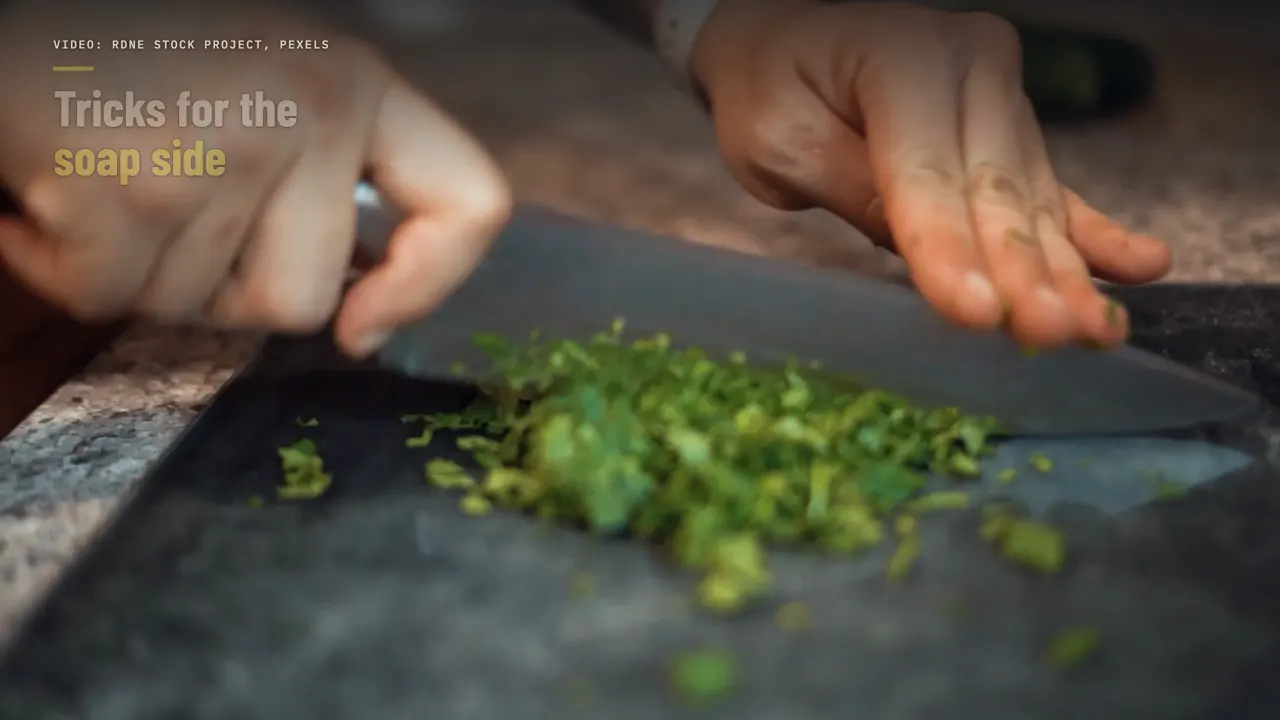
If you are on the soap side, there are a few things you can try. Cilantro leaves carry their own enzymes that can turn those aldehydes into alcohols, a different kind of molecule. In a Japanese lab study, cut leaves held in boiling water for 2 minutes had less of the main aldehydes, and more of the matching alcohols. So cooked cilantro is not the same as raw cilantro.
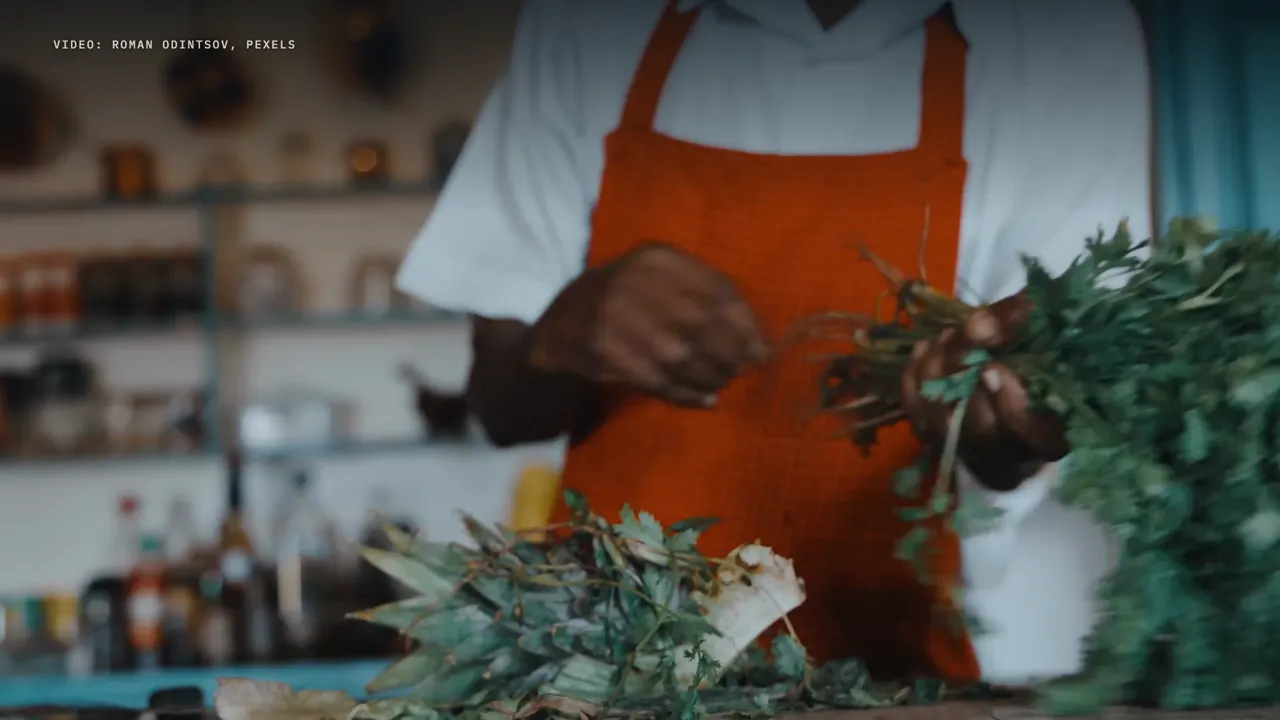
The food writer Harold McGee suggested crushing the leaves, for example into a pesto, to tame the soapy notes. He also suggested eating it with food and people you already enjoy, so the smell gets filed under something pleasant. And if none of that works, parsley and mint are right there on the shelf.
Two noses, one leaf
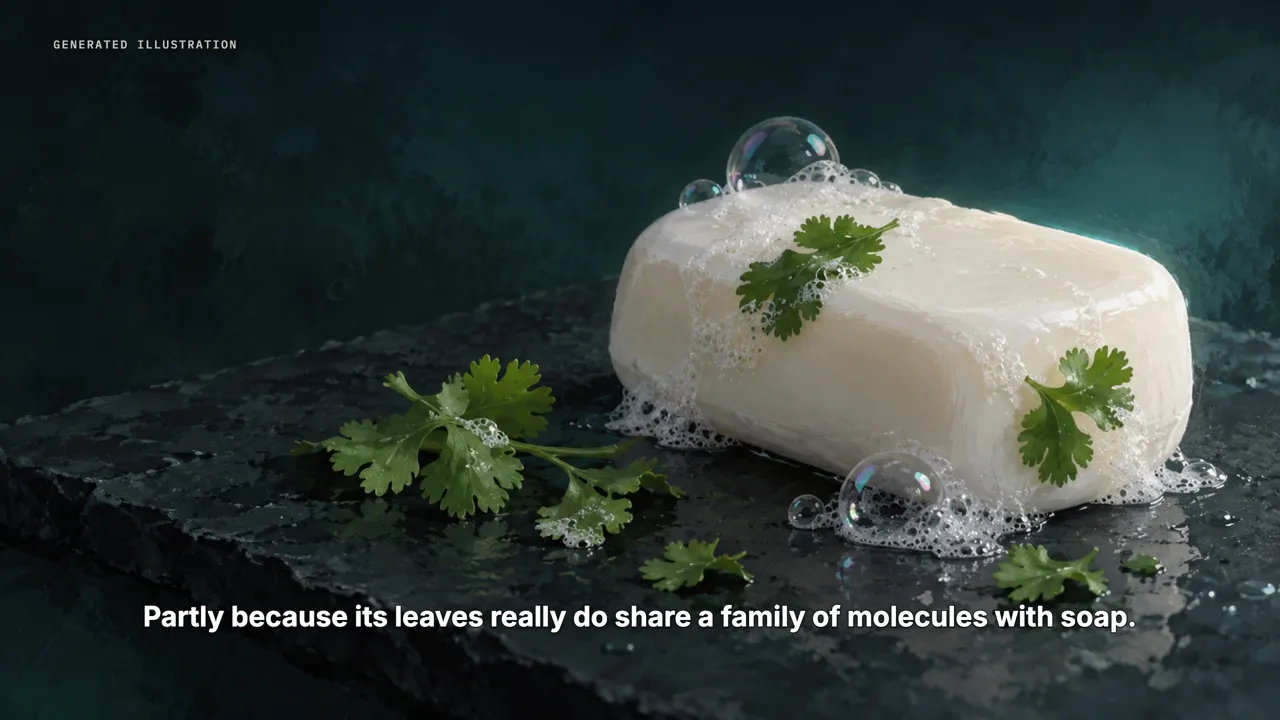
So why does cilantro taste like soap to some people? Partly because its leaves really do share a family of molecules with soap. Partly because of smell receptor genes that read those molecules a little differently from person to person. But the best known of those genes is a small piece of the answer.

The rest is probably many other genes, and a lifetime of meals. The same leaf lands in two different noses, with two different food histories behind them. Neither of them is tasting it wrong.
Watch on YouTube
Sources
- Eriksson et al., Flavour 2012, 23andMe cilantro study: https://flavourjournal.biomedcentral.com/articles/10.1186/2044-7248-1-22
- Mauer & El-Sohemy, Flavour 2012, cilantro dislike in Toronto: https://flavourjournal.biomedcentral.com/articles/10.1186/2044-7248-1-8
- Knaapila et al., Chemical Senses 2012, twin study: https://europepmc.org/article/MED/22977065
- Coriander leaf aroma, Frontiers in Plant Science 2022: https://www.frontiersin.org/journals/plant-science/articles/10.3389/fpls.2022.820644/full
- Brown marmorated stink bug and (E)-2-decenal, Frontiers in Physiology 2018: https://pmc.ncbi.nlm.nih.gov/articles/PMC6243750/
- To Quynh, Iijima & Kubota, J Agric Food Chem 2010, leaf enzymes: https://pubs.acs.org/doi/10.1021/jf901463p
- Etymology of coriander: https://www.etymonline.com/word/coriander
- Footage and photos
- Pexels videos by TYPHOON BRO, RDNE Stock project, ROMAN ODINTSOV, cottonbro studio, Pavel Danilyuk, Dominik Zítka, khanhhoangminh, Monstera Production, Kampus Production, Gustavo Fring, Anh Nguyen, Anna Tarazevich, Chris G (Pexels License)
- Mixkit video "Closeup of some tacos and a lemon" (Mixkit Free License)
- Photo "Bunches of coriander leaves" by Kpsudeep, CC BY-SA 4.0, Wikimedia Commons
- Photo "Brown marmorated stink bug adult" by David R. Lance, USDA APHIS PPQ, Bugwood.org, CC BY 3.0 US
- Photo "Coriander seeds" by Amada44, CC BY 3.0, Wikimedia Commons
- Photo "Coriander Green Seeds (Coriandrum sativum) in Shimla" by Sapna Sony, CC BY-SA 4.0, Wikimedia Commons
- The Herball (1597) title page, public domain
- Narration is synthetic. Illustrations are drawn or AI-generated and labeled on screen.