Mouth of Hell: The Men Lowered Into Masaya Volcano for Gold

In 1538, a Dominican friar was lowered on a rope into Masaya Volcano in Nicaragua, the crater Spanish accounts called hell. He and his partners believed the boiling matter below was gold or silver. They went down three times, lowered an iron chamber on a chain into the fire, and carried their samples to the silversmiths of León. This video follows some of the earliest written accounts of the crater: Gonzalo Fernández de Oviedo's climb in 1529, the old woman the local chiefs said lived in the pit, Bobadilla's cross, and the three descents of April 1538. Then it explains what was really boiling down there, why Masaya's lava lake keeps appearing and vanishing, what buried it in March 2024, and what a 2026 satellite radar study suggests is changing underneath.
This article is the full narration of the video. Watch on YouTube
The Mouth of Hell
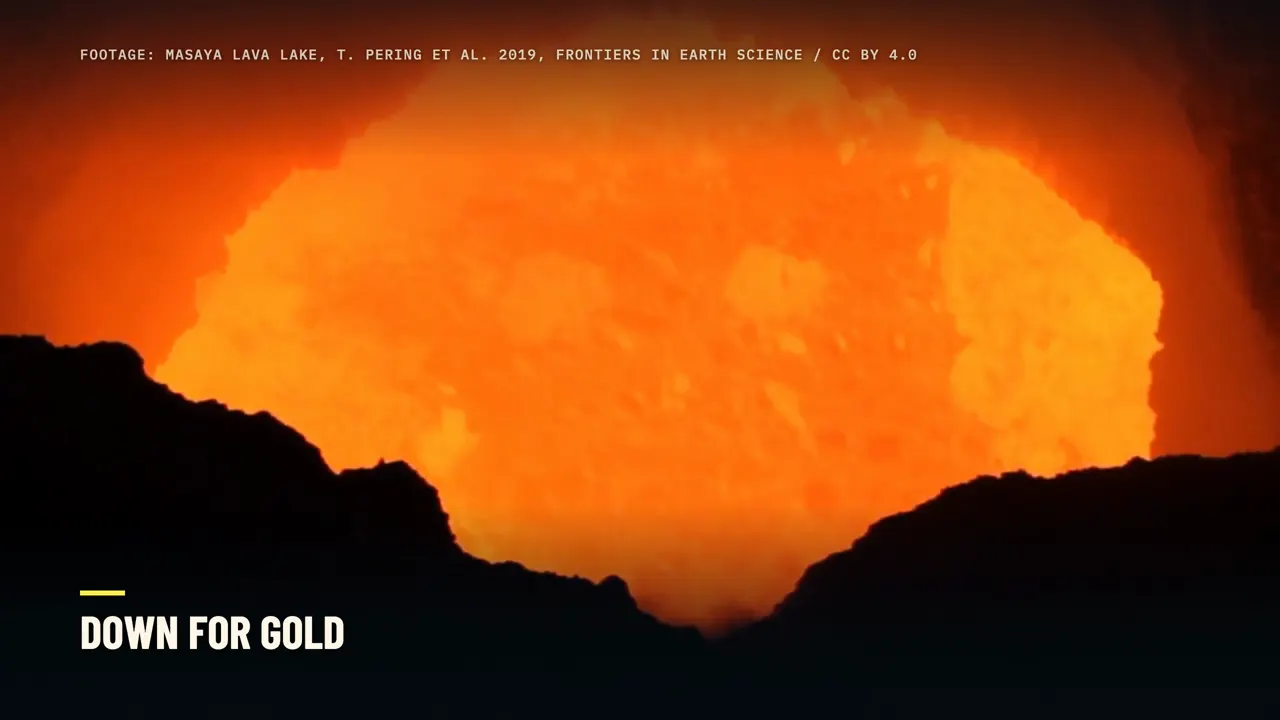
In 1538, men were lowered into this volcano to bring up gold. This is Masaya Volcano, in Nicaragua. Spanish accounts called it hell. Today, it's often called the Mouth of Hell. A friar and his partners believed that whatever was boiling down there was treasure: gold, or silver. They built a winch, tied one of them into a rope sling, and lowered him into the crater.
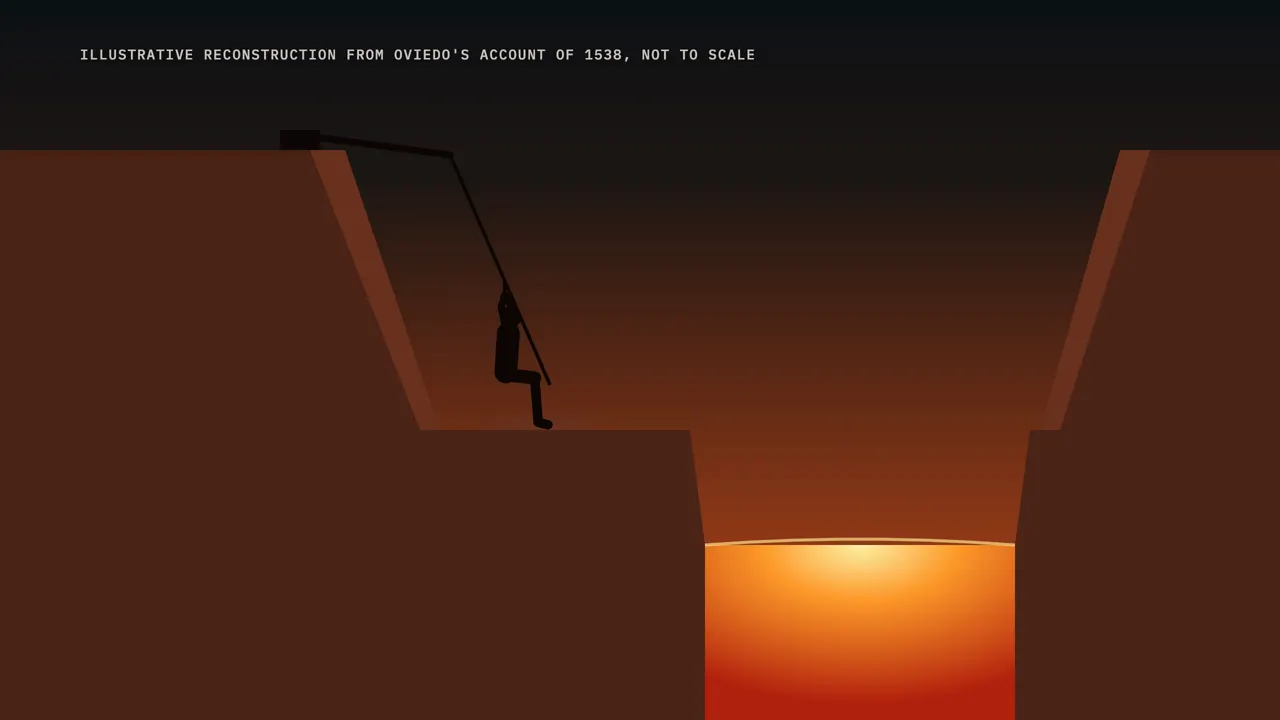
Days later, they lowered an iron chain toward the molten surface. Today, Masaya's lava lake is covered by landslides. But satellites can still measure the ground moving, and it suggests that something far below is changing. So who went down first, and what did they think they would bring back up?
The first man down
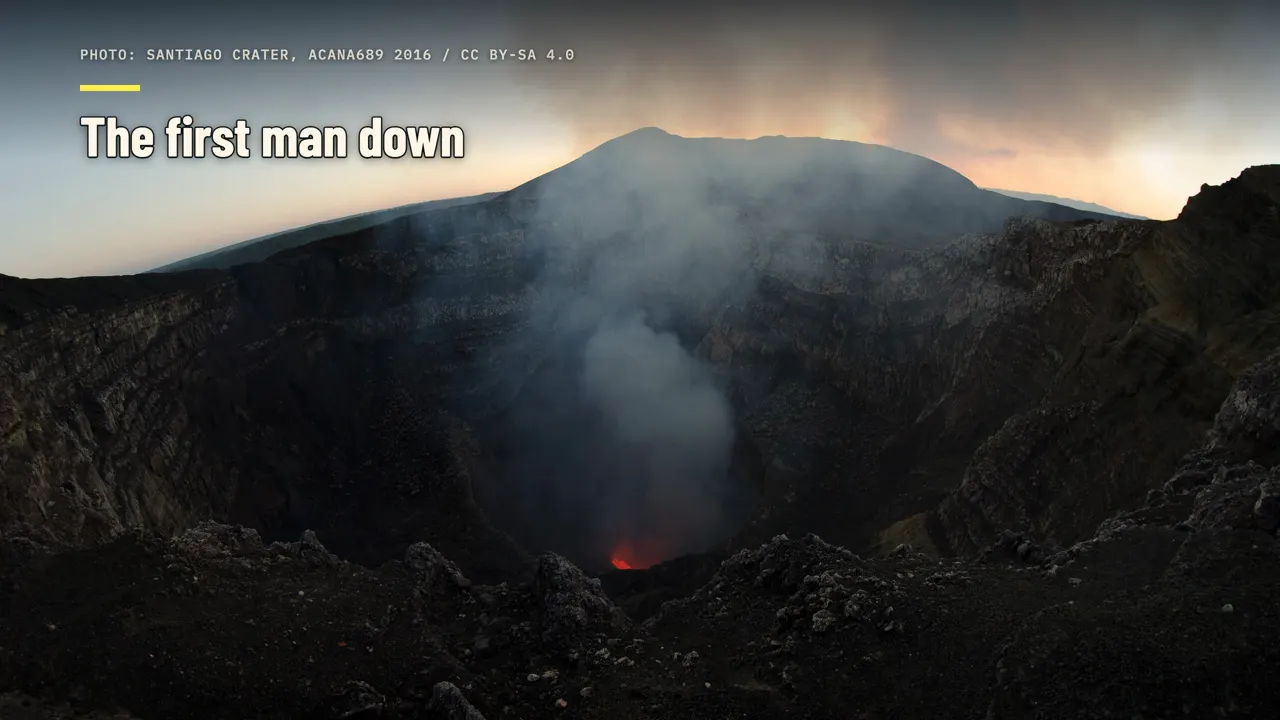
In 1536, a Dominican friar named Blas del Castillo came to Granada, a Spanish town near Masaya. People argued about what was boiling in the pit. Some said gold, some silver, some copper, iron, or sulfur. Some said it was hell itself. A Franciscan friar in Granada told him it could only be gold or silver, "the greatest riches in the world." Blas saw the crater for the first time in June 1537, and he wanted to go down.
He gathered partners from Granada, and they swore to keep the plan secret. They measured the drop with ropes. The first ropes snapped. Then they hid their gear in a nearby Indigenous village: ropes, pulleys, and a winch that Blas built himself. They also fitted an iron handle to the heavy chamber of a cannon, to lower on a chain and haul up whatever was down there.
Indigenous workers carried all of it up the mountain. Days before the descent, two of the partners backed out. One said that whoever went in would be burned alive. On Saturday, the thirteenth of April, 1538, the men made their confessions, Blas said Mass, and they asked each other's forgiveness, in tears. They had dropped a log as thick as an ox down to a heap of rubble below, and pulled a cable tight above it, like a ship's rigging.
Blas sat in a sling that slid down that cable. He wore an iron helmet under a hat, with a small hammer at his belt and a gourd of wine and water tied to his wrist. He carried a little wooden cross, sometimes in his hand, sometimes in his mouth. He told the forty or fifty Indigenous men watching that the cross was the Christians' sword against their god.
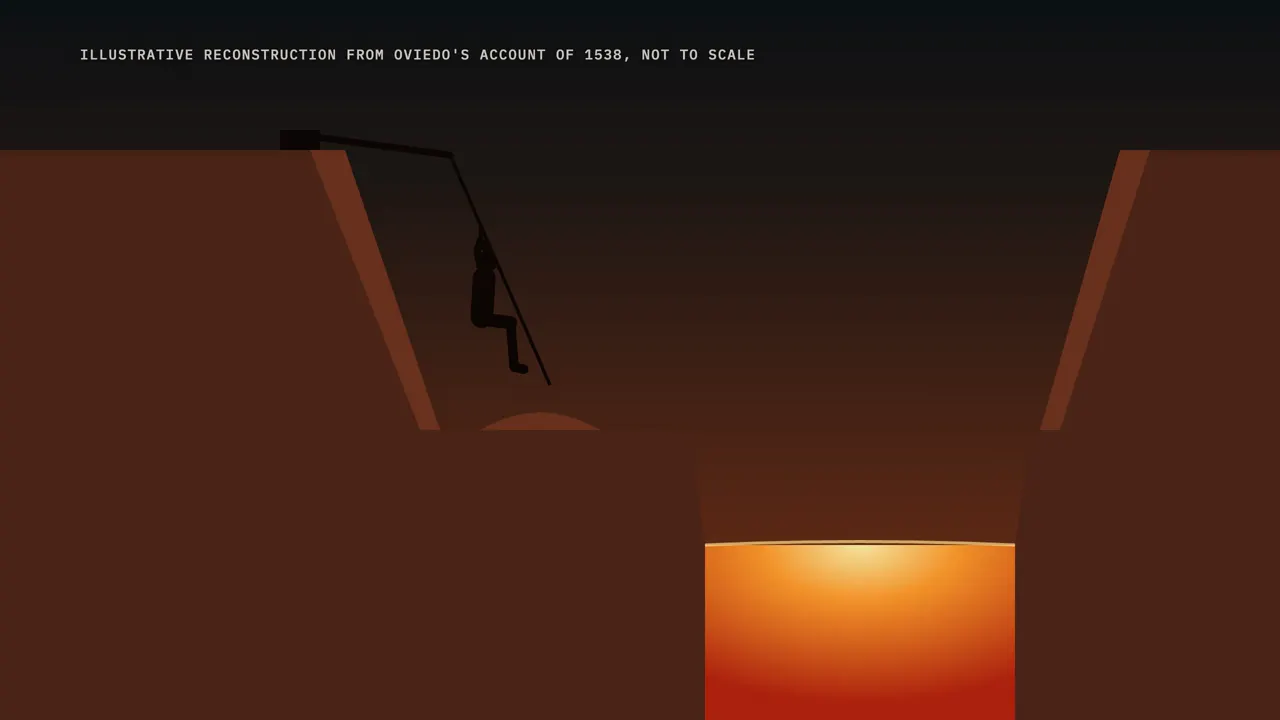
The men at the winch weren't used to the job. They kept losing sight of him and let him drop several body lengths at a time. By the time he reached the bottom, most of the skin on his hands was gone, and a falling stone had struck his helmet. He knelt and kissed the ground. Then he made his way from the rubble down to the crater floor, reciting the Gospel of
John, and looked for the bones of people said to have been thrown in as offerings. He found none. Rock falling from above, he guessed, had covered everything. He set his little cross on a big rock and piled stones around it so the wind wouldn't knock it down. He spent about three hours down there.
He reported no extra heat on the floor, and plenty of air, but stinging dust and fumes that smelled of sulfur. And thin golden threads, like the fine bristles on an ear of wheat, that broke when they cooled and stuck in his hands. Volcanologists call those threads Pele's hair: strands of volcanic glass, spun out of lava by gas and wind. When he came back up, he told his partners the boiling stuff was silver.
An iron chain in the fire
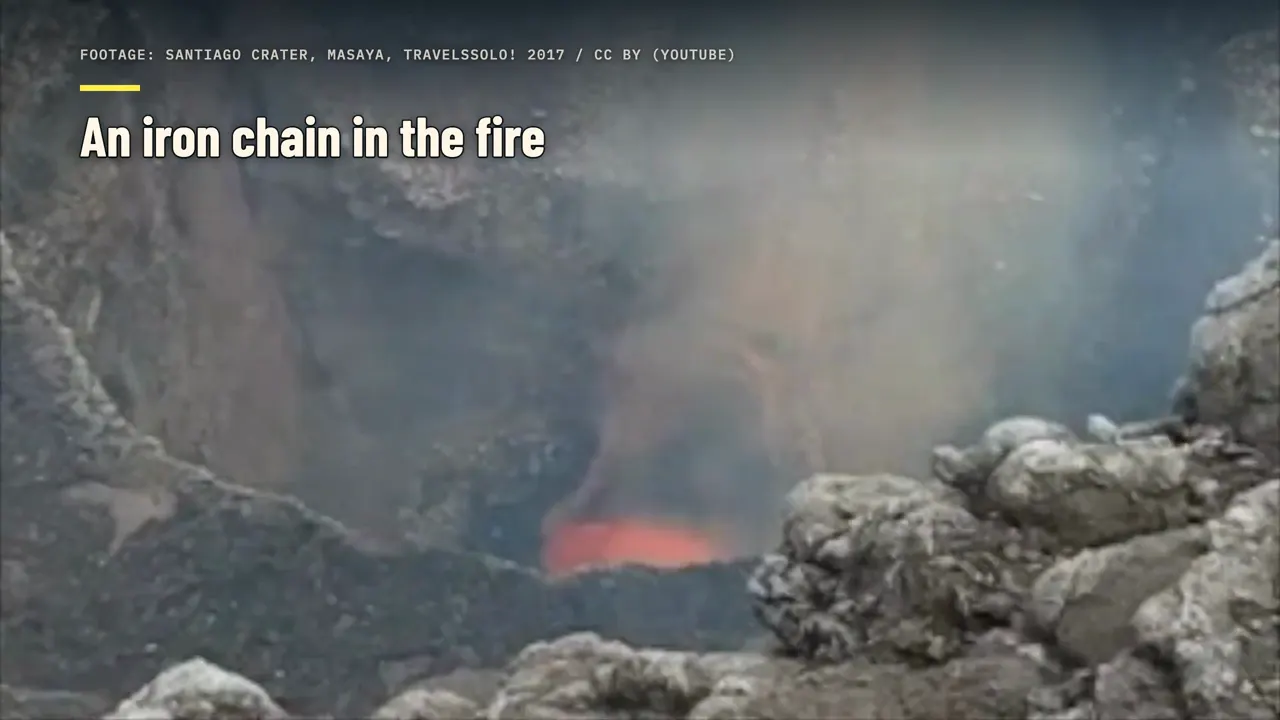
Three days later, on the sixteenth of April, four men went down, Blas among them. They carried chains, the iron chamber, clay buckets, and three written claims of possession, in the king's name and their own. They spent the night on the crater floor. The glow, they said, was so bright that down there it was never night. They pushed a beam out over the edge of the inner pit and lowered the iron chamber on its chain.
Twice it came back empty. The third time, it stuck in the crust on top. When they pulled it free, it came up coated in black, light slag, full of shiny holes. To men who wanted treasure, those holes looked like signs that metal had once been there. They sent word up: great riches. Blas carried a basket up and locked it in a chest.
The rumor reached the governor, Rodrigo de Contreras, in León. On the thirtieth of April, he came to watch a third descent himself. Seven men went down. Down there, two of them claimed veins of rock for their masters. Blas claimed the whole boiling cauldron for the king, himself, and his partners. Everyone laughed. Then they started fighting, and broke the gourds of water that were lowered to them.
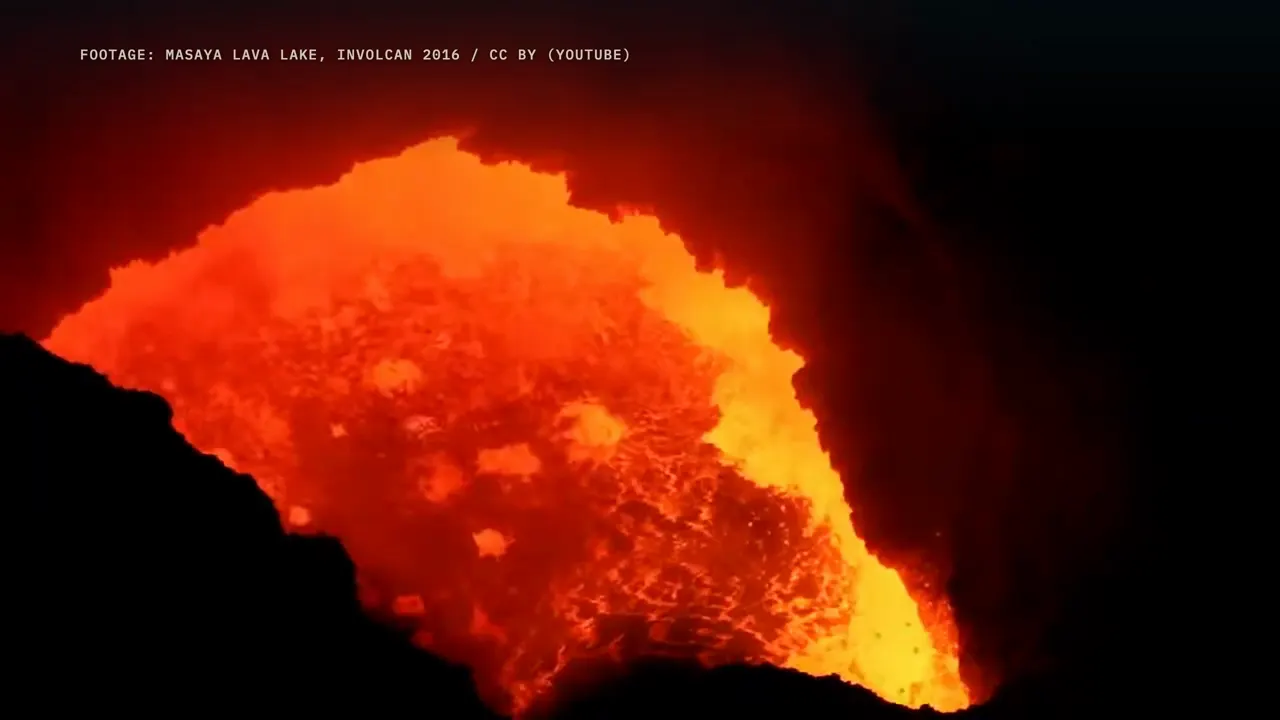
On the fourth try, the chamber stuck in the thick crust, and seventeen or eighteen brazas of chain stayed down there with it. The rest of the chain came up glowing red, and the rope was scorched. The next day, under oath, one of the men said about ten brazas of chain had "melted in the fire." Two weeks later, in León, two silversmiths ground up the stones from the crater and heated them in a crucible for more than two hours.
Their verdict: no metal at all, just "burned stones," full of sulfur and saltpeter. The governor refused to let anyone go down again. Blas wasn't finished. He sailed to Spain with his report and a drawing of the crater, and came back with a royal order to let them try again. But he died as soon as he landed in Nicaragua.
Oviedo, the royal chronicler, disliked him, and called him "more daring and greedy than wise." Still, their testimony left one of the earliest written descriptions of what lay inside the crater.
What Oviedo saw first
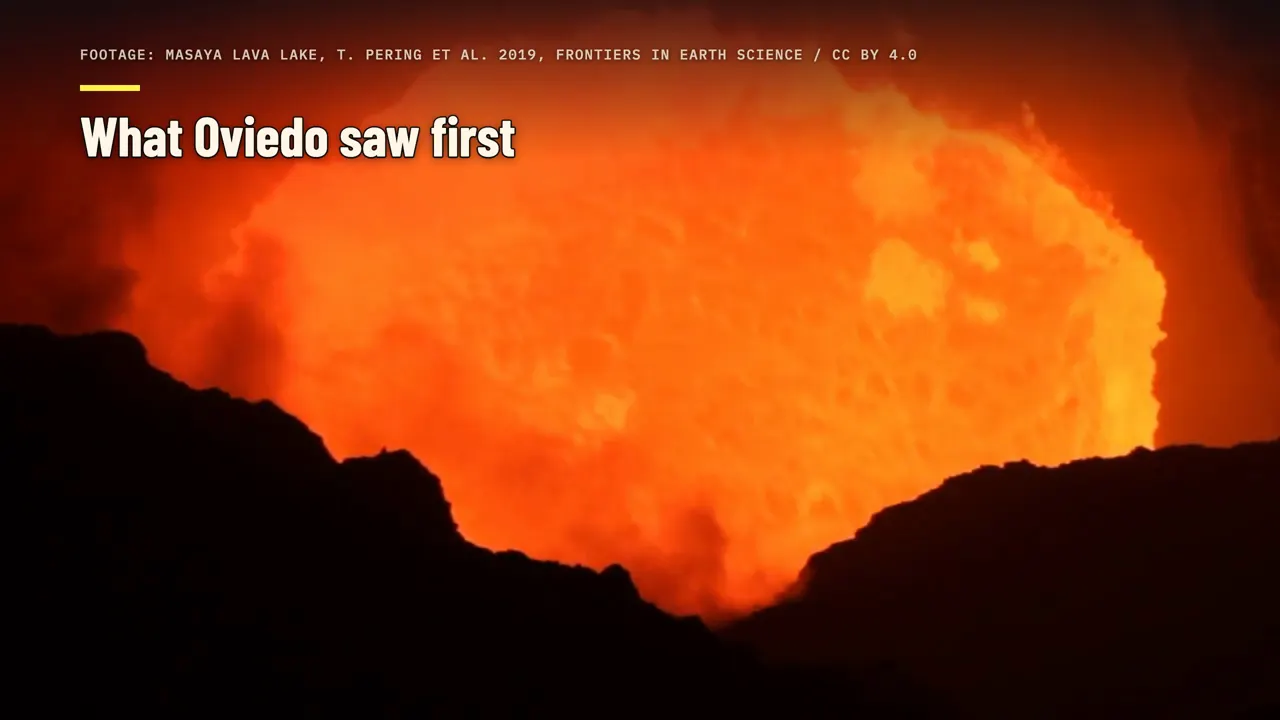
Nine years before the descent, Oviedo had stood on this rim himself. In July 1529, he left the town of Managua and spent the night at a Spanish farm near the foot of the mountain. One or two Spaniards had promised to climb with him. When the day came, neither showed up. So he went up in the dark with a local chief as his guide, a Black servant, and two Indigenous men.
The chief had been baptized Don Francisco. His earlier name was Nacatime. In the chief's language, Oviedo wrote, Masaya meant "the mountain that burns." In another local language it had a second name, Popogatepe, "the mountain that boils." He had heard that the glow from the summit was bright enough to read a letter by, three leagues away.
He didn't believe that. But he did write that the town of Granada, three leagues off, was lit up on moonless nights. At dawn, near the top, the guide sat down about fifteen or twenty paces from the edge and pointed. Below Oviedo was a round pit, so wide that no musket shot could cross it. Its walls dropped to a flat, round floor, big enough for a hundred horsemen to play a game on.
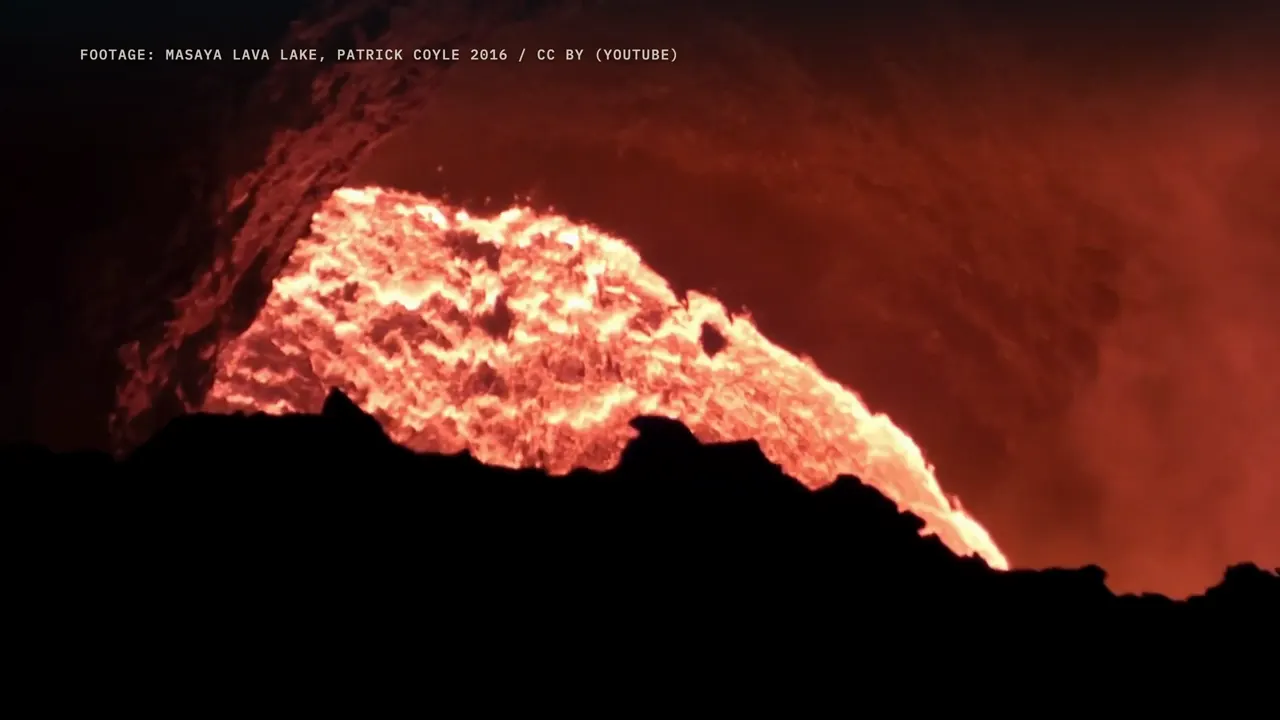
A governor later told him the drop had been measured at 130 brazas. That's a little over two hundred meters in today's units. And on one side of that floor was a smaller hole. At its bottom, Oviedo saw what he called "a liquid fire, like water," brighter than live coals. It boiled in patches. Where the surface settled, a thin skin formed, then cracked, showing the liquid fire underneath.
Every so often, the whole surface heaved and threw drops higher than a man. Scientists who film this volcano today still see that same skin, and those same cracks. He threw stones in and never saw them land. Parrots with long tails nested in the walls. He stayed more than two hours, sketching the mountain on paper.
The 1855 edition of his history printed engravings based on those sketches.
The old woman of the crater
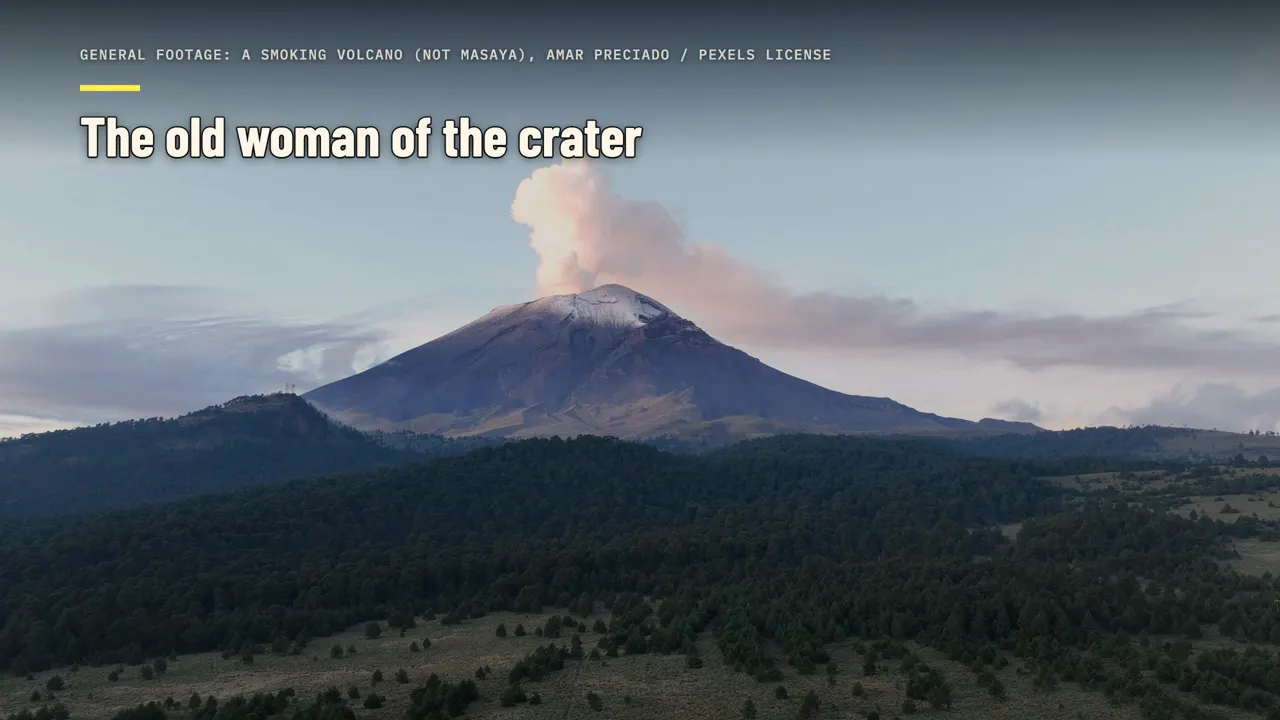
A local chief told Oviedo why people had climbed this mountain long before the Spanish came. He said that he and other chiefs used to go down to that floor. Out of the hole, he said, came a very old woman, naked, with long sharp teeth and deep, burning eyes. The chiefs held a secret council with her. They asked whether to go to war, whether
to make peace, whether rain would come, whether the maize would grow. And a day or two before or after each council, the chief said, they threw in men, women, and children as offerings. Next to the edge, Oviedo saw a great pile of pots, plates, and jars, some broken, some whole. People had carried food up in them, he was told, so the old woman would eat, and stay calm when the earth shook.
Since the Christians arrived, the chief said, she rarely came out at all. Oviedo had no doubt who she was. To him, she was the devil. We only have this story through a Spanish writer who already believed he was looking at hell, so it tells us as much about him as about the people who lived here.
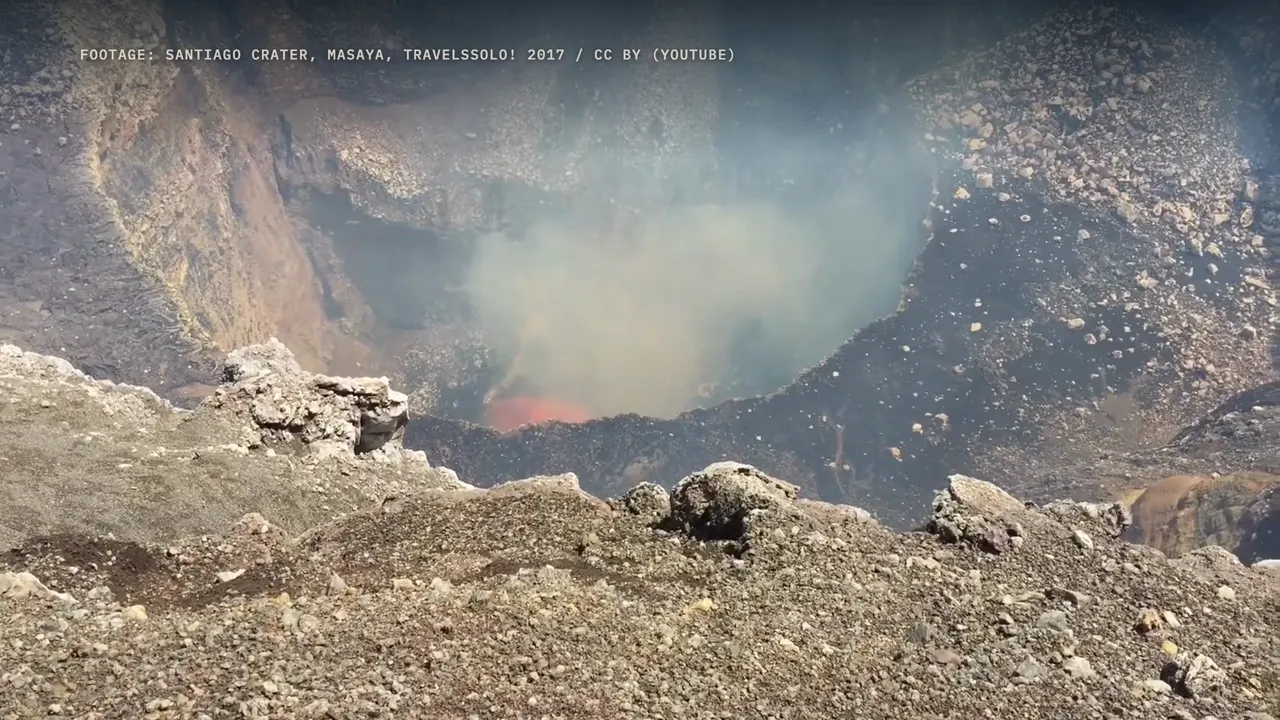
He also found a cross near the rim. A Mercedarian friar, Francisco de Bobadilla, had climbed up about six months earlier with a small group. His report said they planted crosses around the mouth. According to a record Oviedo saw, the same friar baptized more than twenty-nine thousand people in nine days.
Later writers say the crosses were meant to drive out the devil. Oviedo himself doesn't say why. A cross named for Bobadilla still stands on a hill above the crater today. It was put up much later.
What was really boiling
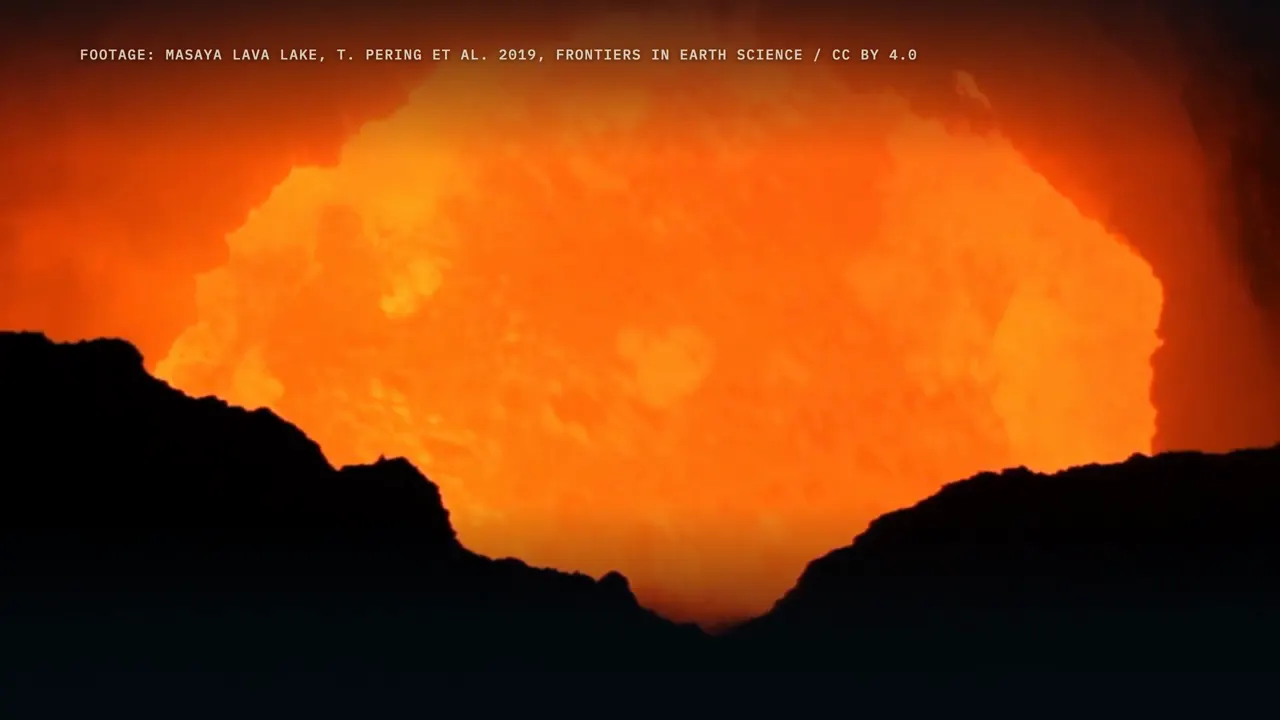
So what were they looking at? Not gold, and not silver. Only lava: molten basalt, a dark volcanic rock. A lava lake forms where hot magma keeps rising into an open crater instead of hardening in the vent. Magma carries dissolved gas. Near the surface, the gas escapes, like bubbles from an opened bottle.
Once it loses that gas, the magma is a little cooler and denser, so it sinks back down, while fresh magma rises to take its place. That loop keeps the surface molten, and keeps the vent open. The top cools into a thin black crust, which cracks, sinks, and forms again. Much of the lava footage in this film comes from a team that measured Masaya's lake in June 2017.
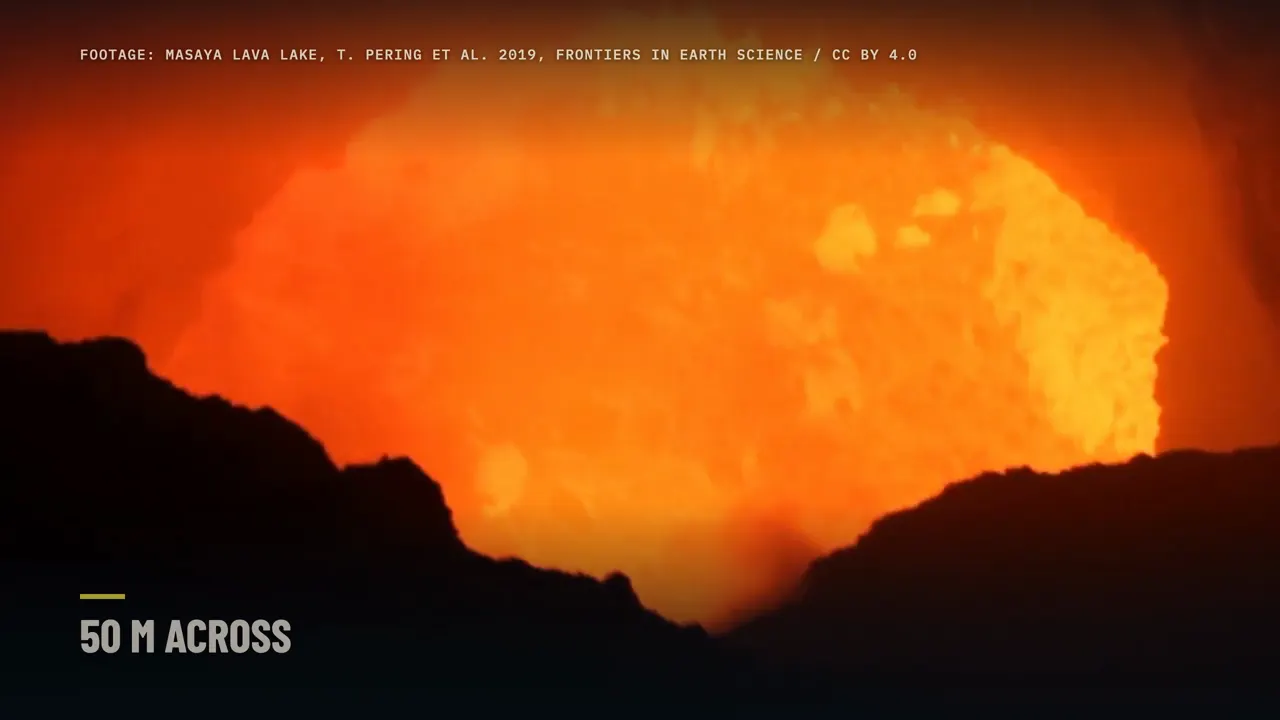
The lake was about fifty meters across, and its surface measured roughly nine hundred to a thousand degrees Celsius. Its surface raced along at about fourteen to sixteen meters per second, among the fastest flows ever reported for a lava lake. Only a handful of volcanoes on Earth have kept a lava lake open for years at a time. Masaya has been one of them. Others include Erebus in Antarctica, Erta Ale in Ethiopia,
Nyiragongo in the Democratic Republic of the Congo, and Kilauea in Hawaii. And they all breathe out gas. Between 2005 and 2015, satellites measured Masaya releasing about 870 tonnes of sulfur dioxide a day. That ranked it eighteenth among ninety-one volcanoes giving off gas without erupting.
A lake that comes and goes
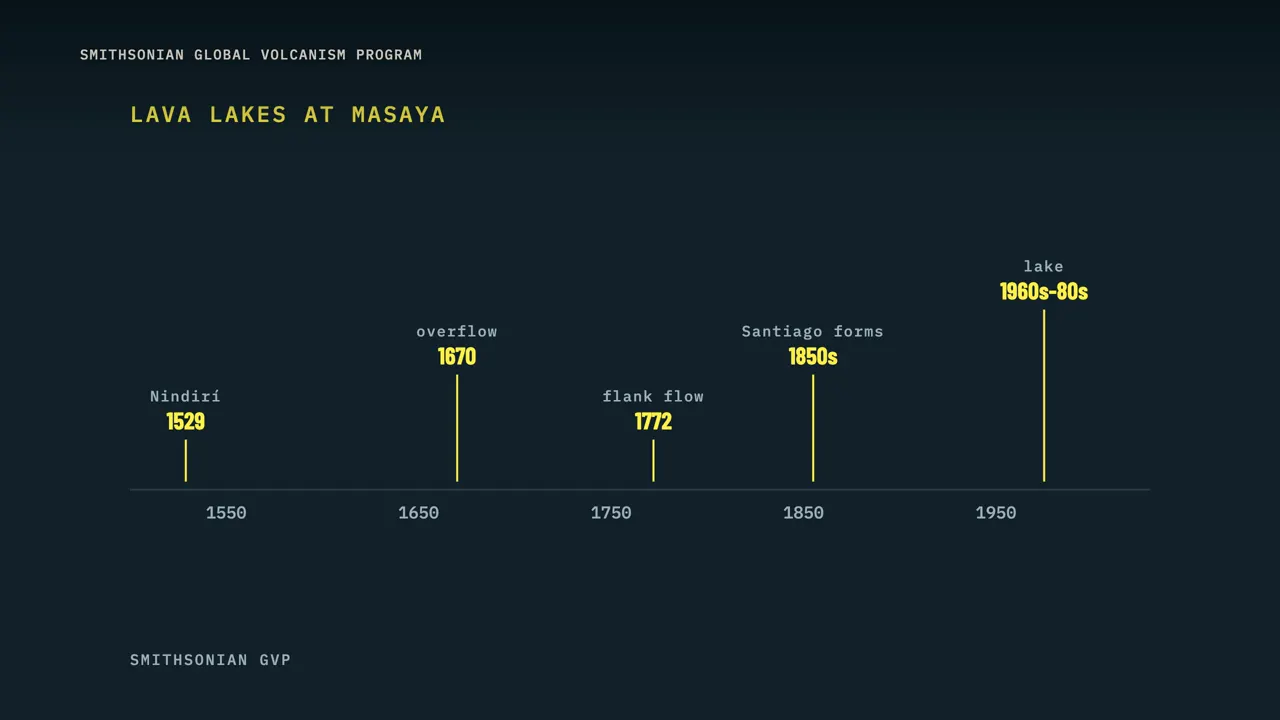
Masaya's lake has never stayed put. Even in 1529, Oviedo heard that only months earlier the liquid fire had risen almost to the top of the inner hole. The lake the Spanish saw was in a crater called Nindirí. In 1670, lava from that crater spilled over and ran down the north side of the volcano.
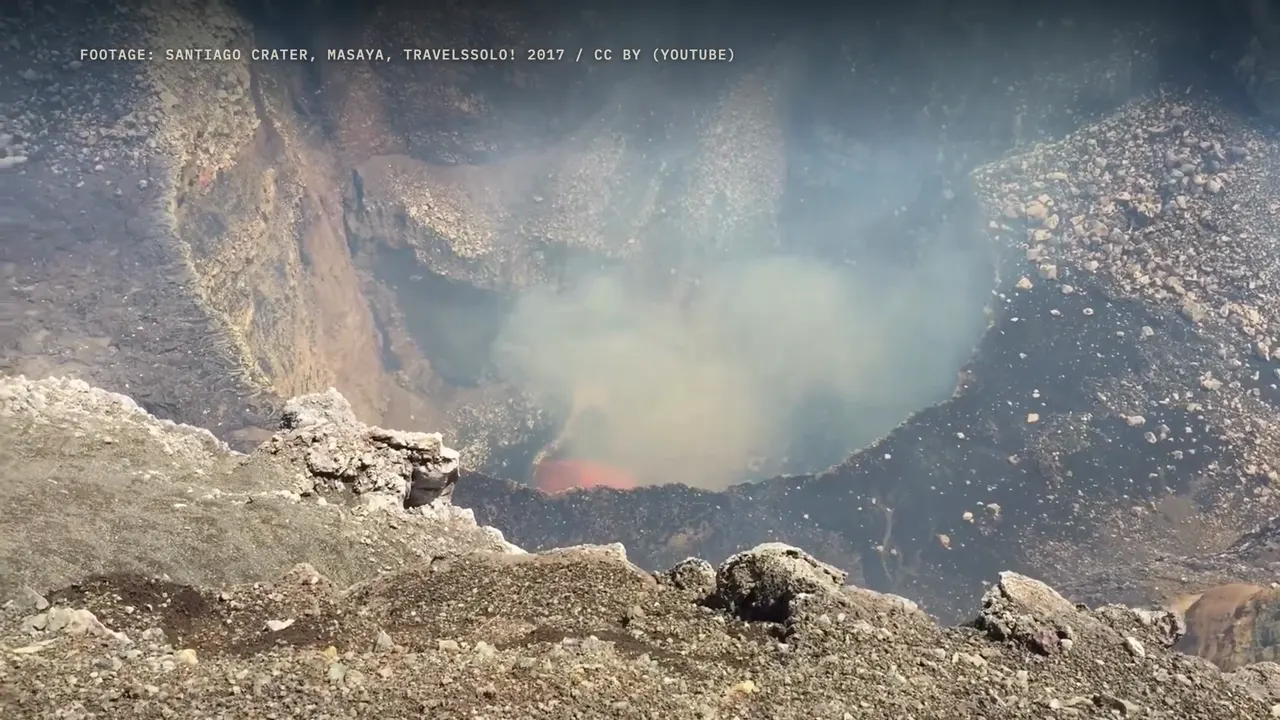
In 1772, the volcano split open on its north side, and lava poured out toward Lake Managua. Today's active crater, Santiago, only took its shape in the 1850s. Lava lakes have come and gone there too, from the 1960s into the 1980s, and again in 1989. Then, in December 2015, a lava lake appeared again at the bottom of Santiago crater.
For years after that, visitors could look down from the rim toward the glowing lake. In 2019 and 2020, the lake slowly sank and shrank. And on the second of March, 2024, parts of the crater's inner walls collapsed, covering the lava lake and blocking the main vent. The park closed for a while, because with the vent blocked, the chance of an explosion went up.
The viewpoint reopened in 2025. The lake was still covered. So for now, the Mouth of Hell has closed its mouth. But under the rubble, the volcano hasn't stopped moving.
What the satellites saw
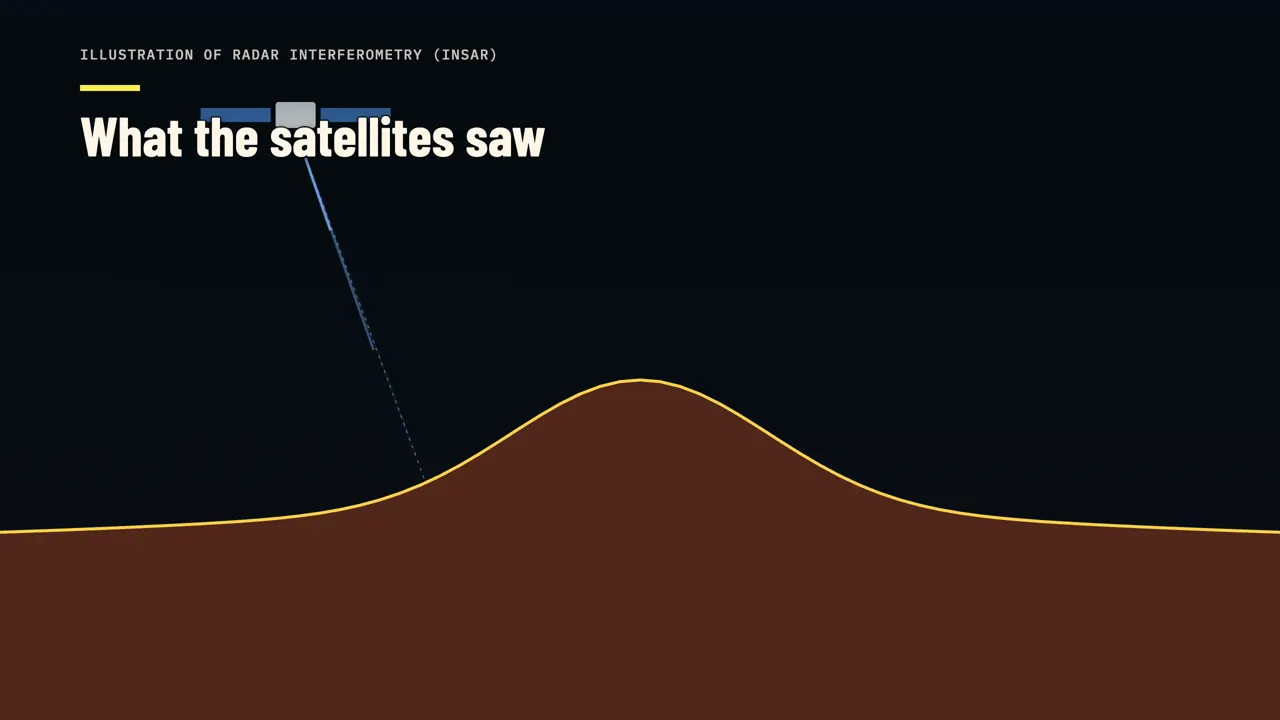
Europe's Sentinel-1 radar satellites pass over Masaya about every twelve days. Each pass bounces radar waves off the ground and times their return very precisely. Compare repeated passes, and you can see the ground shift toward or away from the satellite by a centimeter or so. This technique is called InSAR.
A Penn State team led by Lizzie Johnson, with Young Cheol Kim and Christelle Wauthier, looked at six years of these passes, from 2018 to 2024. They published their results in July 2026, in the journal Geophysical Research Letters. They found two separate places where magma seems to be stored. The first is deep, about 3.2 kilometers under the middle of the caldera, the wide basin the volcano sits in.
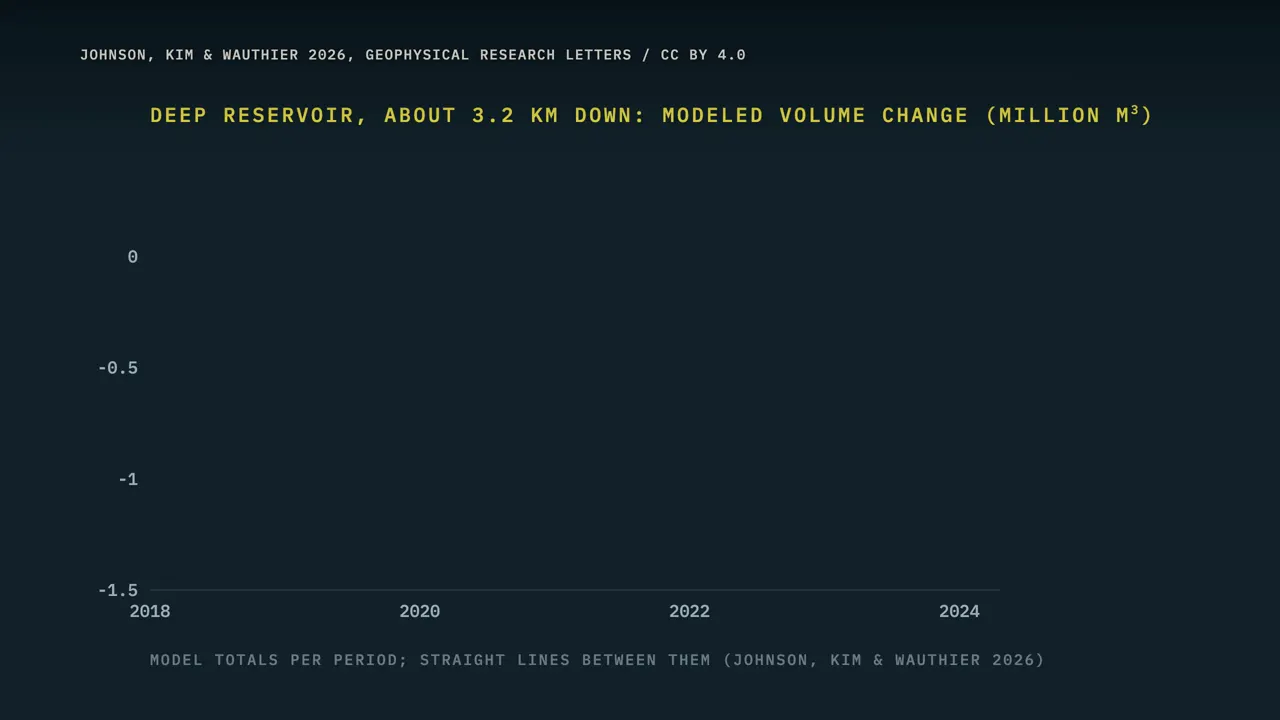
From 2018 to the middle of 2022, the ground above it moved about three centimeters away from the satellites, as if that reservoir were losing about 1.3 million cubic meters. Then the ground began moving back toward the satellites. By early 2024, the reservoir had gained back about 450,000 cubic meters. The team reads that as new magma arriving from deeper down.
The second place is shallow, only about two hundred meters under Santiago crater. The ground there kept sinking for all six years, as if a small reservoir were draining. That shallow reservoir sits beneath Santiago crater, where the lava lake disappeared in 2024. Satellites don't see magma directly. They see the ground move, and the team works out what's underneath from how it moves.
Living next to the Mouth of Hell
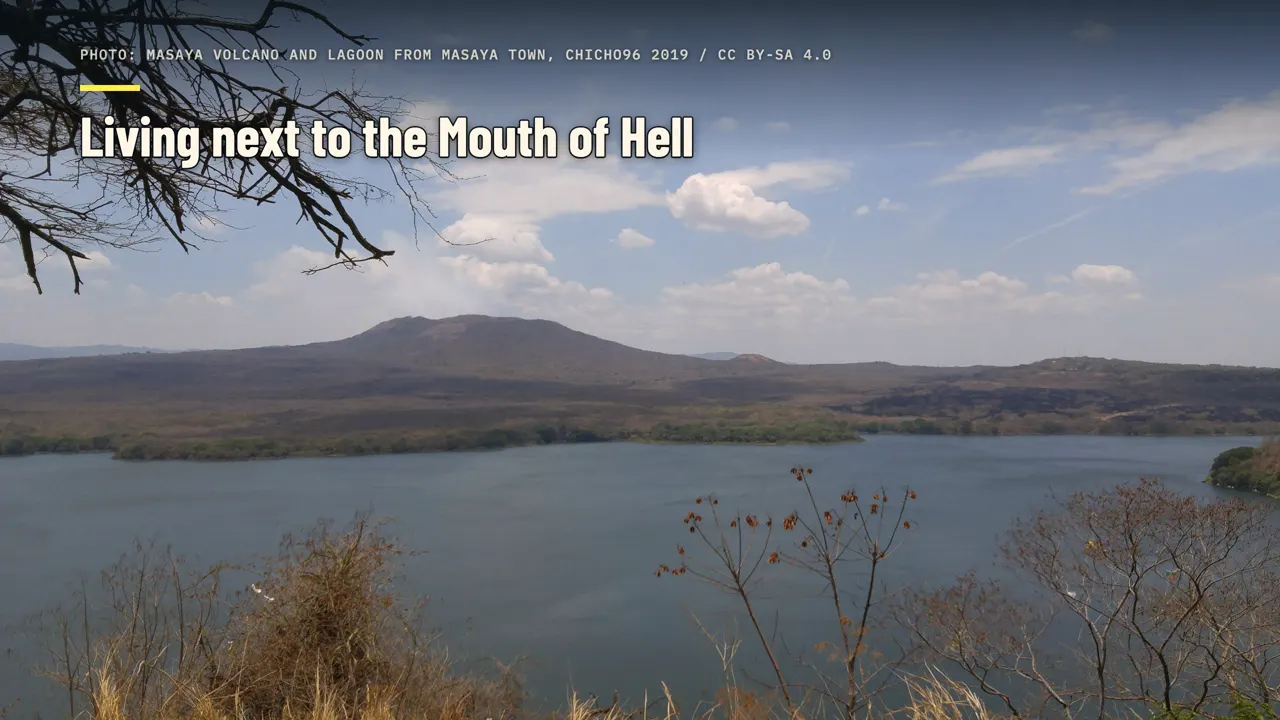
Nearly two million people live within thirty kilometers of Masaya. The capital, Managua, is about twenty kilometers away. And Masaya can be violent. On the twenty-third of April, 2001, an explosion threw rocks up to sixty centimeters across as far as five hundred meters from the crater.
Cars at the viewpoint were hit. The researchers say they saw no immediate danger to the people around it. The bigger everyday hazard is the gas. Sulfur dioxide from the crater stays a danger, even without an eruption. What the team wants is a baseline: a record of how the volcano normally breathes, so that unusual changes stand out.
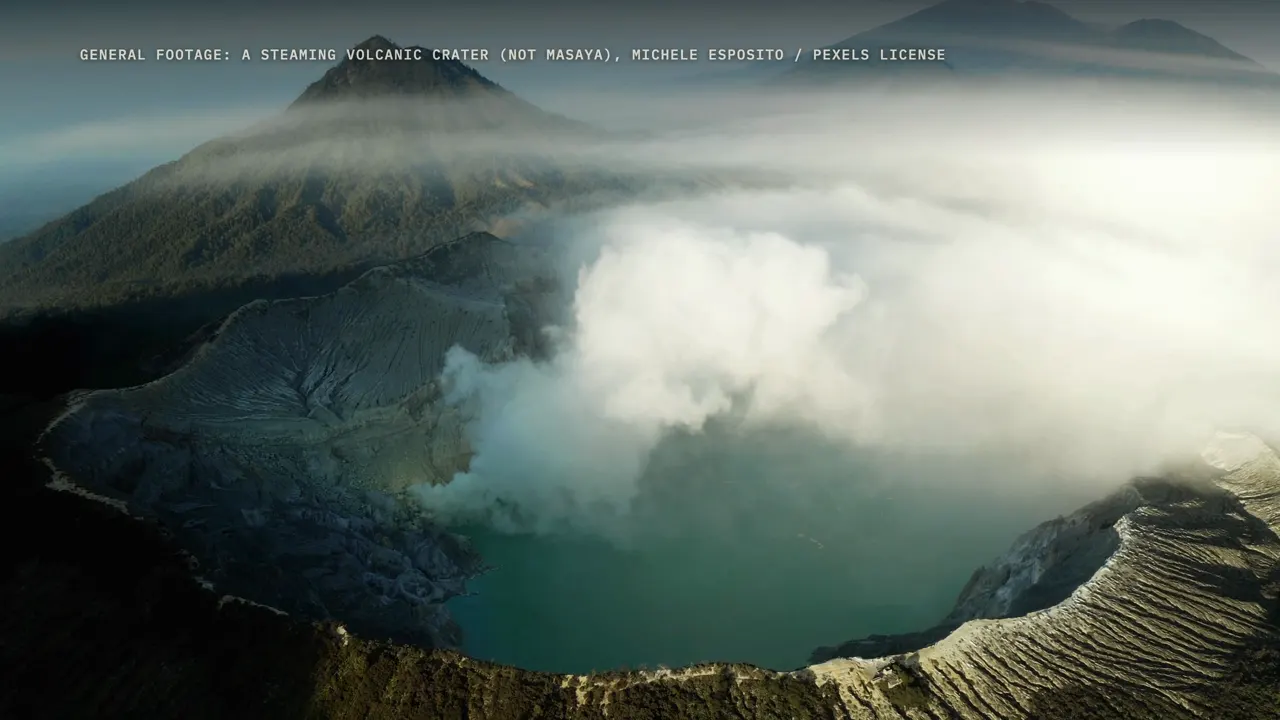
Five centuries ago, people lowered a chain into the fire to find out what Masaya was hiding. They pulled up burned stone, and lost the chain. Today, the measuring line is a radar beam from space, and the answer it brings back is not gold. It's a message written in centimeters: from 2022 to 2024, a deep reservoir under the mountain that burns was filling up again from below.
Watch on YouTube
Sources
- Gonzalo Fernández de Oviedo, Historia general y natural de las Indias, Book XLII, chapters 3 and 5 to 10, ed. José Amador de los Ríos, vol. IV (Madrid, 1855), read on the Internet Archive scan
- Jaime Incer Barquero, Crónicas sobre el volcán Masaya (Fundación Enrique Bolaños), reprinting the 1 May 1538 inquiry, the 15 May 1538 assay and the Sánchez Portero memorial from the Archivo General de Indias
- Smithsonian Institution Global Volcanism Program, Masaya (volcano 344100), eruptive history and weekly reports
- E. Johnson, Y. C. Kim and C. Wauthier, Double Trouble: Two Active Magma Reservoirs Identified at Masaya Volcano, Nicaragua, Using Satellite Geodesy, Geophysical Research Letters 53 (2026), doi:10.1029/2026GL123214; Penn State via ScienceDaily (19 Oct 2026)
- T. D. Pering et al., A Rapidly Convecting Lava Lake at Masaya Volcano, Nicaragua, Frontiers in Earth Science (2019), doi:10.3389/feart.2018.00241
- USGS Hawaiian Volcano Observatory, Volcano Watch: Earth has just a handful of long-lived lava lakes (25 Mar 2010)
- S. A. Carn et al., A decade of global volcanic SO2 emissions measured from space, Scientific Reports 7, 44095 (2017)
- Despacho 505 (16 Apr 2024) and La Prensa (4 Aug 2025) on the buried lava lake and the reopened viewpoint
Images and video
- Footage: T. Pering et al. 2019, Masaya lava lake, CC BY 4.0 (Frontiers / figshare); S. Wanmer 2016, Volcanicsapphire.com, CC BY 3.0 (YouTube Creative Commons license); Patrick Coyle 2016, INVOLCAN 2016 and travelssolo! 2017, Masaya lava lake and crater, CC BY 3.0 (YouTube Creative Commons license); Alton Chang, Erta Ale, CC BY 3.0 (Wikimedia Commons)
- General footage via Pexels (Pexels License): K; Florian Delée; Videas Cl; khanhhoangminh; ArtHouse Studio; max laurell; Zulfugar Karimov; Aamir Somewhere; Matias Luge; Michele Esposito (a crater that is not Masaya); Amar Preciado (a volcano that is not Masaya); Altaf Shah; Matthias Groeneveld
- CC BY-SA 4.0: Chicho96; Saraedum; Acana689; JrPilarte; Pi3.124
- CC BY-SA 2.0: Kim Gunnarsson; Alexey Yakovlev
- CC BY-SA 1.0: Mark Stevens
- Public domain: Oviedo, Historia general y natural de las Indias (1855 edition, engravings and page scans); NASA ISS photograph ISS034-E-46895
- Diagrams and maps drawn for this video; the 1538 descent is an illustrative reconstruction from Oviedo's account, not to scale. Maps from Natural Earth.
- Photos via Wikimedia Commons. Share-alike images are used under their CC BY-SA licenses.
- Narration is synthetic.