What Happened After the World's Largest Dam Removal

In 2024, four hydroelectric dams on the Klamath River came down in what NOAA calls the largest dam removal in the world. Within two seasons, Chinook salmon were back in 88% of their documented historical range above the old dams. Then 2026 brought drought and a parasite outbreak. What can two years really tell us?
This article is the full narration of the video. Watch on YouTube
Four dams down
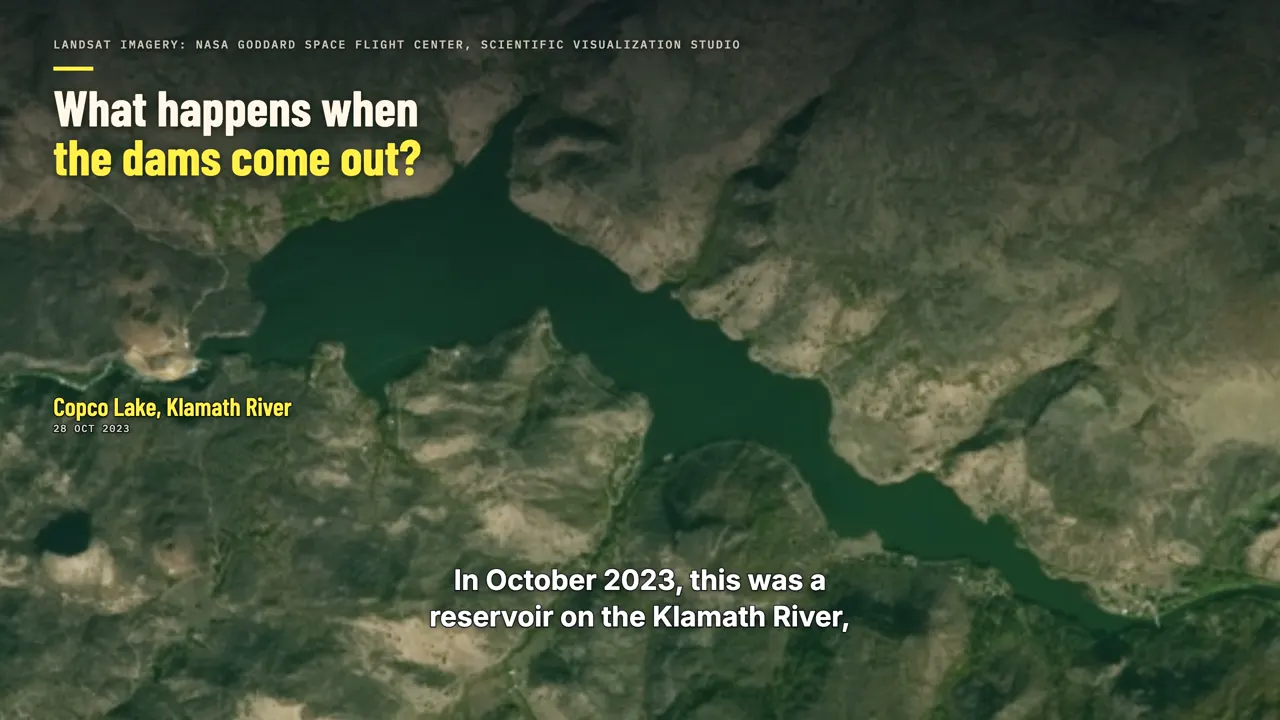
In October 2023, this was a reservoir on the Klamath River, near the border between California and Oregon. A year later, the lake was gone, and a river ran through the middle of it. Four hydroelectric dams came down in what NOAA calls the largest dam removal in the world.
Within weeks, salmon were swimming past the spot where the last dam had stood. Within two seasons, a study published this August found Chinook salmon in 88% of their documented historical range above the old dams. Some reached streams in Oregon where no salmon had been recorded since 1912.
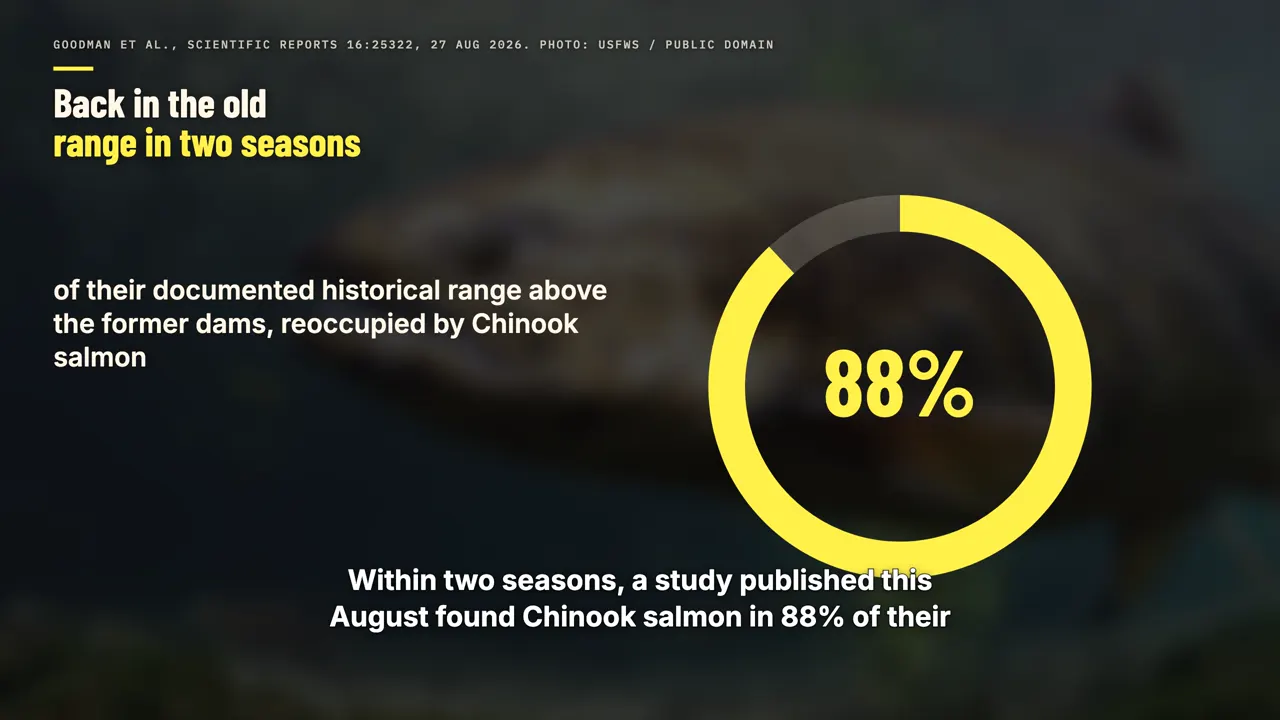
Then this year brought drought, low water, and a parasite that infected nearly half of the young salmon that biologists tested. So what actually happens to a river when you take the dams out, and how much can two years really tell us?
A river cut in half
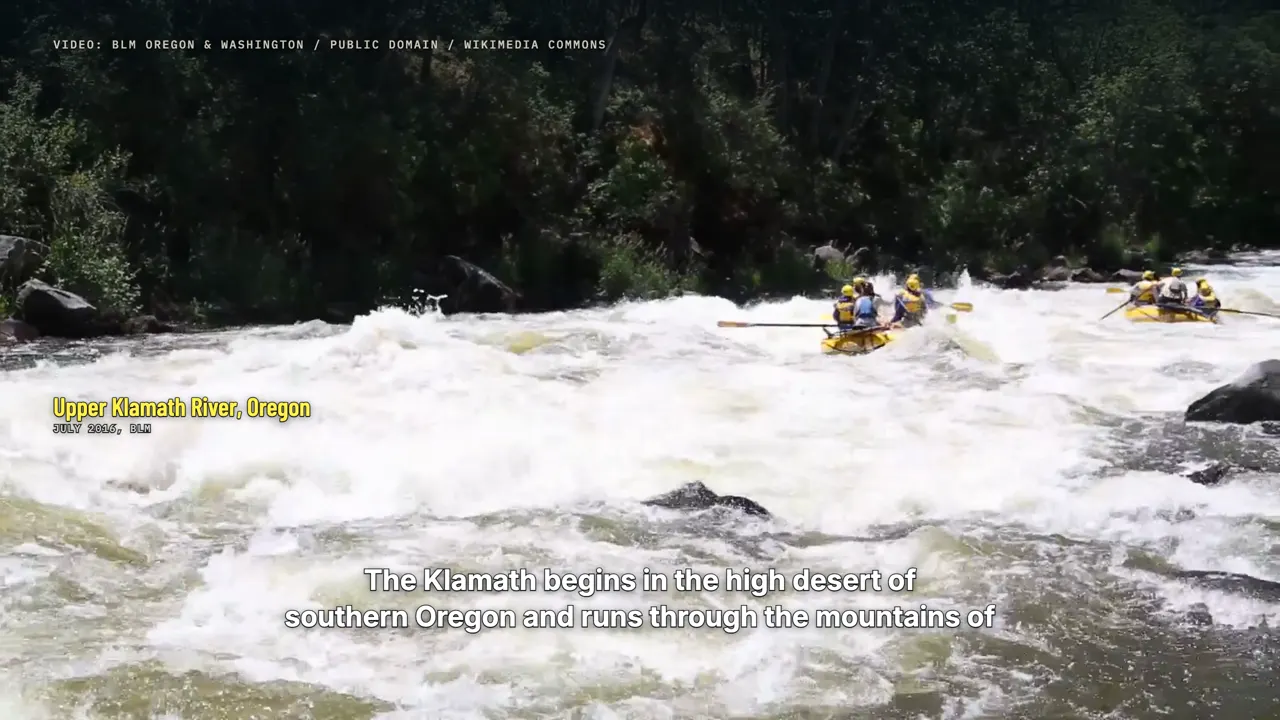
The Klamath begins in the high desert of southern Oregon and runs through the mountains of northern California to the Pacific. NOAA describes its salmon run as historically the third largest in the lower 48 states. Then, more than a century ago, a power company built a concrete dam across the river at a
place called Copco. A magazine article from 1918 describes the new dam, the lake behind it, and the turbines in its powerhouse. From then on, salmon could no longer reach the upper river.
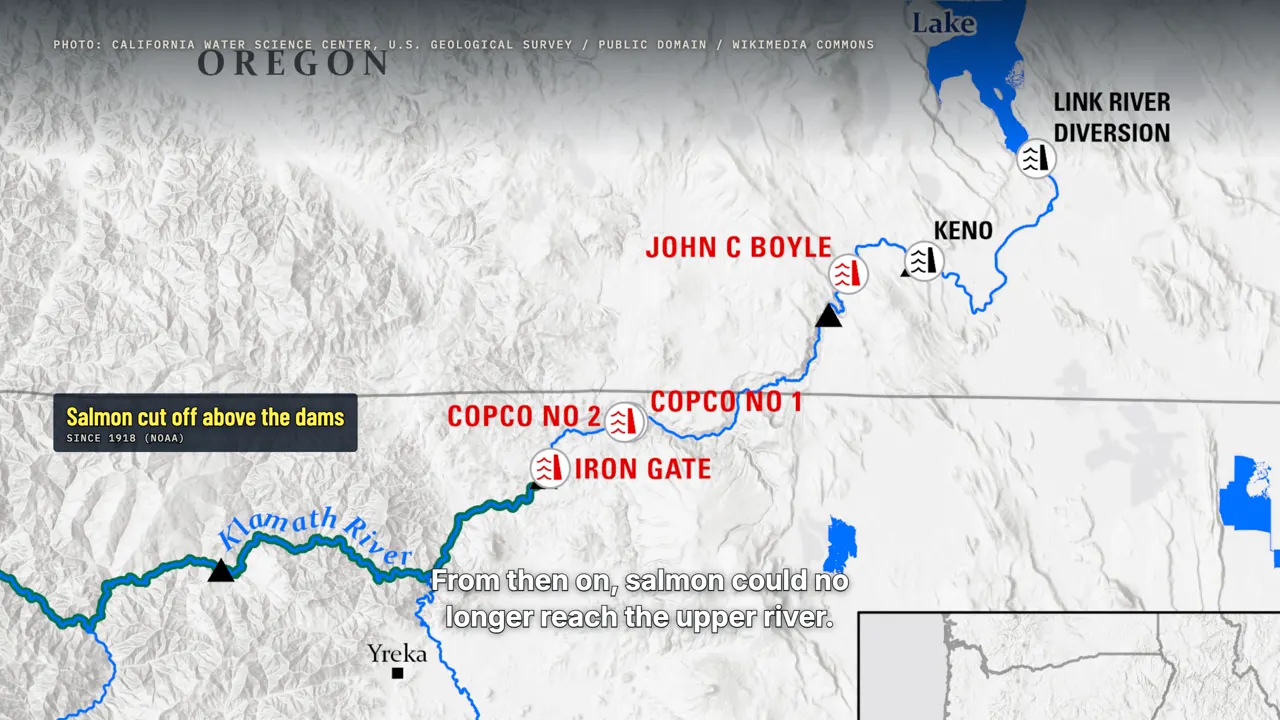
Three more dams followed downstream and upstream, and the last, Iron Gate, was finished in the 1960s. Together the four dams could generate about 160 megawatts. That was less than 2% of the power supplied by their owner, PacifiCorp.
None of them stored water for irrigation or drinking, and none was run for flood control. But they blocked more than 400 miles of river and streams that salmon had once used.
What the reservoirs did
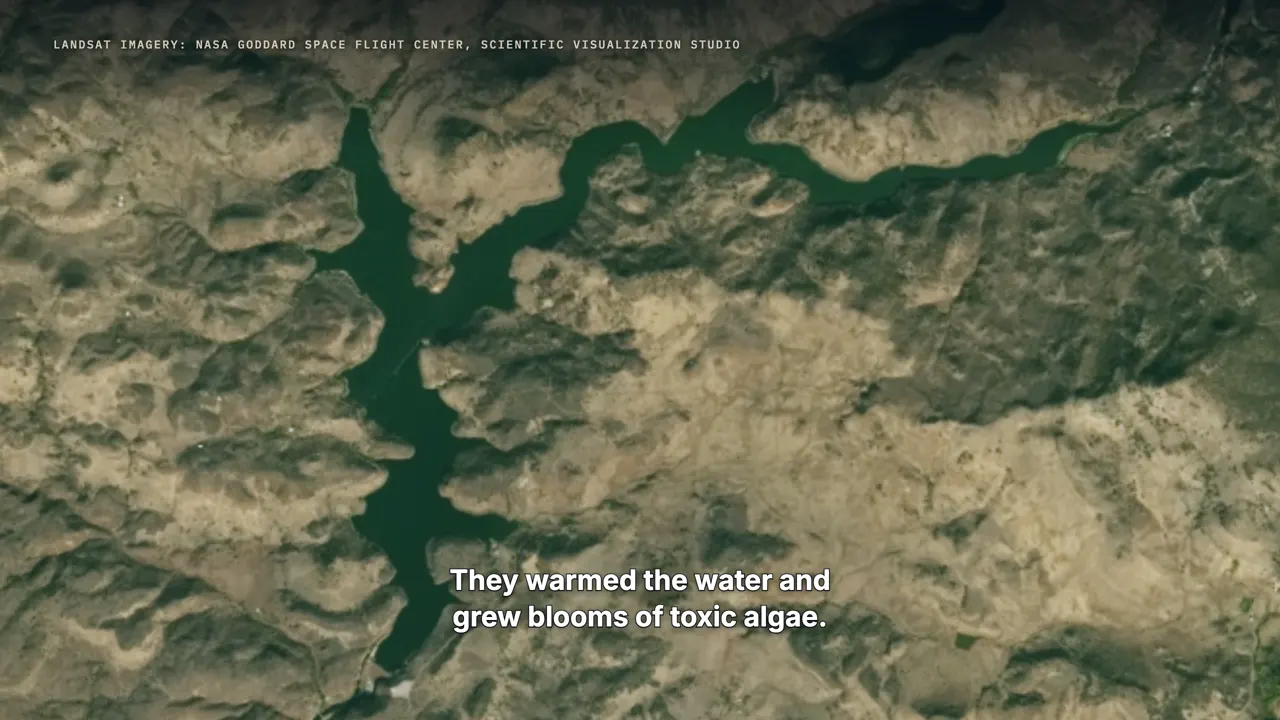
The reservoirs also changed the water below them. They warmed the water and grew blooms of toxic algae. According to the US Geological Survey, the algae reached levels harmful to swimmers and boaters from 2005 on.
And the US Geological Survey says the river's salmon had fallen to about 5% of their numbers before the dams. The worst moment came in September 2002. Low, warm water in the lower river set off a disease outbreak among salmon crowded together on their way upstream.
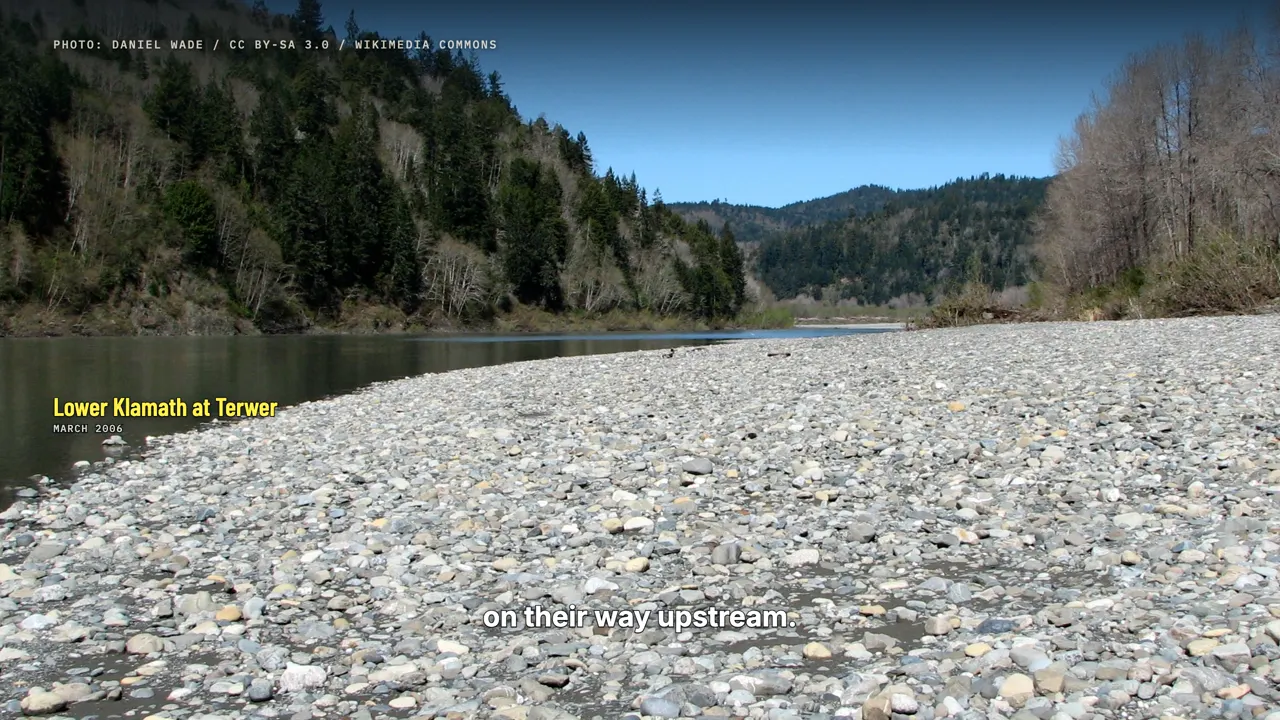
Federal biologists counted more than 34,000 dead fish, most of them adult Chinook salmon. California biologists later wrote that the real losses may have been more than double that count. For decades, tribes along the river led the campaign to remove the dams,
joined by fishing groups and conservationists. This rally in 2006 took the message straight to a hydropower industry conference.
The license
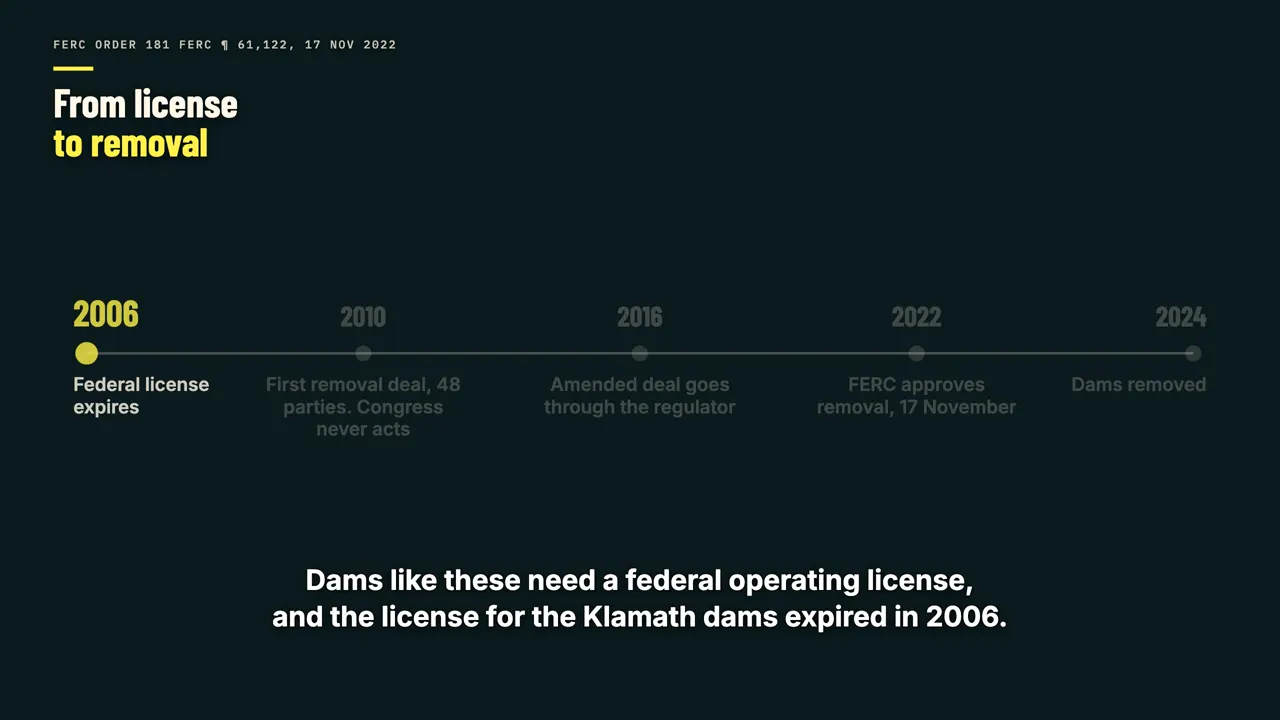
What finally changed the math was a license. Dams like these need a federal operating license, and the license for the Klamath dams expired in 2006. To renew it, regulators would have required ways for fish to get past the dams. PacifiCorp concluded that building them would mean running the dams at a loss.
In 2010 the company and 47 other parties signed an agreement to remove the dams, but it needed an act of Congress that never came. In 2016 the two states, the federal government, PacifiCorp, and the Yurok and Karuk tribes rewrote the deal so it could go through the energy regulator instead.
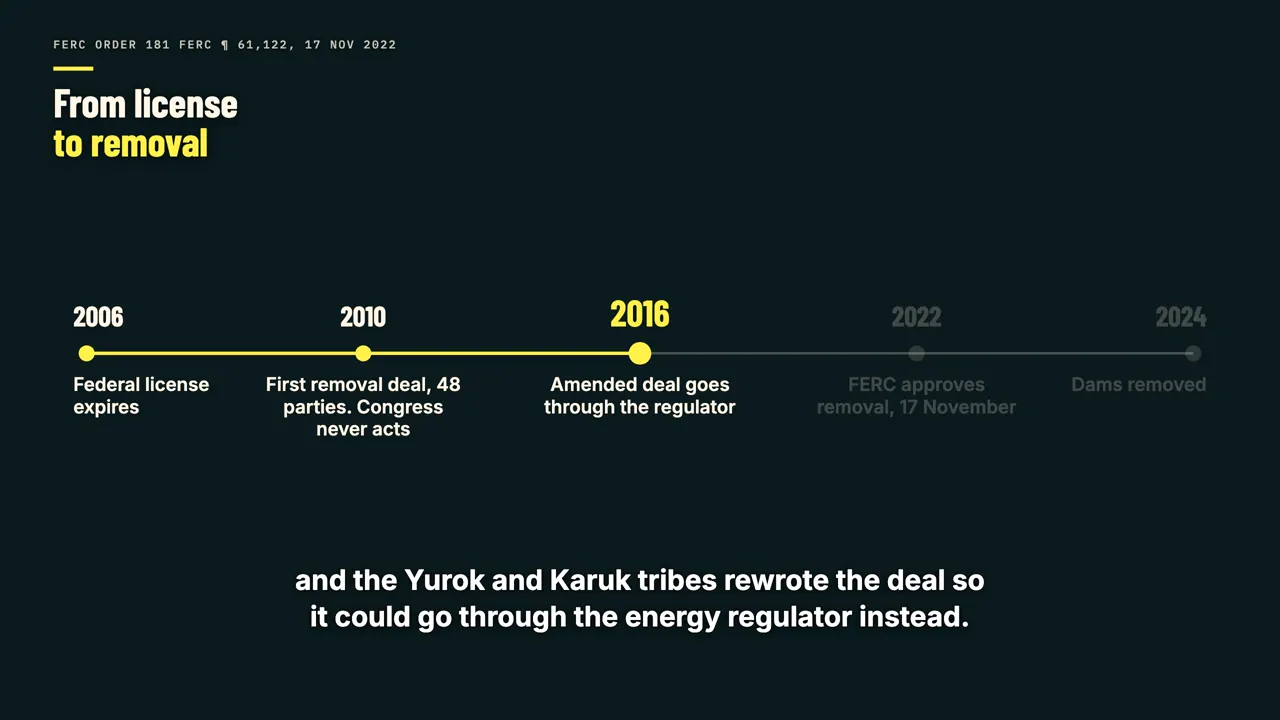
A new nonprofit, the Klamath River Renewal Corporation, was set up to take the dams down. On November 17, 2022, federal regulators approved the removal of all four dams. The budget was $450 million, plus a contingency fund of $45 million.
PacifiCorp's customers paid up to $200 million of it, and most of the rest came from a California water bond.
Draining the lakes
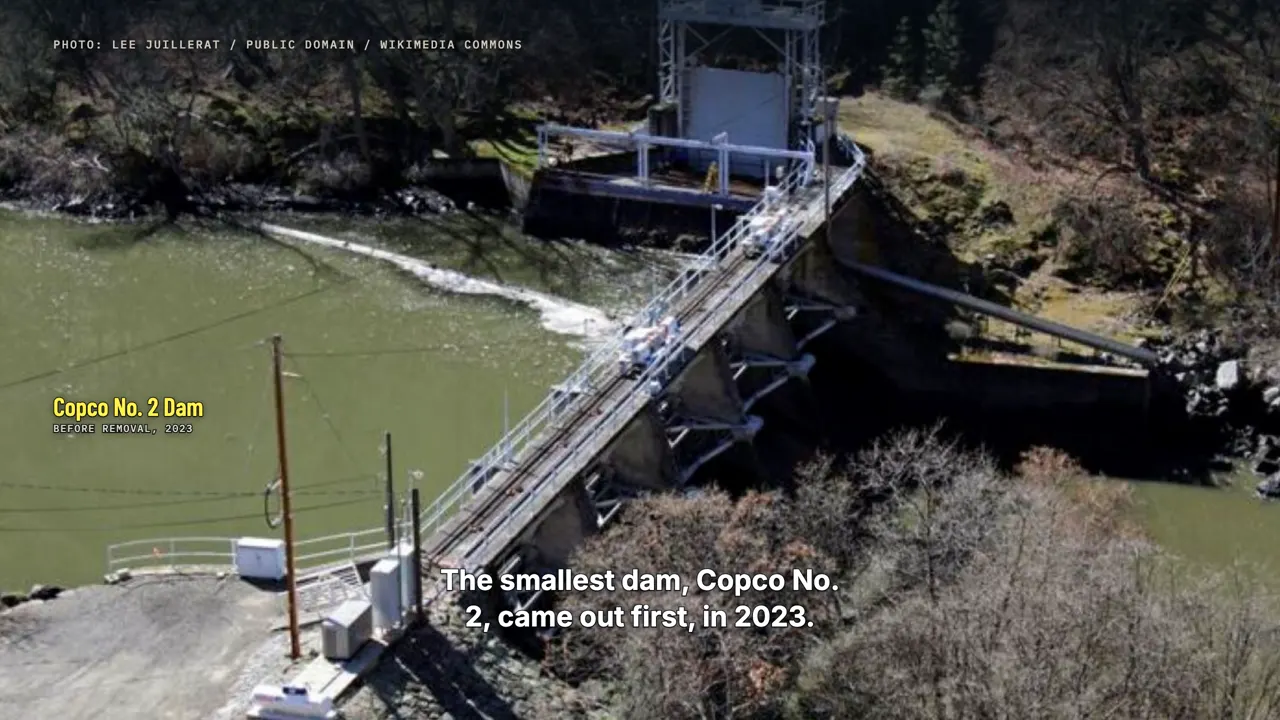
The smallest dam, Copco No. 2, came out first, in 2023. In January 2024, crews opened outlets low in the other three dams, and the reservoirs began to drain. Decades of mud on the reservoir floors started moving downstream.
The removal corporation expected about 5 million cubic yards of sediment to wash out during the drawdown. At the peak, researchers measured about 30 grams of sediment in every litre of river water. The drawdown was timed for winter, when most adult salmon were out at sea. Fish that lived in the reservoirs died in large numbers,
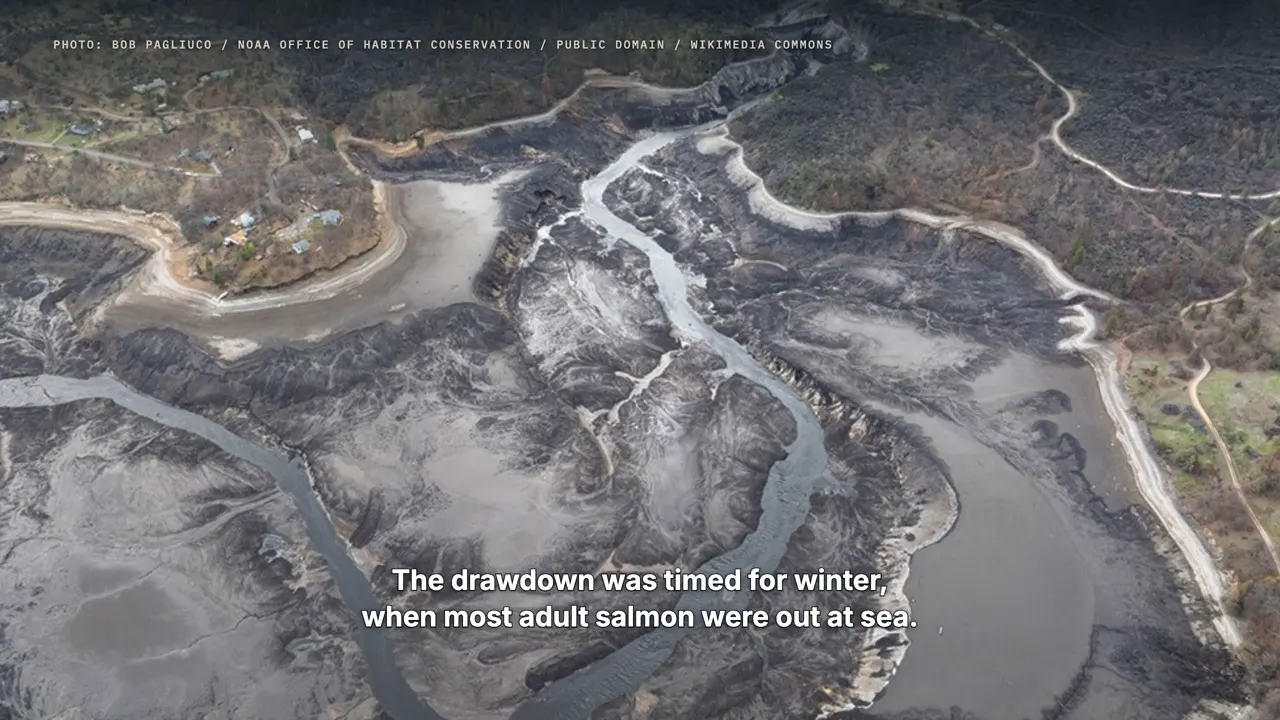
as the planners had predicted. Through the summer, excavators broke up what was left of the dams. On September 26, 2024, the last barrier at Iron Gate was removed, and fish could swim freely past it.
Six days later, the removal was declared complete.
Seventeen billion seeds
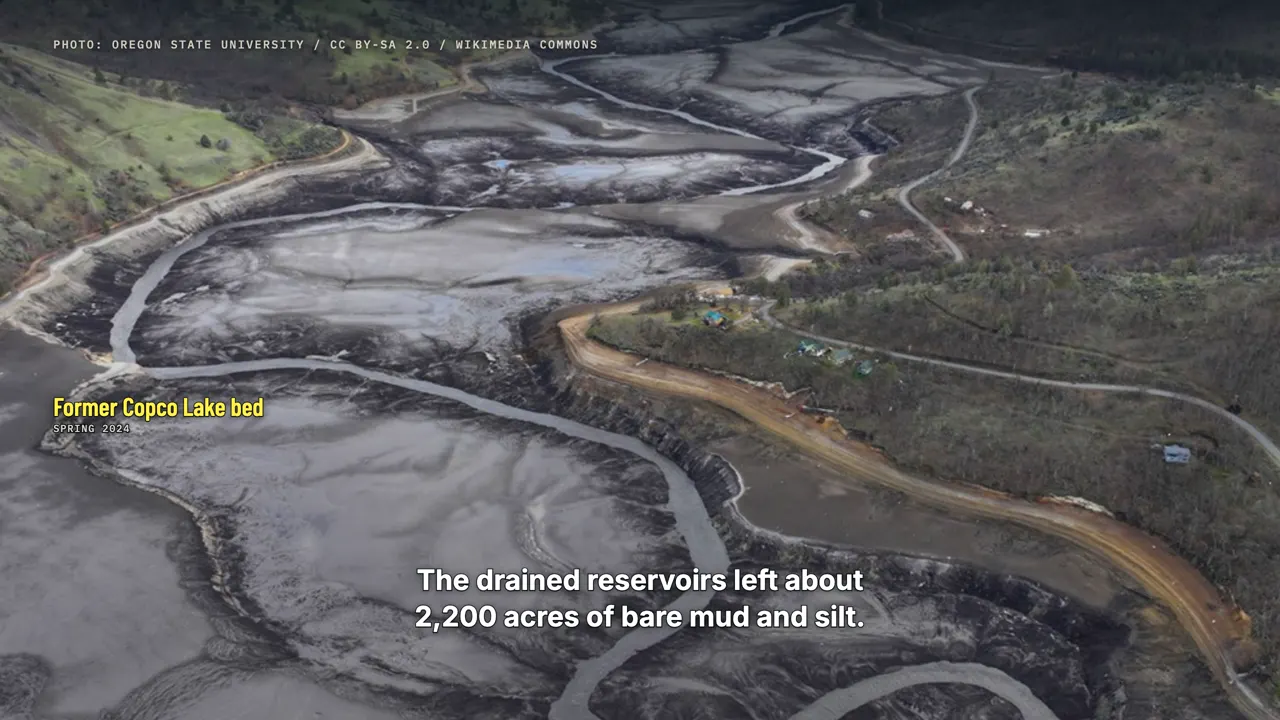
The drained reservoirs left about 2,200 acres of bare mud and silt. Crews had started seeding them with native plants in January 2024, as soon as the water dropped. The Yurok Tribe, which led the replanting with a restoration company,
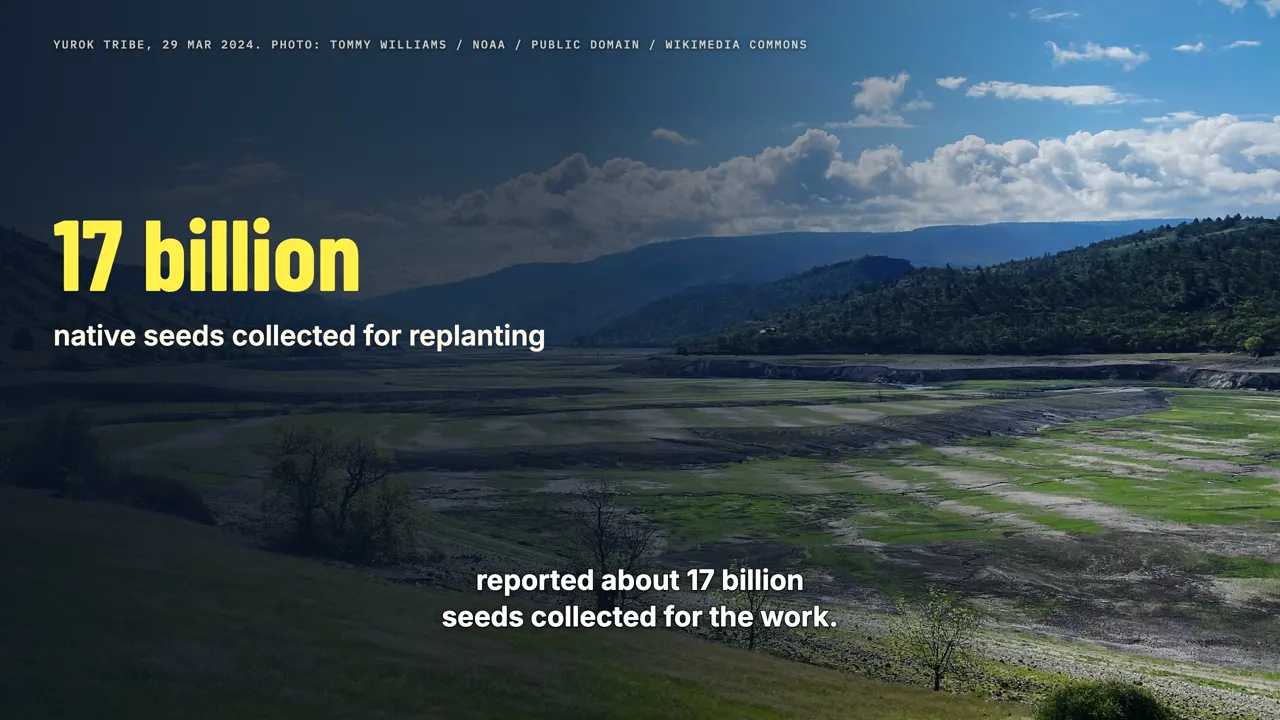
reported about 17 billion seeds collected for the work. The plan used nearly 100 native species, and about 76,000 young trees and shrubs. By spring 2025, NASA satellite images showed green along the new riverbanks where the lakes had been.
The salmon come back
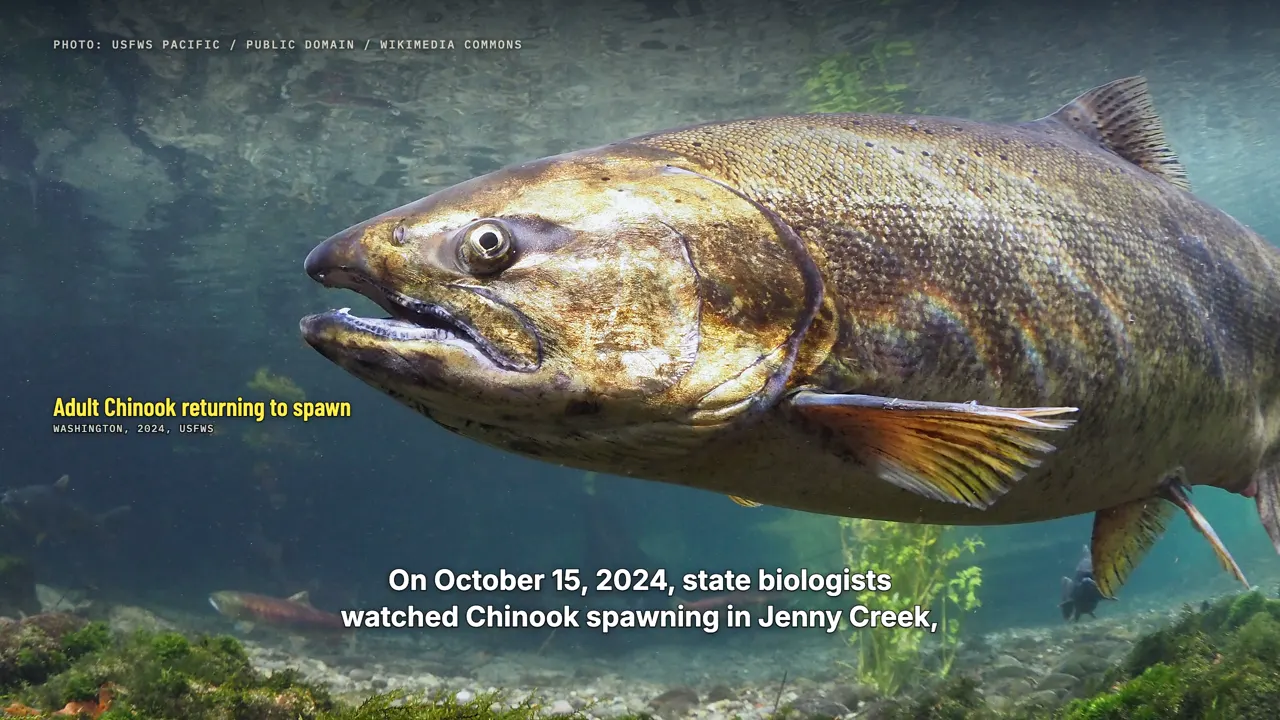
The salmon did not wait for the plants. On October 15, 2024, state biologists watched Chinook spawning in Jenny Creek, a few miles above the old Iron Gate Dam. It was the first time salmon had been seen in a California tributary above Iron Gate since 1961.
The next day, Oregon biologists found a Chinook in a stream above the former J.C. Boyle Dam, about 230 miles from the ocean. It was the first salmon recorded in Oregon's part of the Klamath Basin since 1912. In November, seven coho salmon swam into a hatchery in the upper basin,
the first coho there in more than 60 years. Researchers counted the fish with an underwater sonar camera at the former Iron Gate site. In the fall of 2024 it recorded about 7,700 Chinook heading upstream. In 2025 the count rose to about 13,300.
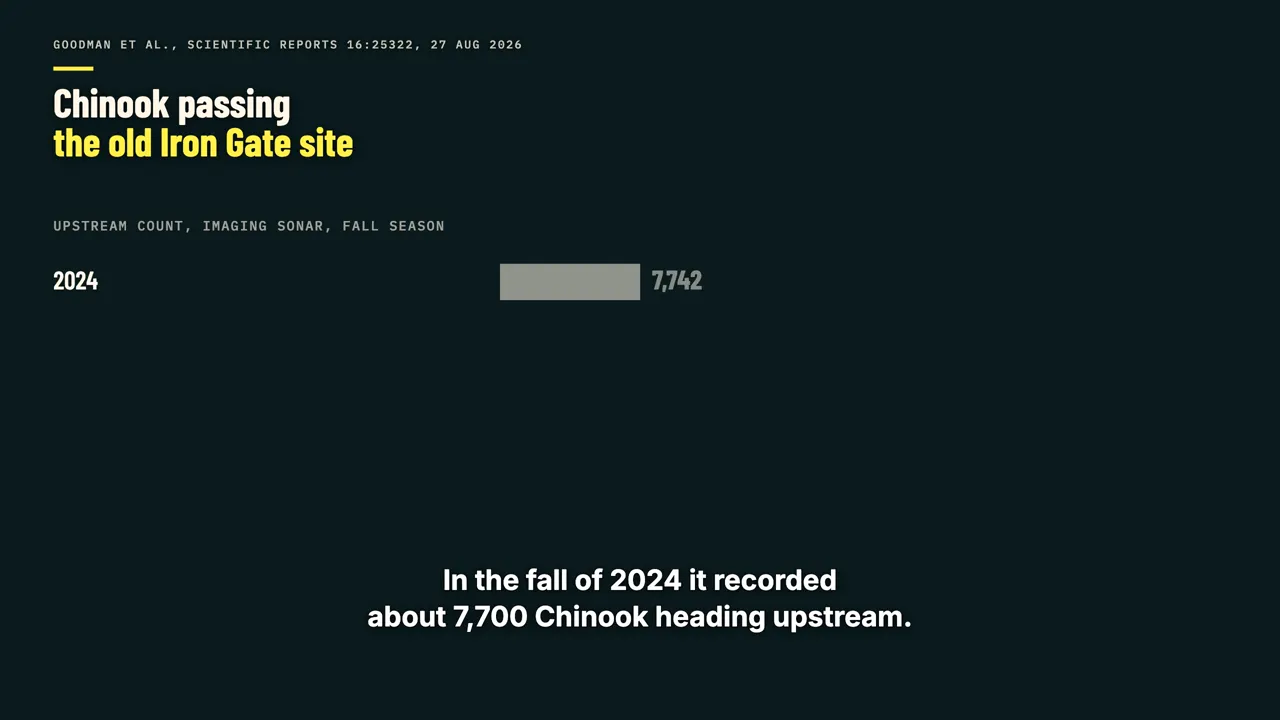
In August 2026, a team of federal, state and tribal scientists published those results in Scientific Reports. Within two migration seasons, they found, Chinook had returned to 88% of their documented historical range above the old dams.
That meant about 345 kilometres of reconnected river and streams, up to 1,250 metres above sea level. The farthest fish found by the study team crossed Upper Klamath Lake and reached the Sprague River, more than 360 river miles from the sea.
A bigger run
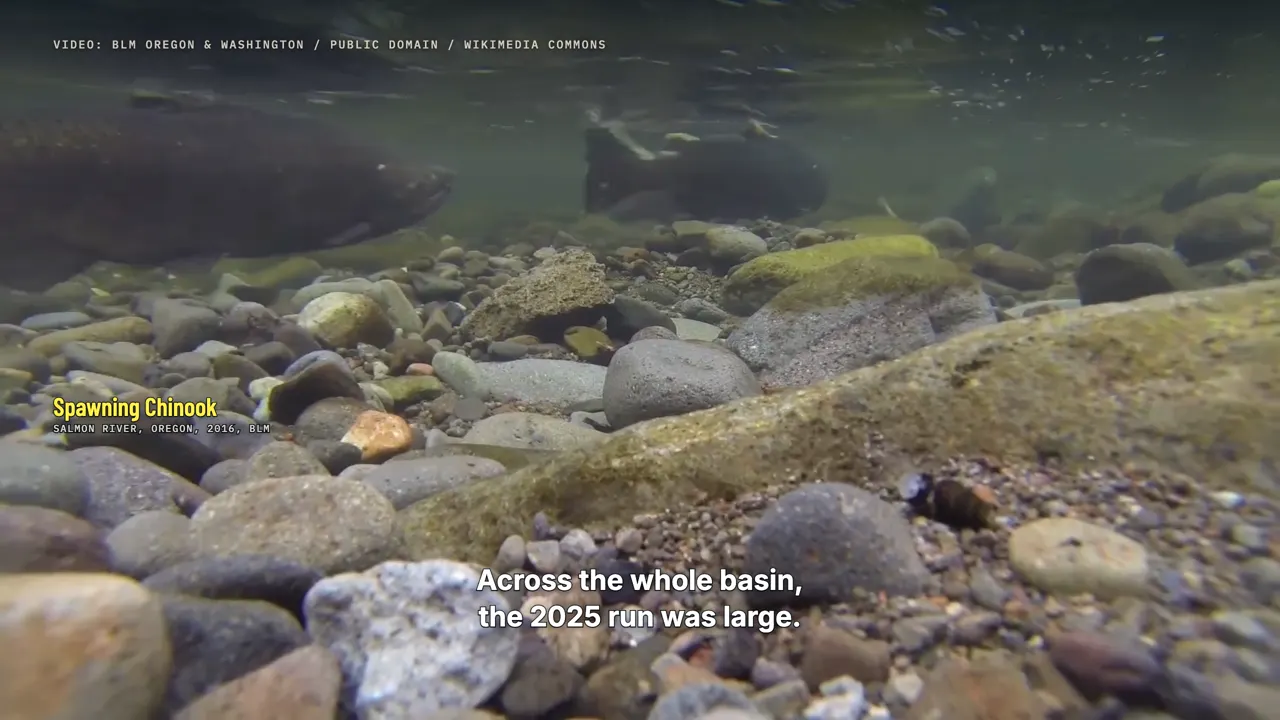
Across the whole basin, the 2025 run was large. Fishery managers estimate that about 39,900 adult Chinook spawned in the wild. Before the season, they had forecast about 19,400, roughly half that. That lifted Klamath fall Chinook off the list of overfished stocks,
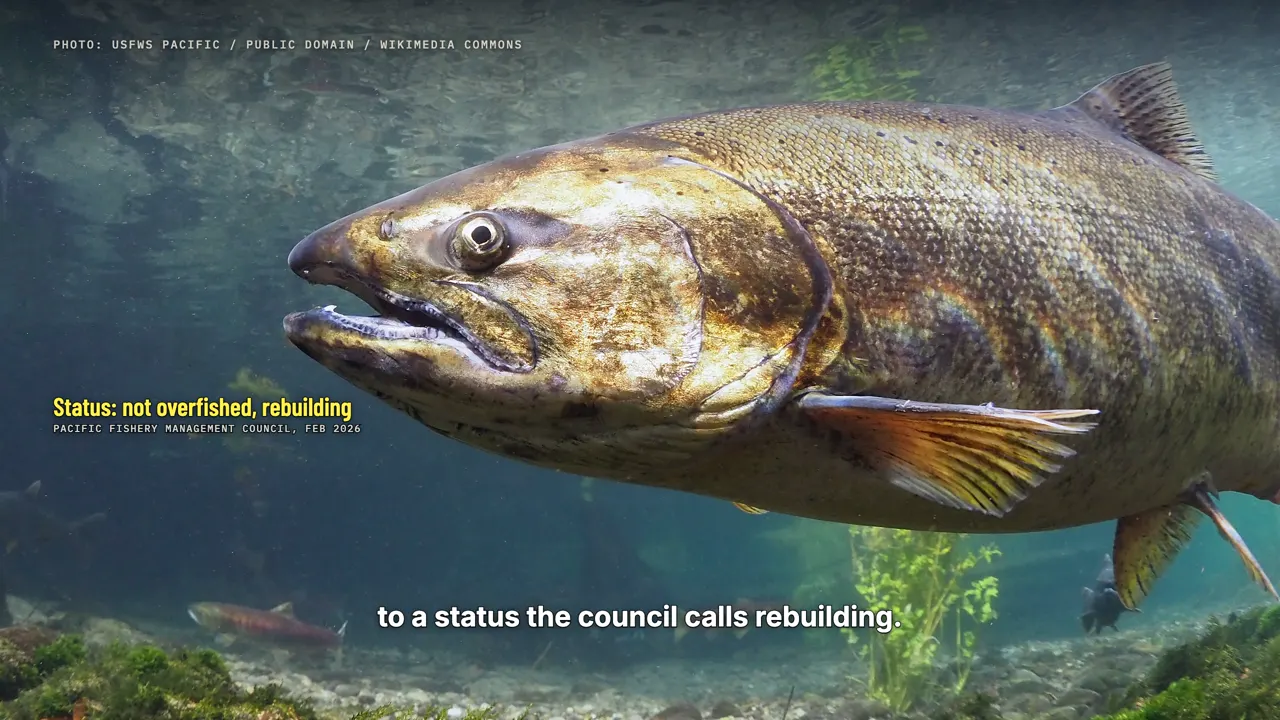
to a status the council calls rebuilding. In Fall Creek, a stream that had been cut off by the dams, snorkel crews counted about 65,000 wild juvenile Chinook in 2025. And in May 2026, salmon fishing reopened on the Klamath after three straight years of closures.
Not only the dams
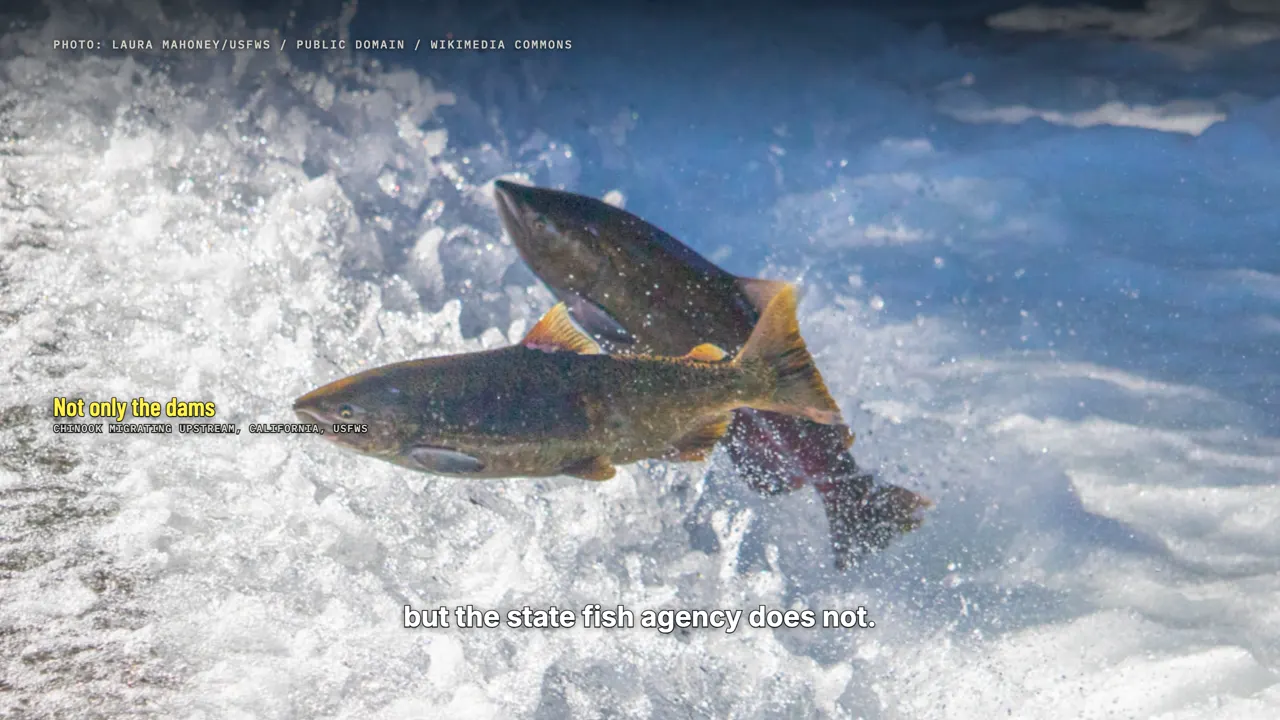
It would be easy to give the dam removal all the credit, but the state fish agency does not. It lists hatchery production, habitat restoration, good water years and fishing closures alongside the dam removal.
A new hatchery on Fall Creek replaced the old one at Iron Gate, and hatchery fish are part of the river's returns. The 88% figure also measures where the fish went, not how many there are or whether they will last. Chinook usually come back to spawn at two to four years old.
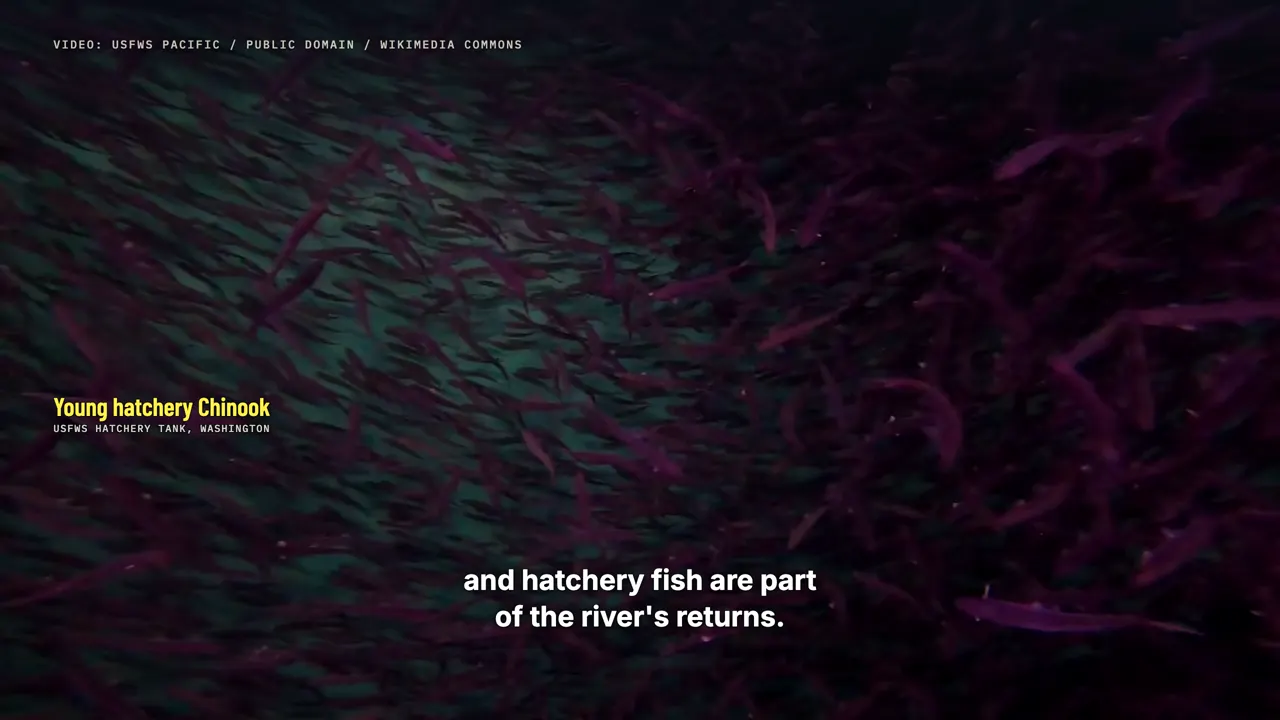
So the first fish hatched in the reopened streams have not finished returning yet.
A hard year
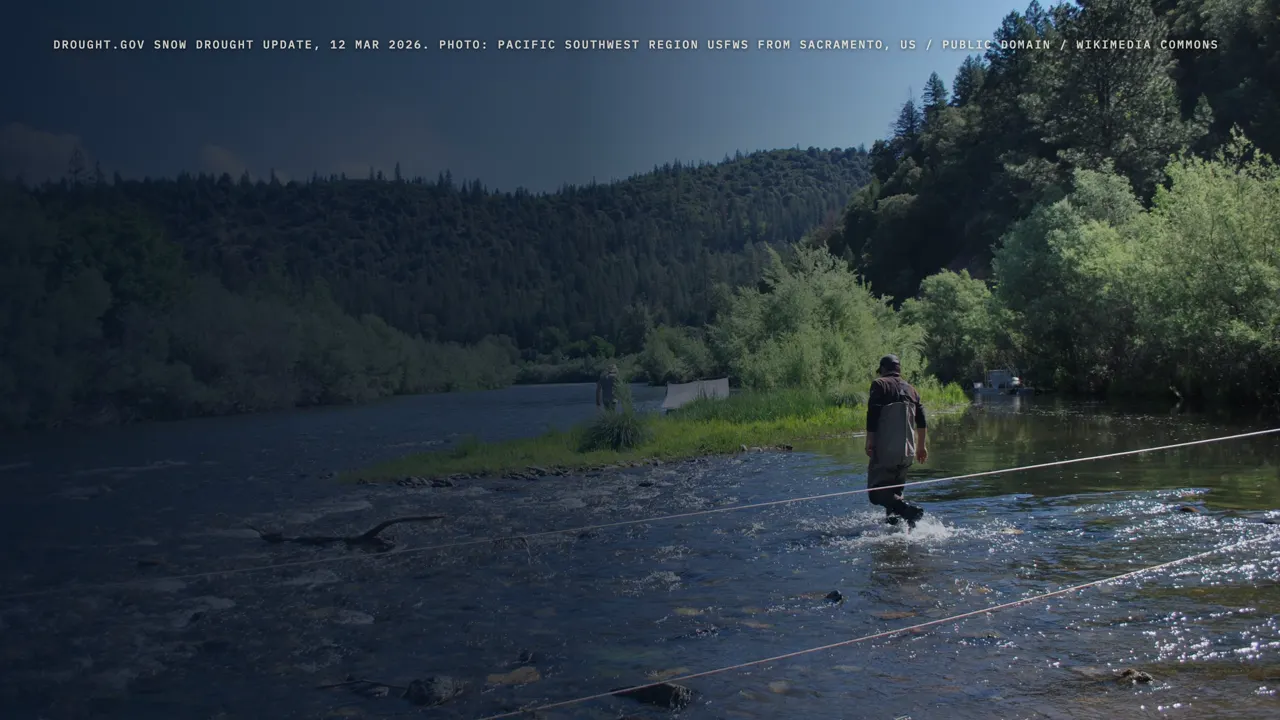
And 2026 has been a hard year. In March, snowpack in the Klamath Basin was at 23% of the median. Low, warm water is the kind of condition linked to outbreaks of a native parasite called Ceratonova shasta, which attacks the gut of young salmon.
Between March and May, the US Fish and Wildlife Service detected the parasite in 46% of the young Chinook it tested. In the same weeks of 2025, the rate had been 22%. In the reach just below the Oregon state line, infection went from zero in early April to
every fish tested two weeks later. About one in five infected fish carried a parasite load associated with death. Many of the dead were hatchery fish released that spring, and wild fall Chinook mostly moved downstream earlier and avoided the worst of it,
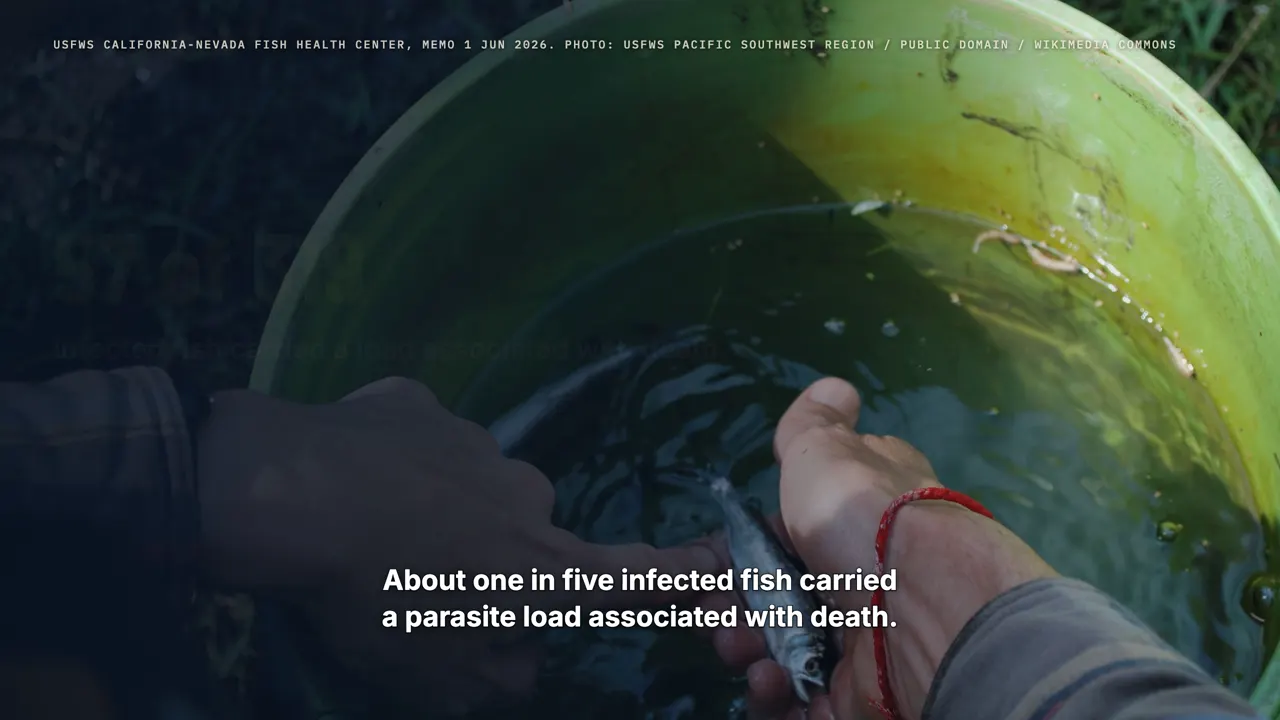
according to reporting by Inside Climate News. The study's lead author put it simply: removing the dams did not remove climate risk. This fall, the count at the Shasta River, a big lower tributary, stood at about 3,500 adults by early October, compared with about 5,700 at the same point
last year, according to state figures reported locally.
What two years can tell us
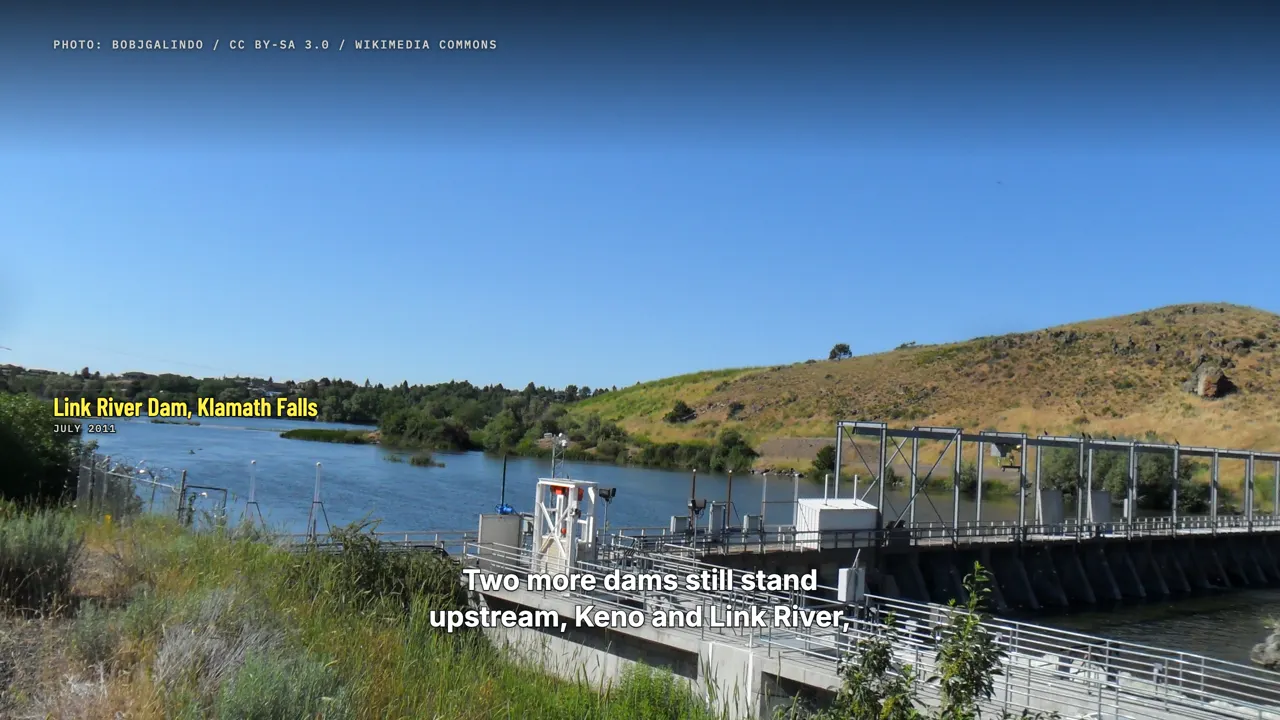
Two more dams still stand upstream, Keno and Link River, run by the federal Bureau of Reclamation. They manage water for a farm irrigation project of more than 240,000 acres, and Keno does not meet current fish passage standards.
NOAA cites models projecting up to 80% more Chinook within 30 years. The scientists behind the new study expect recovery to play out over the next decade, not the next season. What two years can tell us is that the fish were ready.
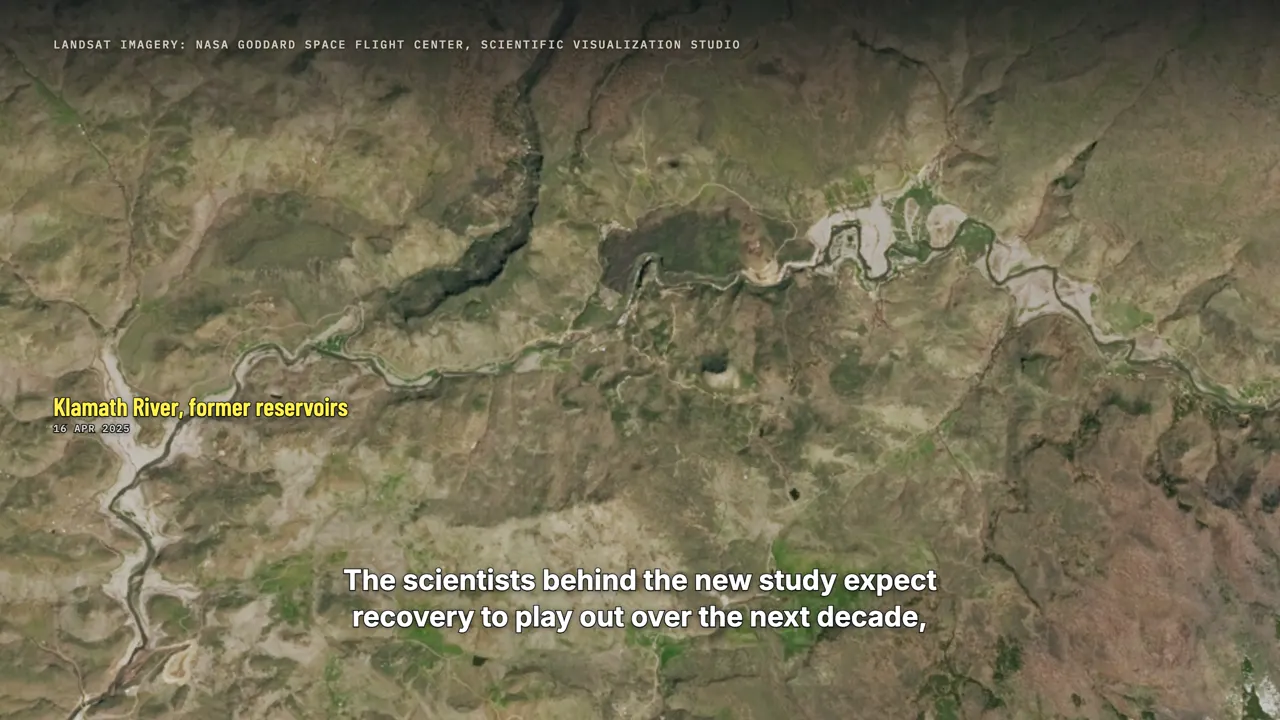
As soon as the river was open, they went back to most of the places the dams had cut off. What two years cannot tell us is whether there will be enough cold water for their young. That answer will come back from the ocean over the next few autumns, one salmon at a time.
Watch on YouTube
Sources
- Goodman et al., "Rewilding the upper Klamath River Basin", Scientific Reports 16:25322 (27 Aug 2026): https://pubs.usgs.gov/publication/70279535
- FERC order approving license surrender and removal, 17 Nov 2022: https://www.opb.org/pdf/Klamath%20Project%20Order_1668750641288.pdf
- Klamath River Renewal Corporation: https://klamathrenewal.org/klamath-dam-removal-comes-to-a-close
- NOAA Fisheries: https://www.fisheries.noaa.gov/feature-story/worlds-biggest-dam-removal-project-open-420-miles-salmon-habitat-fall
- Pacific Fishery Management Council, Review of 2025 Ocean Salmon Fisheries: https://www.pcouncil.org/documents/2026/02/review-of-2025-ocean-salmon-fisheries.pdf/
- CDFW bulletins (18 Oct 2024, 22 Nov 2024, 18 Nov 2025, 12 May 2026); ODFW release, 17 Oct 2024
- USFWS California-Nevada Fish Health Center, C. shasta update, 1 Jun 2026: https://www.fws.gov/sites/default/files/documents/2026-06/c-shasta-update-6-1-2026.pdf
- California Department of Fish and Game, September 2002 Klamath River fish-kill final analysis (2004)
- USGS EROS Earthshots; Yurok Tribe revegetation report (Mar 2024); Inside Climate News (27 Aug 2026); Siskiyou News (13 Oct 2026)
- Imagery
- Landsat time series: NASA Goddard Space Flight Center Scientific Visualization Studio (https://svs.gsfc.nasa.gov/15027)
- Video: Bureau of Land Management Oregon & Washington; USFWS Pacific (public domain)
- Photos via Wikimedia Commons: Lee Juillerat (Public domain); Oregon State University (CC BY-SA 2.0); Bob Pagliuco / NOAA Office of Habitat Conservation (Public domain); KMashian (CC0); USGS (Public domain); Tommy Williams / NOAA (Public domain); Internet Archive Book Images (No restrictions); USFWS Mountain Prairie (Public domain); USFWS Pacific (Public domain); USFWS Pacific Southwest Region (Public domain); BLM Oregon & Washington (Public domain); Pacific Southwest Region USFWS (Public domain); California Water Science Center, U.S. Geological Survey (Public domain); Patrick McCully (CC BY 2.0); Daderot (CC0); Bobjgalindo (CC BY-SA 4.0); Daniel Wade (CC BY-SA 3.0); Robert Ashworth from Bellingham, WA., USA (CC BY 2.0); Bobjgalindo (CC BY-SA 3.0)
- Narration is a synthetic voice.