Internet Cables Break 150+ Times a Year. What Breaks Them?

Is the internet under the ocean? Between continents, almost all of it is. This video follows the cables that carry it: the 1858 Atlantic telegraph that needed about sixteen hours for a 98-word message and failed within weeks, William Thomson's law of squares, the Great Eastern hauling a lost cable up from the sea floor in 1866, Charles Kao's glass fibers, the amplifiers placed about every 70 km, and Meta's planned Petal cable, designed for one petabit per second. Then what actually breaks cables (mostly fishing gear and ship anchors, not sharks), what investigators and courts have said about the Baltic, Red Sea and Taiwan incidents since 2024, and how repair ships still hook a broken cable from the bottom.
This article is the full narration of the video. Watch on YouTube
Is the internet under the ocean?
Is the internet under the ocean? Yes. Almost all of it, at least between continents. When you stream a video from another continent, the data almost certainly crossed the sea floor, not the sky. So the next question people ask makes sense: how do they lay internet cable across the ocean?
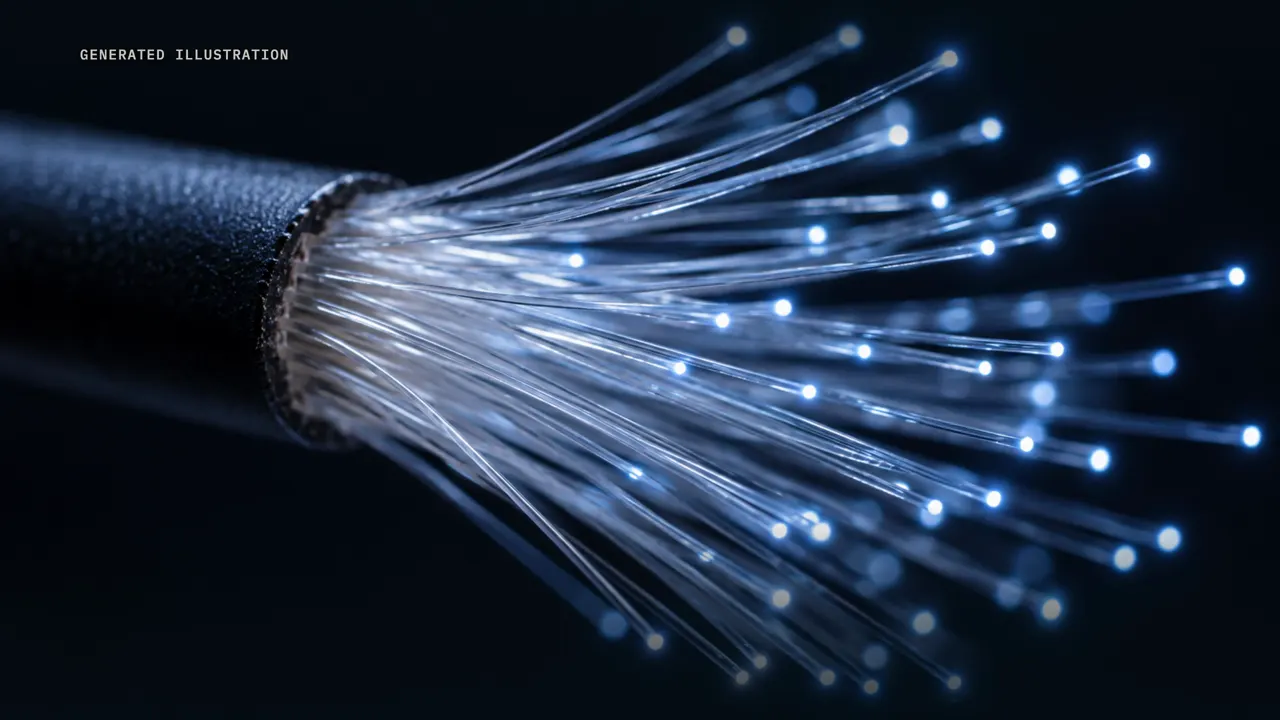
TeleGeography, a research firm that maps this network, counts more than 600 active and planned cables. The cables already in service run for more than 1.5 million kilometers. In the deep ocean, a cable like that is about as thick as a garden hose. The glass fibers inside, which carry your data, are about as thin as a human hair.
In September 2026, Meta announced a cable designed to carry one petabit per second across the Atlantic. That's a thousand terabits, every second, through one cable. The first cable across the Atlantic took almost sixteen hours to deliver a 98-word message. This is the story of how we got from one to the other.
It runs through a famous failure, a stubborn physicist, a giant ship, and a lot of fishing boats. And along the way, we'll check some things almost everyone believes about these cables, including the one about sharks.
1858: ninety-eight words in sixteen hours
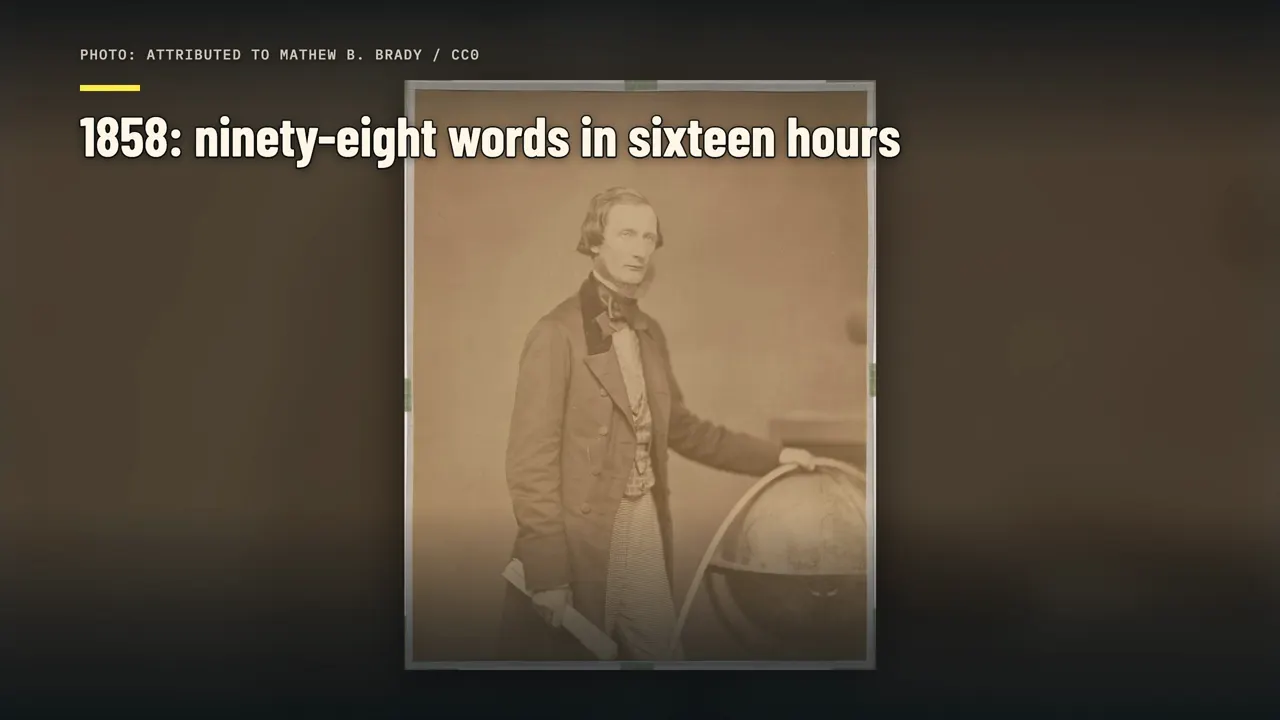
In the 1850s, an American businessman named Cyrus Field set out to wire Europe to North America. In the summer of 1858, two ships, the Agamemnon and the Niagara, joined the cable's halves in mid-ocean, then steamed toward Ireland and Newfoundland. One end reached Trinity Bay, Newfoundland, on August 4, and the other reached Valentia, Ireland, on August 5.
The cable was about 3,200 kilometers long. On August 16, the line officially opened with greetings between Queen Victoria and President James Buchanan. According to the IET archive, the first official message began: "Europe and America are united by telegraphic communication." The Queen's greeting was 98 words long.
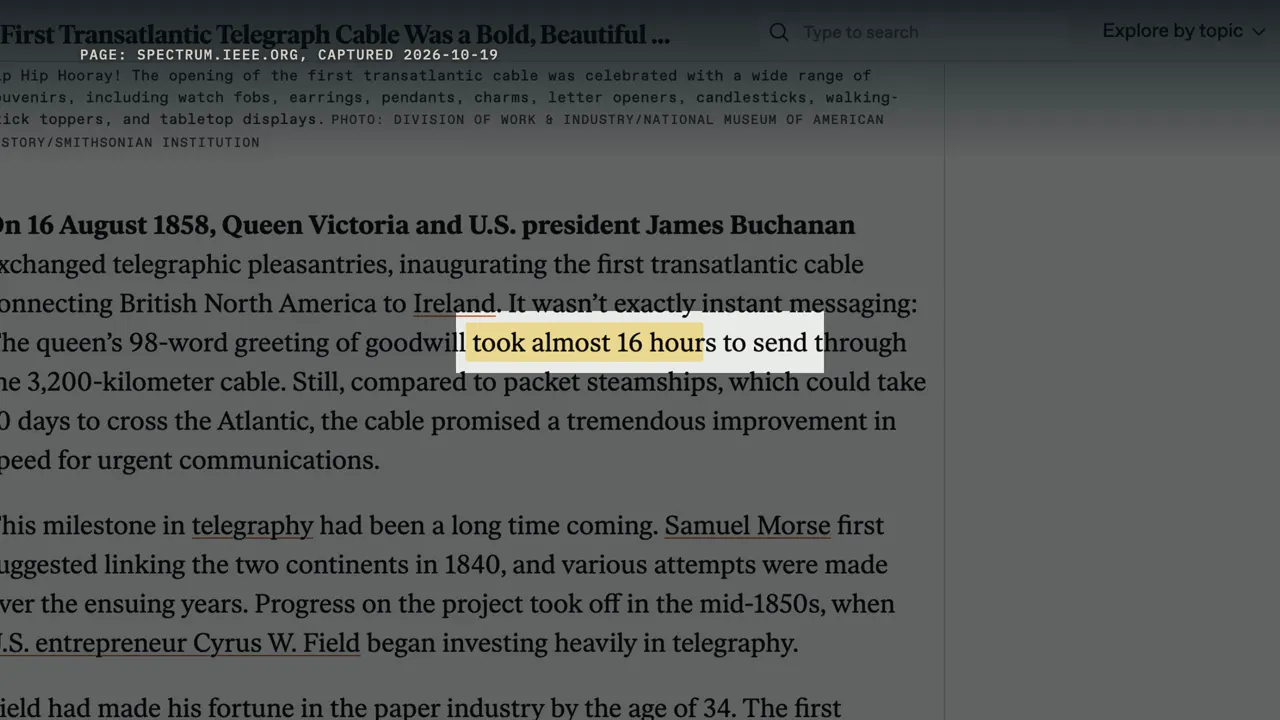
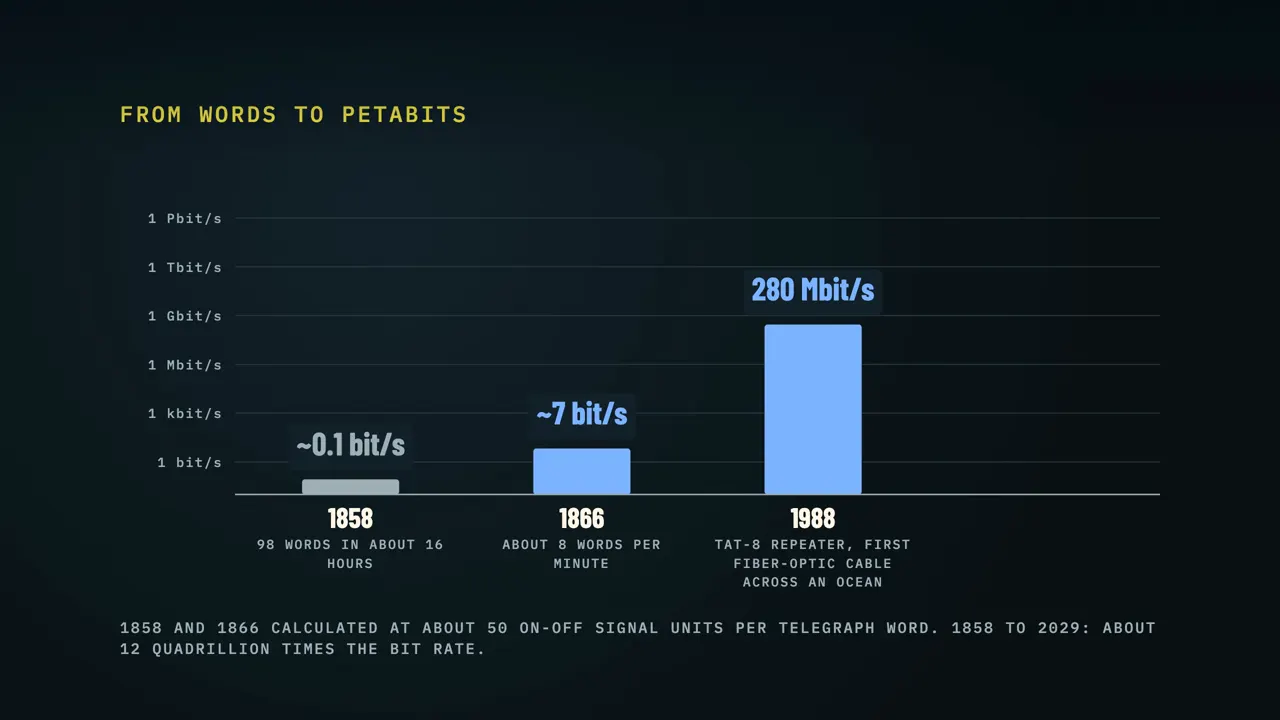
By IEEE Spectrum's account, it took almost sixteen hours to send that message. One historian says sixteen and a half hours. Buchanan's reply, 143 words, took about ten hours. But a London newspaper at the time, The Leader, reported that the Queen's message reached Newfoundland in sixty-seven minutes.
An eyewitness account published in 1859 says those sixty-seven minutes covered a repeat, sent back to Ireland to check the message. People celebrated anyway, on both sides of the Atlantic. But within a few weeks, reliable communication had broken down, though occasional words still came through as late as October. To see why, we need to look at what electricity does inside a very long wire.
The physicist and the voltage

The cable's problem had been predicted years earlier by a Glasgow professor, William Thomson. Later, he would become Lord Kelvin. A long cable under seawater acts a bit like a long, stretched-out capacitor. That stretches each electrical pulse out, so the sharp signals sent from shore arrive blurred.
Thomson worked out that this delay grows with the square of the cable's length. His own example: a 200-mile cable might delay a signal by a tenth of a second. Make it 2,000 miles, and the delay grows to about ten seconds. Ten times longer, a hundred times slower.
So the fix was not more force, but a better cable and a more sensitive receiver. Thomson argued for a thicker copper core and more insulation, but the cable had already been ordered. The company's chief electrician, Wildman Whitehouse, disputed Thomson's law of squares. Whitehouse used induction coils, 36 inches long, to push the signal harder.
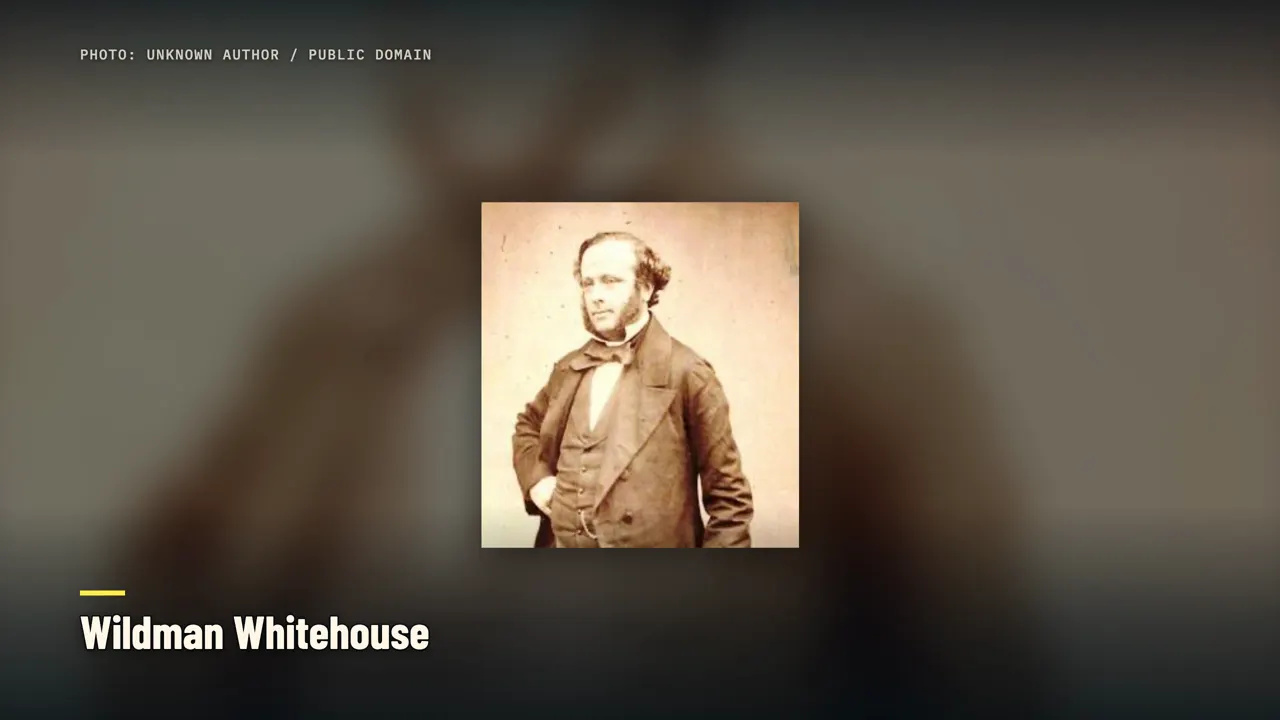
Later accounts describe them as producing thousands of volts. On August 17, 1858, the company's board dismissed Whitehouse. Thomson's mirror galvanometer, which could detect a very weak current, took over at both ends. But the insulation was already damaged.
Steady messages lasted until about the 23rd day after the cable landed. An early history records the cable's final word on October 20, 1858. Hundreds of messages got through before the line faded. So the popular line that it "died after three weeks" roughly describes its useful working life, while occasional words kept coming into October.
The lesson stuck: on a cable this long, physics sets the speed limit, not willpower.
1866: the Great Eastern

The next serious attempt needed a ship big enough to carry a whole ocean's worth of cable. That ship was the Great Eastern, a giant steamship. In 1865, it paid out about 1,200 miles of cable before the cable snapped. The crew marked the spot with a buoy and went home.
In 1866 they tried again, and on July 27 the Great Eastern landed its cable at Heart's Content, Newfoundland. Then the crew did something remarkable. They went back to the 1865 cable, still lying on the sea floor. They lowered grappling hooks, dragged them across the bottom, and hauled the lost cable up.
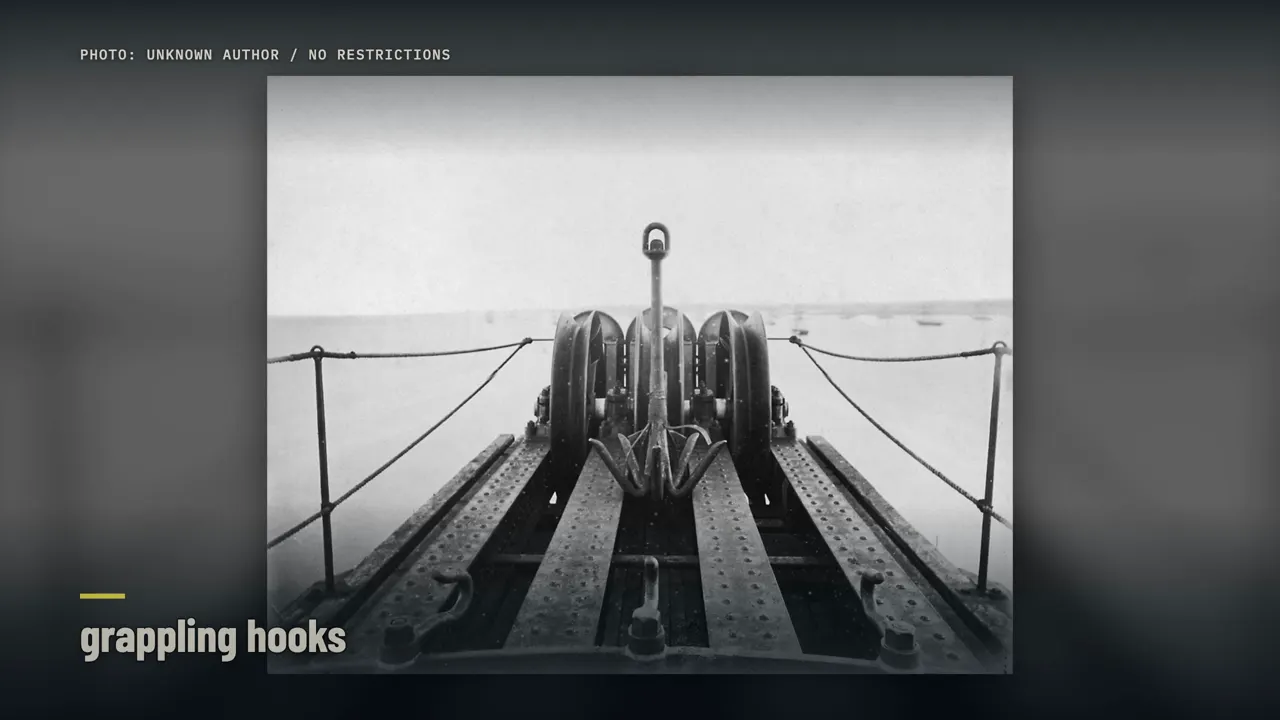
They spliced on new cable and landed it on September 7, so the Atlantic now had two working lines. The new cables could send about eight words a minute. Compare that with sixteen hours for 98 words in 1858. Thomson was knighted for his part in the success.
And that 1866 method is still how repairs work today: hook the cable from the bottom, lift it, and splice it.
From copper to glass
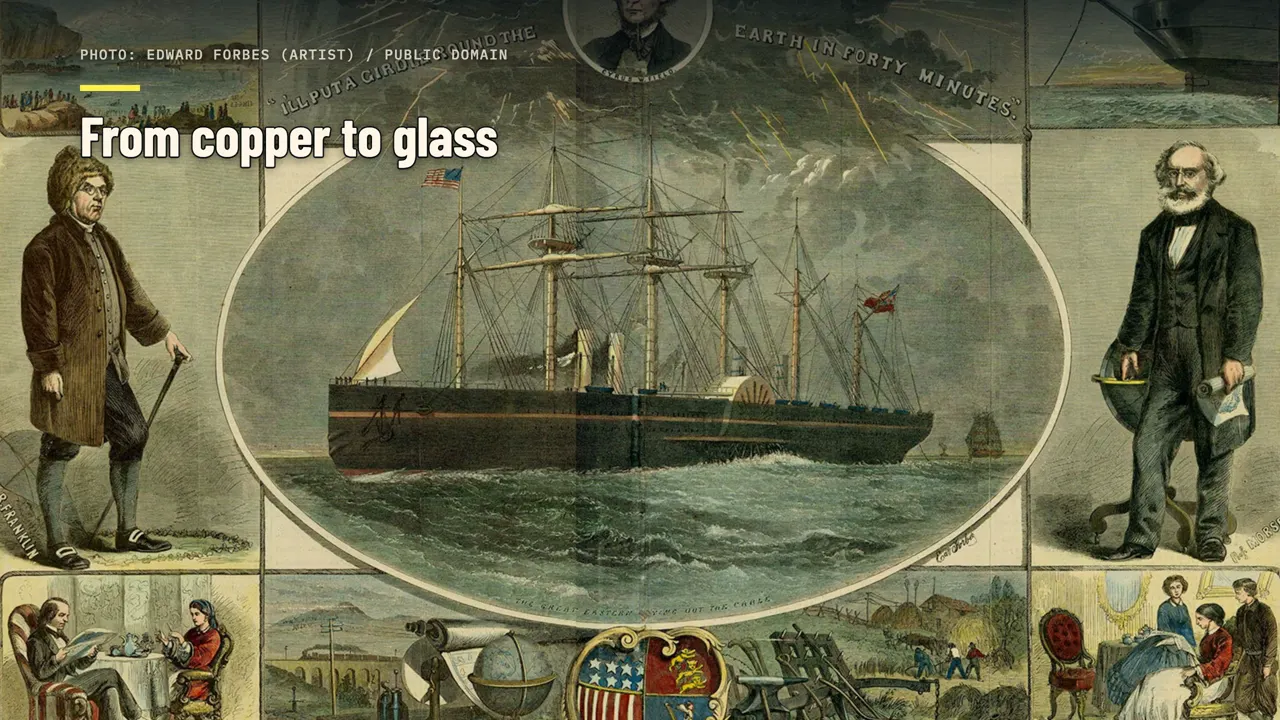
For more than a century, ocean cables carried messages as electrical signals. Then the job moved to light. In 1966, the engineer Charles Kao worked out how glass fibers could carry light over long distances. In the fibers available in the 1960s, light faded after only about 20 meters.
Kao argued that with pure enough glass, light could travel more than 100 kilometers. He shared the 2009 Nobel Prize in Physics for that work. In December 1988, TAT-8 became the first fiber-optic cable to cross an ocean. It ran 5,846 kilometers across the Atlantic and could carry 40,000 telephone calls at once.
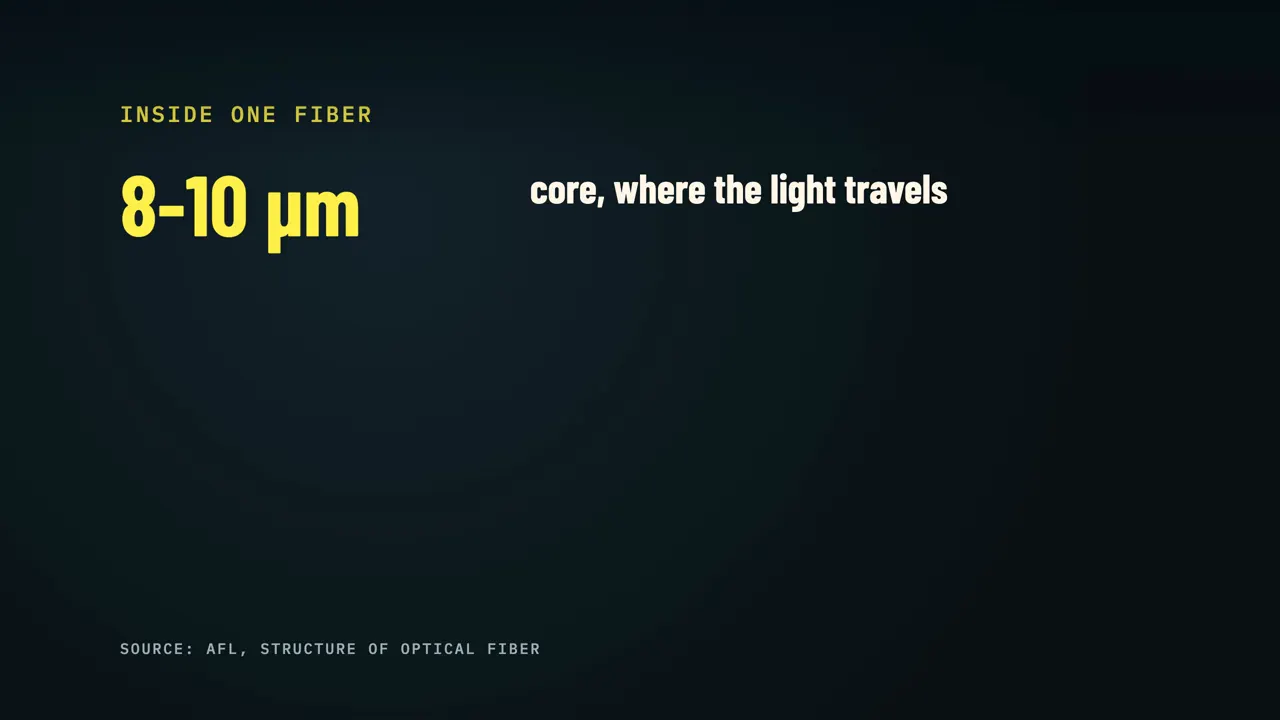
In a typical single-mode fiber, the light travels in a core only about 8 to 10 micrometers wide. Around the core is another layer of glass called cladding, 125 micrometers across. And ocean fiber can lose remarkably little light. In 2017, Sumitomo Electric reported a record low loss of 0.1419 decibels per kilometer.
Light in glass is not as fast as light in a vacuum, though. It moves at roughly two thirds of that speed, so every kilometer of fiber costs about five microseconds. Over 7,000 kilometers, that's about 35 milliseconds one way, and about 70 milliseconds for a round trip, on the fiber alone.
An amplifier every seventy kilometers
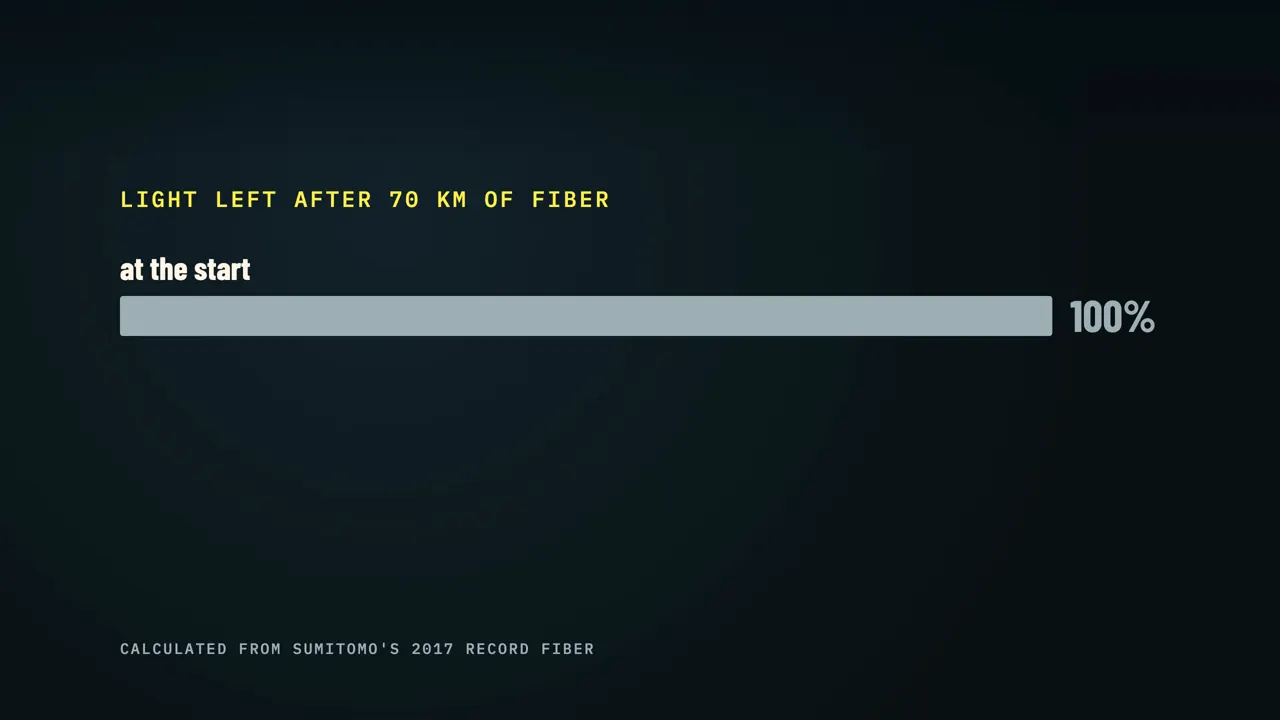
Even record-low loss adds up. At 0.14 decibels per kilometer, after 70 kilometers only about a tenth of the light is left. So long cables boost the light along the way, every 50 to 100 kilometers. In 1987, teams at Bell Labs and the University of Southampton published the first papers on a better way.
It's called the erbium-doped fiber amplifier, or EDFA. A short piece of fiber laced with the element erbium is energized by a pump laser. When the weak signal passes through, it comes out stronger, still as light. It can boost many channels within the same wavelength band at once, so a single fiber can carry many separate signals.
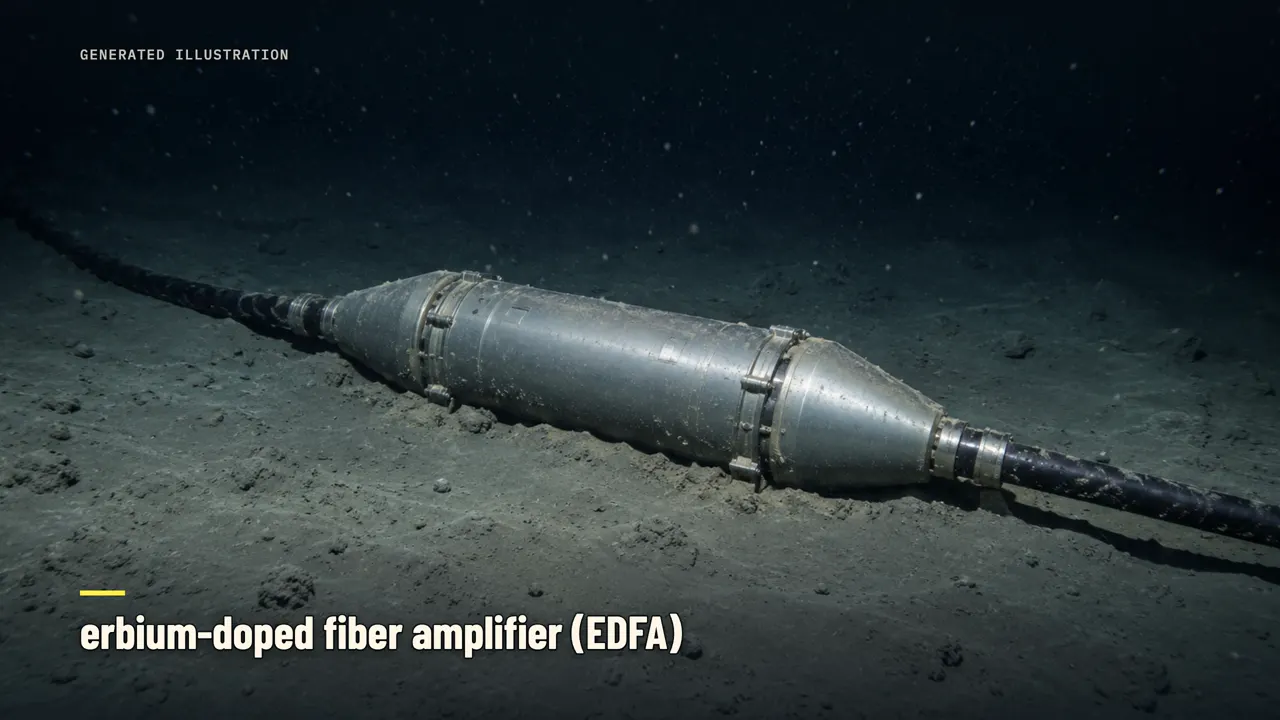
According to the prize that honored this work, intercontinental capacity without EDFAs would be stuck around 40 to 100 gigabits per second. With them, the same prize summary puts a single fiber at about 200 terabits per second. Meta says a 7,000-kilometer cable typically needs about a hundred of these repeaters. That works out to roughly one every 70 kilometers, sitting on the sea floor.
They need electricity, which is fed down the cable from the shore, with equipment rated up to 18 kilovolts. And that power limit is where the newest design idea comes from.
More fibers, not brighter light: SDM and Petal

If you can't send more power down the cable, you can't keep pushing each fiber harder. So engineers flipped the approach: use more fibers, and run each one a little more gently. This is called space-division multiplexing, or SDM. Google's Dunant cable, opened in 2021, was the first long-haul cable built around 12 fiber pairs in this way.
Its fiber pairs share pump lasers, and its capacity is 250 terabits per second. Meta's Marea cable has 8 fiber pairs, and its Anjana cable has 24, for about half a petabit per second. Petal, announced in September 2026, goes one step further. It will run about 7,000 kilometers between the United States and France.
It also has 24 fiber pairs, but each fiber has two light-carrying cores instead of one. Meta says that makes it equivalent to 48 fiber pairs. The glass still measures 125 micrometers across, the same as before. The hard part is stopping the two cores from leaking into each other, and Meta describes the remaining crosstalk as nearly immeasurable.
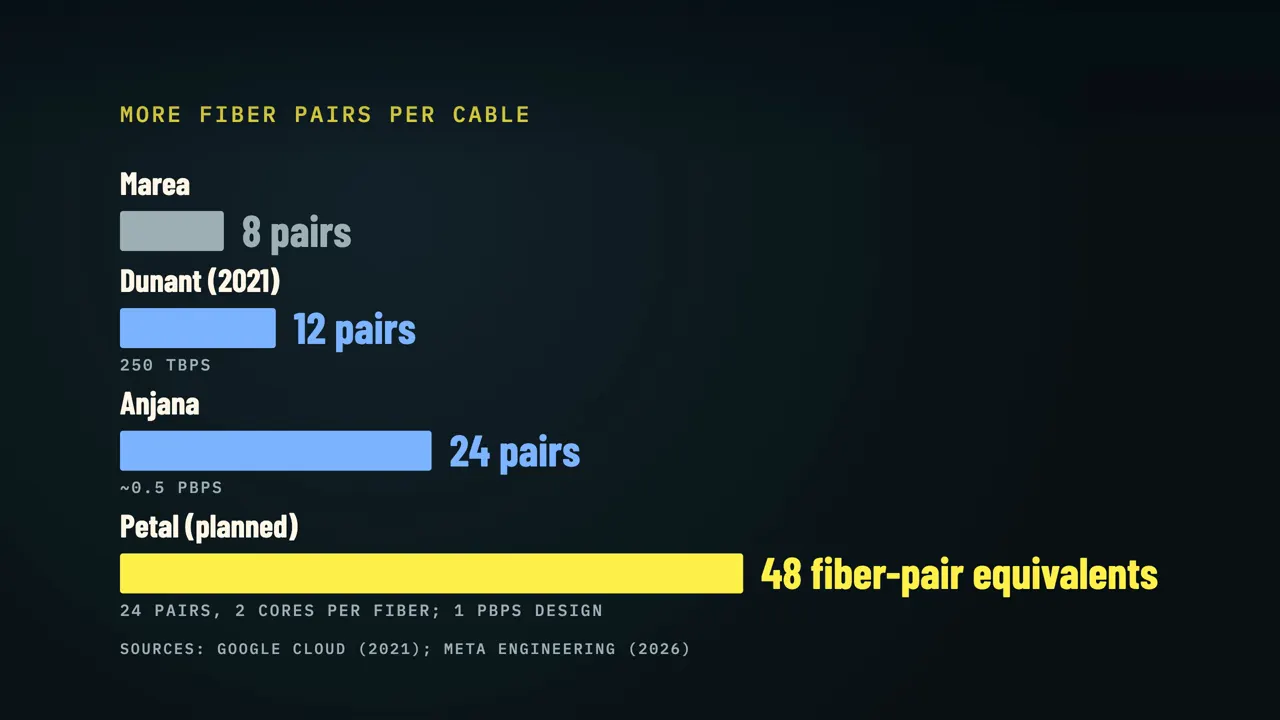
It's designed for one petabit per second and is expected to enter service in 2029. That's a design target for a planned system, not a measured result. Why build so much capacity? TeleGeography estimates that used international bandwidth passed 6.4 petabits per second in 2024.
Its growth has slowed, from 45 percent a year in 2020 to 29 percent in 2024, but it's still growing. In 2024, content and cloud companies like Google and Meta accounted for almost three quarters of used international bandwidth.
Is it really 99 percent?
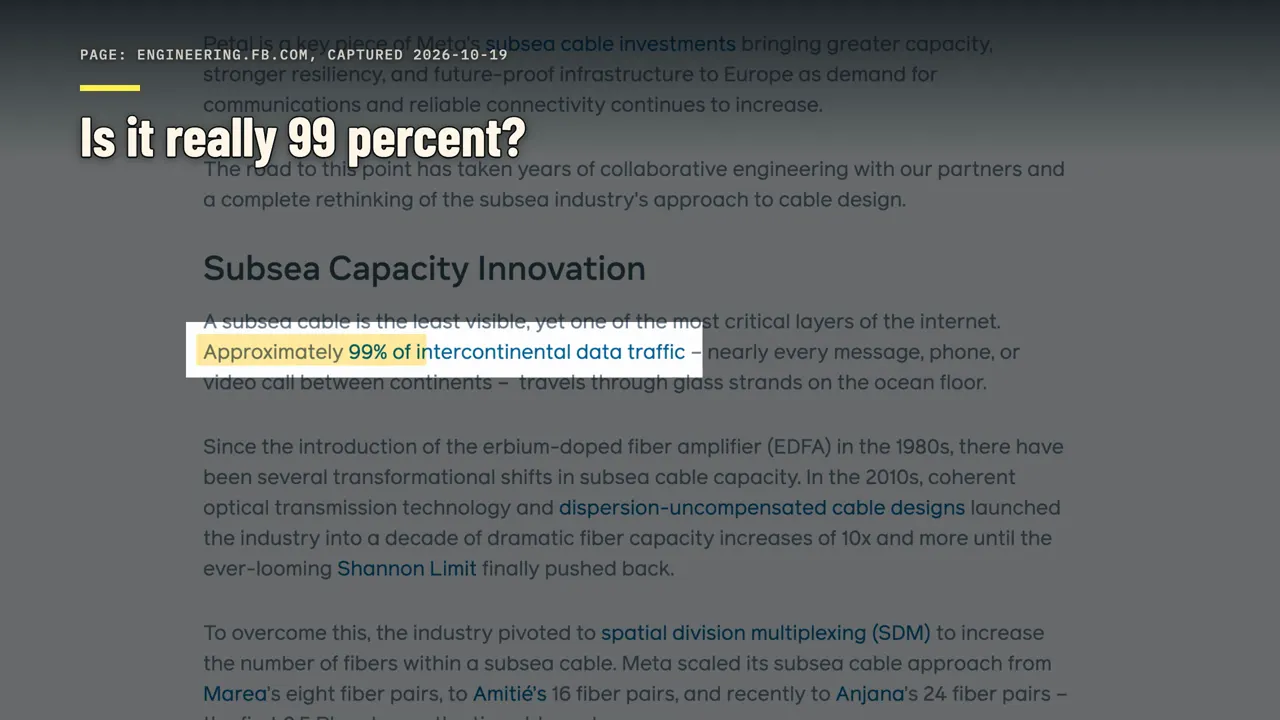
You'll often hear that cables carry about 99 percent of intercontinental data. Meta's announcement cites the International Telecommunication Union for that figure. TeleGeography says, "We can confirm that this is true." But it adds that precise calculations aren't possible, because there's no data on intercontinental satellite traffic.
The most-quoted number behind it is old: in 2013, satellites carried just 0.37 percent of US international capacity. So "99 percent" is a strong, well-supported estimate, not a precise measurement. What about Starlink? In 2019, TeleGeography estimated SpaceX's planned network could reach a theoretical maximum of nearly 24 terabits per second.
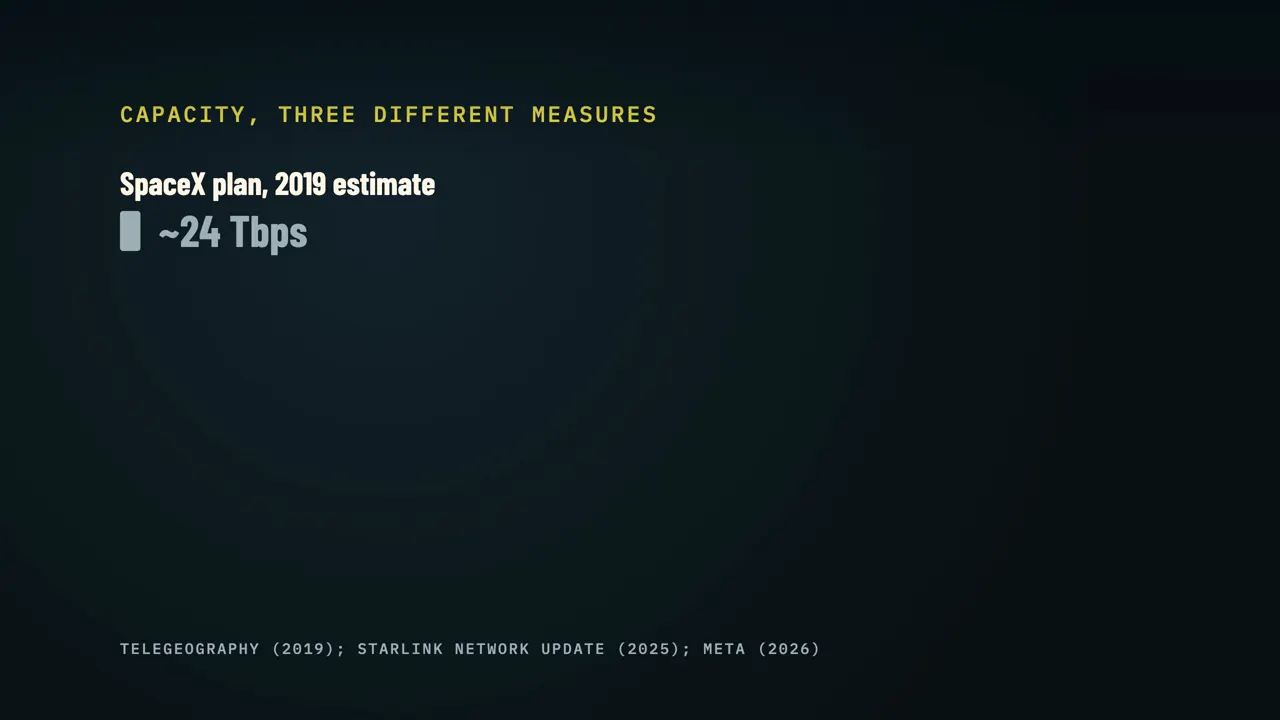
That was slightly less than one fiber pair on the Marea cable. In July 2025, Starlink said it had launched about 450 terabits per second of capacity in total. On paper, that's less than half of Petal's planned capacity, though the two numbers measure different things. And they do different jobs: Starlink connects customers across wide areas, while Petal is designed to carry traffic between two continents.
Distance matters too: for a geostationary satellite, one trip up and back down takes about 240 milliseconds, even at the speed of light. Between continents, the heavy lifting is done on the sea floor.
What actually breaks cables
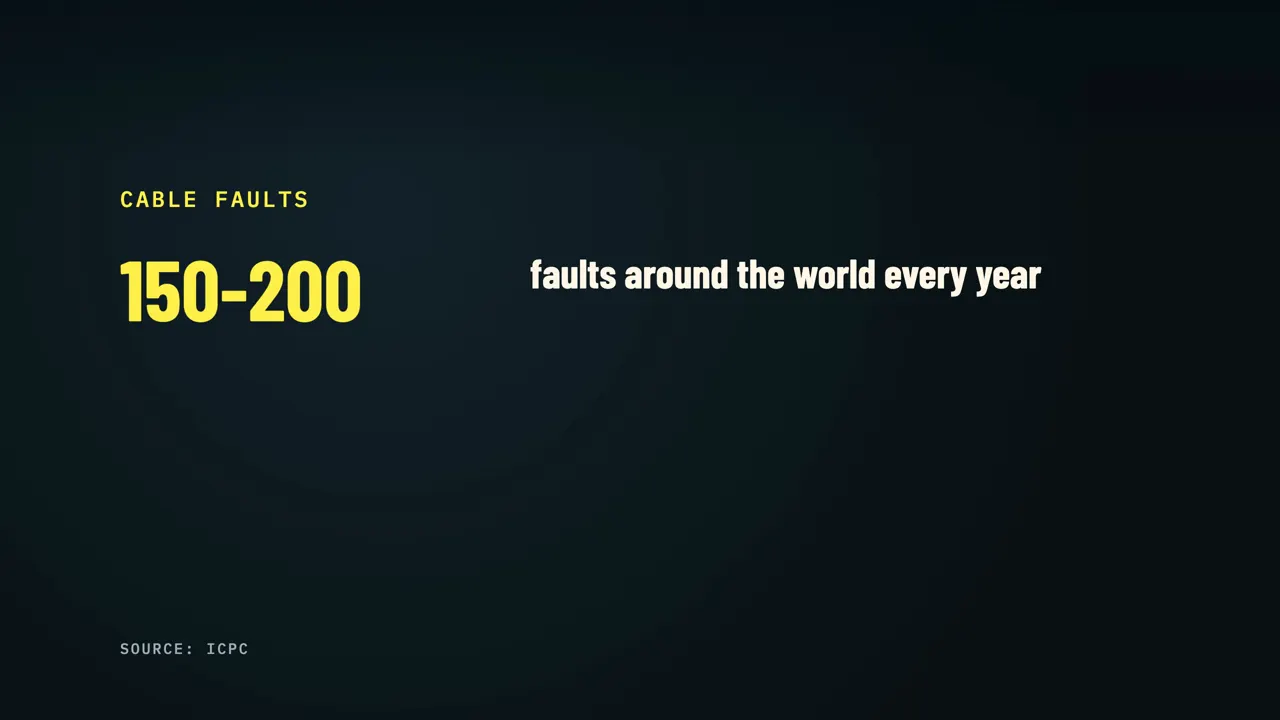
Cables break more often than most people think. The International Cable Protection Committee, or ICPC, says there are on average 150 to 200 faults around the world every year. The ICPC attributes about 70 to 80 percent of them to accidental human activity, mainly fishing and ships' anchors. TeleGeography puts accidents like these at about two thirds.
Bottom trawling and anchoring together cause most cable faults. In shallow water, steel armor can bring the cable's diameter to 40 or 50 millimeters, and the cable is often buried. Out in the deep ocean, far below fishing gear, they're thinner, about 17 to 21 millimeters. A 2009 report by the ICPC and the United Nations put natural hazards at less than 10 percent of all faults.
For faults deeper than about 1,500 meters, that report put the natural-hazard share at around 30 percent. The most famous natural break happened in 1929. On November 18, a magnitude 7.2 earthquake struck about 250 kilometers south of Newfoundland, under the Grand Banks. Twelve transatlantic cables were broken.
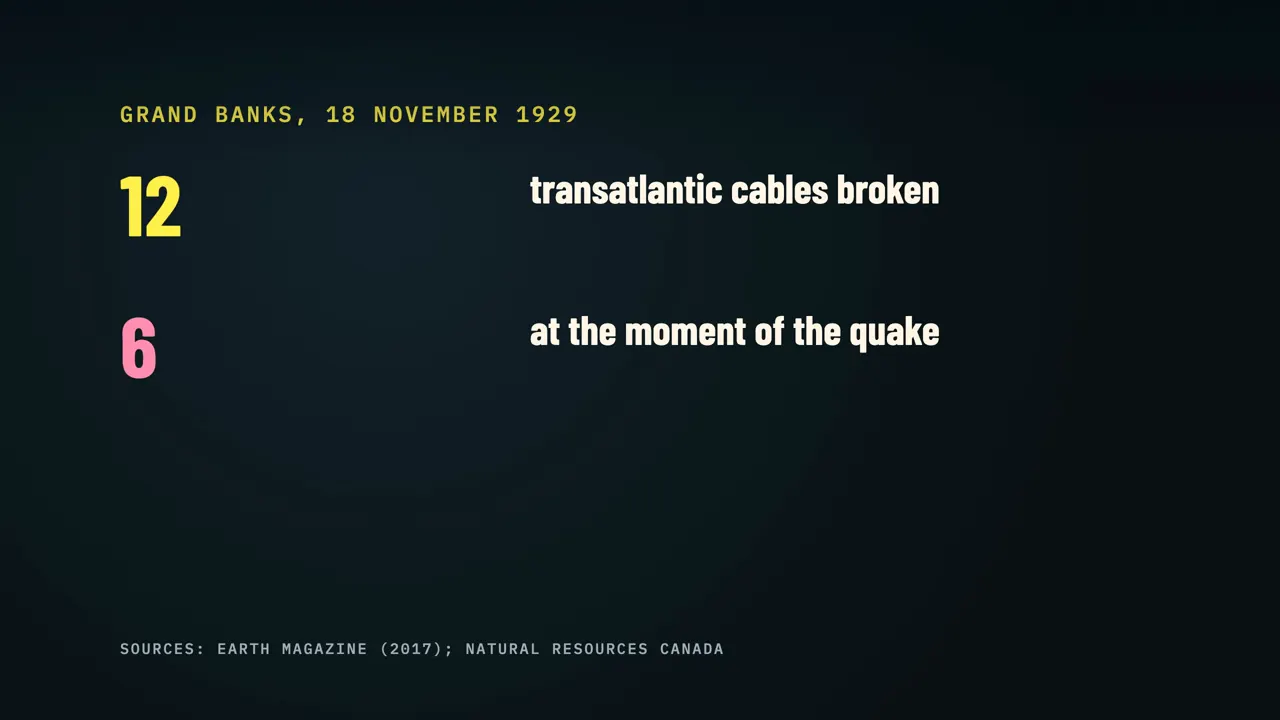
Six broke at the moment of the quake. The other six broke one after another over 13 hours and 17 minutes, along nearly 500 kilometers of sea floor. The tsunami drowned 27 people on Newfoundland's Burin Peninsula, and an injured child died years later, bringing the toll to 28. For years, existing explanations failed to account for the slow sequence of breaks.
In 1952, the geologists Bruce Heezen and Maurice Ewing used the exact times of the breaks to solve it. The quake had set off an underwater avalanche of mud and sand, called a turbidity current. By working out where and when each cable snapped, they could estimate its speed: roughly 60 to 100 kilometers per hour. The broken cables had become a measuring instrument, timing an event no one could see.
It happened again in 2006, off southern Taiwan. On December 26, a magnitude 7.0 earthquake near Pingtung broke nine fiber-optic cables. Later research counted 22 cable breaks, caused by sediment flows moving at about 20 to 45 kilometers per hour. Fixing everything took 11 repair ships and 49 days.
Do sharks really bite internet cables?
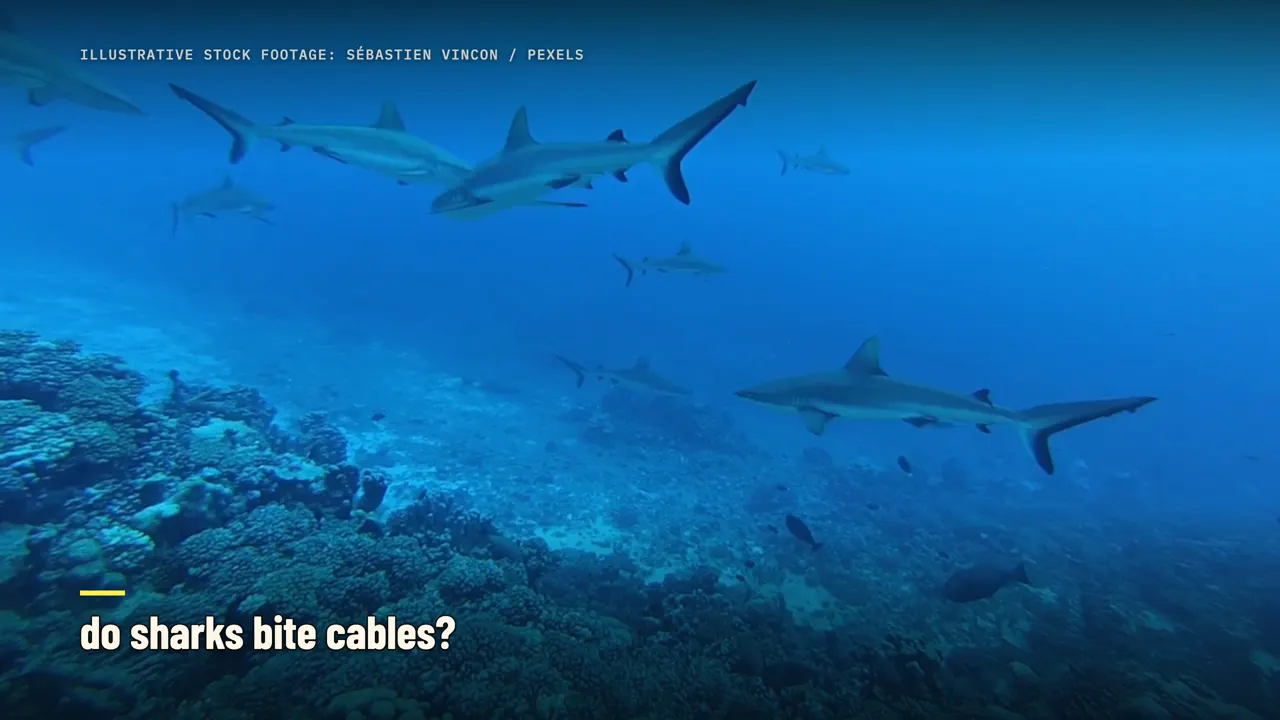
Do sharks really bite internet cables? Sometimes, yes. The first deep-ocean fiber-optic cable, laid off the Canary Islands, failed four times because of shark bites. Those bites came at depths of 1,060 to 1,900 meters.
But across the whole record, it's rare. From 1959 to 2006, fish bites caused about half a percent of all cable faults. And the ICPC found no shark-caused faults at all in its analysis of 2007 through 2014. So where did the idea come from?
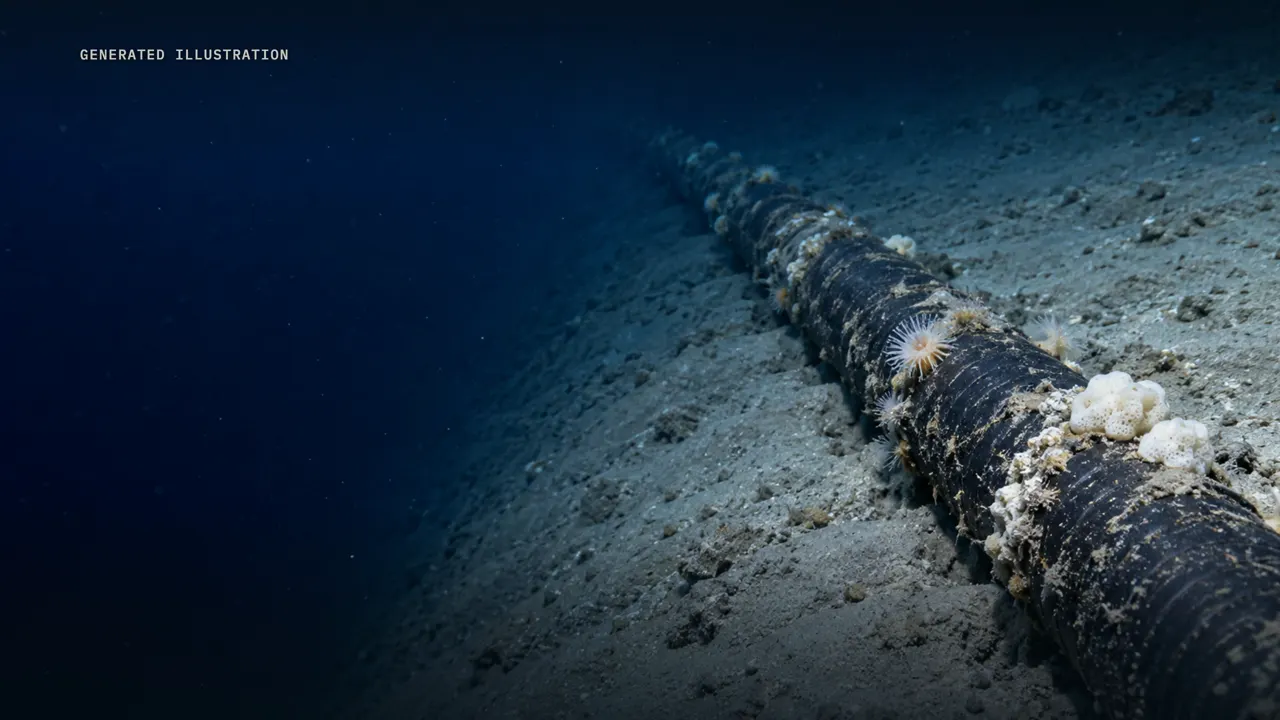
In 2014, an older video of a shark biting a cable resurfaced online. Then stories claimed Google was wrapping its cables in Kevlar to stop sharks. The original report was vaguer: a Google manager had mentioned a Kevlar-like protective material around its cables. But armor and burial mostly guard against anchors and fishing gear, which cause far more damage.
So sharks are a real but tiny risk. The real threat to your internet is much more ordinary: a ship's anchor or a fishing net.
Accident or deliberate?
That brings us to the cable cuts that keep making headlines. Since 2024, damaged cables in the Baltic Sea, the Red Sea and around Taiwan have raised the same question: accident, or deliberate? We're going to stick to what investigators, prosecutors and courts have actually said, case by case. In November 2024, in the Baltic Sea, two data cables, BCS East-West and C-Lion1, were damaged within about a day of each other.
Attention turned to the Chinese-flagged ship Yi Peng 3. The Washington Post reported that US intelligence and two European intelligence services were leaning toward accidents in this and other recent cases. Not everyone agreed: Germany's defense minister called the November damage sabotage.
Sweden's accident investigators found that Yi Peng 3 had dragged its anchor, but could not establish whether that was deliberate or accidental. On December 25, 2024, in the Gulf of Finland, five cables were damaged, including the Estlink 2 power link. Prosecutors say the tanker Eagle S dragged its anchor for about 90 kilometers. At the time, Finland's president said the incident was definitely linked to Russia.
Finland's National Bureau of Investigation said it was too early for final conclusions. In August 2025, prosecutors charged the captain and two officers with aggravated criminal mischief and aggravated interference with communications. The Helsinki District Court dismissed the case, ruling that it lacked jurisdiction.
In August 2026, the Court of Appeal overturned the dismissal and sent the case back to be heard. That ruling didn't decide guilt, and it could itself be challenged in Finland's Supreme Court. January 2025: a cable between Latvia and the Swedish island of Gotland was damaged, and the ship Vezhen had passed the spot. Swedish prosecutors concluded it was an accident, not sabotage.
They pointed to bad weather, equipment problems and poor seamanship. In February 2024, in the Red Sea, three cables, Seacom, AAE-1 and EIG, were damaged. The cargo ship Rubymar had been hit in a Houthi attack and abandoned nearby. The ICPC's general manager said it was "generally accepted" that the Rubymar dropped its anchor when it was attacked.
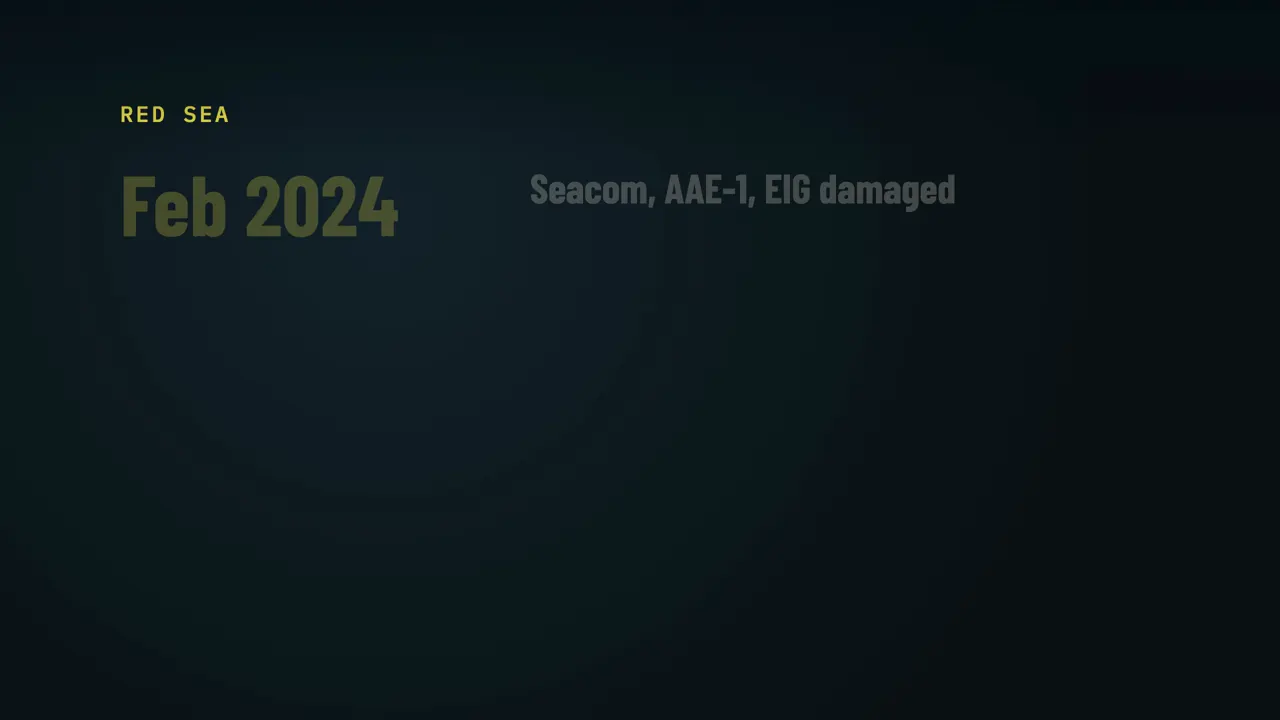
In his assessment, that anchor damaged the cables nearby. The Houthis denied targeting the cables. TeleGeography says repairs were delayed by about five months. In September 2025, several more Red Sea cable systems were reported cut, including SMW4 and IMEWE.
The ICPC's early assessment pointed to commercial shipping, but we found no public final finding on the cause by October 2026. Microsoft warned Azure customers of higher latency as traffic was rerouted. February 2025, Taiwan: a cable between Taiwan and the Penghu islands was cut. A Taiwanese district court sentenced the Chinese captain of the Togo-flagged Hong Tai 58 to three years in prison.
The conviction was under Taiwan's Telecommunications Management Act. The captain denied intending to damage the cable, but his three-year sentence was upheld on appeal and became final. Across these cases, there's no single story. Swedish prosecutors called one case an accident, and a Taiwanese court sent a captain to prison in another.
The Eagle S case is back in Finnish courts, and in the Yi Peng 3 case, the public evidence still leaves intent unresolved. Several of these cases involve the same mechanism: an anchor dragging across the sea floor. And in the November Baltic case, the internet stayed up, because traffic was sent around the break. Not every place has a detour: when a 2022 eruption broke the main cable linking Tonga
to the rest of the world, emergency satellite service helped bring the internet back.
The repair ships
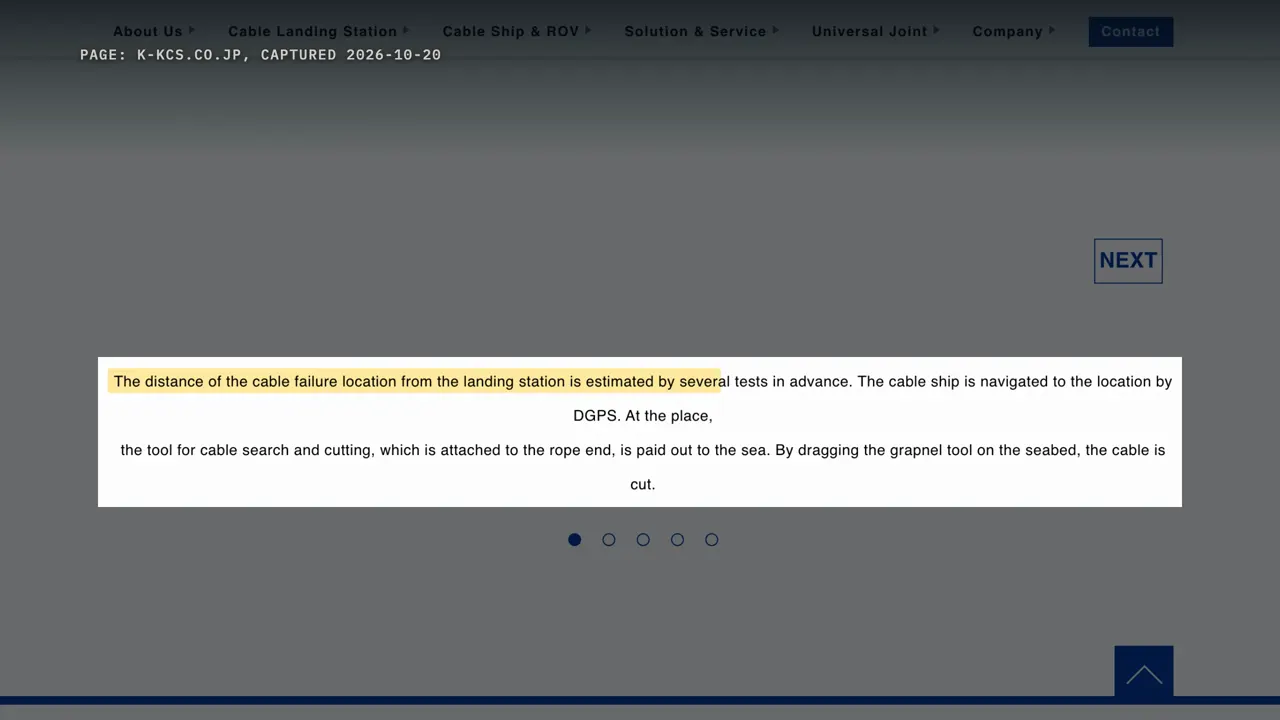
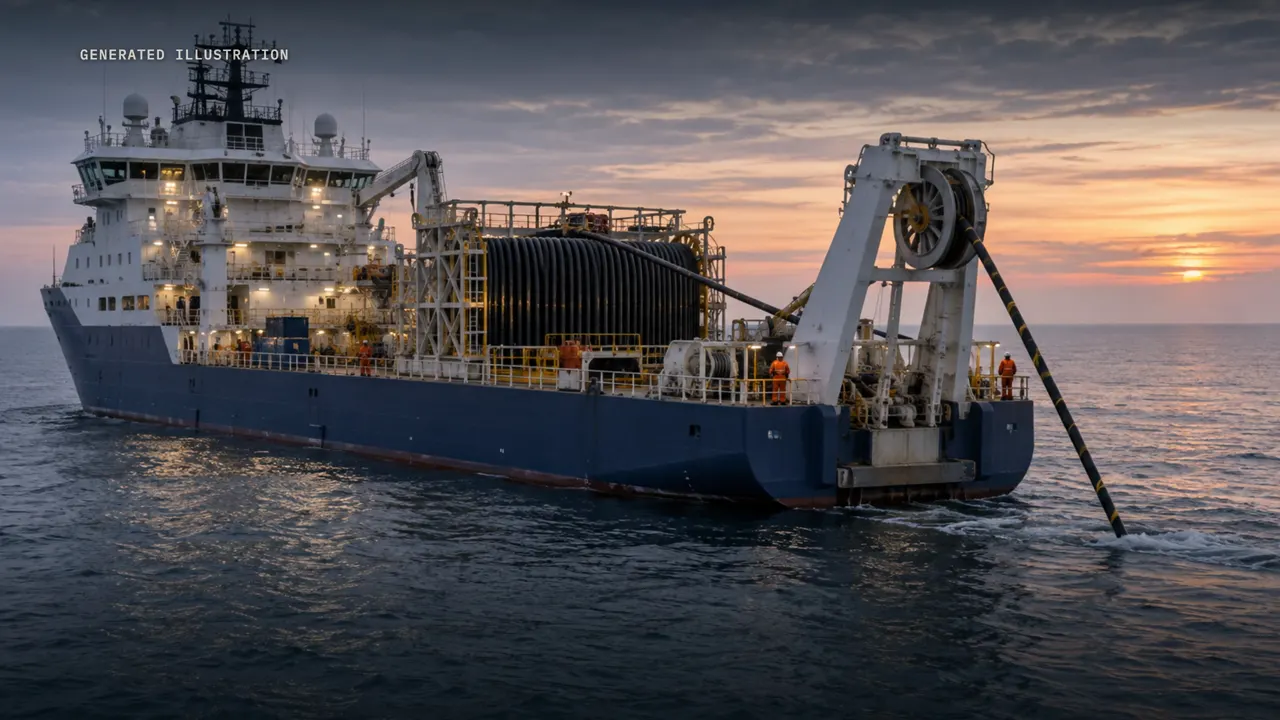
So what happens when a cable breaks? First, engineers send test signals from the shore to estimate how far away the fault is. Maintenance agreements keep repair ships on standby, with a target of setting out within 24 hours. At the site, the repair ship drags a tool along the bottom that finds the cable and cuts it.
A grapnel, a kind of hook, lifts one end to the surface. The crew tests it, seals it, and ties it to a buoy. Then they recover the other end. They add a length of spare cable, splice the second end, and test the whole line from shore to shore.
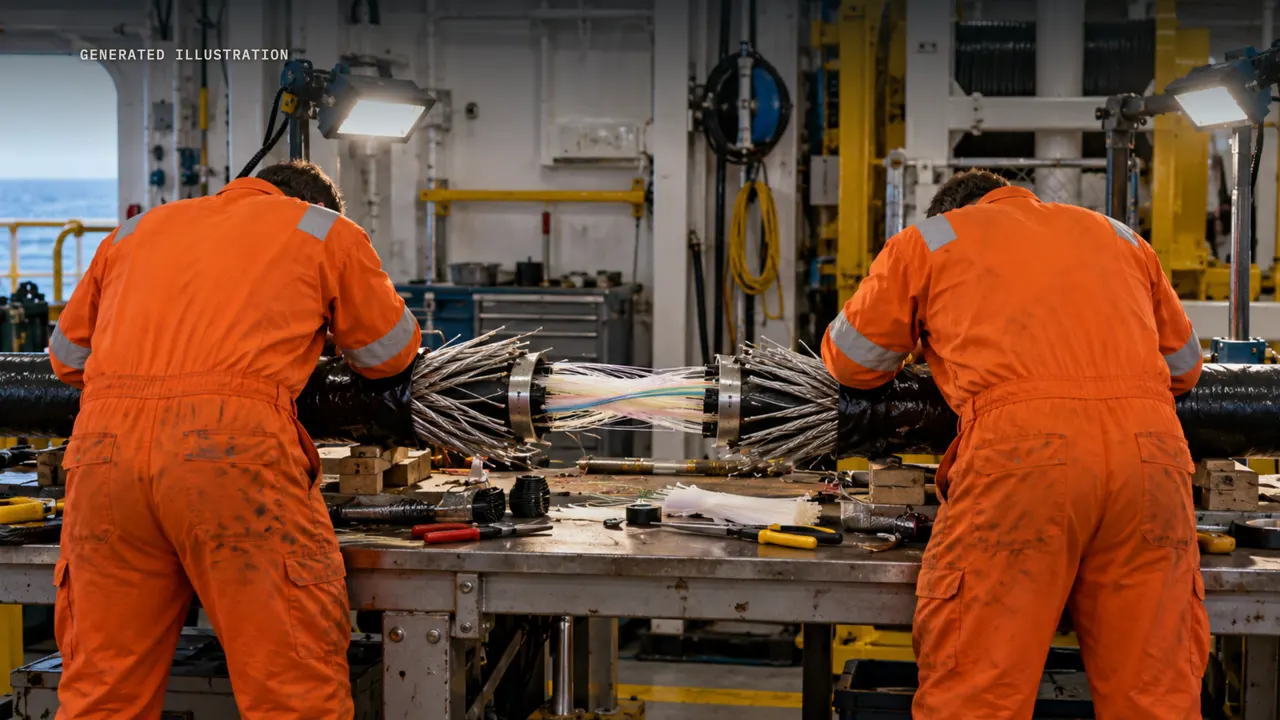
At a depth of 8,000 meters, just lifting the cable can take more than a day. Splicing, testing and recovering the cable can keep the crew at the site for days. And permits can delay the start of that work. It's the 1866 method, with better tools.
And the ships that do this work are getting old. TeleGeography estimates that by 2040, about two thirds of cable maintenance ships will have reached the end of their service life. Replacing 15 of them and adding five more would cost roughly 3 billion dollars.
Ninety-eight words, one petabit
So, is the internet under the ocean? Between continents, almost all of it is. In 1858, one copper cable took about sixteen hours to deliver 98 words, then lost reliable service within weeks. Manufacturing defects, damage during laying and high-voltage equipment all helped kill it.
In 1866, a giant ship laid a working cable and pulled a lost one up from the bottom. In 1988, the first fiber-optic cable across the Atlantic carried its signals as light. And now engineers are putting two light paths inside each hair-thin fiber, aiming for a whole cable that carries one petabit per second. The biggest danger is still the most ordinary one: anchors and fishing gear.
The internet feels like it lives in the air. Between continents, it actually runs along the sea floor, through deep-ocean cables about as thick as a garden hose.
Watch on YouTube
Sources
- TeleGeography: Submarine Cable FAQs; State of the Network 2026; Mythbusting Part 3 (2023); satellites (2019); cable maintenance data (2025)
- 1858 cable: IEEE Spectrum (2019); IET Archives; G. Cookson, History Today (2000); The Leader, 21 Aug 1858 (NCSE); J. B. Russell (1859); C. Bright, The Story of the Atlantic Cable (1903); S. P. Thompson, Life of Lord Kelvin; University of Glasgow Kelvin exhibition
- Charles Kao: Nobel Prize in Physics 2009 press release; TAT-8: IEEE Milestone (ETHW); fiber structure: AFL; Sumitomo Electric (2017); Bozkurt et al. 2018, arxiv.org/abs/1811.10737
- EDFA: VinFuture Prize 2022; Dunant: Google Cloud (2021); Petal: Meta Engineering (21 Sep 2026); 99%: ITU backgrounder on submarine cable resilience; Starlink network update (July 2025)
- Faults: ICPC media FAQ; Carter et al. 2009, Submarine Cables and the Oceans (ICPC and UNEP-WCMC); Carter et al. 2014, Oceanography 27(2); L. Carter (2011); Natural Resources Canada, 1929 Grand Banks earthquake; Earth magazine (2017)
- Sharks: Fibre Systems (ICPC); ICPC 2015 review; Network World (2014)
- Incidents: Washington Post via Stars and Stripes (2025); Swedish Accident Investigation Authority, Yi Peng 3 memorandum (2025); Finnish Prosecution Service (2025); Helsinki Court of Appeal (27 Aug 2026); gCaptain (2024, 2025); AP (2025); Telecom Review (2025); DatacenterDynamics (2025); Central News Agency (2026); ITU, Tonga (2022)
- Repairs: KDDI Cableships & Subsea Engineering; ICPC, Submarine Cable Network Security; S. Drew (2011)
Images and video
- CC BY 4.0: Gordon Leggett (Cable Innovator), Ka23 13 (KDDI Cable Infinity), via Wikimedia Commons
- CC BY-SA 3.0: David Dobkin (Charles K. Kao), via Wikimedia Commons
- Public domain and CC0: Library of Congress, Royal Museums Greenwich, National Portrait Gallery, NASA, NOAA and other archives via Wikimedia Commons
- Footage: Pexels (ALL IZ Well, Colin Jones, Dima Krivoy, Gram Film, JUN HO LEE, Julien Goettelmann, Kindel Media, PNW Production, Pok Rie, Ravenswood Photography, Salva F. Ayala, Sururi Ballıdağ, Sébastien Vincon, Zahid Nisar, cottonbro studio); generic ships are not the ships in the incidents described
- Web pages are shown as captures with the outlet name and capture date on screen
- Narration is synthetic. Illustrations marked "Generated illustration" on screen are AI-generated scenes, not records of real events.