What Actually Kills a Tardigrade?

Dried-out tardigrades (water bears) have survived ten days in the vacuum of space and about a thousand times the radiation dose that kills a person. Yet in one experiment, half of the awake animals died after a single day at 37 °C. This video follows how both can be true: the tun, a dried state where life nearly stops; why surviving drought may also explain radiation tolerance; Dsup, a tardigrade protein tested in cultured human cells and mice; the fine print behind the famous records; what actually kills a tardigrade; and the thousands of dried tardigrades aboard Beresheet when it crashed on the Moon in 2019.
This article is the full narration of the video. Watch on YouTube
Tardigrades (water bears)
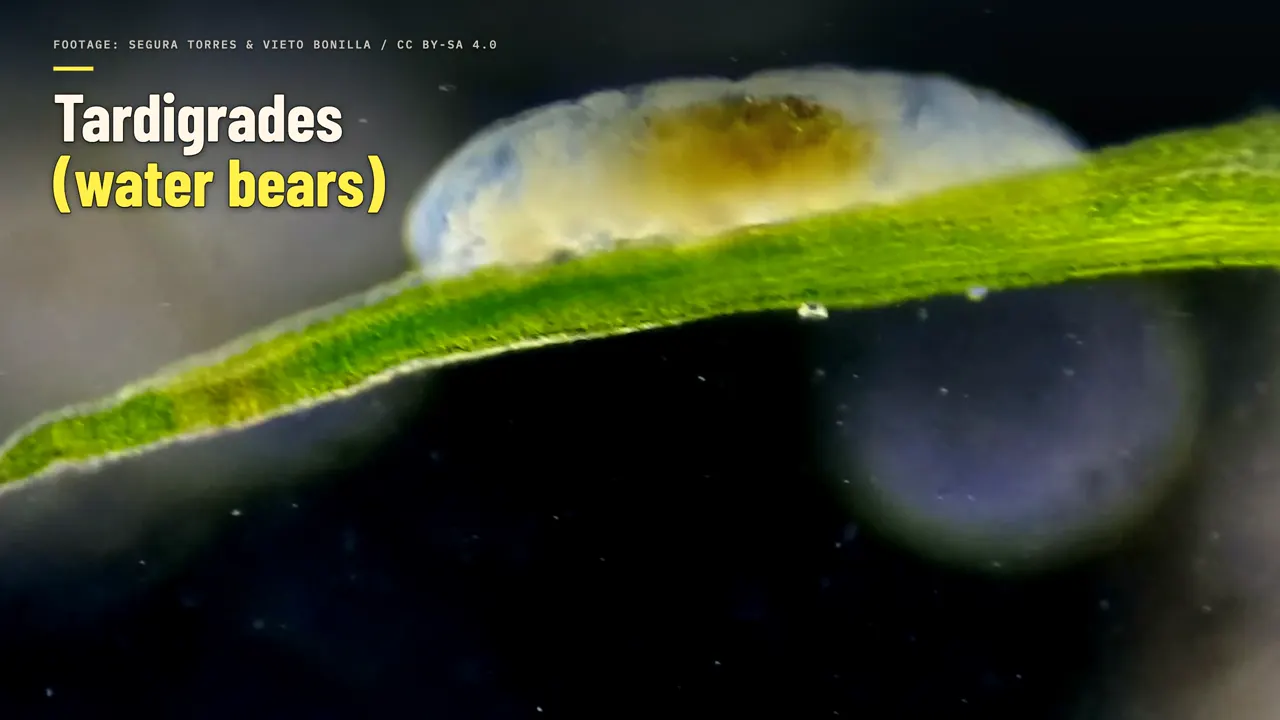
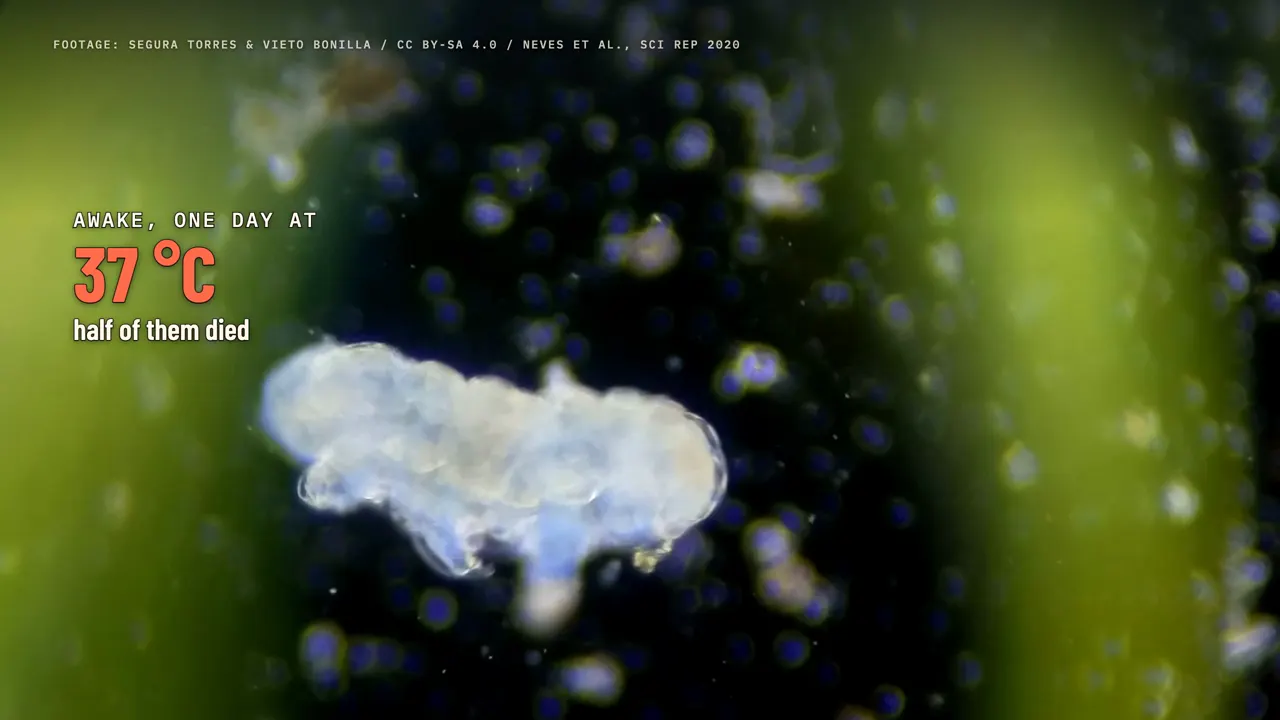
What actually kills a tardigrade, the tiny water bear? Dried out, they've survived ten days in the vacuum of space and gamma rays about a thousand times the dose that would kill a person. Frozen, they've come back after thirty years in Antarctic moss. But in one experiment, half of the active, awake tardigrades died after a single day at 37 degrees Celsius, about the temperature of your body.
All of that is true. To see how, we'll follow a tardigrade as its world dries up, and see why drying protects it from dangers it never meets in nature, and what finally breaks it.
The little water bear

In 1773, a German pastor named Johann August Ephraim Goeze looked at one under a microscope and called it the kleiner Wasserbär, the little water bear. A few years later, the Italian naturalist Lazzaro Spallanzani gave it the name scientists still use: tardigrade, the slow stepper. It's smaller than a millimeter, with eight stubby legs that end in claws, and a mouth with two sharp stylets that pierce its food.
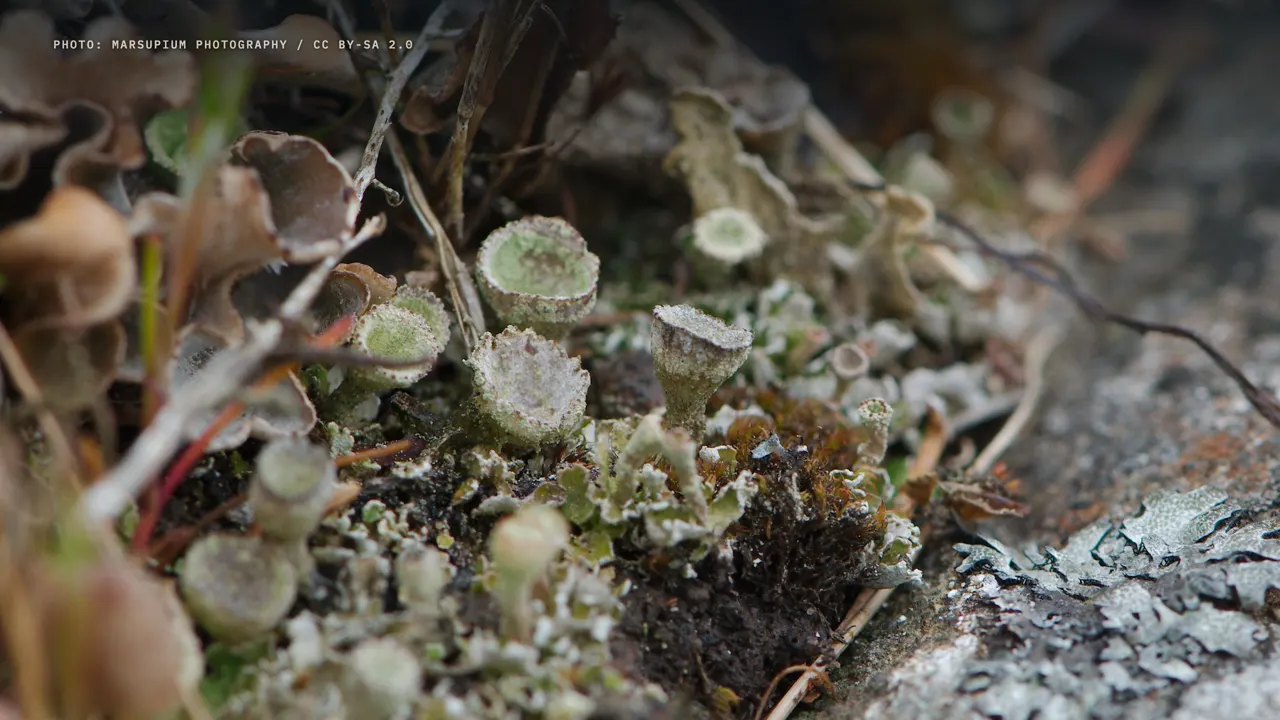
About fifteen hundred species have been described, from ocean sediment more than four and a half kilometers deep to meltwater holes on Alpine glaciers. But the ones that made tardigrades famous live much closer to us, in the moss and lichen on walls, roofs and tree bark. Some graze on algae, and some hunt.
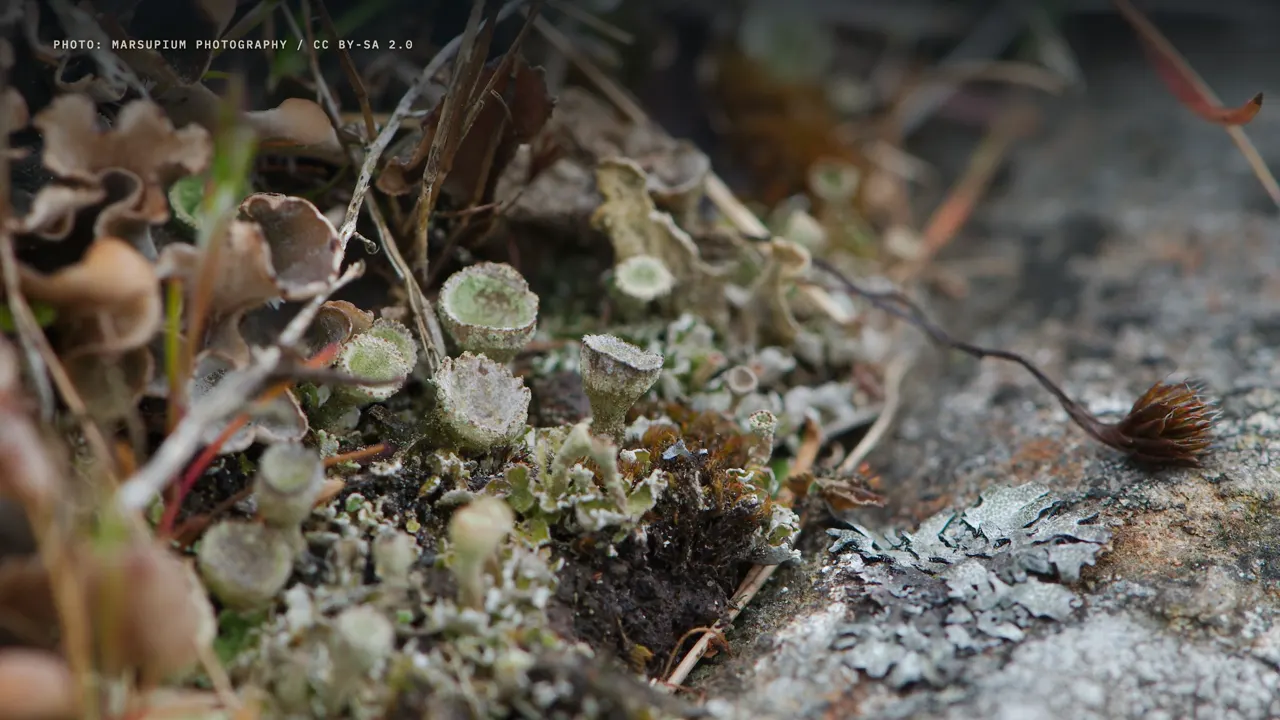
Inside the guts of one Antarctic species, researchers found rotifer jaws and the claws of other tardigrades. Many species need no males at all, and the females lay eggs without mating, sometimes inside the skin they've just shed. A cushion of moss is a hard place to live. After rain it's a tiny wetland, and a few dry days later it's dust.
Many tardigrades in the sea and in fresh water die if they dry out. The moss dwellers do something else.
Hidden life
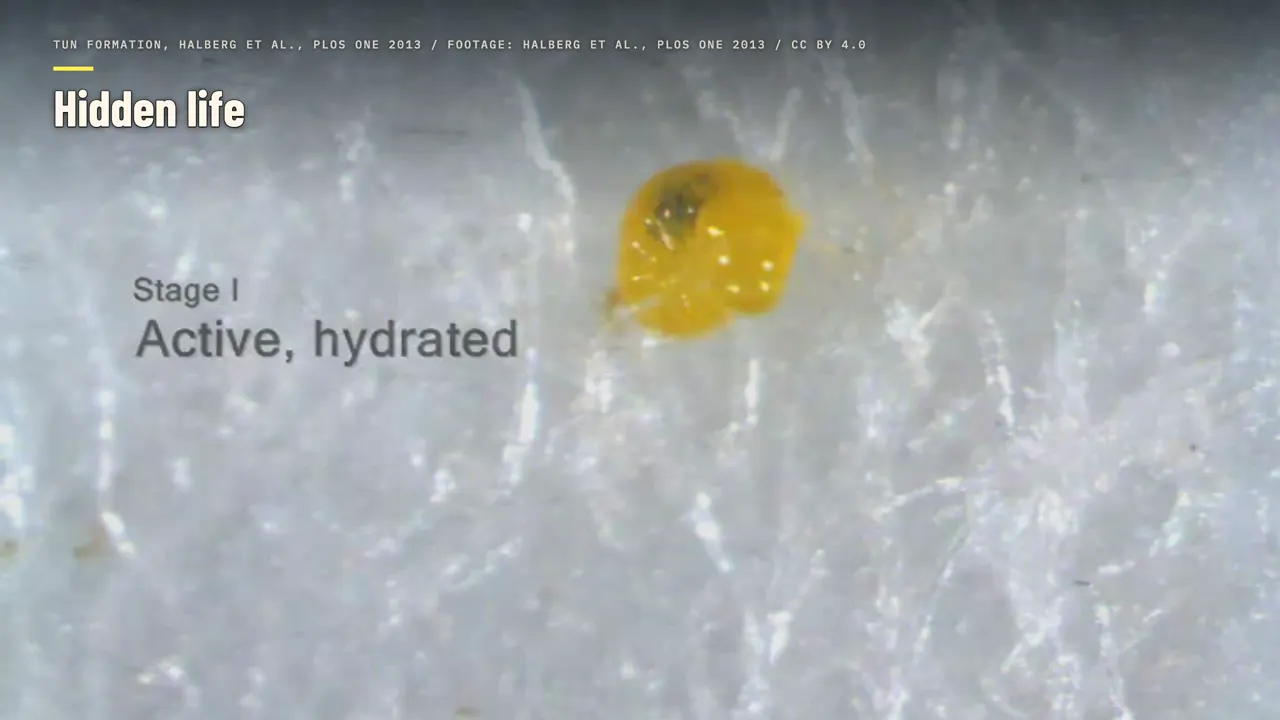
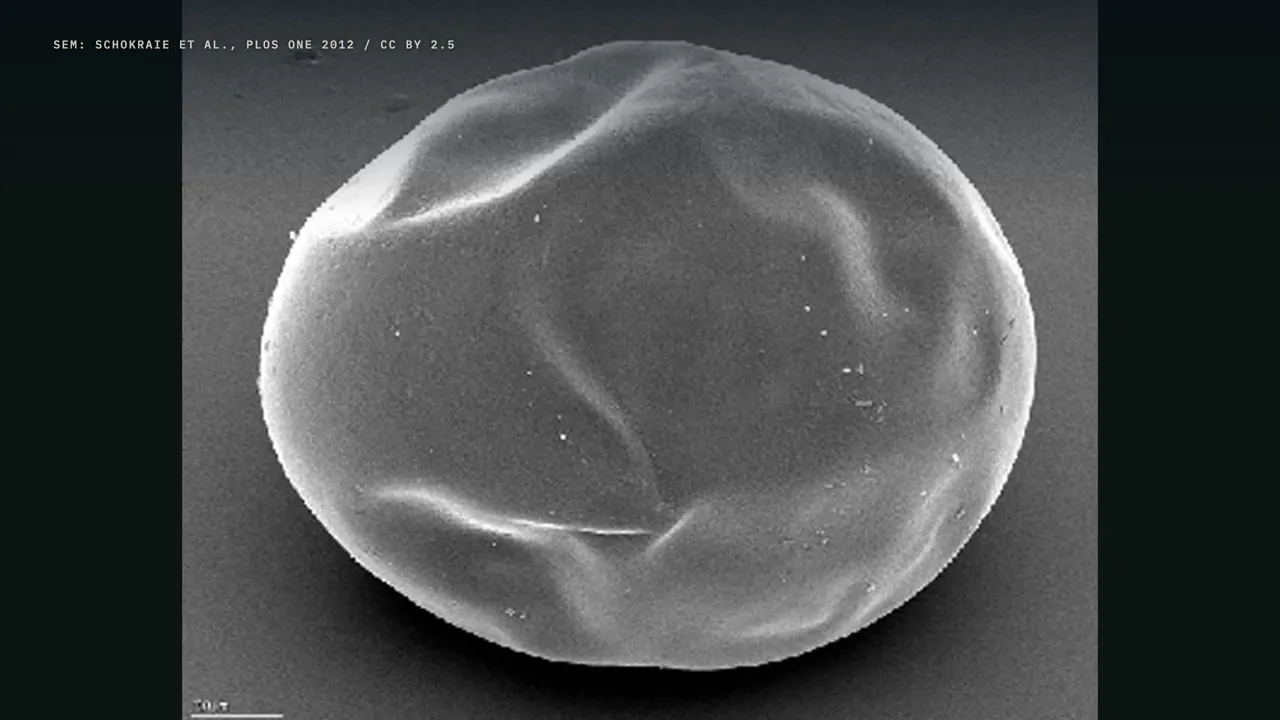
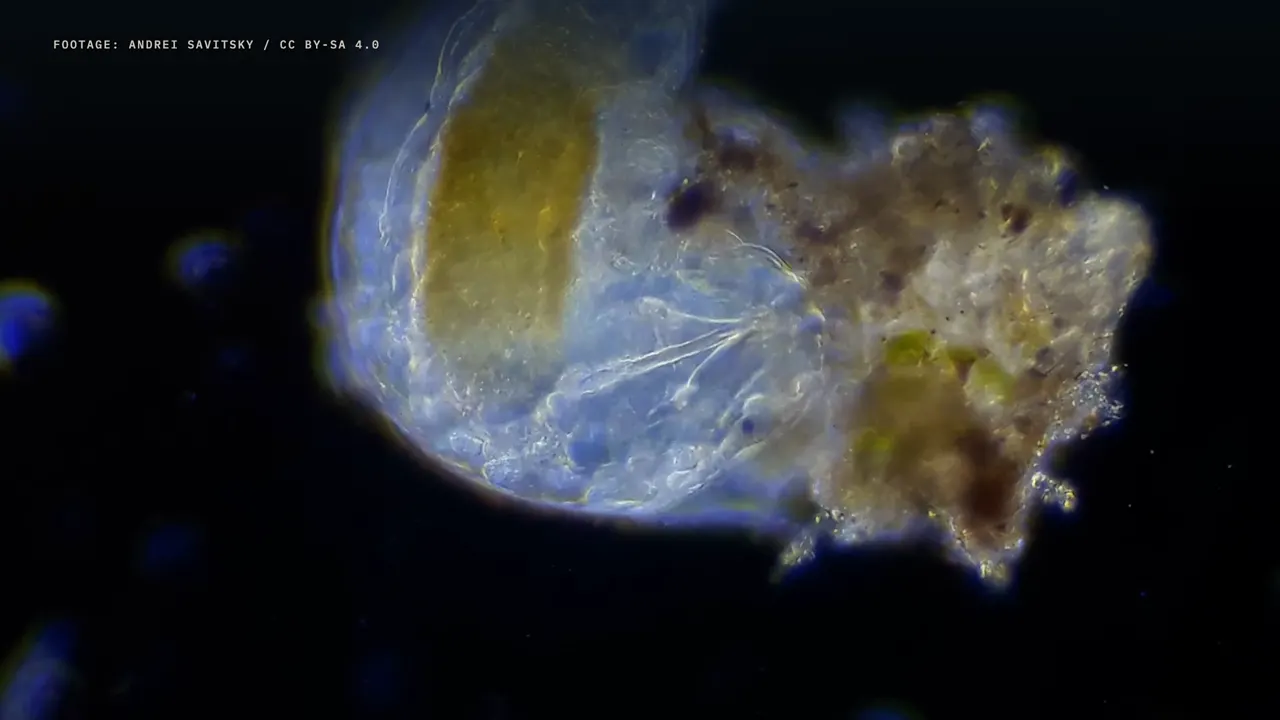
As the moss dries, a tardigrade pulls in its head and legs and curls into a small, wrinkled barrel. Biologists call it a tun. It keeps only two to three percent of the water it had while active. Its metabolism drops so low that it's hard to measure at all.
It can stay like this for years, and the best documented case from a dry moss sample is about twenty years. Add water, and within minutes or hours, it unfolds and walks away. In 1959, the biologist David Keilin named this state cryptobiosis, hidden life. He described it as a state with no visible signs of life, where metabolism becomes hardly measurable or stops altogether.
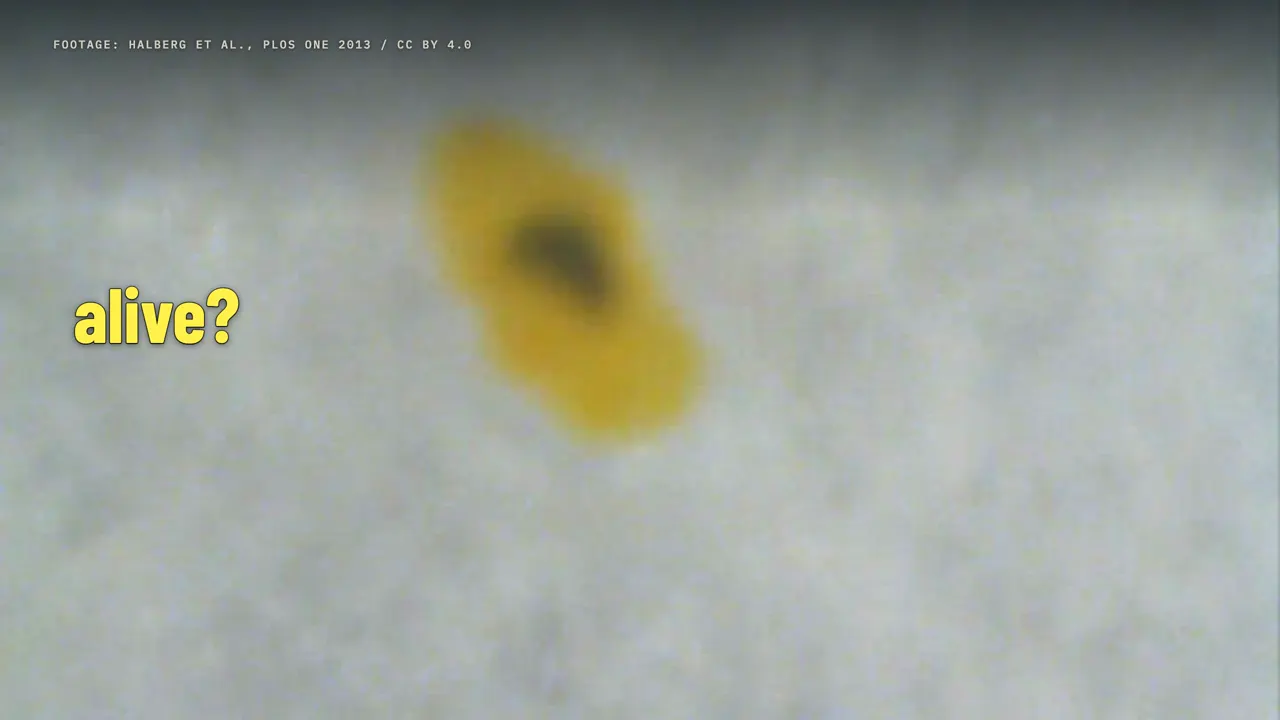
That raises an odd question: is a dried tardigrade alive? It shows no visible signs of life, but it isn't dead either, because it can come back. Tardigrades weren't the first animals seen doing this. In 1702, Antonie van Leeuwenhoek added water to dry sediment from a gutter and watched tiny animals called rotifers come back to life.
Today we know the trick evolved more than once, in rotifers, in some roundworms, in brine shrimp eggs and in the seeds of plants. Frozen in Siberian permafrost, a roundworm came back after about forty-six thousand years, and a rotifer after about twenty-four thousand. Even within tardigrades, the two main branches seem to have evolved it separately, using different sets of genes.
Glass without sugar
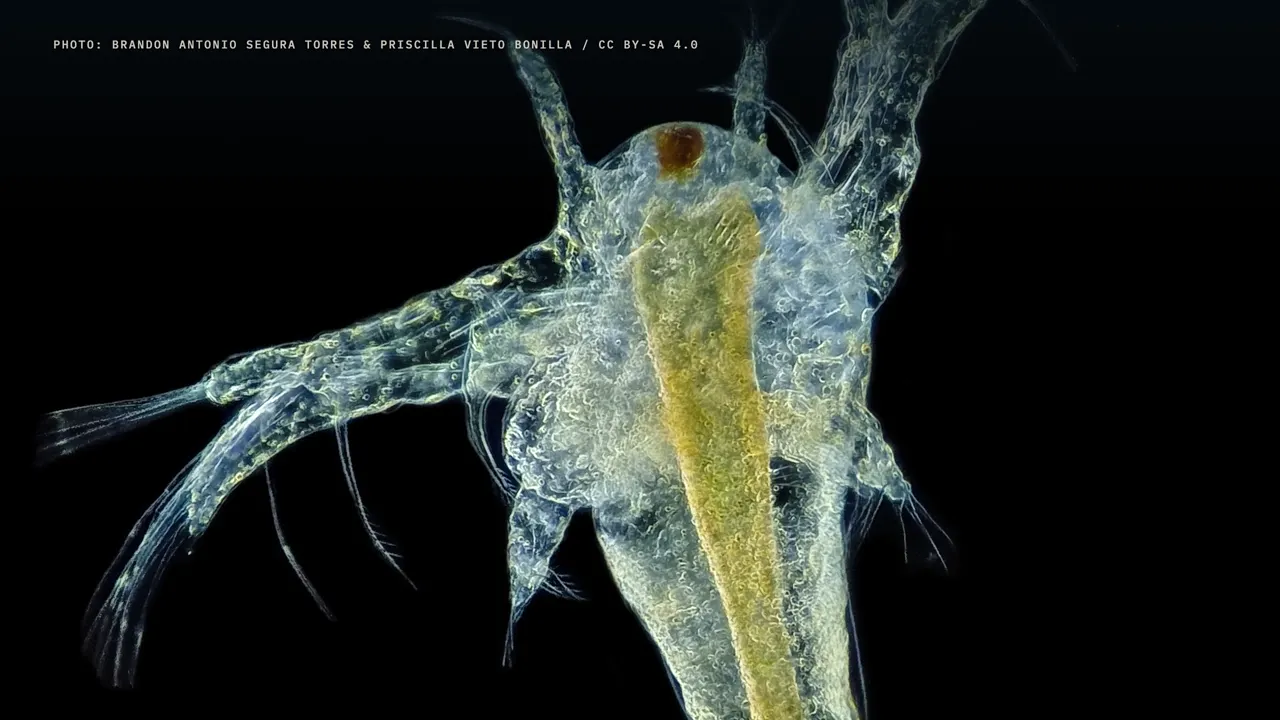
So what keeps a dried cell from falling apart? Many animals that survive drying pack their cells with a sugar called trehalose. Brine shrimp embryos make it up to about fifteen percent of their dry weight. As the water leaves, the sugar can set into a glass that holds the cell's molecules in place.
Tardigrades have very little of it, and some species seem to have almost none. In 2017, Thomas Boothby and colleagues in Bob Goldstein's lab found what they seem to rely on instead: proteins that exist only in tardigrades and have no fixed shape. As a tardigrade dries, it turns some of these genes up as much as twenty-two times.
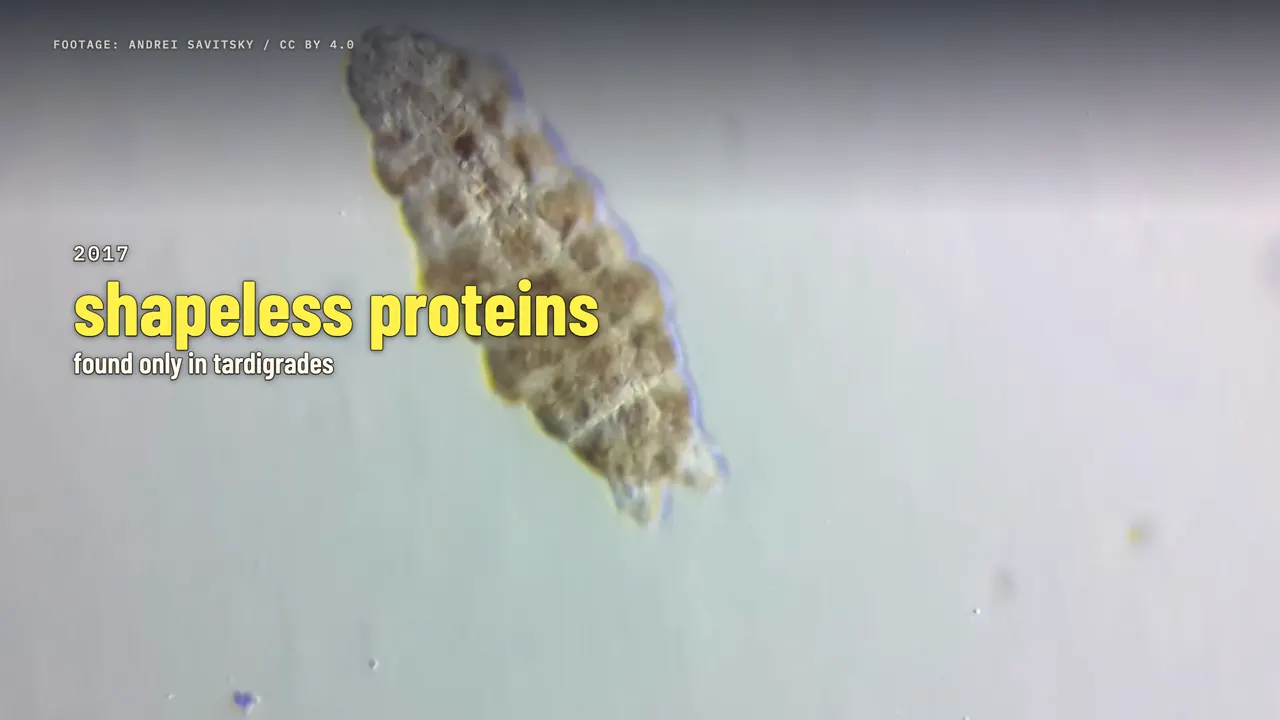
When the researchers blocked two of them, fewer tardigrades survived drying. In a test tube, the proteins turned into a glass-like solid as they dried. Later work found that they can also form fibers and gels, and exactly how they protect a cell is still debated.
Ten days in space

In September 2007, an experiment called TARDIS put dried tardigrades on the outside of a Russian satellite, Foton-M3. For ten days, about 260 to 280 kilometers up, they sat in the vacuum of space and its cosmic radiation. Two species flew, and some got no sunlight at all, some got part of the Sun's ultraviolet, and some got all of it. Back on Earth, the ones that only faced the vacuum did as well as tardigrades that never left the ground.
That makes sense, because vacuum is extreme dryness, and dryness is what they're built for. The full ultraviolet was different. Of one species, none came back, and of the other, only three animals survived. Flights inside spacecraft, out of the sunlight, went much better.

On Space Shuttle Endeavour's final mission in 2011, more than ninety percent of the tardigrades survived, and their eggs hatched normally. In 2021, NASA sent a lab species to the International Space Station to see which of its genes change in orbit, and as far as we can find, no results have been published yet.
A thousand times the dose
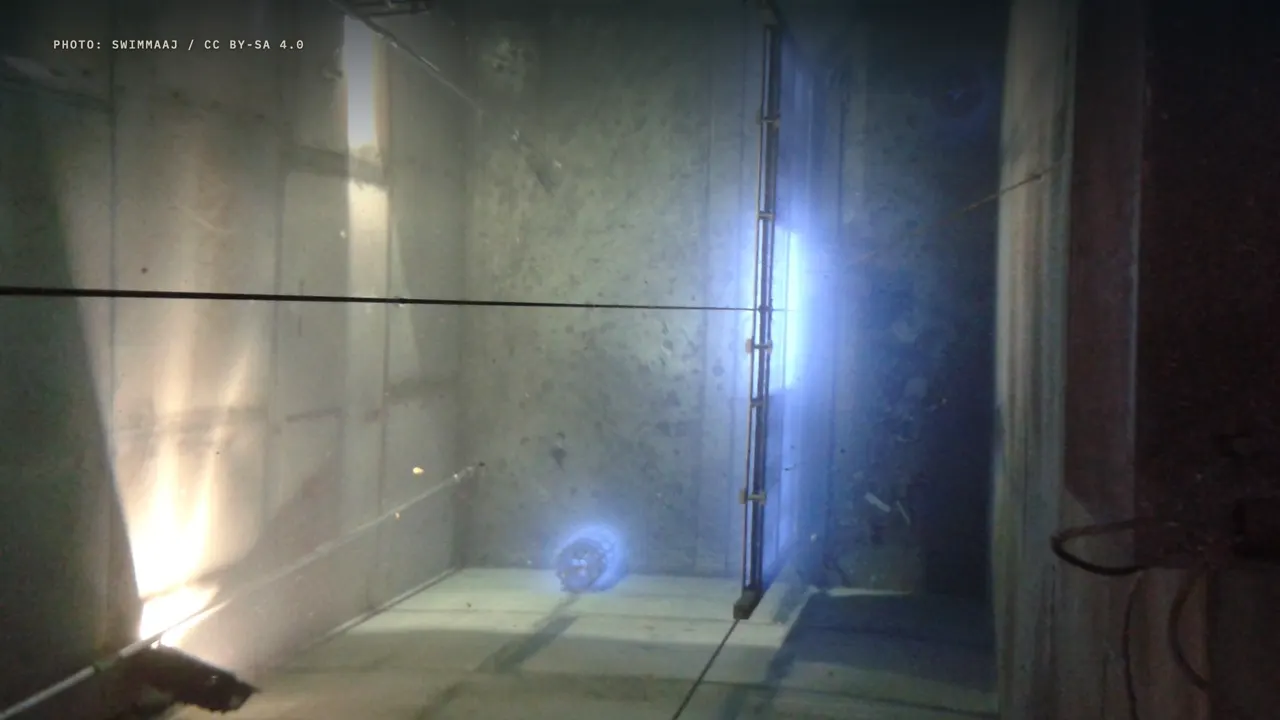
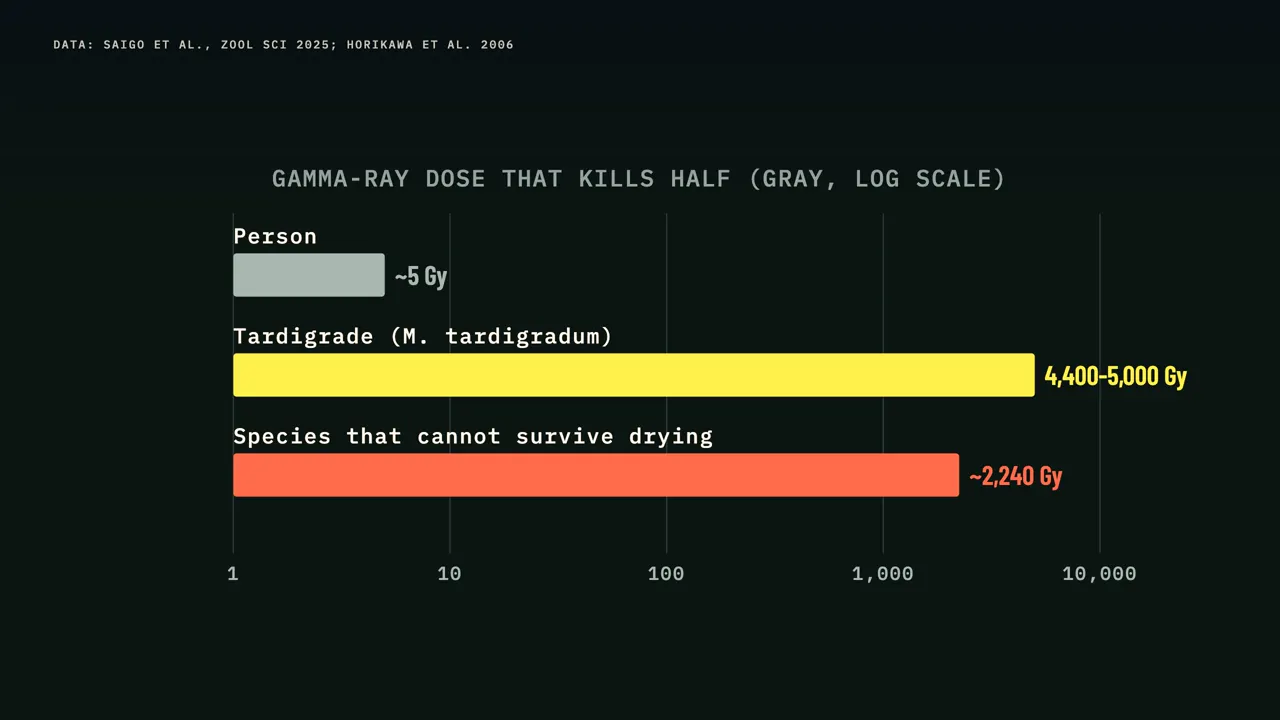
Radiation is where tardigrades look most like superheroes. Radiation dose is measured in gray, and for people, about five gray of gamma rays kills half of those exposed. In 2006, researchers found it took between forty-four hundred and five thousand gray to kill half of a group of tardigrades. That's roughly a thousand times more.
And active, hydrated animals did just as well as dried ones, or even a little better. So the dry state can't be the whole reason. But surviving isn't the whole story either. After more than a thousand gray, none of those animals laid an egg that hatched.
In the lab species Hypsibius exemplaris, fertility drops sharply above about a hundred gray. In a 2026 study with drugs that break DNA the way radiation does, the cells that keep dividing, in the gut and in eggs and embryos, were the first to fail. Here's the puzzle. No moss bed on Earth has ever been bathed in thousands of gray, so why can a tardigrade survive that much?
Built for drought
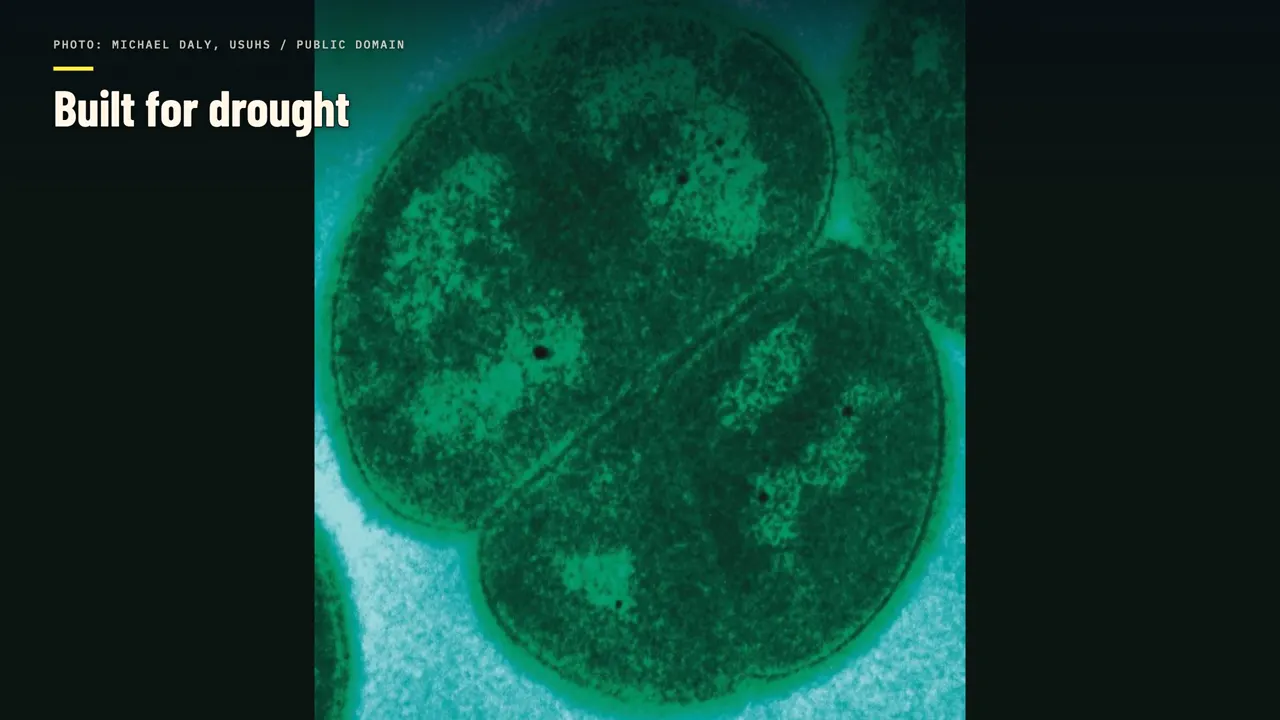
The leading answer starts with a bacterium called Deinococcus radiodurans, famous for surviving radiation. In 1996, researchers found that all 41 of its radiation-sensitive mutant strains also died after six weeks of drying. Drying breaks DNA, just as radiation does, so a cell that can repair one kind of damage can repair the other. That means radiation resistance may be an accident, a side effect of surviving drought.
In 2003, the tardigrade biologist Ingemar Jönsson proposed the same idea for tardigrades. Drying does damage their DNA. In one species, broken DNA in certain cells went from almost none in active animals to about a seventh after six weeks dry, and about a quarter after ten months.
In 2025, researchers tested a tardigrade species that can't survive drying. Its radiation tolerance was about half that of drought-proof species: about twenty-two hundred gray. That's still about 450 times the dose that kills a person, so drought doesn't explain everything, but it fits. In 2024, Bob Goldstein's lab looked at what happens inside a tardigrade after radiation.
Radiation does break the animal's DNA, but within a day the damage is being repaired. After a big dose, thousands of genes ramped up, and some DNA repair genes became among the most heavily used genes in the whole animal. Another team found the same response in three species, along with a new tardigrade-only protein that binds DNA, called TDR1. And in 2024, a Chinese team described a new species, Hypsibius henanensis.
It uses a gene probably borrowed from another organism to make betalains, plant pigments that mop up harmful molecules radiation creates. So a big part of their defense is repair, done fast and on a huge scale.
A shield in a gene
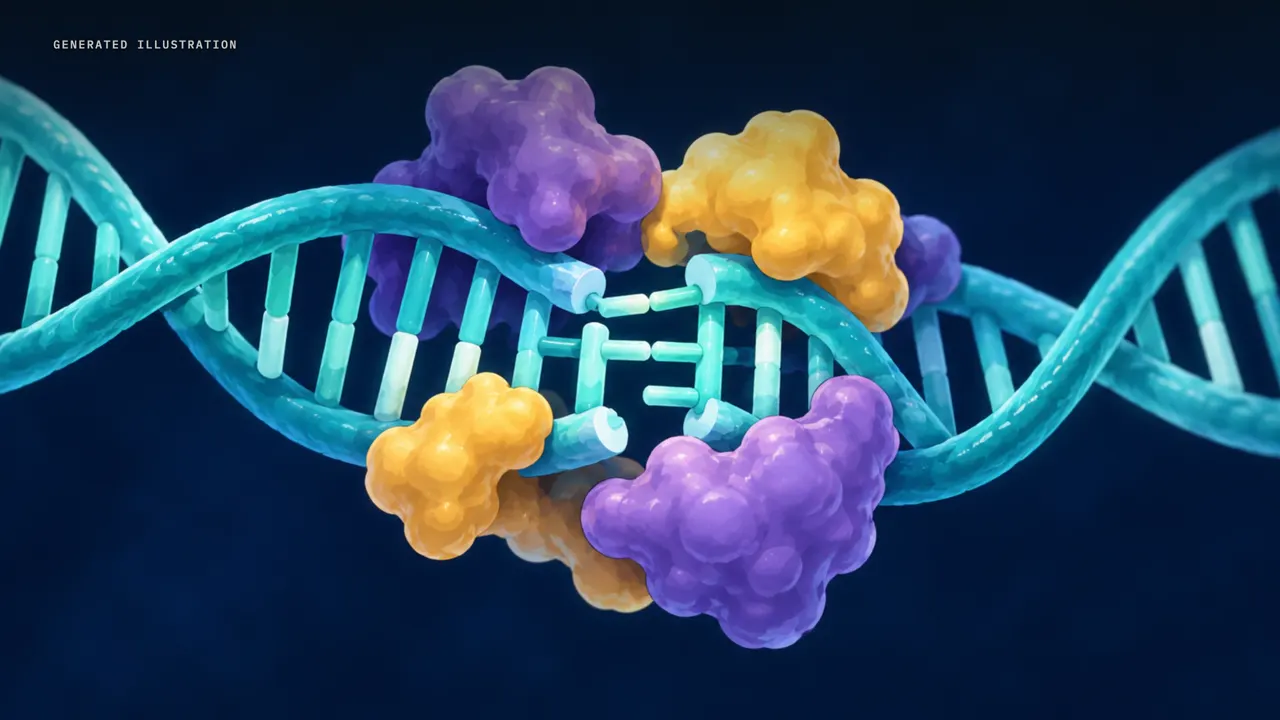
Some tardigrades also carry a shield. In 2016, a team led by Takekazu Kunieda sequenced the genome of Ramazzottius varieornatus, one of the toughest species. They found a protein unknown in any other animal and named it Dsup, short for damage suppressor. When they put its gene into human cells grown in a dish, X-ray damage to the cells' DNA fell by about forty percent.
Dsup sticks to the spools that DNA is wound around and protects it from hydroxyl radicals, the molecules that do most of the damage when radiation hits water. Not every tardigrade has it, and one of the two main branches of the tardigrade tree seems to lack it entirely. In 2025, researchers packed instructions for making Dsup into nanoparticles and injected them into the cheeks of mice before radiation.
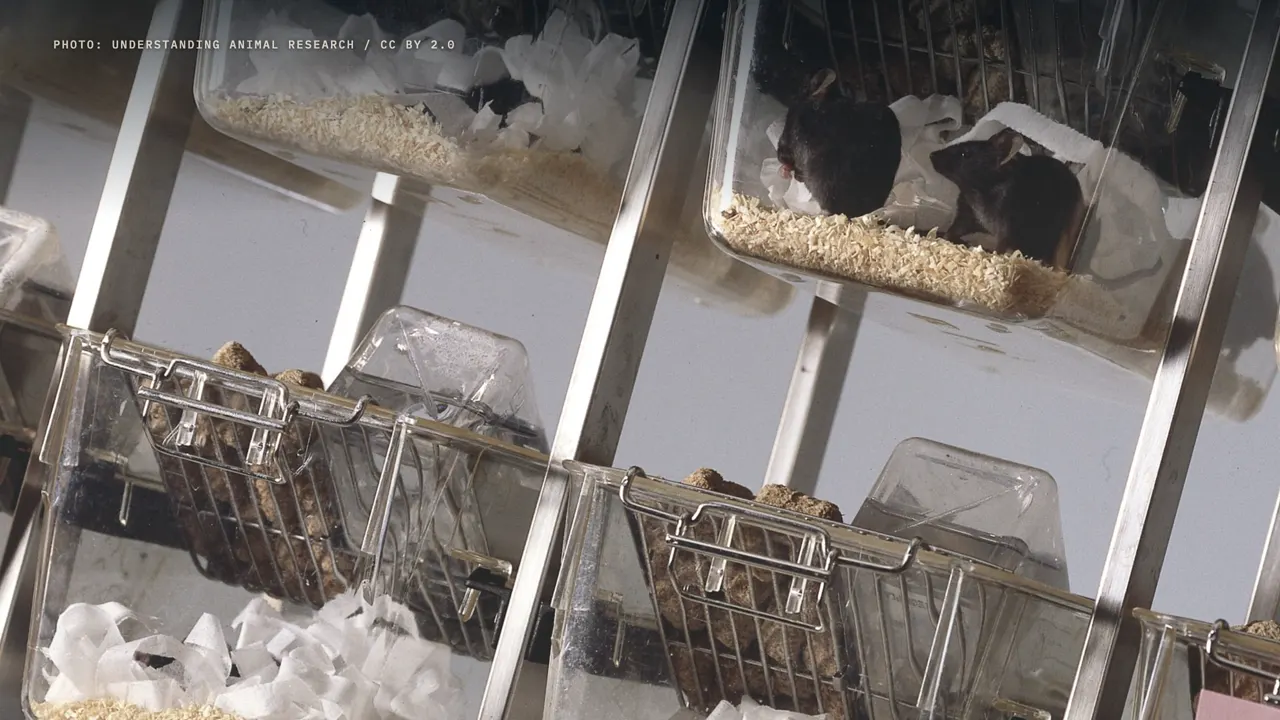
The treated tissue showed much less DNA damage, and in mice with tumors on the other cheek, the radiation still worked on the tumor. The protein peaked within hours and was mostly gone after four days. It's still only mice, and Dsup isn't harmless everywhere: in rat brain cells grown in a dish, it actually caused DNA damage. Other tardigrade proteins are being tested to keep fragile medicines stable when they're dried.
In 2023, an engineered fragment of one of those shapeless proteins kept a dried hemophilia drug, clotting factor eight, unchanged for ten weeks. That work was partly funded by DARPA, the US military's research agency. None of it has reached patients.
The stopped clock
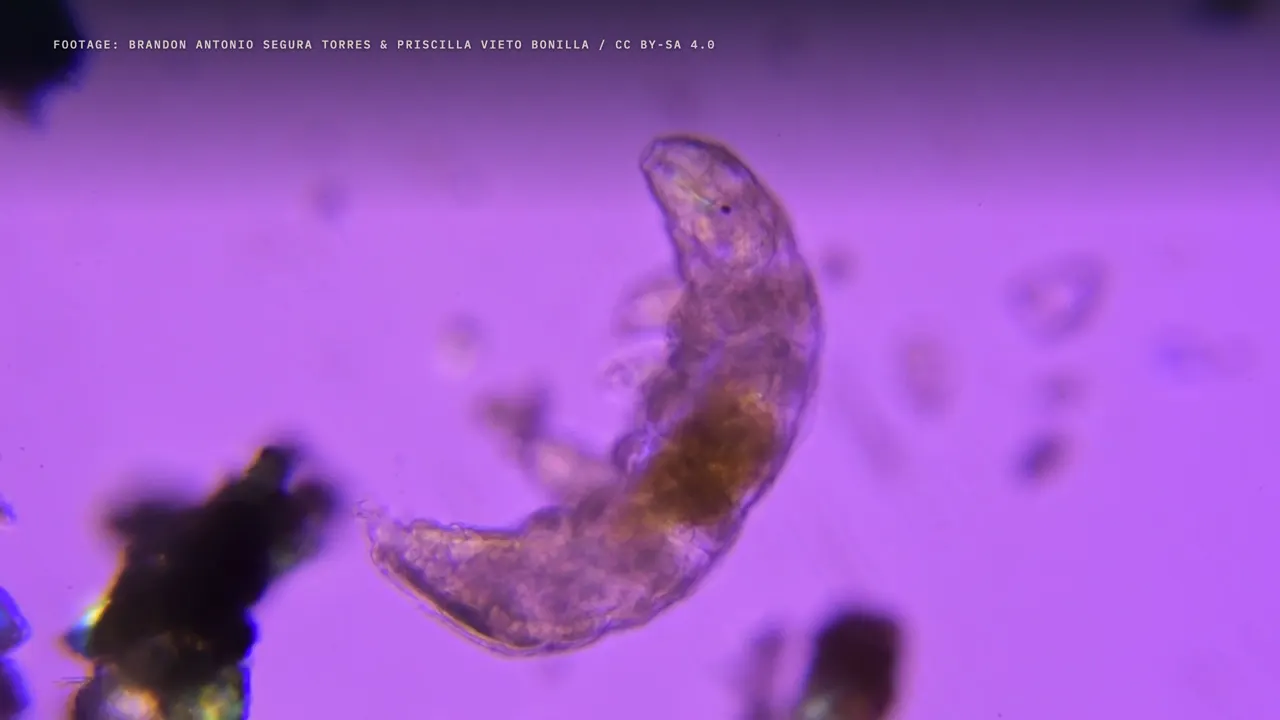
There's another strange thing about the tun: time seems to stop. In 2008, German researchers dried one species again and again between feeding periods. Its active lifespan came out about the same as that of animals that were never dried, as if the time spent dry didn't count. In 2022, the same group froze another species at minus thirty degrees, every other week.
The frozen ones lived twice as long by the calendar, and about as long as the others once you subtract the time on ice. Biologists call this the Sleeping Beauty hypothesis. But the pause isn't perfect. While dry, their DNA slowly breaks, and the longer they stay dry, the fewer come back and the longer they take.

The animal's clock stops, but its molecules don't.
The fine print
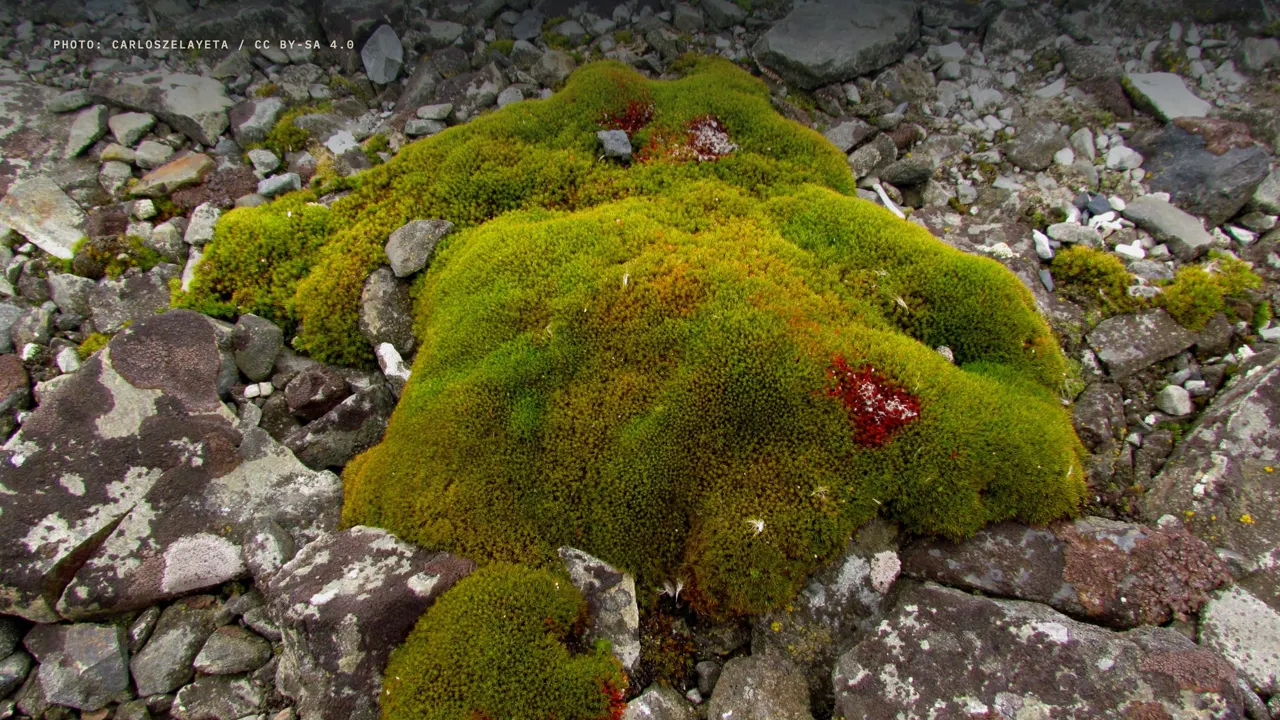
That's one reason the famous records come with fine print. In 1983, Japanese researchers collected moss in Antarctica and froze it at minus twenty degrees. In 2014, after thirty and a half years, they thawed it. Two tardigrades and one egg came back, and one of the animals and the hatchling went on to have young, but they took a long time to recover.
You may have heard that tardigrades survive 151 degrees Celsius. That number comes from experiments done a century ago or earlier. In modern tests, half of the dried tardigrades died after an hour at about 83 degrees, or after a day at 63. In 2007, Japanese researchers squeezed dried tardigrades at about seventy-four thousand
atmospheres, nearly seventy times the pressure at the bottom of the deepest ocean. After twenty minutes, they were fine. After six hours, they all woke up, but their legs twitched, they couldn't walk, and within five days they were dead. And the story of tardigrades revived from 120-year-old museum moss traces back, by
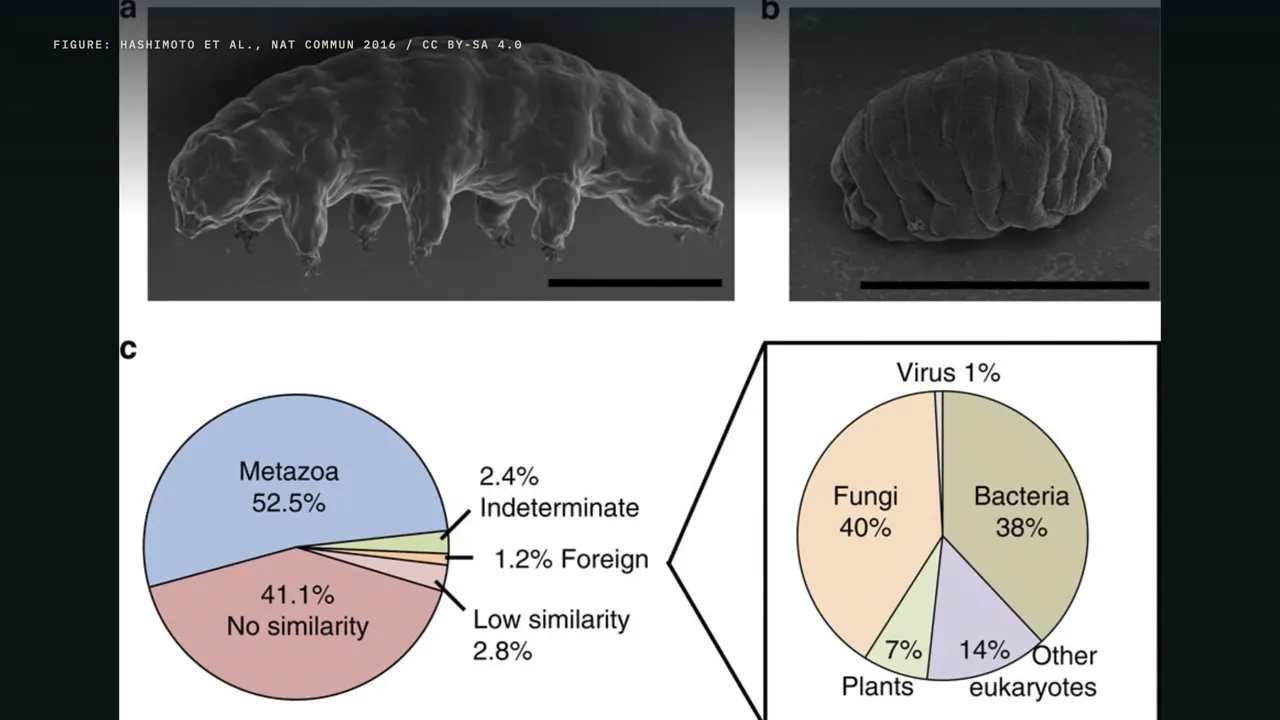
later accounts, to a 1948 report of a single animal briefly moving its front legs. Even the genome had fine print. In November 2015, a paper reported that about one sixth of a tardigrade's genes had come from other organisms. Eight days later, another team posted a preprint showing that much of that foreign DNA came from bacteria contaminating the sample.
By May 2016, more analyses had reached the same conclusion, and the real share turned out to be one or two percent at most. A few borrowed genes do seem to be real, though, like the pigment gene in that Chinese species.
What actually kills a tardigrade
So let's go back to the question: what kills a tardigrade? Heat, first. In 2020, Danish researchers kept active Ramazzottius varieornatus at different temperatures for a day. Half of them died at 37.1 degrees.
Other species tested died at similar temperatures, between 36 and 39. The researchers called high temperature the tardigrade's Achilles heel. Then oxygen: in water with almost no oxygen, active tardigrades bounce back from a short exposure, but after a day, almost none recover. Then time, because the longer a tardigrade stays in the tun, the more damage builds up.
Then speed. In 2021, British researchers froze tardigrades and fired them from a gas gun into sand. Up to about 730 meters per second, they all survived, and by 900, none did. And radiation, long before it kills them, stops them from reproducing.
Almost every record belongs to the dried, switched-off tun. Awake, a tardigrade is a small, soft animal that needs water, oxygen and mild temperatures, like most animals do.
Tardigrades on the Moon
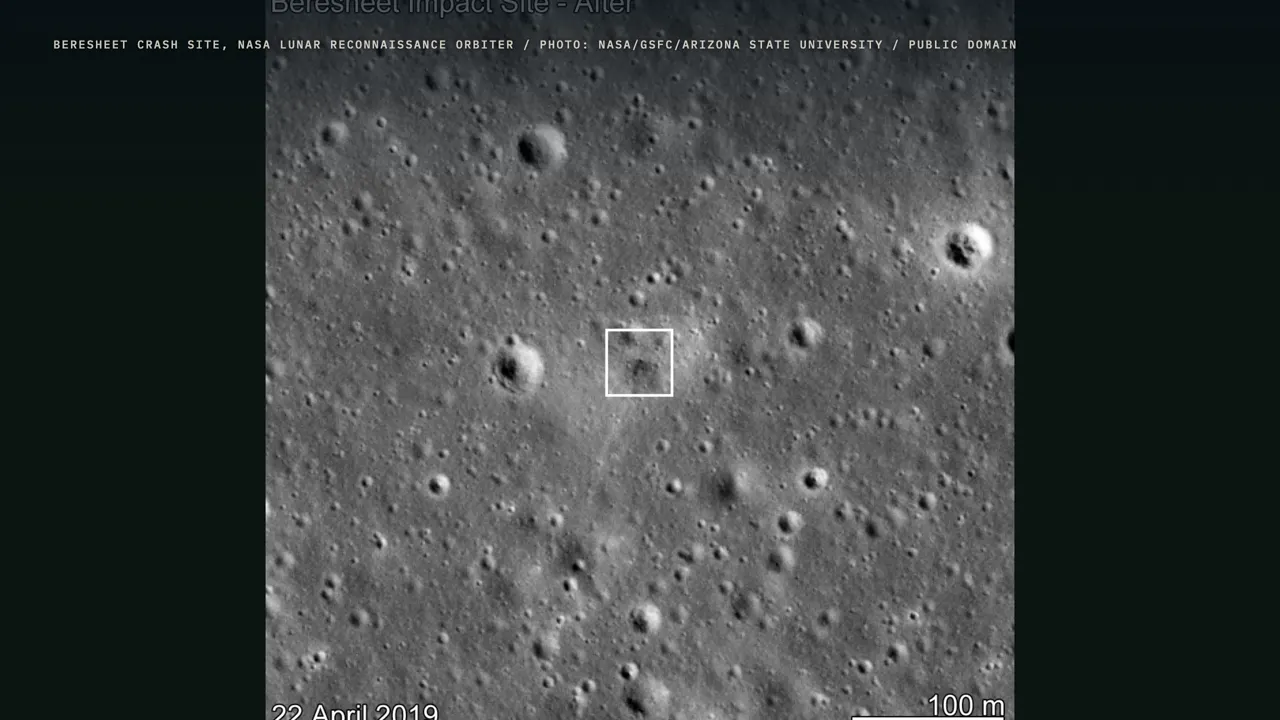
Which brings us to the Moon. In April 2019, the Israeli lander Beresheet crashed during its landing attempt. On board was a small archive from the Arch Mission Foundation: a stack of 25 thin nickel layers, about the size of a DVD, holding millions of pages of text.
Between the layers, set in epoxy, were thousands of dried tardigrades. Nova Spivack of the foundation later said they never told the lander team they were putting life on board. Could they have survived? The gas-gun limit was under a kilometer per second, and the researchers who
ran those tests thought a crash like Beresheet's was very likely beyond it. Even if a few survived intact, the Moon has no liquid water to wake them and nothing to eat. At best, the tardigrades on the Moon are dried and inactive, and most likely they're dead.
A walking head
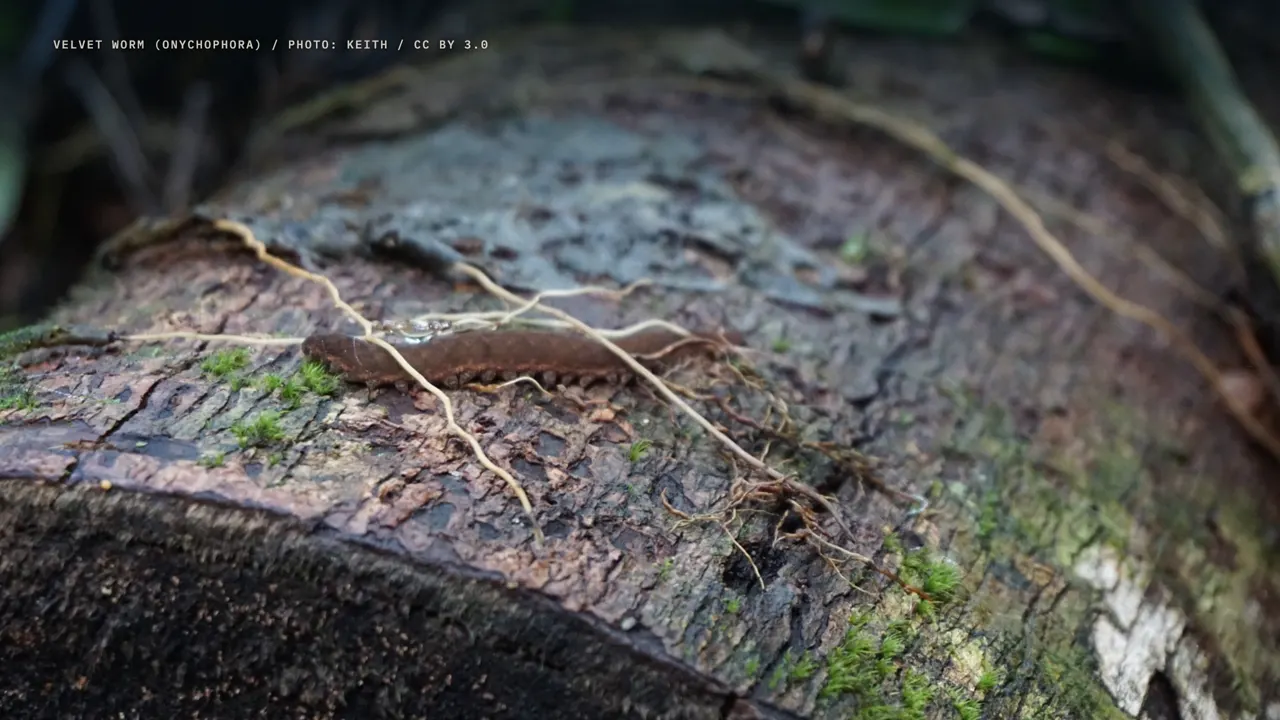
If they aren't superheroes, what are they? Tardigrades belong to the same big group as insects, spiders and velvet worms. Their ancestors, around half a billion years ago, probably looked like long worms with stubby legs, called lobopodians. In 2016, Frank Smith and colleagues compared the genes that lay out an animal's body from head to tail.
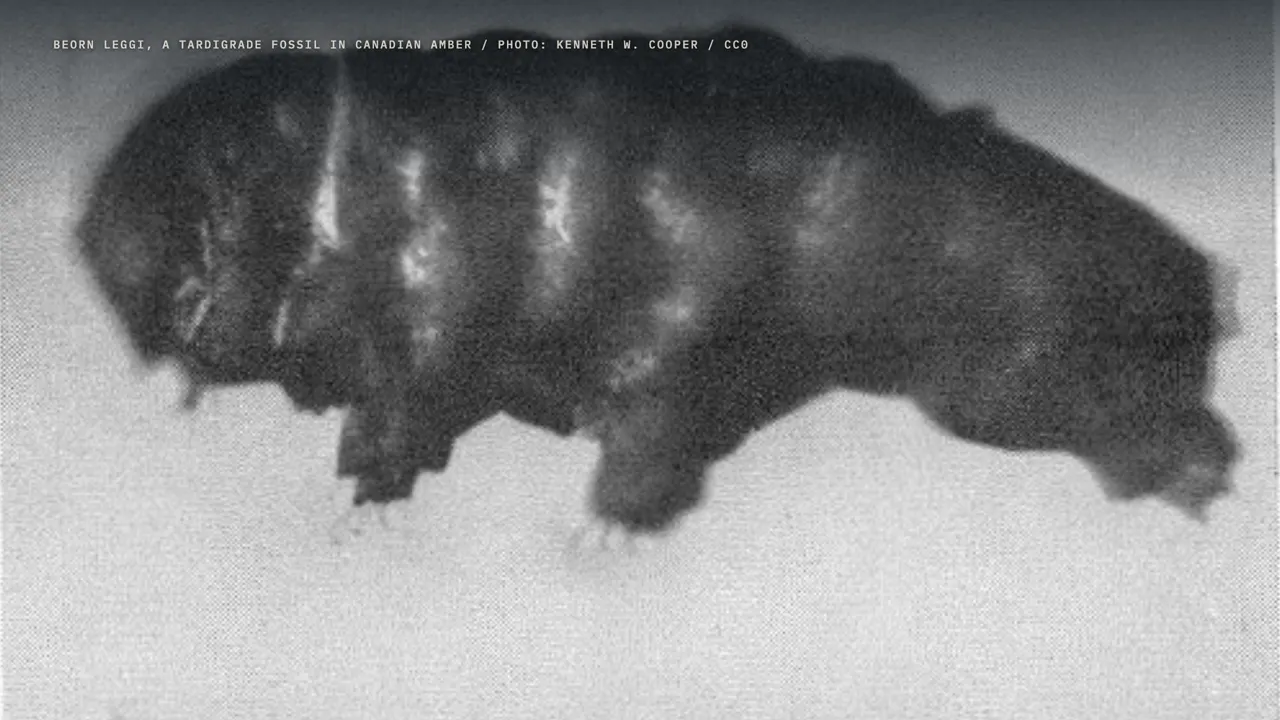
Tardigrades had lost the genes for a huge middle section, and almost the entire tardigrade body matches just the head of an insect. In other words, a tardigrade is mostly head, with legs. Their fossil record is tiny, and only a few have been found, mostly in amber. One from New Jersey, about 92 million years old, looks almost identical to a living species.
They can't walk far, but they get around. Researchers found tardigrades in seventy percent of the bird nests they checked, and on the bodies of birds. In one experiment, about a third of the tardigrades eaten by snails came out alive at the other end. Since many species need no males, a single dried female carried somewhere new could, in principle, start a population.
Not indestructible
So the tardigrade isn't indestructible. Its real talent is stopping: drying out, switching off and waiting, sometimes for decades, until the water comes back. Its radiation tolerance seems to be a side effect of that talent, shaped by drought in a cushion of moss, not by space. And the tools it uses to survive, a DNA shield, shapeless proteins and fast repair, are now being tested in human cells, in medicines and in mice.
Not bad for an animal that can die after a day at body temperature.
Watch on YouTube
Sources
- Jönsson et al. 2008: doi.org/10.1016/j.cub.2008.06.048
- Rizzo et al. 2015: doi.org/10.1155/2015/167642
- Horikawa et al. 2006: doi.org/10.1080/09553000600972956
- Beltrán-Pardo et al. 2015: doi.org/10.1371/journal.pone.0133658
- Clark-Hachtel et al. 2024: doi.org/10.1016/j.cub.2024.03.019
- Anoud et al. 2024: doi.org/10.7554/eLife.92621
- Li et al. 2024: doi.org/10.1126/science.adl0799
- Mattimore & Battista 1996: doi.org/10.1128/jb.178.3.633-637.1996
- Jönsson 2003: doi.org/10.1086/377743
- Neumann et al. 2009: doi.org/10.1016/j.cbpa.2009.04.611
- Saigo et al. 2025: doi.org/10.2108/zs240056
- Hashimoto et al. 2016: doi.org/10.1038/ncomms12808
- Chavez et al. 2019: doi.org/10.7554/eLife.47682
- Kirtane et al. 2025: doi.org/10.1038/s41551-025-01360-5
- Escarcega et al. 2023: doi.org/10.1016/j.mcn.2023.103826
- Packebush et al. 2023: doi.org/10.1038/s41598-023-31586-9
- Boothby et al. 2017: doi.org/10.1016/j.molcel.2017.02.018
- Hibshman et al. 2020: doi.org/10.3389/fphys.2020.592016
- Roszkowska et al. 2023: doi.org/10.1371/journal.pone.0270386
- Keilin 1959: doi.org/10.1098/rspb.1959.0013
- Shatilovich et al. 2023: doi.org/10.1371/journal.pgen.1010798
- Shmakova et al. 2021: doi.org/10.1016/j.cub.2021.04.077
- Hengherr et al. 2008: doi.org/10.1111/j.1469-7998.2008.00427.x
- Sieger et al. 2022: doi.org/10.1111/jzo.13018
- Tsujimoto et al. 2016: doi.org/10.1016/j.cryobiol.2015.12.003
- Neves et al. 2020: doi.org/10.1038/s41598-019-56965-z
- Saigusa et al. 2007 (JAXA): jaxa.repo.nii.ac.jp/record/13613
- Hagelbäck & Jönsson 2023: doi.org/10.3389/fphys.2023.1249773
- Traspas & Burchell 2021: doi.org/10.1089/ast.2020.2405
- Boothby et al. 2015: doi.org/10.1073/pnas.1510461112
- Koutsovoulos et al. 2016: doi.org/10.1073/pnas.1600338113
- Smith et al. 2016: doi.org/10.1016/j.cub.2015.11.059
- Kihm et al. 2023: doi.org/10.1073/pnas.2211251120
- Mapalo et al. 2024: doi.org/10.1038/s42003-024-06643-2
- Mogle et al. 2018: doi.org/10.7717/peerj.5035
- Vuori et al. 2022: doi.org/10.1002/ecy.3702
- Beresheet payload: earthsky.org (14 Aug 2019); thespacereview.com/article/3783/1
Images and video
- CC BY-SA 4.0: Andrei Savitsky, Bob Blaylock, Brandon Antonio Segura Torres & Priscilla Vieto Bonilla, Carloszelayeta, Dmitry Brant, Hashimoto et al. 2016, Hnapel, Hoddyfool, James K. Douch, Juan Carlos Fonseca Mata, Matteo Pasotti, PacatoWinters, Roberto Guidetti, Swimmaaj, TaBaZzz
- CC BY-SA 3.0 de: Frank Fox
- CC BY-SA 2.0: marsupium photography
- CC BY 4.0: Alexander Klepnev, Andrei Savitsky, Halberg, Jørgensen & Møbjerg 2013, Neves et al. 2020, Polishchuk et al., Retro Lenses, Robert Martin, Roland et al., Ruby1846, Stec, Arakawa & Michalczyk 2018, Vader1941
- CC BY 3.0: Keith
- CC BY 2.5: Schokraie et al. 2012
- CC BY 2.0: Charlie Marshall, James St. John, Philippe Garcelon, Understanding Animal Research
- CC0: Adrian James Testa, Han Zeng, Kenneth W. Cooper, Museum of Cosmonautics, jensu
- Public domain: E de Laplante, Jan Verkolje, Johann August Ephraim Goeze, Michael Daly (USUHS), NASA, NASA/Amber Jean Watson, NASA/GSFC/Arizona State University, NASA/Jack Pfaller, Scott Kelly, Steffen Janke
- The narration is a synthetic voice. Images labeled "Generated illustration" on screen (for example the drying moss, the shapeless proteins, Dsup on DNA, the gas gun lab, the lab mouse and the Cambrian lobopodian) are AI-generated illustrations, not records. Charts marked "schematic" show the shape of a published result, not the underlying data.