What Makes Your Knuckles Crack?
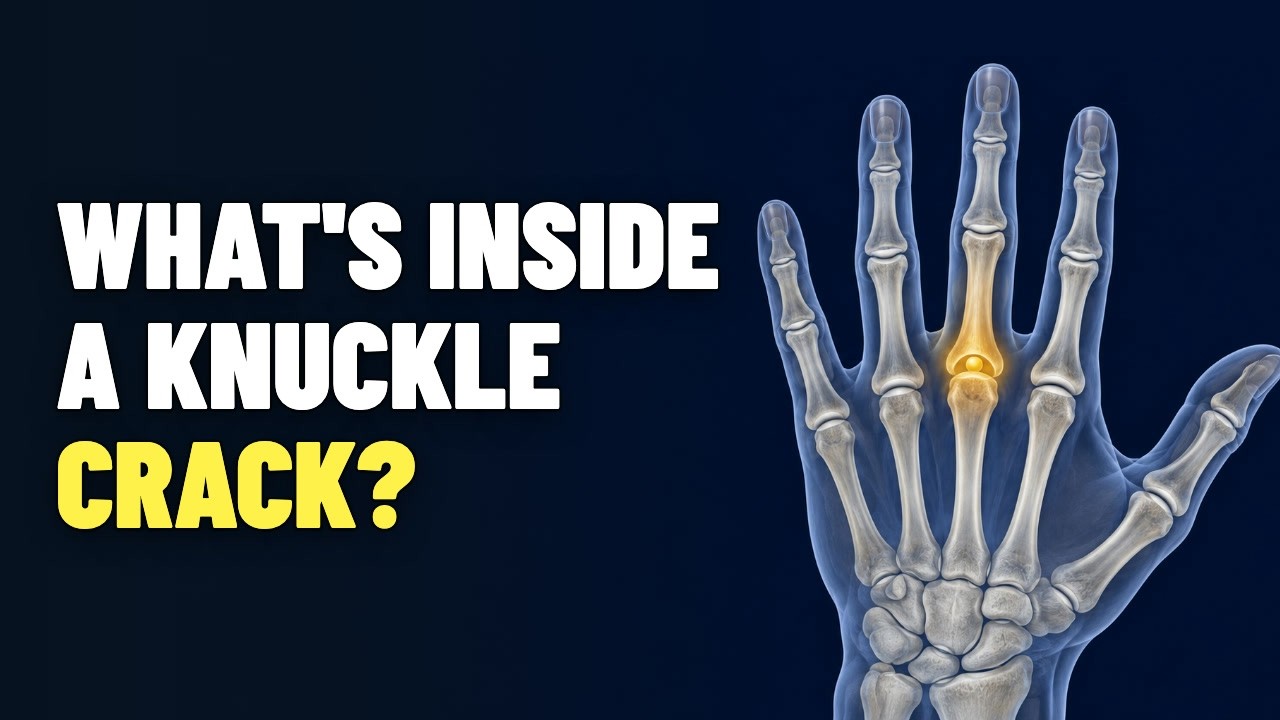
What is the crack you hear when you pull a finger? In 1947, researchers used X-rays to study knuckle cracking and linked the sound to a gas pocket forming in the joint. In 1971, another team proposed that the sound came from that bubble collapsing. In 2015, a team in Canada filmed a knuckle cracking inside an MRI scanner: the pocket appeared and stayed visible while the finger was still being pulled. In 2018, a mathematical model suggested that a partial collapse could still make the sound. Then there's the warning about arthritis. For 50 years, doctor Donald Unger cracked his left-hand knuckles at least twice a day, while his right hand cracked only rarely.
This article is the full narration of the video. Watch on YouTube
The crack
Pull a finger, bend it back, and the knuckle gives with a sharp crack. Somewhere between a quarter and almost half of people do it on purpose, and scientists have argued since the 1940s about where the sound comes from. In 2015, a team in Canada slid a man's finger into an MRI scanner, pulled on it
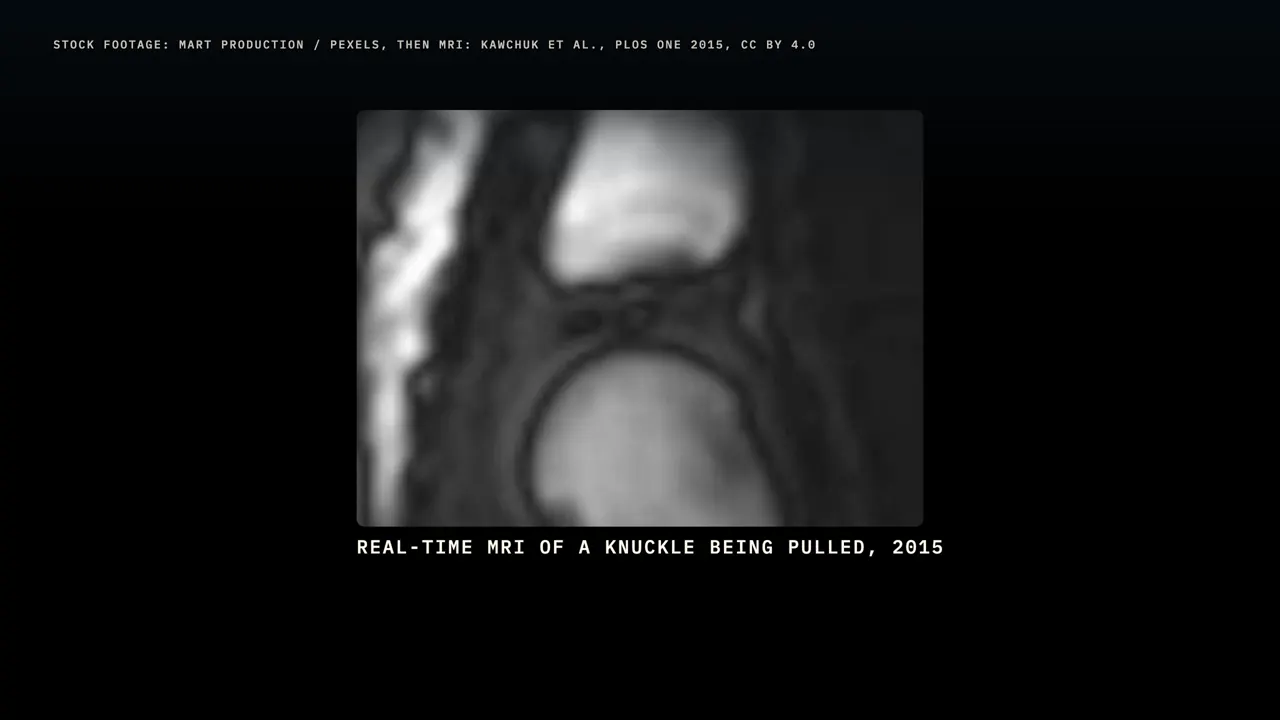
with a cable, and filmed the inside of his knuckle at the moment it cracked. What they saw contradicted the explanation in most textbooks, and three years later a set of equations pushed back. And the warning you probably heard as a kid, that it gives you arthritis, was tested by a doctor who cracked the knuckles of only one hand for fifty years.
Inside a knuckle
The knuckles most people crack are the joints where the fingers meet the hand. In each one, the rounded end of a hand bone sits against a shallow cup at the base of the finger. Both surfaces are covered in smooth cartilage, and the whole joint is sealed inside a capsule. Inside that capsule is a thin layer of synovial fluid, a slippery liquid that lets the joint move.
That fluid also holds dissolved gas, a bit like a sealed can of soda holds carbon dioxide. Pull the two bones apart, and the space inside the capsule has to get bigger. The fluid can't stretch to fill it, so its pressure drops. Drop the pressure far enough, and gas comes out of the liquid, like the bubbles that appear when you open the can.
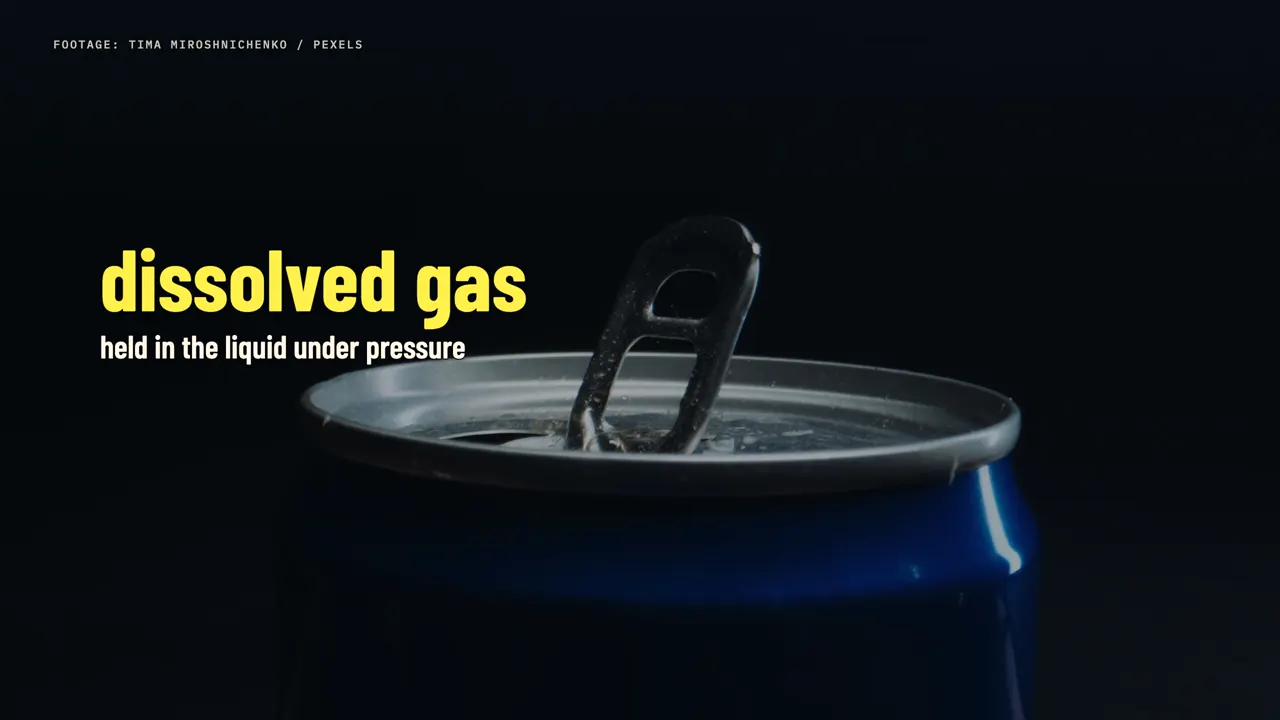
Almost every researcher agrees on that part: a pocket of gas forms inside the joint. The argument is about which moment makes the noise.
The X-ray answer
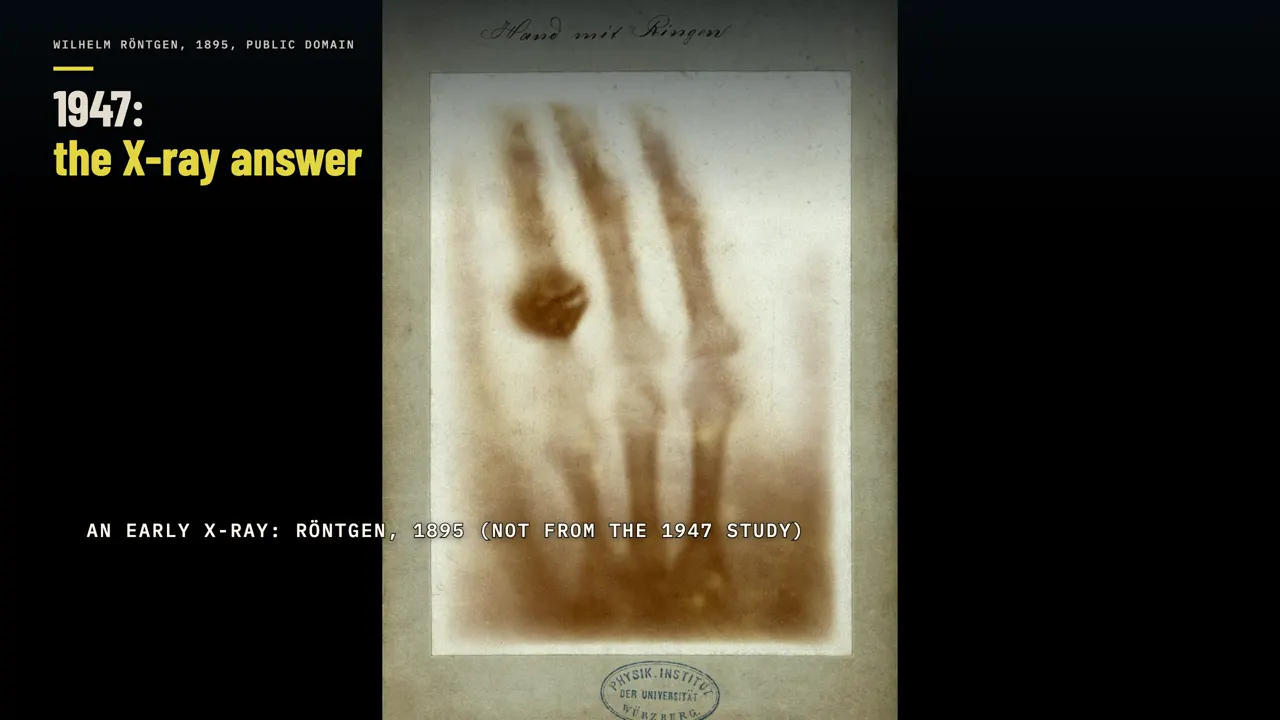
The first careful attempt to answer that came in 1947. Two researchers, Roston and Wheeler Haines, pulled on fingers and took a series of X-rays as the joint gave way. They described the same sequence of events leading up to a crack. At first, the joint surfaces stay pressed together, and a light pull barely moves them.
As the pull gets stronger, the surfaces resist, and resist, until they suddenly jump apart. That jump is when you hear the crack. Afterwards, the X-rays showed a clear space inside the joint, which they took to be a pocket of gas. Then came the part everyone who cracks their knuckles already knows: the same joint won't crack again right away.
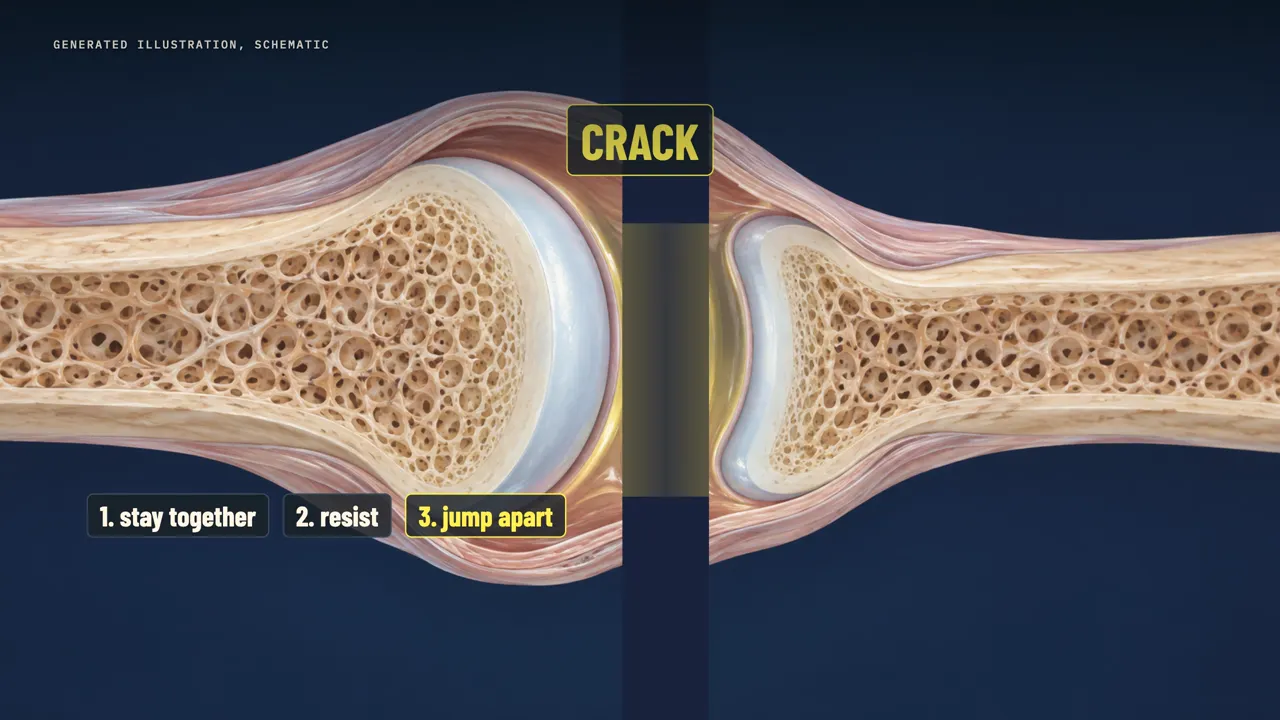
The wait was about twenty minutes. Roston and Wheeler Haines concluded that the sound comes from the moment the gas pocket forms. That explanation stood for twenty four years.
A bubble that bursts
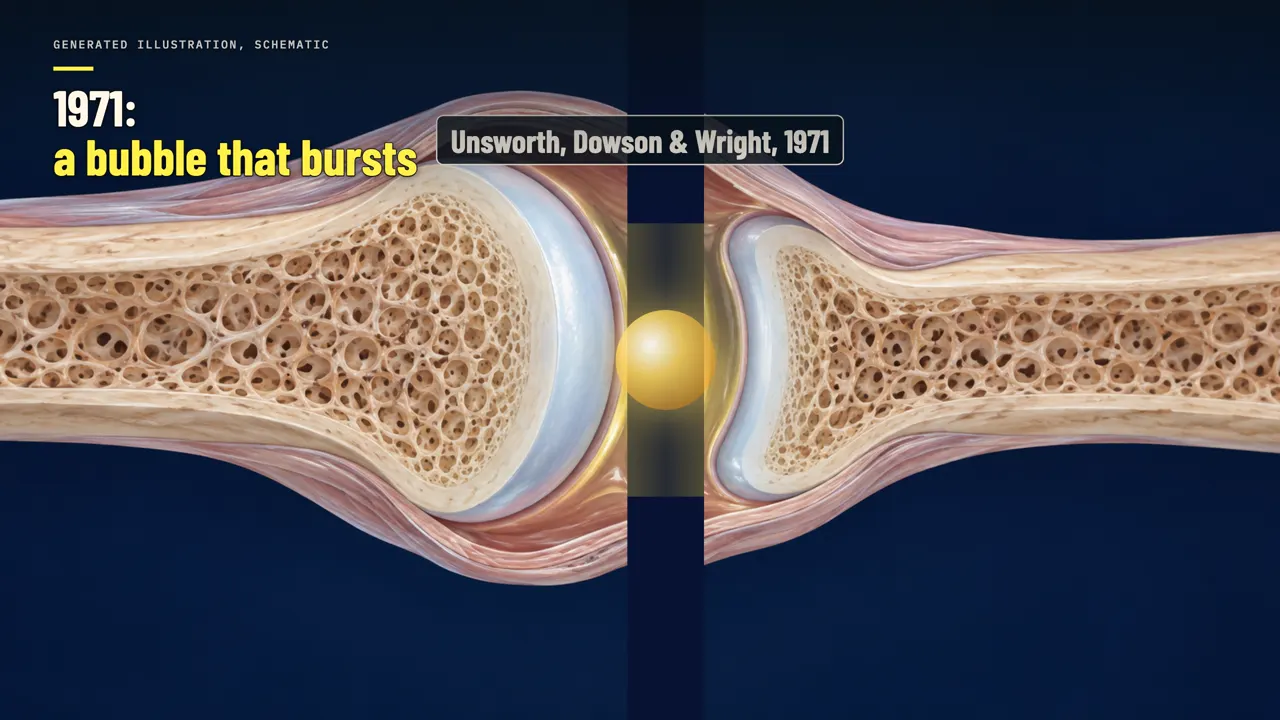
In 1971, Unsworth, Dowson and Wright repeated the X-ray experiment. They saw the same sequence, but they came to a different conclusion. The sound, they argued, comes not from the bubble forming, but from the bubble collapsing. That idea had a lot of physics behind it.
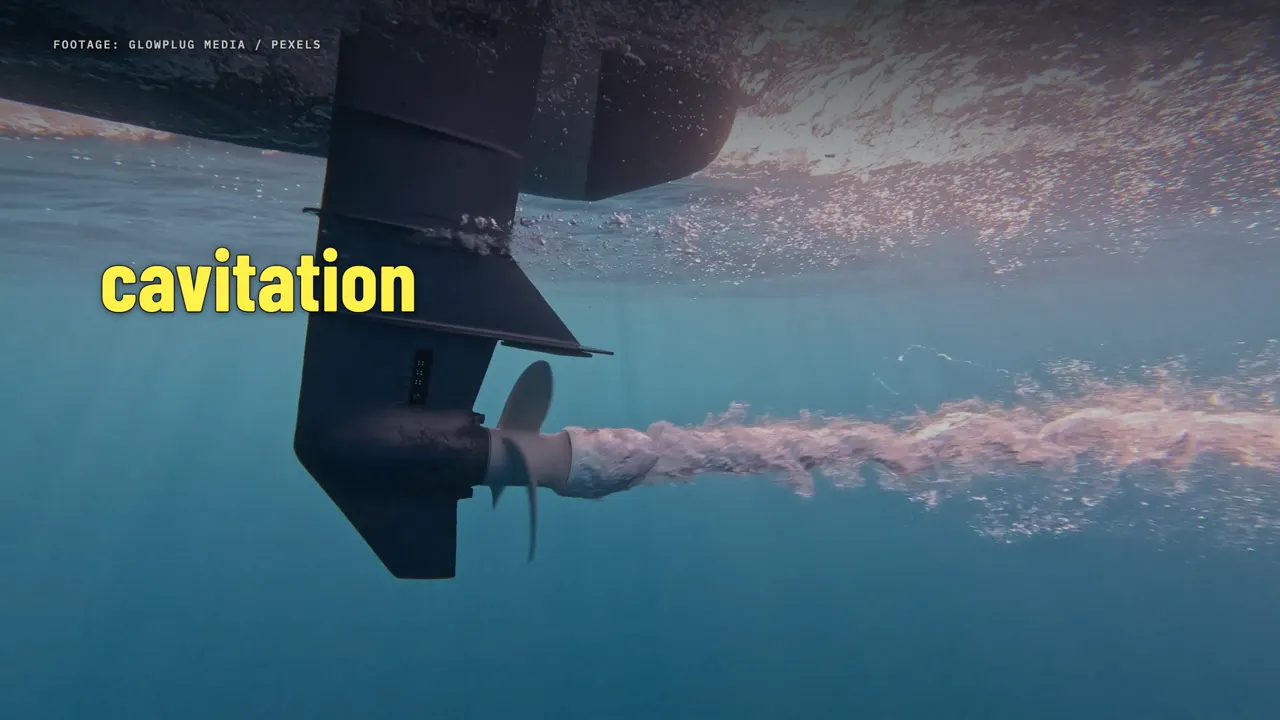
Lord Rayleigh had described in 1917 how a bubble collapsing in a liquid releases a sudden burst of energy. By the late 1960s, engineers were finding that those collapses could eat away the metal of ship propellers. Engineers call this cavitation: bubbles forming and collapsing in a liquid. A knuckle crack as a tiny version of the same thing seemed to make sense.
The 1971 team also found that the gas in the joint was about eighty percent carbon dioxide. And their idea explained the twenty minute wait: the gas needs time to dissolve back into the fluid. For more than forty years, bubble collapse was the textbook answer. But no one had directly seen a bubble collapse inside a cracking joint.
X-rays were too slow and too blurry to show what the bubble did at the instant of the sound.
Filmed inside the joint
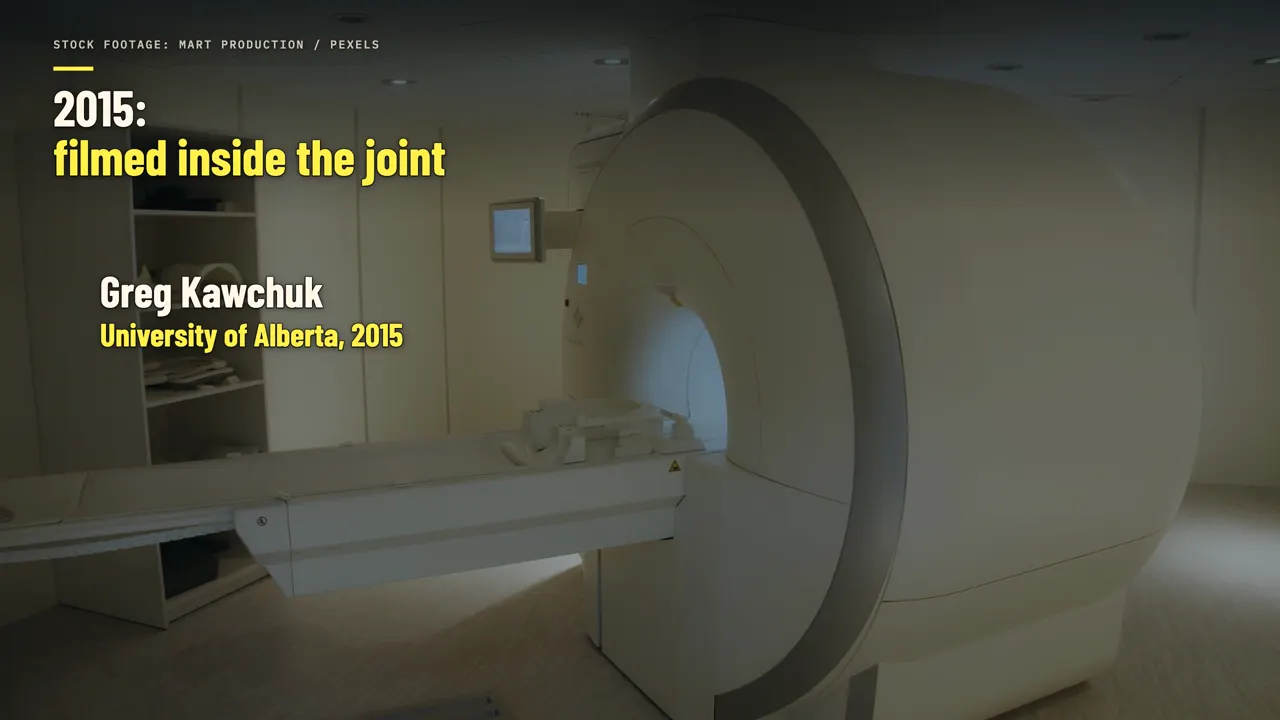
In 2015, Greg Kawchuk at the University of Alberta tried a different camera. His co-author, a chiropractor named Jerome Fryer, could crack his finger joints on demand. Fryer lay in an MRI scanner with one finger held in a tube, tied to a cable. On the other side of the magnet, someone pulled slowly on the cable until the joint cracked.
The scanner took about three pictures a second, enough for a rough movie of the inside of the joint. They did this on ten different knuckles. This is what they saw. At first, the two bone ends stay together while the cable pulls.
Then, within a third of a second, they jump apart, and a dark space appears between them. That dark space is the gas. And here is the important part: after the crack, the dark space did not go away. As long as the finger stayed pulled, the pocket stayed there.
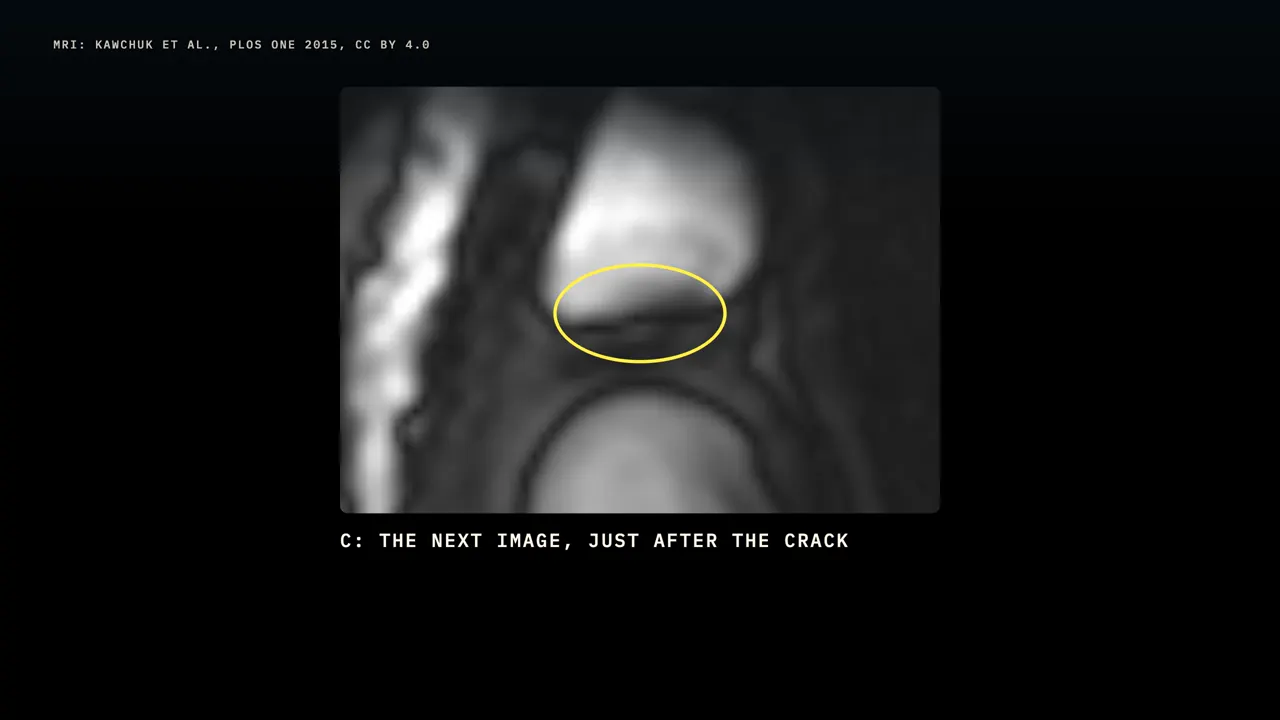
It disappeared from the scan once they let go and the bones came back together. To the team, a pocket that was still there after the sound argued against the collapse idea. So Kawchuk's team argued the crack comes from the pocket forming, just as Roston and Wheeler Haines had said in 1947. Two wet surfaces cling together, then separate so suddenly that the fluid between them tears open into a cavity.
Headlines announced that the mystery was solved.
The equations push back
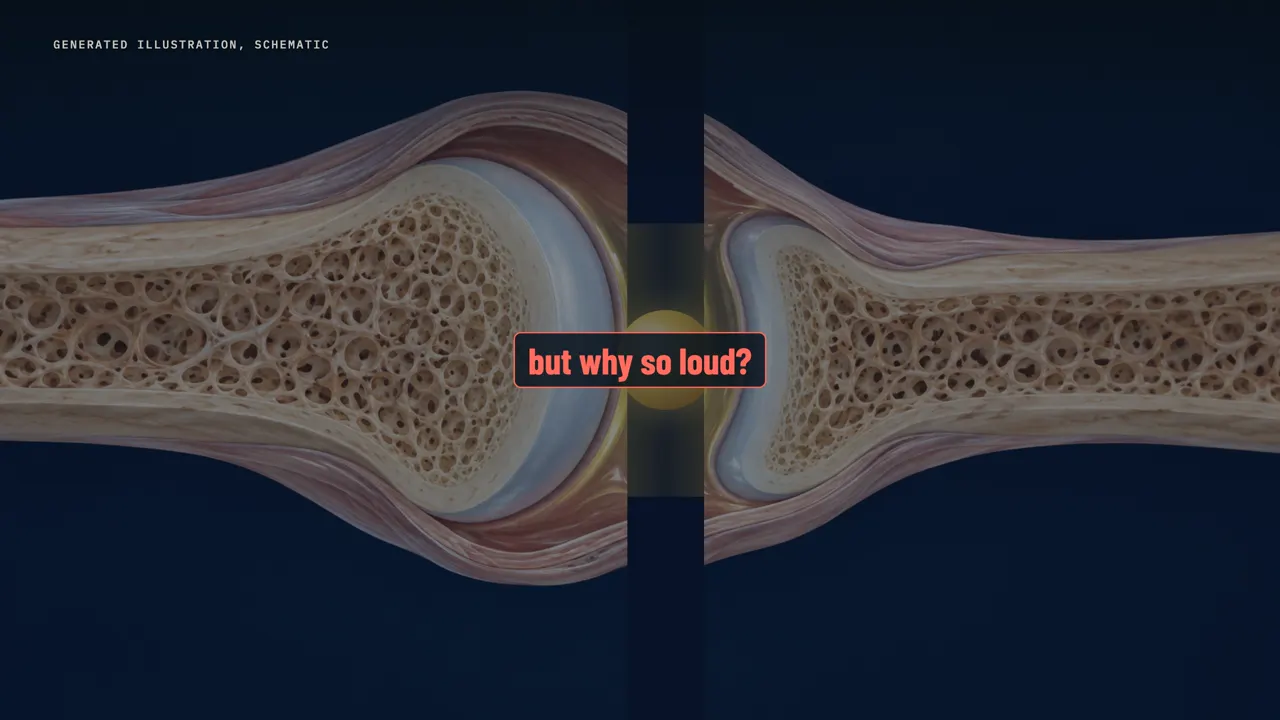
It wasn't quite. A pocket simply opening up did not explain how loud the crack is. In 2018, two engineers, Chandran Suja at Stanford and Barakat at a research lab near Paris, tried to calculate the sound from the physics. They wrote equations for a knuckle joint pulling apart, and for a bubble in the fluid inside it.
They also recorded real cracks from three volunteers, with a microphone less than a centimeter from the knuckle. In their model, almost all of the pressure change happens within a hundredth of a second. Their equations start just after the pressure has dropped and a bubble has formed. Then the pressure starts to rise again, squeezes the bubble, and the bubble starts to collapse.
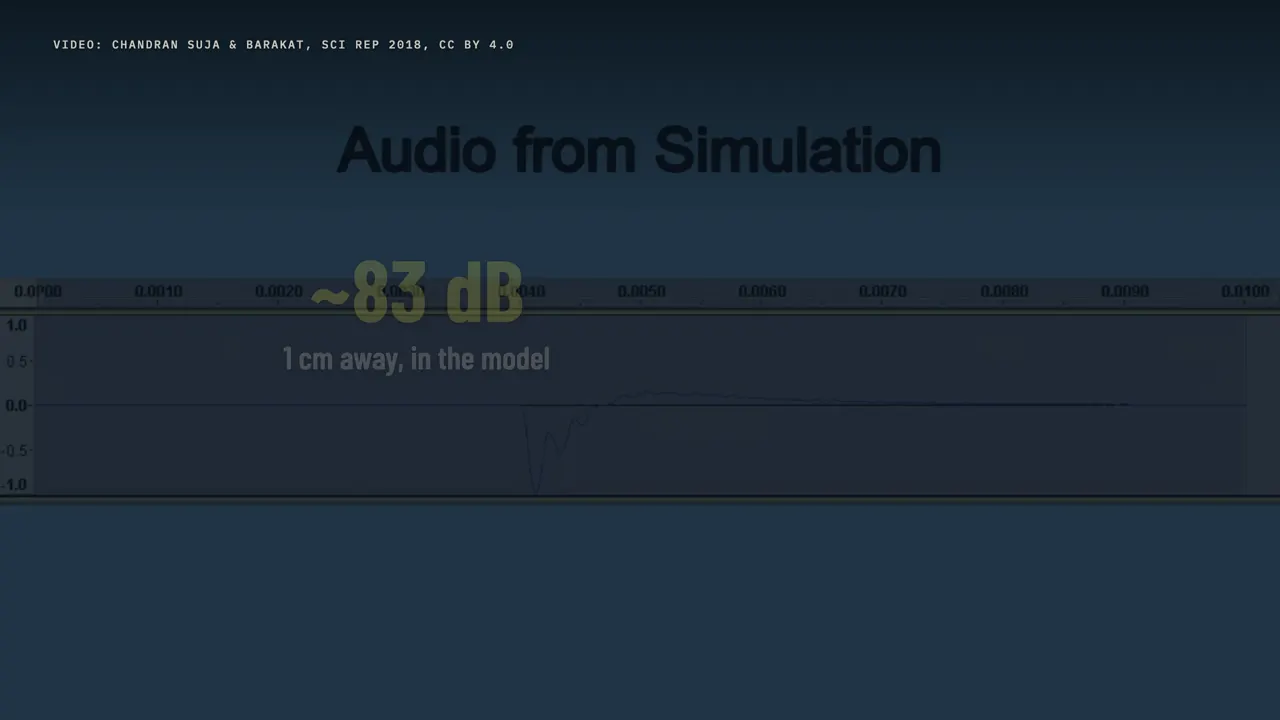
That collapse produced a sound of about 83 decibels one centimeter away, with a main pitch around 130 hertz. That was close to earlier measurements, and the main pulse looked like their own recordings. But in the model, the bubble never collapsed all the way. It shrank only part of the way, and a smaller bubble was left behind.
That leftover bubble could be the dark space the MRI kept seeing after the crack. So the 2018 paper makes the case that a partial collapse could be the source of the sound. The MRI took about three pictures a second, far too slow to see those rapid changes in the bubble. The paper says you'd need at least 1,200 pictures a second, hundreds of times faster than that MRI.
Right after the crack
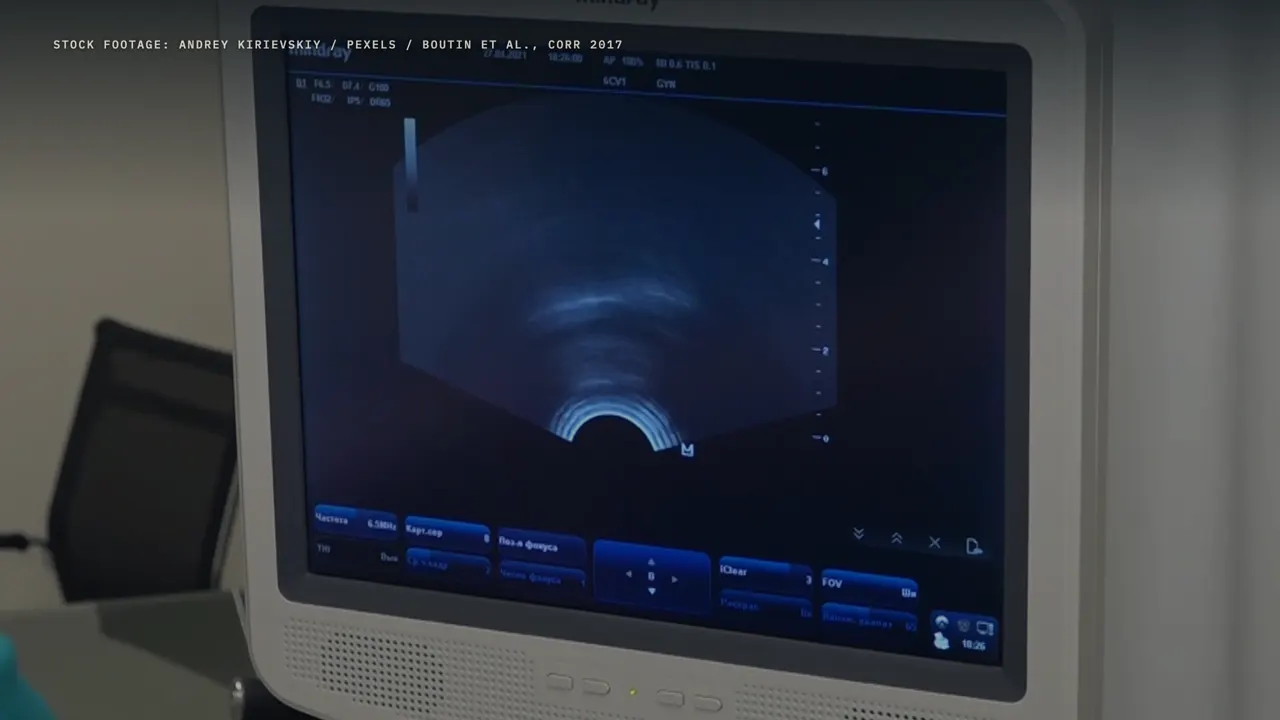
What happens after the crack is easier to check. In 2017, a team led by Robert Boutin looked at 400 knuckles from 40 adults with ultrasound, and 30 of those adults cracked their knuckles every day. When a knuckle cracked, a bright spot suddenly appeared inside the joint on the screen. When an examiner moved those joints right after a crack, their total range of motion was about eight degrees greater.
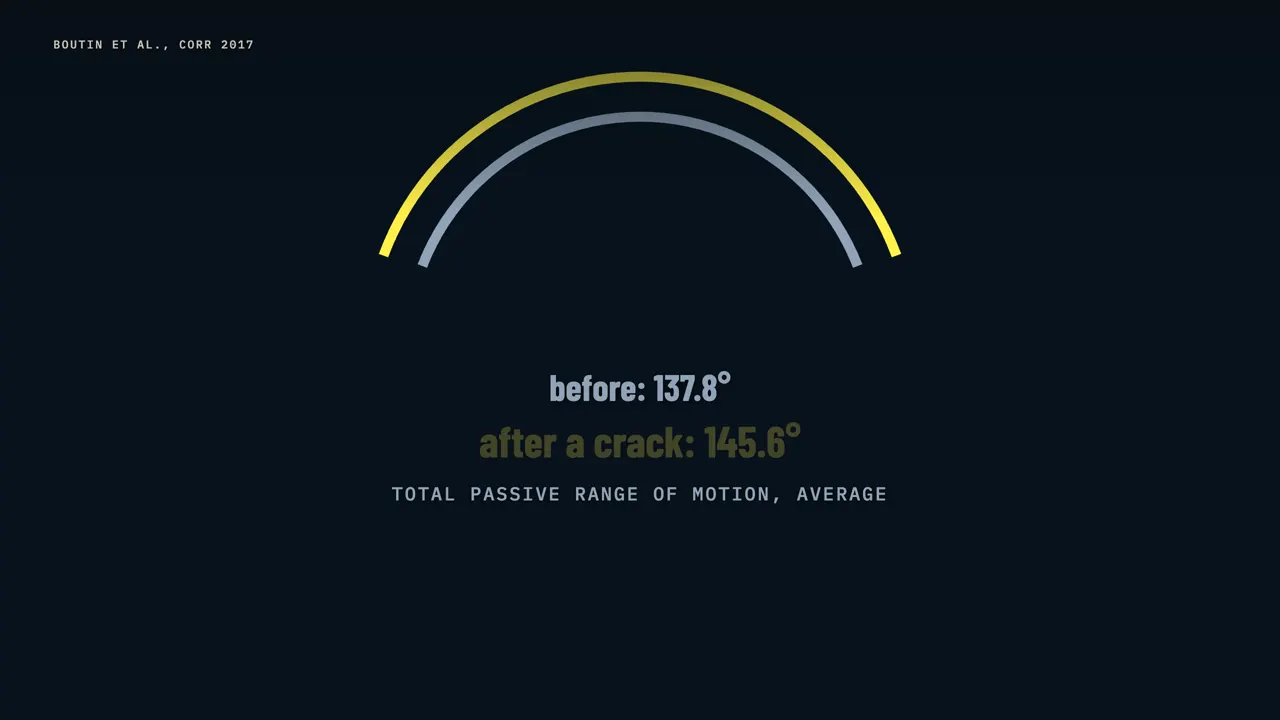
None of the joints swelled up, before or after. So the joints moved further right after a crack, though that alone says nothing about long-term harm.
The warning
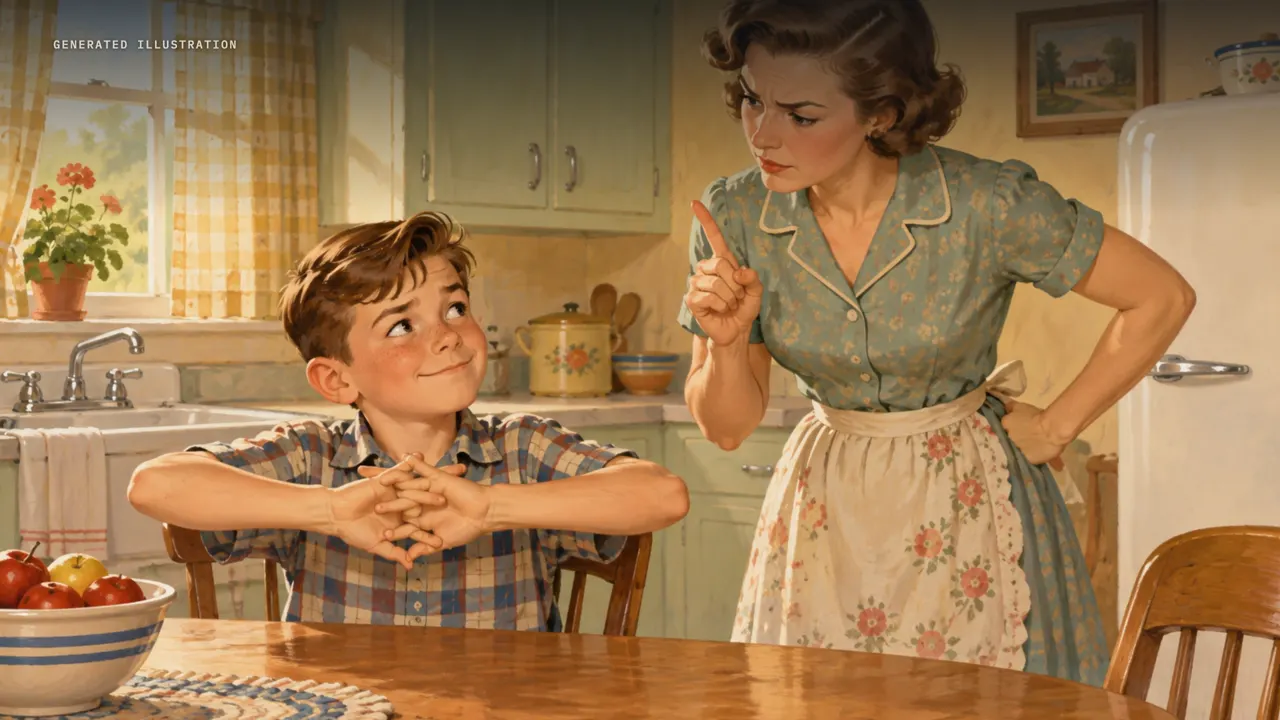
Which brings us to the warning. Donald Unger, a doctor in California, heard it as a child from his mother, several aunts, and later his mother-in-law. So he ran an experiment on himself. For fifty years, he cracked the knuckles of his left hand at least twice a day, while the knuckles of his right hand cracked only rarely, as a control.
By his count, that's at least 36,500 cracks on one side. In 1998 he reported the result in a letter to the journal Arthritis & Rheumatism. Neither hand had arthritis, and he couldn't find any difference between them. In 2009, that letter won him an Ig Nobel Prize in medicine, an award for research that makes people laugh and then think.
Of course, one man with two hands isn't proof. But larger studies mostly come out the same way. A 1975 survey of older patients found no link between knuckle cracking and wear in those joints. In 2011, a study of 215 people aged 50 to 89 compared their hand X-rays with their cracking habits.
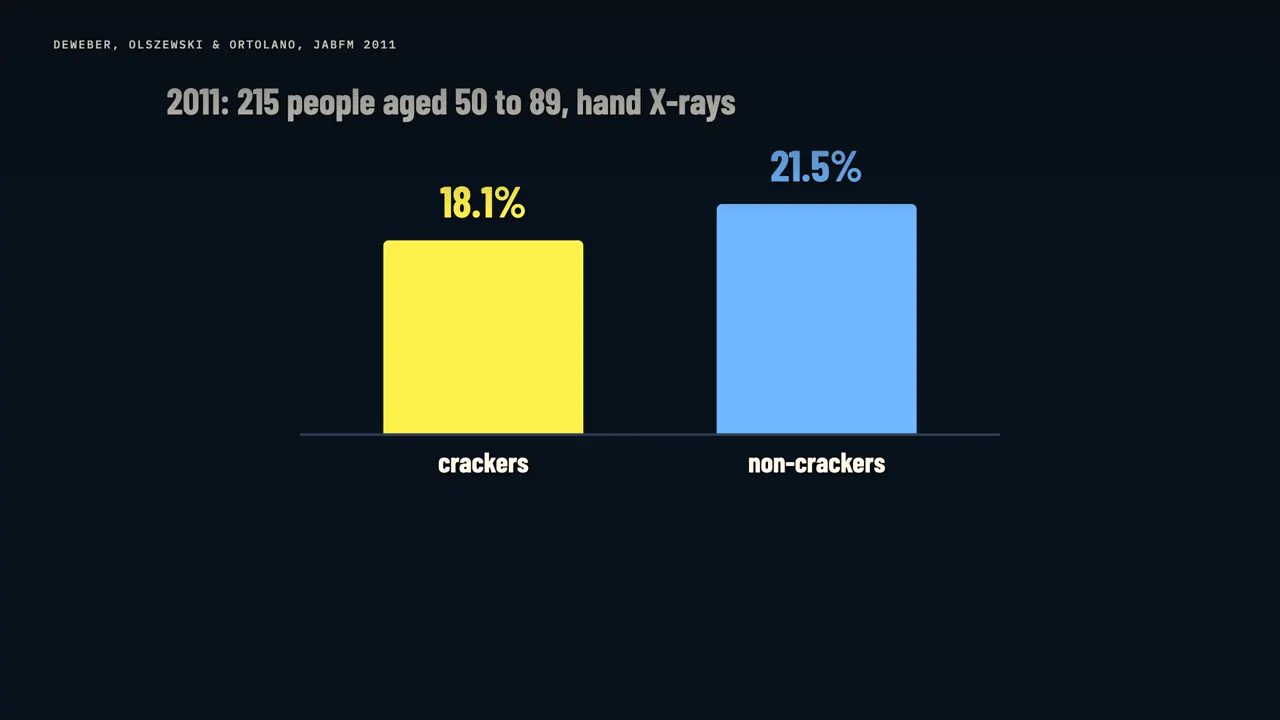
Arthritis showed up in about 18 percent of the knuckle crackers and 22 percent of the others, a gap too small to mean anything statistically. Even people who had cracked often for decades showed no higher risk. One study did raise concerns. In 1990, a survey of 300 patients aged 45 and over found no extra arthritis, but the crackers were more likely to have swollen hands and a weaker grip.
Later studies did not find the same problems with swelling or grip. The 2017 ultrasound study found no difference in grip strength between crackers and non-crackers, and no swelling at all. Another 2017 study compared 35 habitual crackers with 35 people who didn't crack, and found similar grip strength but thicker cartilage in the crackers' knuckles.
What that thicker cartilage means, if anything, is still unknown. There is also a 1999 report of two injuries linked to knuckle cracking.
So what is the sound?
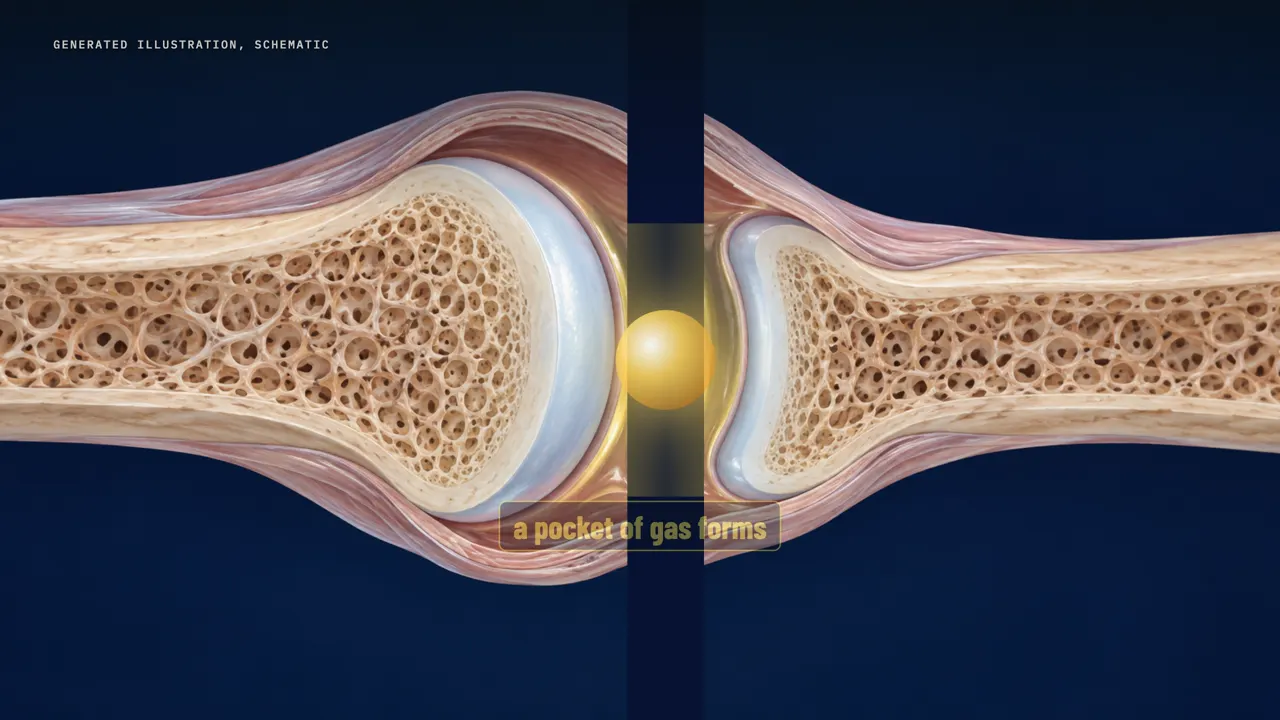
So, what is that sound? We know a pocket of gas forms in the fluid of your joint as the two surfaces pull apart. Whether the snap comes from the pocket opening, or from it partly closing again, is still being argued. As for arthritis, the studies so far have not found a link with knuckle cracking.
If you cracked a knuckle while watching this, you'll probably have to wait about twenty minutes before that same joint cracks again.
Watch on YouTube
Sources
- G. Kawchuk et al., "Real-Time Visualization of Joint Cavitation", PLoS ONE 10(4), 2015: https://doi.org/10.1371/journal.pone.0119470
- V. Chandran Suja, A. I. Barakat, "A Mathematical Model for the Sounds Produced by Knuckle Cracking", Scientific Reports 8, 2018: https://doi.org/10.1038/s41598-018-22664-4
- R. D. Boutin et al., "'Knuckle Cracking': Can Blinded Observers Detect Changes with Physical Examination and Sonography?", Clinical Orthopaedics and Related Research 475(4), 2017: https://pubmed.ncbi.nlm.nih.gov/28050816/
- D. L. Unger, "Does knuckle cracking lead to arthritis of the fingers?", Arthritis & Rheumatism 41(5), 1998: https://pubmed.ncbi.nlm.nih.gov/9588755/
- R. L. Swezey, S. E. Swezey, "The consequences of habitual knuckle cracking", Western Journal of Medicine 122(5), 1975: https://pubmed.ncbi.nlm.nih.gov/1130029/
- K. deWeber, M. Olszewski, R. Ortolano, "Knuckle cracking and hand osteoarthritis", Journal of the American Board of Family Medicine 24(2), 2011: https://pubmed.ncbi.nlm.nih.gov/21383216/
- J. Castellanos, D. Axelrod, "Effect of habitual knuckle cracking on hand function", Annals of the Rheumatic Diseases 49(5), 1990: https://pubmed.ncbi.nlm.nih.gov/2344210/
- M. T. Yildizgoren et al., "Effects of habitual knuckle cracking on metacarpal cartilage thickness and grip strength", Hand Surgery and Rehabilitation 36(1), 2017: https://pubmed.ncbi.nlm.nih.gov/28137441/
- P. S. Chan, D. R. Steinberg, D. J. Bozentka, "Consequences of knuckle cracking: a report of two acute injuries", American Journal of Orthopedics 28(2), 1999: https://pubmed.ncbi.nlm.nih.gov/10067714/
Images and video
- Cine MRI video and figures: Kawchuk et al. 2015, CC BY 4.0
- Waveform video: Chandran Suja & Barakat 2018, CC BY 4.0
- First medical X-ray, Wilhelm Röntgen, 1895, public domain
- Lord Rayleigh, photograph by Elliott & Fry, Wellcome Collection, CC BY 4.0
- Cavitation propeller damage, Erik Axdahl, CC BY-SA 2.5
- Hand bones, Gray's Anatomy, public domain
- Stock video from Pexels: cottonbro studio, Kindel Media, MART PRODUCTION, Tima Miroshnichenko, K, Glowplug Media, Andrey Kirievskiy
- The narration is a synthetic voice. The joint cross-section, see-through hand, two hands, kitchen scene and grip meter are AI-generated illustrations, not photographs or recordings of the experiments. Diagrams marked "schematic" show the idea of a published result, not its data.