How Does Anesthesia Switch Off Your Mind?
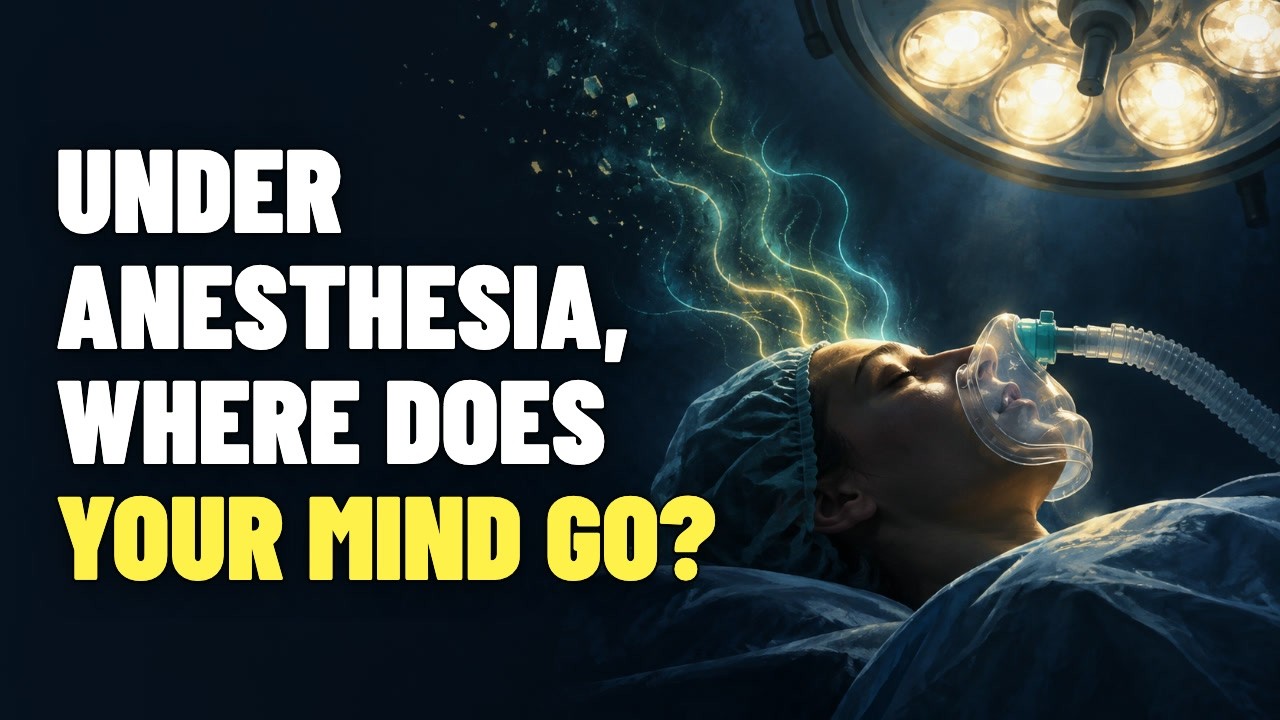
Every year, hundreds of millions of operations rely on general anesthesia, and the first public demonstration took place 180 years ago this October. Yet science still can't fully explain how these drugs switch consciousness off, or how it comes back.
This video walks through what is known: the 1846 ether demonstration in Boston, the olive oil rule that pointed early researchers to fat, the receptor targets of propofol, ketamine and xenon, why anesthesia is closer to a reversible coma than to sleep, how brain waves break into isolated islands, a thalamic "switch" that woke anesthetized monkeys, why the way back is not the way in, and the disputed clues from flytraps, fat clusters and microtubules.
This article is the full narration of the video. Watch on YouTube
Where does the mind go?
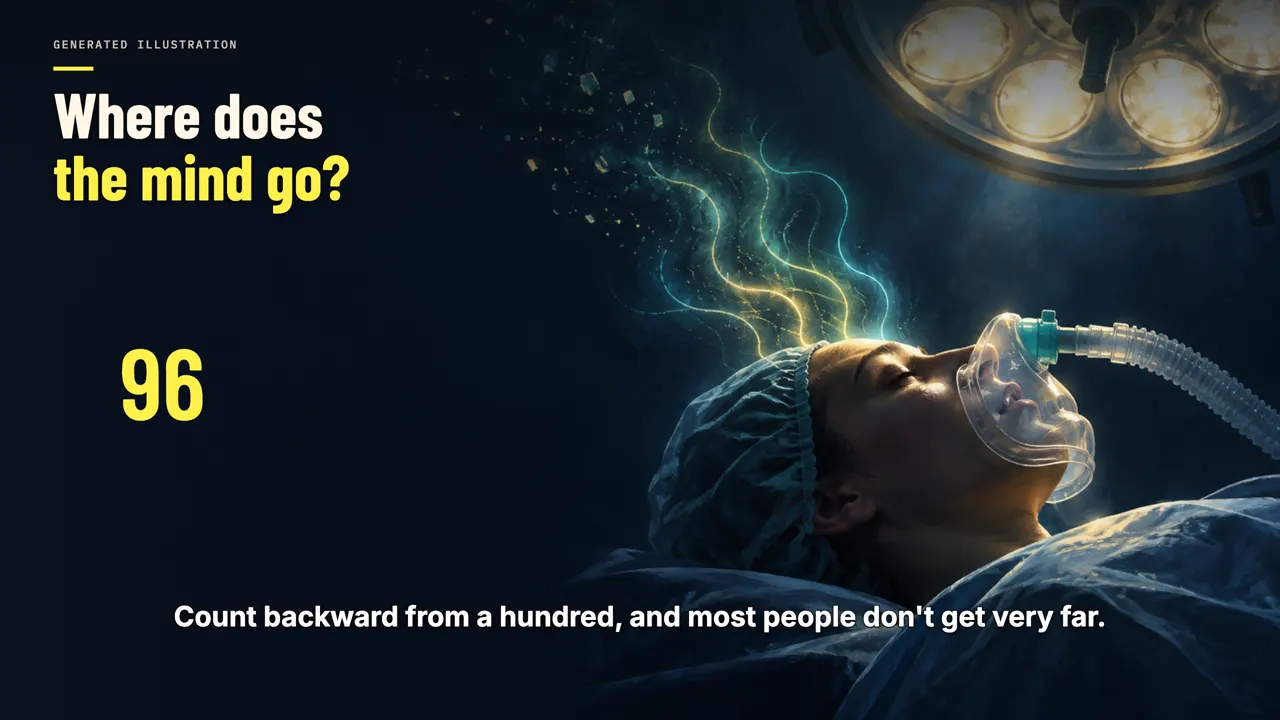
Count backward from a hundred, and most people don't get very far. On a brain monitor, the fast, busy rhythm of an awake brain gives way to slow, rolling waves. The patient isn't asleep, won't feel the surgery, and won't remember any of it. Every year, hundreds of millions of operations rely on drugs like this one.
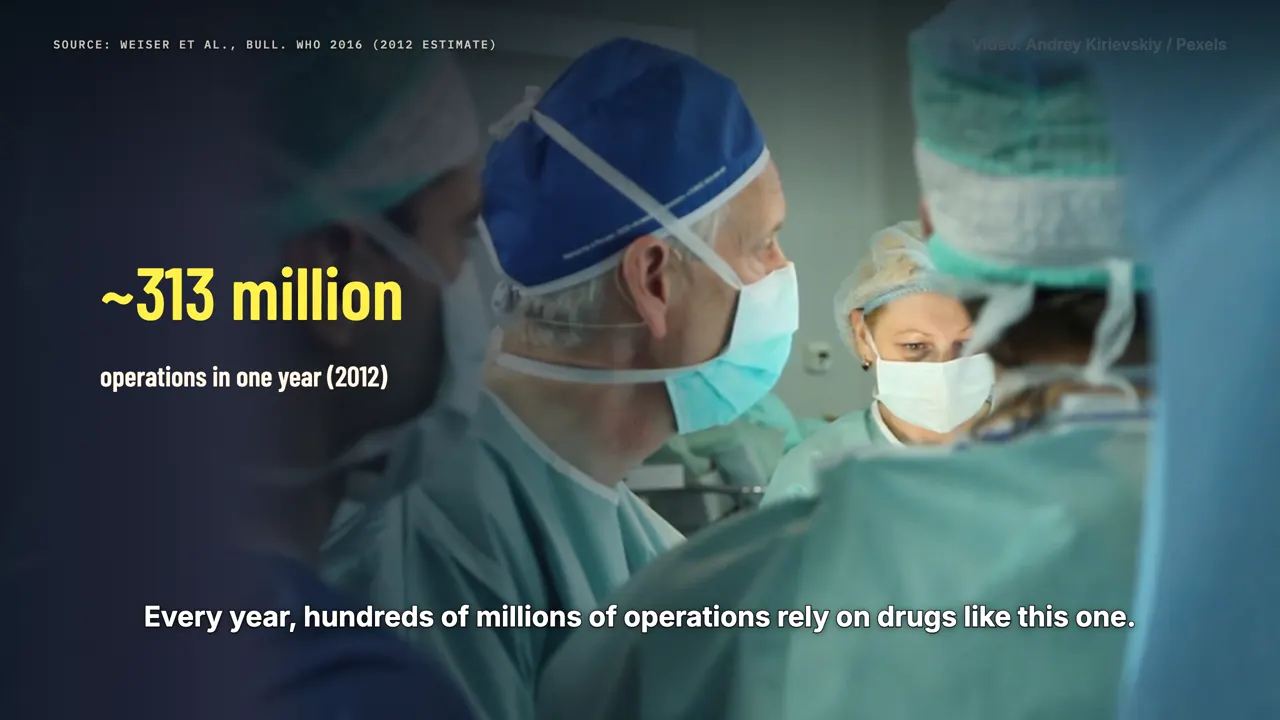
The first public demonstration was 180 years ago this October. And yet nobody can fully explain how these drugs switch the mind off, or how it switches back on. So what do scientists actually know, and where does the map run out?
No humbug
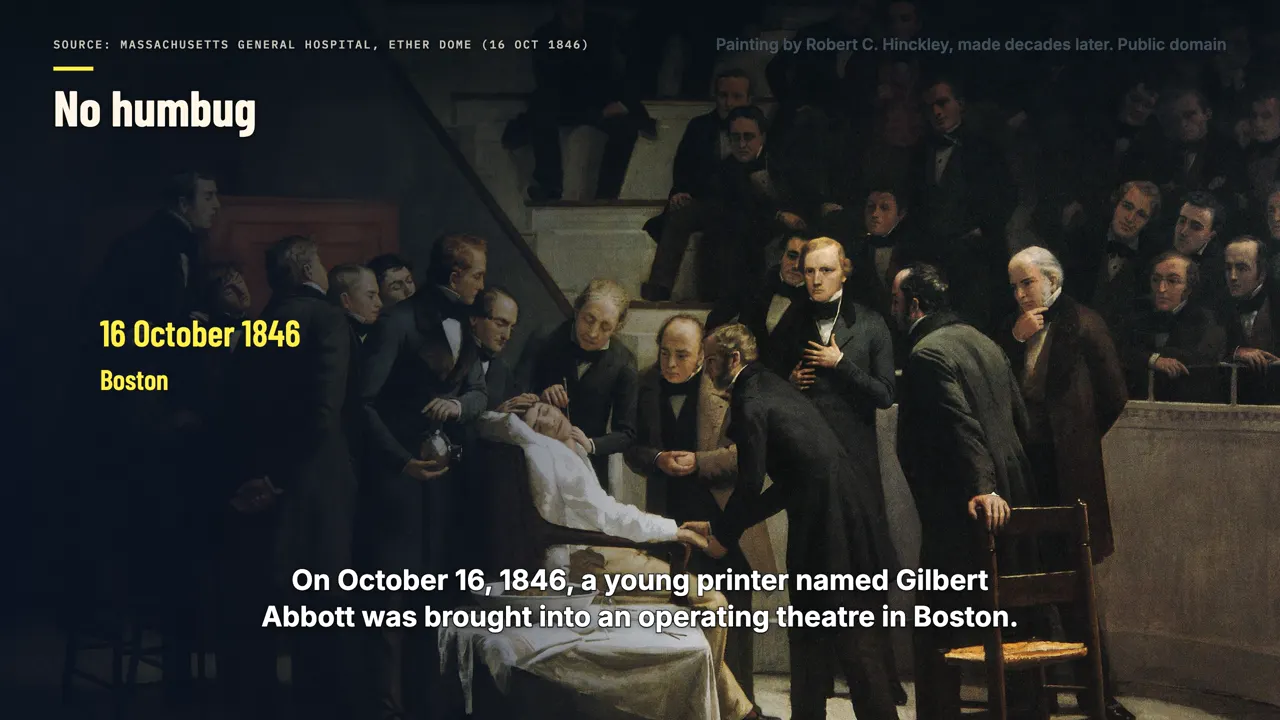
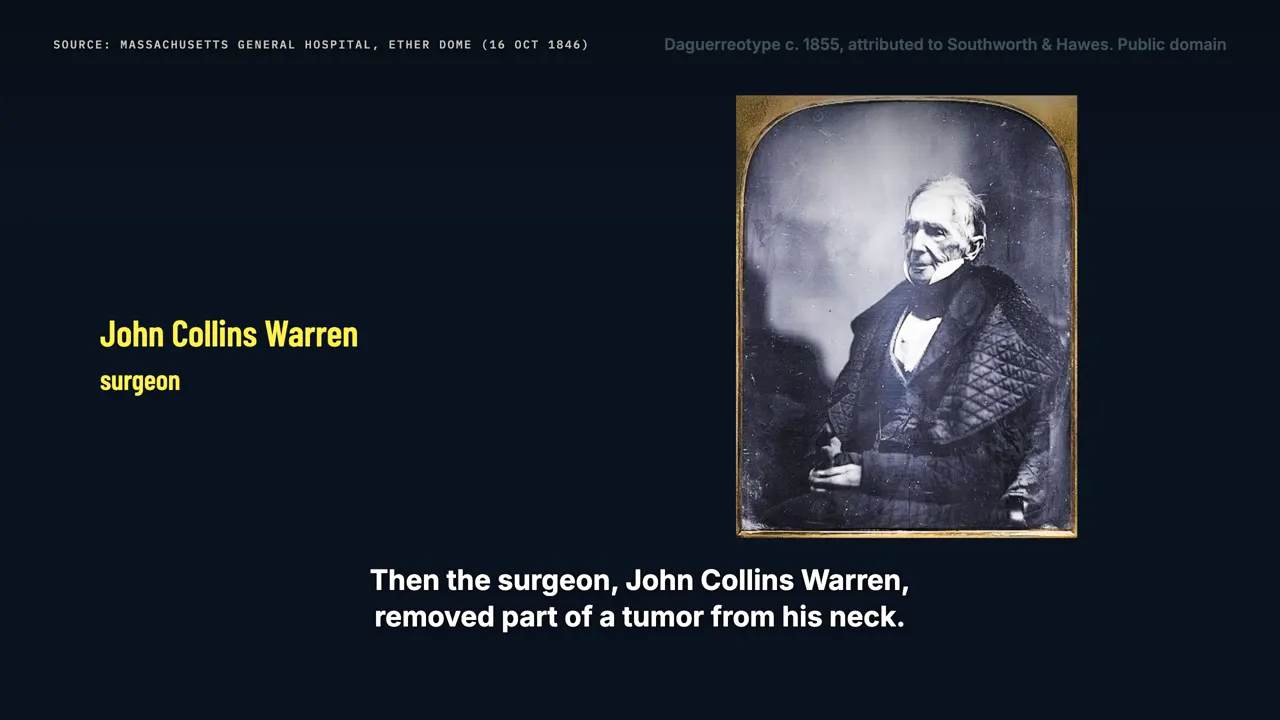
On October 16, 1846, a young printer named Gilbert Abbott was brought into an operating theatre in Boston. A dentist, William Morton, had him breathe ether vapor from a glass inhaler. Then the surgeon, John Collins Warren, removed part of a tumor from his neck. Warren reportedly turned to the watching doctors and said, gentlemen, this is no humbug.
News of it spread quickly across America and Europe. But no one in that room had any idea how it worked.
The olive oil clue

The first real clue came around 1900, from two scientists working separately, Hans Meyer and Charles Overton. Overton measured how much of each chemical it took to stop tadpoles from swimming. Then he compared that with how easily each chemical dissolved in olive oil. The two lists lined up.
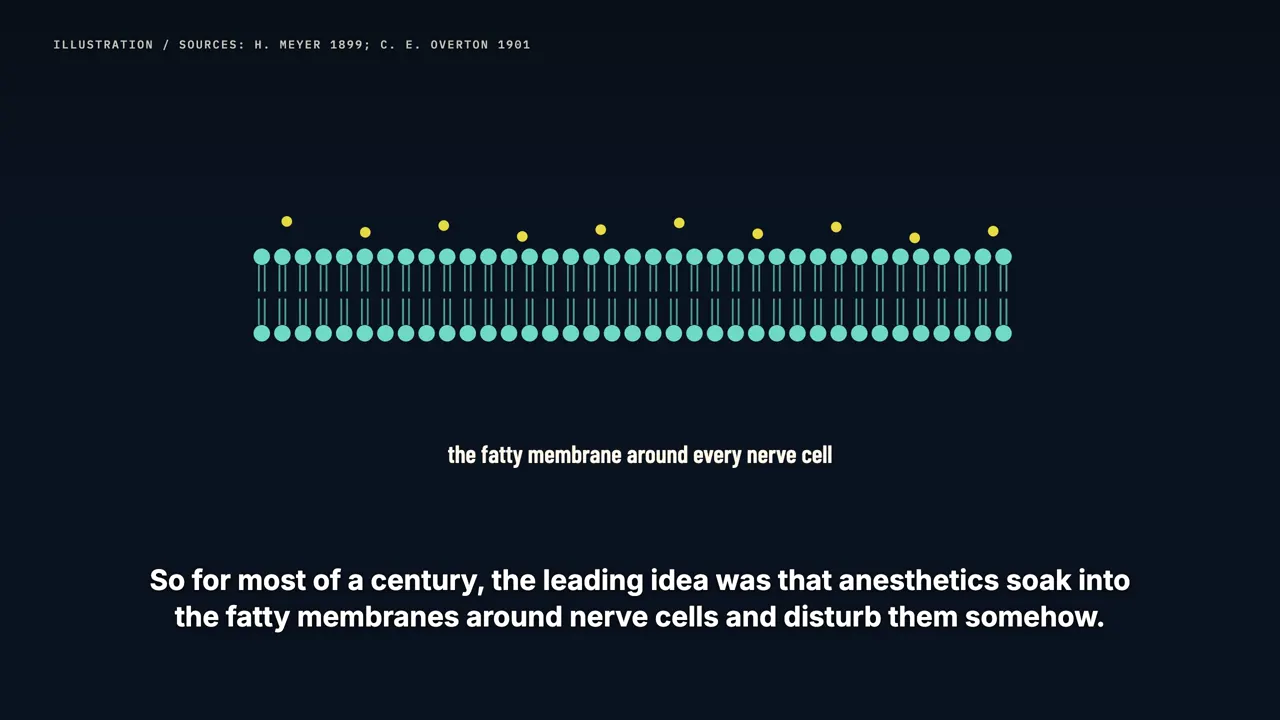
The more a chemical liked oil, the less of it you needed, across a range of more than 10,000 times. And the chemicals had almost nothing else in common. Even xenon works, a noble gas that barely reacts with anything. So for most of a century, the leading idea was that anesthetics soak into the fatty membranes around nerve cells and disturb them somehow.
In the 1980s, two scientists in London, Nicholas Franks and William Lieb, found a twist. Anesthetics also switched off the glowing enzyme of fireflies, a protein floating in water, with no membrane at all. And they did it in step with the same olive oil rule. So the rule could just as well describe a greasy pocket inside a protein.
That started the hunt for the proteins themselves.
The brain's brakes
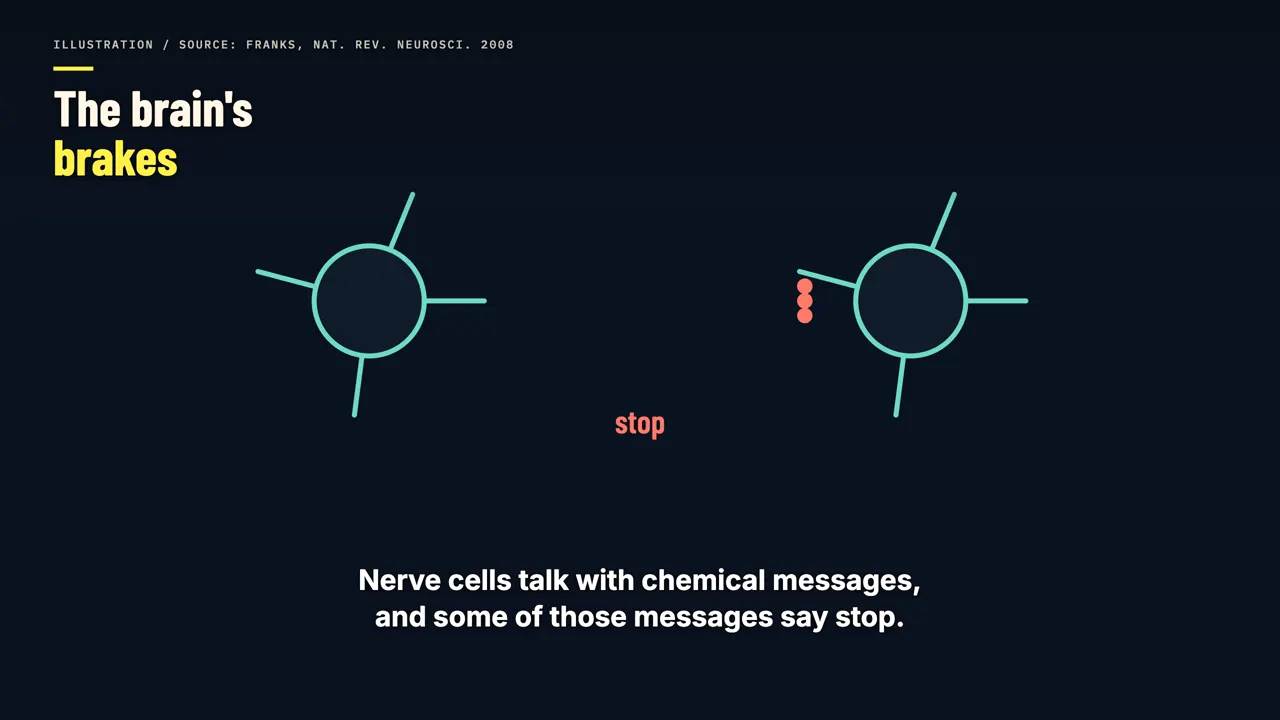
Nerve cells talk with chemical messages, and some of those messages say stop. The most common stop signal in the brain is a small molecule called GABA. When GABA lands on its receptor, a tiny channel opens and makes the cell harder to fire. Propofol, one of the most widely used anesthetics, makes those receptors respond more strongly, so the brakes stay on longer.
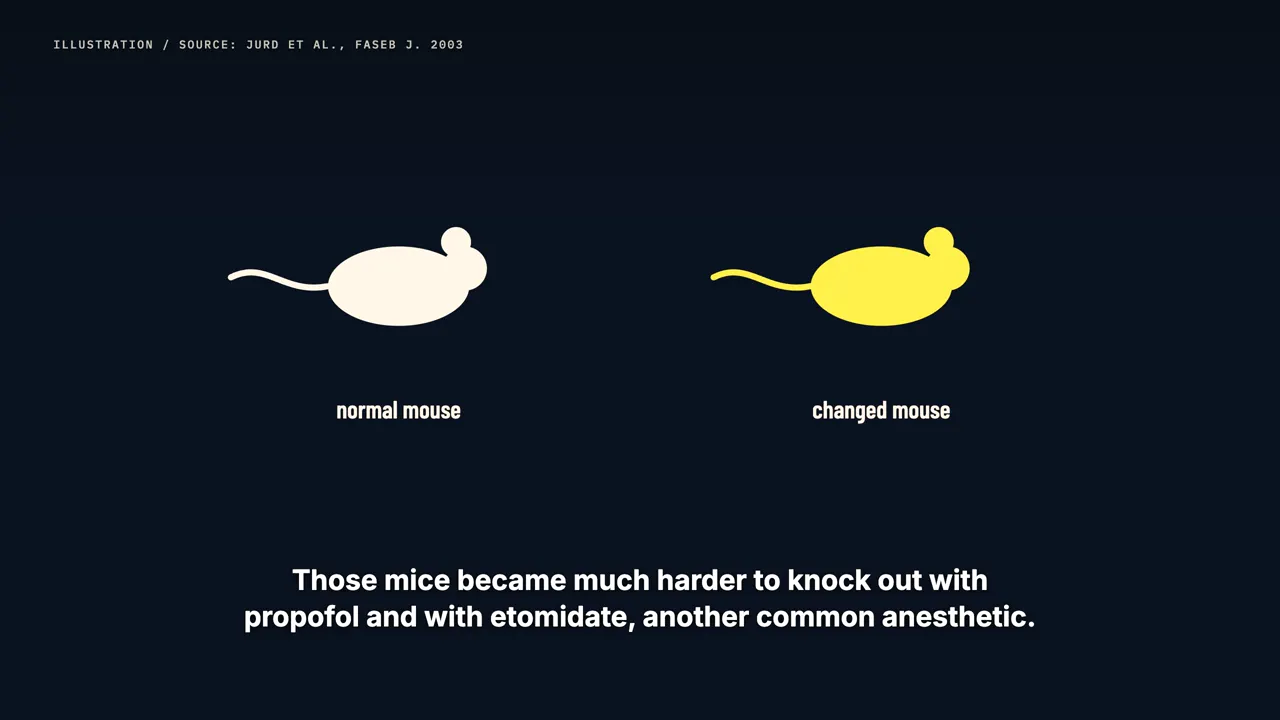
The strongest evidence that this matters came from mice. In 2003, researchers bred mice with a single change in one part of that receptor. Those mice became much harder to knock out with propofol and with etomidate, another common anesthetic. But anesthetic gases like halothane still worked on them almost as well.
Ketamine, nitrous oxide and xenon mostly act on a different receptor, called NMDA, and block it. So these drugs grab different molecules in different ways, and yet all of them can take a person out of the room. That's the first gap: knowing where a drug lands doesn't tell you how a mind turns off.
Not sleep

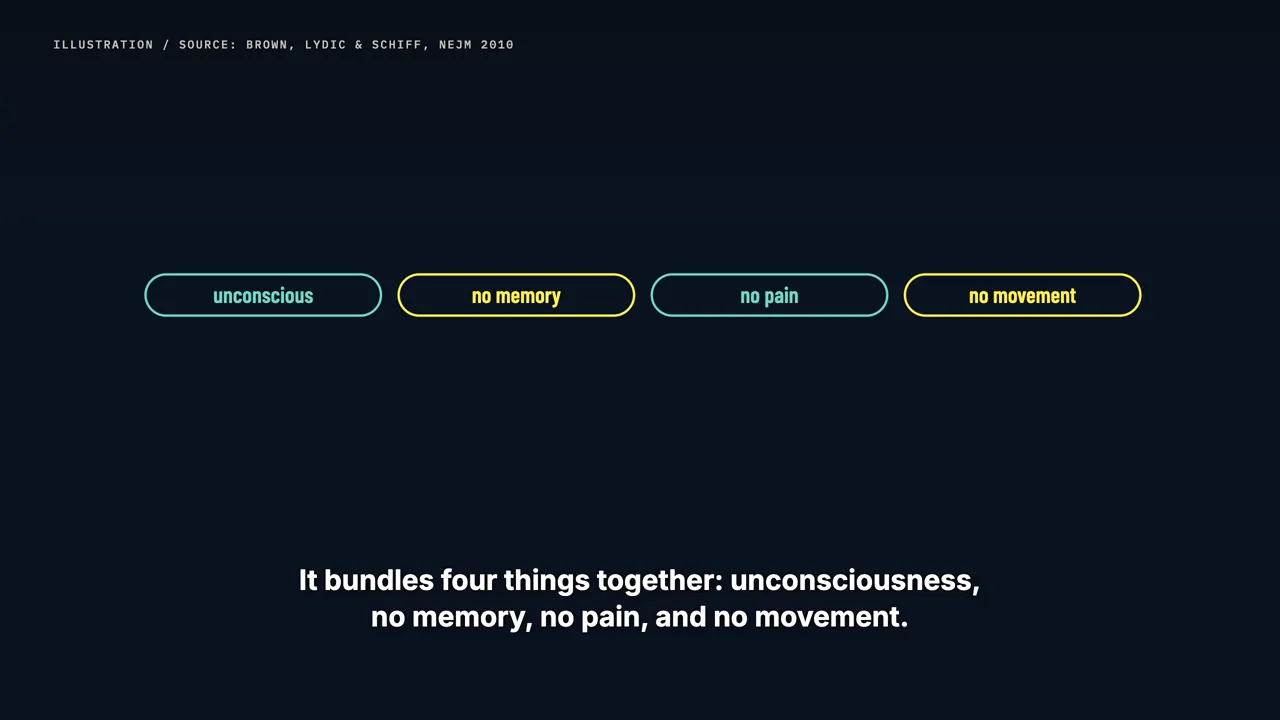
Doctors often tell patients they're going to sleep. In 2010, a review in the New England Journal of Medicine argued that's the wrong picture. General anesthesia, the authors wrote, is a reversible coma, caused by drugs. It bundles four things together: unconsciousness, no memory, no pain, and no movement.
Meanwhile the anesthesiologist keeps the heart, breathing and body temperature steady. Sleep has stages, and none of their brain wave patterns looks like this. You can wake a sleeping person by calling their name, but not a patient under general anesthesia.
Islands in time
So what actually changes in the brain at the moment someone goes under? In 2013, a team in Boston recorded volunteers' brain waves while slowly raising their dose of propofol. The volunteers pressed a button whenever they heard a sound, until they stopped pressing. Right around that moment, a very slow wave appeared, less than one cycle per second.
In patients who already had electrodes in their brains for epilepsy treatment, a related study found that neurons hadn't gone quiet. They fired in short bursts at one point in each slow wave, then went silent. And different patches of the brain fell out of step with each other. Each small local network still worked, but they were cut off from each other, in time and in space.
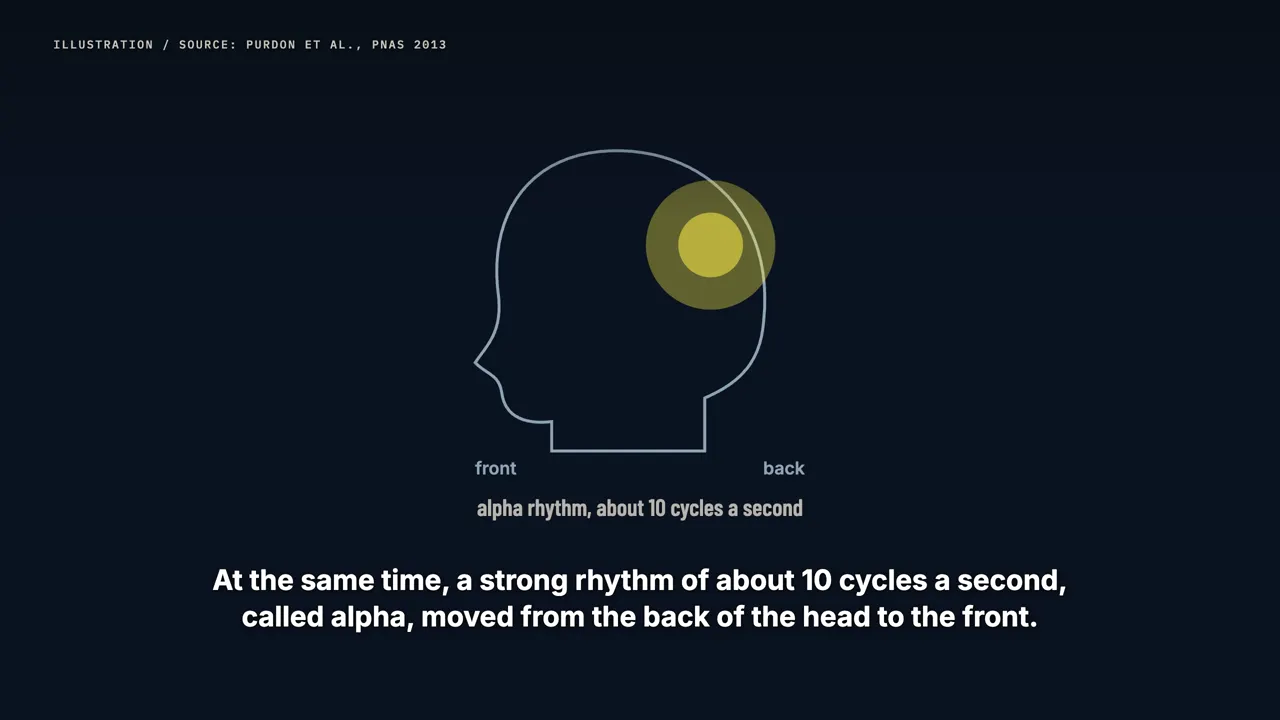
At the same time, a strong rhythm of about 10 cycles a second, called alpha, moved from the back of the head to the front. Some anesthesiologists now read these patterns on a monitor to judge how deep a patient is. In 2024, a study at MIT added a twist. Propofol strengthens the brain's brakes, so you'd expect activity to simply calm down.
Instead, in monkeys given propofol, brain activity became less stable, slower to settle after each disturbance. The researchers think the extra braking also brakes the cells that normally keep other cells in check. So going under may be less like flipping a switch, and more like losing your balance.
A switch deep inside
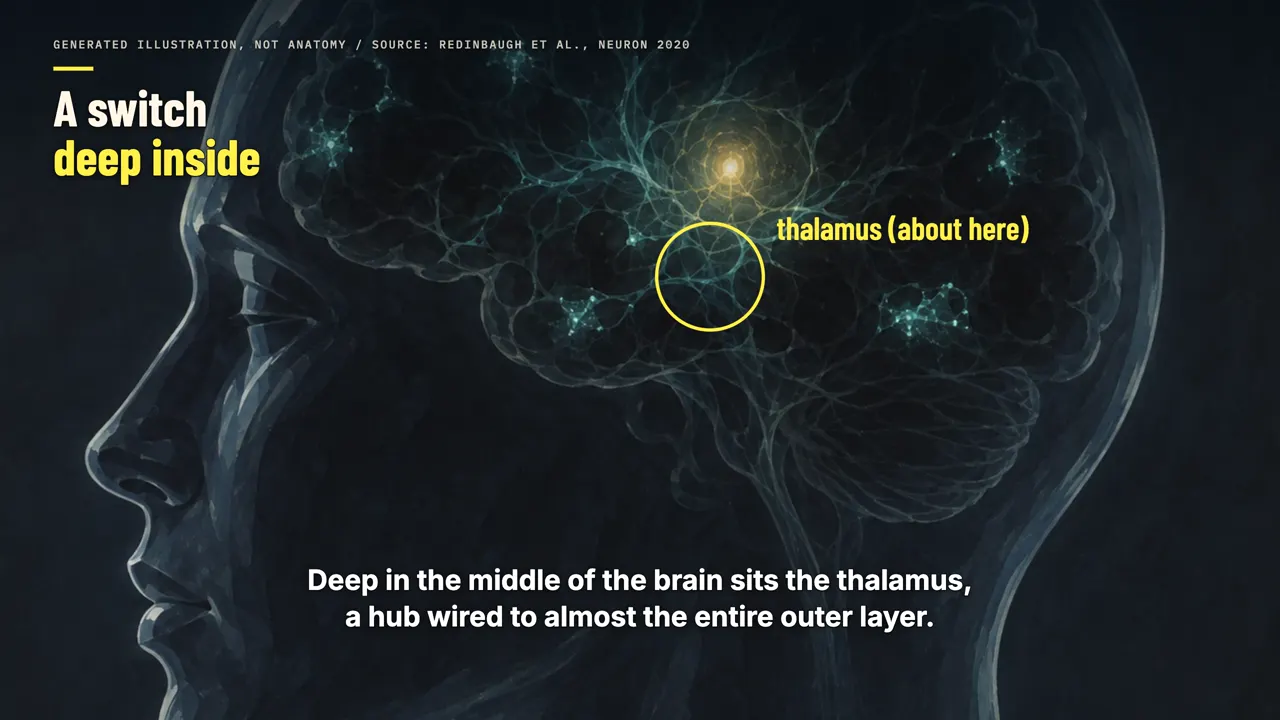
Deep in the middle of the brain sits the thalamus, a hub wired to almost the entire outer layer. In 2020, researchers in Wisconsin placed electrodes in one small part of it, in two anesthetized monkeys. Then they stimulated it 50 times a second. Still on the anesthetic, the monkeys opened their eyes, reached out with their arms, and their heart rate and breathing changed.
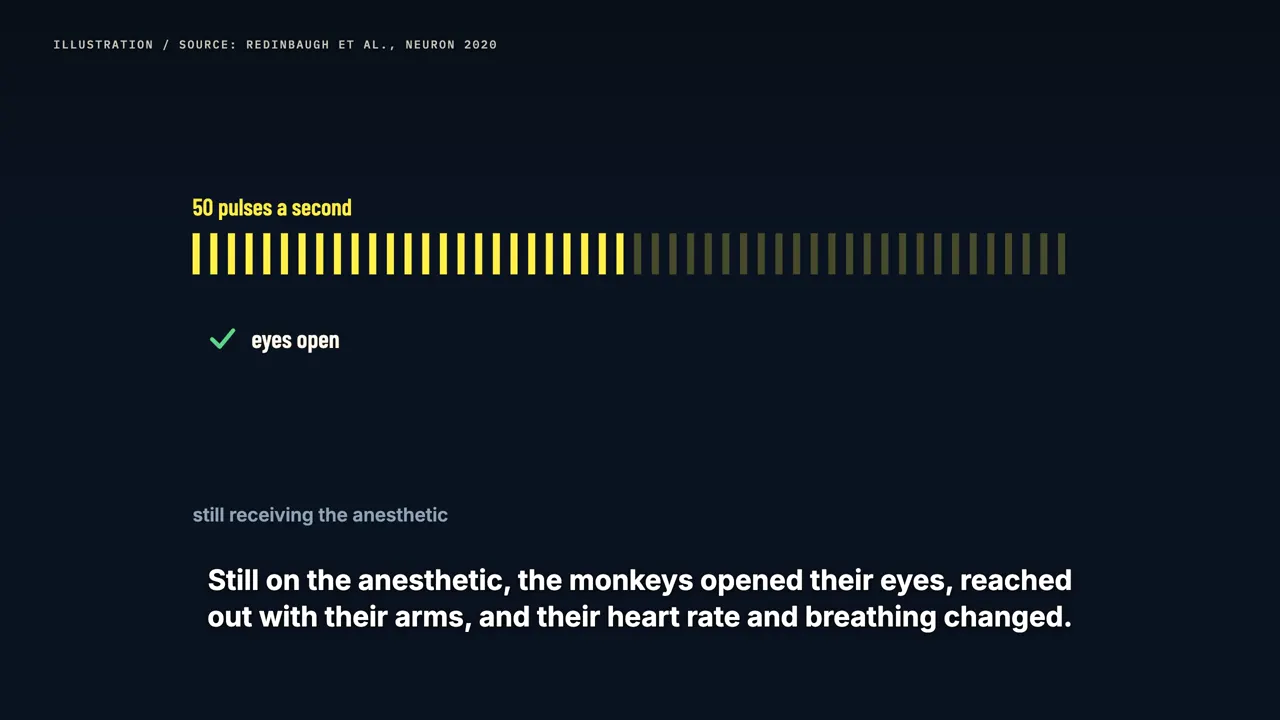
When the stimulation stopped, they slipped back under. It's a striking result, but it comes from two monkeys, and it shows a hub, not the whole mechanism.
The way back
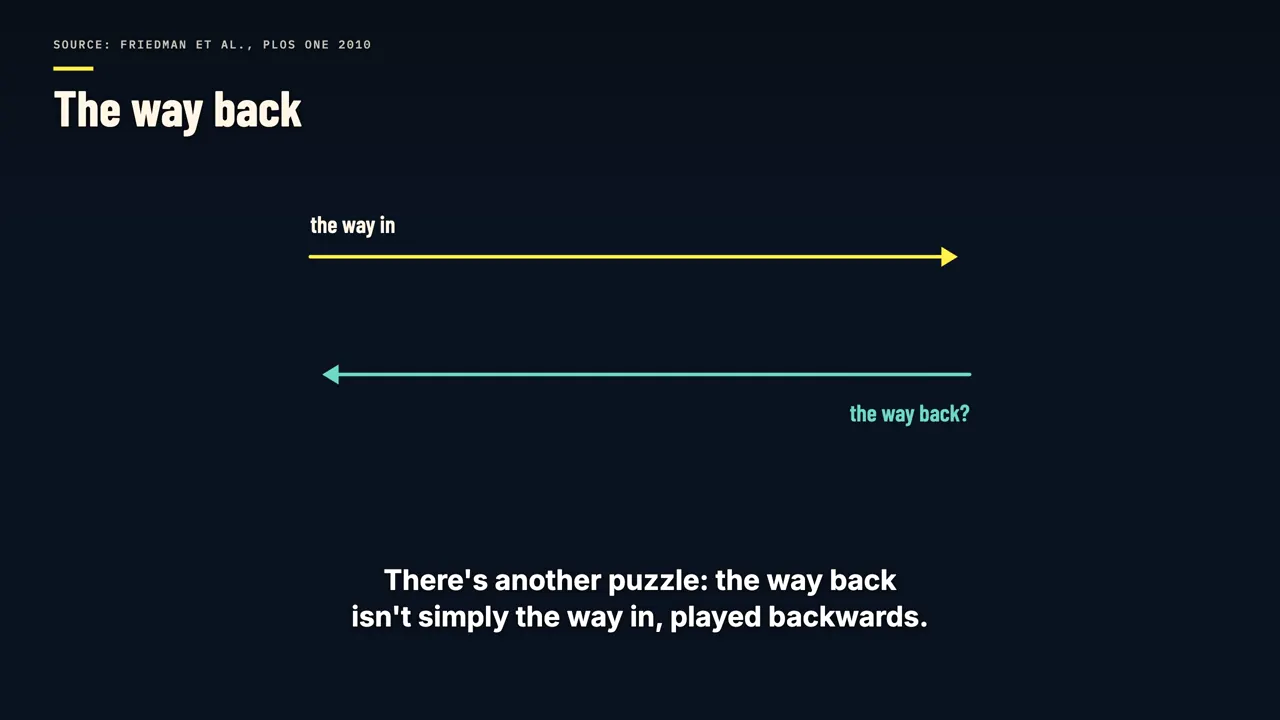
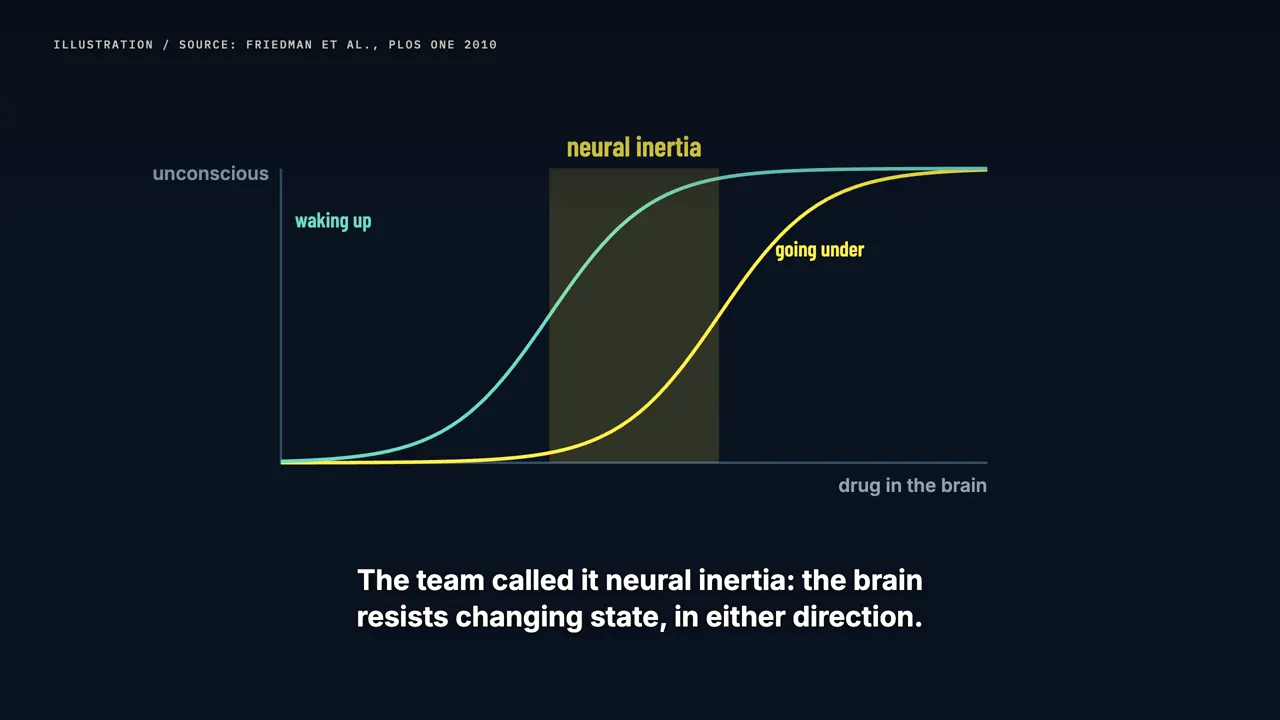
There's another puzzle: the way back isn't simply the way in, played backwards. If it only depended on how much drug was in the brain, you'd wake up at the same level you went under. In 2010, a team at the University of Pennsylvania showed that's not what happens, in both mice and fruit flies. The animals needed more drug to go under than the level at which they woke up again.
The team called it neural inertia: the brain resists changing state, in either direction. And single gene changes linked to sleep could widen or shrink that gap. Those transitions are also where things most often go wrong. A large British audit in 2014 found about 1 report of awareness for every 20,000 general anesthetics.
Two thirds of those cases happened while patients were going under, or coming back. And reports were far more common when drugs that paralyze the muscles were used, about 1 in 8,000.
Stranger clues
Without a full explanation, some surprising findings keep the question open. In 2018, researchers exposed Venus flytraps to ether vapor. The traps stayed open, even when their trigger hairs were touched, and the electrical signal that normally snaps them shut disappeared. When the ether wore off, they worked again.
Plants have no brain, so ether must be acting on something more basic than one. Other findings are far more disputed. In 2020, a team at Scripps Research reported that anesthetics break up tiny fat clusters in cell membranes, which in turn opens a potassium channel. Fruit flies missing one enzyme in that chain were harder to put under.
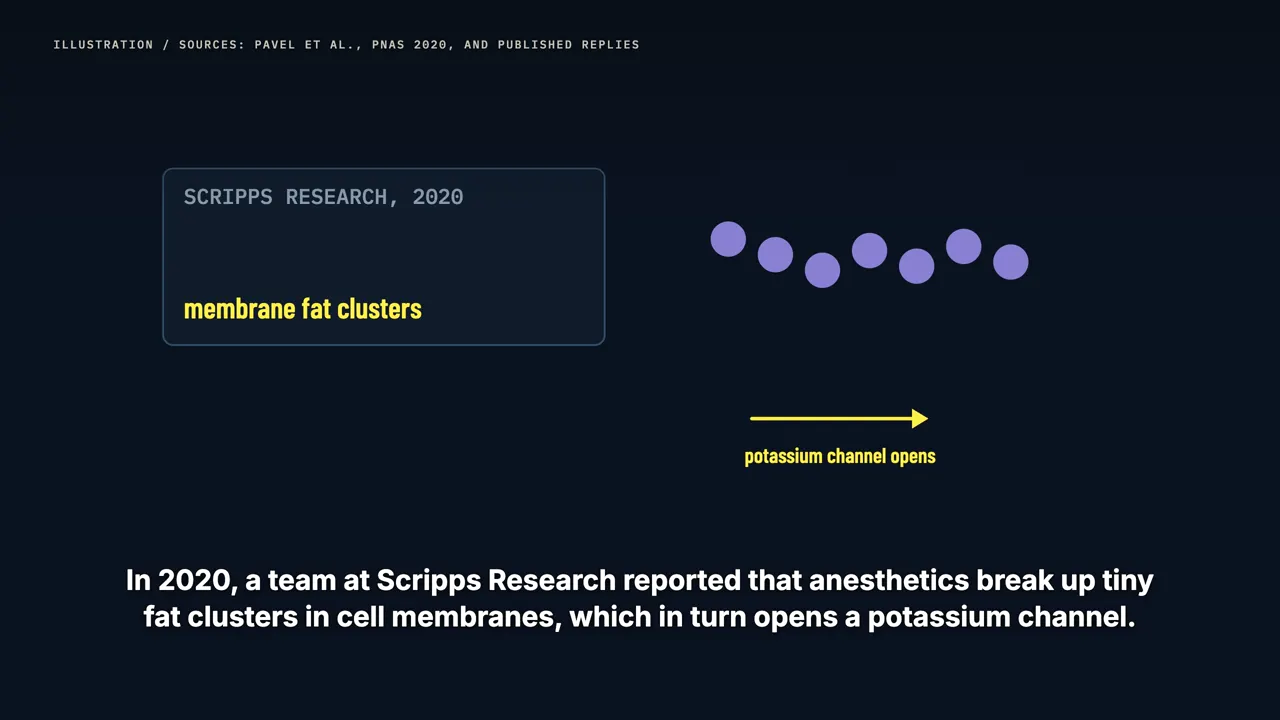
Some headlines called the mystery solved, but other scientists challenged the fly experiments, and the argument continues. And in a 2024 rat study, a drug that stiffens microtubules, the scaffolding inside nerve cells, delayed unconsciousness from isoflurane by about a minute. It's one small study in rats, and what it means is still an open question.
The deeper gap
The deepest gap isn't really about the drugs. To explain how consciousness is switched off, you'd need to know what consciousness is in the first place. And there's no agreed theory. In 2025, two leading theories were tested head to head, in experiments whose design both camps signed off on in advance.

The results challenged key predictions of both. That's one reason anesthesia has become a research tool, a reliable way to turn consciousness down and watch what changes.
The last step
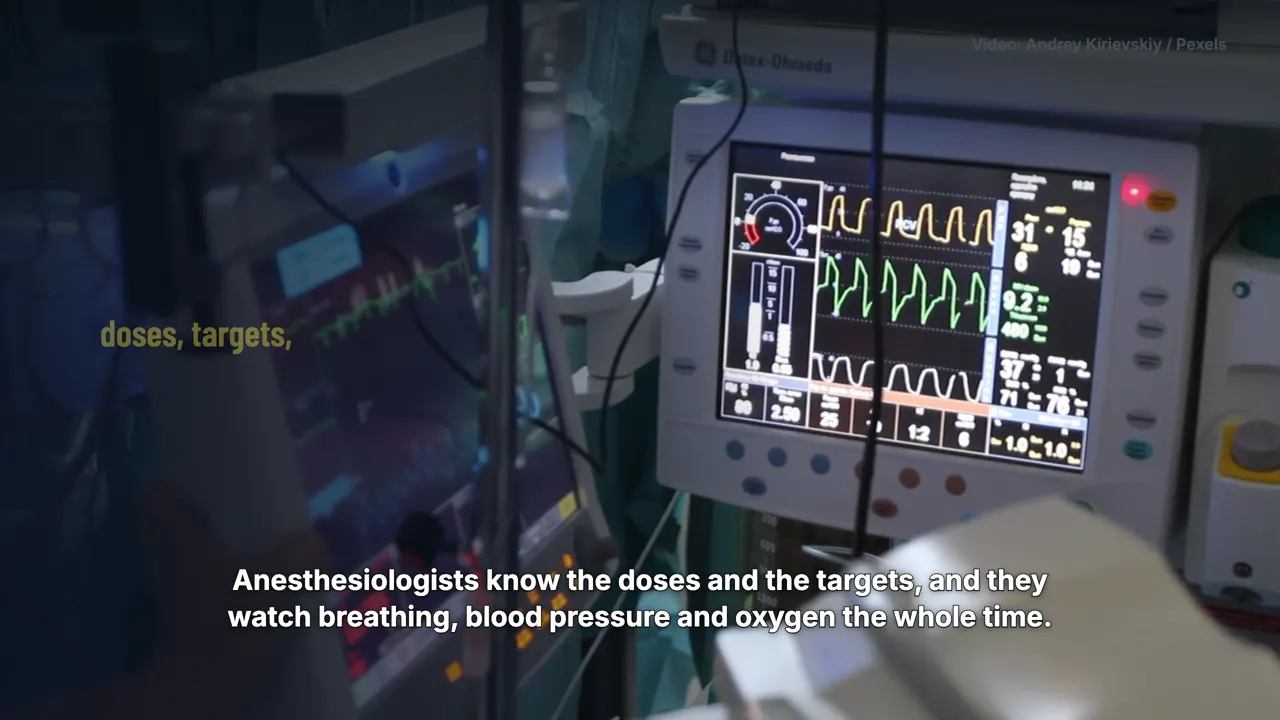
None of this makes anesthesia a guess. Anesthesiologists know the doses and the targets, and they watch breathing, blood pressure and oxygen the whole time. What's missing is the last step, from molecules to the moment you stop being there. In 1846, when Gilbert Abbott came around, he said it felt as if his neck had been scratched.
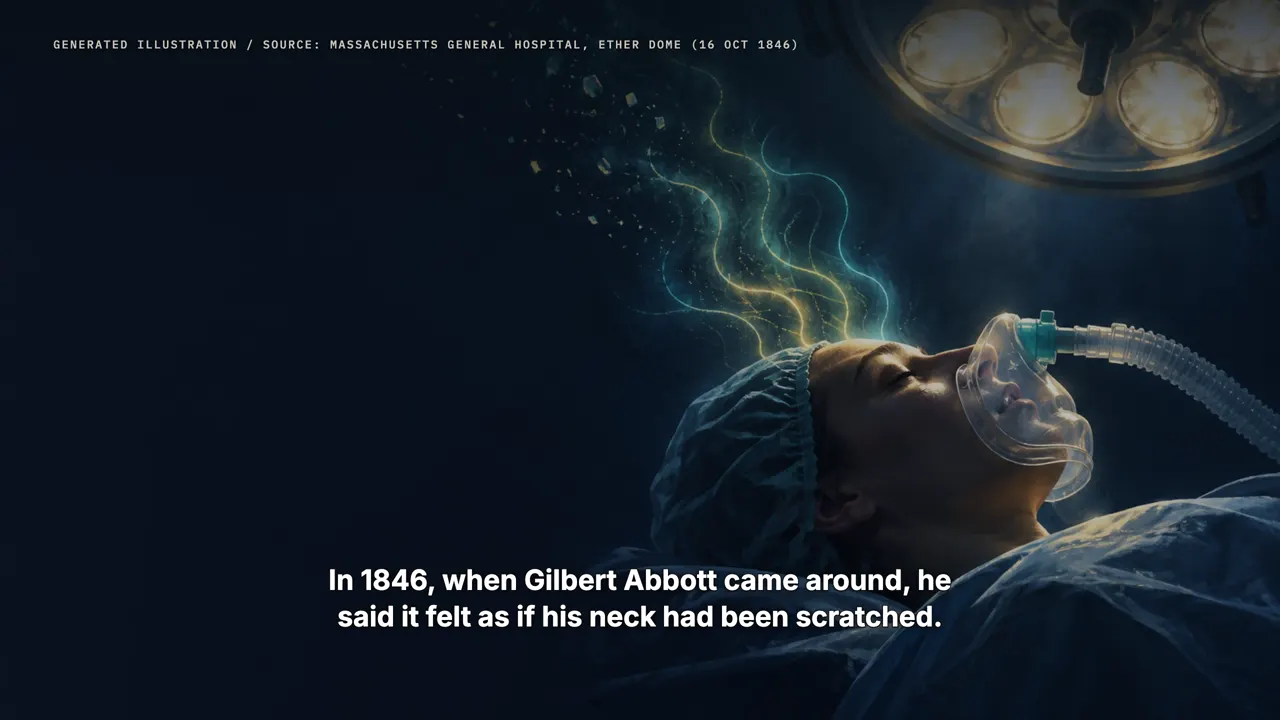
180 years later, we still can't fully say where he went.
Watch on YouTube
Sources
- Ether Day, Massachusetts General Hospital, 16 Oct 1846 (Ether Dome)
- Weiser et al., "Size and distribution of the global volume of surgery in 2012," Bull. WHO 94:201 (2016)
- Brown, Lydic & Schiff, "General anesthesia, sleep, and coma," NEJM 363:2638 (2010)
- Meyer (1899) and Overton (1901), lipid solubility and anesthetic potency
- Franks & Lieb, Nature (1984, 1985), anesthetics and firefly luciferase
- Franks et al., "How does xenon produce anaesthesia?" Nature 396:324 (1998)
- Franks, "General anaesthesia: from molecular targets to neuronal pathways of sleep and arousal," Nat. Rev. Neurosci. 9:370 (2008)
- Jurd et al., FASEB J. (2003), beta3 N265M knock-in mice; Liao, Sonner, Jurd et al., beta3 receptors and volatile anesthetics
- Purdon et al., PNAS 110:E1142 (2013); Lewis et al., PNAS 109:E3377 (2012)
- Eisen, Kozachkov et al., Neuron (2024), propofol destabilizes neural dynamics
- Redinbaugh et al., Neuron 106:66 (2020), central lateral thalamus stimulation
- Friedman et al., PLoS One 5:e11903 (2010), neural inertia
- Pandit et al., NAP5, Br. J. Anaesth. 113:540 (2014), accidental awareness
- Yokawa et al., Ann. Bot. 122:747 (2018), anaesthetics and Venus flytraps
- Pavel et al., PNAS (2020), lipid rafts and PLD2, with published replies
- Khan et al., eNeuro 11(8) (2024), epothilone B and isoflurane
- Cogitate Consortium, Nature (2025), adversarial test of IIT and GNWT