Why Is English Spelling So Weird?

Why does knight have a K nobody says? English spelling records how people spoke about 600 years ago. This video follows how that happened: French-trained scribes after 1066, no standard spelling in the Middle Ages, William Caxton's printing press in 1476 and its imported type, the Great Vowel Shift that changed every long vowel while spelling was settling, consonants that went silent in the 1600s, letters added on purpose (the b in debt, the s in island, the l in could), the dictionaries of Samuel Johnson and Noah Webster, and Theodore Roosevelt's failed spelling reform of 1906.
This article is the full narration of the video. Watch on YouTube
A K nobody says
Say the word knight out loud, and you skip the K at the front and the G H in the middle. Six hundred years ago, people said both: the K was spoken, and the G H sounded like the rough C H in the German word ich. And knight is not alone: tough, though and through share the same four letters, O U G H, and say them three different ways. In a study of beginning readers across Europe, children in most of the language groups read

over 90% of simple, familiar words correctly by the end of their first school year. The English-speaking group in Scotland averaged 34%, even though they were making excellent progress by British standards. So why is English spelled so strangely? The short answer is that English spelling settled down, while the way people spoke kept moving.
Spelling what you say
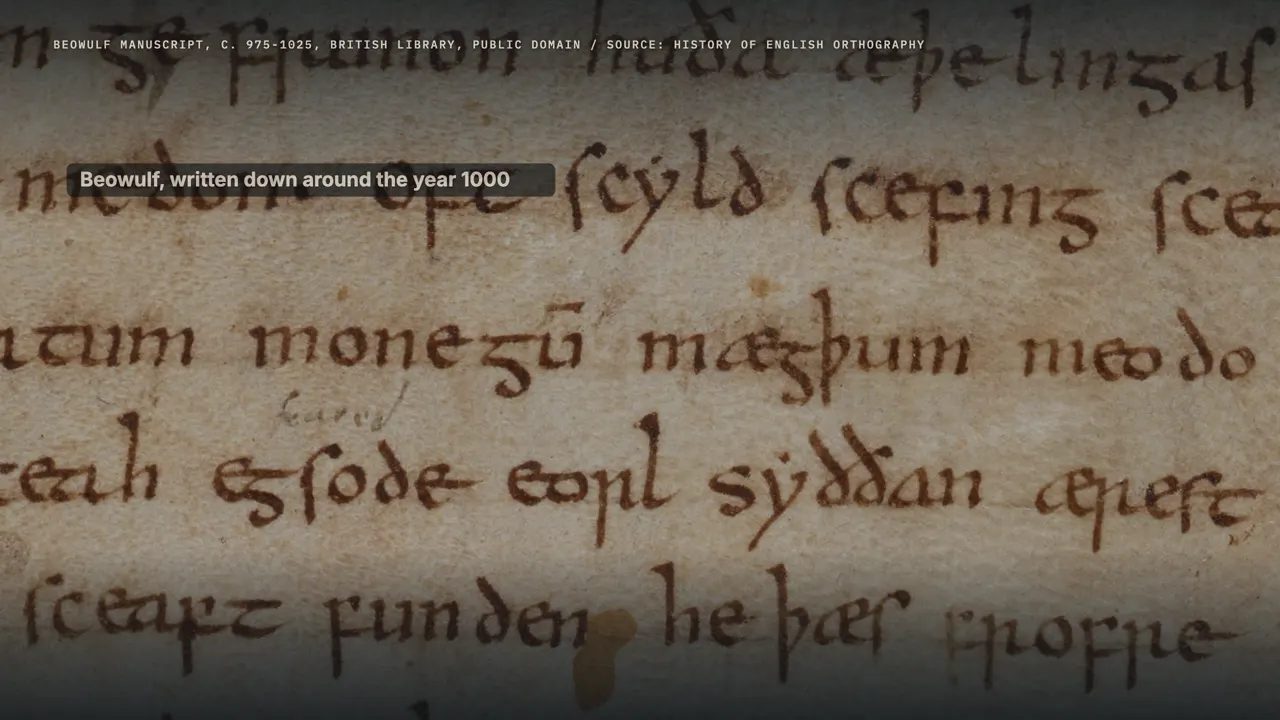
It didn't start out this way. A thousand years ago, Old English had a fairly regular spelling system: by and large, you wrote what you said. Knight was written C N I H T, and every letter was pronounced. Then, in 1066, the Normans conquered England.
For about three centuries, much of the writing that mattered was done in French and Latin, and English spelling came out the other side shaped by French habits. The Old English word for queen began with C W, which scribes later replaced with Q U. In the word that became house, scribes began writing the long oo sound with the French O U.
Some changes were about handwriting. In the handwriting of the time, the letters I, U, N and M were all built from the same short vertical strokes, called minims. Put a U next to an M, an N or a V, and a reader saw a fence of identical strokes. So scribes wrote an O instead.
That's why love, come and son are spelled with an O, even though they have the vowel of cut.
No right answer
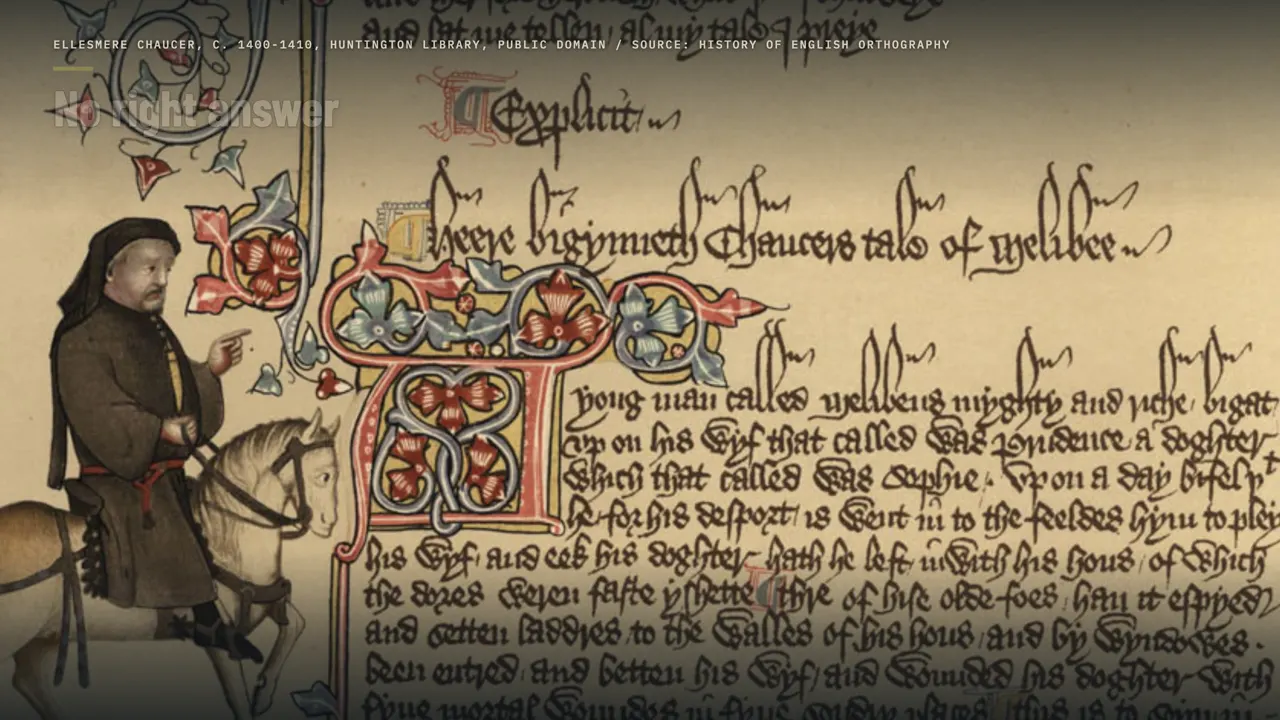
Through the Middle Ages there was no standard way to spell English. Writers spelled words the way they said them in their own dialect, and one writer might spell the same word two ways in a single sentence. In 1417, King Henry V began sending his official letters in English, and the clerks of the royal offices slowly settled on a common style based on London speech.
A printer named William Caxton described the problem in 1490. He told the story of some merchants who set sail down the Thames for the Low Countries, and ran out of wind. They went ashore in Kent, and one of them, a cloth merchant named Sheffield, walked into a house and asked for some eggs. The woman of the house said she didn't speak French.
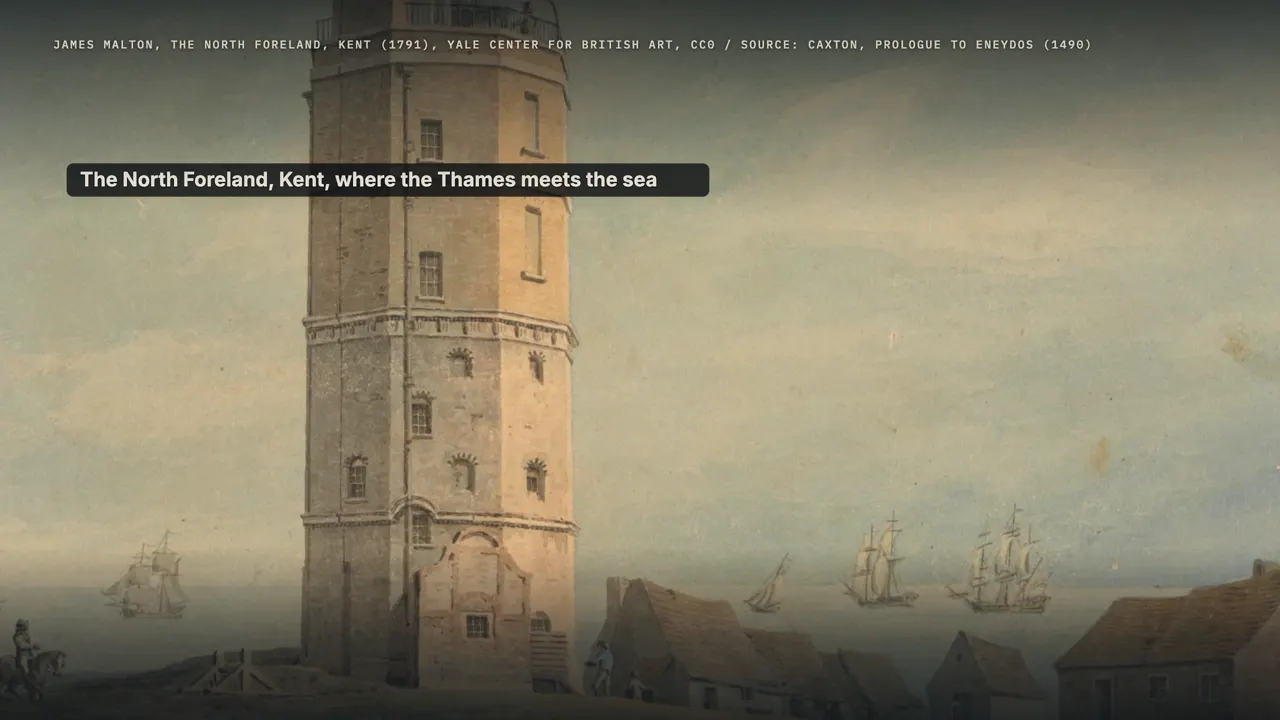
The merchant was annoyed, because he didn't speak French either. Then someone else asked for eyren, and she understood. So what, Caxton asked, should a man write these days, eggs or eyren? Certainly, he wrote, it is hard to please every man, because of the diversity and change of language.
Frozen in type
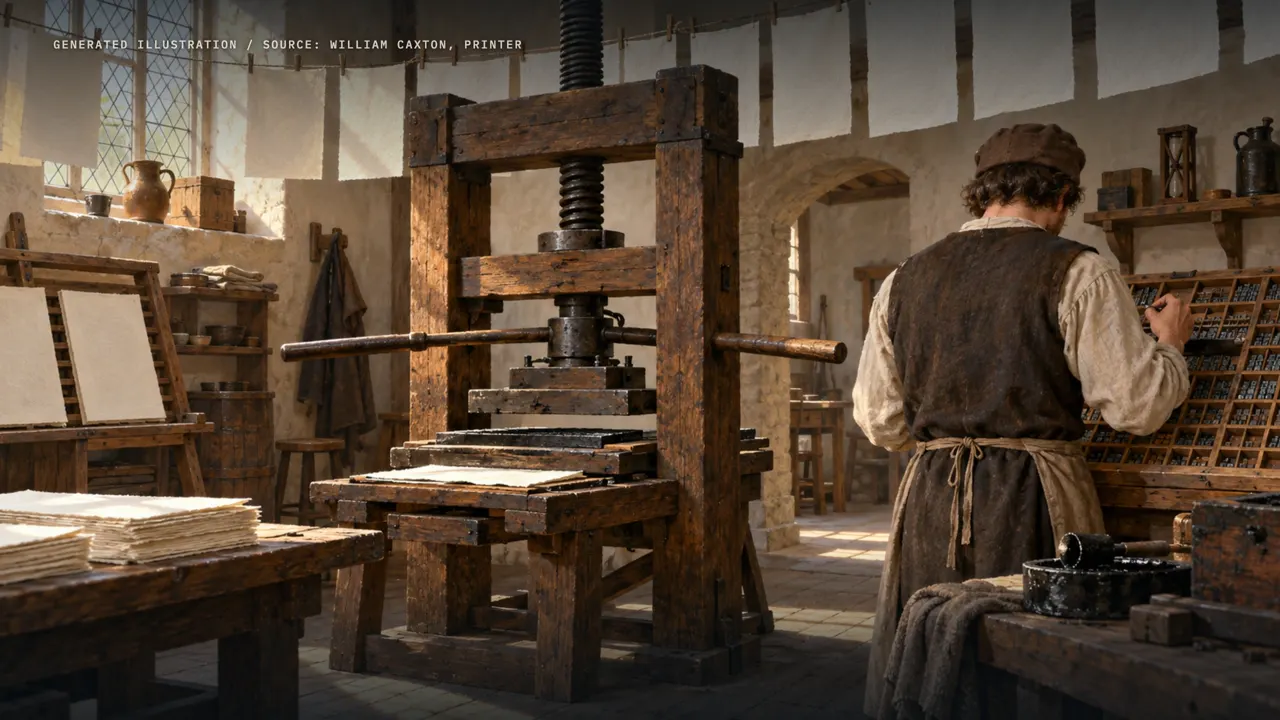
Printing gave that question a new urgency. In 1476, he set up the first printing press in England, at Westminster. The first book known to come off it was Chaucer's Canterbury Tales. Before printing, every copy was written by hand, and every scribe spelled as he saw fit.
Now one set of choices was cast in metal type and repeated in every copy of a book. Printers also brought their own quirks. Caxton had learned the trade on the continent, after many years living in Bruges, in Flanders, and early English printing leaned on workers trained in the Low Countries.

Ghost used to be spelled G O S T. The H turns up in a book Caxton printed in 1484, probably borrowed from the Flemish spelling gheest. There was a practical side too: printers liked every line to end at the same right-hand edge. Sometimes they solved it by adding or dropping a silent E at the end of a word.
And the old letter thorn, which stood for the T H sound, wasn't in the type the printers imported, so they used a Y instead. That's the Y E in ye olde: it stood for the word the. Over the next two centuries, the spellings in print slowly settled down. And that's where the timing went wrong.
The vowels move
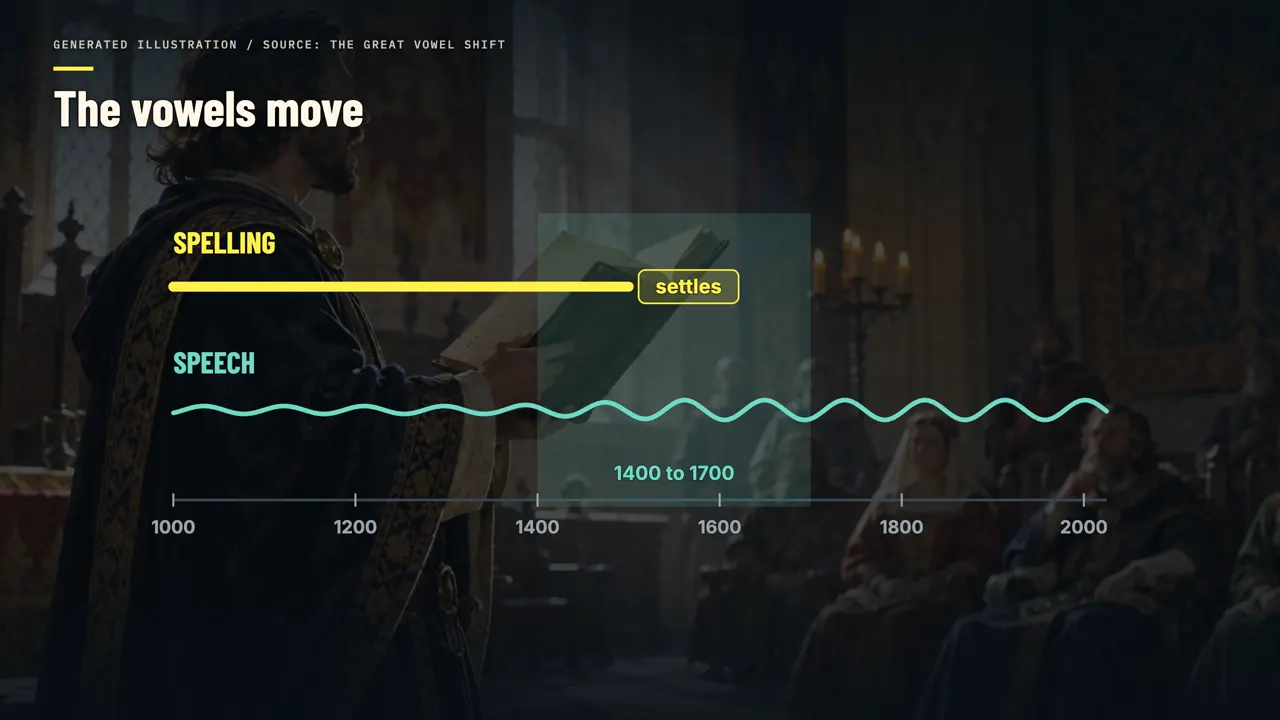
While spelling was settling, the sound of English was moving underneath it. Between about 1400 and 1700, every long vowel in southern English changed its sound. Linguists call it the Great Vowel Shift. Before it, the long vowels sounded much like they do in Italian or German today.
Mate had the vowel of father. Mite sounded like modern meet. And bout, B O U T, sounded like modern boot. Then the vowels began to climb.
Vowels made low in the mouth moved higher, one step at a time. The two highest vowels, ee and oo, gradually became gliding vowels, like the I in mite and the OW in house. Linguists still debate which vowels moved first, and how each change pushed or pulled the others. There is a clue in the north.
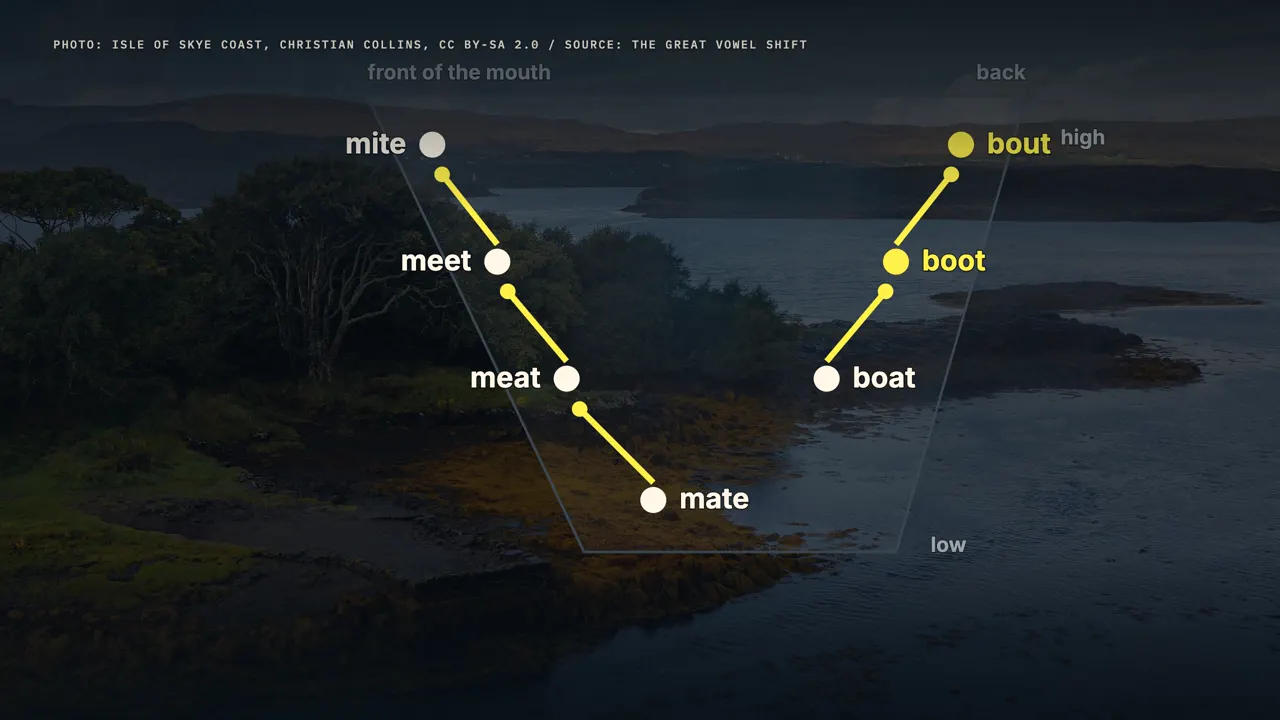
In northern England and Scotland, the oo in house never changed. That's probably because up north, the vowel that would have pushed it, the one in boot, had already moved somewhere else. So the push most likely came from below, and the Scots word for house is still hoose. The spelling didn't follow.
German went through a very similar shift a little earlier, and changed its spelling to match. Its word for bite, once spelled B I Z E N, is now spelled with E I. English kept its old letters. So English vowel letters ended up meaning something different from the same letters in most of Europe.
Meet with double E and meat with E A once had different vowels; the two sounds merged only later. Great took a different path, and ended up rhyming with mate rather than meat.
Letters that went quiet
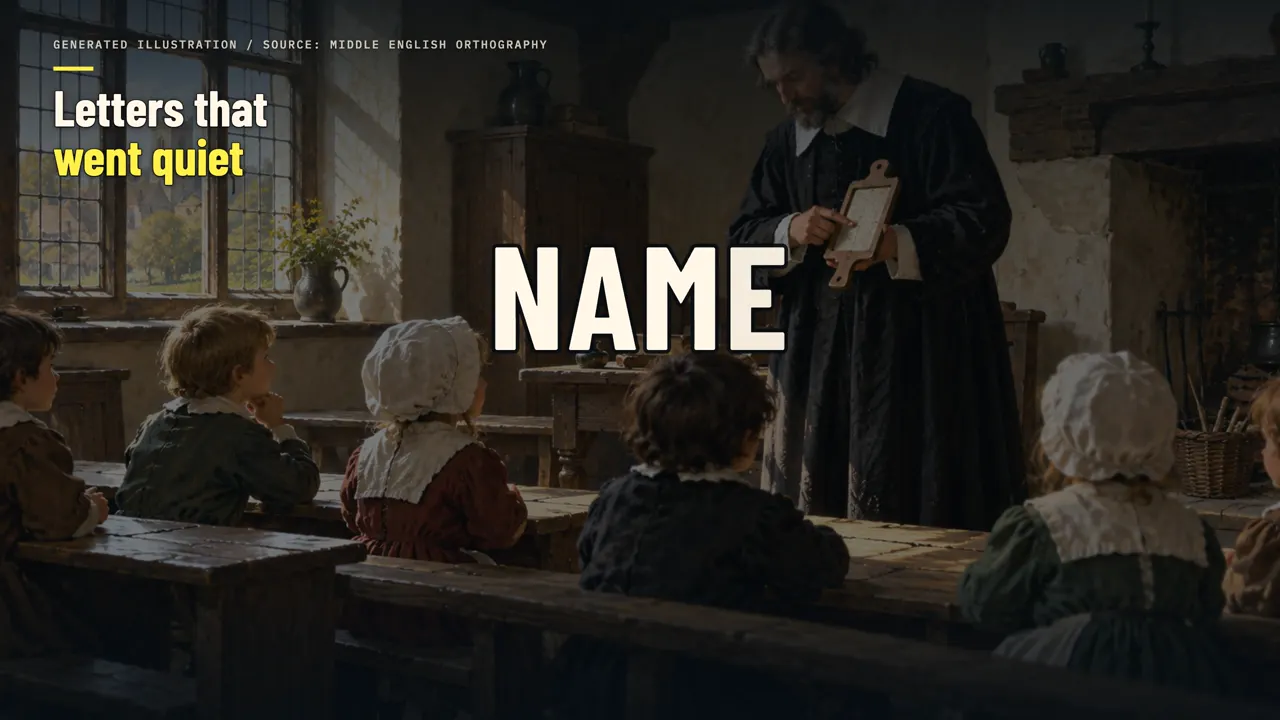
One letter went quiet before the others: the E at the end of words like name. In early Middle English, name had two syllables, with a weak vowel at the end. By Chaucer's time, that ending had dropped out of everyday speech, though poets still pronounced it when the rhythm of a line needed the extra beat.
But the E stayed in the spelling, and readers came to treat it as a signal that the vowel before it is long. Doubled consonants became the opposite signal: the vowel before them is short. That's why hoping has one P and hopping has two. The rule children learn, that a silent E makes the vowel say its name, is left
over from a sound English stopped making more than six hundred years ago. And the vowel it points to has changed since then, because the Great Vowel Shift moved it. The consonants went quiet too. The K in knight, knee and knot was still spoken long after printing began.
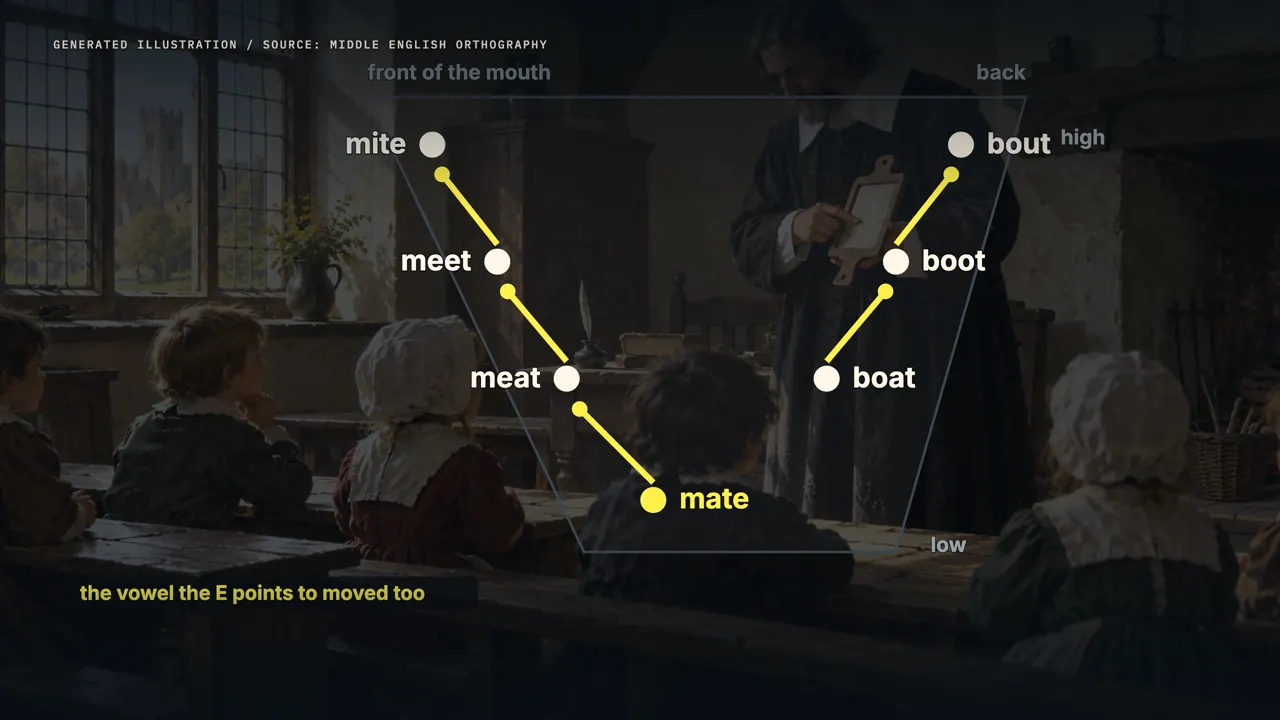
Educated speakers dropped it during the 1600s, and knot became a twin of not. German kept it: knee is Knie in German, and the K is still said. The G in gnat and the W in write and wrong fell silent around the same time. And the rough G H sound in night and light faded away, leaving its two letters behind.
In a few words, like tough and laugh, it ended up sounding like an F, which is one reason O U G H has so many readings today. These letters are fossils of sounds that really were there.
Letters added on purpose

But not every silent letter is a fossil. Some were added by people who never pronounced them. In the early modern period, scholars who admired Latin wanted English words to show their Latin roots. Debt came into English from French as dette, with no B.
A B was added to match the Latin word debitum, but in ordinary speech it is silent. Doubt got its B from the Latin dubitare in the same way. And receipt got its P from the Latin receptus. Sometimes the scholars got the history wrong.
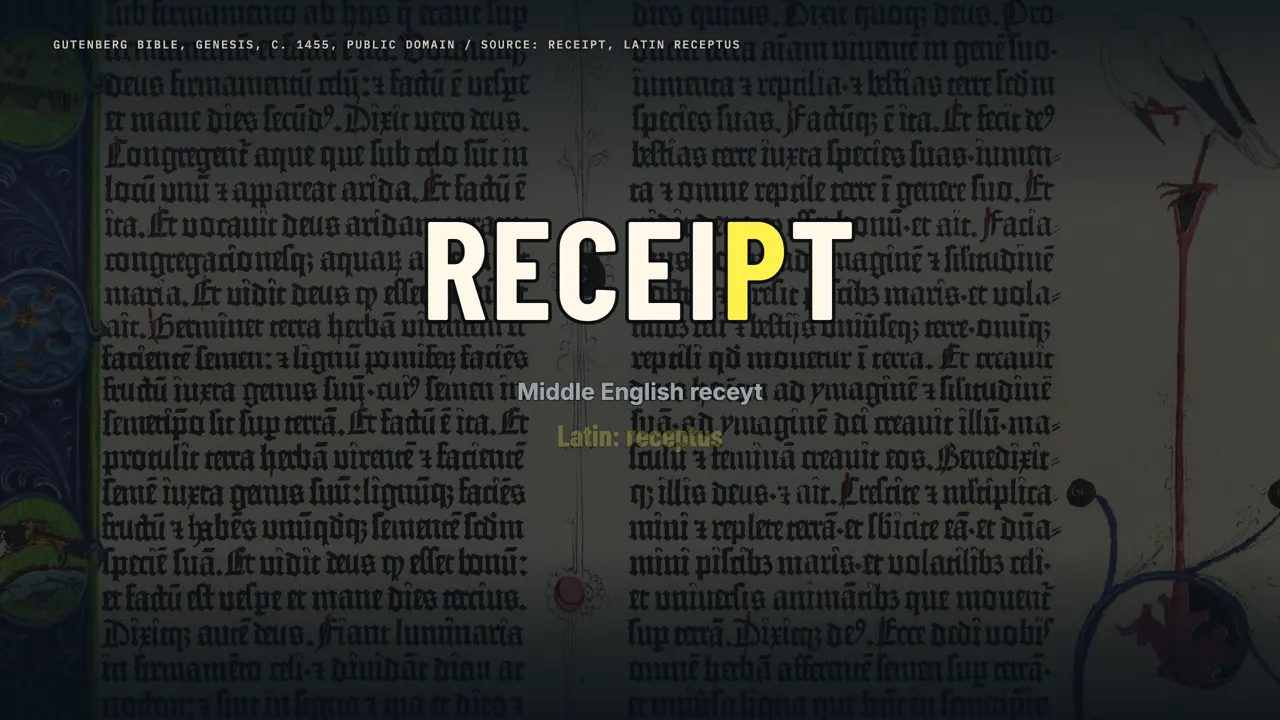
Island comes from an Old English word with no S in it. Isle, a separate word from French, did get an S, from the Latin insula. In the 1500s, island was taken to be related, so it got an S too. Could had no L either, until one was added in the early 1500s to match would and should.
Borrowed spellings
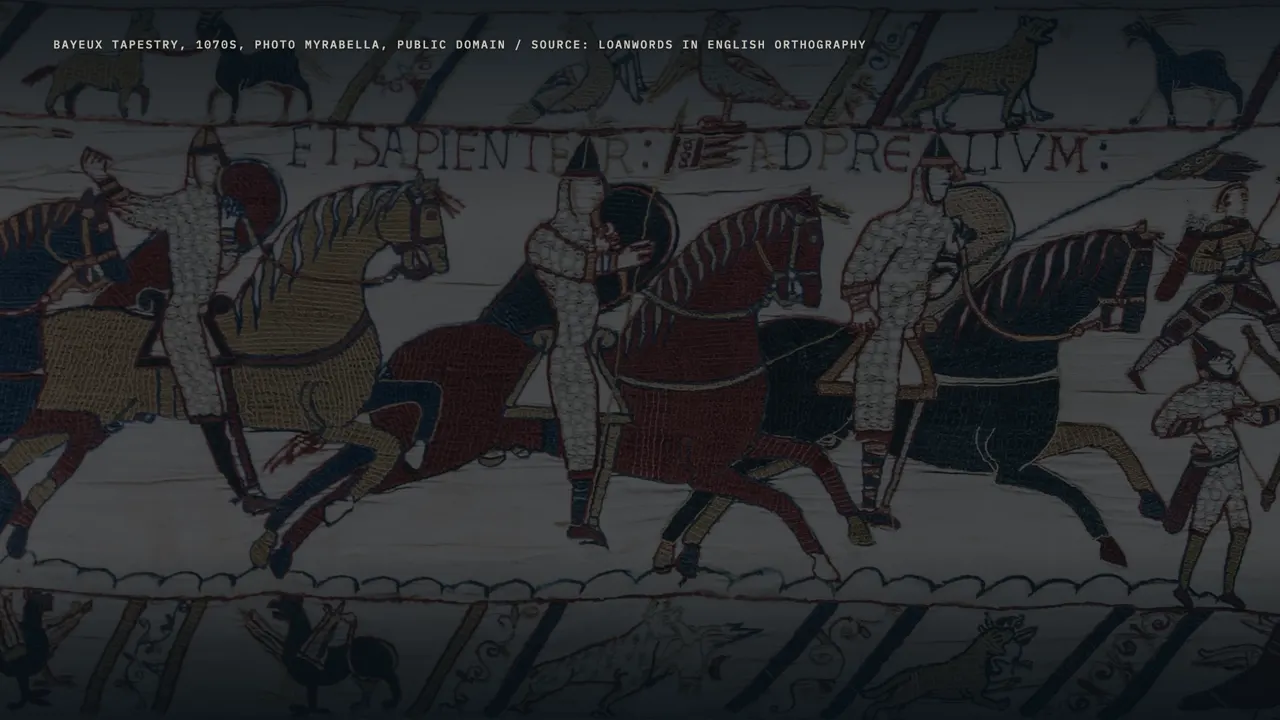
Then there are the words English borrowed. In early Middle English, words taken from French were often respelled the English way: bataille became battle, and bouton became button. Later, English stopped doing that, and borrowed words kept their foreign spelling, like the C Z in Czech or the F J in fjord. Sometimes the spelling even changed the sound.
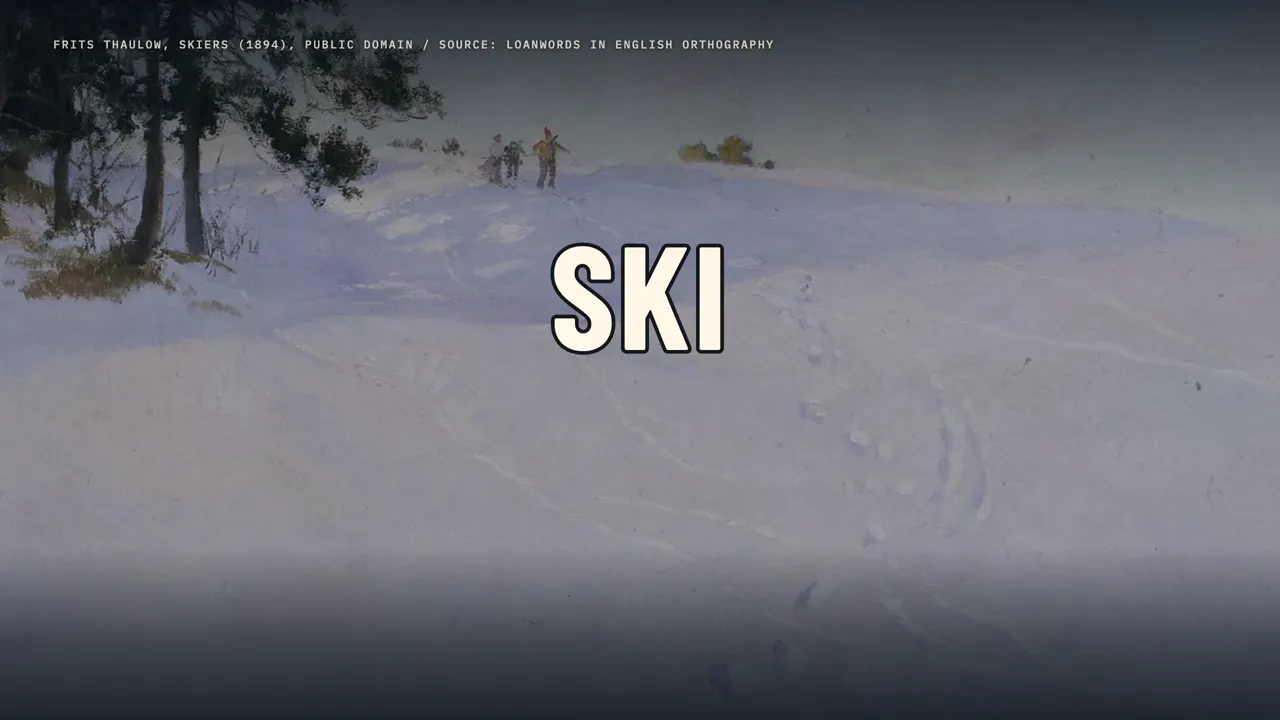
Ski came from Norwegian in the 1700s and was first said like shee, but as the sport caught on, English speakers started saying it the way it is written. Often is another one: its T fell silent around the 1600s, and some speakers now say it again because they see it on the page.
The dictionary makers

By the 1700s, readers wanted an authority. In 1746, a group of London booksellers hired Samuel Johnson to write a dictionary of the English language. He finished it in 7 years, almost single-handed, and it came out in 1755 with more than 42,000 entries. For more than a century it was the dictionary people meant when they said the dictionary.
Johnson was conservative: he kept traditional spellings like public with a K on the end, and favored spellings that pointed back to Latin and Greek. He wasn't always consistent, either: he kept the P in receipt but left it out of deceit. Some of his guesses were simply wrong: he chose ache spelled A C H E over A K E, because he thought it came from the Greek word achos, and it doesn't.

Across the Atlantic, a schoolteacher named Noah Webster wanted something simpler. His spelling book, first published in 1783, taught generations of American children to read and spell. His spelling book and his dictionary of 1828 helped popularize color without a U, center ending in E R, and defense with an S. Most of them weren't his inventions; they were existing alternatives he chose for reasons like simplicity or consistency.
But his attempt to spell tongue as T U N G never caught on.
The president and the spelling list
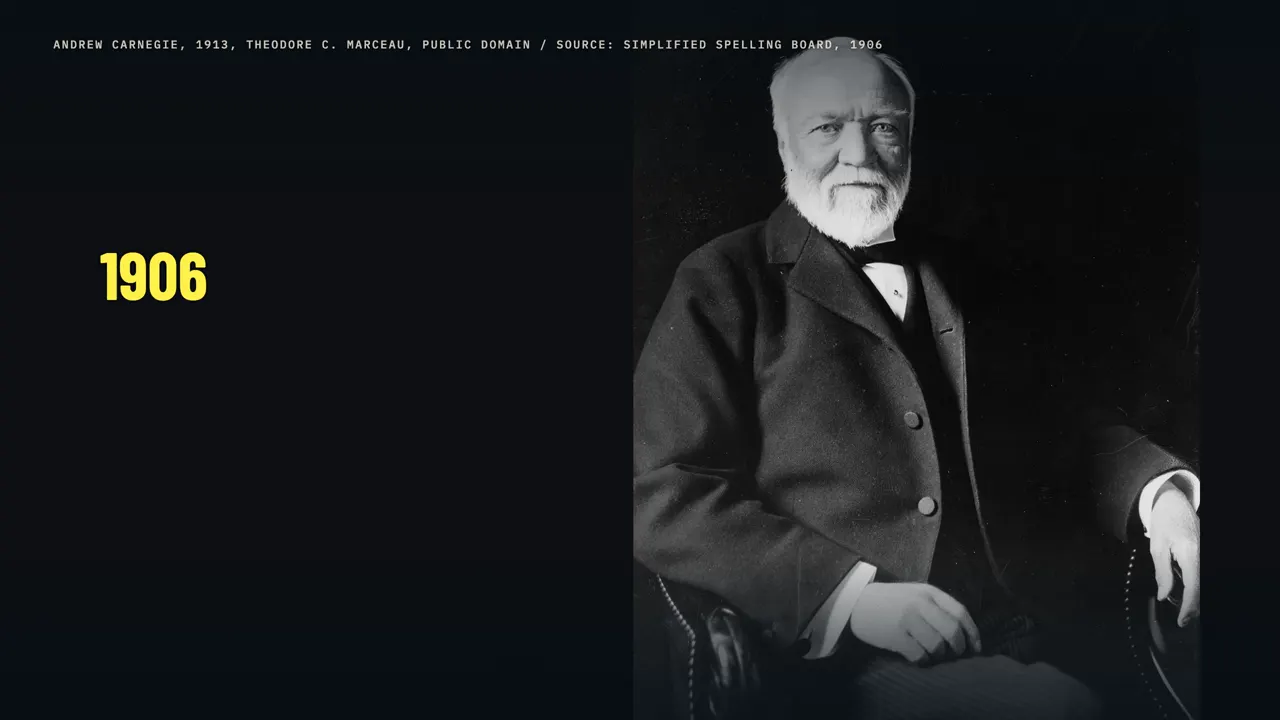
That didn't stop people from trying. In 1906, the steel magnate Andrew Carnegie funded a Simplified Spelling Board in New York. Its first list of 300 words included though spelled T H O, through spelled T H R U, and wished ending in S H T. President Theodore Roosevelt liked it so much that he ordered the government printer to use the new spellings.
Newspapers on both sides of the Atlantic mocked him. One asked whether he would now spell his own name R U S E V E L T. In December, the House of Representatives voted, unanimously, that government printing should follow the standard dictionaries. Roosevelt gave up, and admitted that spelling through as T H R U had done more than anything else to sink the plan.
Reformers still love one joke: ghoti, which is supposed to spell fish, with G H as in tough, O as in women, and T I as in nation. It's often credited to George Bernard Shaw, but the earliest known use is in a letter from 1855, and it doesn't appear in Shaw's writings. It's also a little unfair: G H never sounds like F at the start of a word, and T I only sounds like S H before another vowel.
Why it stays
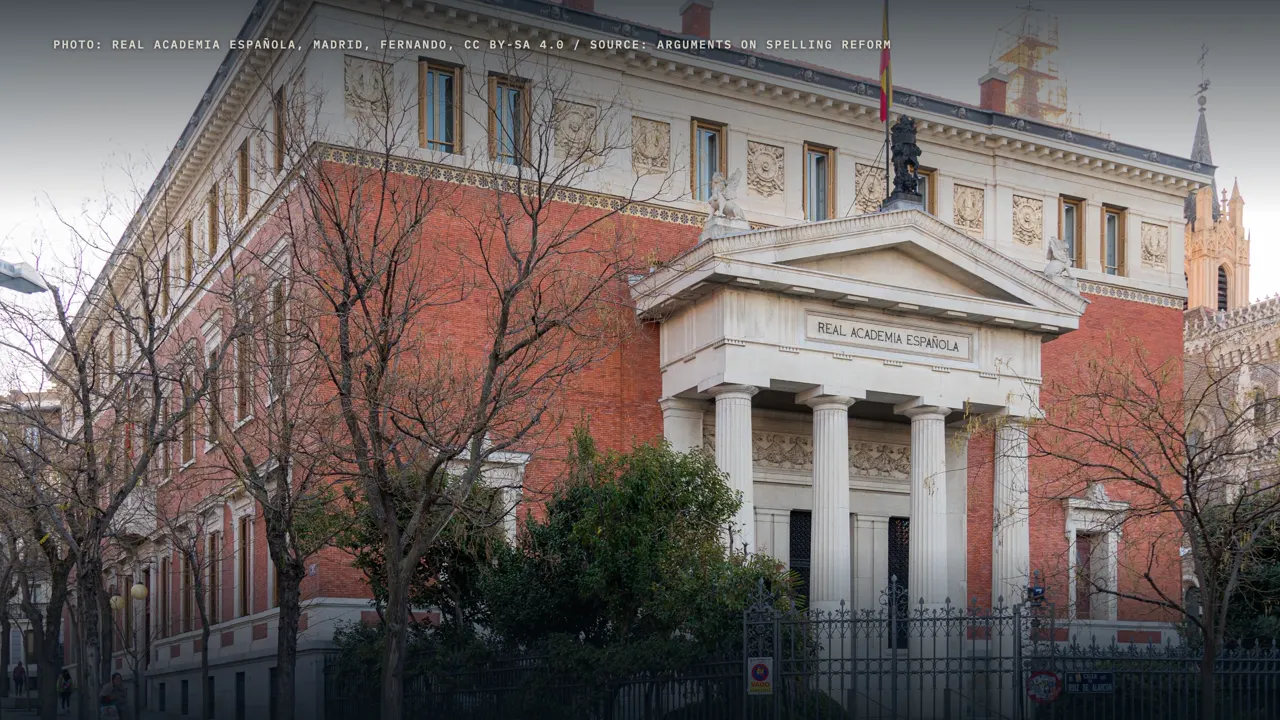
So why hasn't anyone fixed it since? One reason is that nobody is in charge: English has no official academy that can order a reform, the way the Royal Spanish Academy reformed Spanish spelling. Other countries that tried more recently have had mixed results.
In 1990, France changed the spelling of about 2,000 words, and the new forms still haven't fully caught on. German-speaking countries agreed on a reform in 1996, and after years of protest, the most disputed changes were rolled back in 2006. Another reason is accents. A spelling that matches the sound in London won't match in Texas, Glasgow or Sydney, so a strictly phonetic spelling would have to pick one accent.
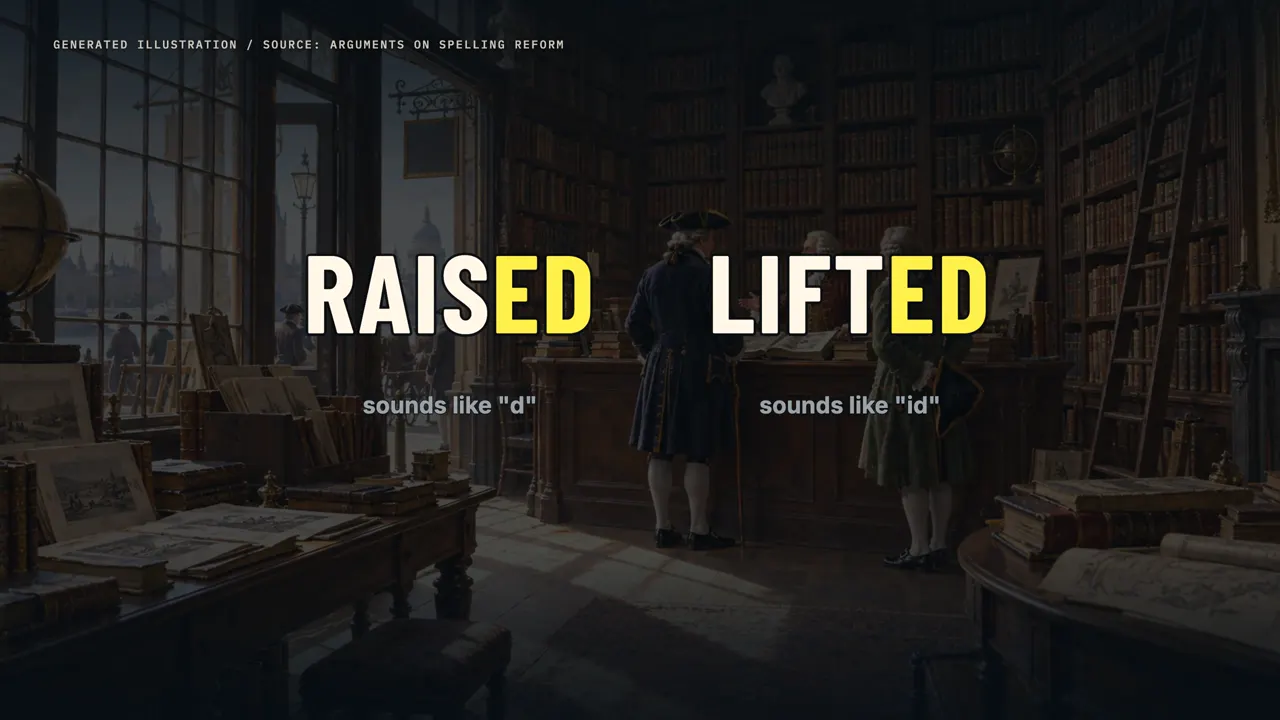
And the current spelling has a logic of its own. The past tense is written E D in raised and in lifted, even though it sounds different in each, so you can see the grammar at a glance. Related words often look related even when they sound different, like sign and signature, or nation and national. Some also argue that skilled readers recognize whole words and familiar chunks, rather than sounding out every letter.
The cost comes at the start: in that European study, the authors estimated that the Scottish children needed more than twice as long to master basic word reading as children learning more regular spellings. Their best guess is that English readers have to build two skills side by side: storing familiar words whole, and sounding out letters one by one for everything else.
English was furthest behind, but not alone: in the same study, children learning French, Portuguese and Danish also read fewer familiar words correctly than the rest.
A record, not a mistake
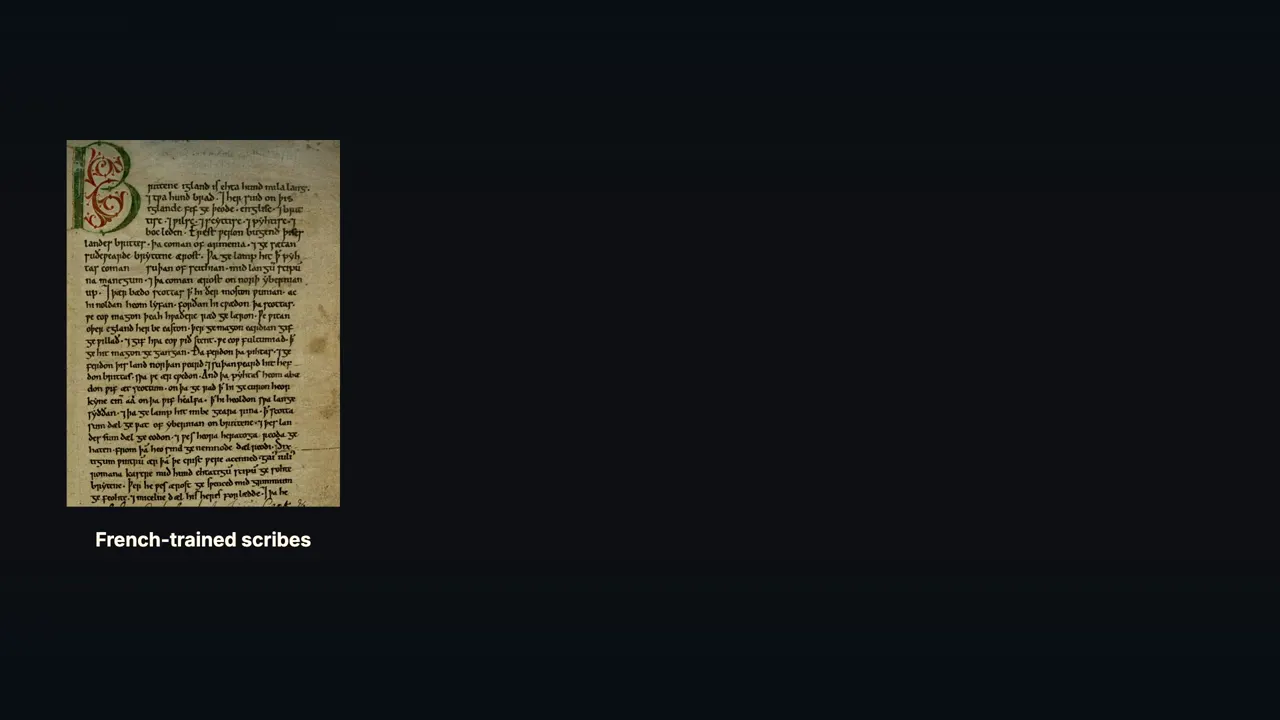
So English spelling isn't random. It's a record of French-trained scribes, of a printer's imported type, of vowels that kept moving while the spelling settled, and of scholars adding letters to point back to Latin. When you write knight, you're spelling it roughly the way people said it when Chaucer was alive.
The letters stayed where they were; the voices moved on.
Watch on YouTube
Sources
- P. H. K. Seymour, M. Aro, J. M. Erskine, "Foundation literacy acquisition in European orthographies", British Journal of Psychology 94 (2003): https://doi.org/10.1348/000712603321661859
- W. Caxton, prologue to Eneydos (1490), in Caxton's Eneydos, ed. W. T. Culley and F. J. Furnivall, EETS (1890): https://archive.org/details/caxtonseneydos00virguoft
- Great Vowel Shift: https://en.wikipedia.org/wiki/Great_Vowel_Shift
- English orthography, history: https://en.wikipedia.org/wiki/English_orthography
- Middle English, orthography and Chancery Standard: https://en.wikipedia.org/wiki/Middle_English
- William Caxton: https://en.wikipedia.org/wiki/William_Caxton
- Phonological history of English consonant clusters: https://en.wikipedia.org/wiki/Phonological_history_of_English_consonant_clusters
- Silent letters: https://en.wikipedia.org/wiki/Silent_letter ; Ye olde: https://en.wikipedia.org/wiki/Ye_olde
- Etymologies of knight, ghost, debt, doubt, receipt, island and could (Wiktionary, citing the OED and D. Crystal, Spell It Out, 2012): https://en.wiktionary.org/wiki/ghost
- A Dictionary of the English Language (Johnson, 1755): https://en.wikipedia.org/wiki/A_Dictionary_of_the_English_Language
- Noah Webster: https://en.wikipedia.org/wiki/Noah_Webster
- Simplified Spelling Board (1906): https://en.wikipedia.org/wiki/Simplified_Spelling_Board
- Spelling reform: https://en.wikipedia.org/wiki/Spelling_reform
Images and video
- Caxton's printing of The Canterbury Tales (1477), public domain (also thumbnail B); Gutenberg Bible, Genesis, public domain
- Ellesmere Chaucer, Huntington Library; Beowulf manuscript, British Library; Peterborough Chronicle, Bodleian Library; Roman de la Rose manuscript: all public domain
- Bayeux Tapestry, photo Myrabella, public domain
- Henry V, National Portrait Gallery; Daniel Maclise, Caxton showing his printing to Edward IV (1851): public domain
- James Malton, The North Foreland (1791), Yale Center for British Art, CC0
- Lead type in a press, Thomas Quine, CC BY 2.0; type case, Rodney Truitt Jr (Unsplash), CC0; metal type in a composing stick, Willi Heidelbach, CC BY 2.5
- Bruges, Ank Kumar, CC BY-SA 4.0; Edinburgh, Daniel Kraft, CC BY-SA 3.0; Isle of Skye coast, Christian Collins, CC BY-SA 2.0; Geirangerfjord, Ximonic (Simo Räsänen), CC BY-SA 3.0
- Long Room, Trinity College Dublin, Diliff, CC BY-SA 4.0; Dr Johnson's House, Gough Square, Paul Farmer, CC BY-SA 2.0
- Real Academia Española, Fernando, CC BY-SA 4.0; Institut de France, Nitot, CC BY-SA 2.5; Duden, Brützlschnätz, CC BY-SA 4.0
- Joshua Reynolds, Samuel Johnson (1772); title page of Johnson's Dictionary; Samuel F. B. Morse, Noah Webster; title page of Webster's American Dictionary (1828); Andrew Carnegie (1913), Theodore C. Marceau; Theodore Roosevelt (1904), Pach Brothers; Collier's Weekly cartoon (1906); C. L. Bartholomew, "Teaching Teddy Bear to Spell"; G. B. Shaw, Vanity Fair (1911); Frits Thaulow, Skiers (1894): all public domain
- Stock video from Mixkit (classroom, calligraphy, books and library)
- Wikimedia Commons files are used as published under the licences listed.
- The narration is a synthetic voice. Images marked "Generated illustration" (the knight, also thumbnail A, and the scenes of scribes, print shop, cottage, market, town crier, schoolrooms, coffeehouse, scholar, bookshop, newspaper office and readers) are generated, not records. The vowel chart and the study chart are drawn explanations; the classroom footage is not from the study.