Why Pilots Can't Tell Up From Down Inside Clouds (Spatial Disorientation)

Spatial disorientation is why pilots can't tell up from down inside clouds. With no horizon to see, the balance system in the inner ear can miss slow turns, stop sensing a turn that continues at a steady rate, and mistake acceleration for gravity, so a pilot can bank, dive and still feel level. This video starts with John F. Kennedy Jr.'s crash over a dark sea in 1999 and a 1954 experiment in which 20 pilots without instrument training lost control in an average of 178 seconds. It then follows the spinning-chair test of 1926, the gyroscope from Foucault to Sperry's autopilot and Doolittle's first blind flight in 1929, the leans and the graveyard spiral, crashes where the body won the argument or an instrument failed, and the gyroscope in your phone.
This article is the full narration of the video. Watch on YouTube
Spatial disorientation
Inside a cloud, a pilot can lose track of which way is up, and there's a name for it: spatial disorientation. It sounds impossible. You'd think you would know if you were upside down. On the night of July 16, 1999, a small single-engine plane flew east along the coast of Connecticut, toward the island of Martha's Vineyard.
At the controls was John F. Kennedy Jr., with two passengers on board. He had about 310 hours of flying experience, including about 55 hours at night. He was not yet qualified to fly by instruments alone. There was no storm that night.
But there was haze, and it was a dark night. Other pilots over the water that evening said they couldn't see any horizon at all. Over open water, about seven miles short of the island, the plane began a series of turns. Then it rolled into a right turn that kept getting steeper, and the nose dropped. By the end of the descent, it was coming down at more than 4,700 feet per minute, about 1,430 meters per minute.
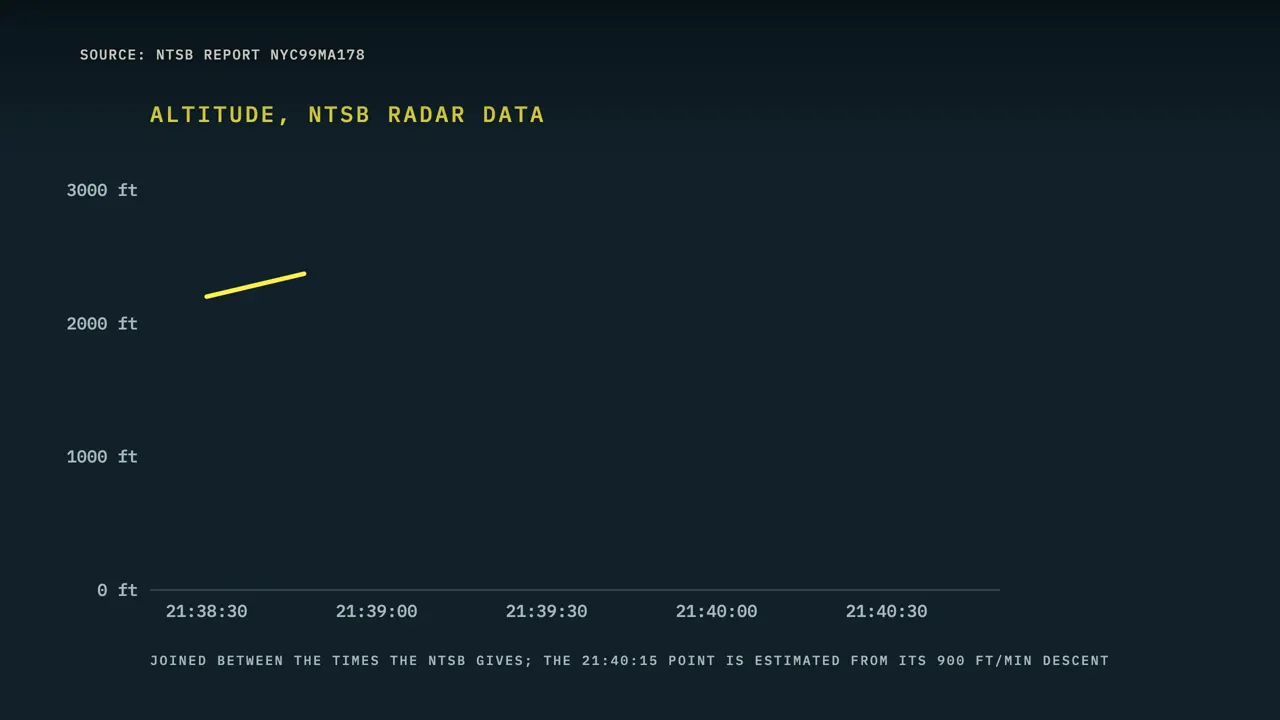
The last radar return came at 9:40 in the evening, at 1,100 feet, about 340 meters above the sea. All three people on board died. A small recorder wired to the radios was found crushed, with nothing saved on it, so no one can know exactly what he felt in those last minutes. So how can someone at the controls fail to feel the plane diving toward the sea?
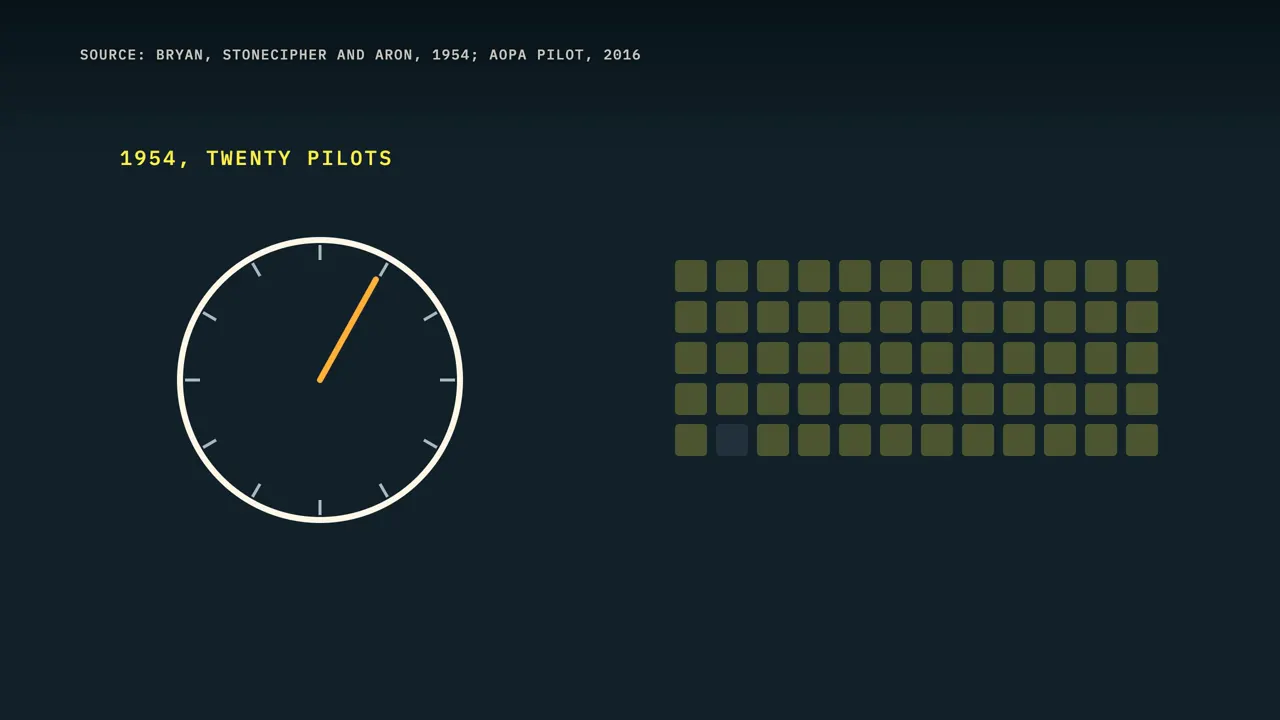
And how long can a pilot keep a plane under control once the outside world disappears? In 1954, researchers put twenty pilots into a fake cloud and timed how long they could stay in control. We'll come back to what they found. To get there, we'll start with a pilot on a spinning chair, and a flight in 1929 that changed flying for good.
The pilot on the spinning chair
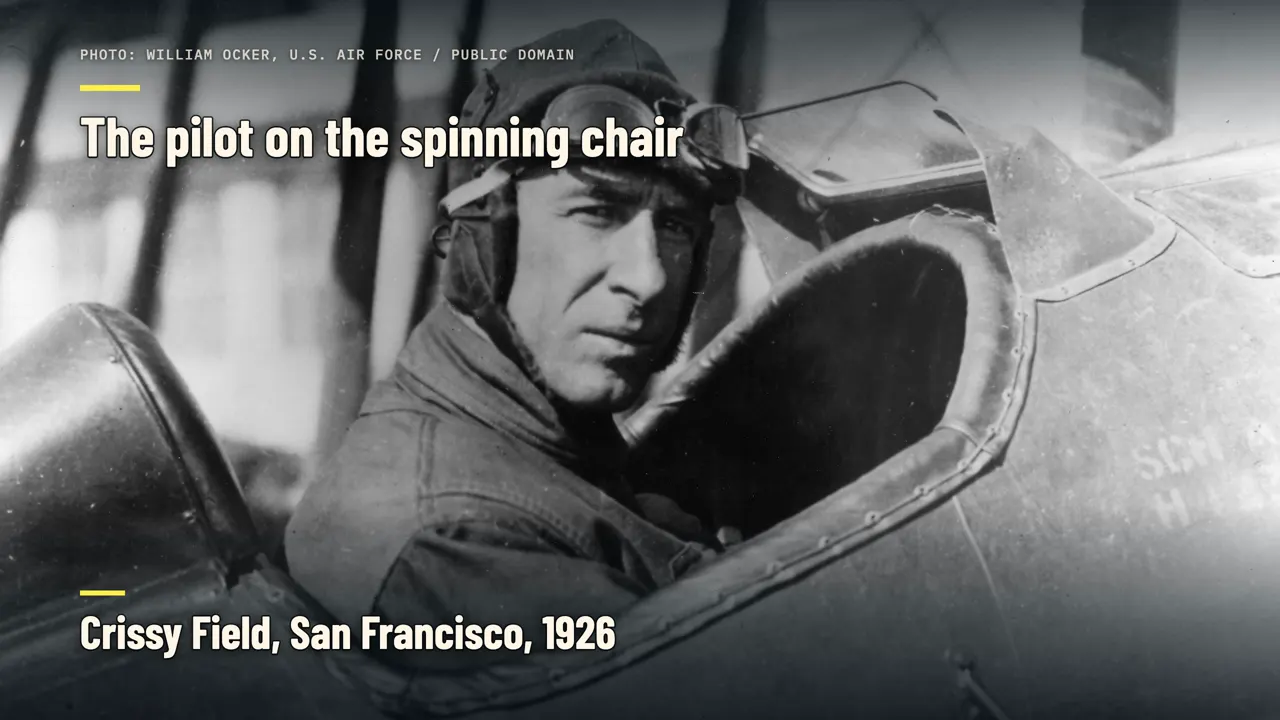
In 1926, at Crissy Field in San Francisco, an army pilot named William Ocker sat down in a spinning chair. The test was run by a flight surgeon, Captain David Myers. It was a Barany chair, a chair doctors used to test the sense of balance. Ocker closed his eyes, and Myers turned the chair.
Ocker couldn't tell whether the chair was turning, or which way. Then they tried something else. They put a turn indicator, a cockpit instrument that shows when a plane is turning, inside a shoe box with a small light. Ocker looked only into the box while the chair turned.
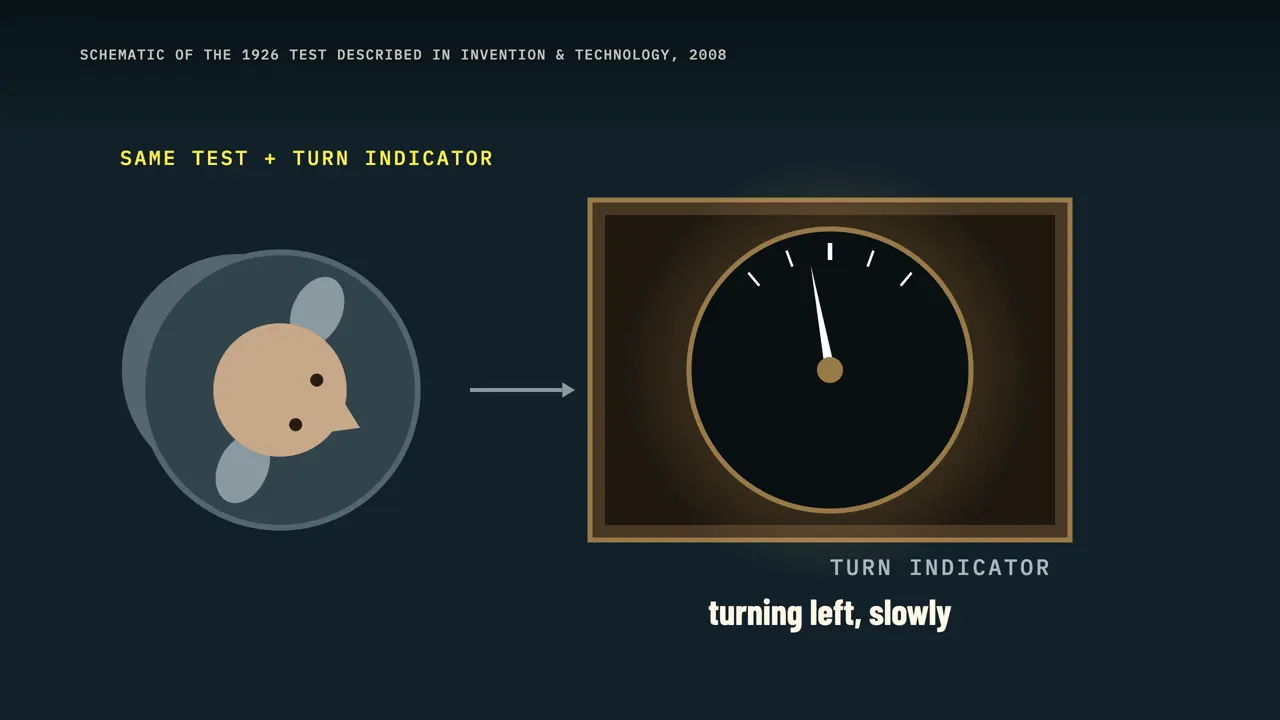
Now he could tell exactly which way he was turning, and how fast. His body had failed the test, and a simple instrument had passed it. Ocker spent years pushing the Army to train pilots to fly by instruments. With Lieutenant Carl Crane he wrote a book in 1932, "Blind Flight in Theory and Practice."
In 1943, a year after he died, the military made his methods standard for all its pilots. Today, air forces still use spinning trainers so student pilots can feel these illusions safely on the ground. But to see why the body gets it wrong, we have to look inside the ear.
The gyroscope in your ear
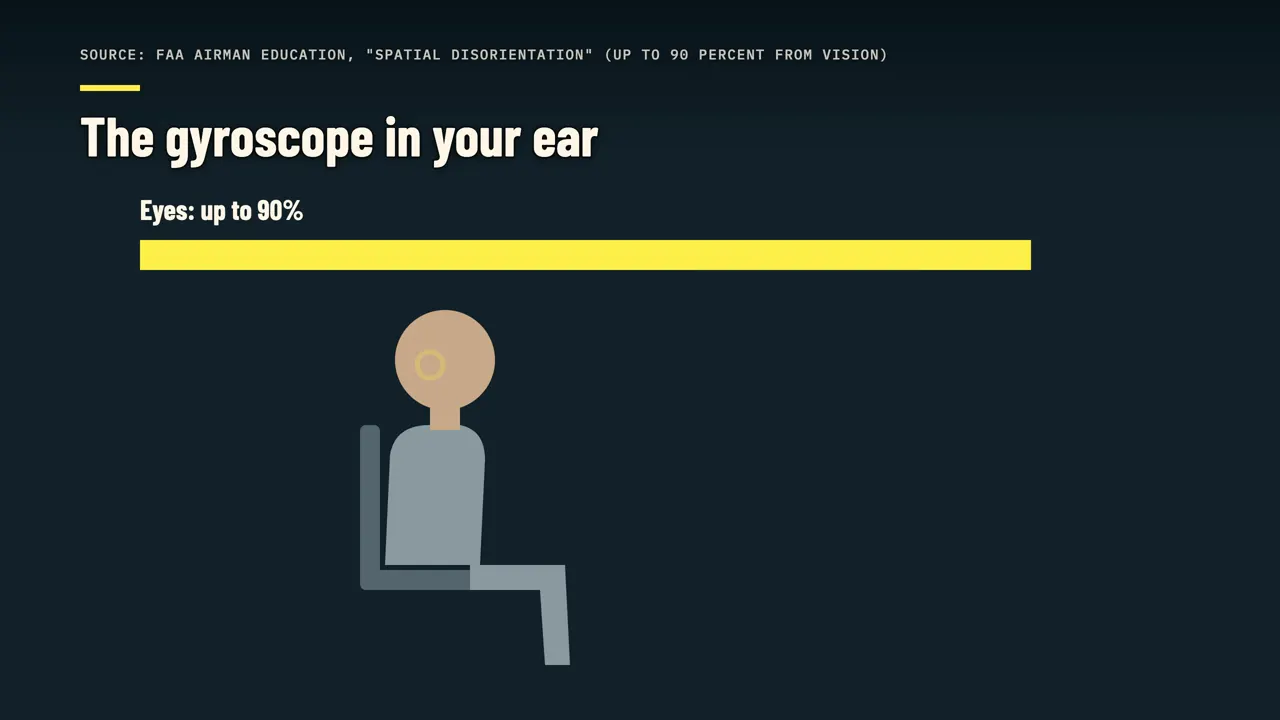
On the ground, your sense of up and down comes mostly from your eyes. The FAA, America's aviation regulator, says up to 90 percent of our sense of orientation comes from what we see. The rest comes from your body: pressure on your skin, your muscles and joints, and a small organ deep inside each ear. It's called the vestibular system, the balance system inside your inner ear.
It has two kinds of sensors. The first kind detects turning. Picture three tiny rings filled with fluid, each one set at right angles to the others. These are the semicircular canals.
One ring for nodding, one for shaking your head, and one for tipping it toward your shoulder. When your head starts to turn, the fluid inside lags behind, a bit like coffee in a cup you suddenly spin. The cup turns, but the coffee stays put for a moment. That lagging fluid bends tiny hairs, and those hairs tell your brain you're turning.
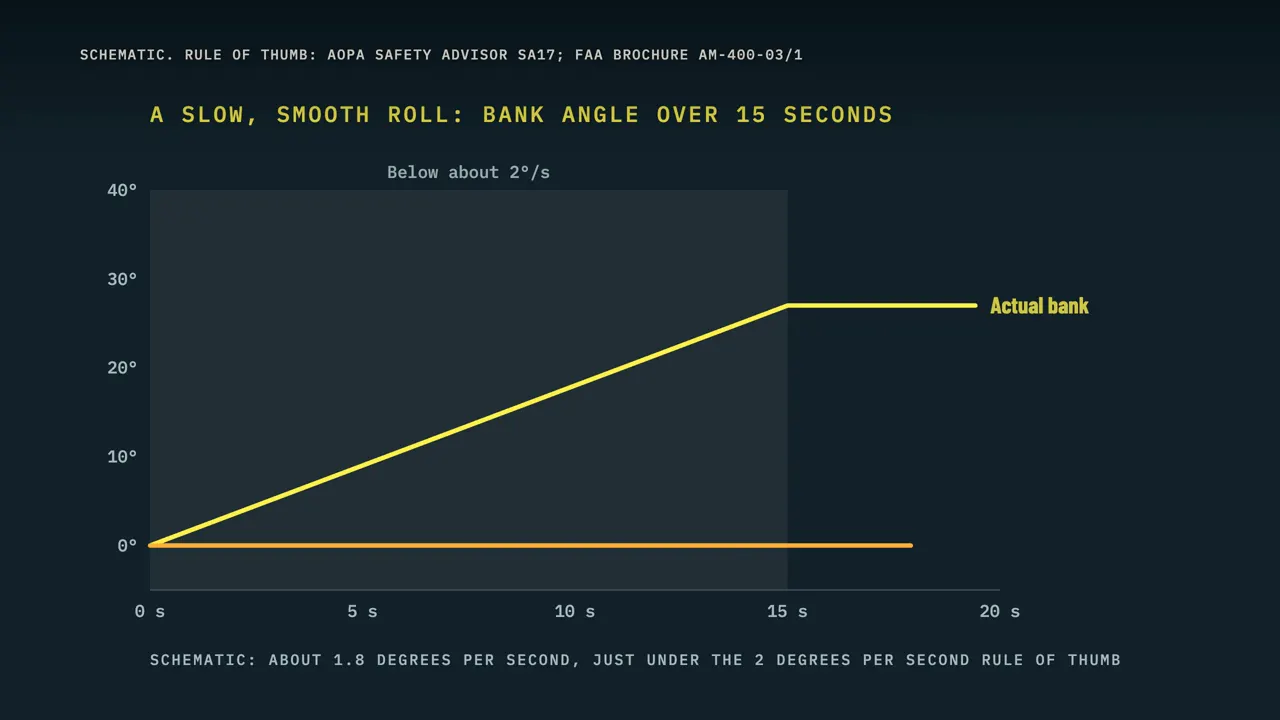
It's a clever design, and it has two weak spots. The first weak spot is slow movement. If a turn starts gently enough, the fluid barely lags, and the hairs barely bend. If the plane rolls slowly and smoothly enough, the pilot may not feel it at all. Pilot safety guides use about two degrees per second as a rule of thumb.
At just under that rate, the wings can tilt 20 or 30 degrees in 15 seconds, and the pilot feels nothing. In the lab, people sitting in the dark can notice some brief movements slower than one degree per second. But how slow a movement can slip by depends on how long it lasts. And a cockpit isn't a quiet lab. The second weak spot is time.
If you keep turning at a steady rate for about 10 to 20 seconds, the fluid catches up with the rings. The hairs straighten, and the feeling of turning fades away. You're still turning, but your body now says you've stopped. And when you really do stop, the fluid sloshes the other way, and you feel as if you're turning in the opposite direction.
The second kind of sensor is called the otolith organs. Here, the sensing hairs sit beneath a layer of tiny crystals that are heavier than the gel around them. When you tilt your head, gravity pulls the crystals, and the hairs bend. So the otoliths tell you which way is down.
But they have a weakness too: they can't tell gravity apart from acceleration. Speed up forward, and the crystals slide back, just as they would if you tilted your head back. A US Air Force manual says that, from the otoliths alone, finding the true direction of down is almost impossible. On the ground, your eyes usually sort out these mixed signals.
Inside a cloud, or over a dark sea at night, your eyes have nothing to work with.
The leans and the graveyard spiral
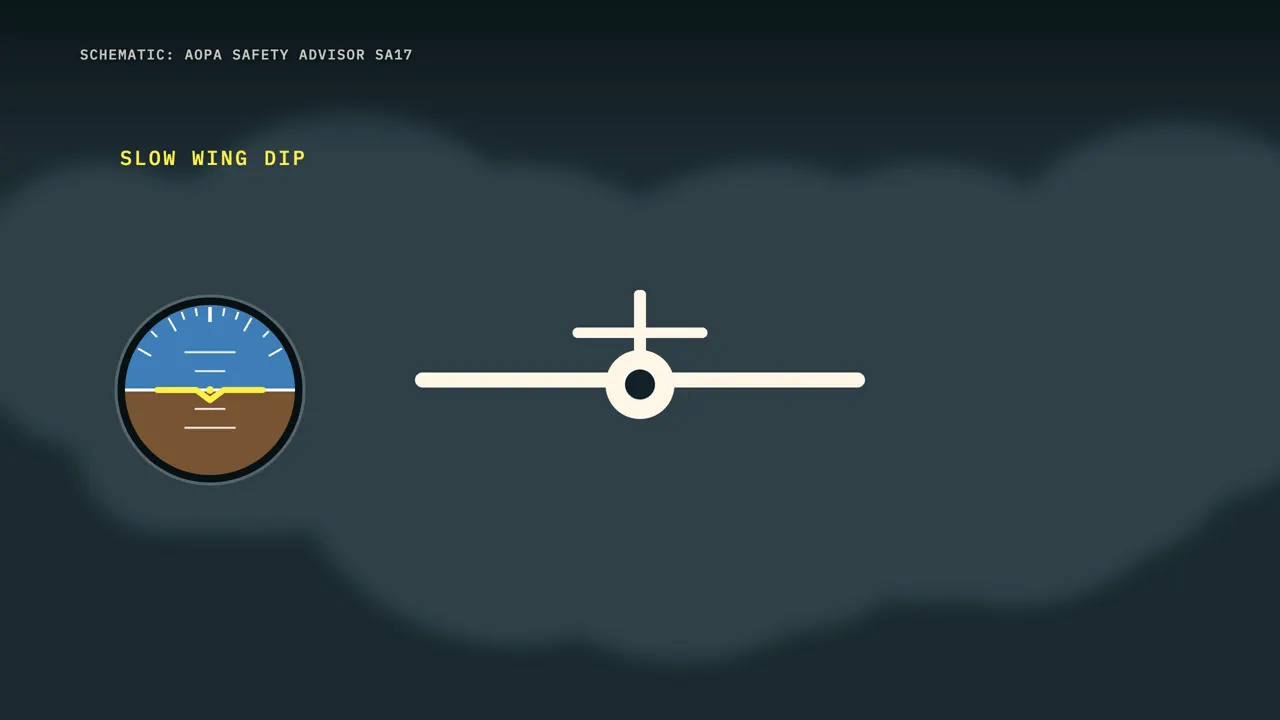
Now put those weak spots in a cockpit, inside a cloud. One wing dips, very slowly, below what the inner ear can sense. The pilot feels nothing. And there's a reason the otoliths don't notice either.
In a smooth, balanced turn, the push of the turn and the pull of gravity add up to one force that points straight into the seat. So in a smooth turn, the body's "down" stays pointed at the floor of the plane. And if nobody corrects the bank, the wings produce less upward lift, so the nose starts to drop. It picks up speed and starts to lose height.
A pilot who sees the altimeter, the height gauge, dropping will often pull back to raise the nose. But pulling back while the plane is banked just tightens the turn. The descent gets steeper, and faster. Pilots call this the graveyard spiral.
It's a fast, tight, descending turn, and it's not a spin, because the wings are still making lift. An FAA brochure says the graveyard spiral is more common than the graveyard spin. Inside the spiral, the pilot may feel the descent but not the turn, so it can feel like a straight dive. Now suppose the pilot does notice, and snaps the wings level.
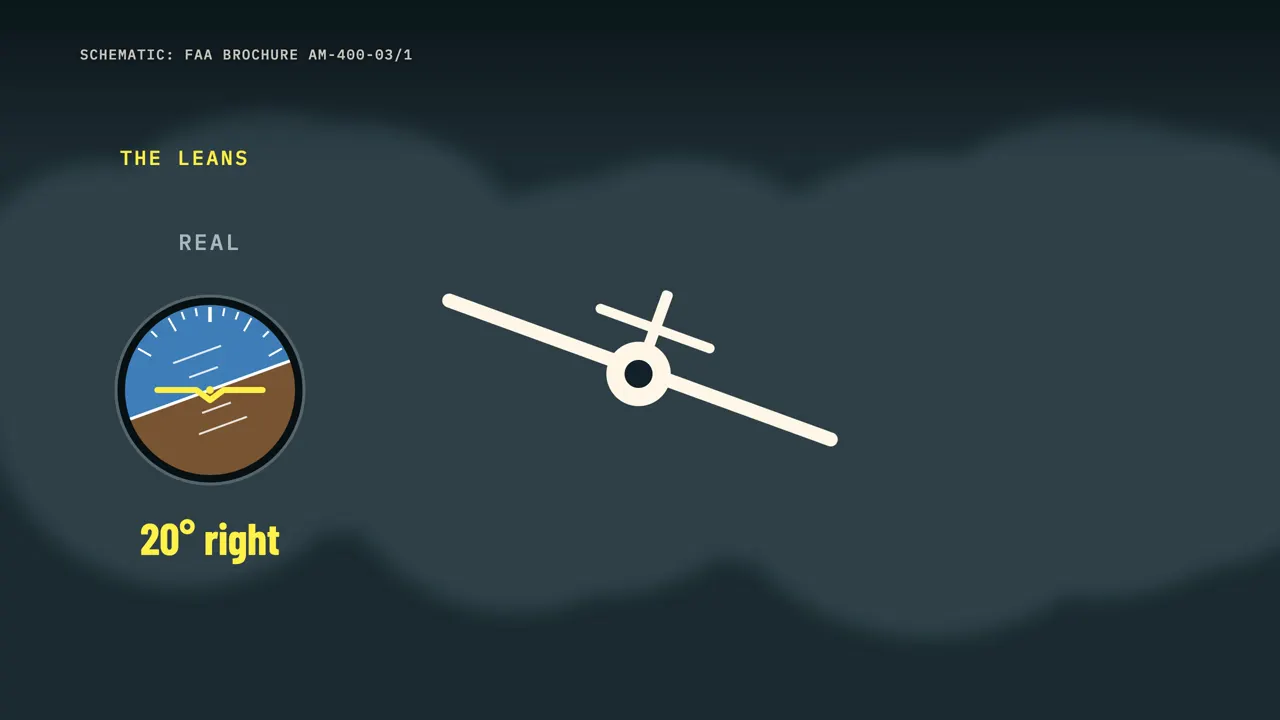
The fluid in the canals sloshes, and the body says the plane is now banking the other way. So the pilot leans, or tips the plane, back into the original bank. This is called the leans, and the FAA calls it the most common illusion during flight. An FAA safety circular cites a survey of a large group of pilots. Forty-five percent said that after leveling the wings, they'd tended to bank back the other way.
And 39 percent said they had felt straight and level while they were actually turning. There's one more illusion, and it strikes when a plane speeds up. A sudden push forward slides the otolith crystals back, and the pilot feels the nose pitching up. It's called the somatogravic illusion.
A pilot who feels the nose rising may push the nose down, toward the ground, during a takeoff or an aborted landing. Notice what's missing in all of this: a spinning, dizzy feeling. Spatial disorientation often isn't vertigo. The body often doesn't panic. It just calmly reports the wrong answer.
178 seconds

Which brings us back to the twenty pilots in the fake cloud. In 1954, a team at the University of Illinois set out to teach pilots with no instrument training how to get out of a cloud alive. First, they measured how long those pilots lasted without help. The study was paid for by a foundation of AOPA, an American association of aircraft owners and pilots. The volunteers were twenty pilots, aged 19 to 60. Nineteen held private licenses, one was still a student, and none had ever flown by instruments.
They flew a Beechcraft Bonanza, a common four-seat plane, with an instructor on board. Amber plastic covered the windows, and each pilot wore blue goggles, so they could see the instrument panel but nothing outside. And the researchers covered the artificial horizon, the instrument that shows a picture of the sky. To the pilots, it was like flying into a cloud with almost nothing to go on. Nineteen of the twenty went into a graveyard spiral.
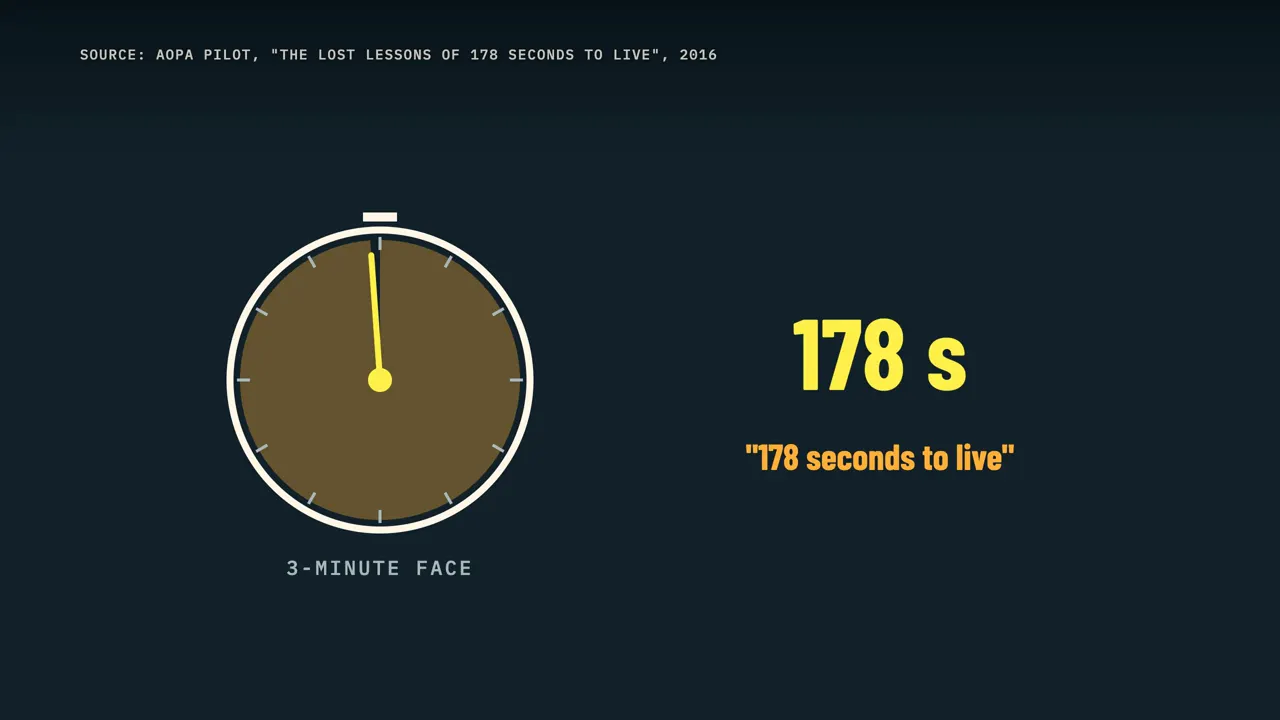
The twentieth pulled the nose up so steeply that the plane was close to stalling. The fastest loss of control came after 20 seconds. The longest took 480 seconds, which is 8 minutes. And the average was 178 seconds, just under three minutes.
The number was later repeated in flight training as "178 seconds to live." But it's an average of twenty people, and the range was huge. One recent article even dates the study to 2003, but the study is from 1954. Then came the part that's quoted less often.
The researchers then gave the same pilots about four hours of lessons on one simple escape routine. Take your hands off the control wheel, slow the plane down, and let it fly itself. Then use only the rudder and a small turn needle to make a gentle 180-degree turn, and fly back out the way you came. In a final test, each pilot ran the whole escape three times, 60 tries in all. The one miss came when a pilot forgot to set the power and slowly lost height.
What changed was what they trusted. Before, they flew by how it felt; after, they flew by a needle on the panel, and kept their hands off. Even with training, the switch from body feelings to instruments isn't instant. An FAA circular says that even qualified instrument pilots can take as long as 35 seconds to regain full control using instruments after they lose sight of the ground.
And the instrument the researchers had covered up, the artificial horizon, is the most important one of all. Why can it be trusted when the body can't?
Gyroscopic instruments: how a spinning top holds its line

The answer starts with a toy. Spin a top, and it stands up on its point. A spinning wheel resists being tipped over. Pilots' textbooks call this rigidity in space: a spinning gyroscope keeps pointing the same way, whatever happens around it.
In 1852, the French physicist Leon Foucault named it the gyroscope, from Greek words meaning roughly "circle" and "to watch." He used it to show that the Earth turns underneath it. A spinning wheel also does something strange. Push on a spinning wheel, and it doesn't tip the way you pushed.
It turns sideways instead, as if the push arrived a quarter turn later. This is called precession. Now mount a fast-spinning wheel in a frame that lets the aircraft rotate freely around it. When the plane banks, the wheel stays level, and the case of the instrument turns around it.
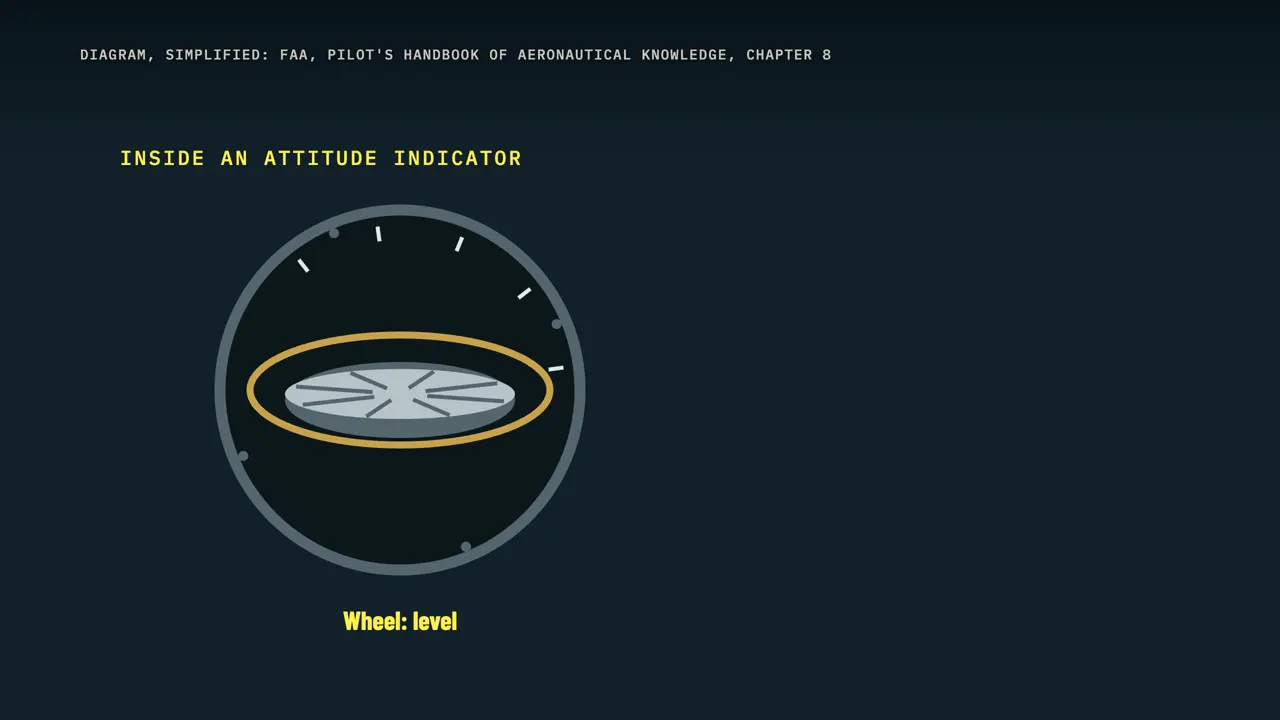
Link a picture of the horizon to that wheel, and you have an attitude indicator, also called an artificial horizon. It shows a small symbol of the plane against a line that stays level with the real horizon. It's a horizon you can carry into a cloud. In many small planes, an engine-driven vacuum pump pulls air through the instrument, and that airflow keeps the wheel spinning.
Unlike the fluid in your ear, the wheel doesn't fade after 20 seconds. It isn't perfect. After a hard speed-up or a long turn, it can be off by a few degrees for a minute or so. But it doesn't quietly fade the way your inner ear does. But someone had to get that spinning wheel into an airplane first.
Hands off: the first autopilot
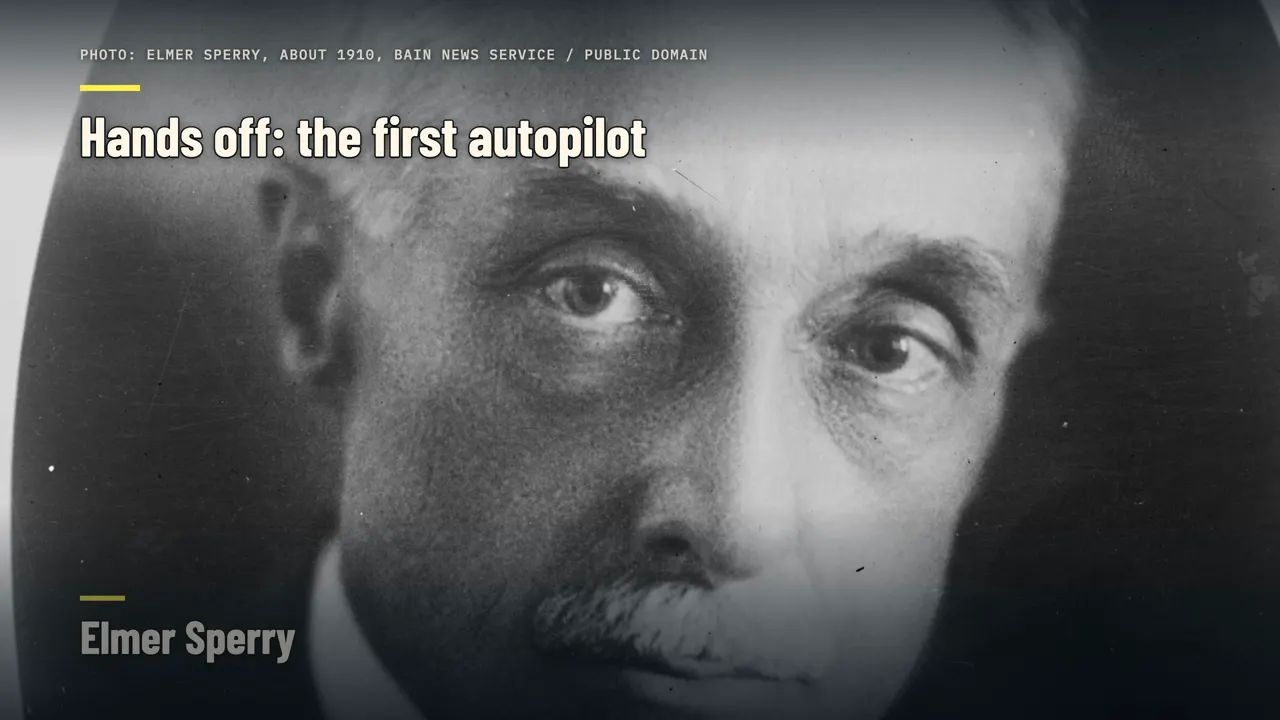
In the early 1900s, the American inventor Elmer Sperry built gyroscopic compasses for warships. His son Lawrence wanted to put gyroscopes into airplanes. On June 18, 1914, he got his chance in France. An aviation safety contest was held on the River Seine, near Paris.
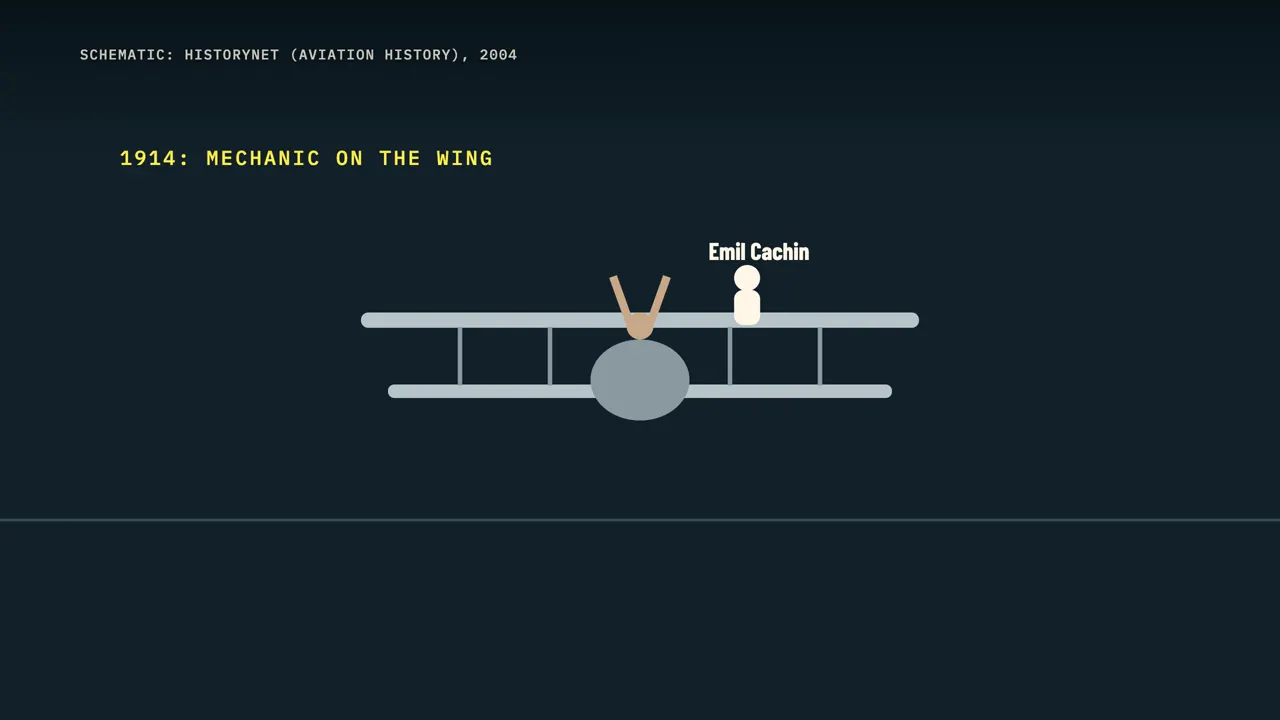
Lawrence Sperry, 21 years old, flew a Curtiss flying boat fitted with his gyroscopic stabilizer. As he flew past the judges, he took his hands off the controls. His mechanic, Emil Cachin, climbed out and walked along the wing. The plane dipped, and the stabilizer brought it back level on its own.
Sperry won the prize of 50,000 francs. By 1918, Sperry's company was testing a turn indicator for pilots. Lawrence Sperry didn't live to see blind flying become routine. In December 1923, flying over the English Channel in fog, his plane went down, and he died at 31.
What caused the crash is not known.
September 24, 1929: the first blind flight
In the 1920s, a pilot who flew into fog was likely to lose control. Again and again, a pilot who lost sight of the ground went into a spiral dive and crashed. Ocker and his colleague, Lieutenant Carl Crane, even threw blindfolded pigeons out of an airplane. Without their eyes, the birds lost their bearings, much like pilots in cloud.
In 1926, the businessman Daniel Guggenheim set up a fund of 2.5 million dollars to make flying safer. One of its goals was to fly safely in fog. At Mitchel Field, near New York, it set up the Full Flight Laboratory. Its test pilot was an army officer named Jimmy Doolittle.
Doolittle practiced more than 100 times with a cloth hood over his cockpit. He relied on new instruments, and three of them mattered most. First, a new altimeter made by Paul Kollsman, much more precise than the standard ones of the time. Second, an artificial horizon built by Elmer Sperry Jr., Lawrence's younger brother.
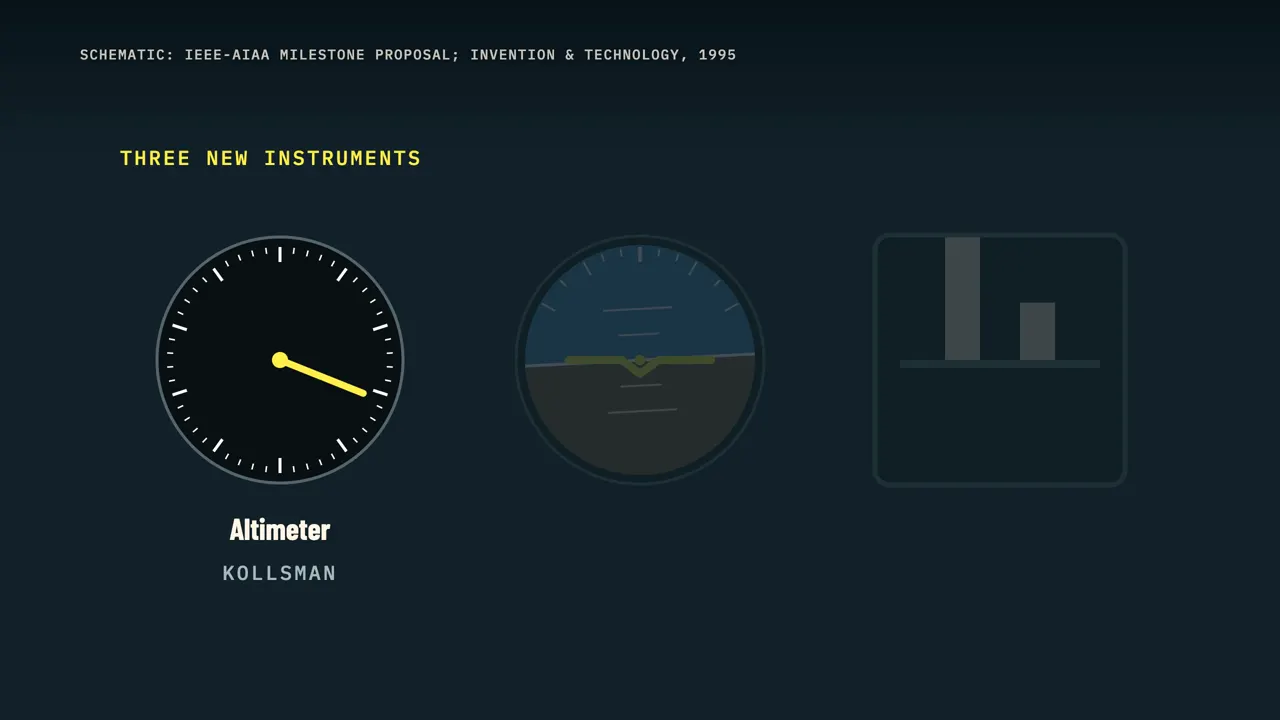
Third, a radio beacon told him whether he was on course. He read it on an instrument with vibrating metal reeds. On September 24, 1929, Doolittle took off in a Consolidated NY-2 biplane, with the hood closed over his cockpit. He flew for about 15 minutes, turned, and came back to land. He never saw the outside.
A safety pilot, Lieutenant Ben Kelsey, rode in the front cockpit with his hands held up where everyone could see them. Doolittle later wrote that, as far as he knew, this was the first airplane to take off, fly a set course, and land by instruments alone. Slowly, a rule for flying in cloud took shape: believe the instruments, not your body. But having instruments is one thing, and trusting them is another.
When the body wins the argument
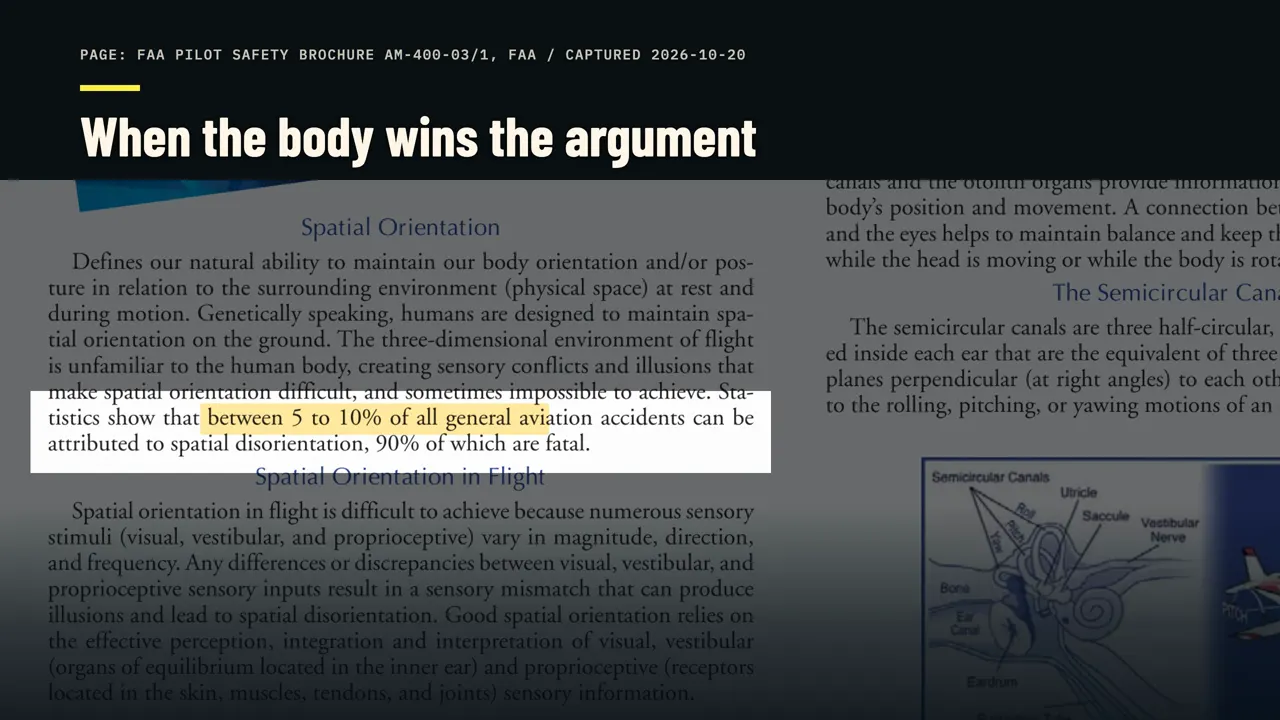
An FAA safety brochure says spatial disorientation is behind 5 to 10 percent of general aviation accidents, the flying done outside airlines and the military. And about 90 percent of those accidents are fatal. In 2025, FAA researchers analyzed 367 fatal accident reports from 2003 to 2021. Across a wider set of 390 spatial disorientation accidents, 94 percent were fatal.
They also found a strong link between these accidents and pilots who had fewer than 500 hours of flying. Spatial disorientation isn't common, but when it happens, it's usually deadly. On August 23, 2000, an Airbus A320 of Gulf Air was coming in to land in Bahrain at night, over the sea. The crew flew a tight circle low near the runway, then gave up on the landing and climbed away to try again.
Less than a minute later, the plane flew into the shallow sea, and all 143 people on board died. The investigation found the crew probably experienced a form of spatial disorientation. The captain may have falsely sensed that the plane was pitching up. That's the illusion we saw earlier, the one that strikes when a plane speeds up and the pilot can't see outside.
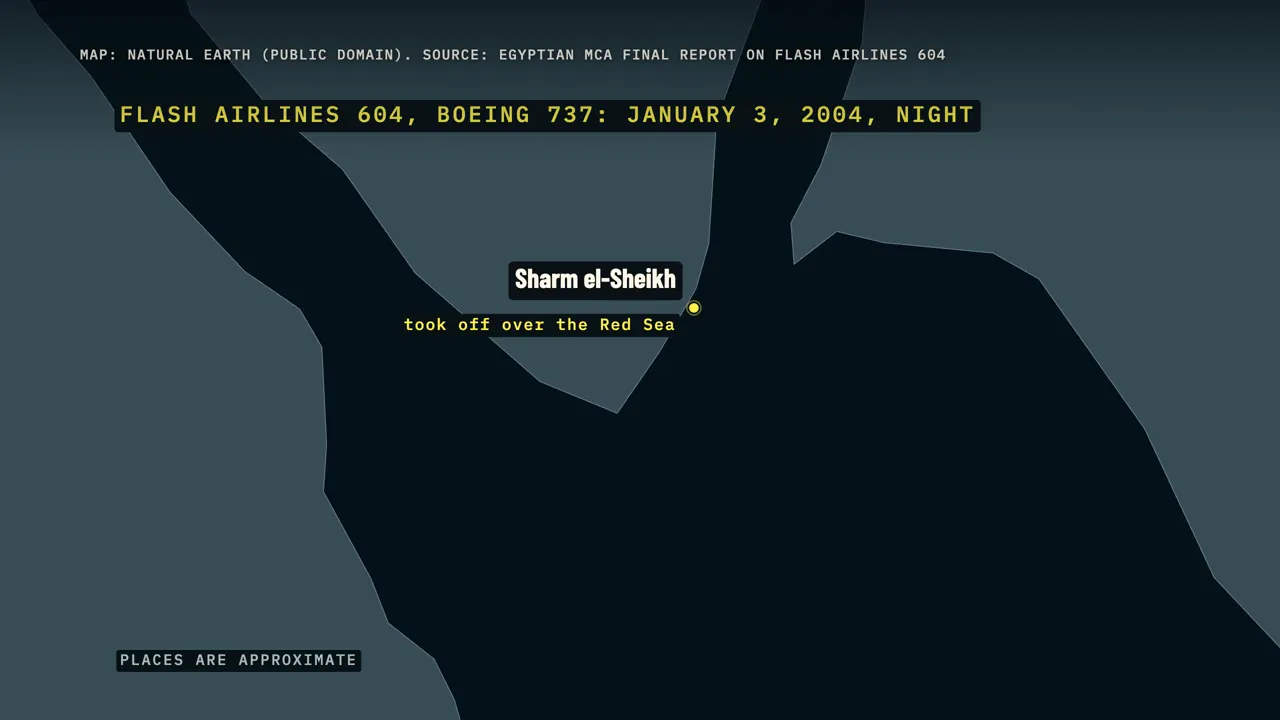
In January 2004, a Boeing 737 of Flash Airlines took off from Sharm el-Sheikh in Egypt at night, over the Red Sea. About two and a half minutes after takeoff, it crashed into the sea, and all 148 people on board died. Egypt's investigators said they couldn't find conclusive evidence for a probable cause. American investigators disagreed. They said spatial disorientation was the only explanation that fit the evidence. France's BEA also pointed to spatial disorientation, along with fatigue.
And on January 26, 2020, a Sikorsky S-76 helicopter flew into clouds near Calabasas, west of Los Angeles. On board were the basketball player Kobe Bryant, his daughter Gianna, and seven others. The pilot was experienced, and he told air traffic control he was climbing to 4,000 feet, about 1,200 meters. In fact, the helicopter had just peaked at about 2,370 feet, roughly 720 meters, and was descending in a left turn.
About 20 seconds later, it struck a hillside, and all nine people died. The NTSB found that the pilot's decision to keep flying by sight into clouds led to spatial disorientation and loss of control. When the NTSB released its findings, its chair, Robert Sumwalt, said: "Unfortunately, we continue to see these same issues influence poor decision making among otherwise experienced pilots." In both the Bahrain and the Calabasas crashes, investigators found no sign that the aircraft itself had failed.
The body was telling a more convincing story.
When the instrument itself fails
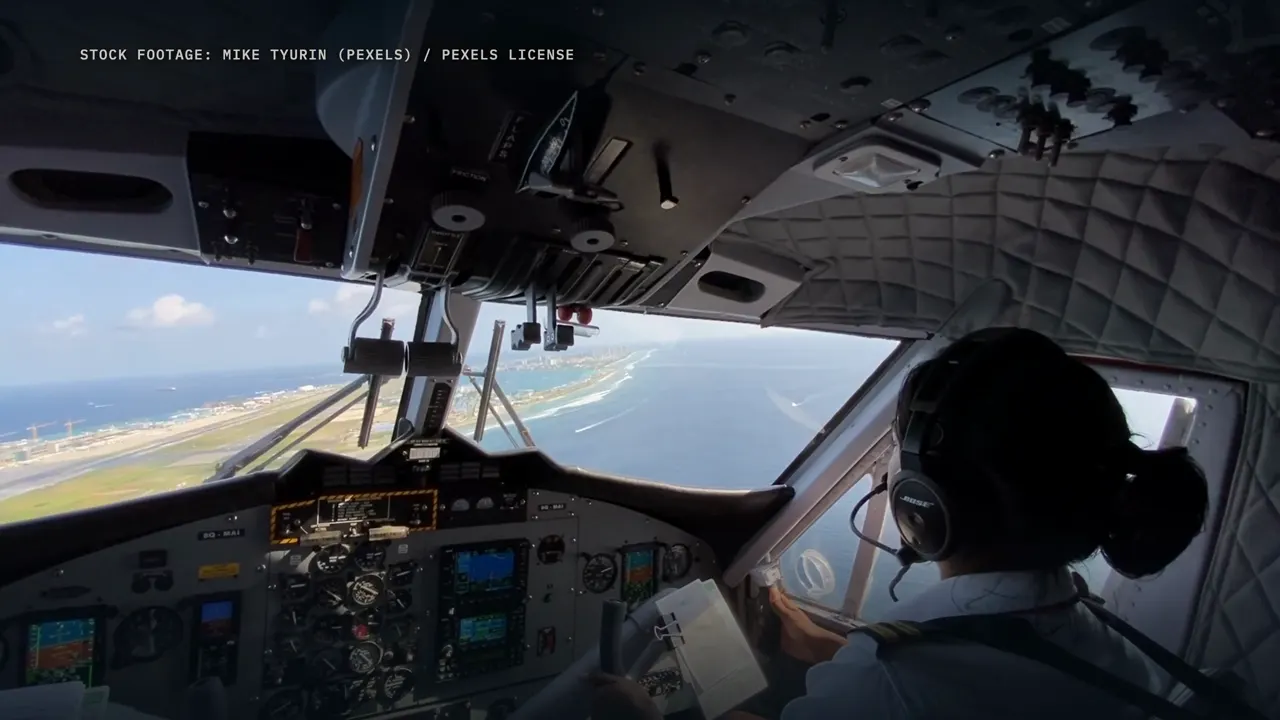
So should a pilot always trust the instruments? Not blindly, because instruments can fail too. In small planes, a failed vacuum pump can let the gyroscopes slow down and drift. Some planes have a warning light, but the pilot still has to notice it. An FAA report, using AOPA's accident data, says vacuum failures caused about three accidents a year, around 11 percent of disorientation accidents, and about 90 percent of them were fatal.
On January 1, 1978, an Air India Boeing 747 took off from Bombay, now Mumbai, at night, over the sea. Investigators blamed a faulty attitude indicator during a right turn. Over the dark sea there was no horizon to check, and the plane kept rolling left, past 90 degrees. Investigators found the crew failed to use the other instruments to recover.
Within minutes of takeoff, the plane hit the sea about three kilometers offshore, and all 213 people on board died. On December 22, 1999, a Korean Air Boeing 747 cargo plane took off from London Stansted Airport after dark. On the previous flight, the captain's attitude indicator had been reported unreliable in roll. The fault was reported correctly, but repairs at Stansted were aimed at the wrong part, so it was still there.
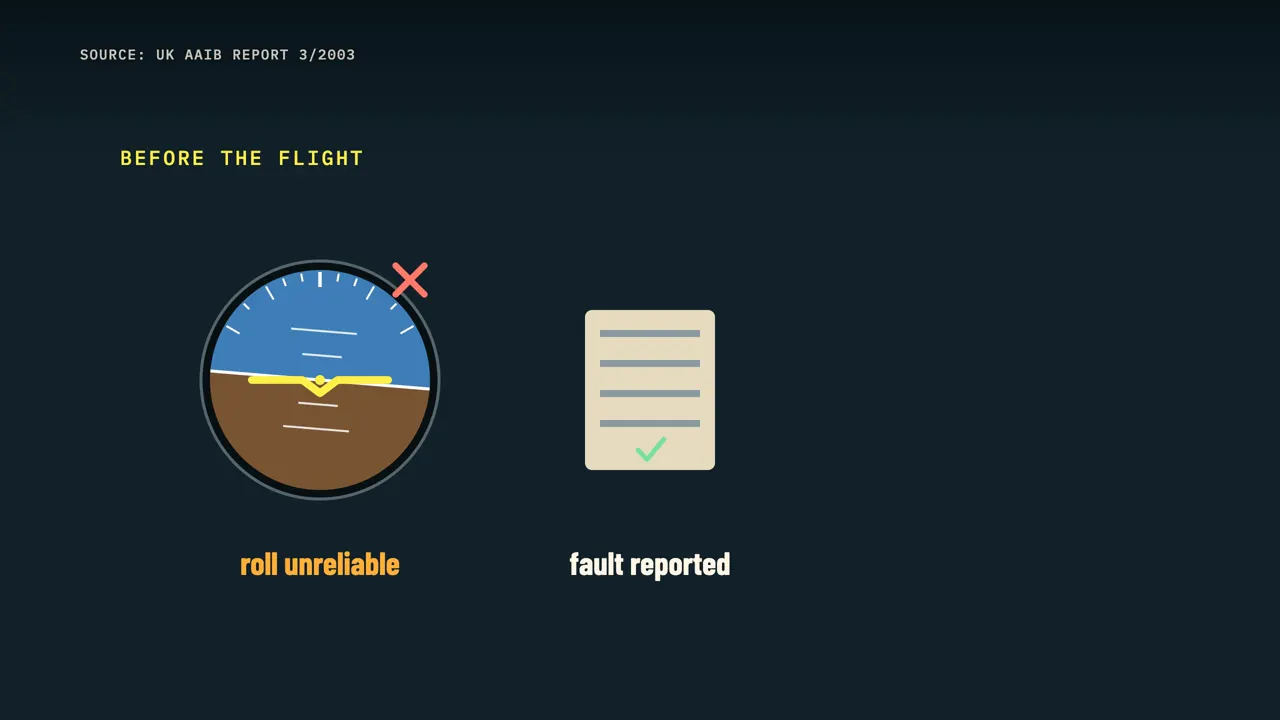
After takeoff, the captain's attitude indicator showed the wings level, even as the plane banked. A warning sounded three times, because the captain's instrument didn't agree with the first officer's instrument. The flight engineer called out, "Bank, bank." Neither pilot answered. But the captain kept rolling left to about 90 degrees of bank.
The plane hit the ground with its wings close to vertical, and its nose about 40 degrees down. It hit a field at the edge of the village of Great Hallingbury, less than a minute after takeoff. All four people on board died: the three flight crew and a company engineer. The British investigators found that the pilots did not respond appropriately to the warnings. They also found that the first officer either didn't monitor the plane's attitude, or didn't alert the captain to it.
So the lesson isn't simply "trust the instruments." It's to compare them, because one instrument, like one inner ear, can be wrong. That's why big planes carry more than one attitude indicator, and a standby horizon. And it's why the same idea, two sensors checking each other, is built into the device in your pocket.
The gyroscope in your pocket

Your phone has a gyroscope, but nothing in it spins. It's a tiny structure etched into silicon, and it vibrates back and forth. When the phone rotates, the vibrating part gets pushed slightly sideways. That's the Coriolis effect, the sideways push that rotation creates. Measure that sideways push, and you know how fast the phone is turning.
Add up those turning rates over time, and you get the phone's angle. But every tiny error gets added up too, so the angle slowly drifts. So phones also use an accelerometer, a sensor that feels gravity, to check which way is down and correct the drift, at least while the phone is held fairly still. One sensor for turning, one for down: the same pair as your inner ear.
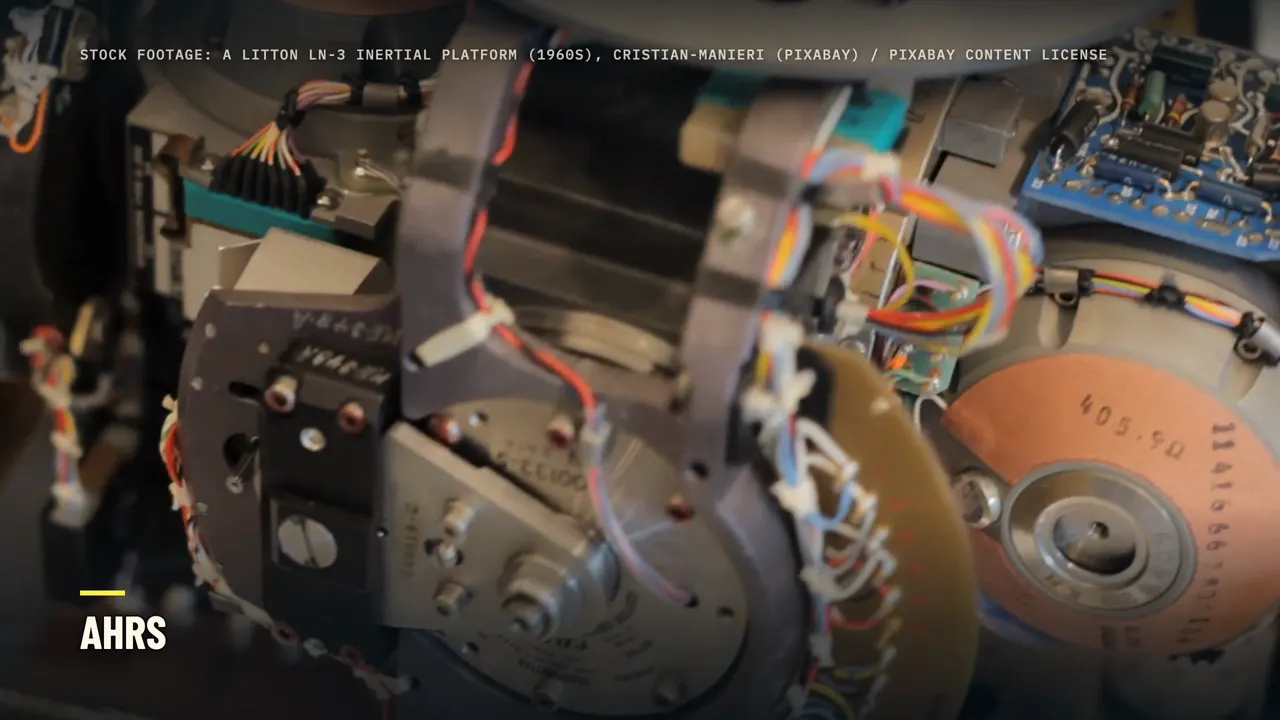
And the accelerometer has the same weakness as the otoliths: it can't tell gravity from acceleration either. Modern cockpits use a related system called an AHRS, short for attitude and heading reference system. It tracks the plane's tilt and direction. It feeds the pilot's main screen with the plane's attitude, without a spinning wheel. Astronauts run into the inner-ear problem from the other side.
In orbit, the otoliths no longer feel a steady pull of gravity. About 65 to 70 percent of Space Shuttle crew members had space motion sickness during their first three days. One explanation is that the brain has to relearn what its otolith signals mean. Motion sickness on Earth, in a car or in a virtual reality headset, is often explained the same way: the senses disagree, very often the eyes and the inner ear.
And birds? Frigatebirds, large seabirds of the tropics, regularly soar inside cumulus clouds, sometimes up to about 4,000 meters. One analysis suggests their circling climbs inside clouds are naturally stable, so they don't need to make big corrections. But the blindfolded pigeons of the 1920s lost their bearings.
Trust the instruments
So why do pilots lose up and down inside a cloud? Because the body's balance system is built for life on the ground, with the eyes open. It misses slow turns, it forgets steady ones, and it can't tell gravity from acceleration. On the ground, the eyes cover for those weak spots, and inside a cloud, nothing does.
The history of flying in cloud is the history of building a better gyroscope, and learning to believe it. In 1954, twenty pilots lost control in an average of under three minutes. After about four hours of lessons, the same pilots got out safely in 59 of 60 tries. What changed was what they chose to believe when the body and the instruments disagreed.
Back over the dark sea in 1999, the instruments in that plane were most likely working. Inside a cloud, the hard part isn't seeing. It's believing what the panel tells you.
Watch on YouTube
Sources
- Kennedy crash: NTSB report NYC99MA178 (2000)
- The inner ear and illusions: FAA Airman Education, "Spatial Disorientation" (2024); FAA pilot safety brochure AM-400-03/1; U.S. Air Force AFPAM 11-417, "Orientation in Aviation" (2015); AOPA Air Safety Foundation, Safety Advisor SA17 (2004); FAA Advisory Circular 60-4A (1983); Bermudez Rey et al., Frontiers in Neurology 7:162 (2016)
- The 1954 experiment: Bryan, Stonecipher and Aron, "180-Degree Turn Experiment," University of Illinois Aeronautics Bulletin No. 11 (1954); Roy and Beringer, FAA report DOT/FAA/AM-02/19 (2002); AOPA Pilot, "The lost lessons of '178 seconds to live'" (2016); General Aviation News (2025)
- Gyroscopes and instruments: FAA, Pilot's Handbook of Aeronautical Knowledge, chapter 8; FAA Instrument Flying Handbook; Foucault, Comptes rendus 35 (1852); Purdue University, ME 274, "Coriolis Vibrational Gyroscope"
- History of blind flying: Wolverton, "The Father of Blind Flying," Invention & Technology (2008); Heppenheimer, "Flying Blind," Invention & Technology (1995); Scheck, "Lawrence Sperry," Aviation History via HistoryNet (2004); IEEE-AIAA Milestone proposal, "First Blind Flight"; Glines, "Flying Blind," Air Force Magazine (1989); U.S. Air Force AETC photo page on disorientation trainers
- Accident data: Baumgartner et al., FAA CAMI report DOT/FAA/AM-25/14 (2025)
- Gulf Air 072: Bahrain accident investigation report, executive summary (BEA copy, 2002); SKYbrary, "Spatial Disorientation"
- Flash Airlines 604: Egyptian Ministry of Civil Aviation final report with U.S. comments (2006); FlightGlobal (2006)
- Calabasas helicopter crash: NTSB report AAR-21/01 and NTSB news release (2021)
- Air India 855: Aviation Safety Network record (citing ICAO file 78/1-0)
- Korean Air 8509: UK AAIB report 3/2003 and ICAO synopsis; Wikipedia, "Korean Air Cargo Flight 8509"
- Space motion sickness: Harm and Parker, Journal of Clinical Pharmacology 34:618 (1994)
- Frigatebirds: Weimerskirch et al., Science 353:74 (2016); Sachs and Weimerskirch, Journal of Theoretical Biology 448:9 (2018)
Images and video
- Public domain: Agence Meurisse photos of the 1914 Sperry trials (BnF Gallica via Wikimedia Commons); National Photo Company Collection and Bain News Service (Library of Congress); unknown author (Lawrence Sperry portrait); U.S. military (Barany chair test); NACA; U.S. Air Force (including Liz Colunga); Stéphane Magnenat (Foucault's gyroscope); NASA Johnson Space Center; U.S. Fish and Wildlife Service, National Conservation Training Center; maps from Natural Earth
- NASA: rotating-chair photo from STS-40 (NASA Images and Media Usage Guidelines)
- CC BY-SA 3.0: Bin im Garten (Cessna 172 instrument panel), via Wikimedia Commons
- CC BY 2.0: Kyle Harmon (Garmin G1000 display), via Wikimedia Commons
- CC BY-SA 4.0: Gavin W Morley (gyroscope video), via Wikimedia Commons
- Stock footage: Pexels (Claudio AFC, One Trillion Views, Abhinav Toppo, Yunus Terk, Rahul Gautam, Kaboompics, max laurell, Sosa Films, John Biehl, Mike Tyurin, Mikhail Nilov); Pixabay (Josh_Malic, Cristian-Manieri); Mixkit. Stock clips are illustrations, not footage of the flights or people described.
- Diagrams, charts and maps are drawn by the channel from the sources above; places on accident maps are approximate.
- Narration is synthetic. Images labeled "Generated illustration" in the video and on the thumbnail are AI-generated, not photos of real aircraft or events.