Why Is the Moon Moving Away From Earth?
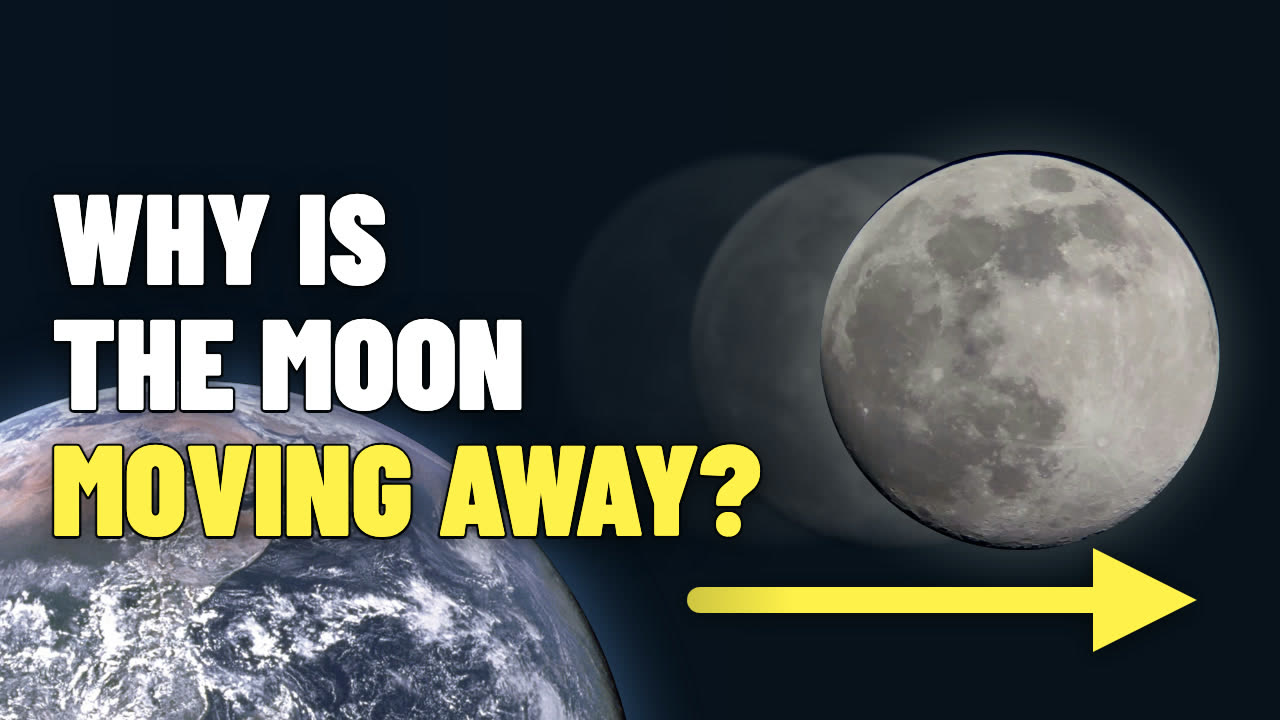
The Moon is moving away from Earth by about 3.8 centimeters a year. We know this because lasers fired from observatories bounce off mirrors left on the Moon by Apollo astronauts and two Soviet rovers: lunar laser ranging. The same slow change shows up at the other end of history, in Babylonian eclipse records, and in fossil corals, tidal rock layers and climate cycles in rocks more than two billion years old. Put together, they show that the Moon does not drift away at a steady pace. It is pushed out by the friction of Earth's ocean tides, and that friction depends on the size and shape of the ocean basins. Today's Atlantic is close to resonance with the tide, so the Moon is moving away faster than it did for most of the last few hundred million years.
This article is the full narration of the video.
Moon moving away from Earth: lunar laser ranging
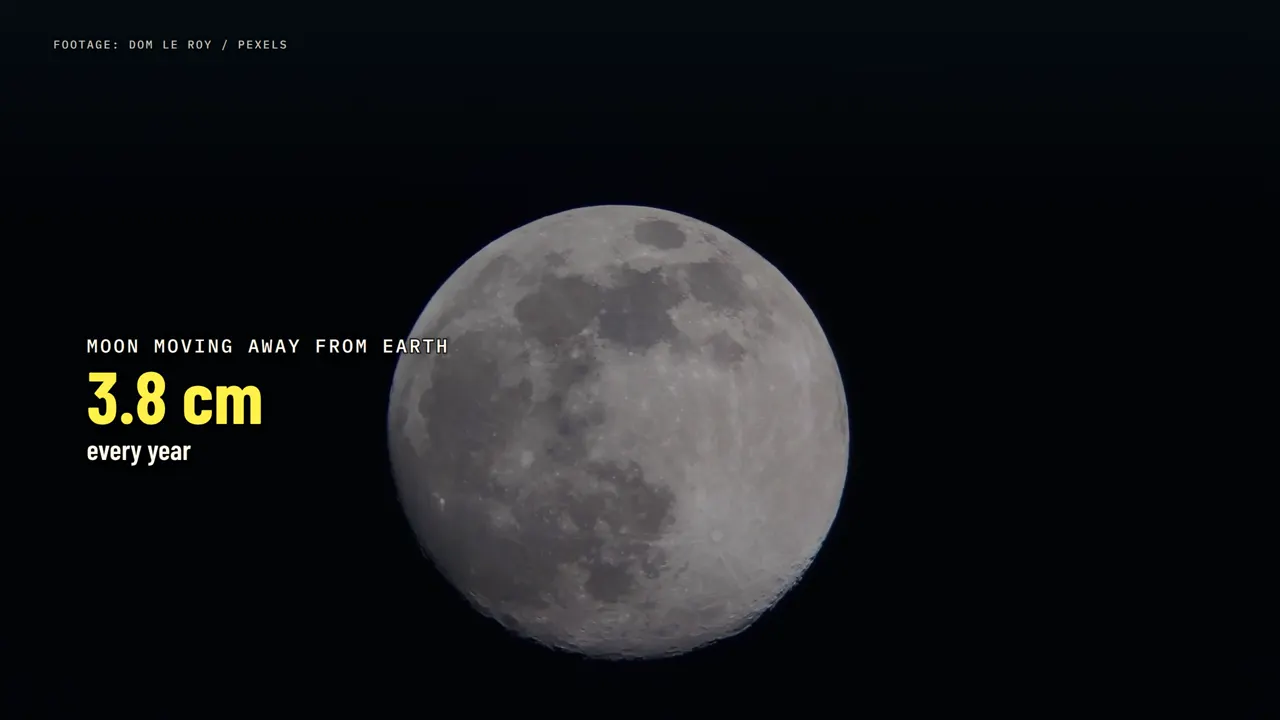
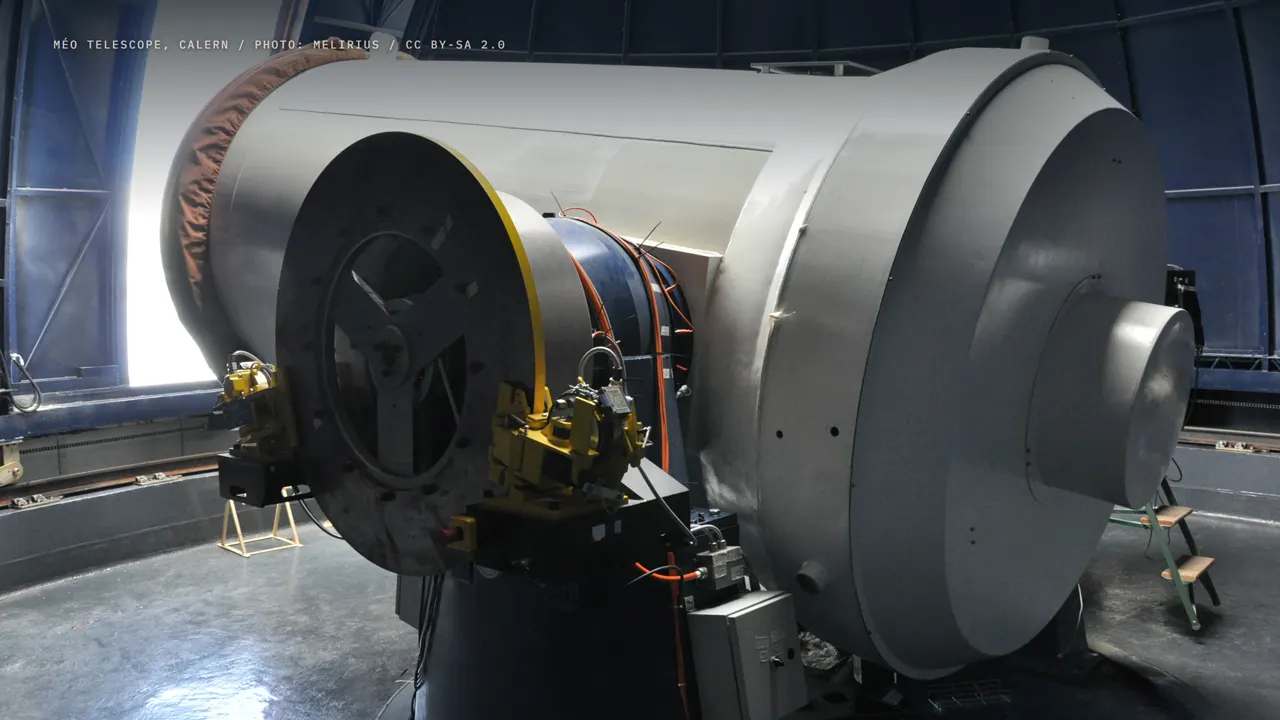
The Moon is moving away from Earth, by about 3.8 centimeters every year. We know that because lasers fired from Earth bounce off mirrors left on the Moon, and the light's round trip is timed. It's called lunar laser ranging. In March 2025, a day after a new mirror landed, a station in France measured
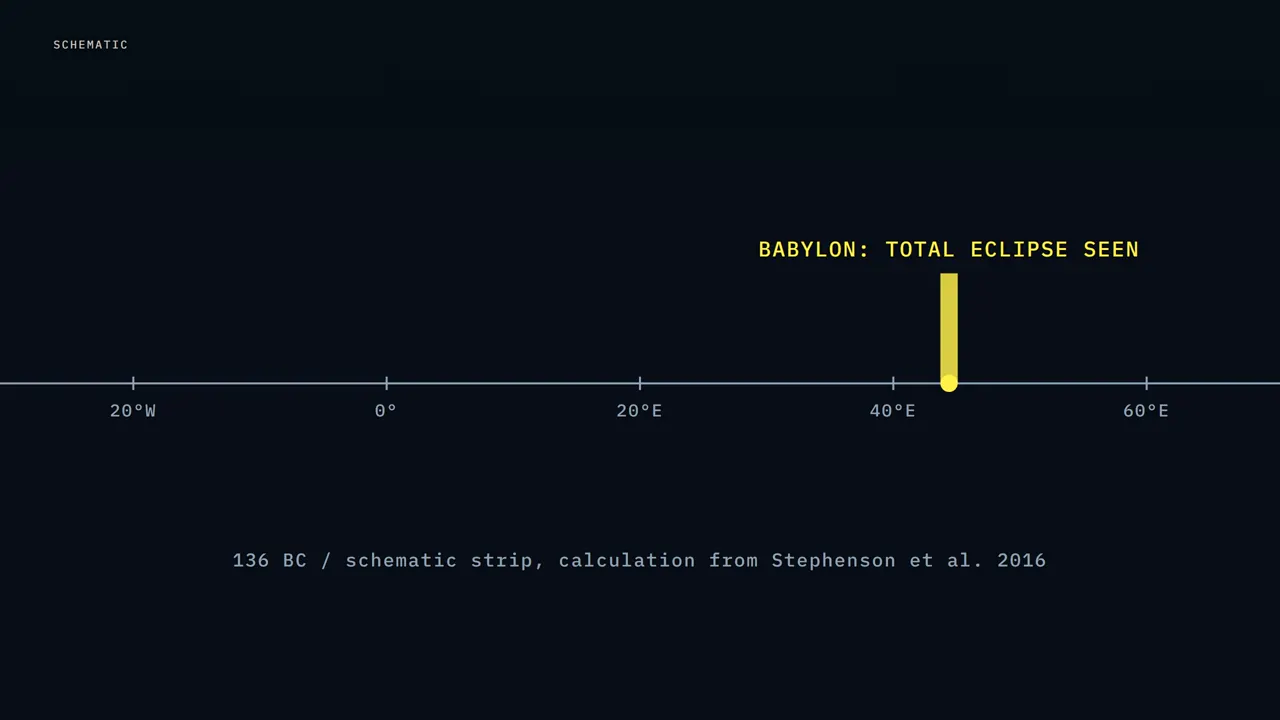
the distance to it with a statistical uncertainty of under a millimeter. More than two thousand years earlier, astronomers in Babylon recorded a total eclipse of the Sun. If Earth had kept perfect time, with every day exactly 86,400 seconds long, that eclipse would have been seen about fifty degrees of longitude farther west.
A clay tablet and a laser are measuring the same slow change from opposite ends of history. Put them together with fossils, ancient rocks and ocean satellites, and you get a story most explanations leave out. The Moon doesn't drift away at a steady pace. Right now it's moving away faster than it did for most of the last few hundred million years, and the reason is the shape of our oceans.
The Moon that seemed to speed up
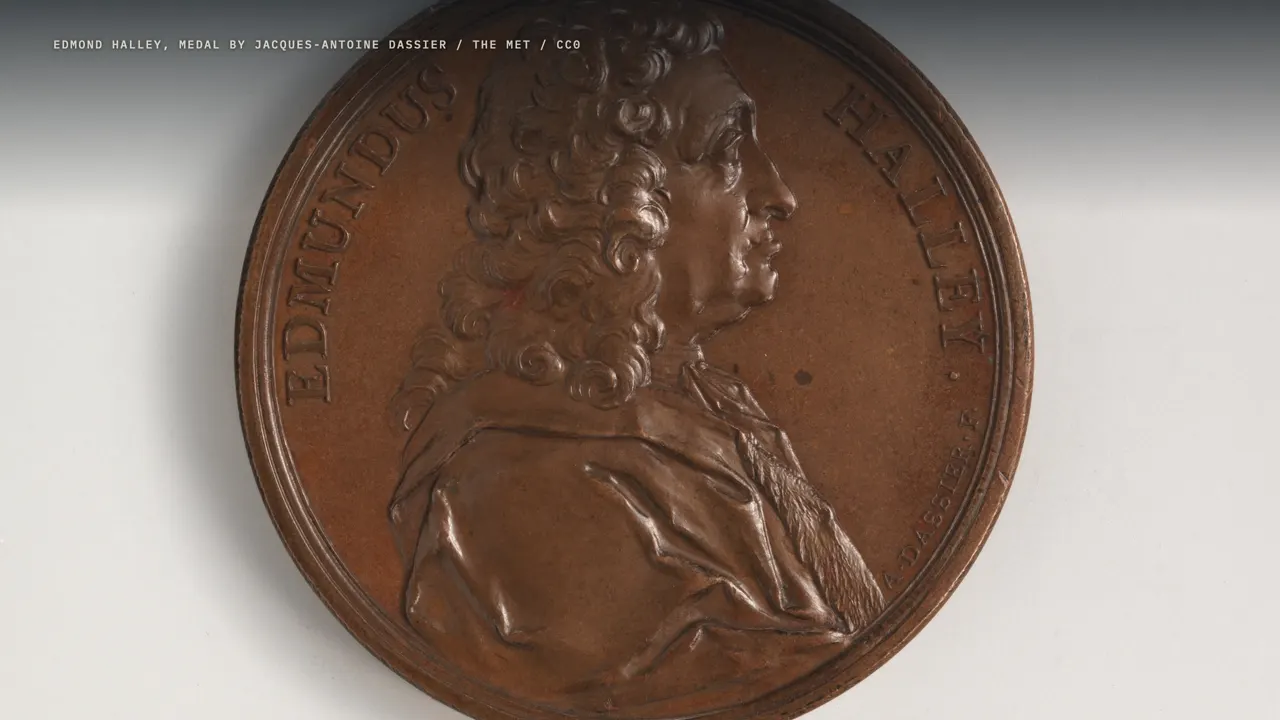
The first clue turned up in an unlikely place. In 1695, Edmond Halley published a paper about the ruins of Palmyra, an ancient city in the Syrian desert. At the end of it, he asked travelers to observe lunar eclipses in Baghdad, Aleppo and Alexandria and pin down where those cities really were. With that, he wrote, he could work out how fast the Moon's motion was speeding up.
Comparing old eclipse records with modern ones, the Moon seemed to be gaining ground in its orbit, century after century. In the 1780s, Pierre-Simon Laplace found what looked like the answer. The shape of Earth's orbit around the Sun slowly changes, and that changes how hard the Sun tugs on the Moon. For about seventy years, that explanation stood.
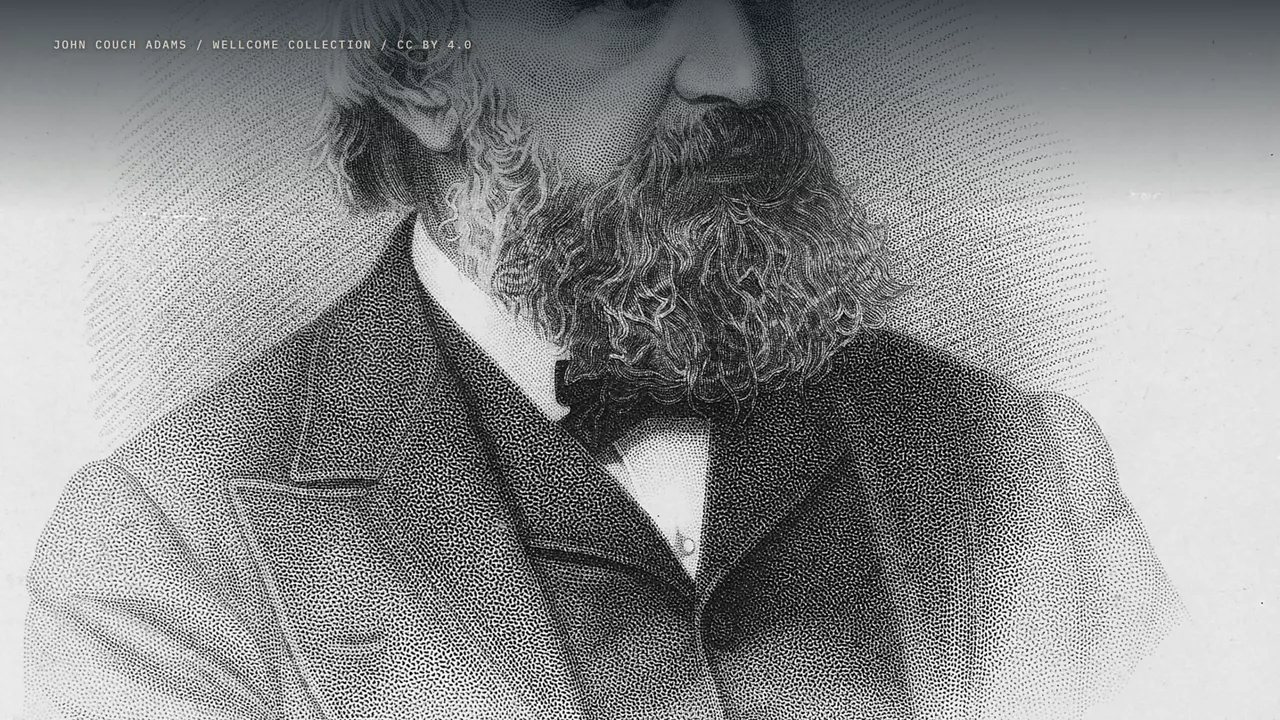
Then in 1853, John Couch Adams, the astronomer who had also predicted where Neptune would be found, redid the calculation. He found an error, and Laplace's effect shrank to about half of what was observed. Half of the Moon's apparent speed-up had no explanation. In the 1860s, Charles-Eugène Delaunay in Paris and William Ferrel in the United States proposed one.
Maybe the Moon wasn't really speeding up. Maybe our clock was slowing down. The clock was Earth itself, and tides were acting as a brake on its spin. If every day is a little longer than the one before, anything measured in days will seem to run fast.
In 1939, Harold Spencer Jones, Britain's Astronomer Royal, pulled the evidence together and showed that the Moon, the Sun, Mercury and Venus all drifted off schedule together. Four bodies in different orbits can't drift in step by coincidence. The error was in the timekeeper: Earth's rotation is not a perfect clock.
A day that keeps getting longer
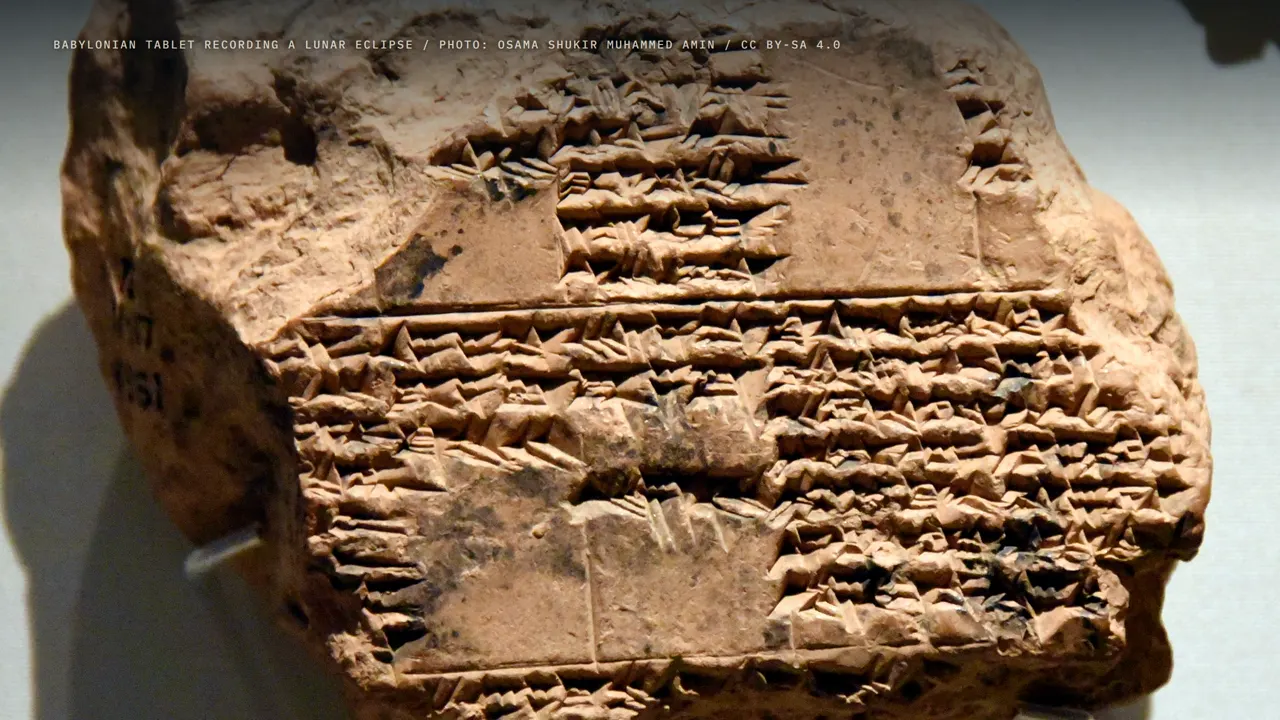
So how much has the day stretched? In 2016, a team led by Richard Stephenson combined almost three thousand years of observations. They used eclipse records from Babylon, China, ancient Greece and the medieval Arab world, going back to 720 BC, and about half a million timings of the Moon passing in front of stars.
Those Babylonian clay tablets turn out to be precise instruments. A total eclipse is only seen inside a narrow strip of shadow, so a single line saying the Sun went dark pins down how far Earth had turned. Their result: on average, the day has been getting longer by about 1.8 milliseconds per century. That sounds like nothing, but it adds up.
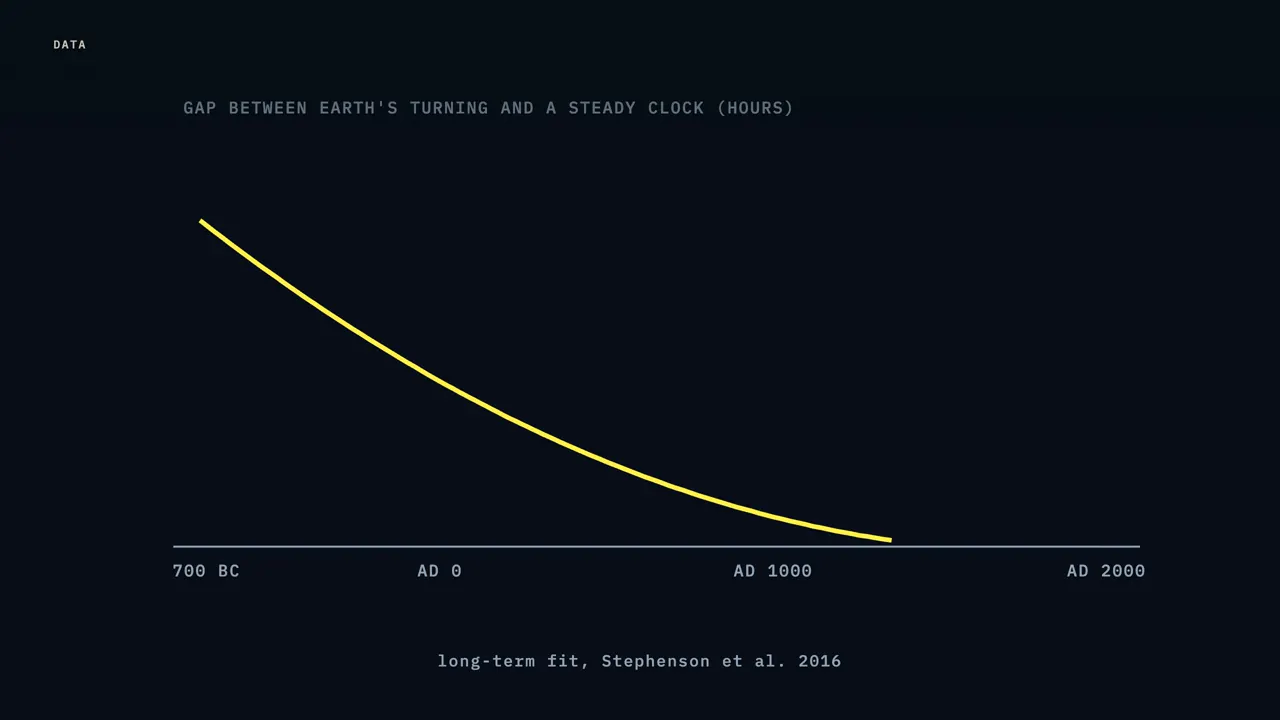
Around 700 BC, the gap between Earth's turning and a perfectly steady clock comes out at about five and a half hours. And here's a detail that matters later. Tidal friction alone, as measured today, should have stretched the day by about 2.3 milliseconds per century. Something else has been speeding Earth up a little.
Part of it is the end of the last ice age. When the great ice sheets melted, the land beneath them began slowly rising back, Earth became slightly less flattened, and it began to spin a little faster, like a skater pulling in their arms. Part of it seems to come from deep inside the planet, where the core and the mantle interact.
The end of the leap second
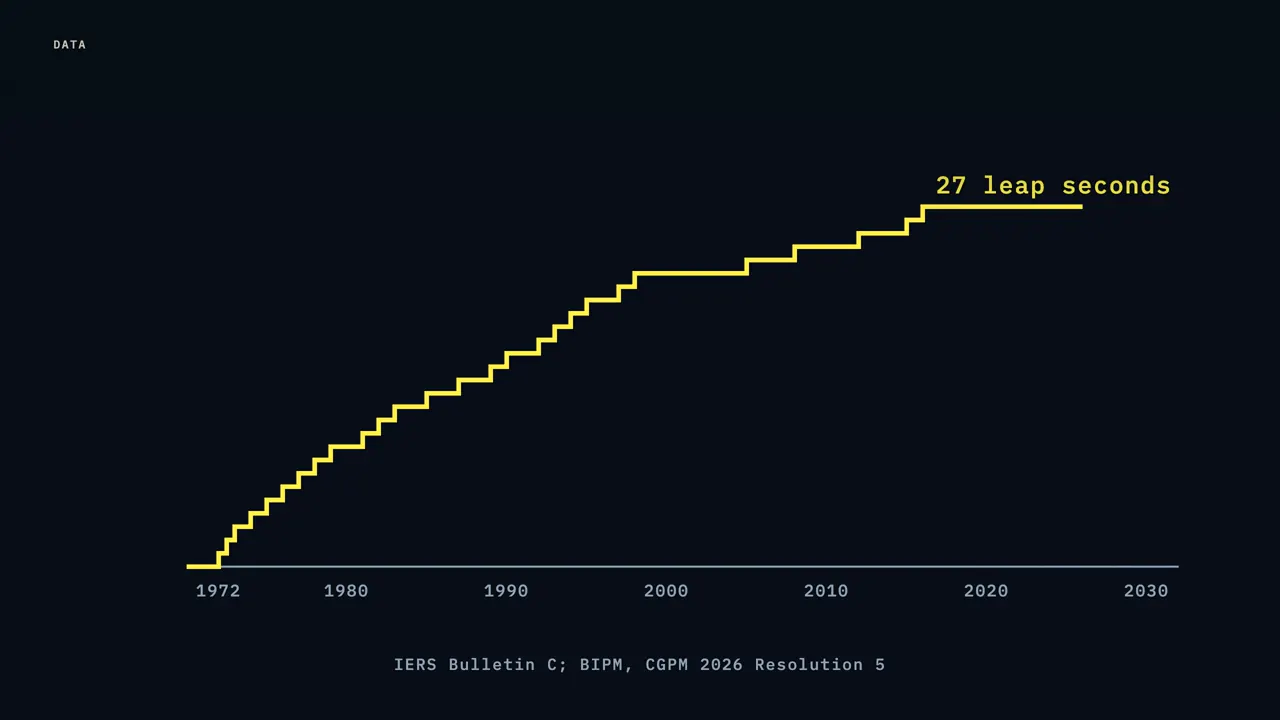
The slowing day is the reason leap seconds exist. The official second was matched to astronomical time in a way that corresponds to the length of a day around the year 1820. Around 2008, an average day was about 2.5 milliseconds longer than that. Over a year, that adds up to roughly one second.
So since 1972, the world's clocks have added 27 leap seconds, all of them extra seconds, the last at the end of 2016. But over the last few years, Earth has been turning a little faster again. One analysis links this to the liquid outer core, which has been slowing down and passing its spin to the rest of the planet. That raised a possibility nobody had faced before: a negative leap second, where a second is taken away.
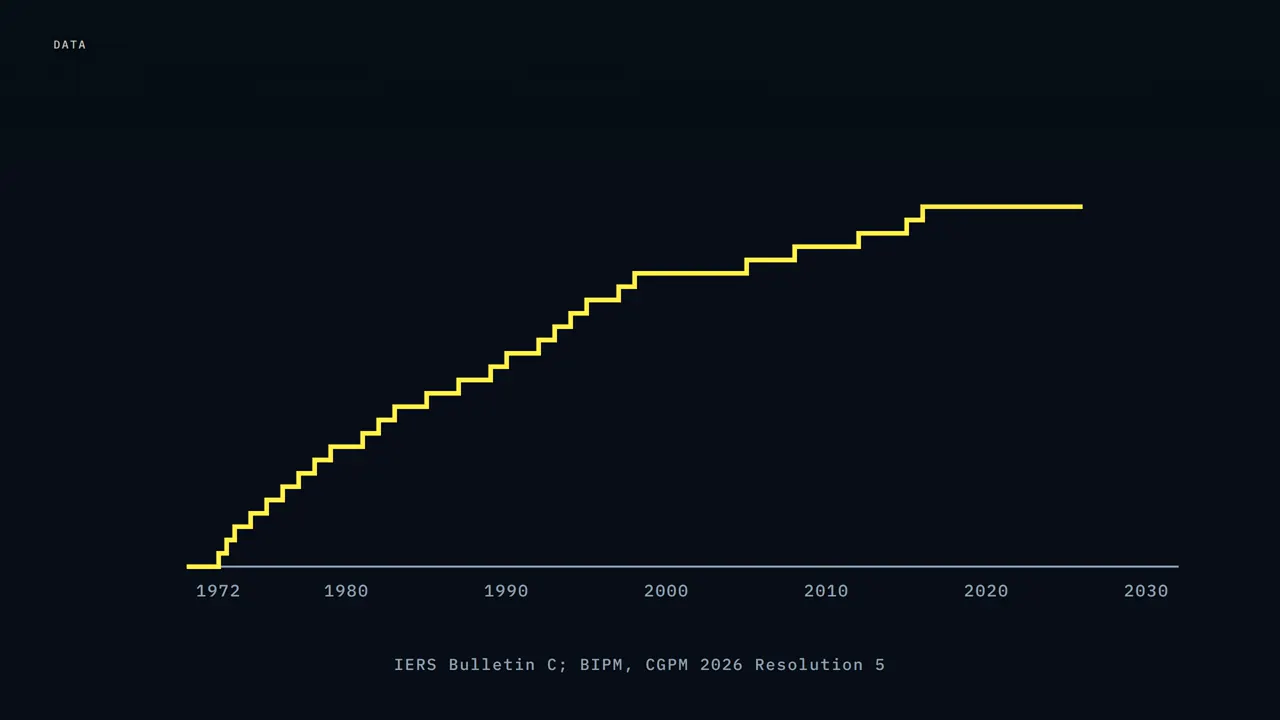
Melting ice in Greenland and Antarctica has pushed that moment back. Today's meltwater spreads toward the equator and slows Earth down, and one 2024 study estimated that this delayed the need for a negative leap second by about three years, to 2029. In October 2026, the General Conference on Weights and Measures decided that from May 2027 the world's clocks
will run without leap seconds, letting atomic time and Earth's rotation drift up to an hour apart. Tides set the long-term trend, while the core and melting ice shake it from decade to decade.
Mirrors on the Moon
The first attempts aimed at the bare Moon. In 1962, researchers at MIT fired a pulsed laser at the bare surface of the Moon and caught a faint echo. A year later, Soviet scientists did the same, aiming at a crater, and their distance was still uncertain by more than a hundred kilometers. They needed a better target.
On July 21, 1969, Apollo 11 astronauts set up a panel of one hundred small glass corner cubes on the Moon. Within its working range of angles, a corner cube sends light straight back toward wherever it came from. Eleven days later, on August 1, a team at Lick Observatory in California hit it with a ruby laser and timed the echo. The light takes about two and a half seconds to get there and back.
Apollo 14 carried a second panel, Apollo 15 a larger one with three hundred cubes, and two Soviet rovers, Lunokhod 1 and 2, carried French-built reflectors. Between them, those five reflectors have been measured for more than fifty years, from observatories in the United States, France, Italy, Germany and China.
Catching single photons
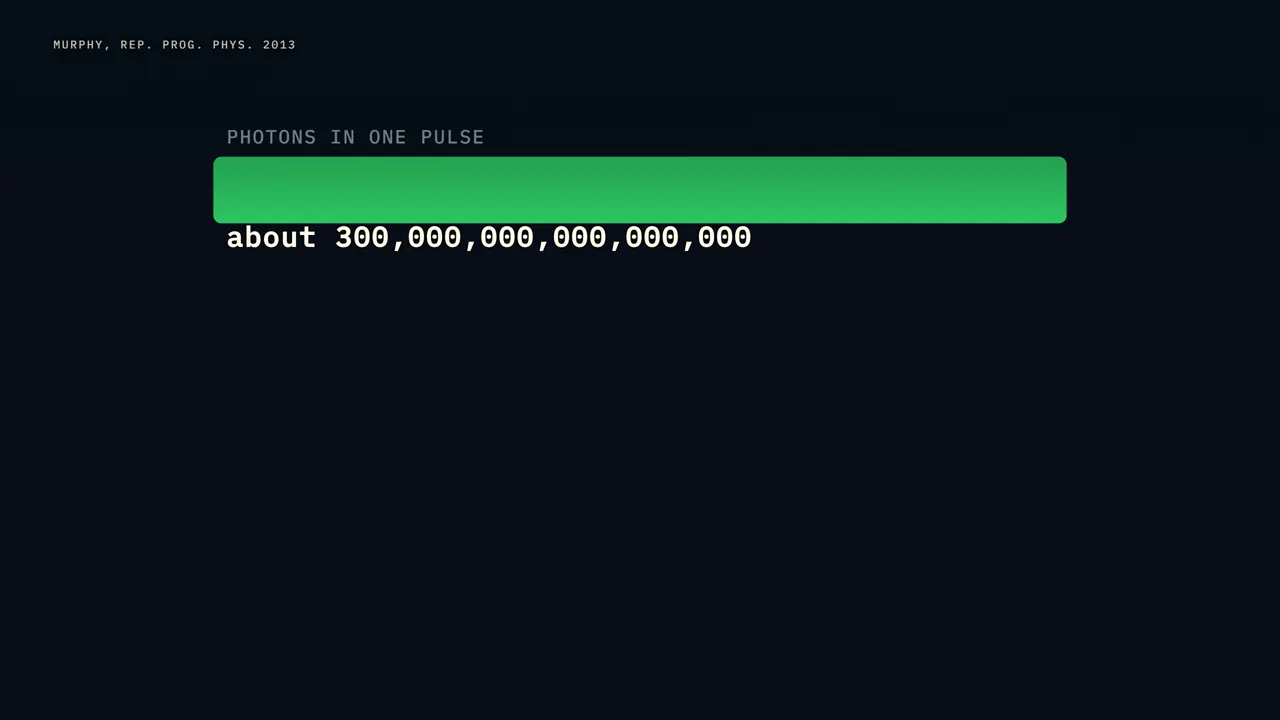
Hitting a mirror on the Moon is not the hard part. Getting light back is. One laser pulse carries about three hundred thousand trillion photons. By the time it reaches the Moon, the beam has spread to about two kilometers across, so only a tiny fraction lands on the reflector.
The returning light spreads out again over many kilometers of Earth. Only about one in a billion billion of the photons sent comes back into the telescope. At the Apache Point station in New Mexico, run by a project called APOLLO, the best run produced about three photons per pulse. On most nights, and at most stations, it's far less.
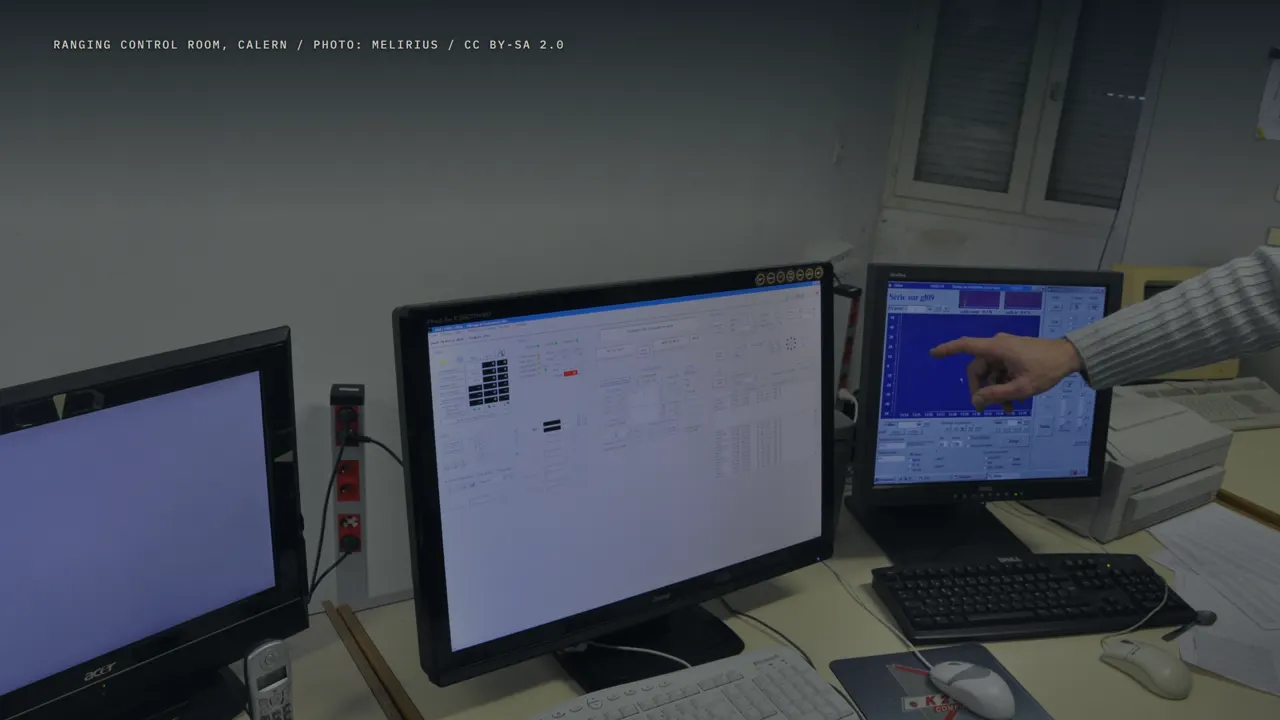
Each returning photon is timed to within about a hundred trillionths of a second. A millimeter of distance is about seven trillionths of a second of round-trip time. So thousands of photons gathered over many minutes are combined into a single measurement. The air adds about two meters of delay, and the Sun's gravity adds more, and both have to be corrected.
The mirrors are aging, too. Their signal is about ten times weaker than it should be, apparently because lunar dust has settled over about half of their surface. Near full Moon it drops about tenfold again, when that dust soaks up sunlight and heats the glass unevenly. During a lunar eclipse, when the reflectors fall into shadow, the signal recovers within about fifteen minutes.
The lost mirror
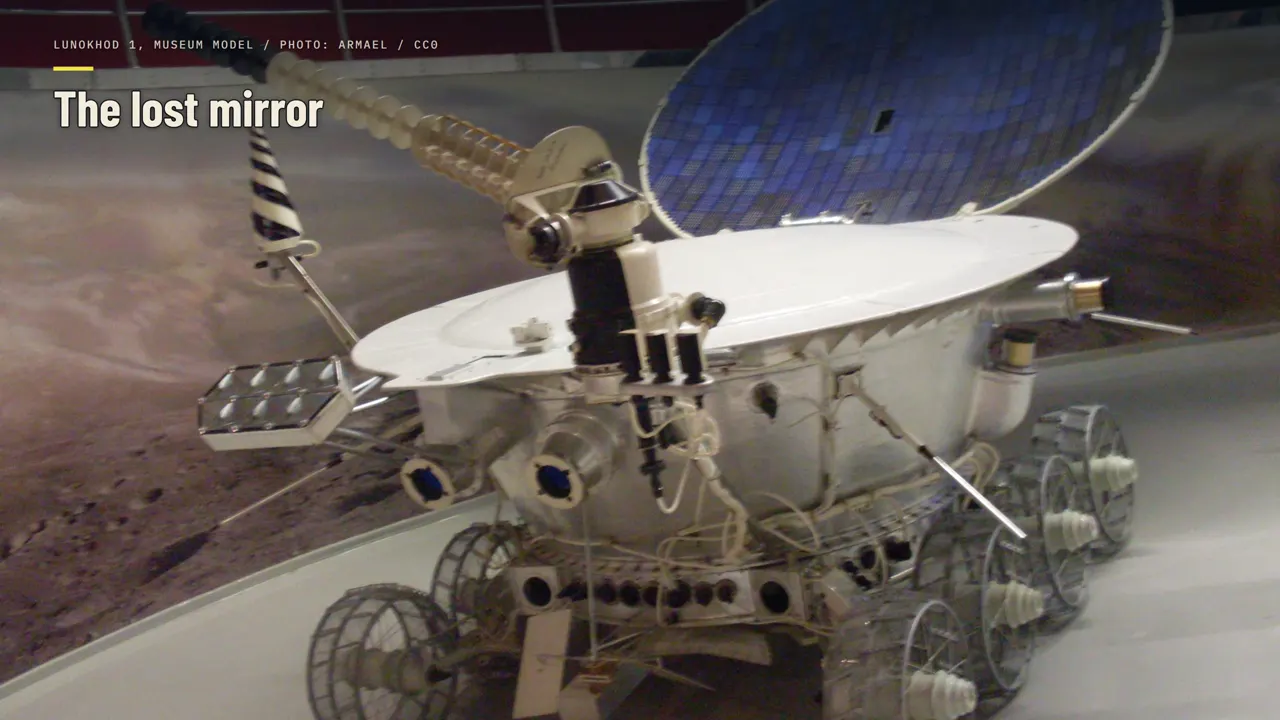
One reflector went missing for almost forty years. Lunokhod 1 landed in 1970, and Soviet scientists ranged to it briefly before contact with the rover was lost in 1971. Its exact position was never shared widely, and nobody could find it again. In March 2010, NASA's Lunar Reconnaissance Orbiter photographed the rover.
A month later, on April 22, the Apache Point team aimed at the new coordinates and received about two thousand photons on the first try. The rover was about five kilometers from where it had been thought to be. And in March 2025, a commercial lander called Blue Ghost set down a new reflector designed at the University of Maryland. It uses a single large cube instead of a panel of small ones, so the echo stays sharp even when the Moon is tilted.
That's the mirror the station in France measured the day after landing. From an uncertainty of a hundred kilometers or more in 1963, to a preliminary statistical uncertainty under a millimeter. The same data also tests other ideas. If the strength of gravity itself were slowly changing, the Moon's orbit could grow for that reason alone.
Laser ranging limits any such change to less than one part in a trillion per year. At most, that could explain about one percent of the Moon's retreat. The Moon's measured drift matches what satellite maps of the ocean tides predict. Today's best figure is 38.3 millimeters per year.
Since Apollo 11 left its mirror in 1969, the Moon has moved about two meters farther away.
The tidal bulge that isn't there
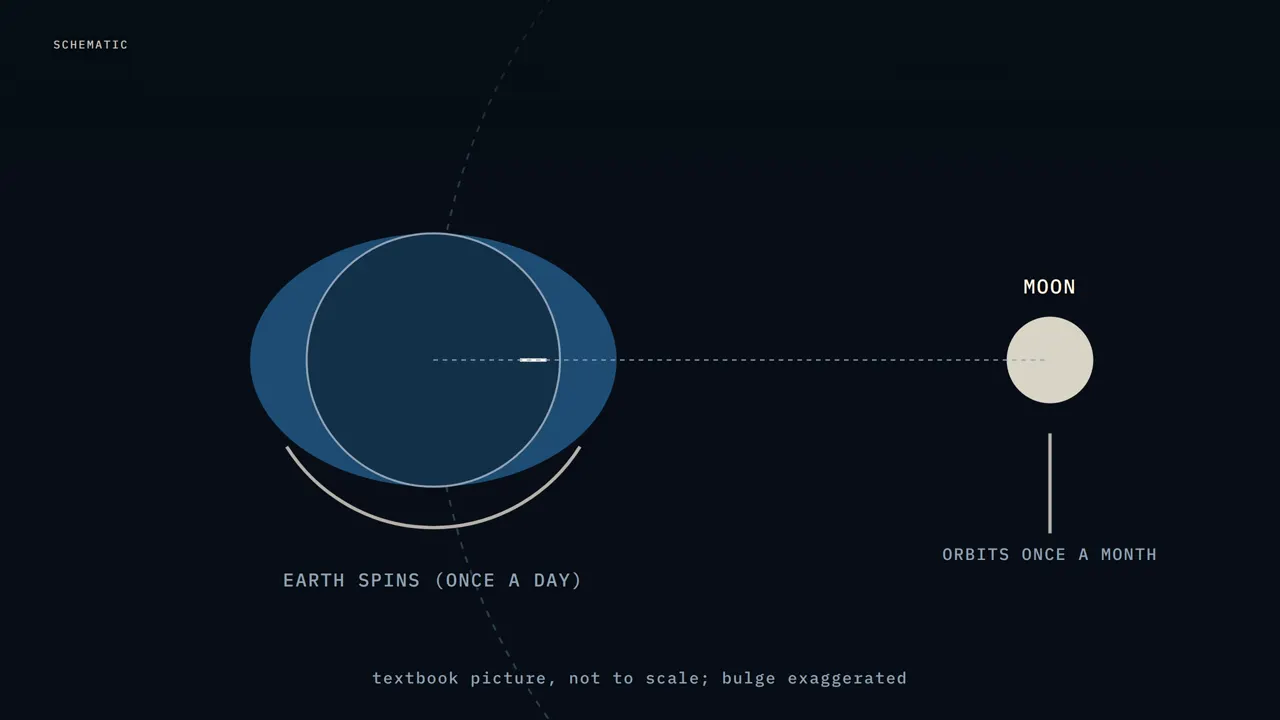
So how do tides push the Moon away? The usual picture shows the Moon pulling Earth's oceans into two bulges, one facing the Moon and one on the far side. Earth spins faster than the Moon orbits, so the spin carries the bulges slightly ahead of the Moon. The bulge ahead of the Moon pulls it forward along its orbit, and that extra tug lifts it into a wider orbit.
At the same time, the Moon pulls back on the bulge and slows Earth's spin. Angular momentum passes from Earth's spin to the Moon's orbit, and the total stays the same. That explanation gets the result right, but the picture is misleading. Real oceans don't have two bulges.
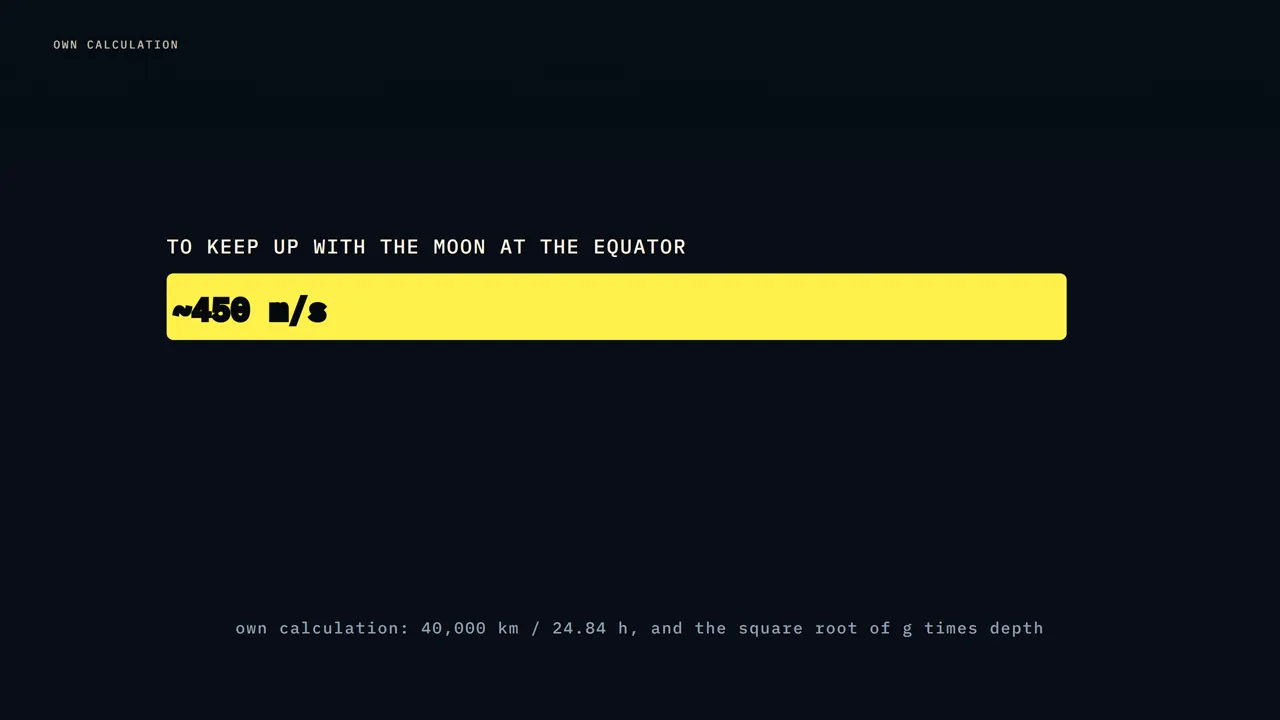
To keep up with the Moon, a bulge at the equator would have to sweep around the planet at about 450 meters per second. The tide moves as a very long wave, and in an ocean four kilometers deep that wave can only travel at about 200 meters per second. The water can't keep up. Instead, tides form complex wave patterns within each ocean basin, often circling points where the water barely rises or falls.
The Moon doesn't feel each of those waves separately. It feels their combined pull, averaged over the whole planet. That combined pull is the effective bulge, and it sits slightly ahead of the Moon. Because it's built out of real waves in real basins, it depends on the size and shape of the oceans.
Change the coastlines, and you change the brake.
Where the energy goes
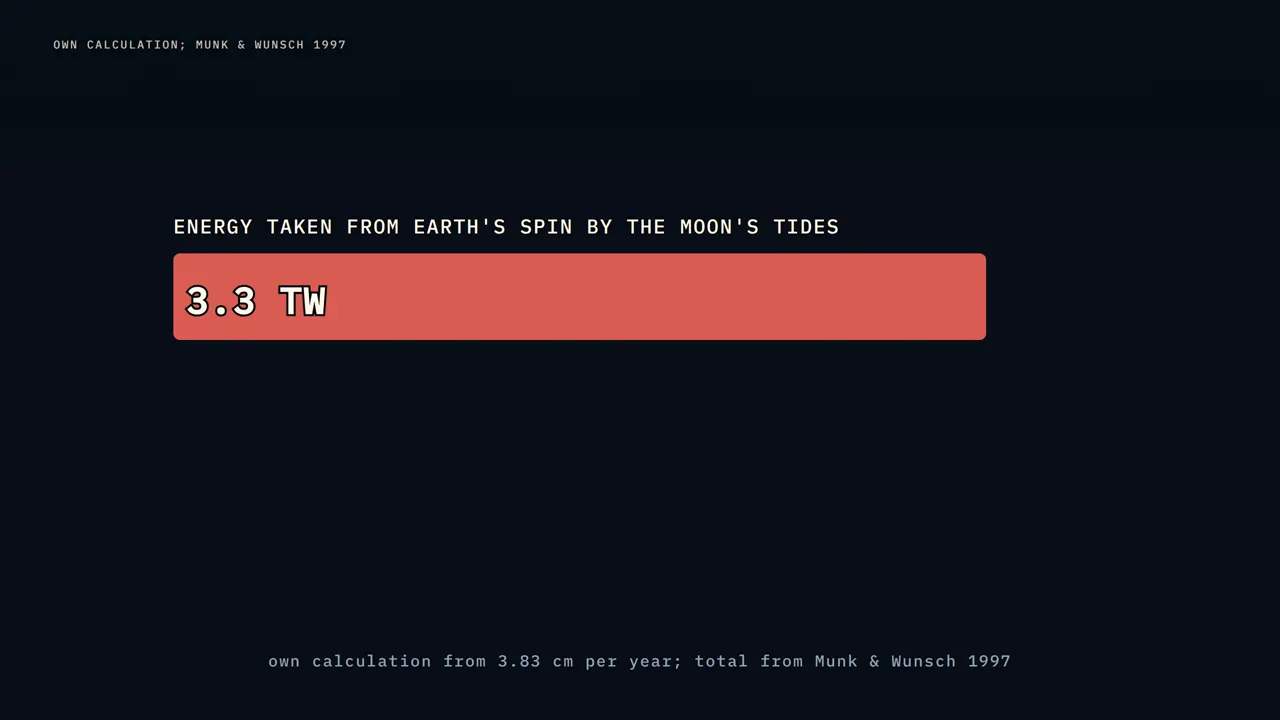
Slowing a planet releases a lot of energy. Working from the laser measurements, you can calculate that the Moon's tides take about 3.3 terawatts of energy from Earth's spin. Only about 0.12 terawatts, roughly four percent, ends up lifting the Moon into a higher orbit. The rest turns into turbulence and heat.
Add the Sun's smaller tides, and Earth loses about 3.7 terawatts to tidal friction. The oceanographers Walter Munk and Carl Wunsch compared that to the world's total electric generating capacity at the time. Almost all of that energy disappears in the oceans, and only a small share in the solid rock of the planet. So the Moon's retreat is a side effect.
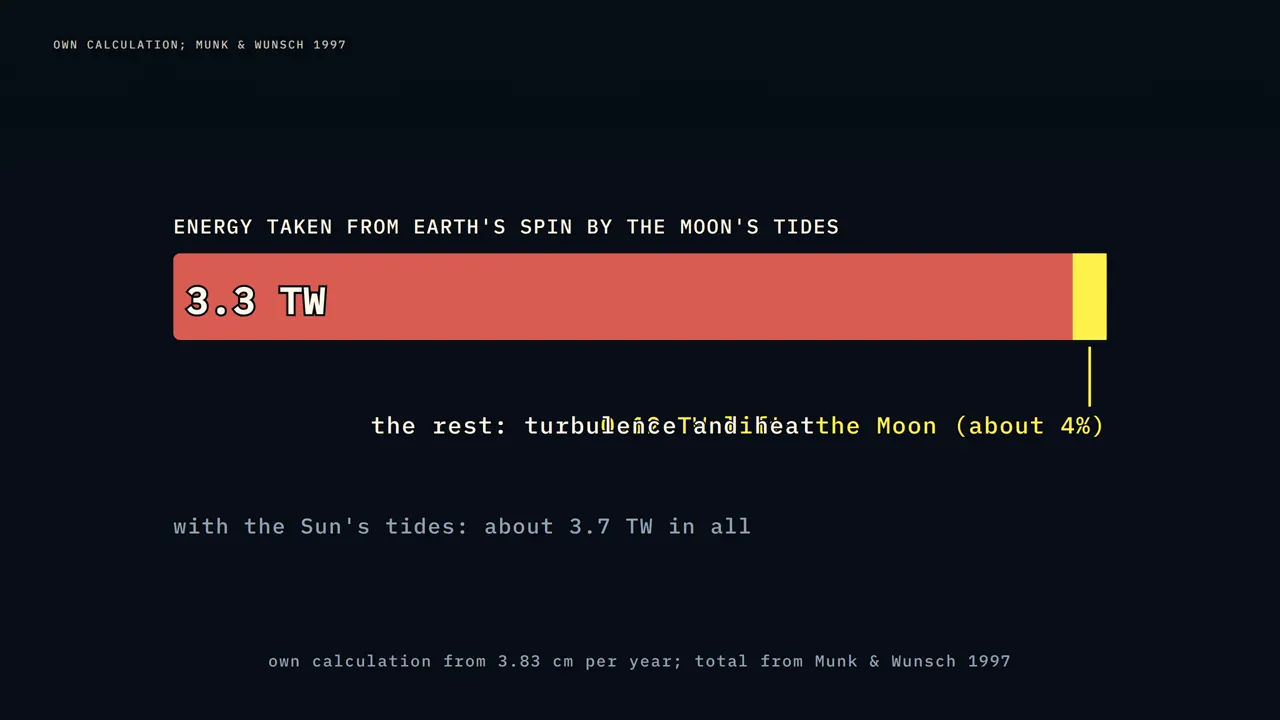
Most of what the tides take from Earth's spin is spent stirring the sea.
The missing terawatt
For most of the twentieth century, scientists thought they knew where that happened. In 1919, the physicist G. I. Taylor estimated the tidal friction in the Irish Sea, and the idea took hold that tides lose their energy by scraping over shallow seafloors. But when the numbers were added up, they fell short.
The main lunar tide alone had to be losing about 2.4 terawatts. Shallow seas didn't seem able to account for all of it. The answer came from space. The TOPEX/Poseidon satellite measured the height of the sea surface across the globe for years, precisely enough to map the tides.
In 2000, Gary Egbert and Richard Ray used that data to show that shallow seas take only about 1.6 to 1.8 terawatts of the main lunar tide, and where the rest goes. About one terawatt, counting all the tides, is lost in the deep ocean, over mid-ocean ridges, seamounts and chains of islands. When the tide flows over rough seafloor, it sets off waves inside the ocean, between
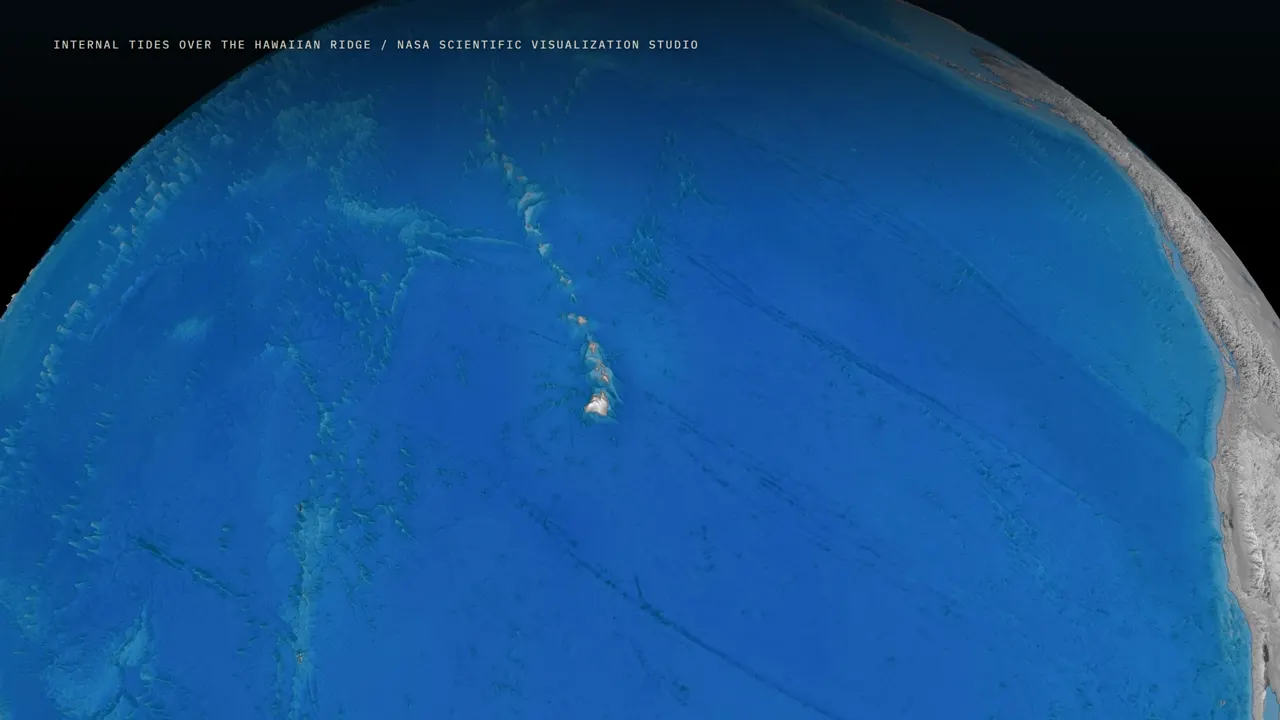
layers of colder and warmer water, and those waves break and mix the deep water. That mixing matters. Cold water sinking near the poles keeps flowing into the deep ocean, and without warmer water being mixed down from above, the deep sea would fill up with that cold water within a few thousand years.
Keeping it mixed takes about two terawatts, and the researchers estimated that tides could supply about half of that. The shallow seas still matter. Among the places where the most tidal energy is lost are Hudson Bay, the European shelf seas, northwest Australia, the Patagonian shelf, and the Yellow Sea and East China Sea.
The friction that pushes the Moon away, the lengthening day and the mixing of the deep ocean are parts of the same flow of energy.
Calendars in stone
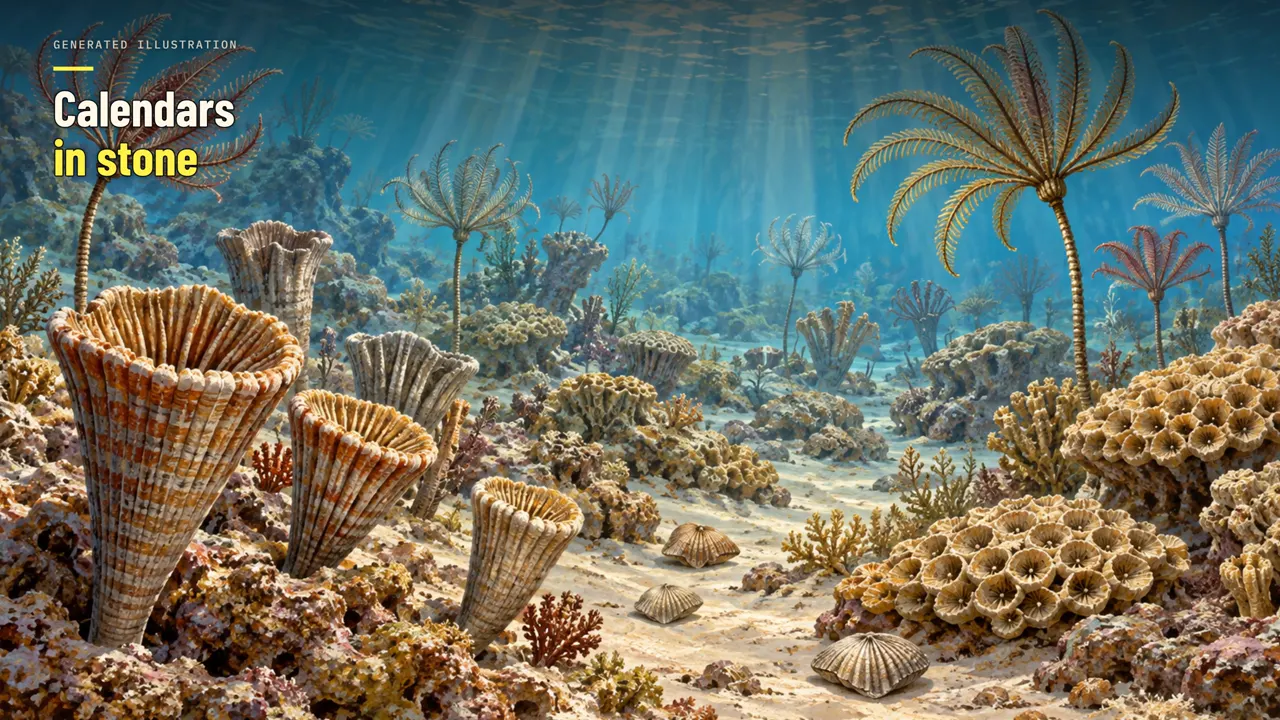
If tides have been slowing Earth for billions of years, ancient days should have been shorter. In 1963, the paleontologist John Wells looked at fossil corals. Some corals add a fine growth ridge every day, and the ridges bunch into yearly bands. On living corals, he counted about 360 ridges in a year's growth, close to the number of days in a year.
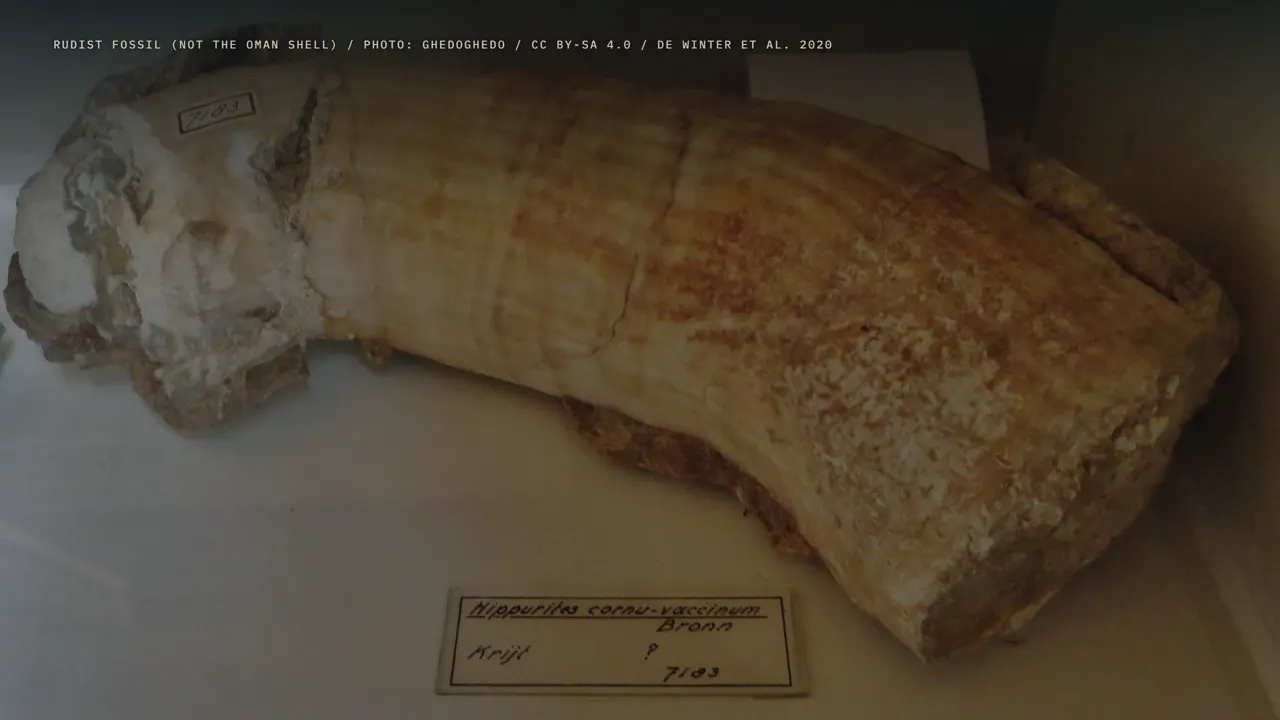
On corals about 380 million years old, from the Devonian period, he counted between 385 and 410, usually about 400. The year itself, Earth's trip around the Sun, hasn't really changed. So if a year held about 400 days, each day was shorter, closer to 22 hours. In 2020, a team studied a single fossil shell of a rudist, an extinct kind of clam, that lived about 70 million years ago in what is now Oman.
Using a laser to sample its shell layer by layer, they found 372 daily layers in a year, which means a day of about 23 and a half hours. Tides leave records too. In South Australia, rocks about 620 million years old preserve layers laid down by tides in a sheltered tidal delta. Strong tides around new and full Moon left thick layers and weak tides in between left thin ones, about 60 years of tides without a break.
From those layers, the geologist George Williams worked out about 13 months and 400 days per year, and a day of about 22 hours. But fossils and tidal layers are hard to read precisely. Ridges can be missing, and the same rock can be counted in more than one way. Another team analyzing those South Australian layers got a noticeably different distance for the Moon.
The direction is clear, but the numbers need a better ruler.
The Moon in climate rhythms
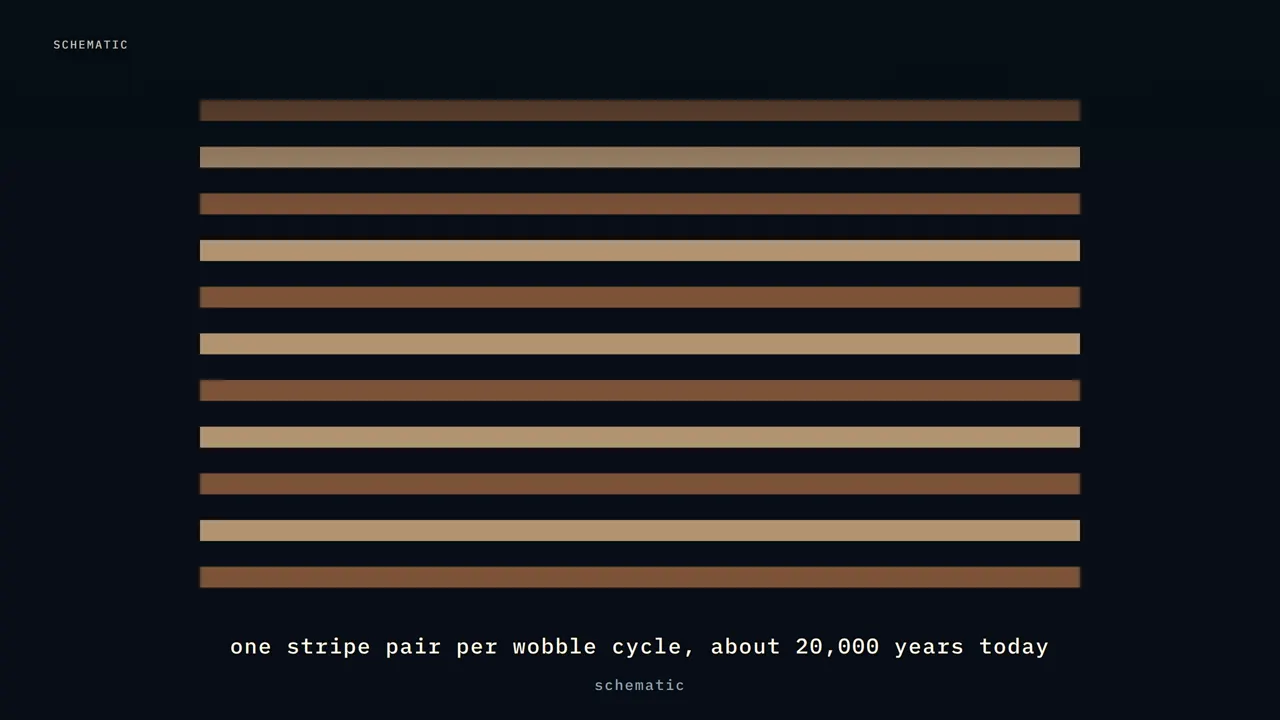
That ruler turned out to be climate. Earth's axis slowly wobbles, like a spinning top, and that wobble shifts the seasons in a cycle that today takes about twenty thousand years. Those cycles leave stripes in sediments, as climate swings between wetter and drier, warmer and cooler. The wobble is caused by the Sun and the Moon pulling on Earth's bulging equator.
When the Moon was closer and Earth spun faster, the wobble was quicker, and the stripes were packed closer together. Another cycle, now about 405,000 years long and set mainly by Venus and Jupiter, serves as a scale bar, on the assumption that it stayed stable that far back. In 2018, Stephen Meyers and Alberto Malinverno applied this to rocks in northern China about 1.4 billion years old.
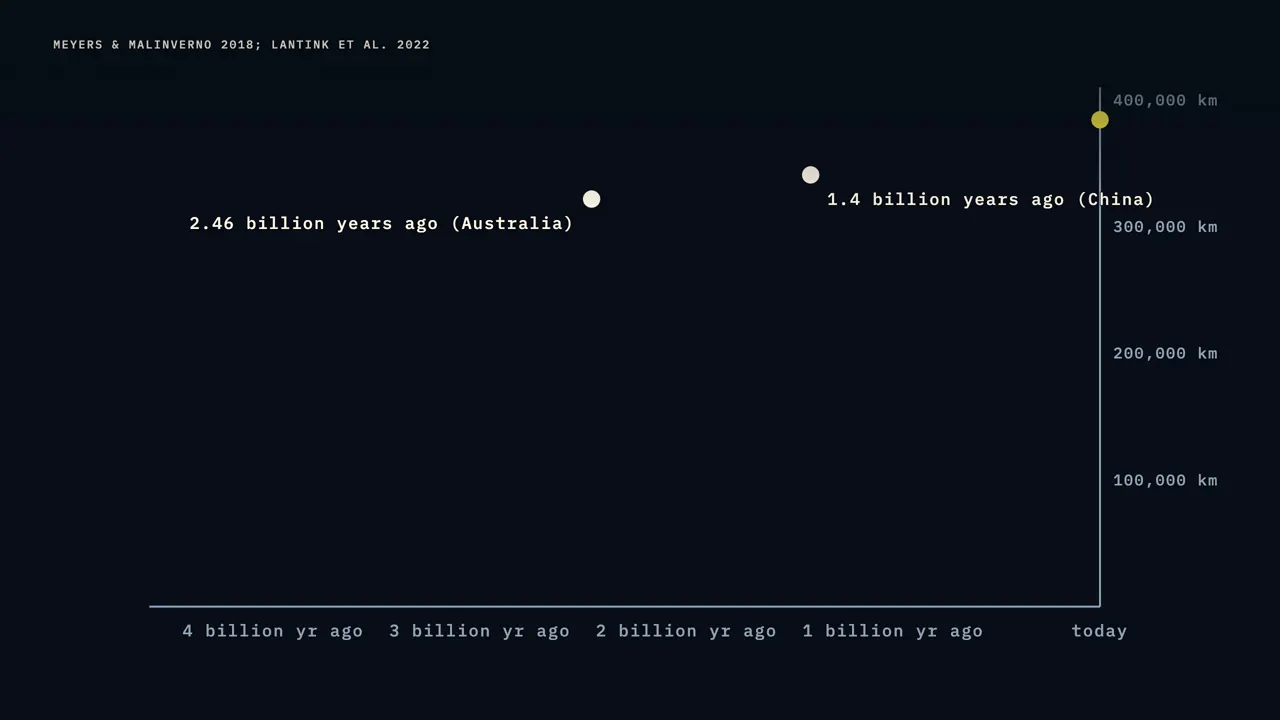
The wobble's climate cycle there took only about 12 to 14 thousand years. That puts the Moon about 341,000 kilometers away, and the day at about 18 hours and 40 minutes. In 2022, a team led by Margriet Lantink went further back, to iron-rich rocks in Western Australia formed 2.46 billion years ago. Back then, the Moon was about 321,800 kilometers away, and a day lasted about 17 hours.
The Moon's distance is written into the rhythm of ancient climate.
The 1.5 billion year problem
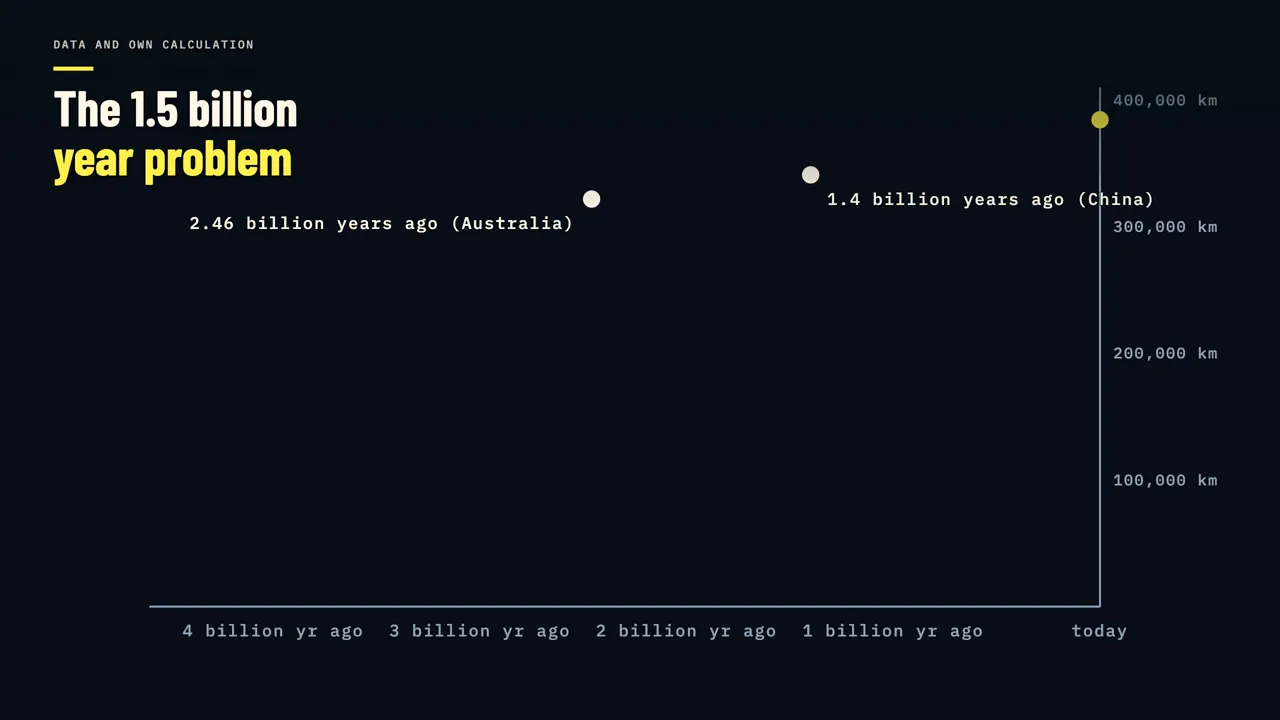
And those rocks expose a problem that had bothered scientists for decades. At today's pace, 3.8 centimeters a year, it would take about ten billion years for the Moon to have drifted out from right next to Earth. That sounds like plenty of time. But tidal forces get much stronger as the Moon gets closer.
If today's tidal friction is run backward with that taken into account, the Moon ends up practically touching Earth only about a billion and a half years ago. But the Moon is roughly four and a half billion years old, and rocks more than three billion years old already show tides. So for most of Earth's history, the Moon must have been retreating more slowly than it is now.
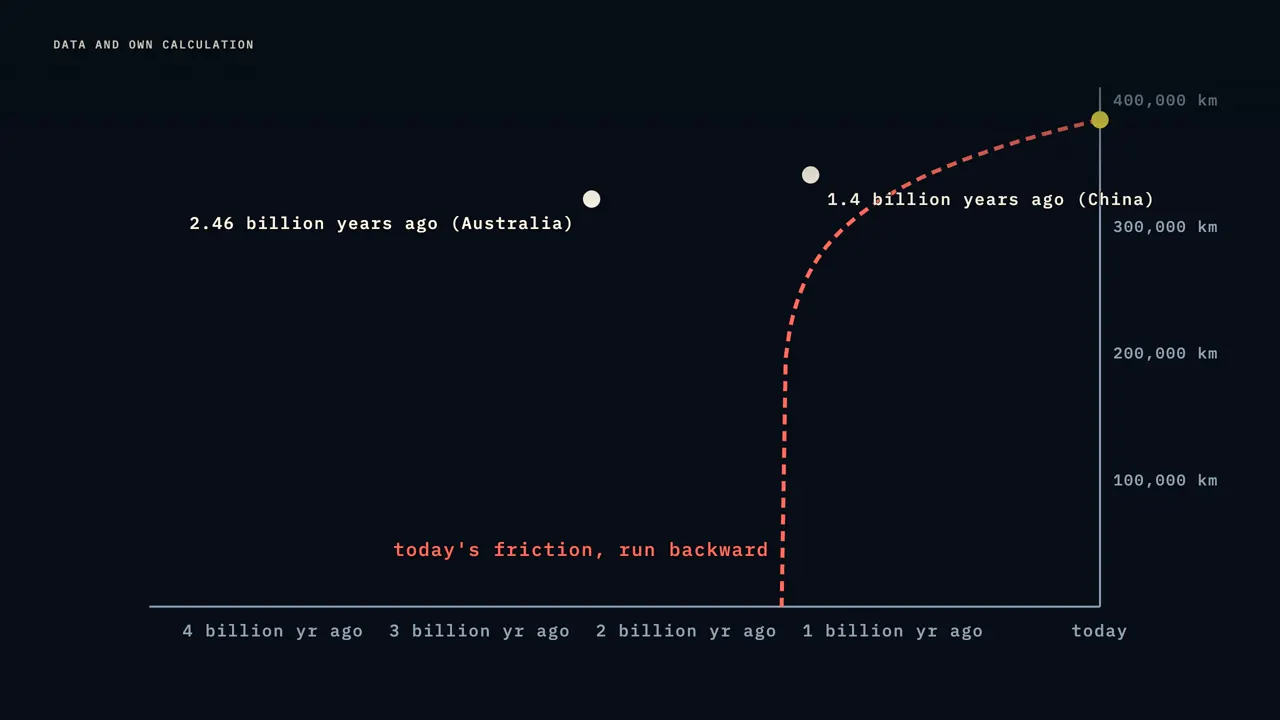
The rock from Western Australia agrees. To get from 321,800 kilometers to today's distance in 2.46 billion years, the Moon only needed an average of about 2.5 centimeters a year. Why is it so much faster today?
The ocean's rhythm
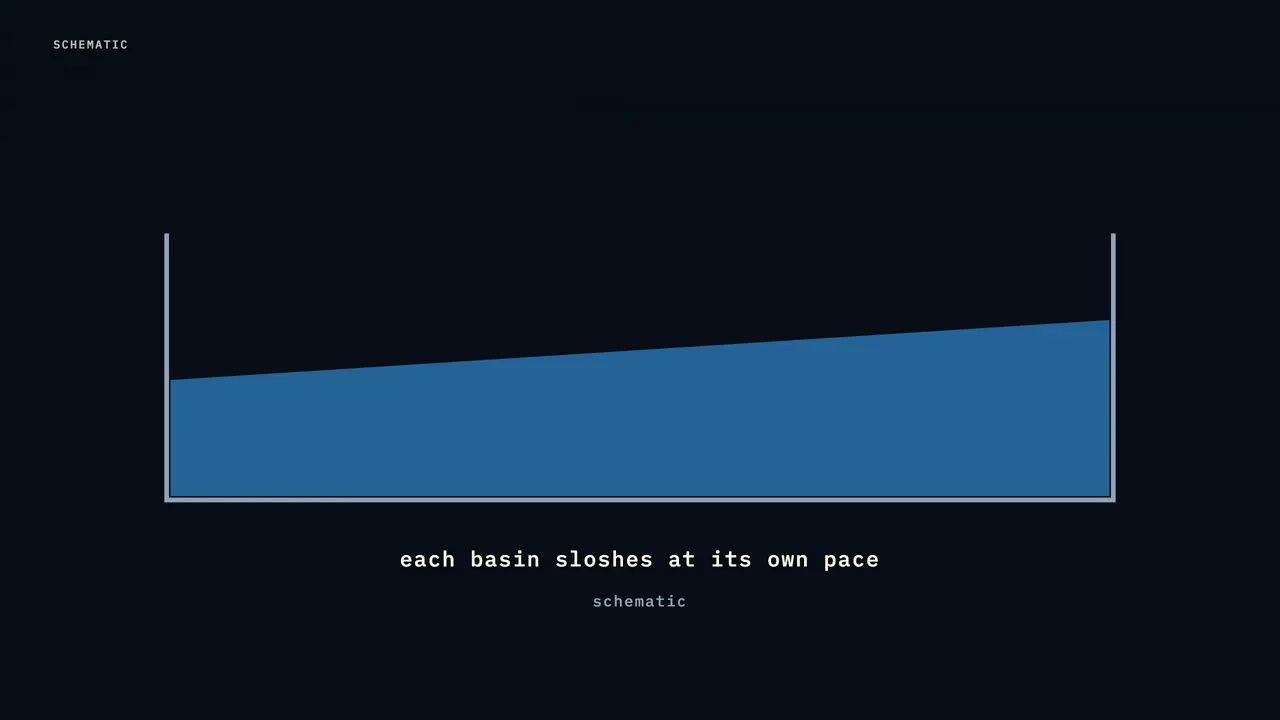
Think of a child on a swing. Push at random, and not much happens. Push in time with the swing, and every push adds up. Bodies of water have their own natural rhythm too.
Water sloshes back and forth across a basin at a pace set by its size and depth. In Canada's Bay of Fundy and the Gulf of Maine beside it, that natural rhythm, about thirteen hours, is close to the rhythm of the lunar tide, a little over twelve hours. So the tide builds up there, and the difference between high and low water can reach around 16 meters.
The same thing happens on the scale of a whole ocean. Today's Atlantic is close to resonance: its natural rhythm is nearly in step with that twice-daily tide. Ocean basins open and close as continents drift, and tide simulations of how today's oceans could reshape themselves suggest that a widening ocean comes close to this resonance when it is about 140 to 180 million years old.
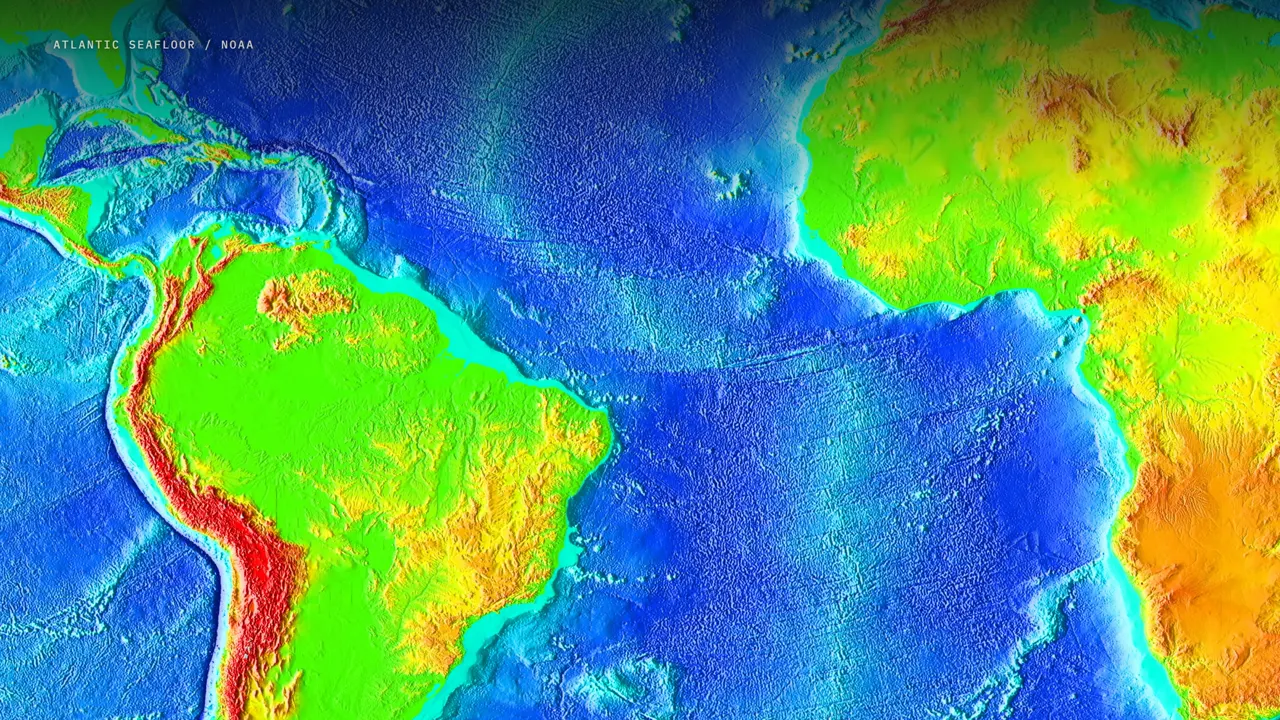
That's roughly the age of today's Atlantic. The same researchers estimate that these strong-tide periods come between one and five times per supercontinent cycle, each lasting no more than about twenty million years. By their rough estimate, they add up to about nine percent of Earth's history.
We happen to live in one of them.
A Moon that moves in bursts
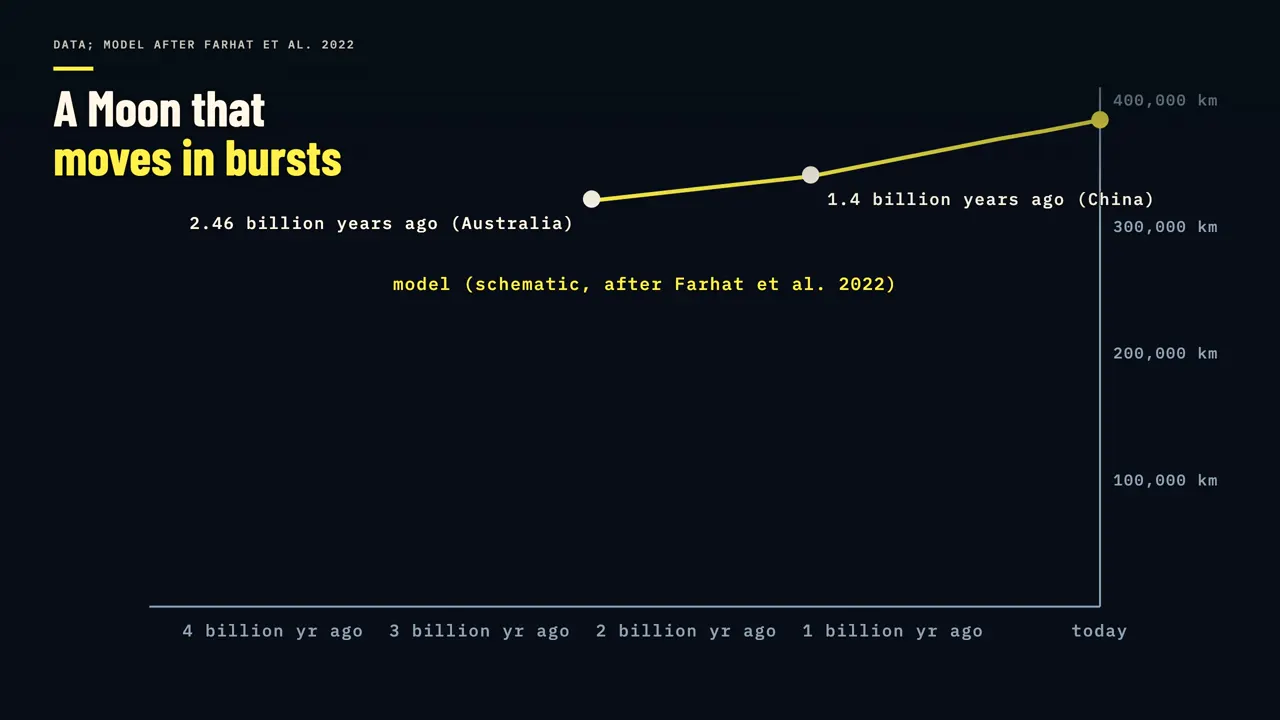
In 2022, a group in Paris led by Mohammad Farhat and Jacques Laskar built a physical model of Earth's tides through time. They tuned just two settings of the model, to match today's measured retreat and the age of the Moon. It wasn't tuned to any of the ancient rocks. Yet its predictions lined up closely with the rock measurements from 1.4 and 2.46 billion years ago.
In that model, the Moon doesn't retreat smoothly. Most of the time, the oceans are far from resonance and the Moon creeps outward. Every so often, as the tides and the oceans' response change, the system passes through a resonance, the brake grabs hard, and the Moon is pushed out quickly.
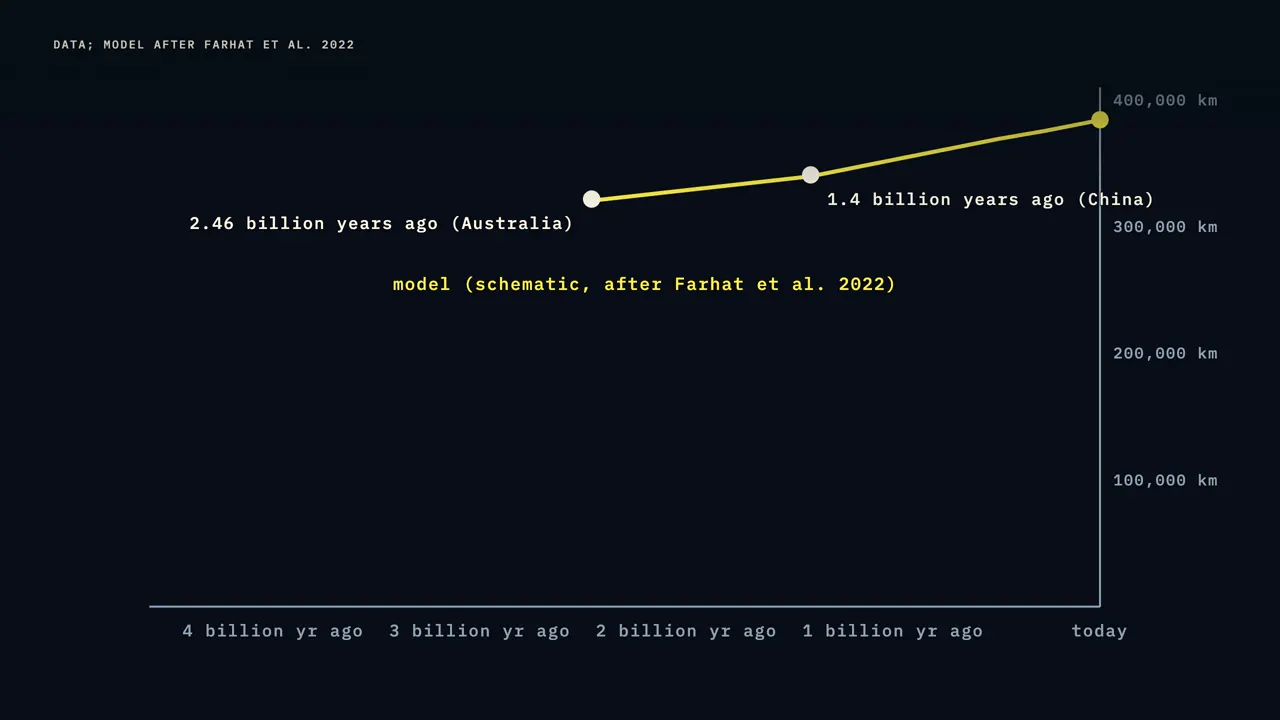
The model finds two such episodes in just the last 700 million years. So it would be wrong to say the Moon is moving away faster than ever. There have been bursts like this before, and right after it formed, the Moon moved away far faster. But compared with most of its history, today's pace is unusually high.
Ice ages and melting ice
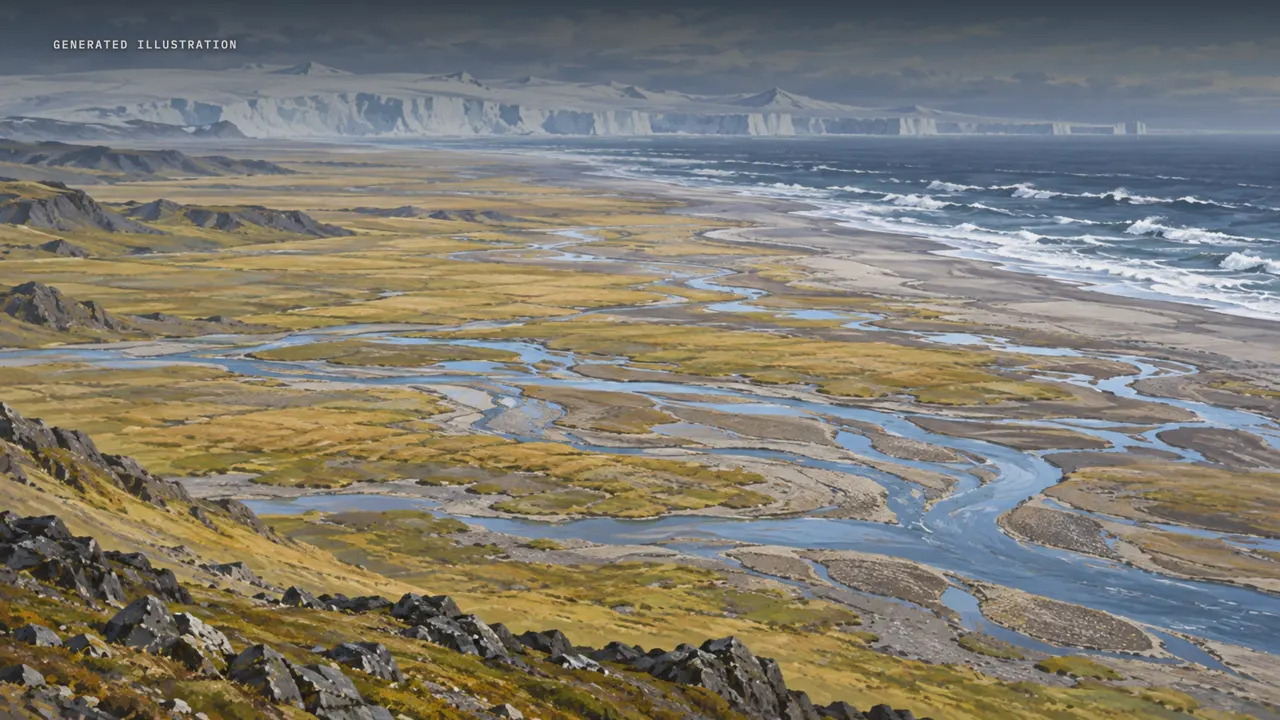
If the shape of the oceans matters, so does their depth. During the last ice age, so much water was locked in ice that the sea was about a hundred meters lower. Wide shallow shelves dried out, and the Atlantic tide grew much larger. One model of the main lunar tide found that tidal energy loss rose by about half, and in the deep ocean it nearly tripled.
The Moon was probably being pushed away faster during the ice age than it is today. Today, melting ice is changing the oceans again. One study has estimated that changes in sea level and in the layering of ocean water have raised the Moon's rate of retreat by about one millimeter per year since 1900.
That figure comes from models and historical records, not from the laser data directly. And it's a different effect from the one that delays leap seconds. Water moving toward the equator makes the day longer without passing anything to the Moon. In that estimate, it's the change in tidal friction that gives the Moon its extra push.
Was the day stuck at 19 hours?
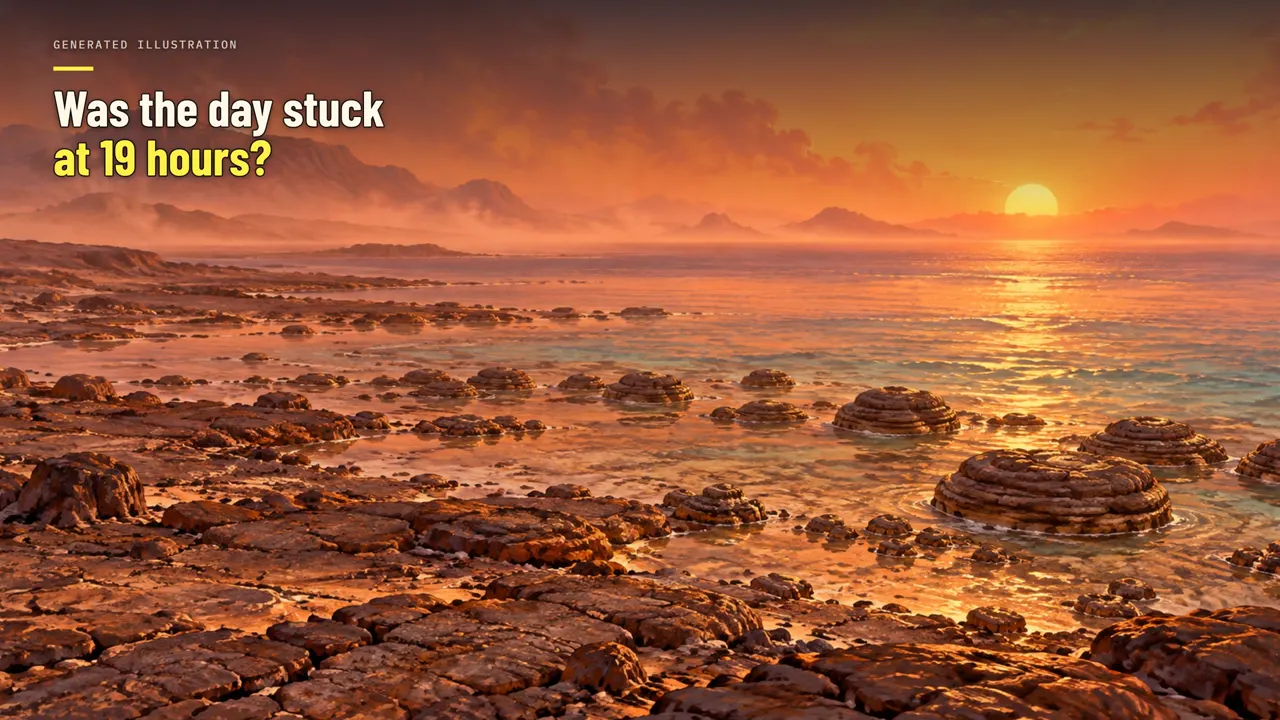
Not everything about this history is settled. In 2023, two research groups proposed that for over a billion years, starting about two billion years ago, the day stopped getting longer and stayed around 19 hours. Their explanation is a second kind of tide, in the air.
Sunlight heats the atmosphere every day, and that heating raises a tide in the air that pushes Earth's spin slightly forward. If the air resonated at the right moment, that push could have balanced the Moon's brake. One of the groups calculated that without that pause, today's day would be longer than 65 hours. But their model needed average surface temperatures of around 40 to 55 degrees Celsius, which the authors themselves called uncomfortably high.
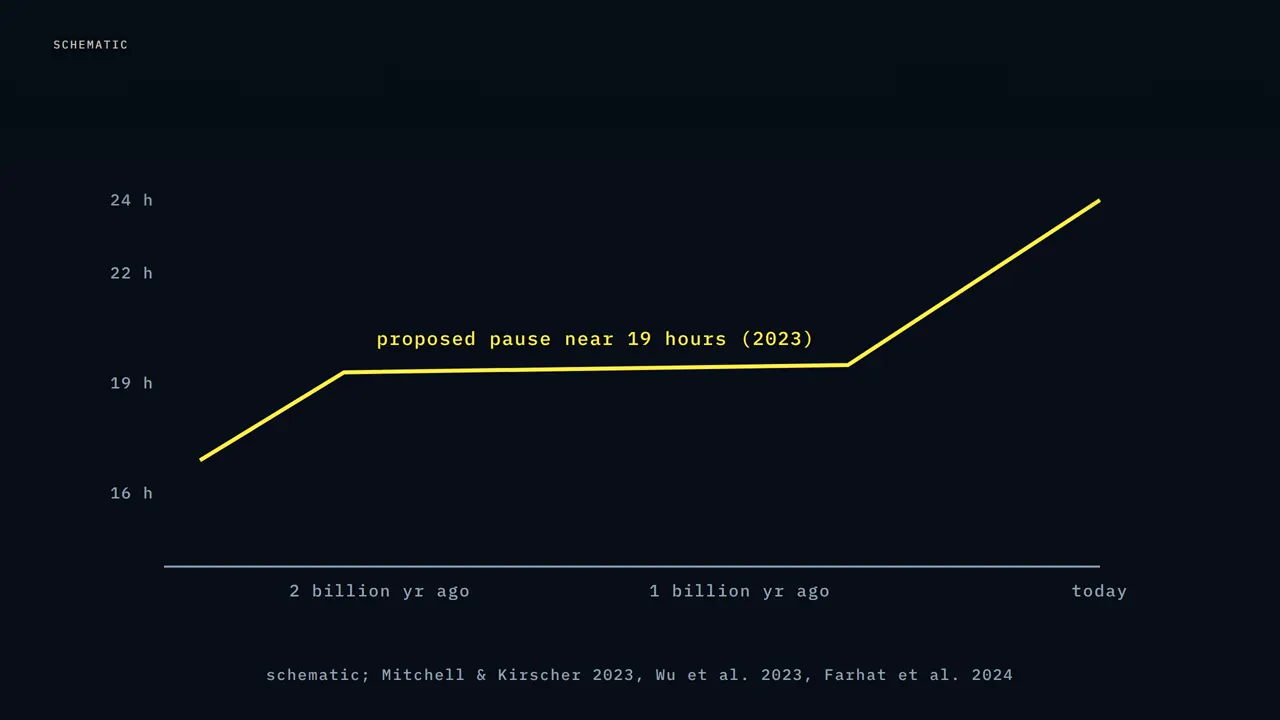
Other researchers, including the Paris group, disagree. They argue that the stall relies on old and shaky fossil data, and their own model of the air tide suggests that, at temperatures like today's, the resonance came much later and was too weak. The clearest test would be more climate rhythms from rocks between one and two billion years old.
For now, it's an open question.
A Moon the size of a fist
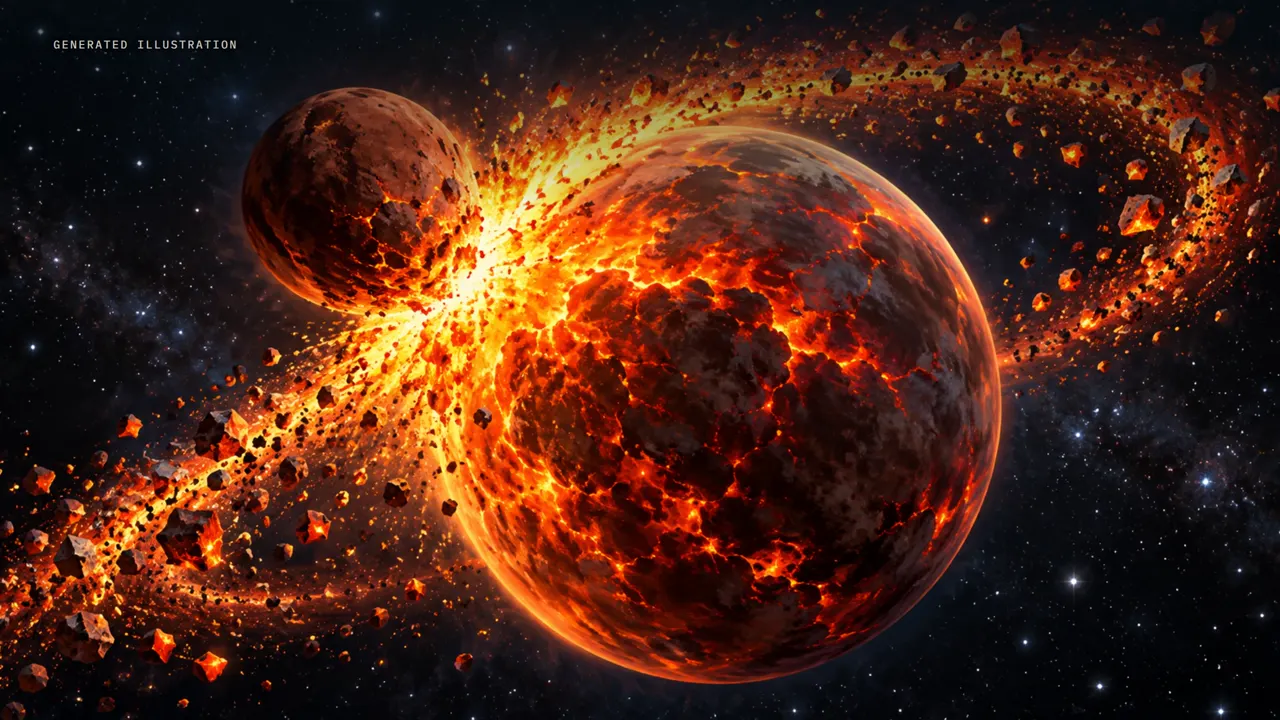
Go back to the beginning. The leading explanation for the Moon's origin is a giant impact. Early in Earth's history, a body perhaps the size of Mars struck the young planet, and debris thrown into orbit gathered into the Moon. Simulations suggest the debris gathered into the Moon in less than a year, only about three to five times Earth's radius from Earth's center.
Today it's about sixty times Earth's radius away. From that distance, the young Moon would have looked about sixteen to thirty-seven times wider than it does now. It would have looked about one or two fists wide, held at arm's length. If all of the Earth-Moon system's spin were put back into Earth, a day would last
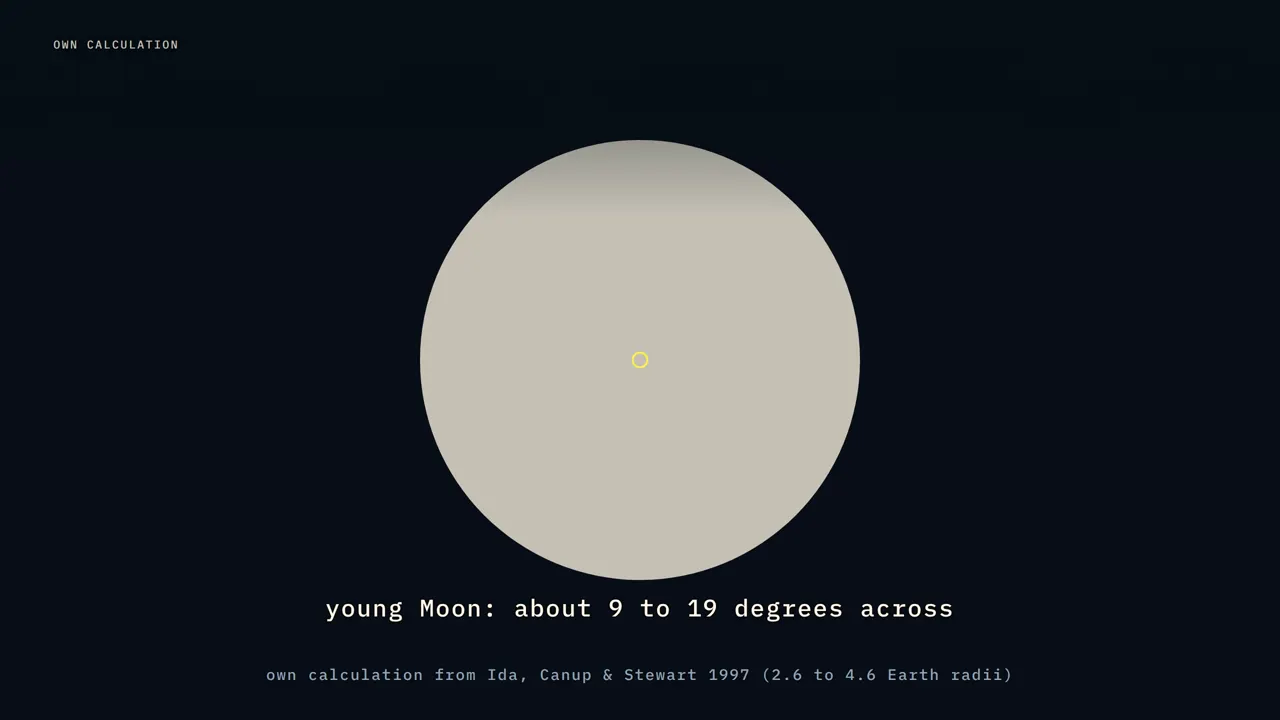
about four hours, and some models suggest the young Earth spun even faster. Tidal friction has been moving spin from Earth to the Moon ever since, and today it happens mainly through the oceans.
The last total eclipse
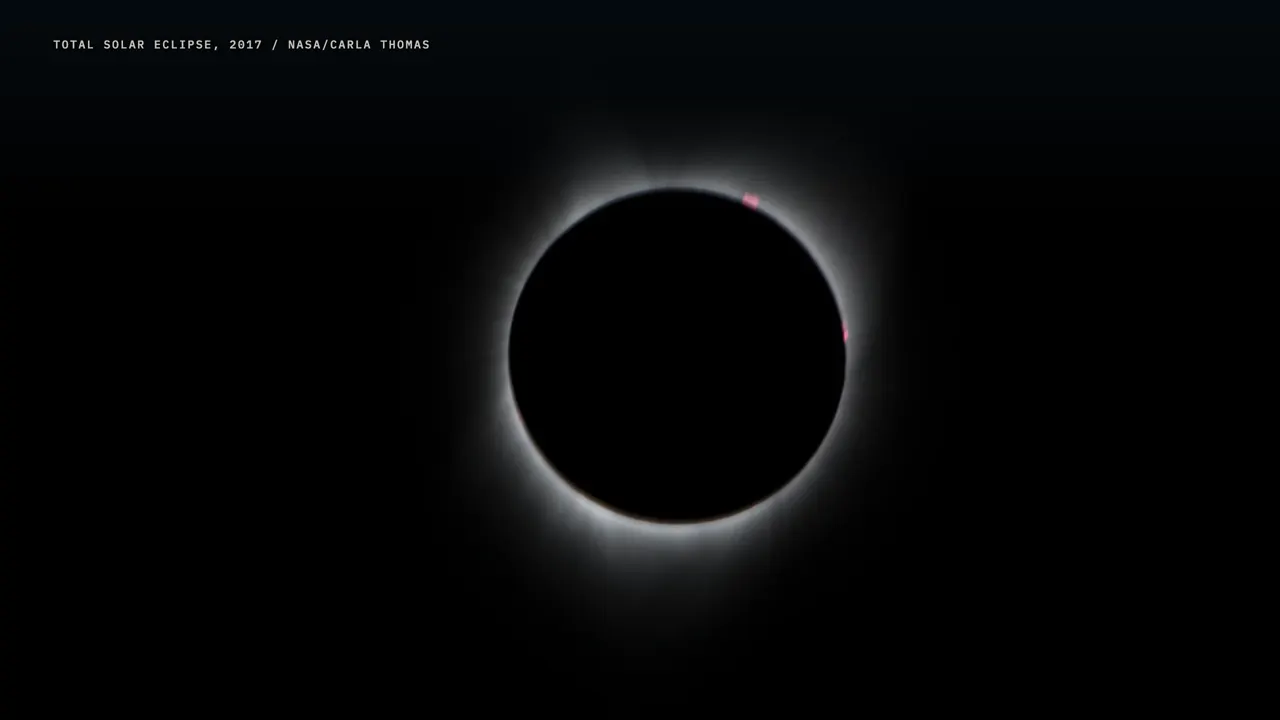
What happens next? If the Moon kept moving away at today's pace, it would eventually look too small to fully cover the Sun. One well-known estimate by the astronomer Jean Meeus has total solar eclipses starting to die out in about 620 million years and ending altogether in about 1.2 billion years.
Those dates depend on how fast the Moon actually moves, and the Atlantic won't stay in resonance forever. The Moon also steadies Earth's tilt. Calculations suggest that as the Moon recedes and Earth slows, Earth's tilt could become unstable somewhere between 1.5 and 4.5 billion years from now.
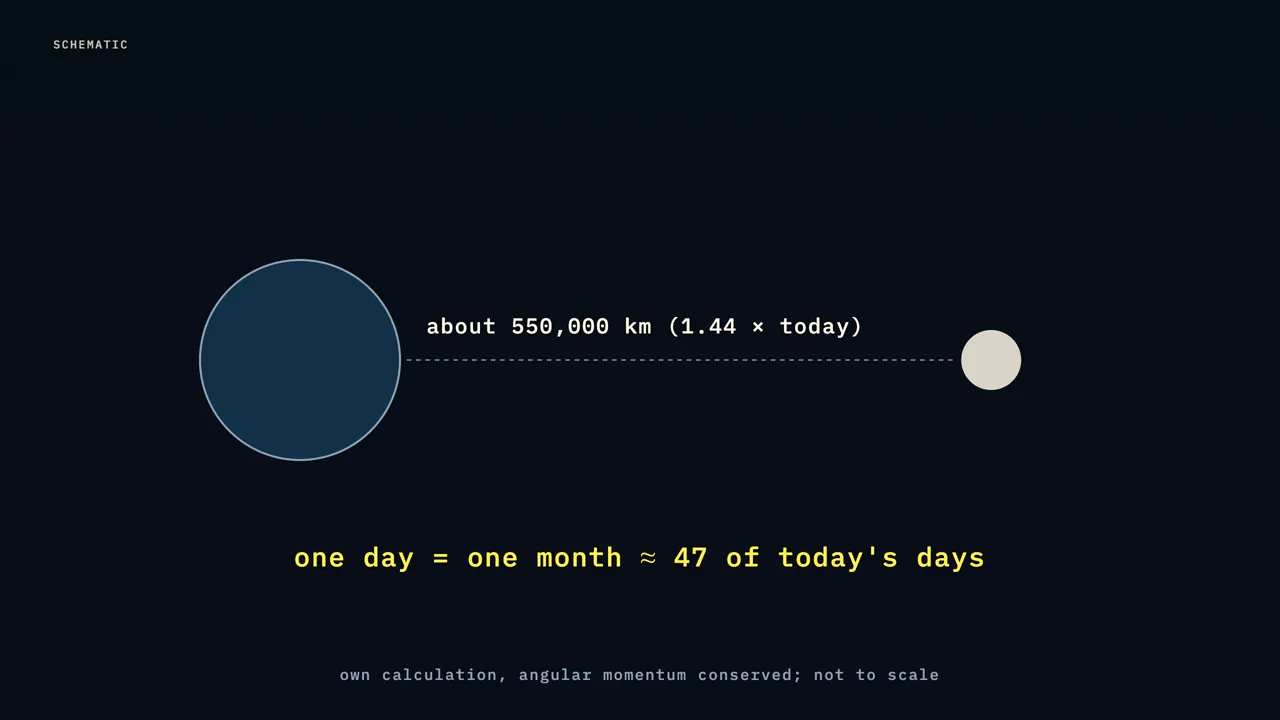
Textbooks describe an end point too. If nothing else intervened, Earth would slow until its day matched the Moon's orbit, at about 47 of today's days, with the Moon about 550,000 kilometers away. The Moon wouldn't leave us, because that is still well within the range where Earth's gravity holds it.
But Earth probably won't get there. The Sun is slowly getting brighter, by about one percent every 110 million years. In roughly a billion years, it's expected to be bright enough for the oceans to begin evaporating. And most of the brake on Earth's spin is the oceans.
Without them, the Moon's retreat would probably slow dramatically. The end of total eclipses and the start of the oceans' loss may both come roughly a billion years from now.
Still measuring
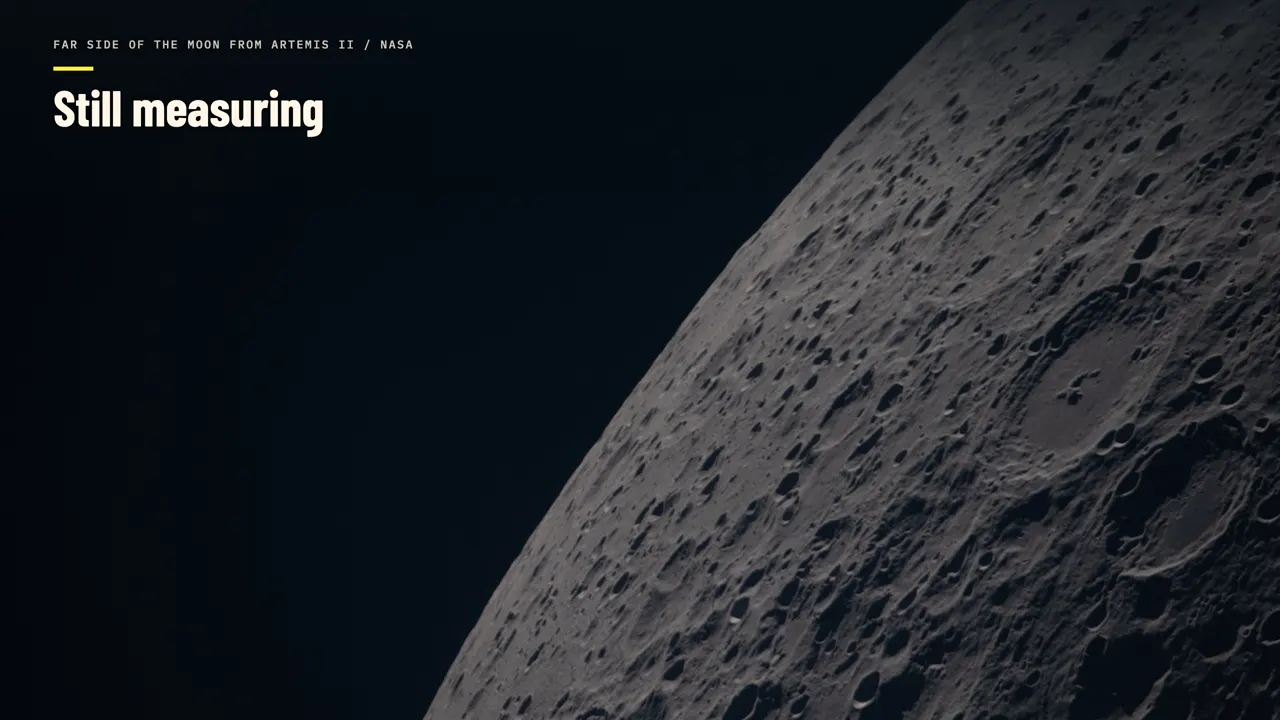
In April 2026, the four astronauts of Artemis II flew around the Moon, the first people to travel there in more than half a century. On the surface, the old Apollo mirrors are still in use, and new ones are planned for future landers. Every night that a station catches a few photons back from the Moon, it adds a little more to a record that began with clay tablets in Babylon. The Moon is moving away from Earth by about 3.8 centimeters a year.
That number comes from the oceans: their size, their depth, and the shape of the coastlines that hold them. And when the Atlantic drifts out of step with the tide, as ocean basins always do, that number will change again.
Sources
- Lunar laser ranging: Murphy, Rep. Prog. Phys. 2013 https://arxiv.org/abs/1309.6294 ; Williams & Boggs, Celest. Mech. 2016
- Earth's rotation from ancient eclipses: Stephenson, Morrison & Hohenkerk, Proc. R. Soc. A 2016 https://doi.org/10.1098/rspa.2016.0404
- History: Halley, Phil. Trans. 1695; Krajnović 2020 https://arxiv.org/abs/2004.03886 ; Spencer Jones, MNRAS 1939
- Leap seconds: BIPM CGPM 2026 Resolution 5 https://www.bipm.org/en/cgpm-2026/resolution-5 ; Agnew, Nature 2024
- New reflector NGLR-1: https://www.physics.umd.edu/nglr/status_03122025.html
- Tidal energy: Munk & Wunsch, Oceanography 1997; Egbert & Ray, Nature 2000 and JGR 2001
- Fossil days: Wells, Nature 1963; de Winter et al. 2020; Williams, Rev. Geophys. 2000
- Climate cycles: Meyers & Malinverno, PNAS 2018; Lantink et al., PNAS 2022
- Ocean resonance: Farhat et al., A&A 2022 https://arxiv.org/abs/2207.00438 ; Davies, Green & Duarte, ESD 2020; Egbert, Ray & Bills, JGR 2004
- Climate and the Moon: Kiani Shahvandi et al., PNAS 2024 and A&A 2025
- 19-hour day: Mitchell & Kirscher 2023; Wu et al., Sci. Adv. 2023; Farhat et al. 2024
- Origin and future: Ida, Canup & Stewart, Nature 1997; Canup 2004; Meeus 2002; Laskar et al. 1993; Néron de Surgy & Laskar 1997; Schröder & Smith 2008
Images and video
- CC BY / CC BY-SA: Calern ranging station, Melirius (CC BY-SA 2.0); Calern laser at night, DPTS - ENSG (CC BY-SA 3.0); Babylonian tablets, Zunkir, Brigade Piron, Osama Shukir Muhammed Amin (CC BY-SA 4.0); Elatina layers, horn coral, stromatolites, James St. John (CC BY 2.0); Bay of Fundy, Dylan Kereluk and Michel Rathwell (CC BY 2.0), Lars Plougmann (CC BY-SA 2.0), The Cosmonaut (CC BY-SA 2.5 CA); banded iron, Graeme Churchard (CC BY 2.0); Karijini, Gypsy Denise (CC BY-SA 4.0); rudist, Ghedoghedo (CC BY-SA 4.0); Lunokhod 2 model, Hayk (CC BY-SA 3.0); full Moon, Gregory H. Revera (CC BY-SA 3.0); Moon mosaic, Astrobond (CC BY-SA 4.0); lunar eclipse, Brucewaters (CC BY-SA 4.0); annular eclipse, Kevin Baird (CC BY-SA 3.0); Harold Spencer Jones, ESO/A. Blaauw (CC BY 4.0); John Couch Adams, Wellcome Collection (CC BY 4.0); tide timelapses, Danilo Hegg and Dean Hardy (CC BY 3.0); Mont-Saint-Michel tides, SentinelHub (CC BY 2.0); Moon's shadow over Spain, Plenz (CC BY-SA 4.0)
- Public domain / CC0: NASA (Apollo 11, 14 and 15 reflectors, Apollo 14 sample, Galileo, Apollo 8 and 17, Artemis I and II, DSCOVR EPIC with NOAA, Scientific Visualization Studio, Richard Ray's tide maps, NGLR-1, Goddard laser), NOAA, USGS, U.S. Space Force, NPS, Smithsonian NASM (Mark Avino), Michael Roudabush, Armael, Wilson44691; portraits of Halley and Laplace and Halley's 1695 paper
- Pexels: Dom Le Roy, Duane Wilkins, Eclipse Chasers, Ivan A., Jean Marc Pampuch, Luz Calor Som, T6 Adventures, The Six, William Laverty, sergeispas
- The narration is a synthetic voice. Images marked "Generated illustration" are generated, not records (thumbnail B, the young Moon, the giant impact, the Devonian and Cretaceous seas, the ice-age coast, the melting ice sheet, the Earth cutaway, the astronomical clock and the Proterozoic shore). Charts marked "schematic" are drawn explanations; NASA visualizations are models.