How Was Krakatoa Heard 4,800 km Away?

On 27 August 1883, Krakatoa exploded. Its booms were heard on Rodrigues, an island about 4,800 km away, and barometers around the world recorded the same wave of air passing over them seven times in five days. This video follows the three kinds of air wave described in the Royal Society's 1888 report on the eruption, using the report's own charts and maps, and looks at how the 2022 Hunga eruption near Tonga repeated the pattern.
This article is the full narration of the video. Watch on YouTube
The gauge that ran out of paper
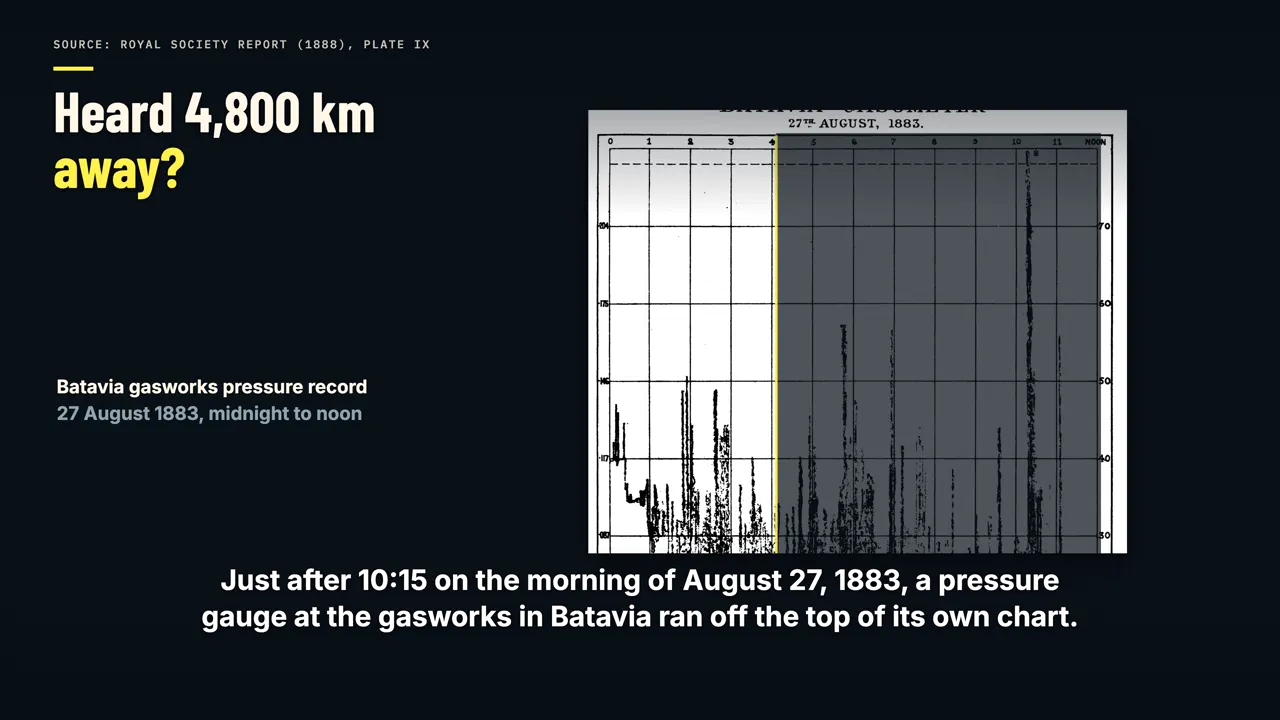
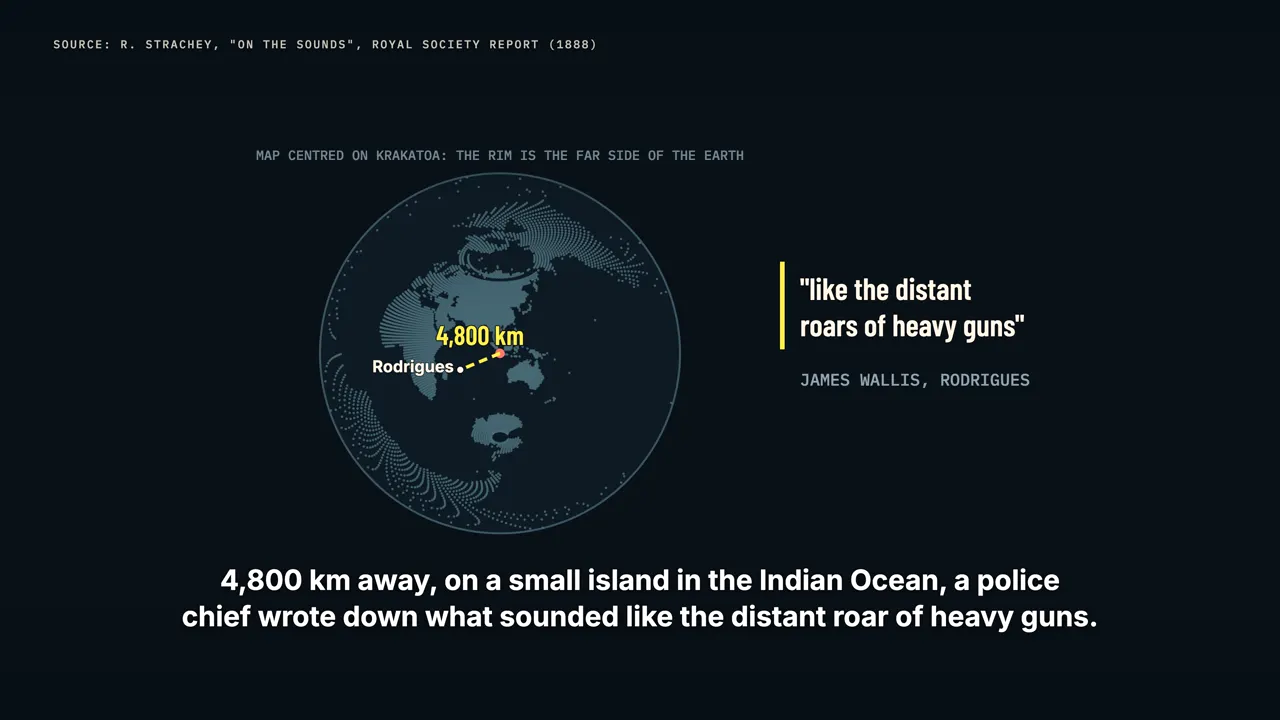
Just after 10:15 on the morning of August 27, 1883, a pressure gauge at the gasworks in Batavia ran off the top of its own chart. Batavia, today's Jakarta, sits about 150 km from a volcano called Krakatoa. 4,800 km away, on a small island in the Indian Ocean, a police chief wrote down what sounded like the distant roar of heavy guns. Then barometers began to twitch around the world, in Bombay, Mauritius, Toronto and Washington.
Many of them twitched seven times over the next five days, as the same wave of air kept passing over them. So how could one explosion be heard across an ocean, and then wrap itself around the whole planet?
Krakatoa, 1883
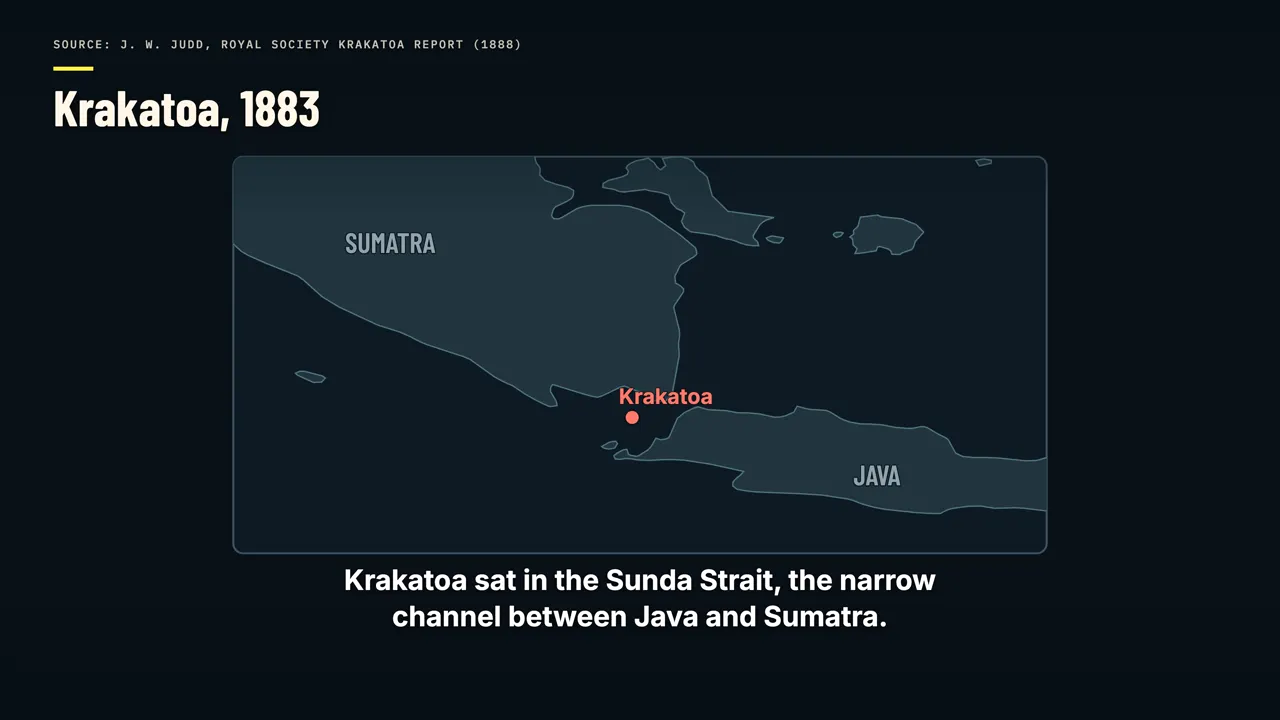
Krakatoa sat in the Sunda Strait, the narrow channel between Java and Sumatra. It had been erupting since May, and in late August the eruption built to a climax. On the morning of the 27th, a series of enormous explosions tore it apart. About two thirds of the island disappeared.
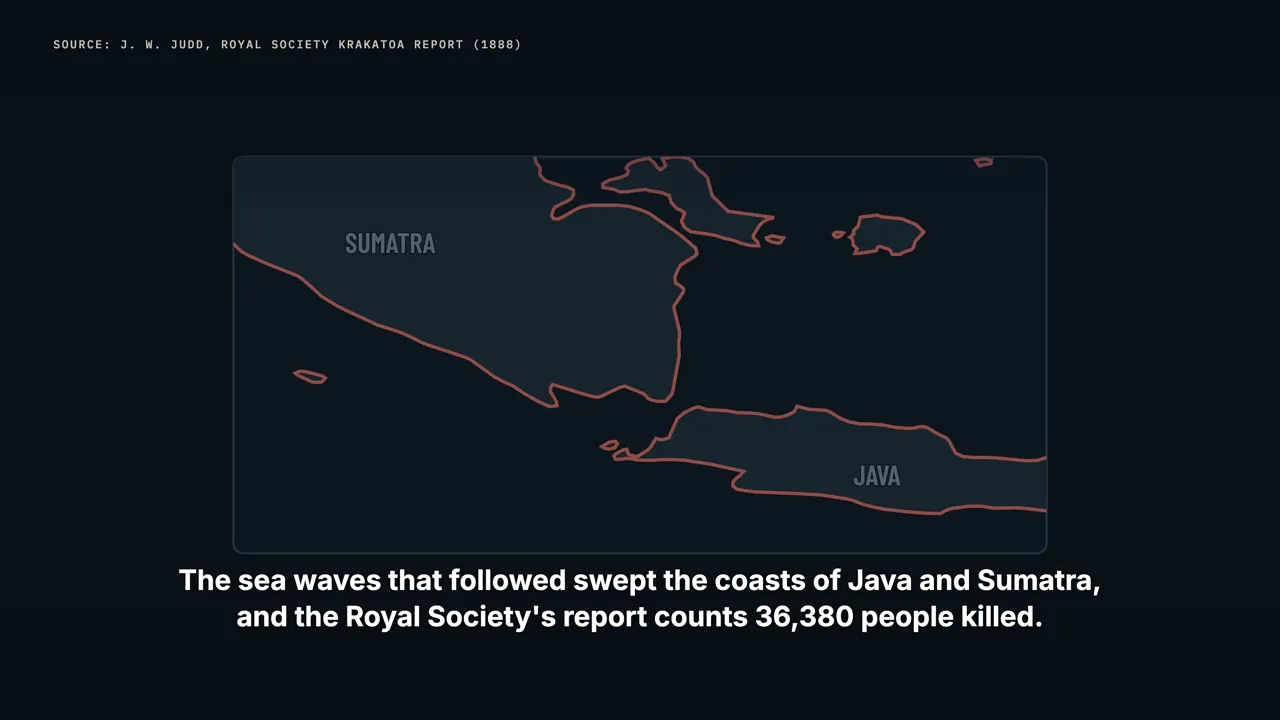
The sea waves that followed swept the coasts of Java and Sumatra, and the Royal Society's report counts 36,380 people killed. In 1884, the Royal Society in London set up a committee to collect every record of the eruption it could find. Its report came out in 1888, and most of what follows comes from its pages.
Three kinds of air wave
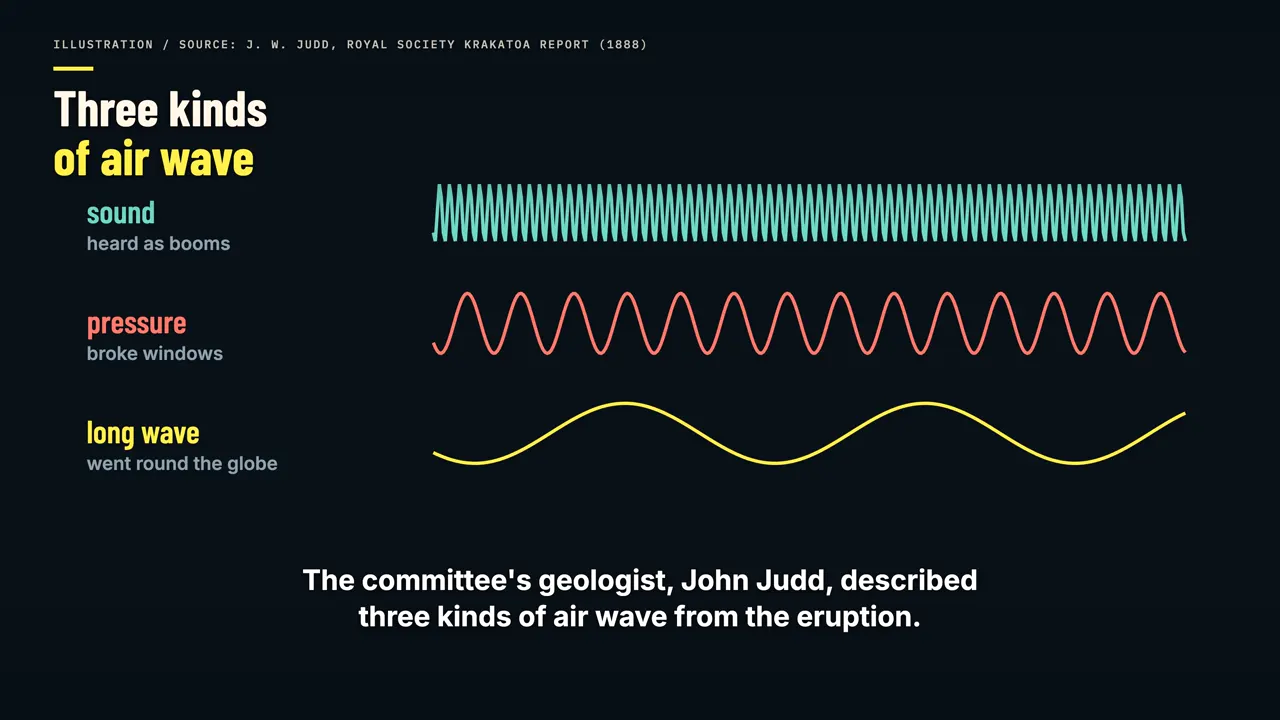
The committee's geologist, John Judd, described three kinds of air wave from the eruption. The quickest were ordinary sound, the booms that people heard. Bigger, slower pushes of air broke windows and cracked walls 160 km away. And the slowest were so long that nobody heard them at all, but barometers felt them going around the globe.

One explosion, three very different journeys. Start with the sound.
Where the booms were heard
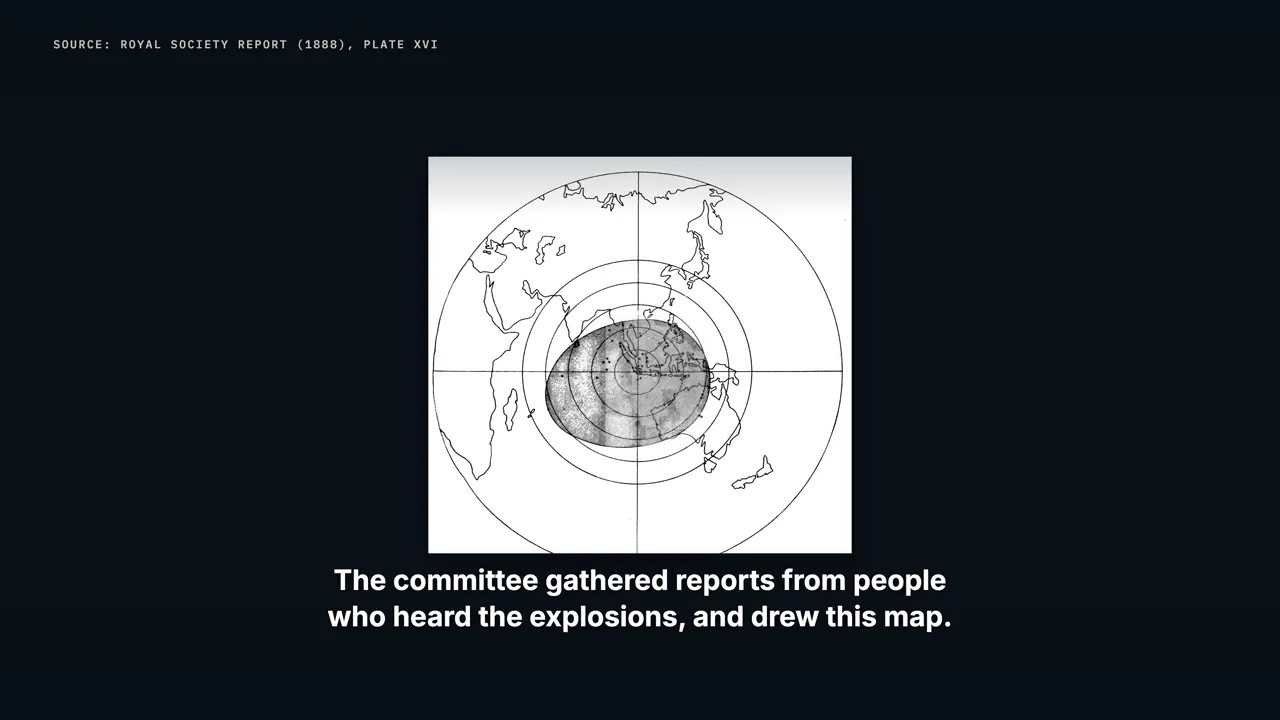
The committee gathered reports from people who heard the explosions, and drew this map. Its list holds nearly 100 reports from at least 30 km away, and 16 from more than 3,000. The shaded area is where the booms reached, a little less than one-thirteenth of the surface of the Earth. Over and over, people described the same thing: it sounded like guns.
On Diego Garcia, more than 3,600 km away, people took the booms for a ship in distress firing its guns. Around the Andaman Sea, officials sent out a police launch and a steamer to search for that ship. They found nothing. The farthest report came from Rodrigues, a small island east of Mauritius, about 4,800 km from the volcano.
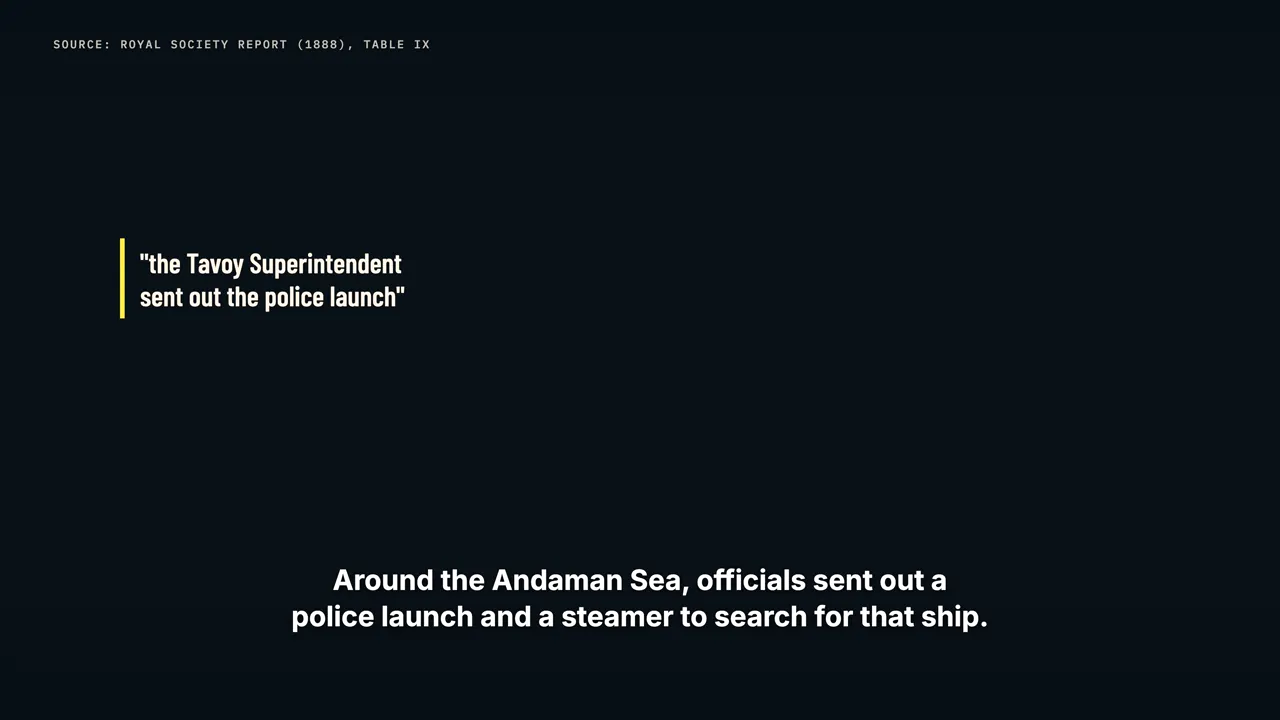
James Wallis, the chief of police there, wrote that the reports came from the east, like the distant roars of heavy guns. That is farther than from New York to San Francisco. The committee called it the only case on record of sound being heard at anything like that distance.
A lopsided map
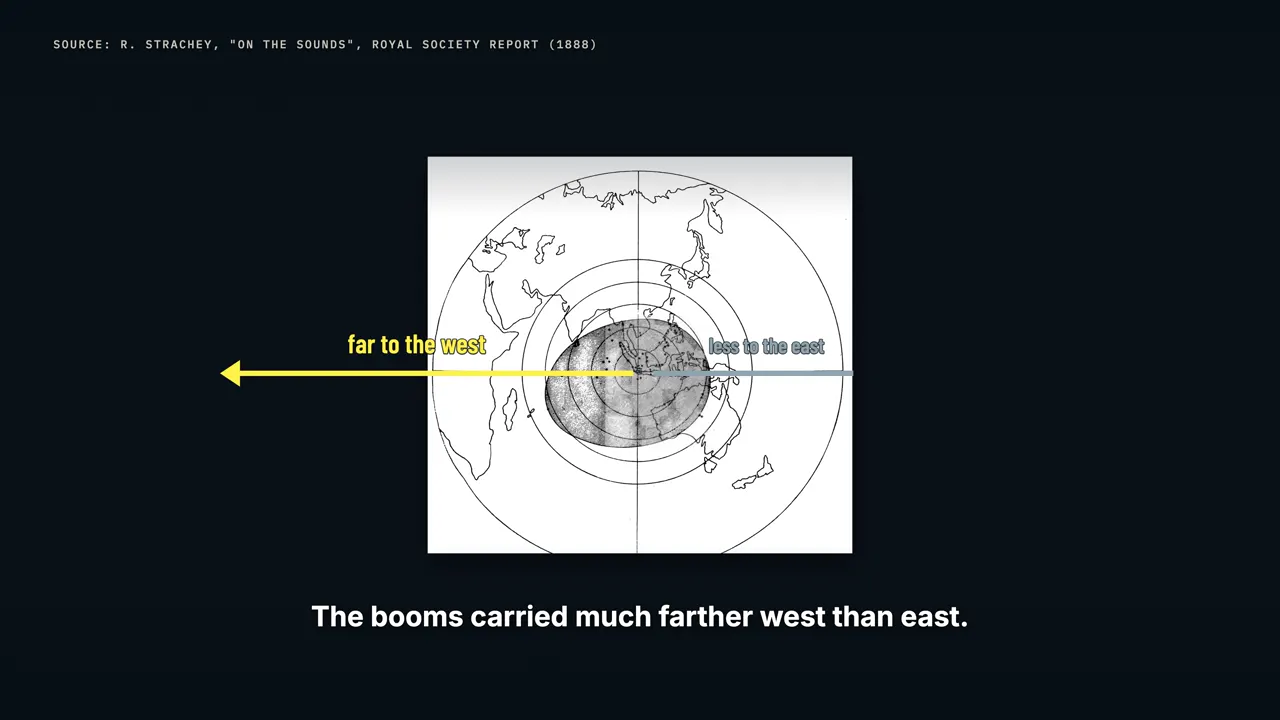
The map is also lopsided. The booms carried much farther west than east. The committee put that down to the trade winds, which blow toward the west in that part of the ocean. And there is a stranger detail.
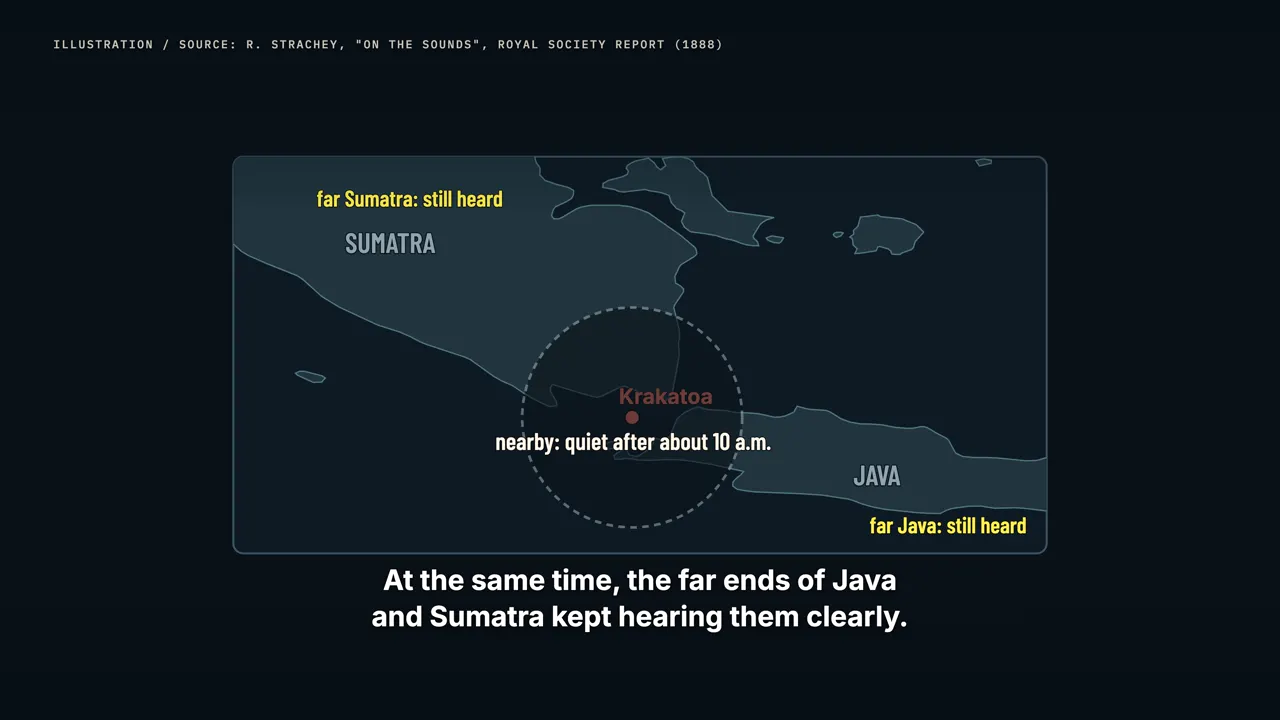
In many places right next to the volcano, people stopped hearing the booms soon after 10 a.m., even though the explosions went on. At the same time, the far ends of Java and Sumatra kept hearing them clearly. The committee guessed that a thick screen of ash over the nearby coast was blocking the sound. An acoustics professor who reviewed the report, Thomas Gabrielson, notes that layers of air bending the sound away could leave silent patches too.
Why sound can travel that far
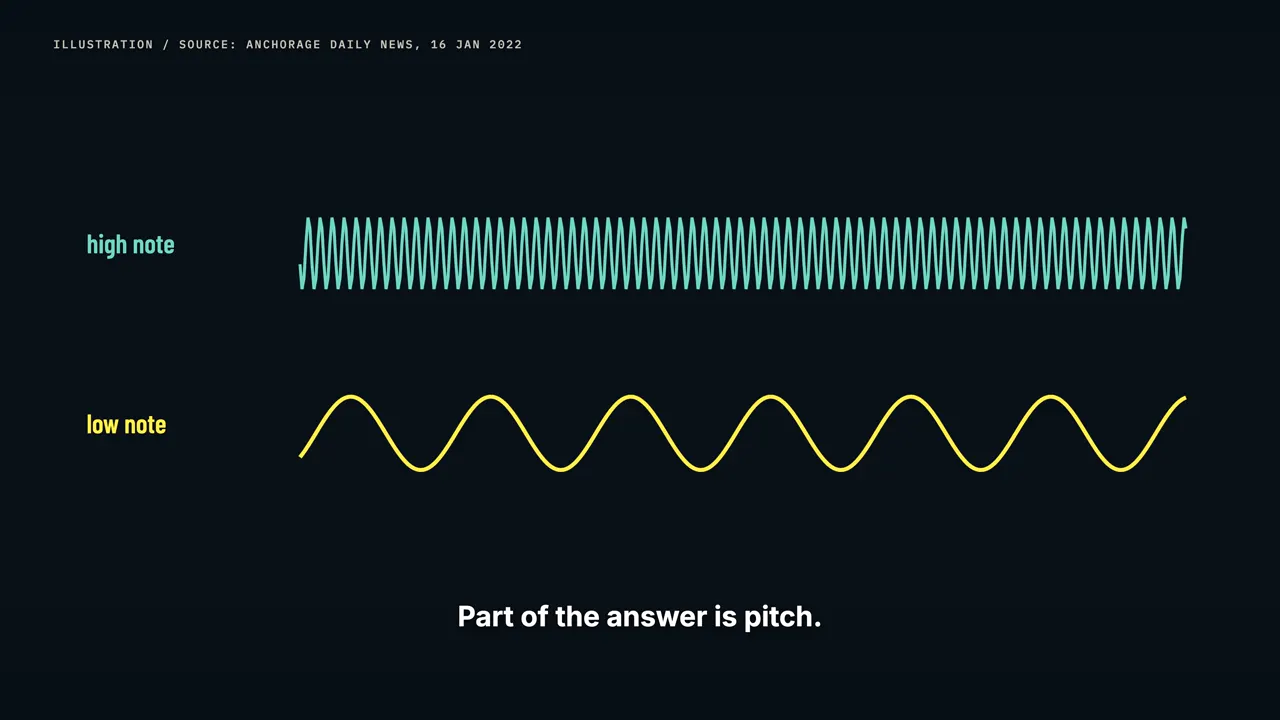
So why could this sound travel so far at all? Part of the answer is pitch. Low sounds lose their energy more slowly than high ones. It's the reason you can hear the bass from a distant concert long before you can make out the singer.
A huge explosion puts out an enormous amount of very low sound, much of it too low for human ears, which scientists call infrasound. The other part of the answer is the sky itself. The atmosphere is not one even block of air, it is stacked in layers with different temperatures and winds. Those layers can bend sound back down toward the ground, so it skips along the surface instead of escaping upward.
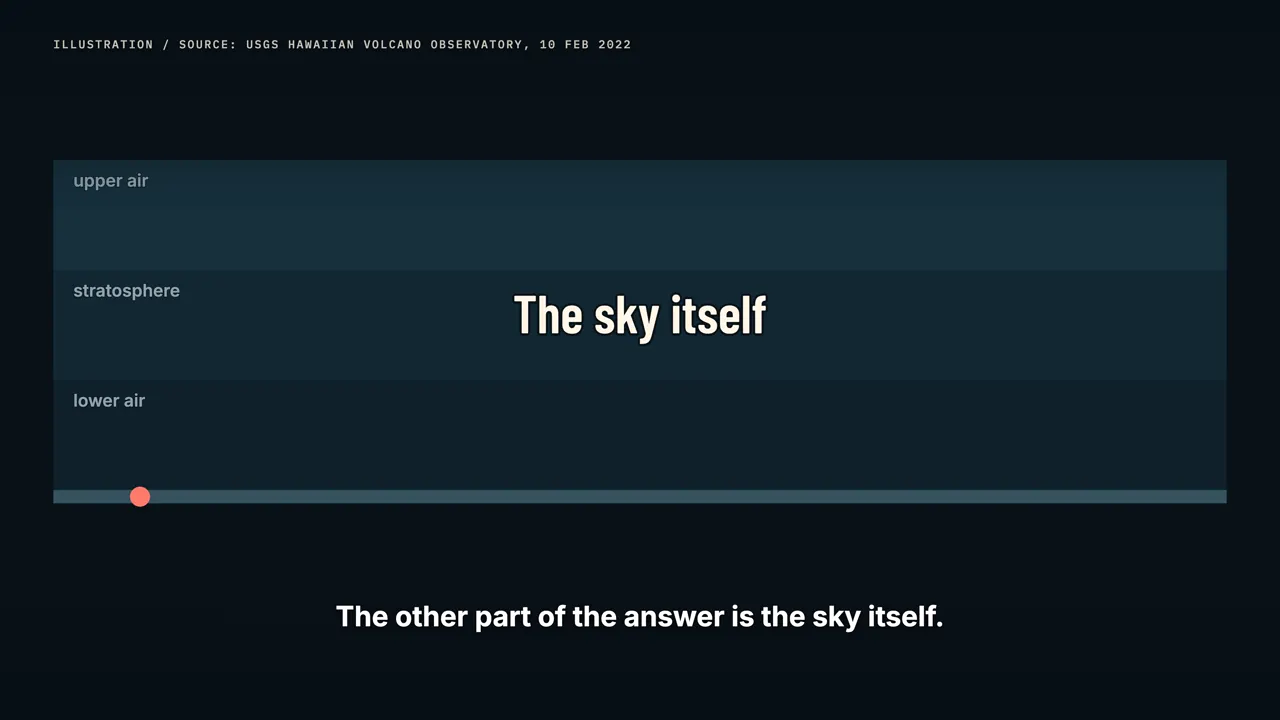
The same bending can carry sound over one place and drop it somewhere farther away, which is one way a silent patch can form.
Off the chart
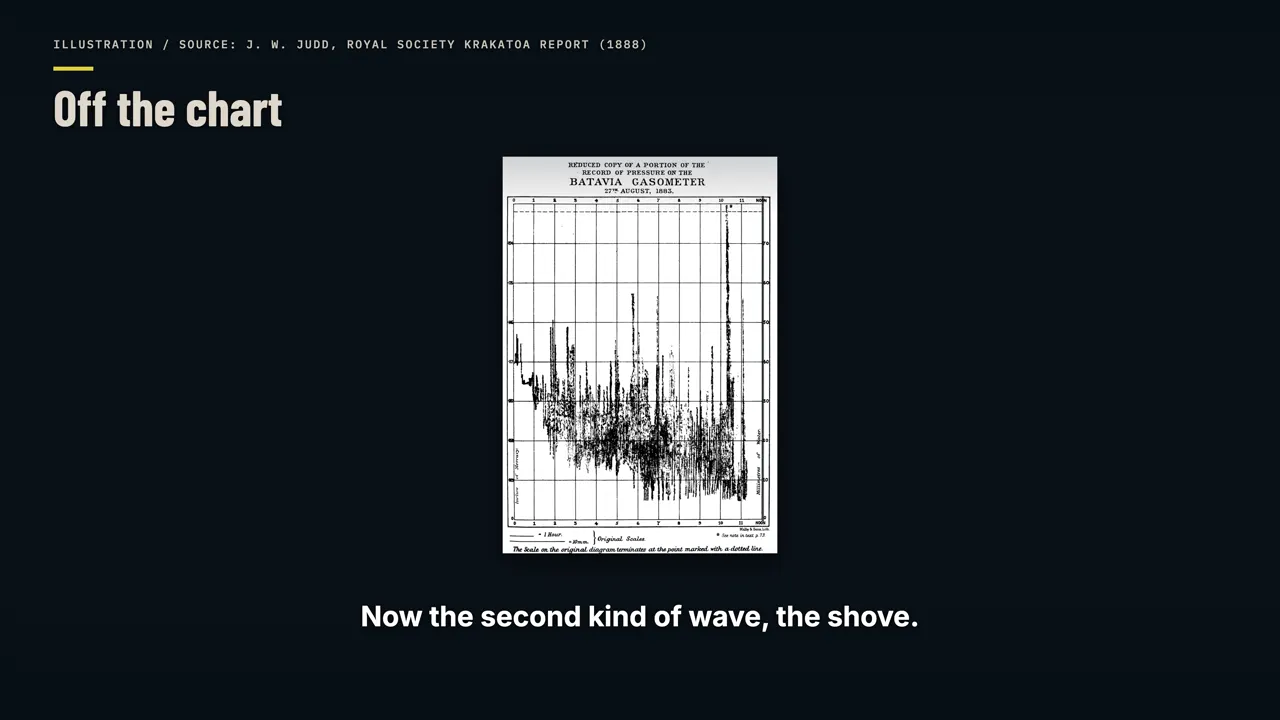
Now the second kind of wave, the shove. The gasworks in Batavia kept a running record of the pressure on its big gas holder. This is the committee's copy of that record for the morning of the 27th. The line jumps around all morning as explosion after explosion arrives.
Then, between 10:15 and 10:20, it shoots straight up and off the top. The note at the bottom says the scale on the original ended right there. So the strongest push was never fully recorded. Judd wrote that these waves blew in windows, knocked over lamps, put out gas lights, and lifted a gas holder right out of its well.
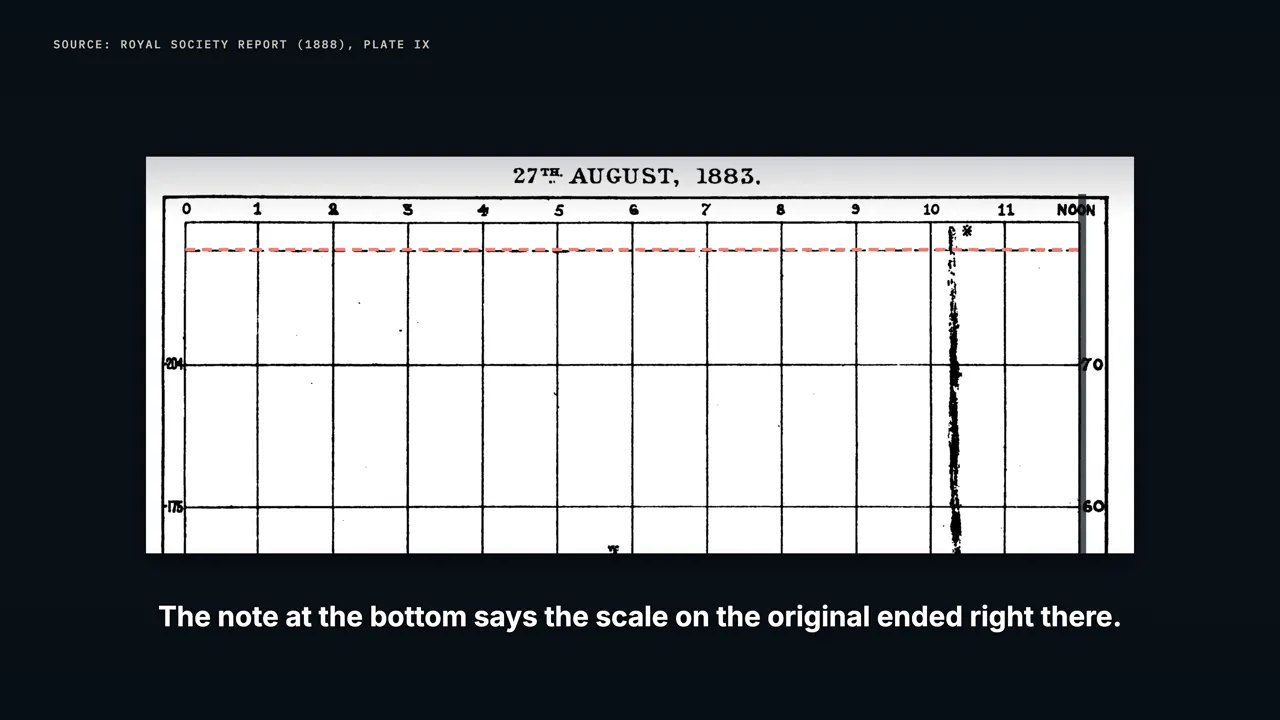
You will often see a precise decibel number for Krakatoa online. Treat it as an estimate, because the one instrument close enough to measure the blast ran out of scale.
Around the world
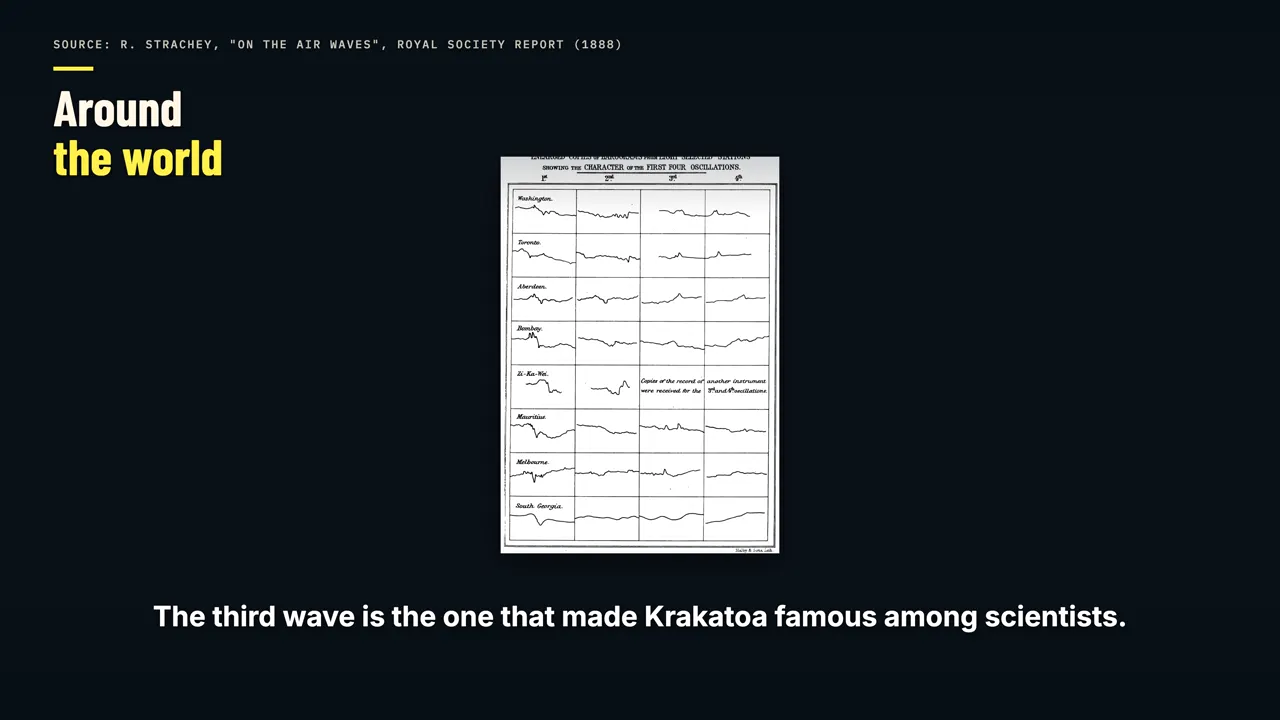
The third wave is the one that made Krakatoa famous among scientists. In 1883, weather stations kept barographs, instruments that draw air pressure as a line on paper. When the charts were collected, more than 50 stations showed the same strange bump. This plate puts eight of them side by side.
Far from the volcano, the bump changed air pressure by a few tenths of a percent at most. And each bump took two or three hours to rise and fall, far too slow for any ear. The timing gave it away. The bump reached Calcutta about 4 hours after the explosion, Tokyo after 6, Vienna after 10, and New York after 15.
Richard Strachey, who studied the charts, saw a single wave spreading out from Krakatoa as a growing circle. The circle widened until it stretched around the middle of the planet. Then it shrank again toward the exact opposite side of the globe, a point in Colombia. From there it came back toward Krakatoa, passed through, and set off again.
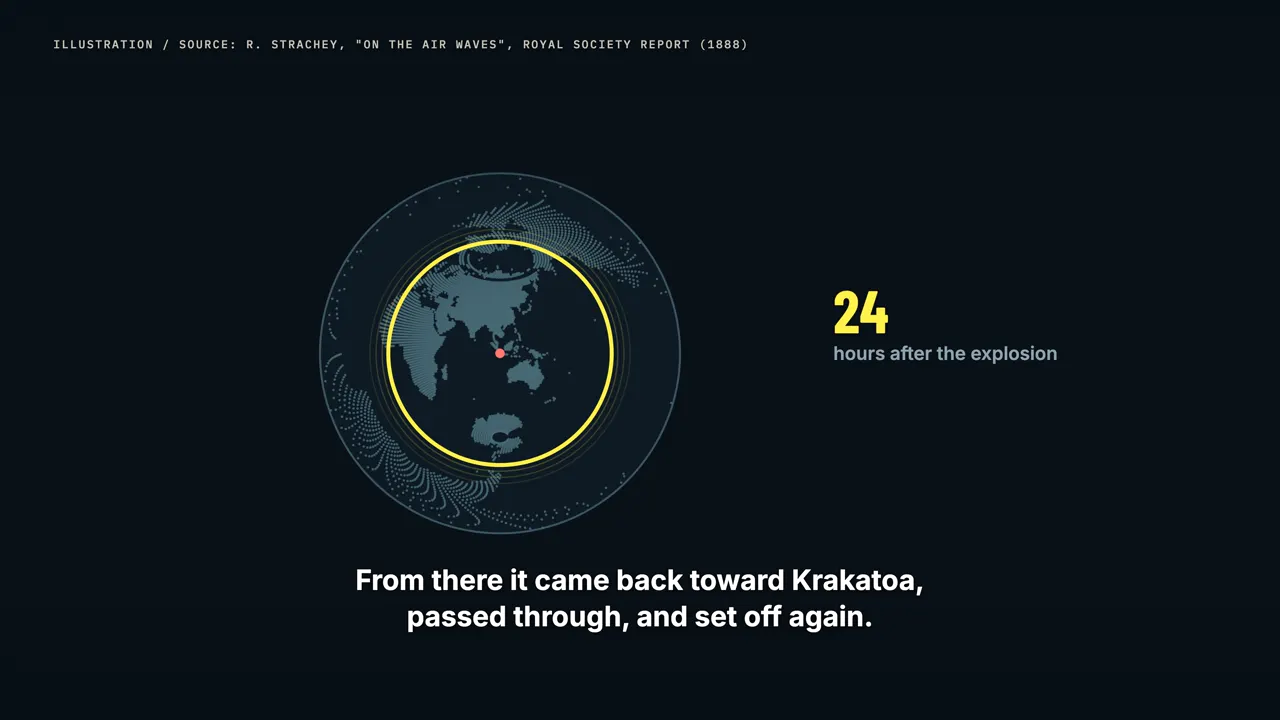
Many stations saw it seven times, four passes heading out and three heading back. In Glasgow, the passes came about 11, 25, 48, 59, 84, 94 and 121 hours after the eruption. Each full lap of the Earth took about 35 to 37 hours. That is roughly 1,100 km/h, close to the speed of sound.
It was not quite the same in both directions: Strachey put the westbound wave at about 674 mph, and the eastbound one at 706. Running the clocks backward from all those stations, he could even work out when the explosion happened. His answer was 9:58 a.m. local time, and the gas holder record in Batavia agreed. Strachey's first estimate was that the wave went around the globe three and a quarter times before the instruments lost it.
It happened again
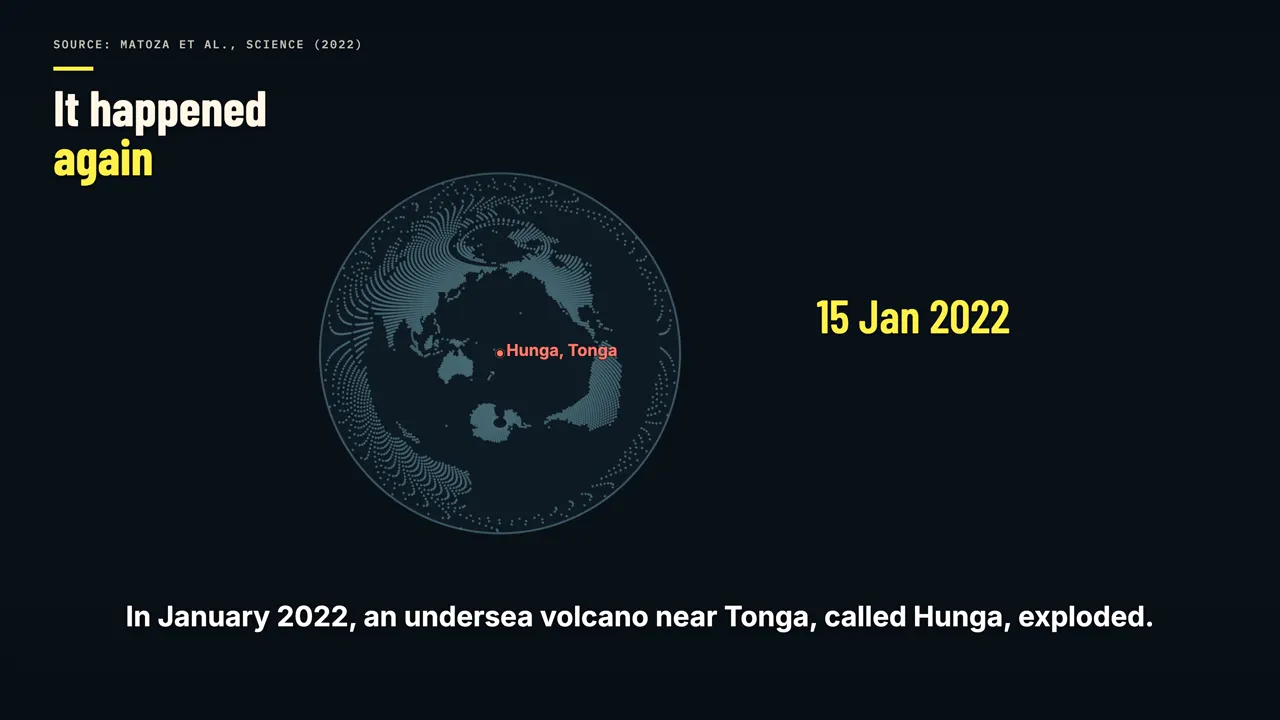
In January 2022, an undersea volcano near Tonga, called Hunga, exploded. Scientists who studied its pressure wave found it comparable in size to Krakatoa's. This time, instruments everywhere were listening, on the ground and in space. One was a network of infrasound stations built to catch secret nuclear tests, and
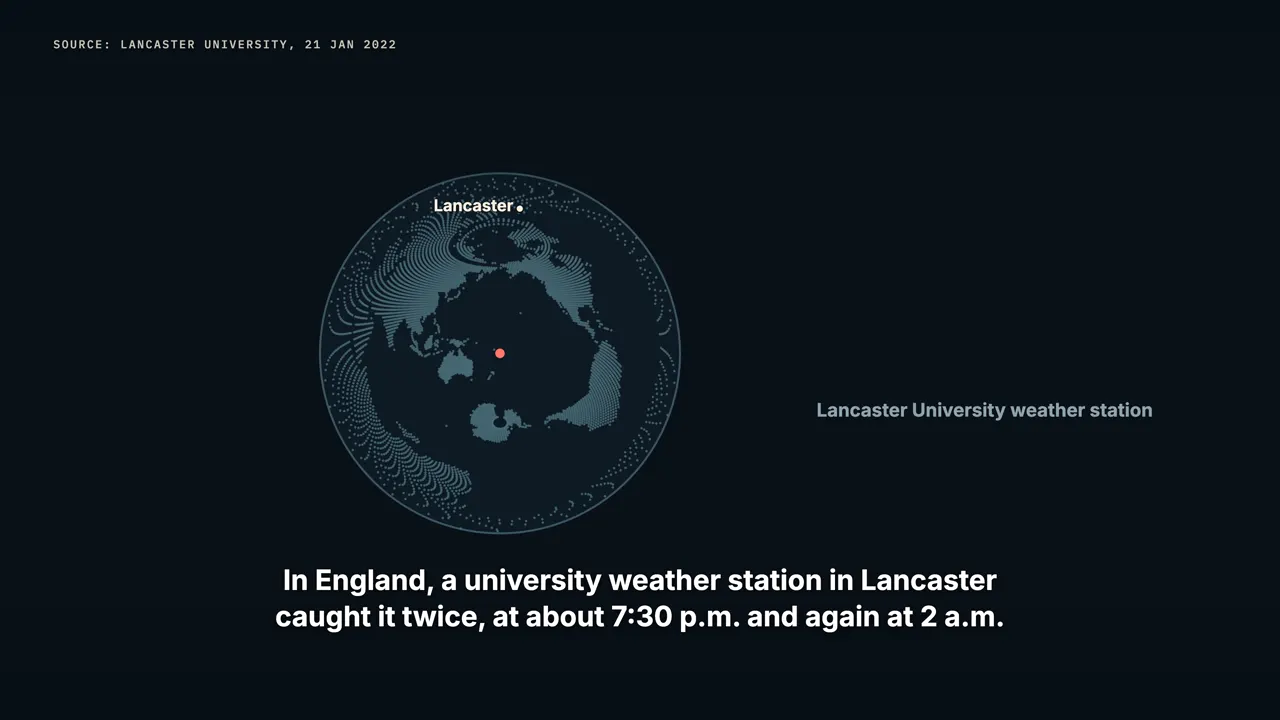
one of its geophysicists called the blast the biggest thing they had ever seen. They tracked the wave around the Earth four times, plus three passes from the opposite side, over six days. That is the same pattern the Victorian barographs drew. In England, a university weather station in Lancaster caught it twice, at about 7:30 p.m. and again at 2 a.m.
And this time, people in Alaska heard the booms, more than 9,000 km away. People from Anchorage to Fairbanks reported them just after 3 a.m., about 7 hours after the eruption. Hawaii is much closer to Tonga, and there were no reports of anyone hearing it there. The same patchiness the committee puzzled over in 1883.
One sky
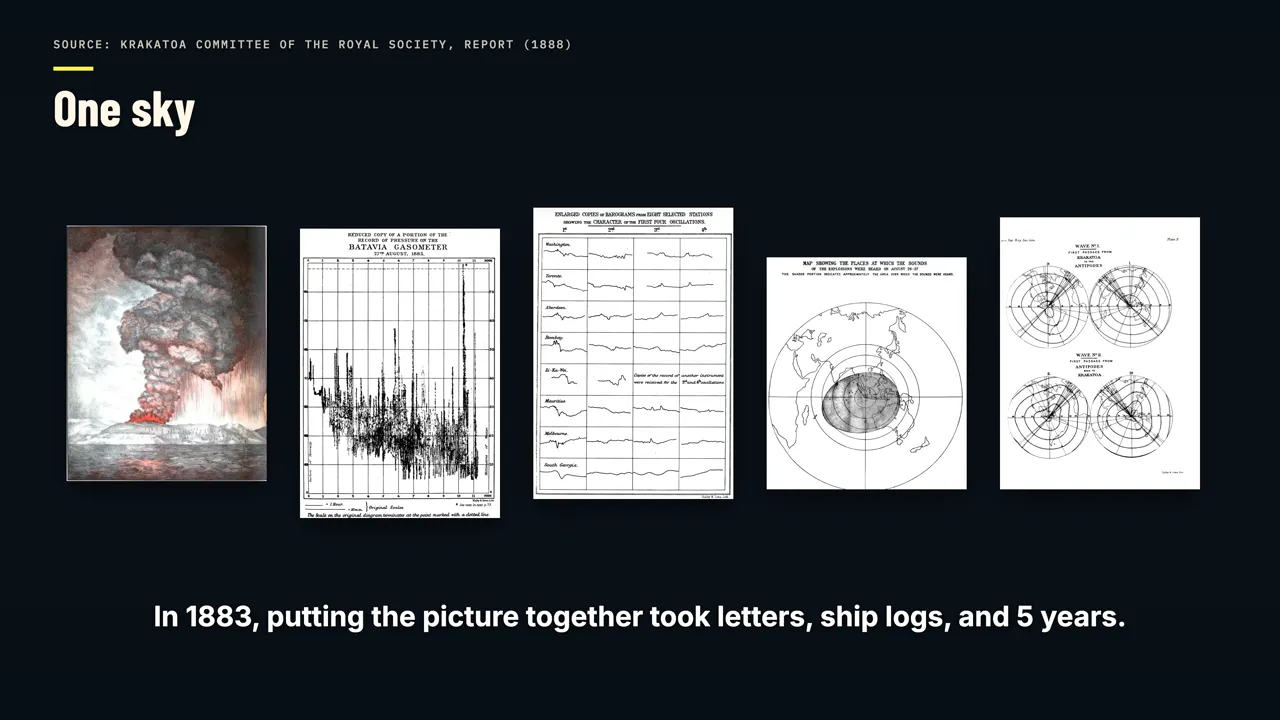
In 1883, putting the picture together took letters, ship logs, and 5 years. In 2022, the same wave showed up on satellites and home weather stations. Both tell the same story. The air around the Earth is one connected thing.
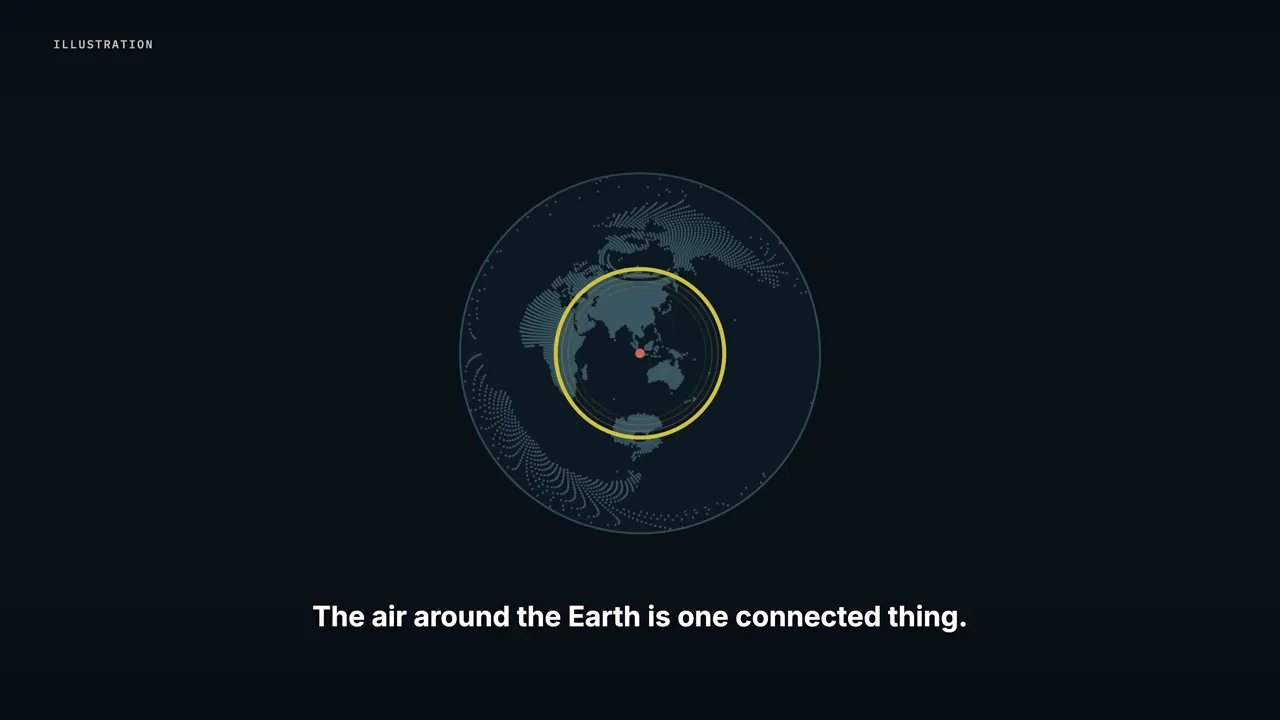
Hit it hard enough in one place, and barometers on the far side of the world will feel it, again and again.
Watch on YouTube
Sources
- G. J. Symons (ed.), The Eruption of Krakatoa, and Subsequent Phenomena, Report of the Krakatoa Committee of the Royal Society, 1888 (plates I, VII, IX, X, XVI): https://archive.org/details/eruptionkrakato00whipgoog
- "The Story of a Vast Explosion", Chambers's Journal, 8 Nov 1884: https://gutenberg.org/ebooks/66575
- T. B. Gabrielson, "Krakatoa and the Royal Society", Acoustics Today, April 2010: https://www.montana.edu/rmaher/eele217_sp12/krakatoa_sound_2010.pdf
- R. S. Matoza et al., Science 377 (2022), Hunga eruption atmospheric waves: https://doi.org/10.1126/science.abo7063
- Anchorage Daily News, 16 Jan 2022: https://www.adn.com/alaska-news/science/2022/01/15/volcano-eruption-near-tonga-causes-booms-heard-by-alaskans-nearly-6000-miles-away/
- USGS Hawaiian Volcano Observatory, 10 Feb 2022: https://www.usgs.gov/observatories/hvo/news/volcano-watch-tonga-eruption-recorded-hawaii-infrasound-network-and-globally
- NPR, 21 Jan 2022 (KPBS copy): https://www.kpbs.org/news/international/2022/01/21/nuclear-test-monitor-calls-tonga-volcano-blast-biggest-thing-that-weve-ever-seen
- Lancaster University, 21 Jan 2022: https://www.lancaster.ac.uk/news/tonga-volcanic-eruption-registered-in-lancaster
- The narration is a synthetic voice. Historical images are plates from the 1888 report; maps and diagrams marked "Illustration" are drawn explanations.