How Does a Heat Pump Get More Heat Than the Electricity It Uses?
A heat pump can put about three units of heat into a home for every unit of electricity it uses. That sounds like heat out of nothing. It isn't: the missing energy comes from the outdoor air, even when that air is below freezing.
This video follows one loop of refrigerant through the outdoor coil, the compressor, the indoor coil and the expansion valve, then shows why the ratio has a physical ceiling, what field measurements found on cold days, and the four conditions that decide whether a heat pump lowers a heating bill.
This article is the full narration of the video. Watch on YouTube
Heat out of nothing?
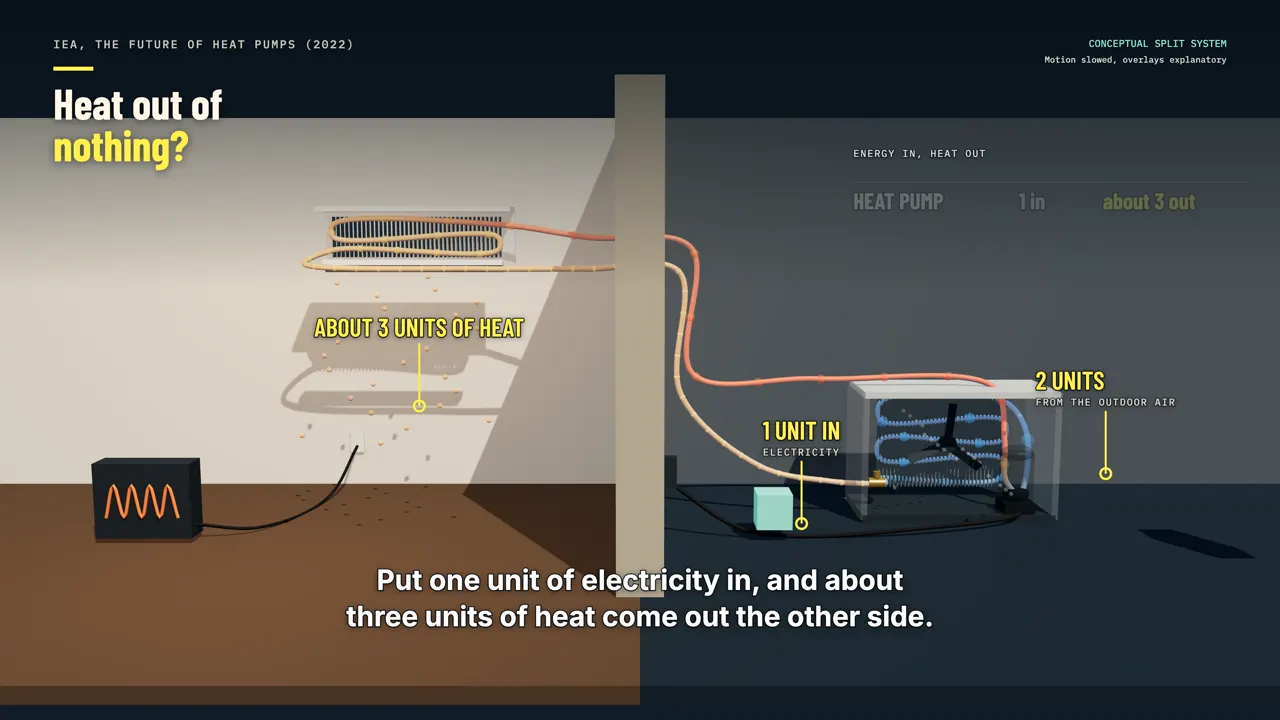
This box seems to make heat out of nothing. Put one unit of electricity in, and about three units of heat come out the other side. But nothing is created here, and the missing energy is sitting in plain sight, in the cold air outside the house. Follow one loop of fluid through four parts, and the extra heat stops being a mystery.
Heaters that make heat
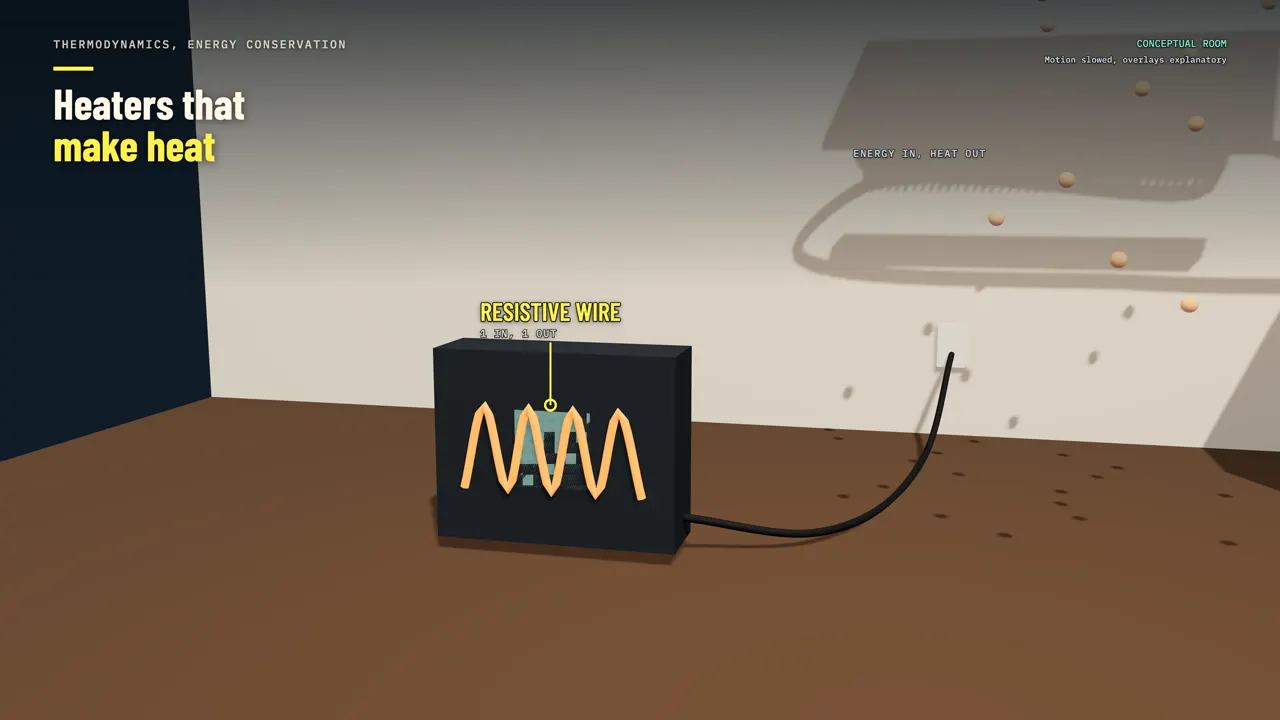
Start with the heater most people already understand. An electric space heater pushes current through a resistive wire, and the wire turns that electrical energy into heat. One unit in, one unit of heat out, and nothing more is possible from the wire alone. A gas boiler burns fuel instead, and the heat it delivers is never more than the energy stored in that fuel.
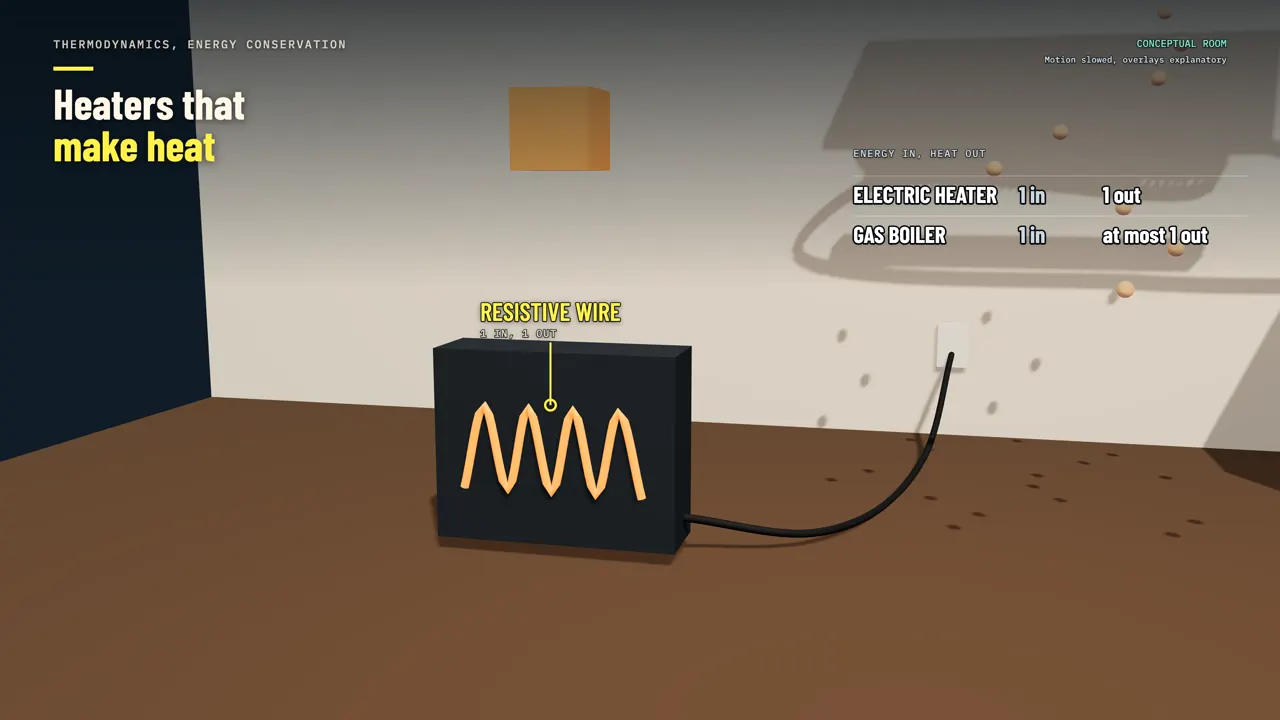
Both of these machines make heat. A heat pump mostly moves heat that already exists.
Cold air still holds heat
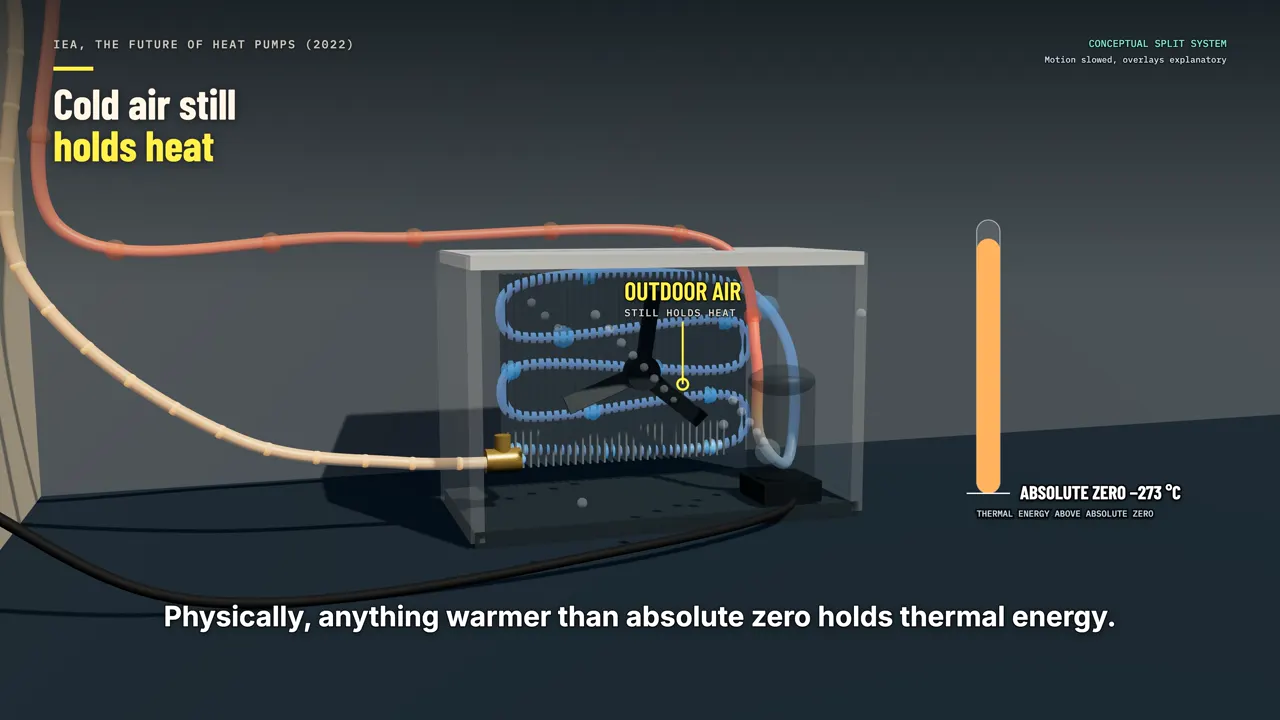
Physically, anything warmer than absolute zero holds thermal energy. Absolute zero is about minus two hundred seventy three degrees Celsius. So air at zero degrees, the air that feels freezing on your hands, is still far above that floor. The problem is that heat flows on its own only from warmer things to colder things.
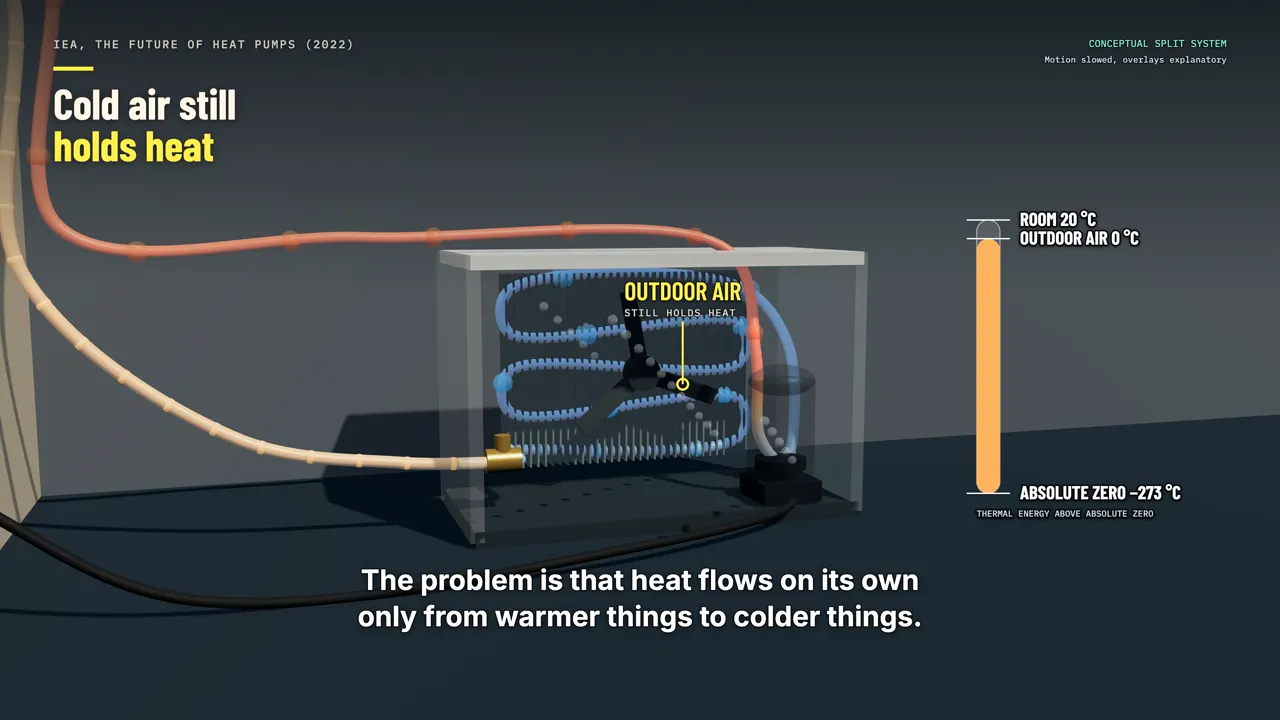
To bring heat from cold outdoor air into a warm room, something has to push it uphill. That push is the job the electricity actually pays for.
A liquid that boils below freezing
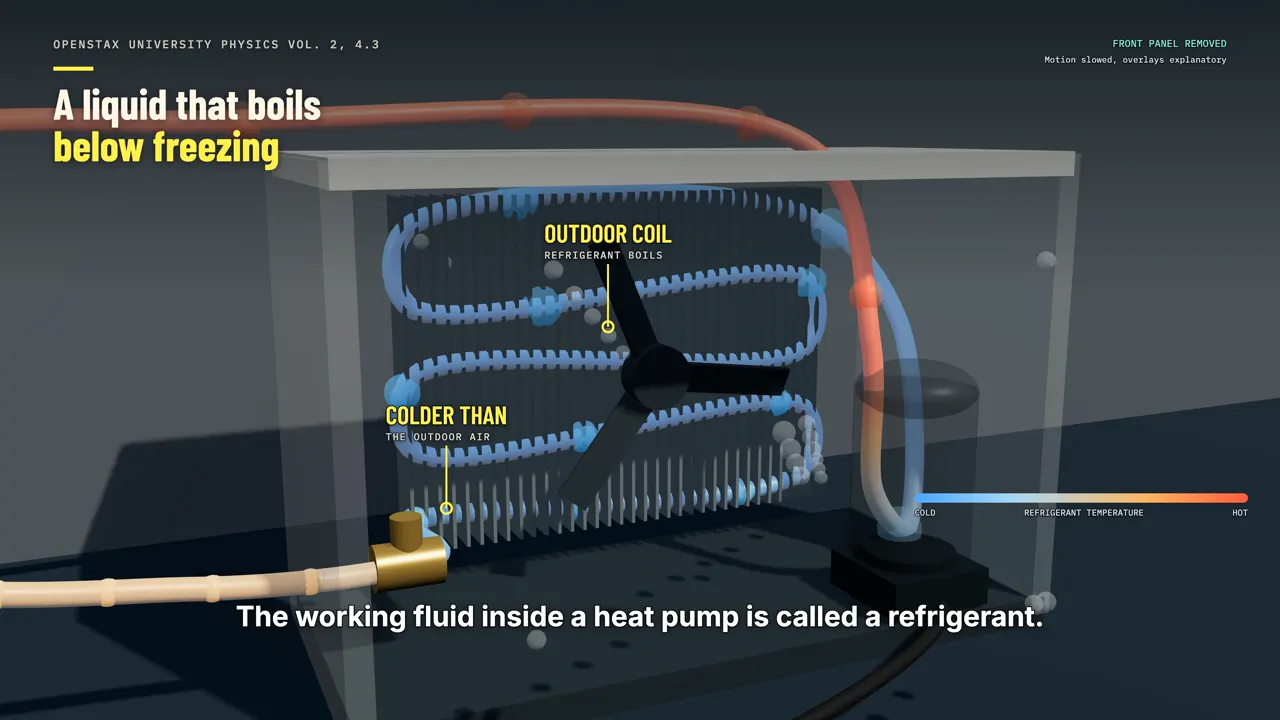
The working fluid inside a heat pump is called a refrigerant. It is chosen because it boils at temperatures below the freezing point of water. One common refrigerant, R-32, boils at about minus fifty two degrees Celsius at normal atmospheric pressure. Boiling soaks up heat, the same way boiling water keeps absorbing energy from a stove without getting any hotter.

So if the refrigerant in the outdoor coil is colder than the outdoor air, it boils and pulls heat out of that air. A fan blows outdoor air across the coil to keep that heat arriving.
The compressor
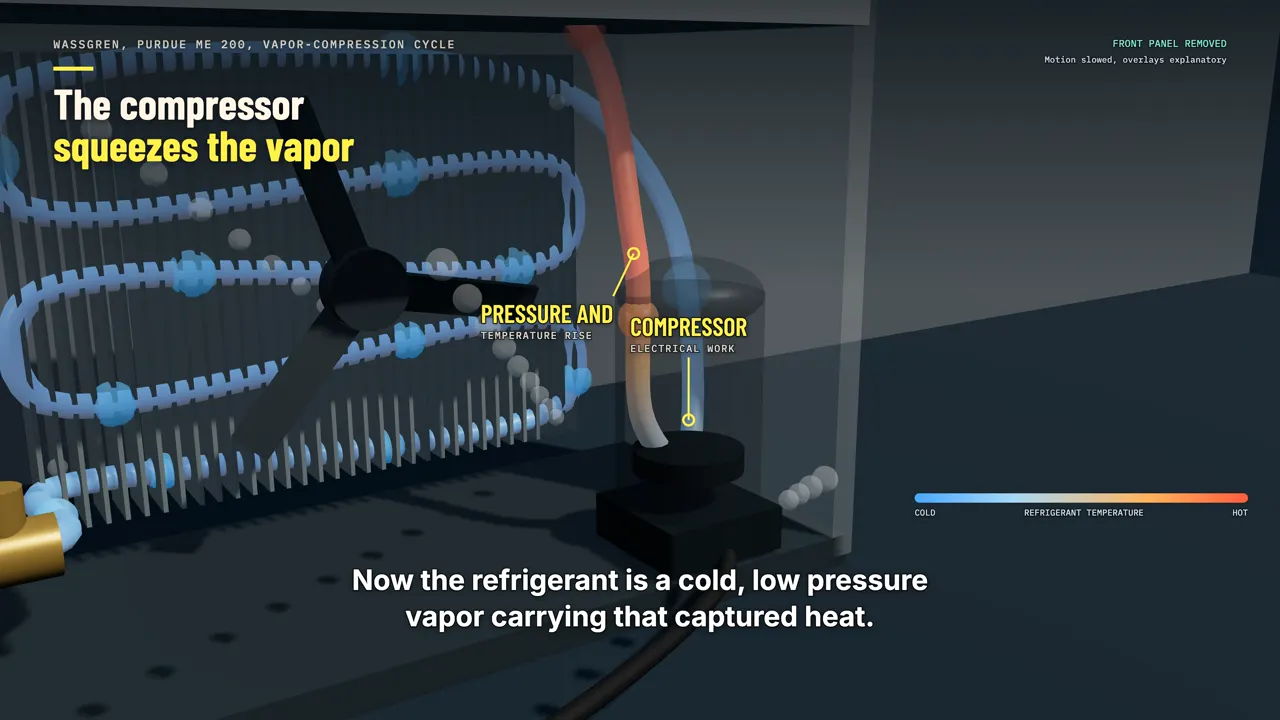
Now the refrigerant is a cold, low pressure vapor carrying that captured heat. The compressor is where the electricity goes to work. It squeezes the vapor into a smaller volume, and the work it does raises the vapor's pressure and temperature. The vapor leaving the compressor is now hotter than the room it is about to heat.
This is the uphill push, done with electrical work.
Heat flows out indoors
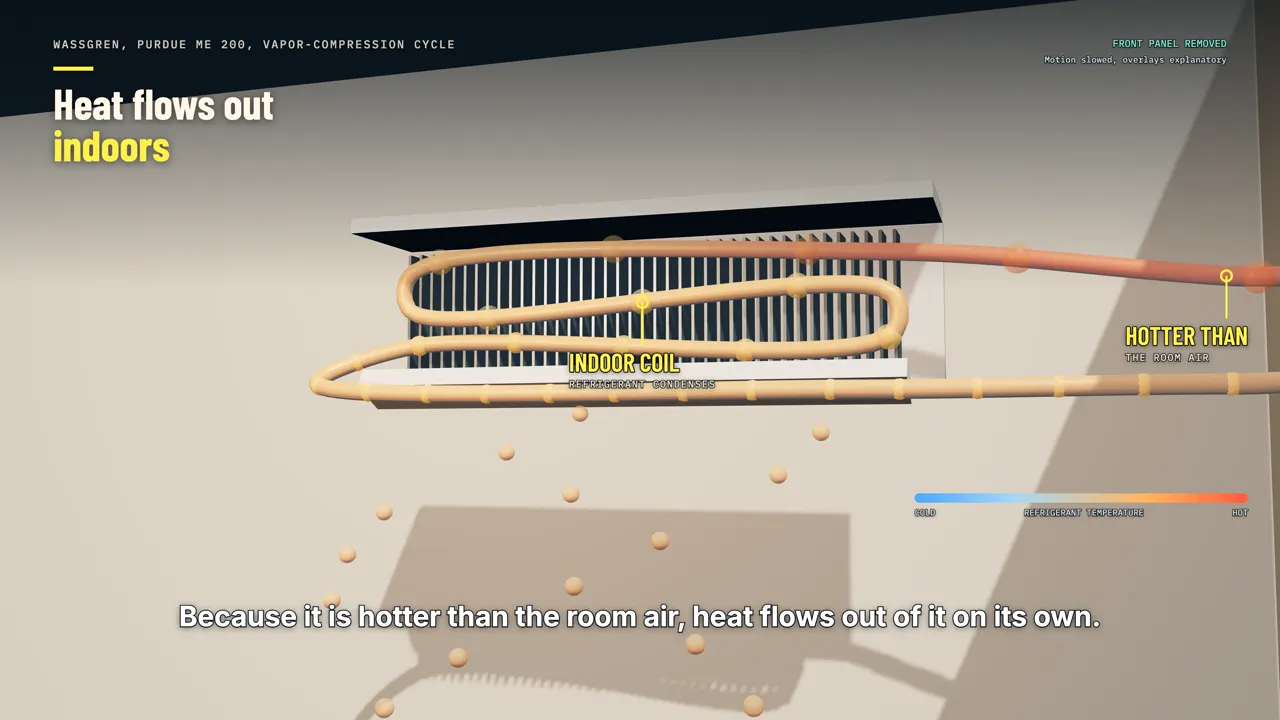
The hot vapor travels to the indoor coil. Because it is hotter than the room air, heat flows out of it on its own. As the refrigerant gives up that heat, it condenses back into a liquid. A fan or a water loop carries the heat into the rooms, through air vents, radiators, or the floor.
The expansion valve
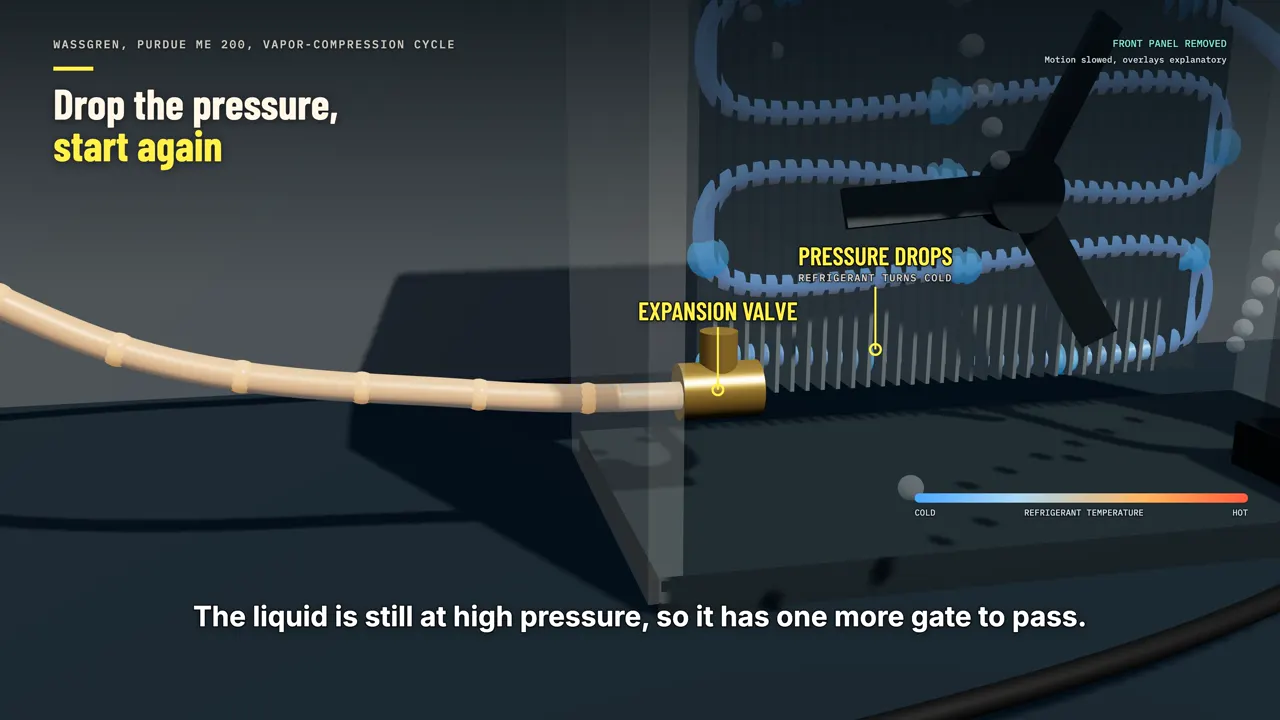
The liquid is still at high pressure, so it has one more gate to pass. An expansion valve lets it through a narrow opening into the low pressure side. The sudden drop in pressure makes the refrigerant much colder. Cold again, it flows back outside to the outdoor coil, colder than the air around it.
And the loop starts over, for as long as the system runs.
Where the three units come from
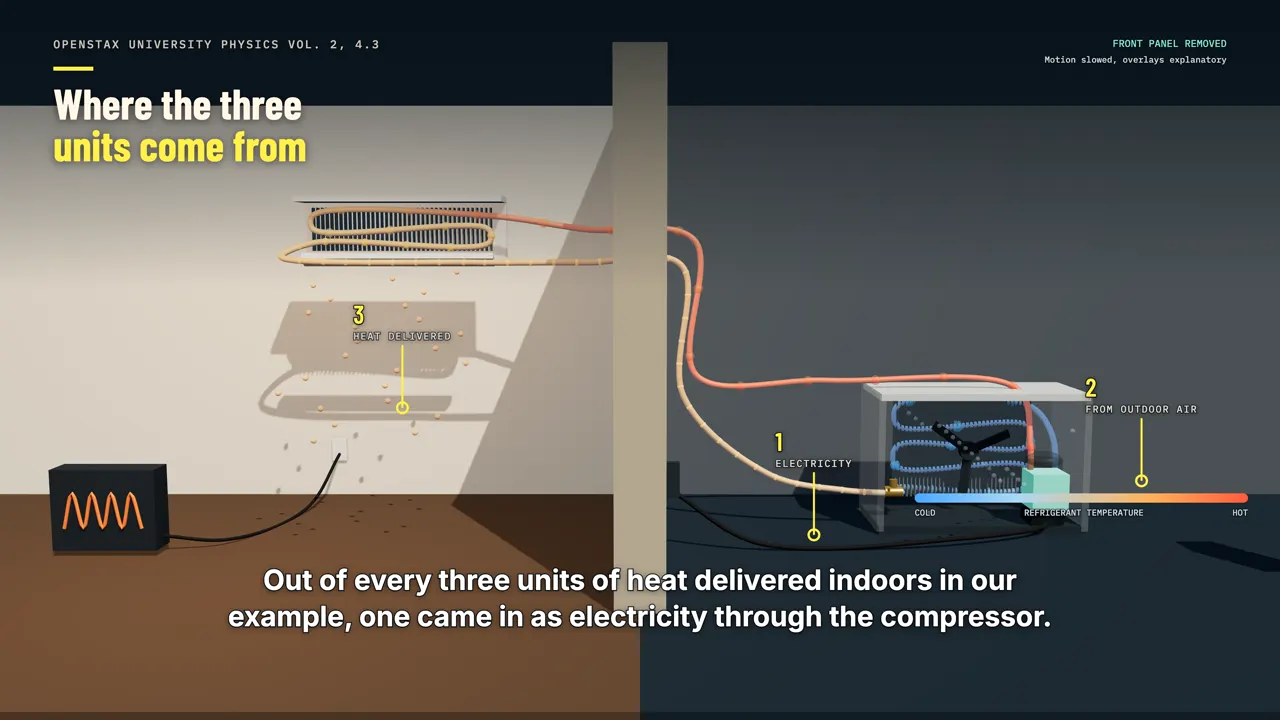
Now the energy books balance. Out of every three units of heat delivered indoors in our example, one came in as electricity through the compressor. The other two were collected from the outdoor air at the cold coil. Engineers call the ratio of heat delivered to electrical work the coefficient of performance, or COP.
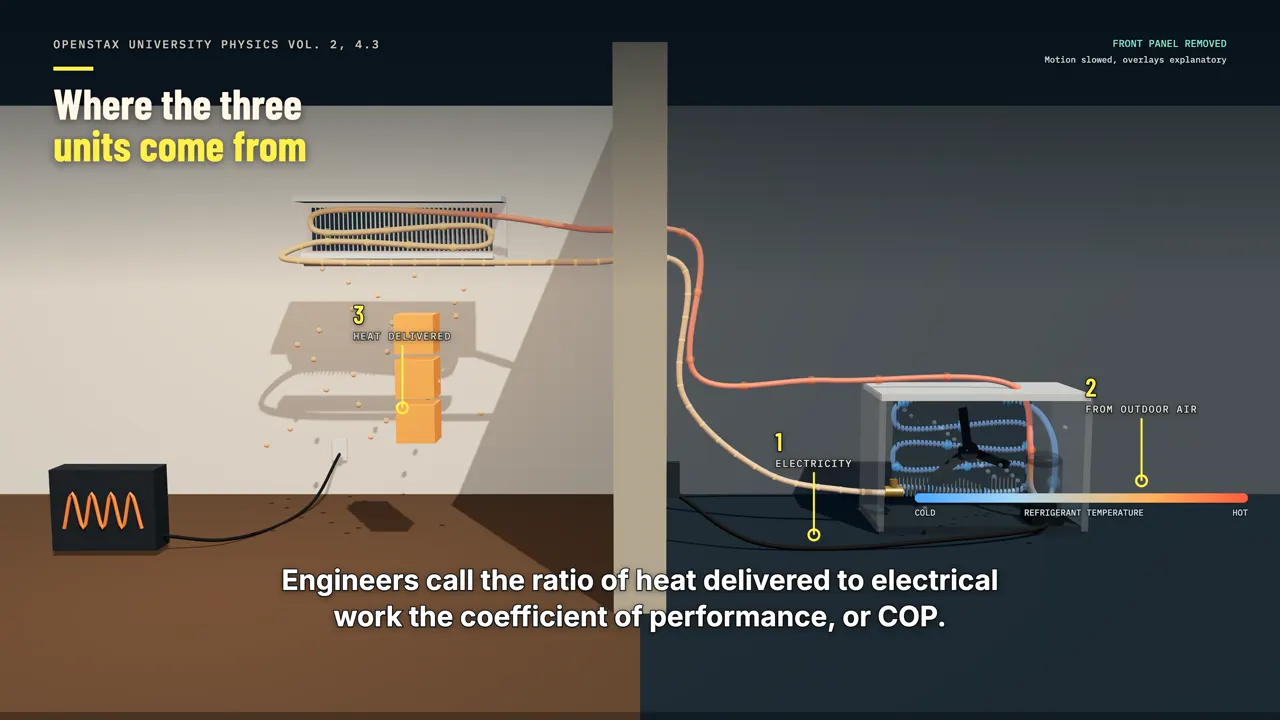
Our example has a COP of three. The International Energy Agency describes a typical household heat pump as having a COP of around four. No energy is created. The electricity buys transport, and transport is cheaper than creation.
Why the ratio has a ceiling
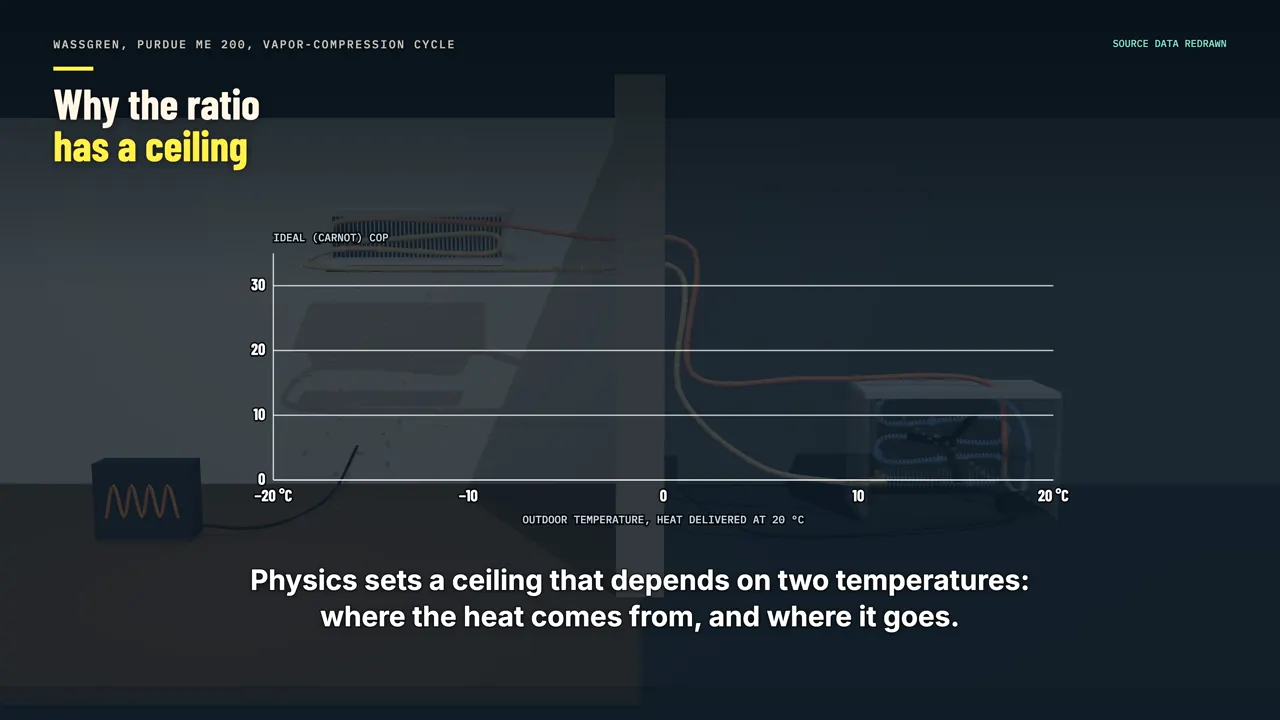
But the ratio cannot grow without limit. Physics sets a ceiling that depends on two temperatures: where the heat comes from, and where it goes. For a perfect, reversible heat pump, the ceiling is the hot side temperature divided by the temperature gap, with temperatures measured from absolute zero.
In a textbook case with zero degrees outside and twenty degrees inside, that ideal ceiling is about fourteen point seven. Warm the outside to ten degrees, and the ceiling roughly doubles, to about twenty nine. Real machines land far below it, because the coils need extra temperature difference to move heat quickly, and the compressor and fans lose energy. The useful lesson is the shape of the formula.
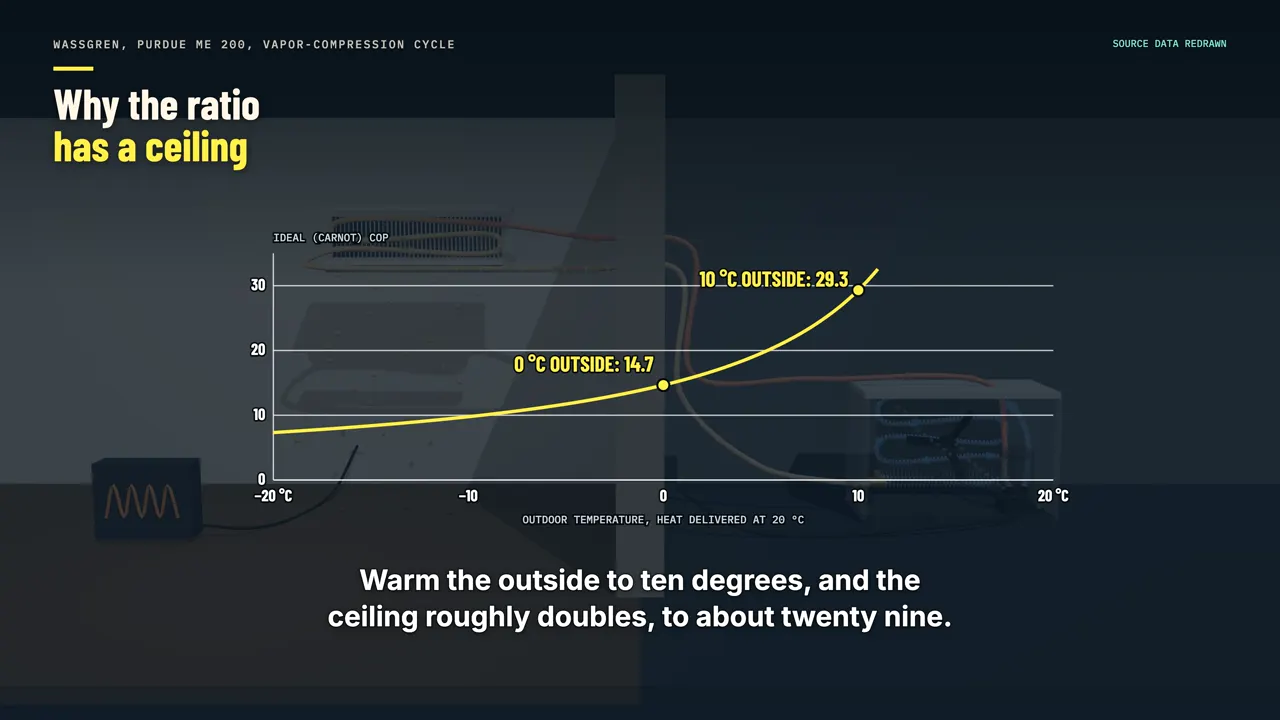
The wider the temperature gap the machine has to lift heat across, the lower its ceiling falls.
The coldest days
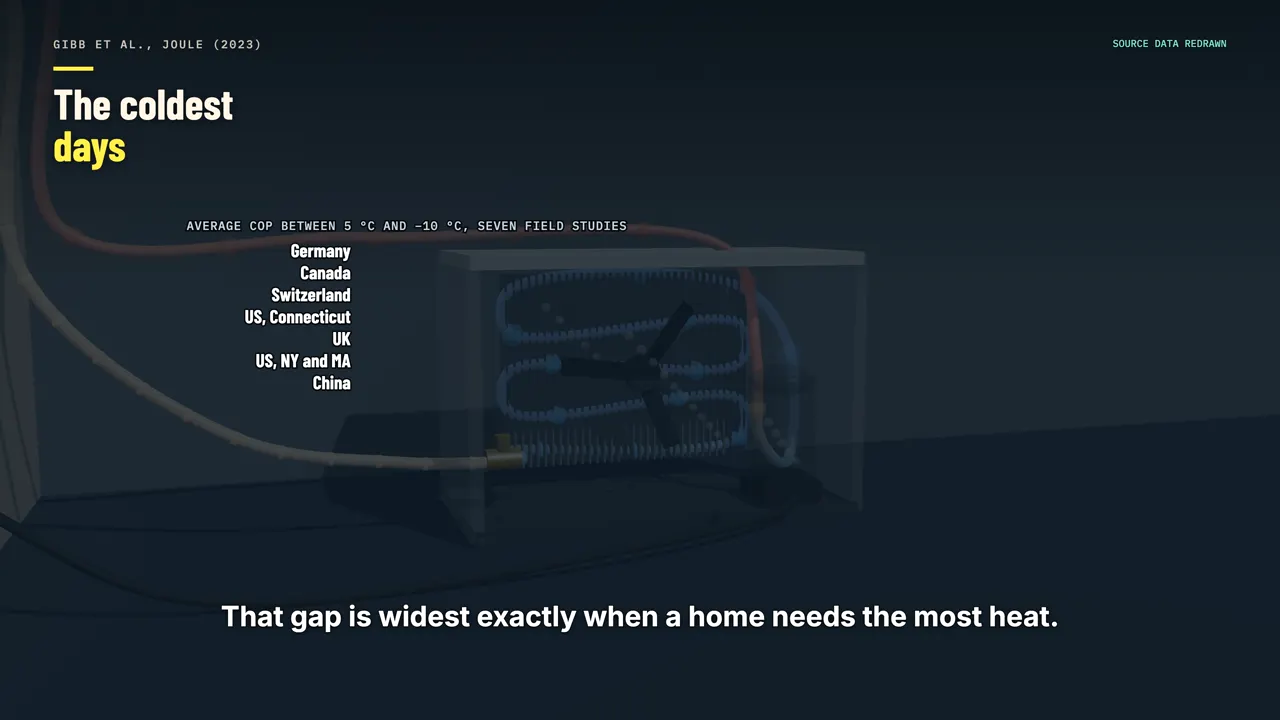
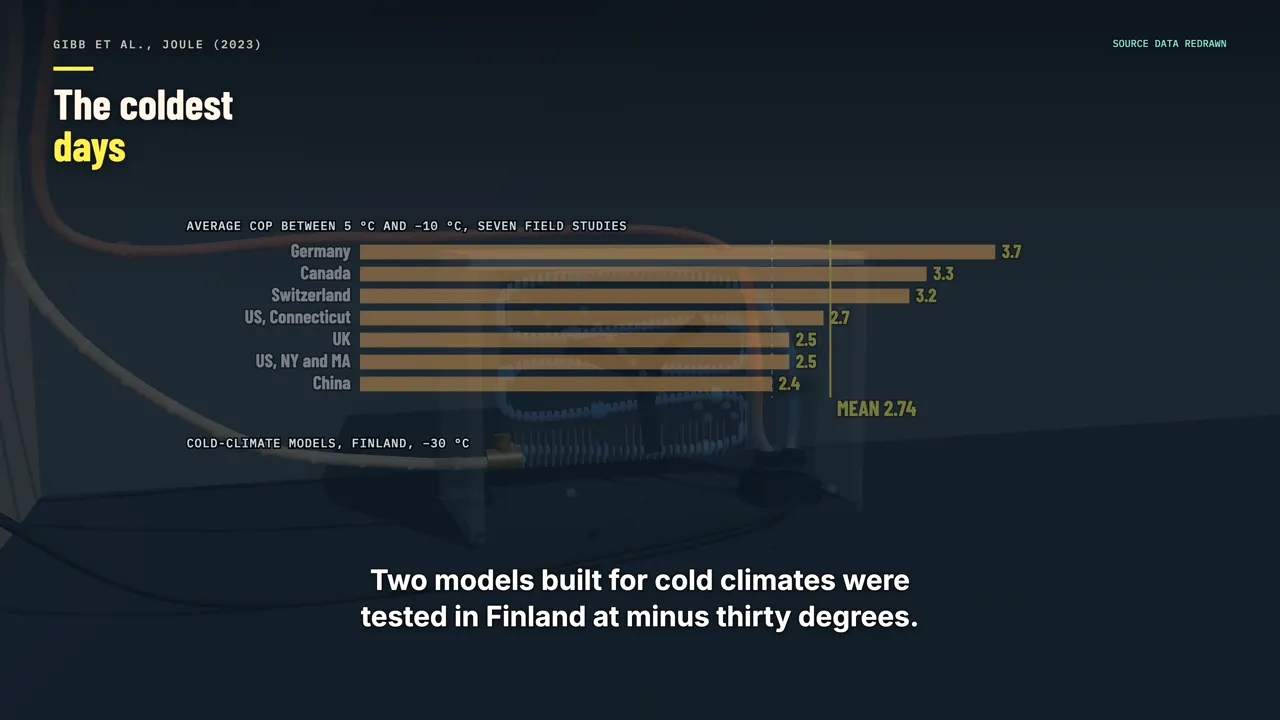
That gap is widest exactly when a home needs the most heat. As outdoor air gets colder, an air source heat pump has to lift heat further, and its COP drops. A 2023 commentary in the journal Joule pooled about two thousand seven hundred measurements from around five hundred fifty heat pumps, in seven field studies across Europe, North America and China.
Between five degrees and minus ten, the mean COP across those systems was two point seven four. Every study in that set averaged at least two point four in that range. Two models built for cold climates were tested in Finland at minus thirty degrees. One still delivered between one and a half and two units of heat per unit of electricity, the other between one and one and a half.
There is another winter cost. Around freezing, frost can build up on the outdoor coil, and the system spends extra energy melting it off. Many air source systems also carry a backup heater for the coldest hours, and an electric backup works like the simple wire from the start, one in, one out.
In the field studies that had backup heating, it typically switched on only when the outside dropped past about minus ten.
Cold countries already rely on them
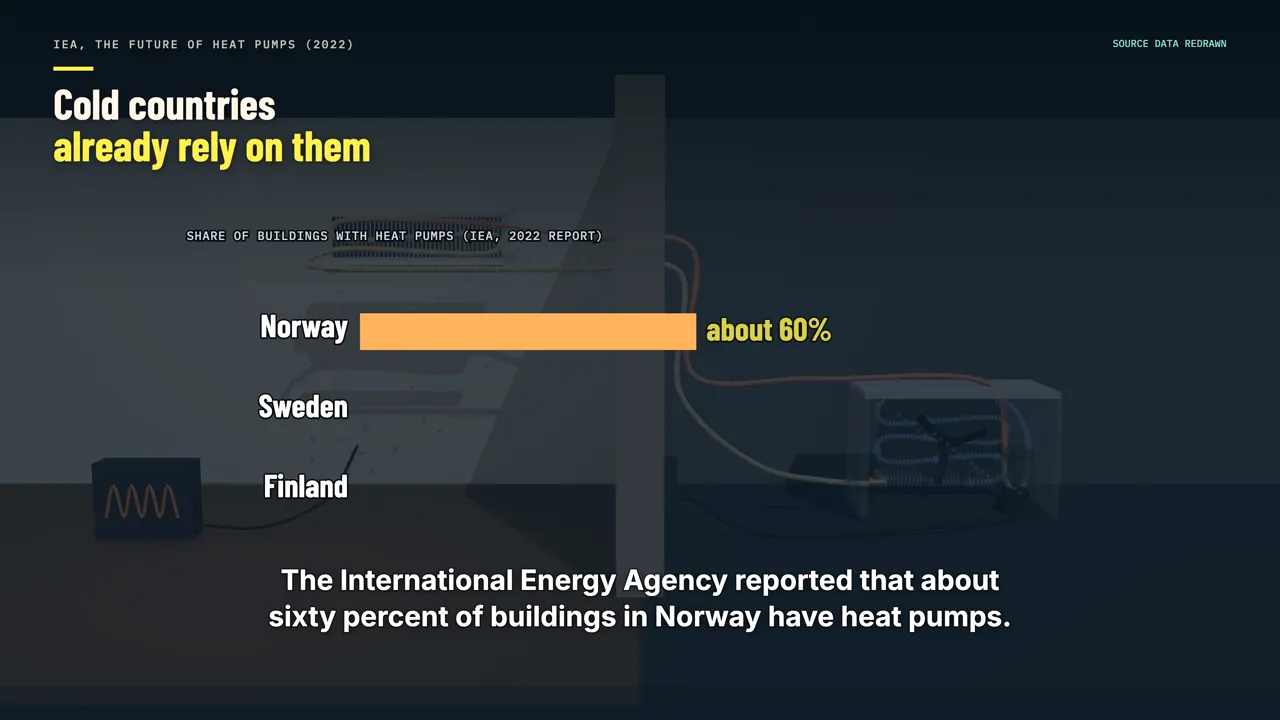
Cold climate alone has not stopped adoption. The International Energy Agency reported that about sixty percent of buildings in Norway have heat pumps. In Sweden and Finland, the share was over forty percent. Those are places where winter heating is not optional.
The temperature inside matters
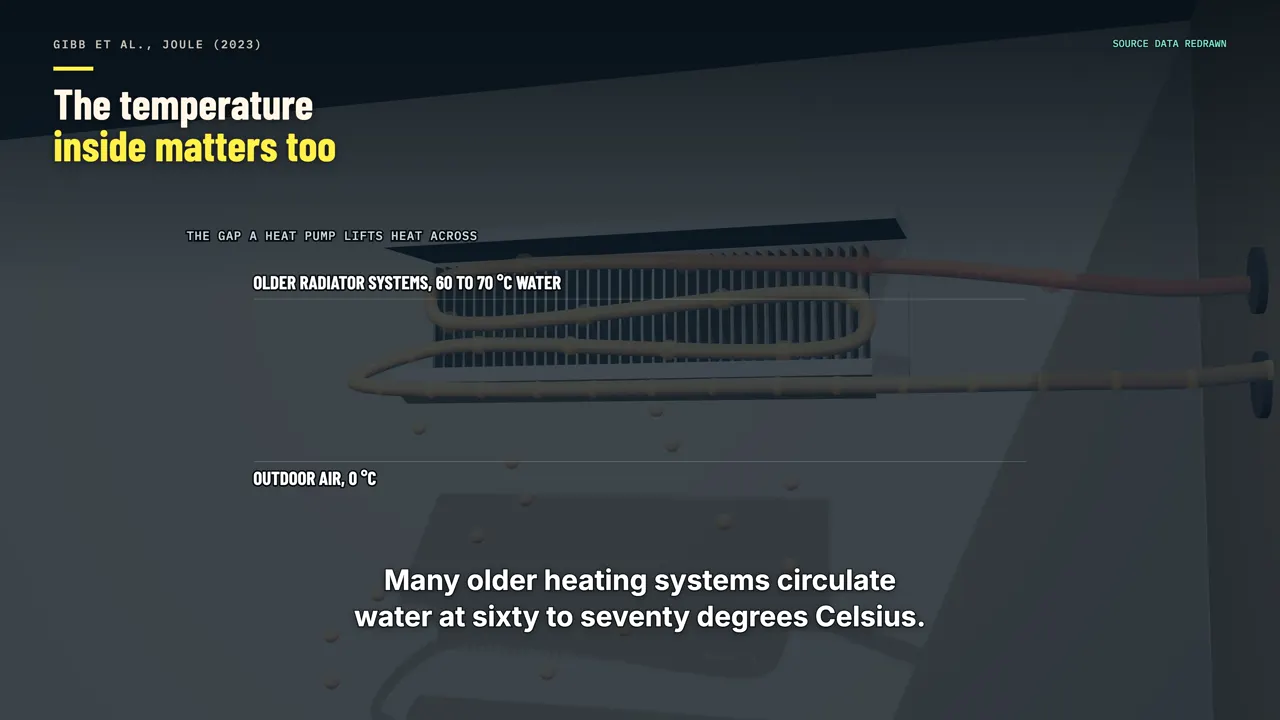
The other end of the gap is inside the house. Many older heating systems circulate water at sixty to seventy degrees Celsius. A heat pump delivering that hot water has to lift heat further, so its efficiency falls. That is why installers sometimes enlarge radiators, add underfloor heating, or improve insulation.
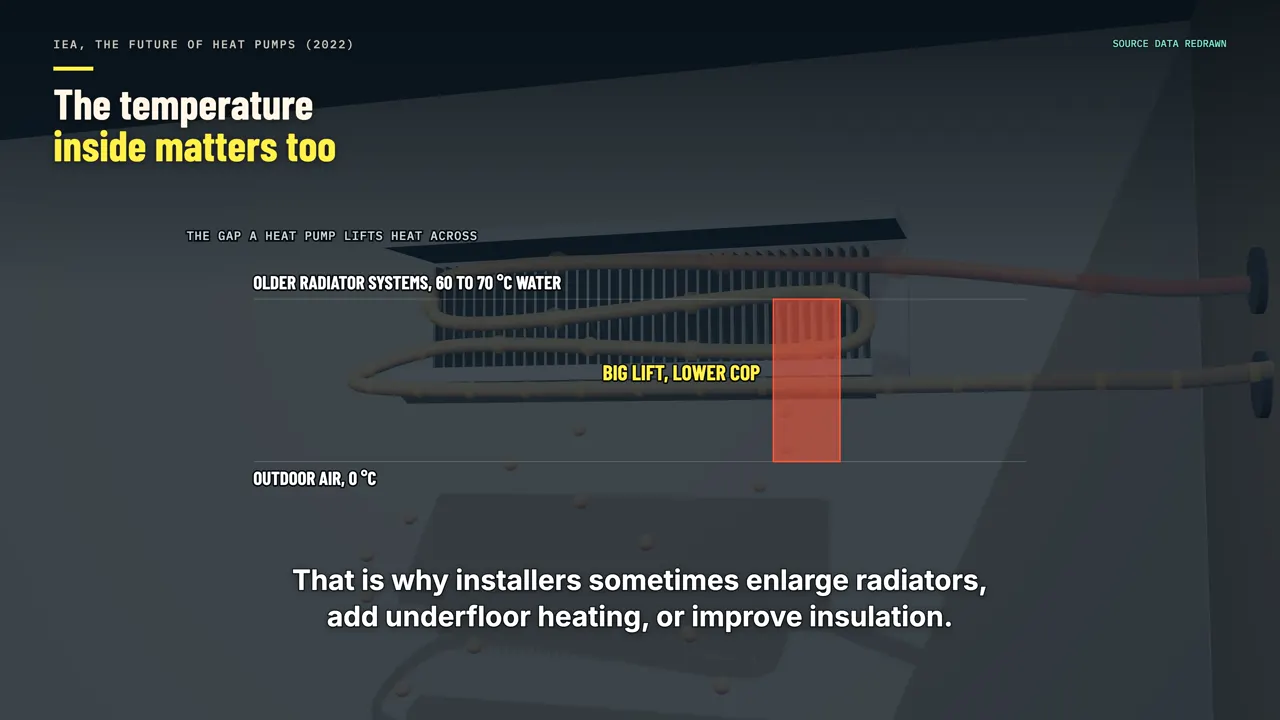
A well insulated home can be kept warm at a lower delivery temperature, which narrows the gap from the inside.
Efficiency is not the bill
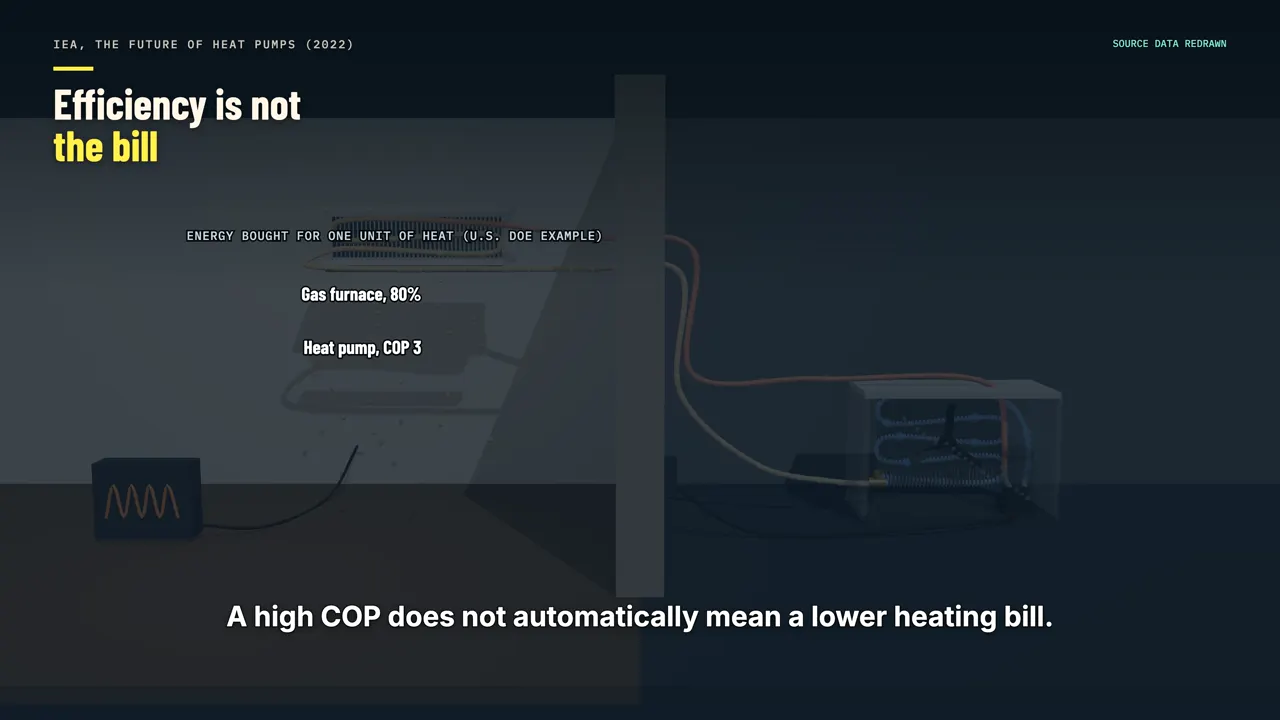
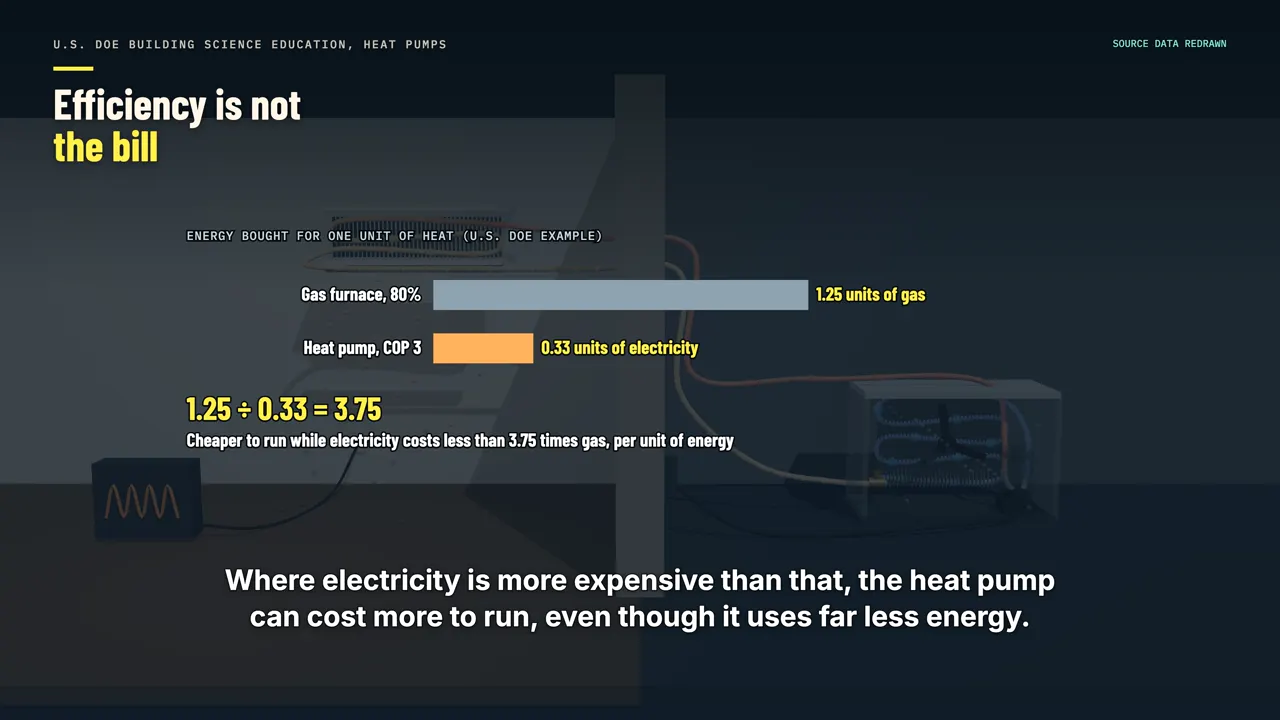
A high COP does not automatically mean a lower heating bill. The bill depends on how many units of heat the house needs, the COP over the whole season, and the price of electricity compared with the fuel it replaces. Here is one worked example from the U.S. Department of Energy.
A heat pump with a seasonal COP of three, replacing a gas furnace that turns eighty percent of its fuel into heat, is three point seven five times as efficient. So it is cheaper to run as long as a unit of electrical energy costs less than about three point seven five times the same unit of gas energy. Where electricity is more expensive than that, the heat pump can cost more to run, even though it uses far less energy.
Installation is the other barrier. The International Energy Agency found that even the cheapest air to water heat pumps cost two to four times as much as a gas boiler in most major heating markets, before subsidies. Refrigerant leaks also matter, because some refrigerants are powerful greenhouse gases.
Even so, the agency estimated that with today's refrigerants a heat pump cuts greenhouse gas emissions by at least twenty percent compared with a gas boiler, and by up to eighty percent where electricity is cleaner.
Two exceptions
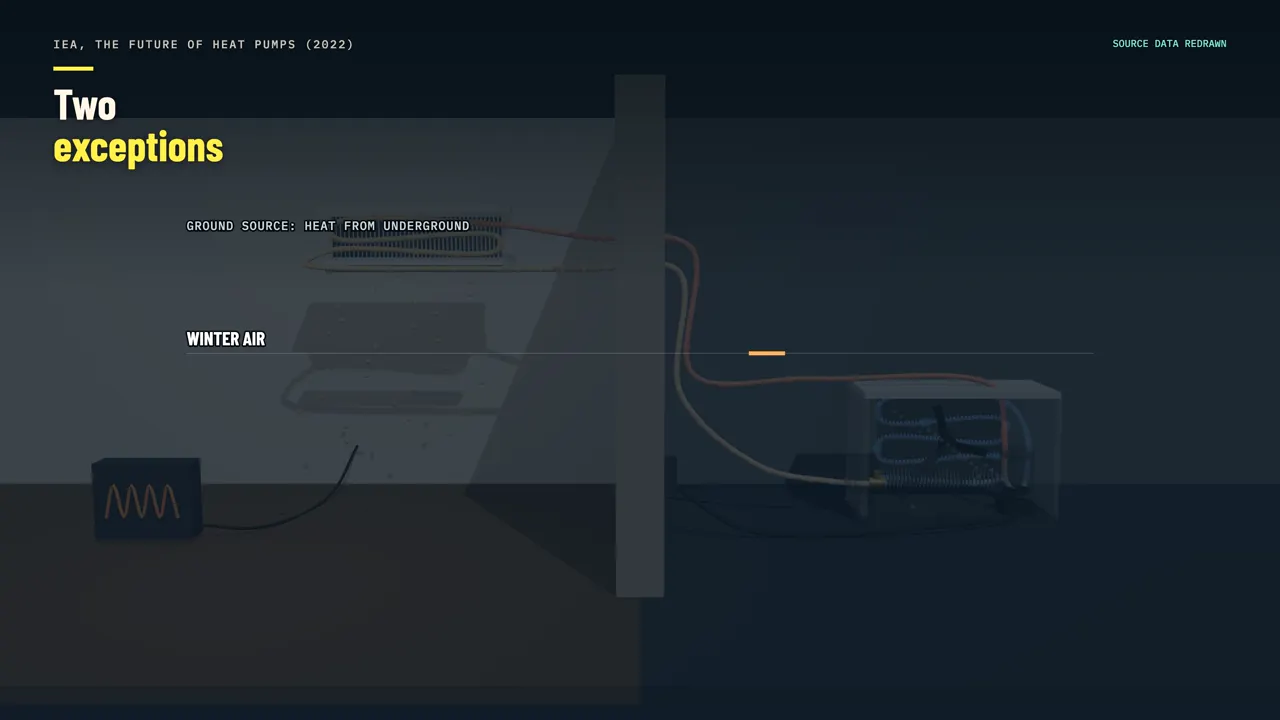
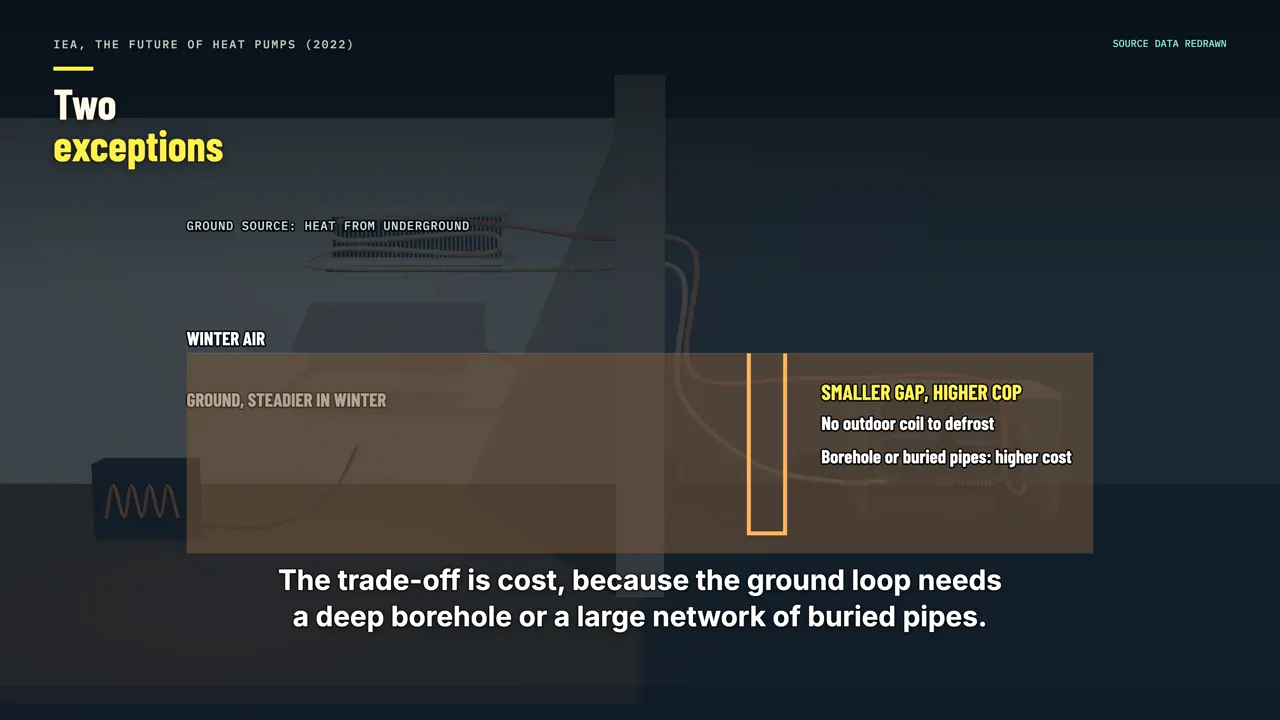
Not every heat pump pulls its heat from the outdoor air. Ground source and water source heat pumps draw on soil, groundwater, or a nearby river, which in winter typically stay warmer than the air. That smaller gap gives them a higher COP, and they never have to defrost an outdoor coil. The trade-off is cost, because the ground loop needs a deep borehole or a large network of buried pipes.
The same machine can also run backwards. A reversing valve swaps the roles of the two coils, so in summer the indoor coil collects heat and the outdoor coil gives it away, like an air conditioner.
Four conditions to check
So the box does not break the laws of physics. It spends one unit of electricity to carry heat across a temperature gap. How much heat that one unit carries depends on four things you can check. How cold it gets outside where you live.
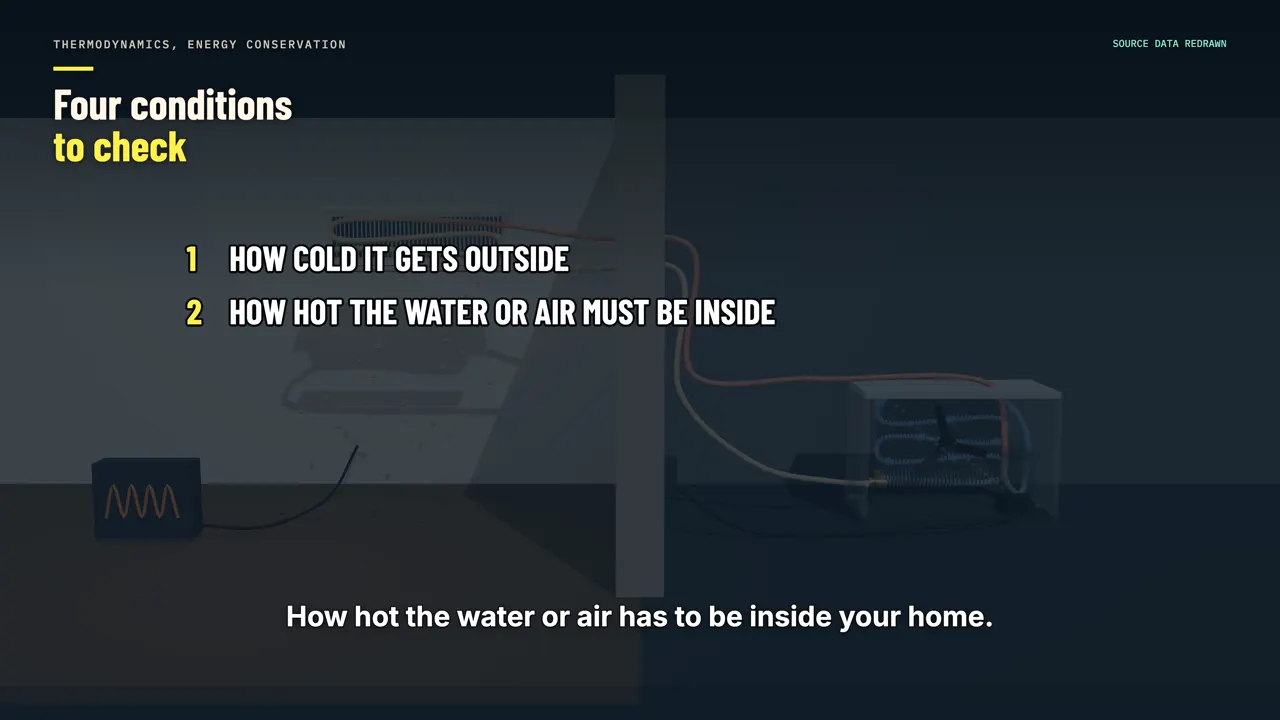
How hot the water or air has to be inside your home. How well the building holds its heat. And how much electricity costs compared with the fuel it replaces. Narrow the gap, and each unit of electricity moves more heat indoors.
Watch on YouTube
Sources
- S1: IEA, The Future of Heat Pumps (2022) https://www.iea.org/reports/the-future-of-heat-pumps
- S2: Gibb, Rosenow, Lowes and Hewitt, "Coming in from the cold: Heat pump efficiency at low temperatures", Joule 7 (2023) https://doi.org/10.1016/j.joule.2023.08.005
- S3: Wassgren, Purdue ME 200, vapor-compression refrigeration and heat pump cycles https://engineering.purdue.edu/~wassgren/teaching/ME20000/NotesAndReading/Lec35_Reading_Wassgren.pdf
- S4: OpenStax University Physics Volume 2, 4.3 Refrigerators and Heat Pumps, and 4.5 The Carnot Cycle https://openstax.org/books/university-physics-volume-2/pages/4-3-refrigerators-and-heat-pumps
- S5: NIST Chemistry WebBook, difluoromethane (R-32) https://webbook.nist.gov/cgi/cbook.cgi?ID=C75105&Mask=4
- S6: U.S. DOE Building Science Education Solution Center, Introduction to Heat Pumps https://bsesc.energy.gov/