The First Nuclear Clocks Just Started Ticking
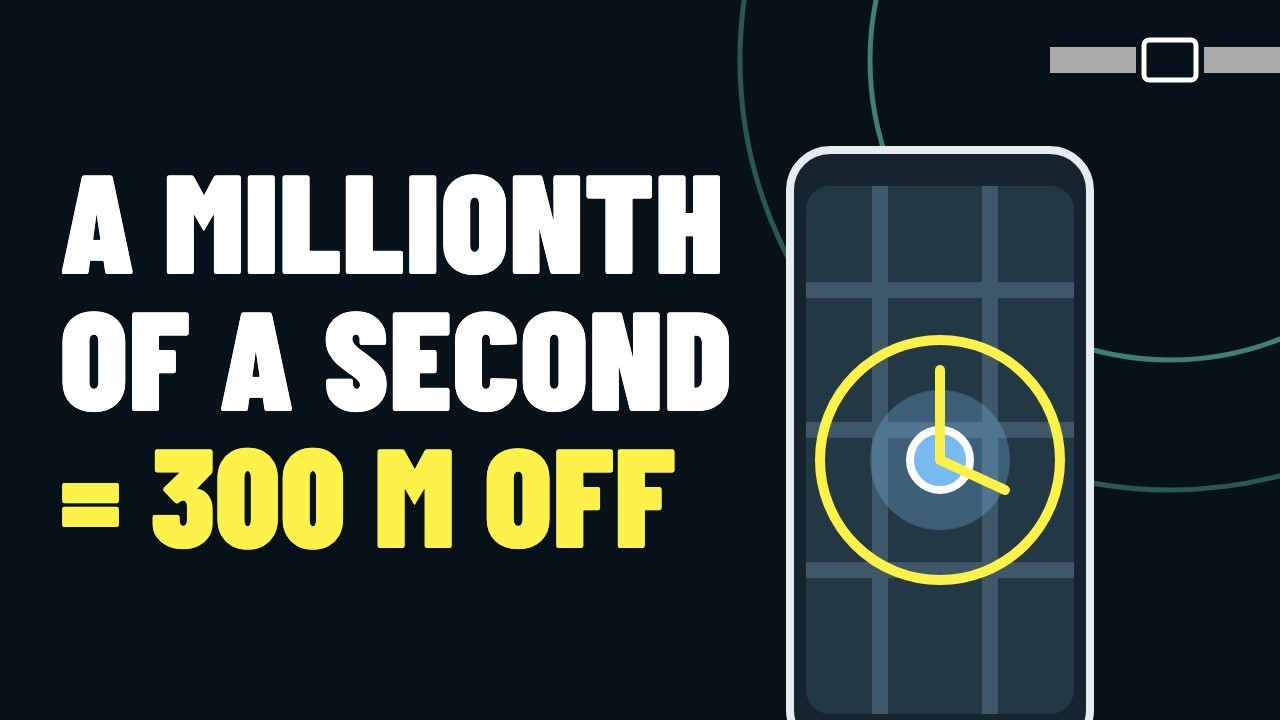
On October 7, 2026, two teams reported in Nature the first working nuclear clocks: clocks that keep time with the nucleus of a thorium-229 atom instead of its electrons. Why does that matter for the blue dot on your phone's map, and why are these clocks still behind the best atomic clocks?
This article is the full narration of the video. Watch on YouTube
Your map is a clock
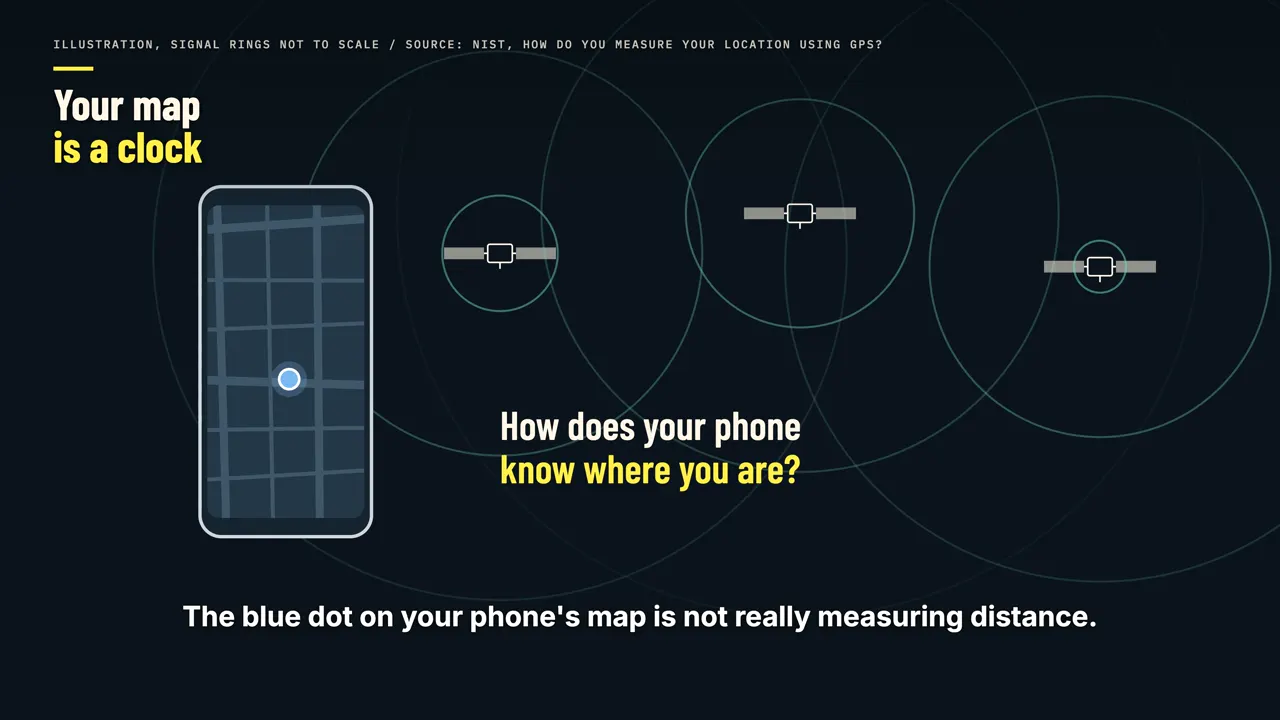
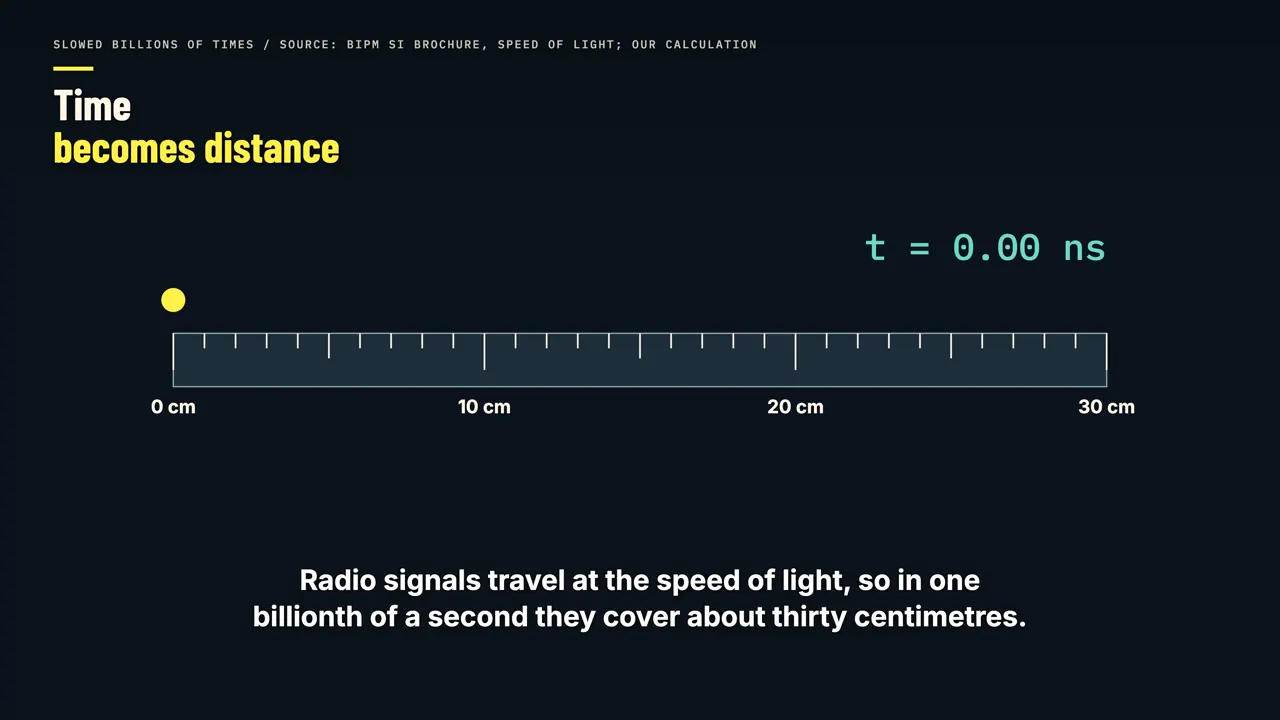
The blue dot on your phone's map is not really measuring distance. It is measuring time. Each GPS satellite carries several atomic clocks, and your phone works out how long each satellite's signal took to arrive. Radio signals travel at the speed of light, so in one billionth of a second they cover about thirty centimetres.
Get the time wrong by a millionth of a second, and your position is off by about three hundred metres.
Two nuclear clocks, one week
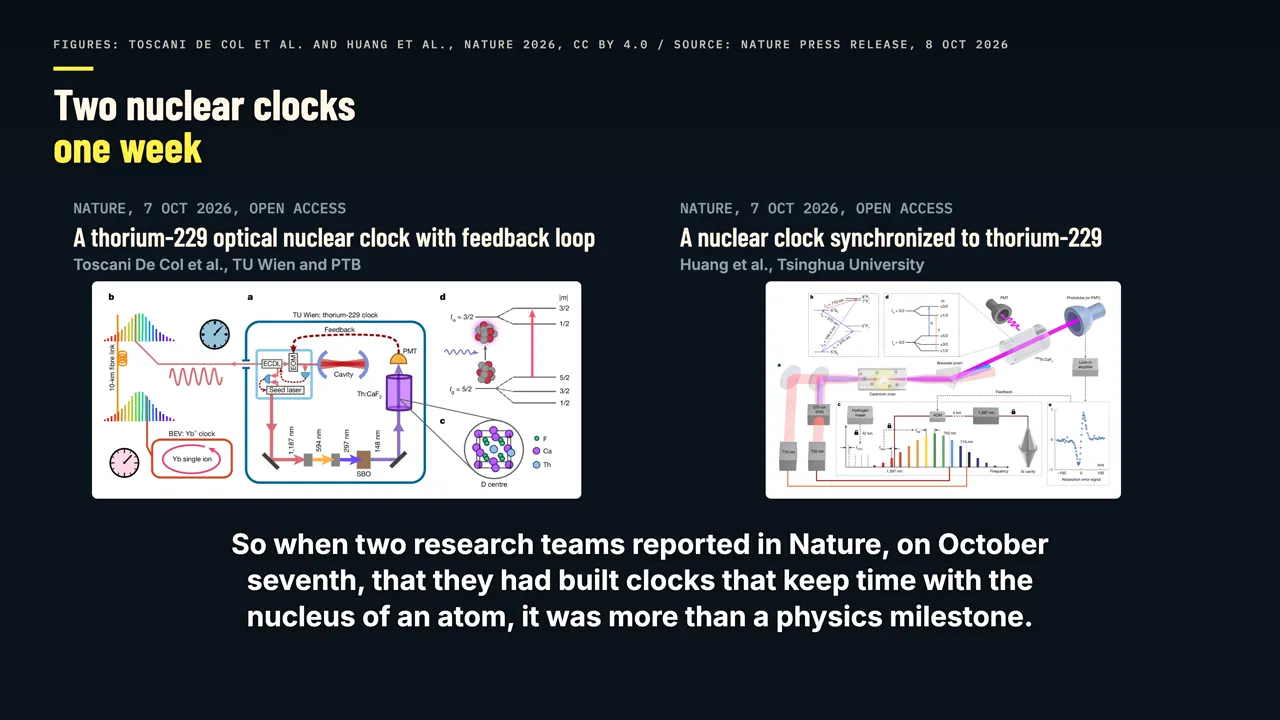
So when two research teams reported in Nature, on October seventh, that they had built clocks that keep time with the nucleus of an atom, it was more than a physics milestone. It was a new kind of clock, and both teams say it might one day beat the clocks we rely on today. But the first versions are still behind the best atomic clocks, and the reasons why matter as much as the result.
Repeat and count
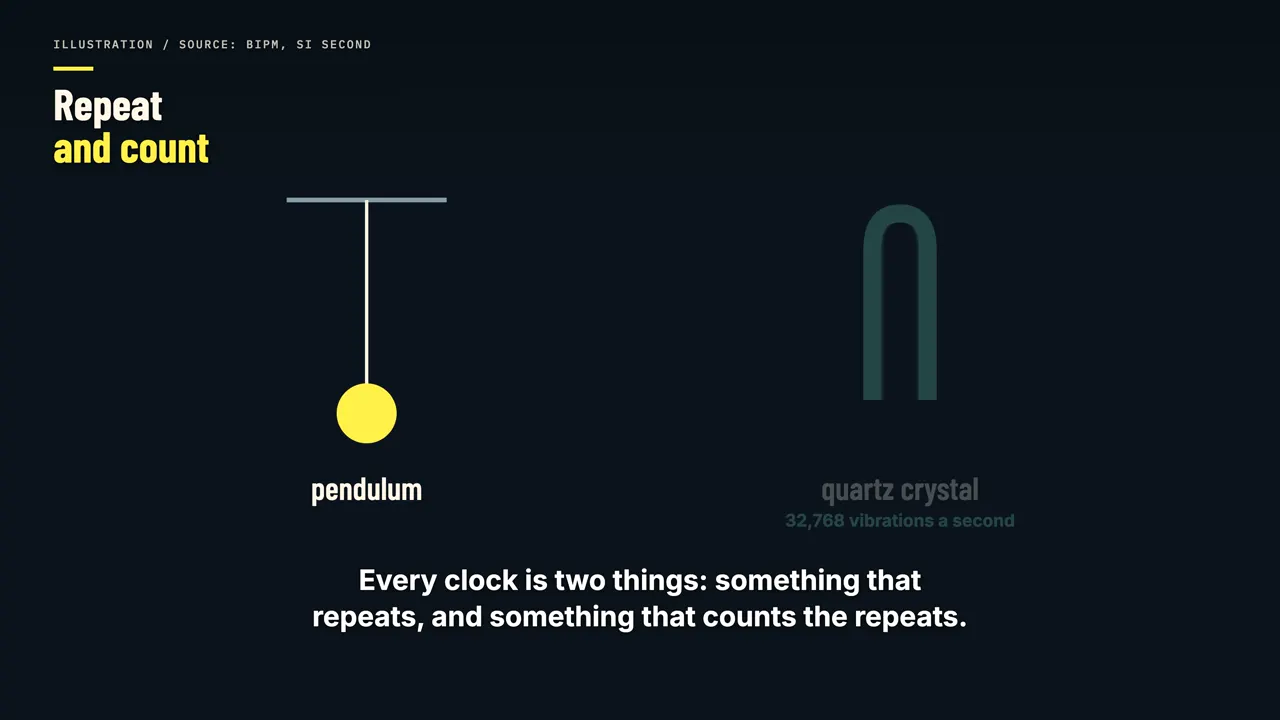
Every clock is two things: something that repeats, and something that counts the repeats. A pendulum swings back and forth, and the quartz crystal in a watch vibrates thirty-two thousand, seven hundred sixty-eight times a second. The faster and steadier the repeat, the finer the clock can slice time.
The atomic second
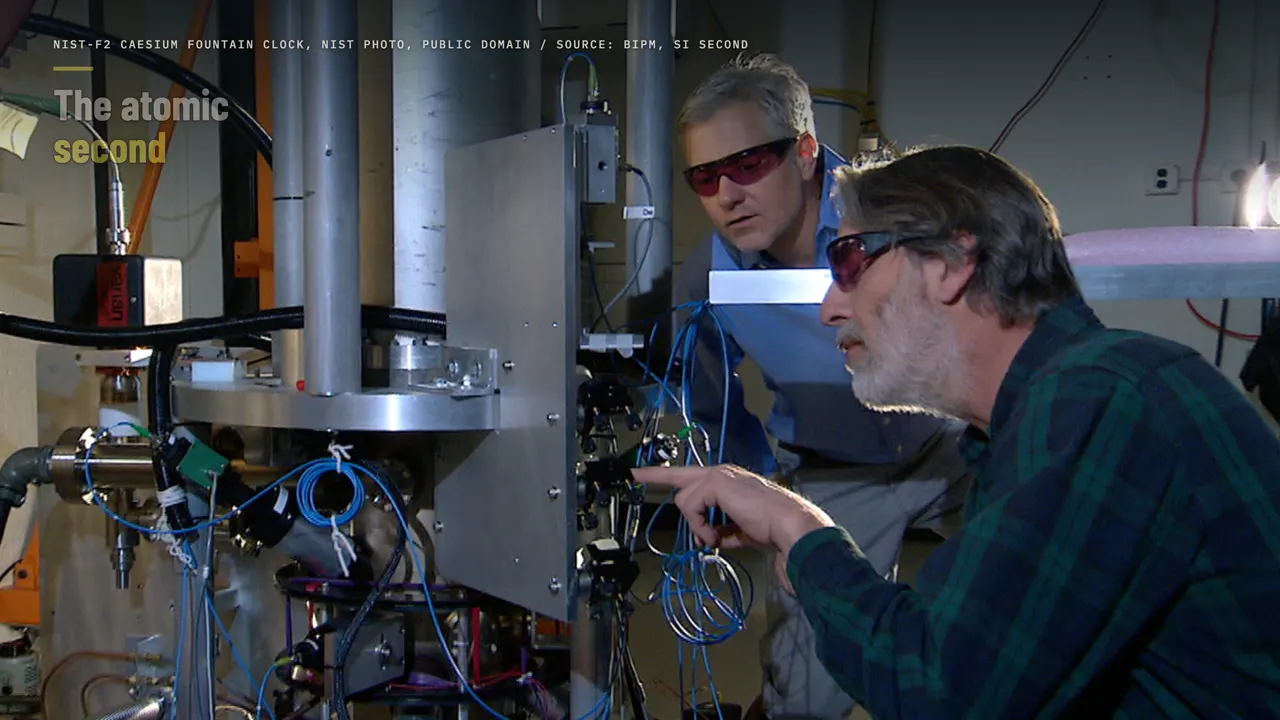
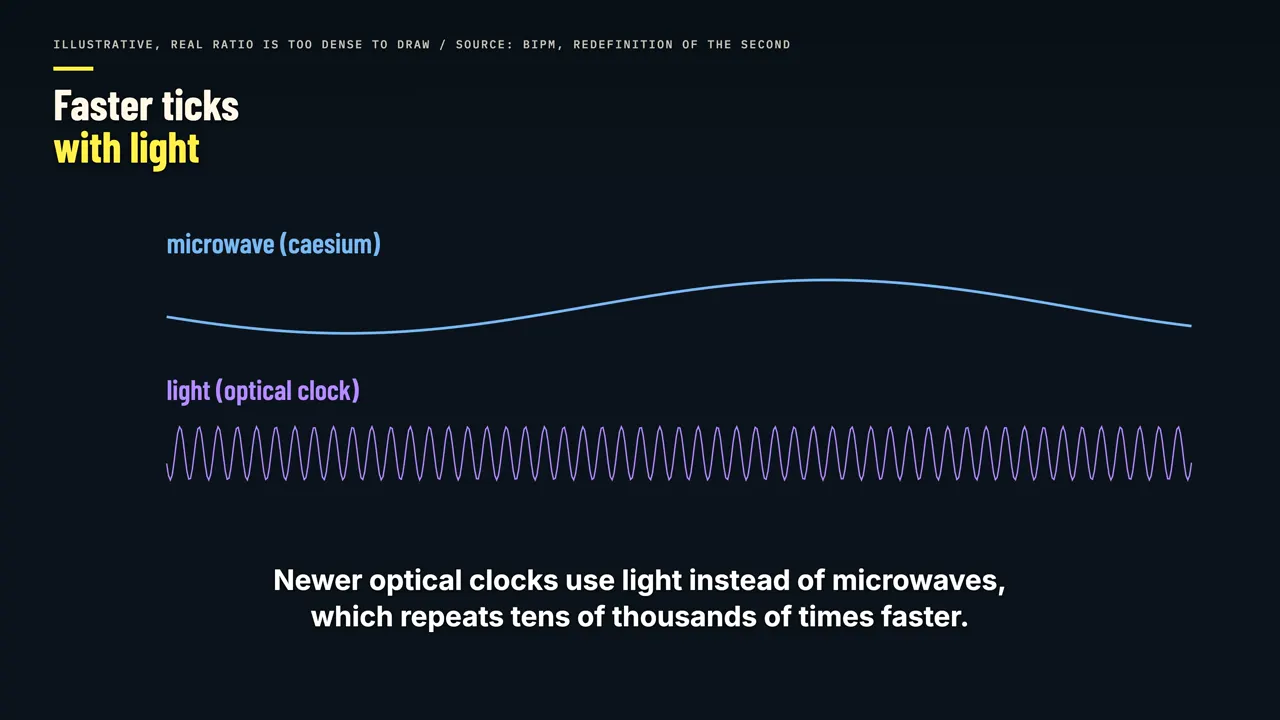
Today, the official second is set by an atom. It is nine billion, one hundred ninety-two million, six hundred thirty-one thousand, seven hundred seventy oscillations of a microwave signal that a caesium atom responds to. Fountain clocks like this one at NIST toss a cloud of laser-cooled caesium atoms upward and check that the microwave frequency still matches the atoms. Newer optical clocks use light instead of microwaves, which repeats tens of thousands of times faster.
In twenty twenty-four, a strontium clock at JILA reported a systematic uncertainty below one part in a billion billion. Because optical clocks have pulled ahead of caesium, the international body that defines the second is preparing to redefine it, with a decision targeted for twenty thirty.
The weak spot: electrons
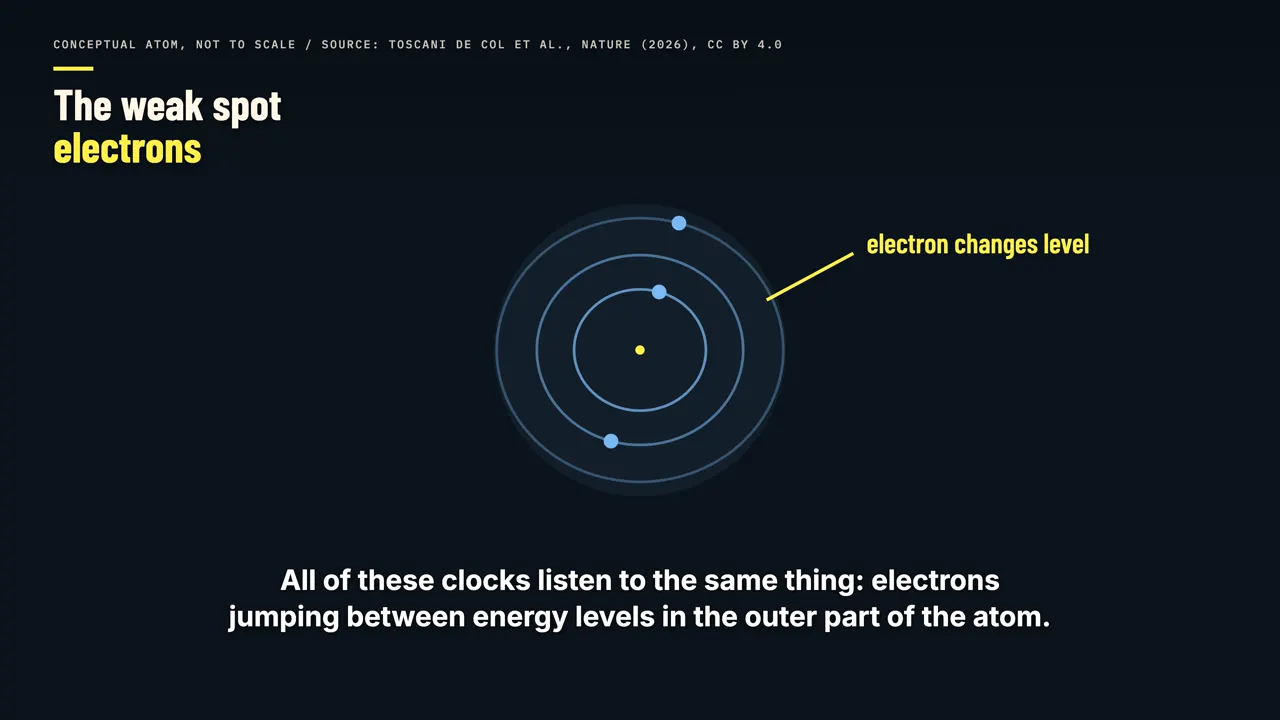
All of these clocks listen to the same thing: electrons jumping between energy levels in the outer part of the atom. Electrons sit on the outside, so stray electric fields, magnetic fields, and heat can nudge their rhythm. That is why the best atomic clocks hold a few atoms in a vacuum, cool them with lasers, and shield them carefully. The nucleus is a different place.
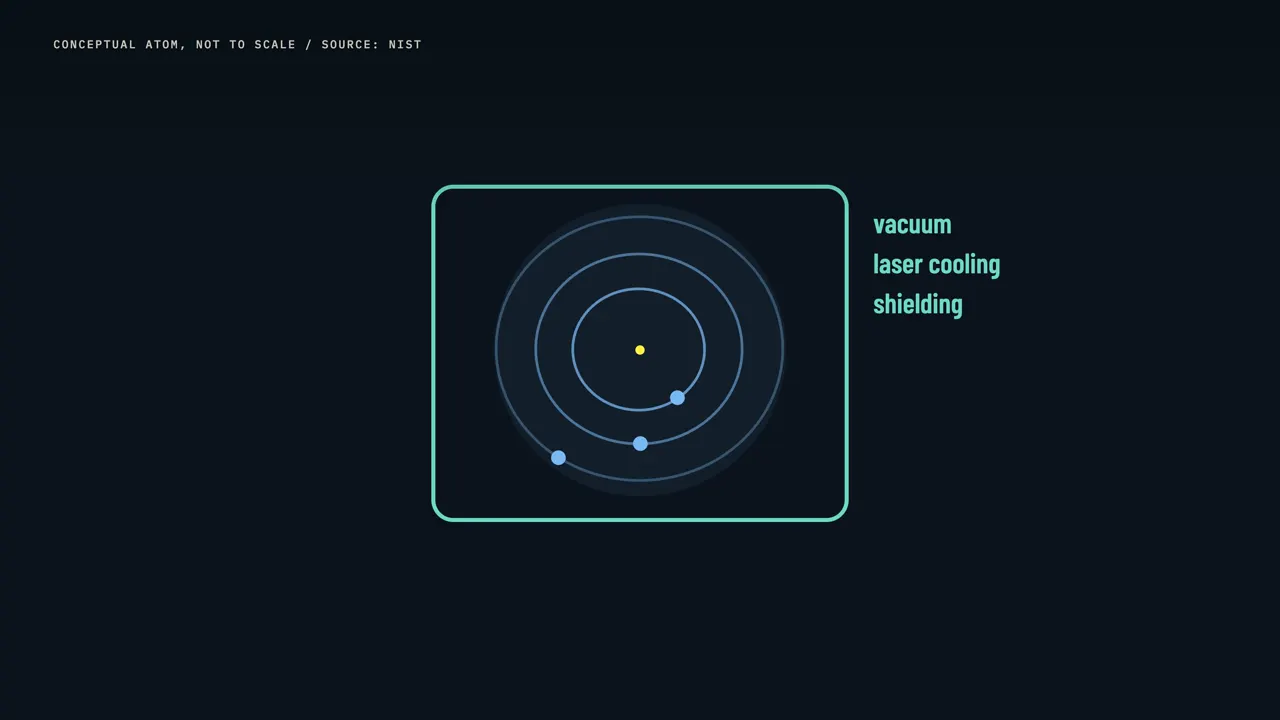
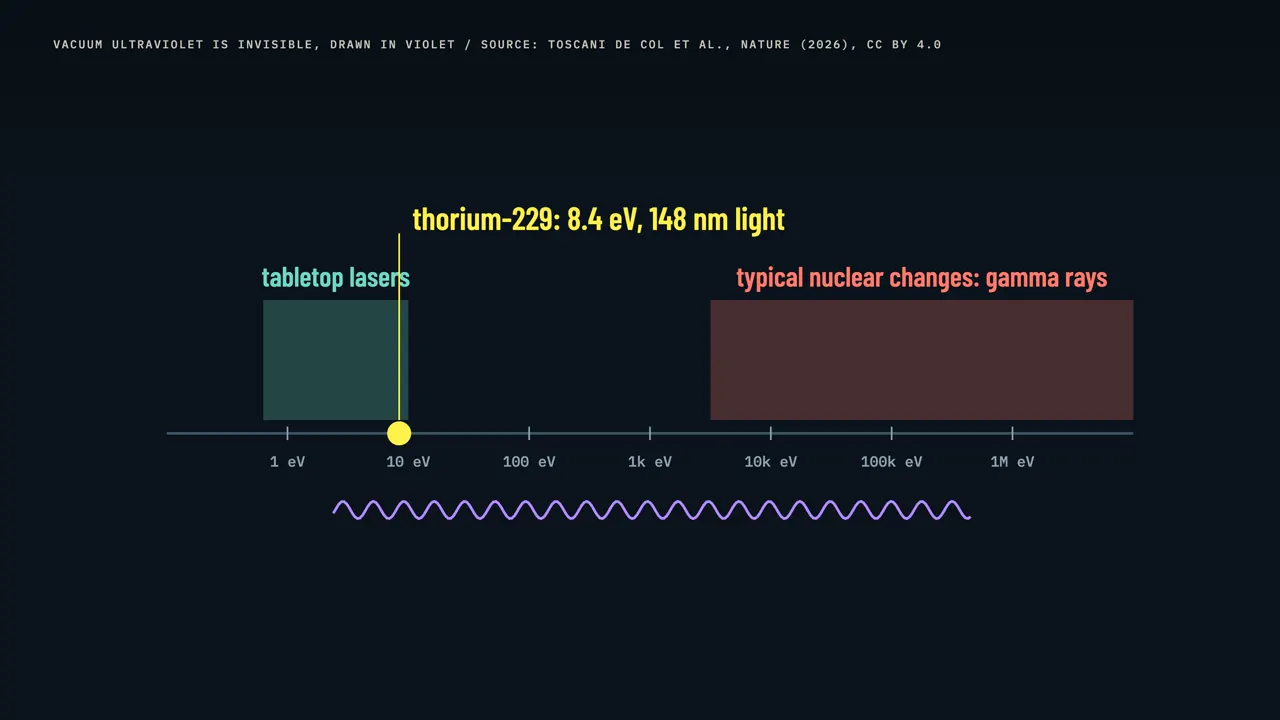
It is tens of thousands of times smaller than the atom around it, and it is much less sensitive to the fields that disturb electrons. The problem is that nuclei usually change energy only with high-energy gamma rays, far beyond anything a tabletop laser can produce.
Thorium-229
Thorium is the exception. One rare isotope, thorium two twenty-nine, has an excited state only about eight point four electronvolts above its ground state. That gap matches vacuum ultraviolet light at a wavelength of about one hundred forty-eight nanometres, which a laser can reach. Physicists proposed a nuclear clock based on this transition in two thousand three.
Proving the excited state existed took until twenty sixteen, and measuring its energy with light took until twenty twenty-two. The first laser excitation in a crystal came in twenty twenty-four.
A clock in a crystal
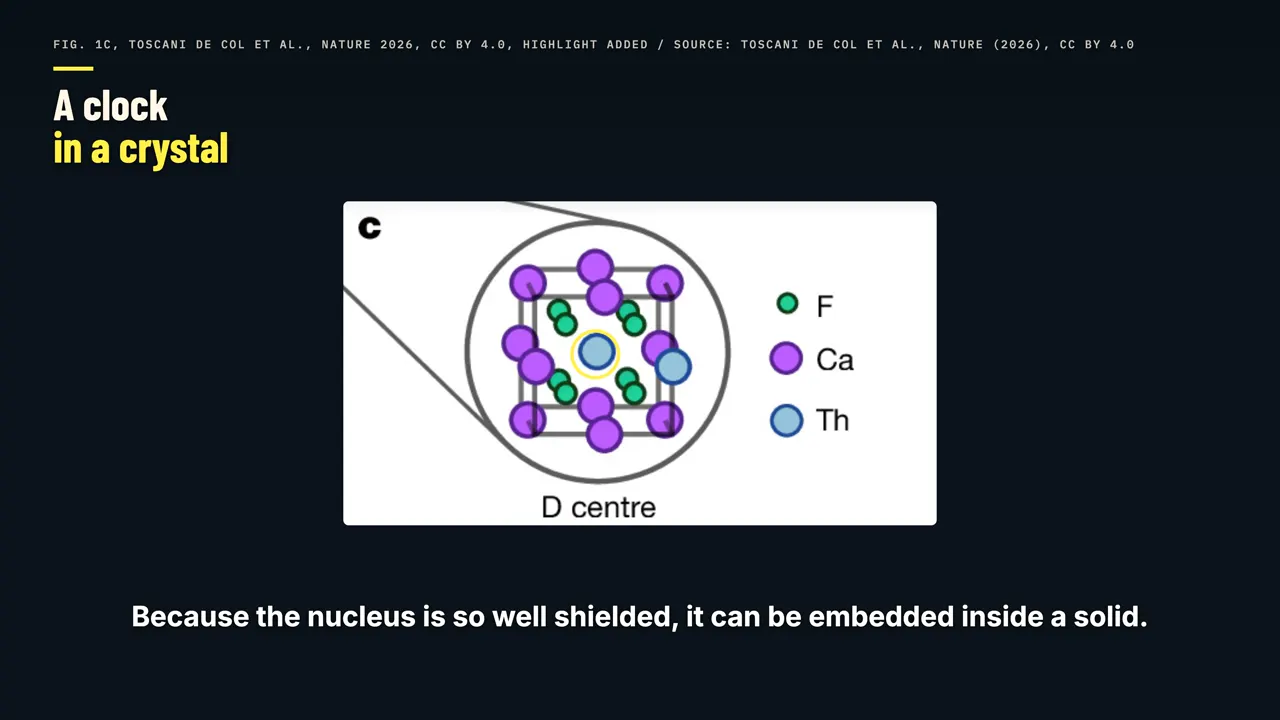
Because the nucleus is so well shielded, it can be embedded inside a solid. Both teams placed thorium two twenty-nine inside calcium fluoride crystals only millimetres across, held near room temperature. The material is scarce: the Chinese team grew one crystal from a solution holding just one point four micrograms of the isotope. Thorium two twenty-nine is made when uranium two thirty-three decays.
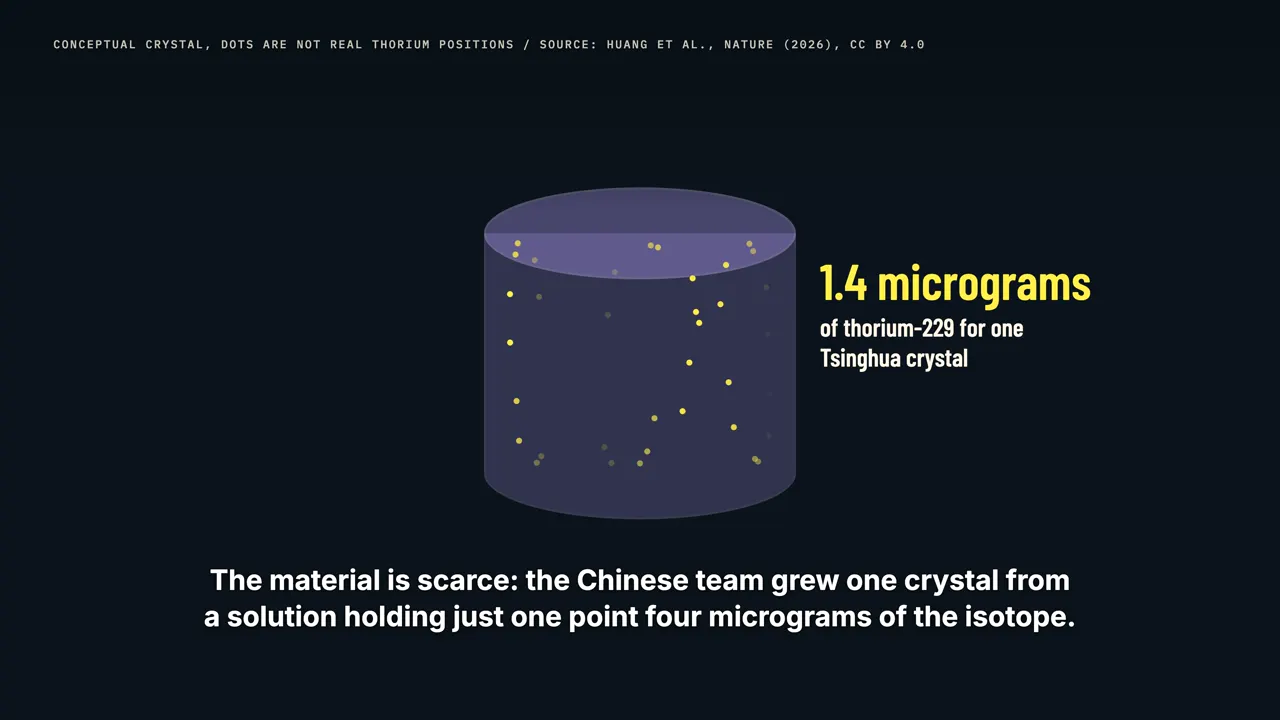
The Tsinghua team writes that this scarcity left essentially no room to grow a crystal, test it, and try again.
Closing the loop
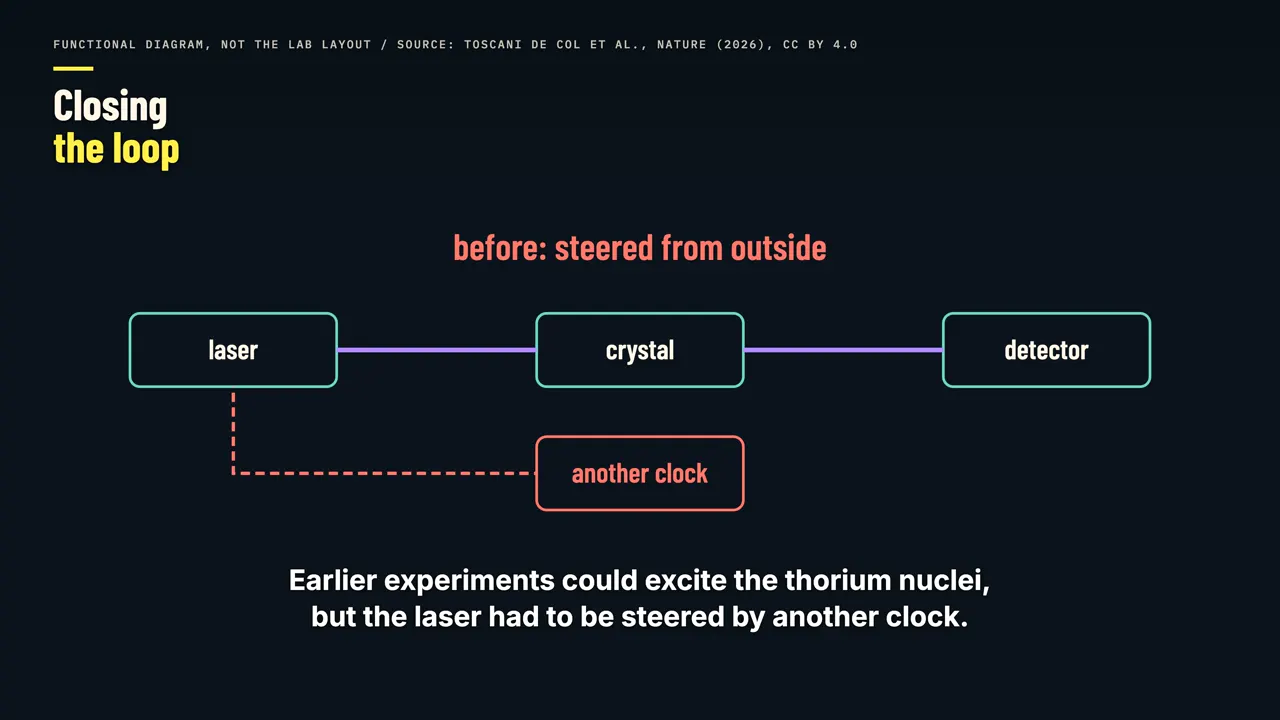
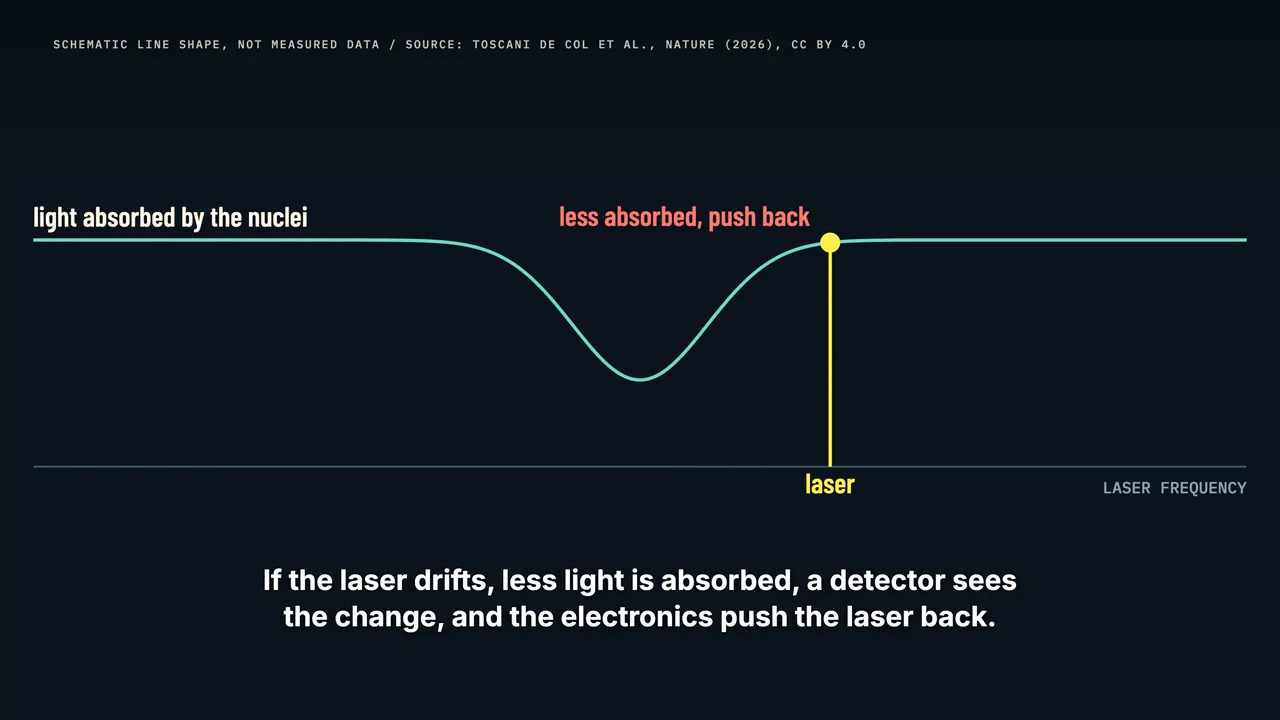
Earlier experiments could excite the thorium nuclei, but the laser had to be steered by another clock. The Vienna team closed that loop, so that the nuclei themselves now steer the laser. The laser shines through the crystal, and the nuclei absorb light only when the frequency is right. If the laser drifts, less light is absorbed, a detector sees the change, and the electronics push the laser back.
This is the published diagram of that system, with the crystal, the detector, and the feedback path that closes the loop. The clock ran for a full day without anyone touching it.
Counting the ticks
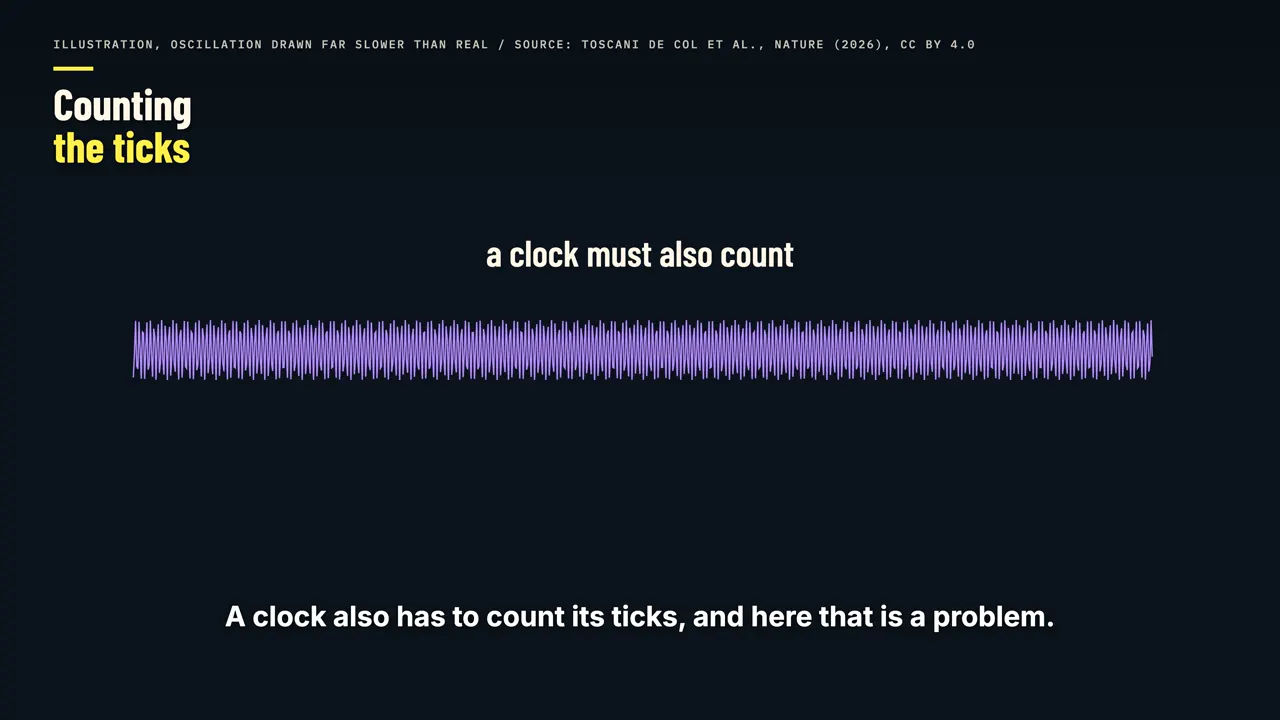
A clock also has to count its ticks, and here that is a problem. Light at one hundred forty-eight nanometres oscillates about two quadrillion times a second, far too fast to count directly with electronics. So the teams use a frequency comb, a laser whose evenly spaced colours act like the gears of a clockwork, stepping that frequency down to something electronics can count. In Vienna, a fibre link about ten kilometres long carried the comparison to a ytterbium ion clock at Austria's metrology office.

At Tsinghua University, a second team built its own nuclear clock with a different way of making the ultraviolet light. Two separately grown crystals gave the same clock frequency to within about one part in ten trillion.
How steady is it?
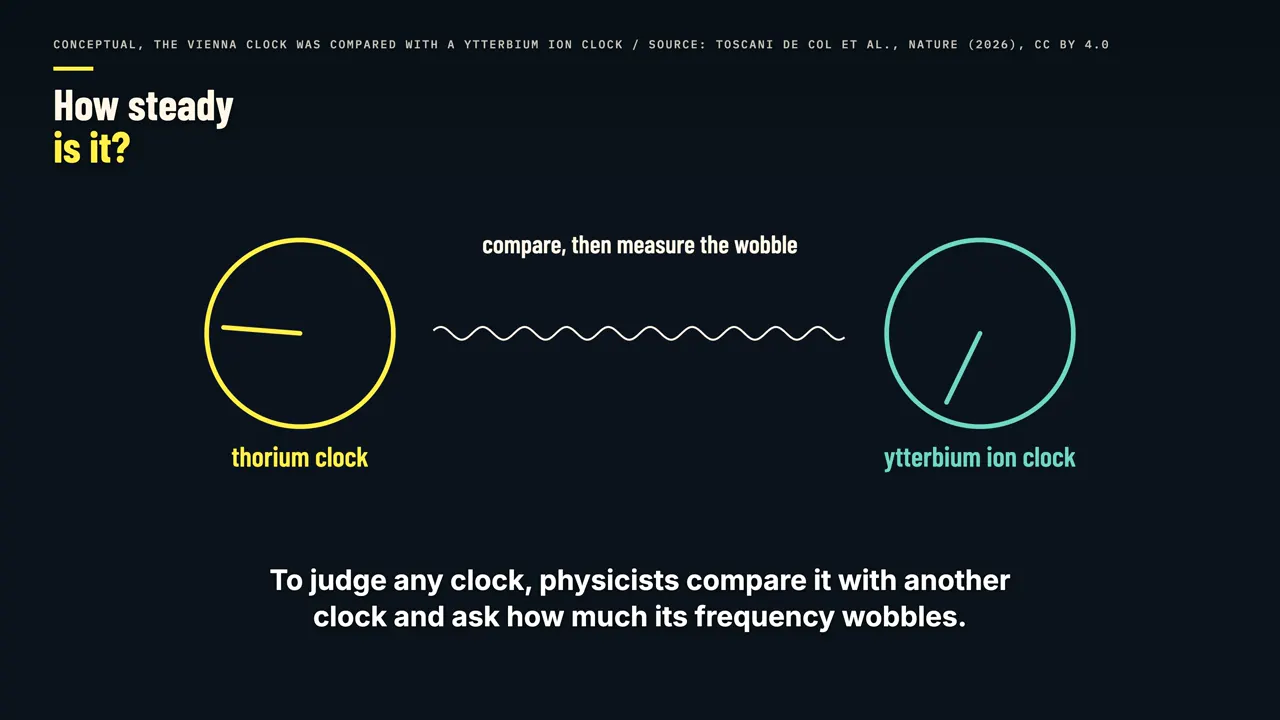
To judge any clock, physicists compare it with another clock and ask how much its frequency wobbles. This chart from the Vienna paper shows that wobble, averaged over longer and longer stretches of time. The longer you average, the lower the curve goes, reaching about two parts in a hundred trillion after a few hours. The university's press release translates its result as an error of about one second in thirty million years, a figure extrapolated from a day of running.
Two clocks, two strengths
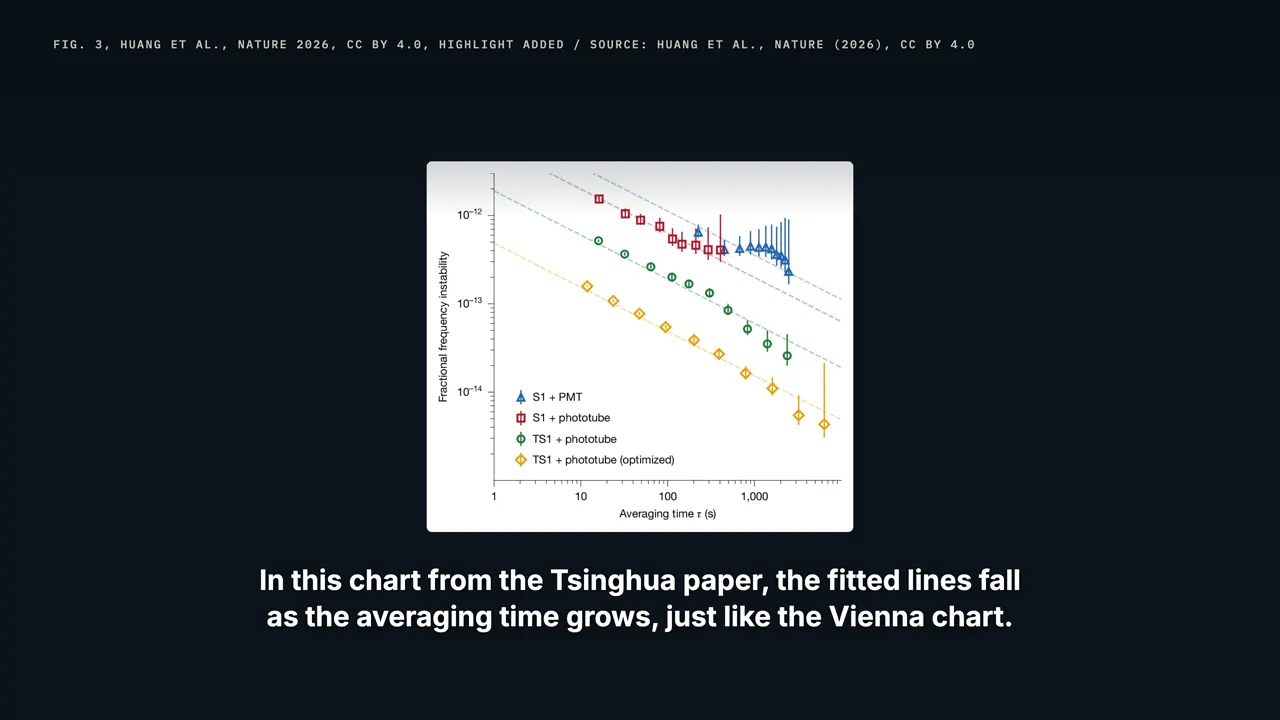
The two new clocks are not equally steady. In this chart from the Tsinghua paper, the fitted lines fall as the averaging time grows, just like the Vienna chart. Its best setting wobbles about six times less than the Vienna clock at the same averaging time. The Tsinghua clock was checked against a hydrogen maser and an ultra-stable laser cavity, linked by four kilometres of fibre.
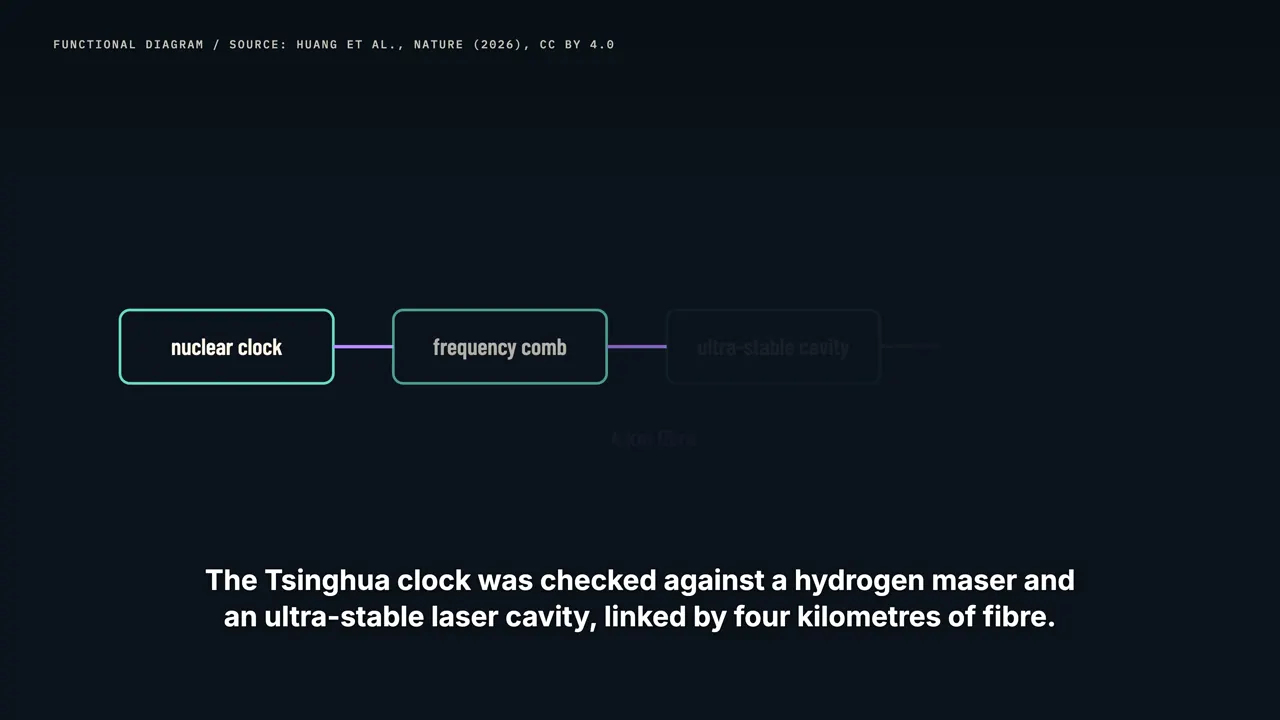
The Vienna clock, in turn, closed its own loop, ran for a full day, and measured how much it drifts from day to day.
Still behind
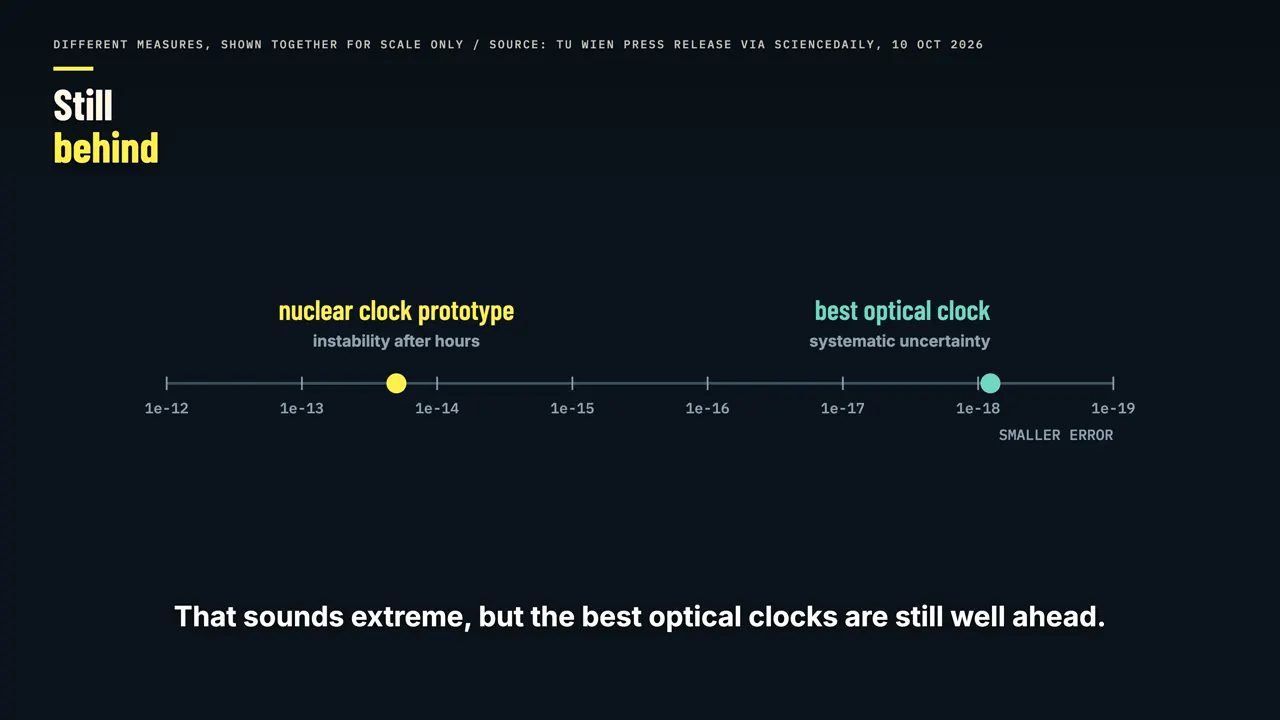
That sounds extreme, but the best optical clocks are still well ahead. The Vienna team calls its clock a first prototype that is not yet at the level of the world's best optical atomic clocks. Its authors project that future devices could improve stability by around four orders of magnitude, which is a forecast, not a measurement.
Same answer every day?
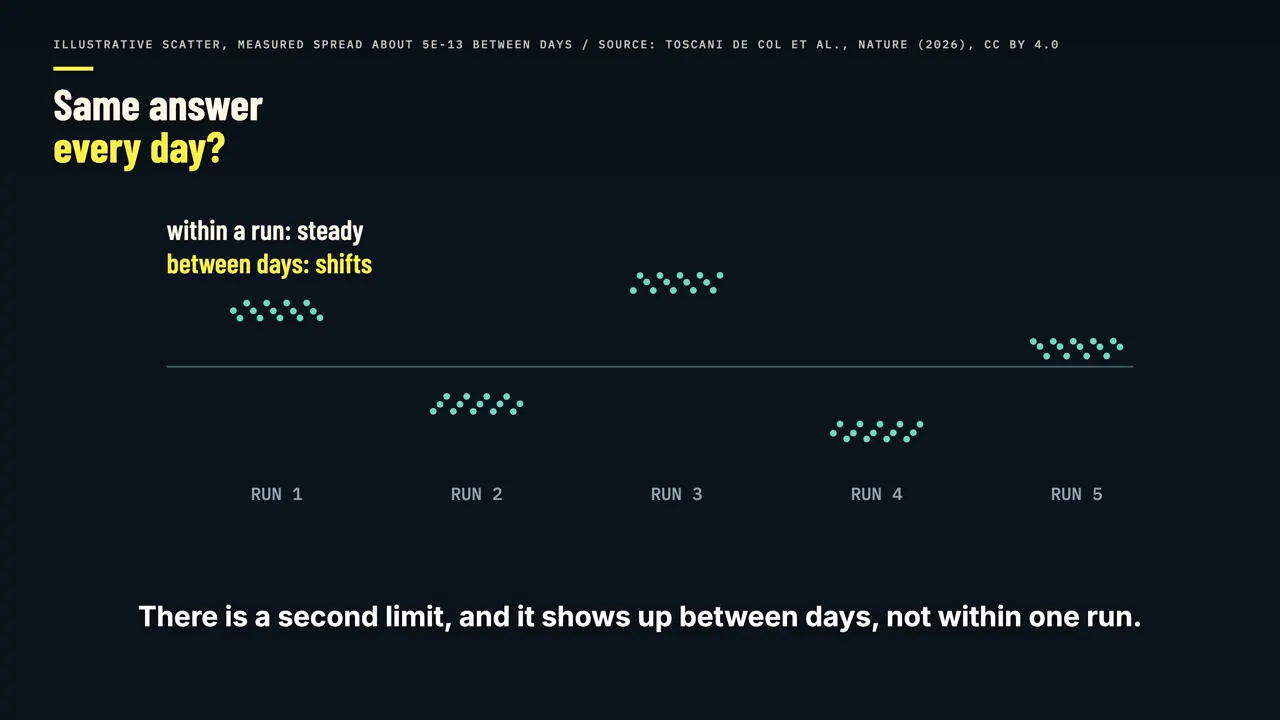
There is a second limit, and it shows up between days, not within one run. Before each run the laser has to be realigned, and its beam crosses a slightly different part of the crystal. Different spots gave slightly different frequencies, so results agreed from day to day only to about five parts in ten trillion. A clock you can carry has to give the same answer every time you switch it on.
Back to your phone
So could this ever reach your phone's map? Your phone does not carry an atomic clock at all. It listens to at least four satellites, so it can solve for its own clock error along with its position. The satellite clocks are kept honest by even better atomic clocks on the ground.
The Tsinghua paper describes thorium crystals as a route to compact, robust timekeeping, and that is where a satellite or a network could benefit. Neither paper claims a GPS upgrade, and today a phone's accuracy of around five metres also depends on the atmosphere, buildings, and the receiver.
Clocks that measure height
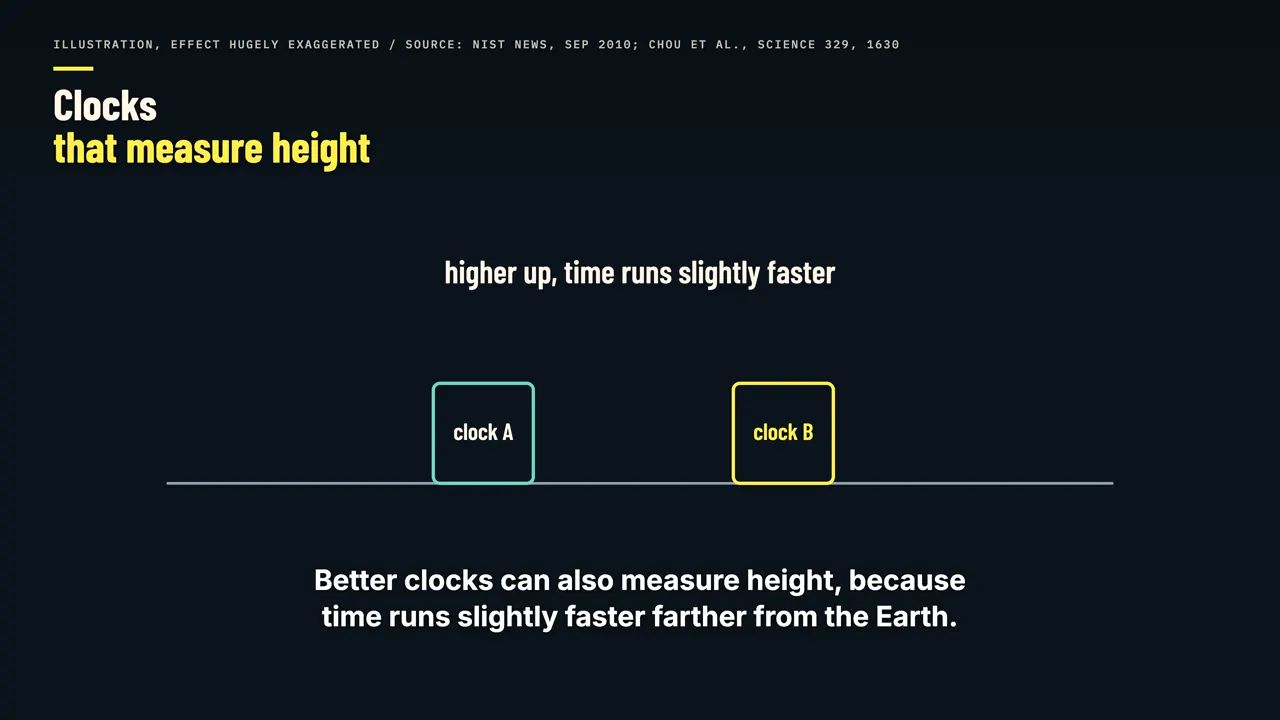
Better clocks can also measure height, because time runs slightly faster farther from the Earth. In twenty ten, NIST compared two optical clocks and detected the difference when one was raised by about thirty-three centimetres. Measuring the shape of Earth's gravity this way is called geodesy, and it needs clocks that can travel to where the measurement is. A robust clock in a crystal could one day help, but for nuclear clocks that is still a possibility, not a result.
A detector for dark matter
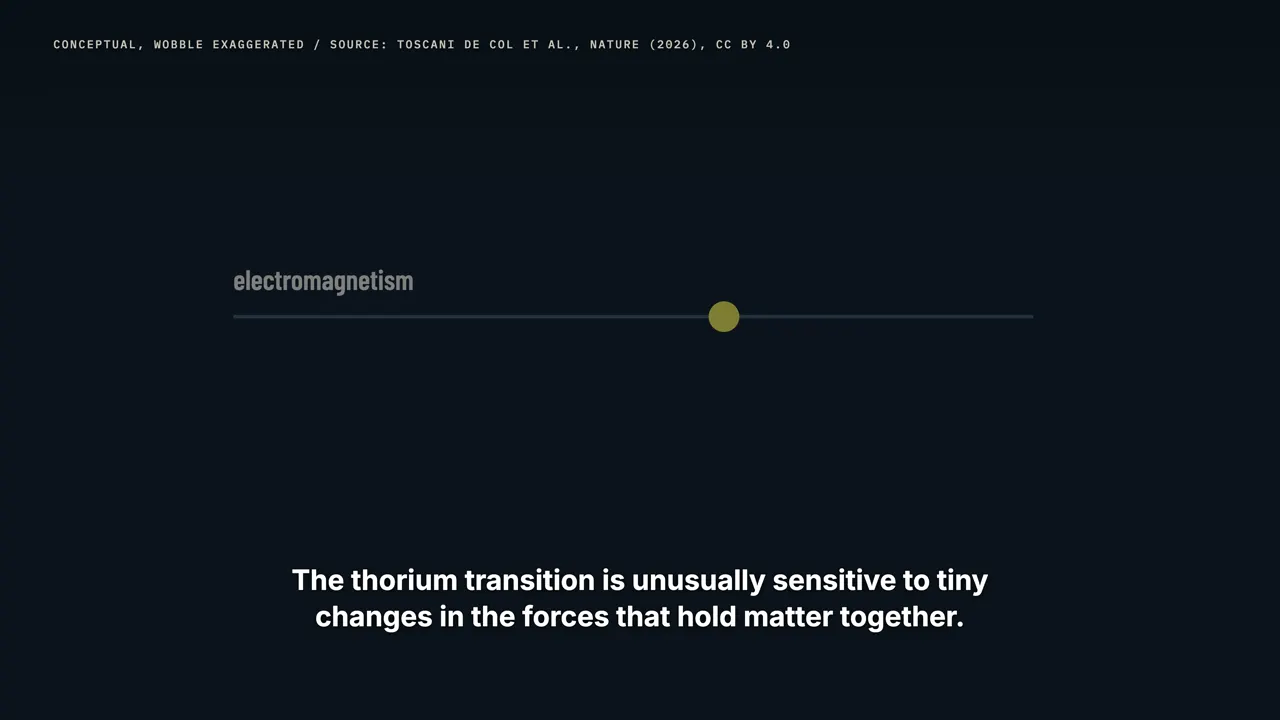
The nearer payoff is in physics. The thorium transition is unusually sensitive to tiny changes in the forces that hold matter together. The Vienna team searched a day of clock data for the faint, regular wobble that some kinds of dark matter would cause. They found no signal, but their limits already compete with the best atomic clocks, using a clock that is only a prototype.
What to watch
So what decides whether nuclear clocks leave the lab? Three things: whether the frequency is the same every day, whether stability really improves by thousands of times, and whether thorium two twenty-nine and the ultraviolet lasers become easier to get. The next redefinition of the second is being prepared around optical atomic clocks, not nuclear ones. For now, the nucleus has proven it can keep time, and the next test is whether it can keep the same time everywhere.
Watch on YouTube
Sources
- Toscani De Col et al., "A thorium-229 optical nuclear clock with feedback loop", Nature (2026), doi:10.1038/s41586-026-11084-4 (CC BY 4.0)
- Huang et al., "A nuclear clock synchronized to 229Th", Nature (2026), doi:10.1038/s41586-026-11122-1 (CC BY 4.0)
- Nature press release, 8 Oct 2026: https://www.natureasia.com/en/info/press-releases/detail/9455
- TU Wien press release via ScienceDaily, 10 Oct 2026: https://www.sciencedaily.com/releases/2026/10/261008102701.htm
- NIST, How do you measure your location using GPS?: https://www.nist.gov/how-do-you-measure-it/how-do-you-measure-your-location-using-gps
- NIST, Keeping us on time: https://www.nist.gov/atomic-clocks/a-technology-powerhouse/keeping-us-time
- NIST, Timekeeping and clocks FAQs: https://www.nist.gov/pml/time-and-frequency-division/timekeeping-and-clocks-faqs
- BIPM, SI second: https://www.bipm.org/en/si-base-units/second
- BIPM, Redefinition of the second FAQ: https://www.bipm.org/fr/FAQ-redefinition-second
- Aeppli et al., "Clock with 8×10^-19 systematic uncertainty", Phys. Rev. Lett. 133, 023401 (2024)
- Mainz University press release, 12 Sep 2019: https://press.uni-mainz.de/probing-a-nuclear-clock-transition/
- NIST, Sep 2010, and Chou et al., "Optical clocks and relativity", Science 329, 1630 (2010): https://www.nist.gov/news-events/news/2010/09/nist-pair-aluminum-atomic-clocks-reveal-einsteins-relativity-personal
- Fresno State, How big are atoms and atomic nuclei?: https://zimmer.fresnostate.edu/~davidz/Chem3AF97/ChA/atomsize.html
- Image and video credits
- Figures from the two Nature papers above, CC BY 4.0, highlights added
- GPS III-4 and GPS III-8 launch video: U.S. Space Force, public domain
- NIST-F2 photo and animation: NIST, public domain
- JILA strontium clock: Ye group and Brad Baxley, JILA, via NIST
- GPS Block IIF artist's concept: NASA, public domain
- Thorium metal photo: James St. John, CC BY 2.0 (natural thorium, not thorium-229)
- Diagrams marked "illustration" or "conceptual" are simplified explanations, not measured data. The 300 m and 30 cm figures are our calculations from the speed of light.