Two Supermassive Black Holes Colliding Soon? We Checked the Math.

Two supermassive black holes colliding in 100 years? In April 2026 a team led by Silke Britzen at the Max Planck Institute for Radio Astronomy reported a second jet in the core of the blazar Markarian 501 and proposed a close pair of supermassive black holes that "could merge in as short as 100 years". We read the paper itself (Britzen et al. 2026, MNRAS) and redid its numbers. This video covers why galaxy mergers should leave black hole pairs, the final parsec problem, what the radio images show, the possible one-day Einstein ring, where the 100 years comes from and why our estimates range from about 5 years to about 5,000, depending on the assumptions, earlier claimed pairs such as OJ 287 and PG 1302-102, evidence for a gravitational-wave background from pulsar timing, and whether any detector could catch this merger.
This article is the full narration of the video. Watch on YouTube
Two black holes colliding
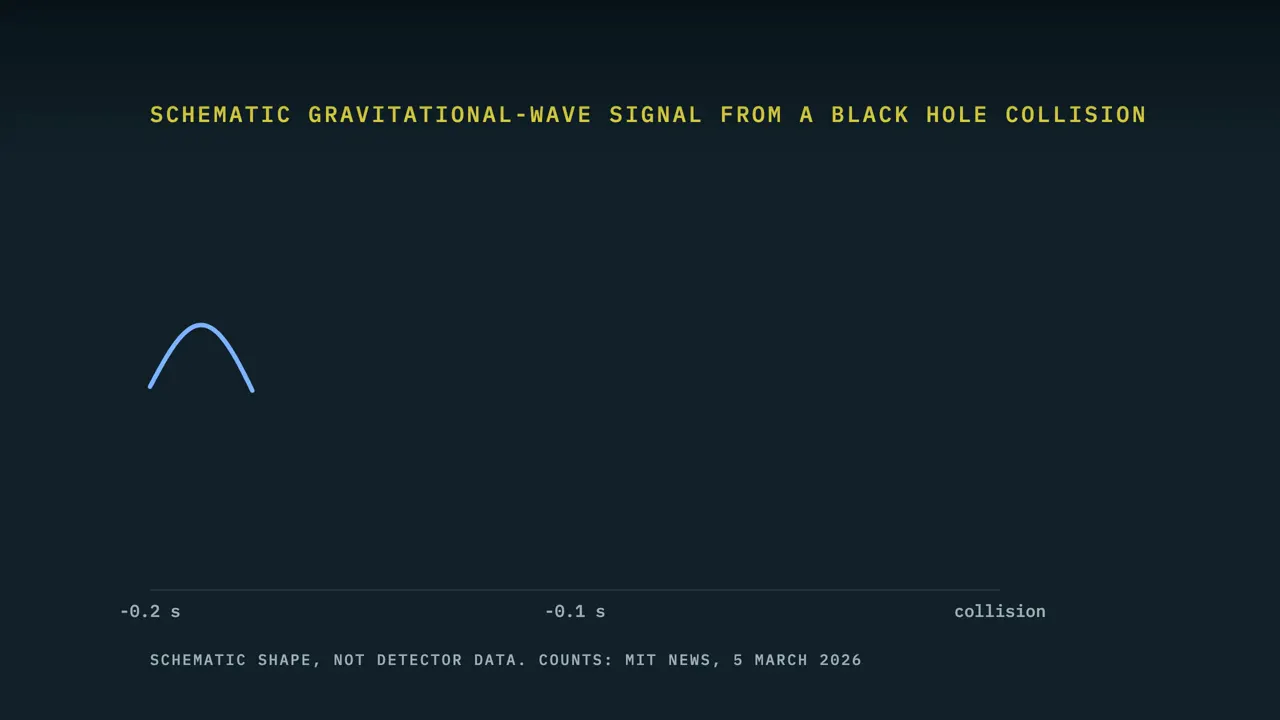
What happens when two supermassive black holes collide? Nobody has ever seen it. Smaller black holes, from a few to over a hundred times the Sun's mass, are now caught colliding regularly. Since 2015, gravitational-wave detectors have caught more than two hundred likely collisions.
A gravitational wave is a ripple in space itself, sent out when heavy objects whirl around each other. But the giants that sit at the centers of most big galaxies are another matter. They can weigh up to tens of billions of Suns. In April 2026, a team led by Silke Britzen at the Max Planck Institute for Radio Astronomy in Bonn announced a close candidate pair.
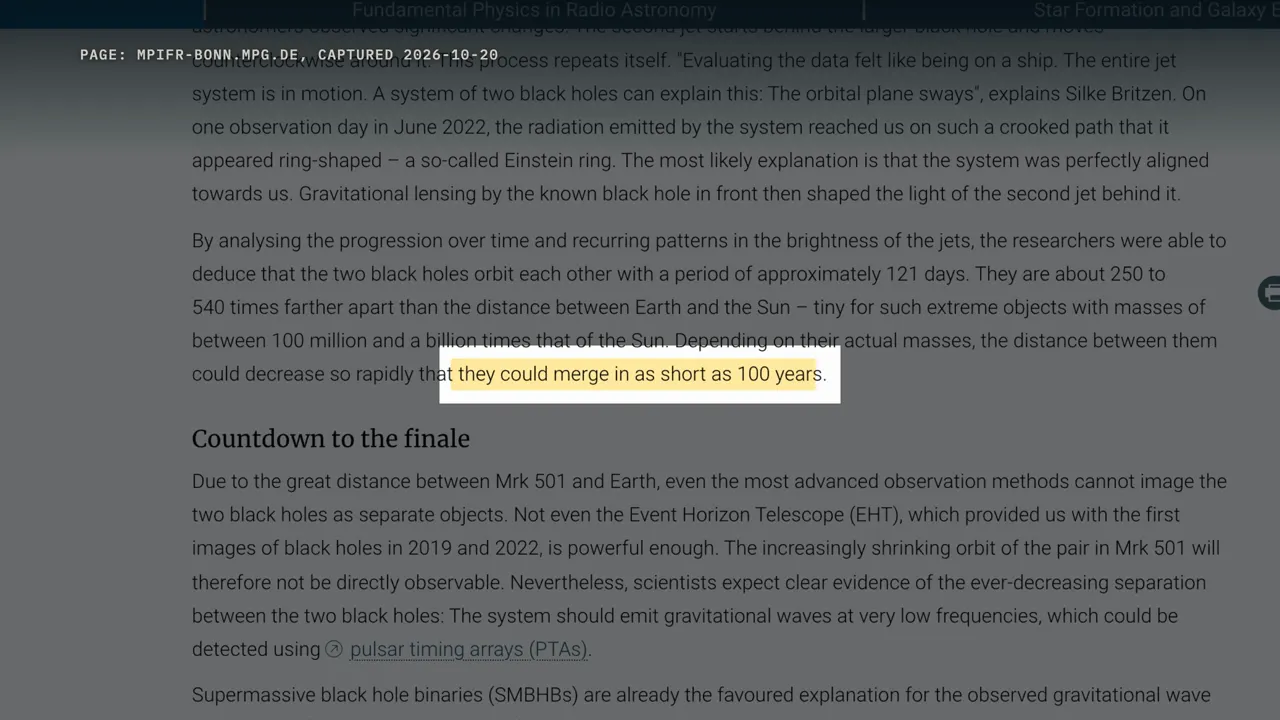
The galaxy is called Markarian 501. Their press release said the two black holes "could merge in as short as 100 years," depending on their actual masses. But the Max Planck Society's own headline ended with a question mark: "First close pair of supermassive black holes detected?" That question mark is what this video is about.
First, the safe part: this galaxy is more than 440 million light-years away. A light-year is the distance light travels in one year, about nine and a half trillion kilometers. Nothing that happens there can touch Earth. Why should two giant black holes end up together at all?
What did the astronomers actually see? Where does "100 years" come from, and does it hold up? And if they really merge, could anyone notice? We read the paper itself and ran its numbers again, and we'll show you exactly where each number comes from.
Galaxies collide, and so must their black holes
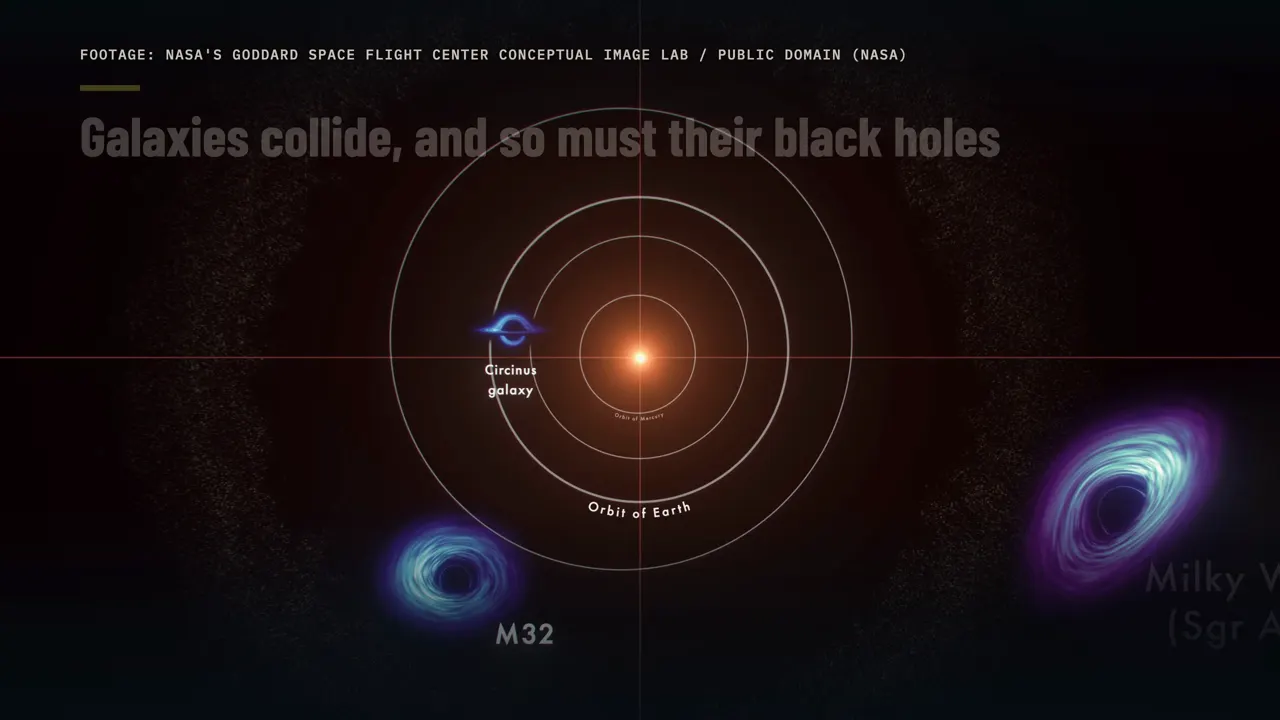
Start with the giants themselves. A supermassive black hole holds anywhere from about a hundred thousand to tens of billions of times the Sun's mass. Galaxies pull on each other, collide and slowly merge into one. When two galaxies merge, each brings its central black hole along.
So sooner or later, those two black holes should meet. Here is one merger caught partway through. This is NGC 6240, about 400 million light-years away. Inside the tangled glow sit two supermassive black holes, roughly 3,000 light-years apart.
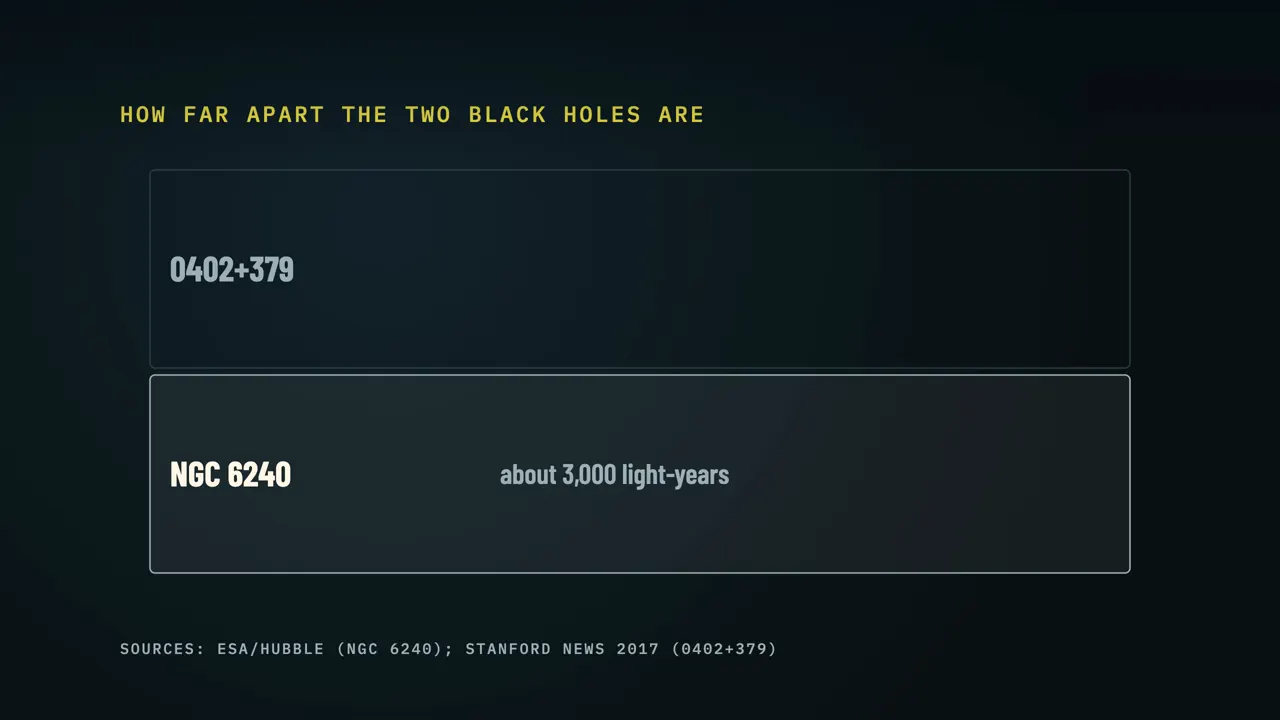
A much tighter pair was found in a galaxy called 0402+379. Astronomers measure such distances in parsecs; one parsec is about 3.3 light-years. In 0402+379, the two black holes are about 7 parsecs apart, roughly 23 light-years. Together they weigh about 15 billion Suns, and one orbit takes about 30,000 years.
It lies about 750 million light-years away, and in 2017 astronomers reported signs that the two are moving around each other. Even the astronomer on that study, Roger Romani, said he would be happy to find a system that completed an orbit "within a few decades". What we have not clearly seen is the last step: a pair so close that it is about to merge. And there is a reason that last step is so hard to catch.
The final parsec problem for black holes
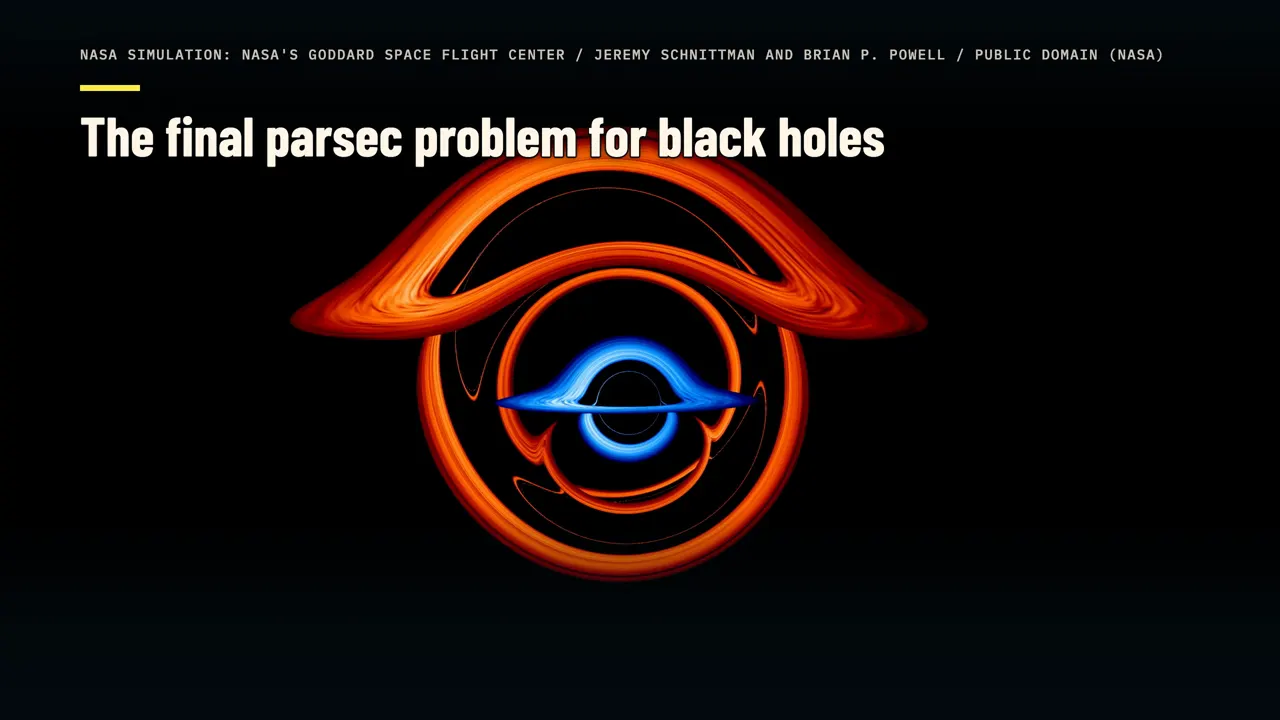
In 1980, three astrophysicists, Mitchell Begelman, Roger Blandford and Martin Rees, wrote a short paper in Nature. They asked what happens if an active galaxy holds two massive black holes orbiting each other. An active galaxy is one whose central black hole is feeding and glowing brightly. They suggested this could explain why some radio jets look bent, or seem to precess.
A jet is a narrow beam of hot, charged gas, shot out near the black hole at close to the speed of light. To precess means to wobble like a spinning top, its axis slowly tracing a circle. They also said the idea could be tested, by looking for the direct effects of the orbit. At first, each black hole sinks toward the middle because of what astronomers call dynamical friction.
That is the drag a heavy object feels as its gravity pulls a crowd of stars along behind it. Once the two form a bound pair, they get closer by throwing stars away. A star that swings past the pair gets flung out like a stone from a slingshot. Each star carries off a little of the pair's orbital energy, so the pair shrinks.
Think of two skaters holding hands, tossing heavy balls outward; each throw draws them a little closer. But in the simplest models, with a round galaxy, the supply of stars on the right orbits runs out quickly. Theory then had the pair stalling at a separation of about a parsec. Gravitational waves would carry energy away too, but at that distance they are far too weak.
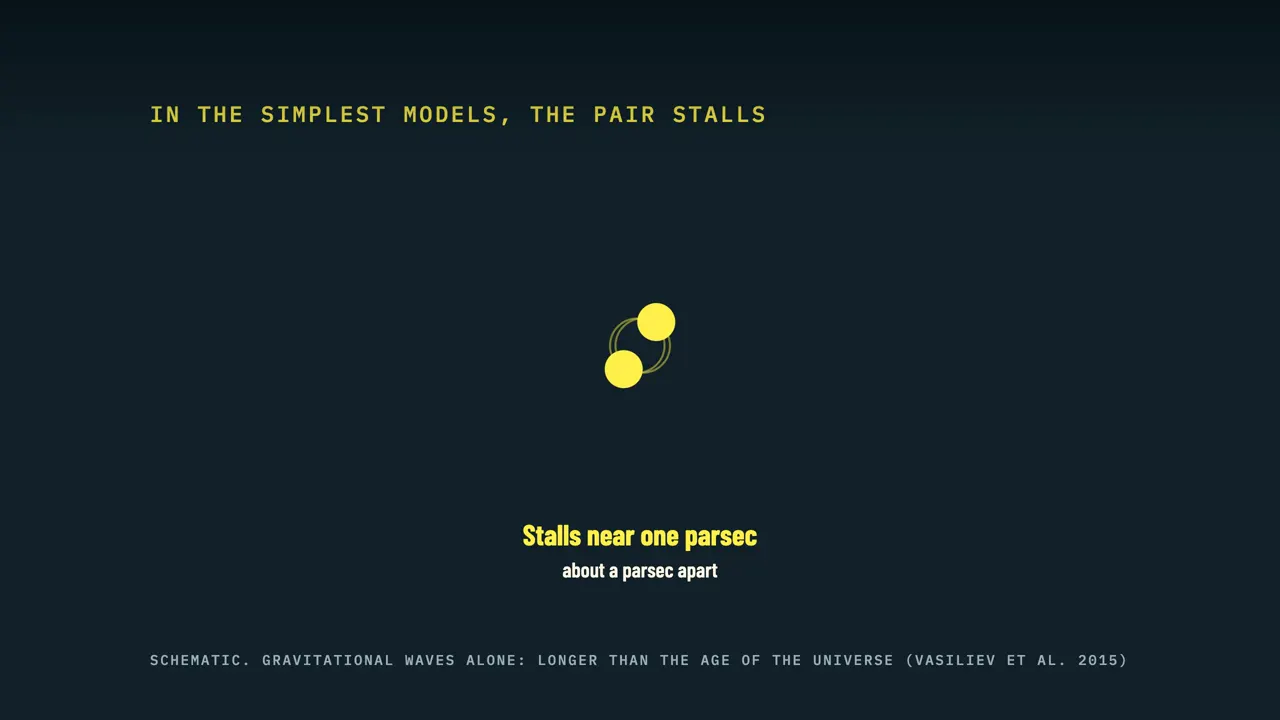
Shrinking the orbit with gravitational waves alone would take much longer than the age of the universe. This is called the final parsec problem for black holes, a label from a 2003 paper by Milos Milosavljevic and David Merritt. Several fixes have been proposed. One says real galaxies are not perfectly round.
In a squashed, so-called triaxial galaxy, stars keep falling onto new orbits toward the center. A 2015 study found that this alone can solve the problem, with mergers in about a billion years or less. Another idea is a third black hole arriving from a later merger, which can shake the pair together. A third, from 2024, involves dark matter.
Dark matter is the unseen mass that holds galaxies together; we detect it only by its gravity. If dark matter particles can bump into each other, a dense clump around the black holes keeps refilling, and the drag continues. In that model, a pair with a primary of about three billion Suns could merge in roughly 100 million to a billion years. But even its supporters note that current data cannot yet tell this effect apart from stars and gas.
So the final parsec problem has candidate solutions, but nobody knows which one works in real galaxies. A confirmed pair caught far inside the final parsec would be strong evidence that nature gets past it.
Markarian 501, an old suspect
Markarian 501 is a blazar. A blazar is an active galaxy whose jet points almost straight at us, so it looks extremely bright. It even shines in very high-energy gamma rays, which is why astronomers call it a TeV blazar. It is one of the closest blazars known, at a redshift of 0.034.
Redshift measures how much the universe's expansion has stretched the light on its way to us; small numbers mean nearby. It sits in the constellation Hercules. Astronomers have suspected it of hiding two black holes before. In 2000, Frank Rieger and Karl Mannheim noticed a roughly 23-day rhythm in its X-ray and gamma-ray flares during a 1997 outburst.
They proposed a binary with an orbit of about 6 to 14 years. That was a different model, with different numbers, from the one in the news today. In 2023, Silke Britzen's team looked at 23 years of radio images of Markarian 501. The images came from the Very Long Baseline Array, ten identical 25-meter radio dishes spread from Hawaii to the US Virgin Islands.
Their signals are recorded at each site and combined later, so the dishes work together like one telescope about 8,000 kilometers wide. Spreading dishes that far apart lets them see much finer detail than any single dish could. They found the inner jet and the much larger outer jet pointing about 90 degrees apart. And features in the jet were drifting sideways, at right angles to the jet.
That paper did not claim a binary; it listed a wobbling jet base and a binary only as possibilities to test.
A second jet
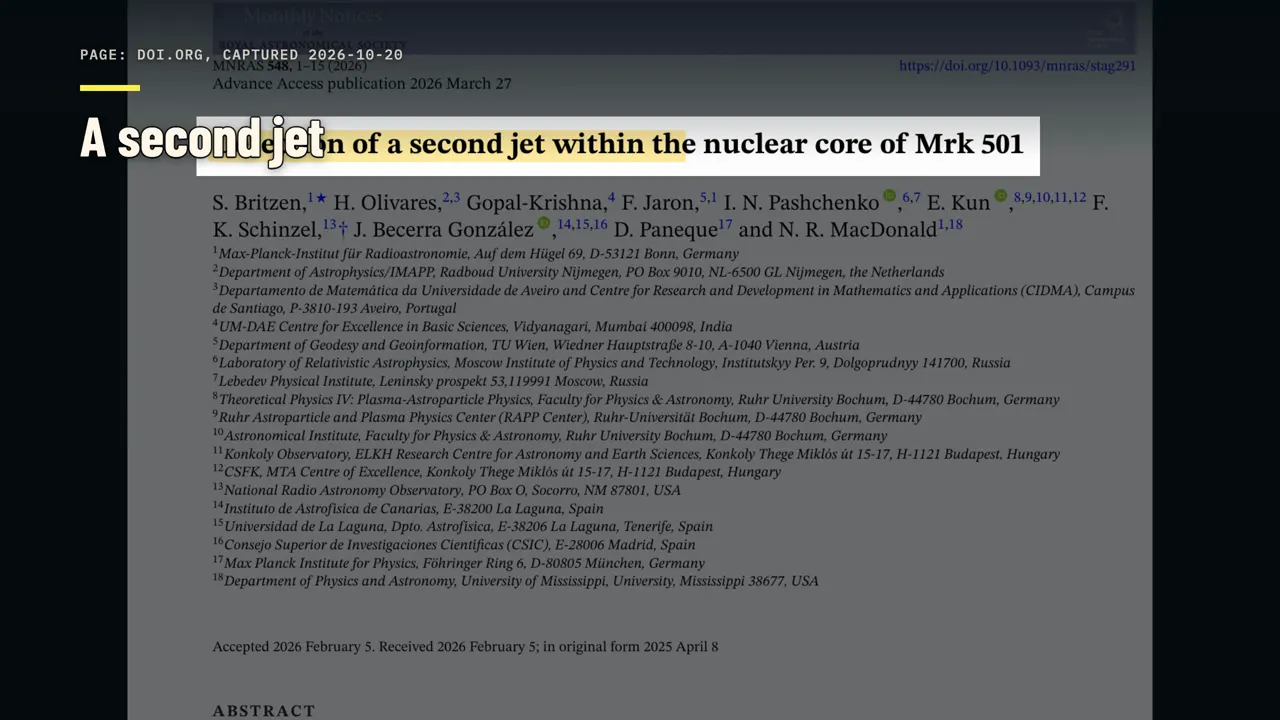
The new study, published in Monthly Notices of the Royal Astronomical Society, turned to sharper images from the same array. The team re-analyzed 83 observations from 2011 to 2023, made at a radio frequency of 43 gigahertz. A higher radio frequency gives a sharper view, so 43 gigahertz shows finer detail than the 15 gigahertz images used before. They compared them with earlier results at 15 and 8 gigahertz.
Besides the known jet, they report another that seems to start on the side opposite the main jet, the counterjet side, and loop around the core. They call it Jet 2. The press release says it points in a different direction from the main jet, which made it harder to spot. The paper even suggests that earlier images may have mistaken it for the bright edge of the main jet.
Britzen said: "We searched for it for so long, and then it came as a complete surprise that we could not only see a second jet, but even track its movement." In her words: "Evaluating the data felt like being on a ship." At 43 gigahertz, the entire jet system shifts sideways on a timescale of about 7 years.
Its total brightness rises and falls on a similar cycle, about 7.4 years. And the brightness of the core hints at a much shorter rhythm, about 121 days. A record of how bright something is over time is called a light curve. The paper itself says that 121-day period is "not well constrained".
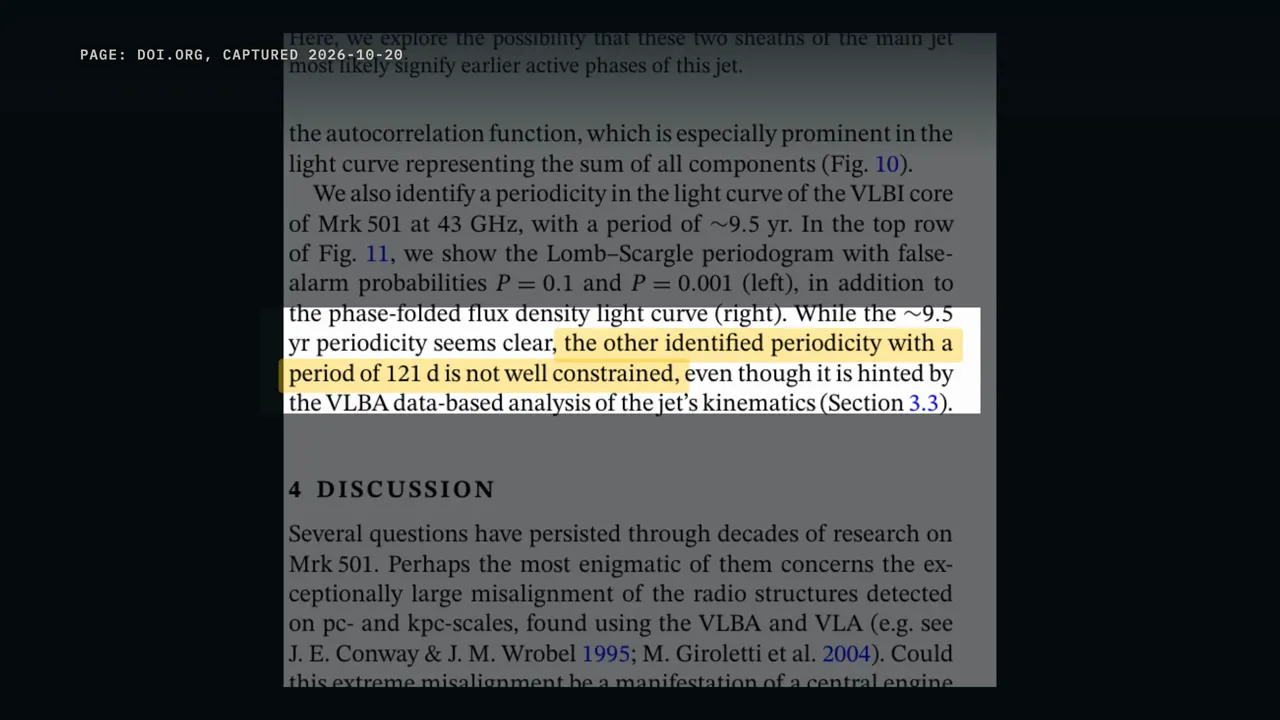
The motion of Jet 2 gave a similar number: it seemed to return to the same shape about every 146 days, give or take about three weeks. The team's reading is that each jet comes from its own black hole, and that the two orbit each other every few months. And the plane of their orbit slowly sways, which would swing the jets around every 7 years. In their words, such a binary "can reasonably explain" what they see.
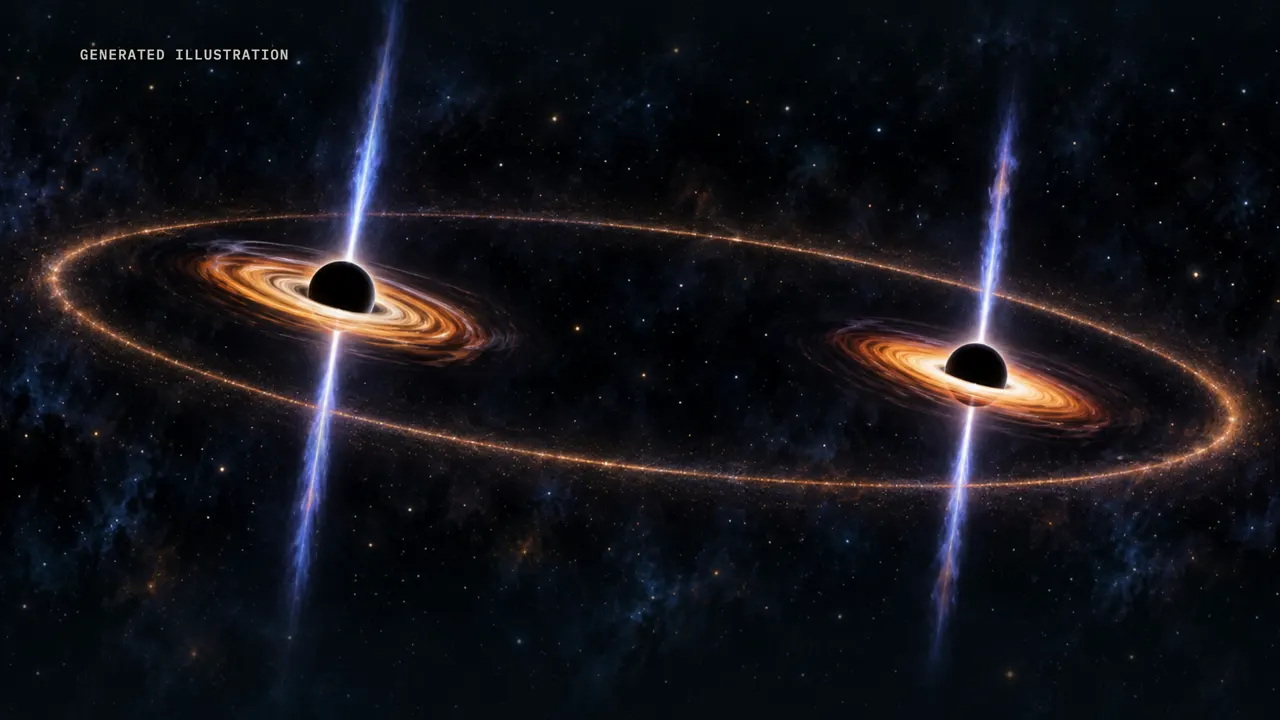
Assuming equal masses, the abstract puts each black hole at roughly 100 million to a billion Suns. That would put the two black holes 27 to 128 Schwarzschild radii apart. A Schwarzschild radius is the size of a black hole's point of no return. For a black hole of a billion Suns, it is about 20 times the Earth-Sun distance.
The press release put it another way: about 250 to 540 times the distance between Earth and the Sun. That Earth-Sun distance, about 150 million kilometers, is called an astronomical unit. That is at most about 0.0026 parsecs. This pair would be more than two thousand times closer than the one in 0402+379, deep inside the final parsec.
Seen from Earth, the gap would be about five times too small for even the Event Horizon Telescope, the network that photographed M87's black hole, to split.
An Einstein ring for one day
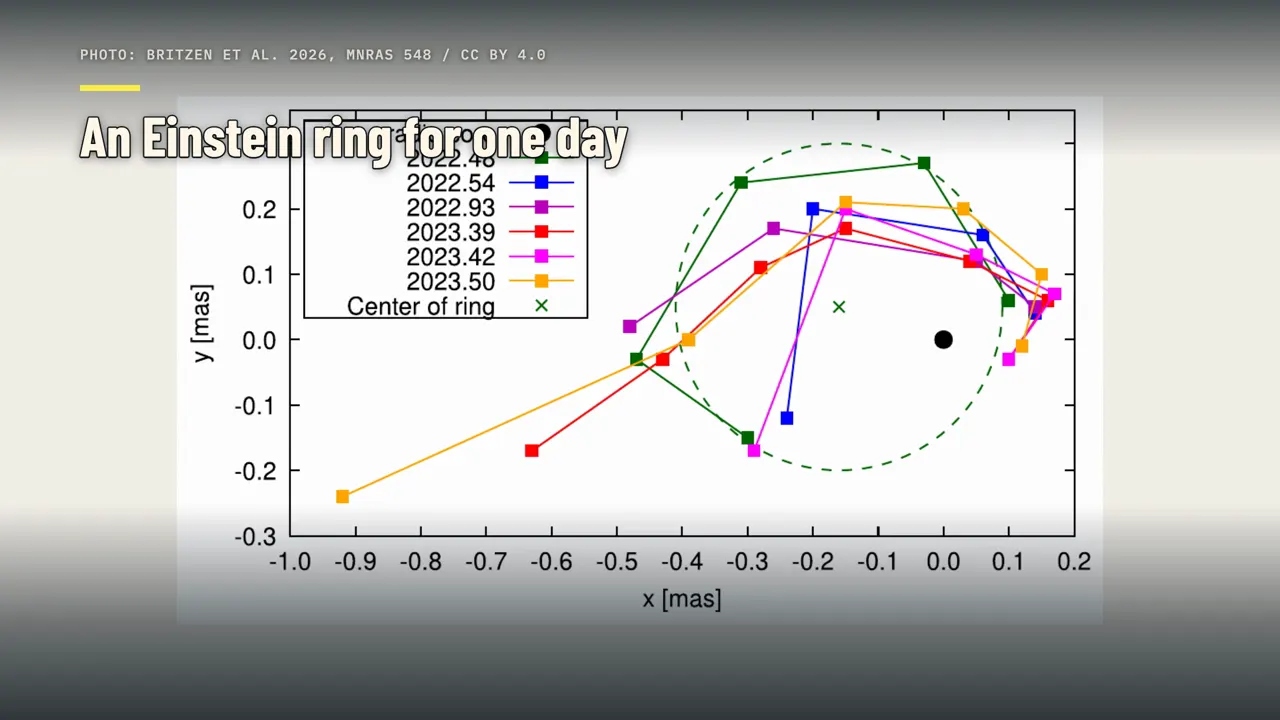
There is one more clue, and it comes from a single day in June 2022. In that day's image, the pieces of Jet 2 lie along an almost closed circle around the core. Heavy objects bend light passing near them, a prediction of Einstein's theory of gravity called gravitational lensing. If a light source sits right behind a heavy object, its light can be smeared into a circle around it: an Einstein ring.
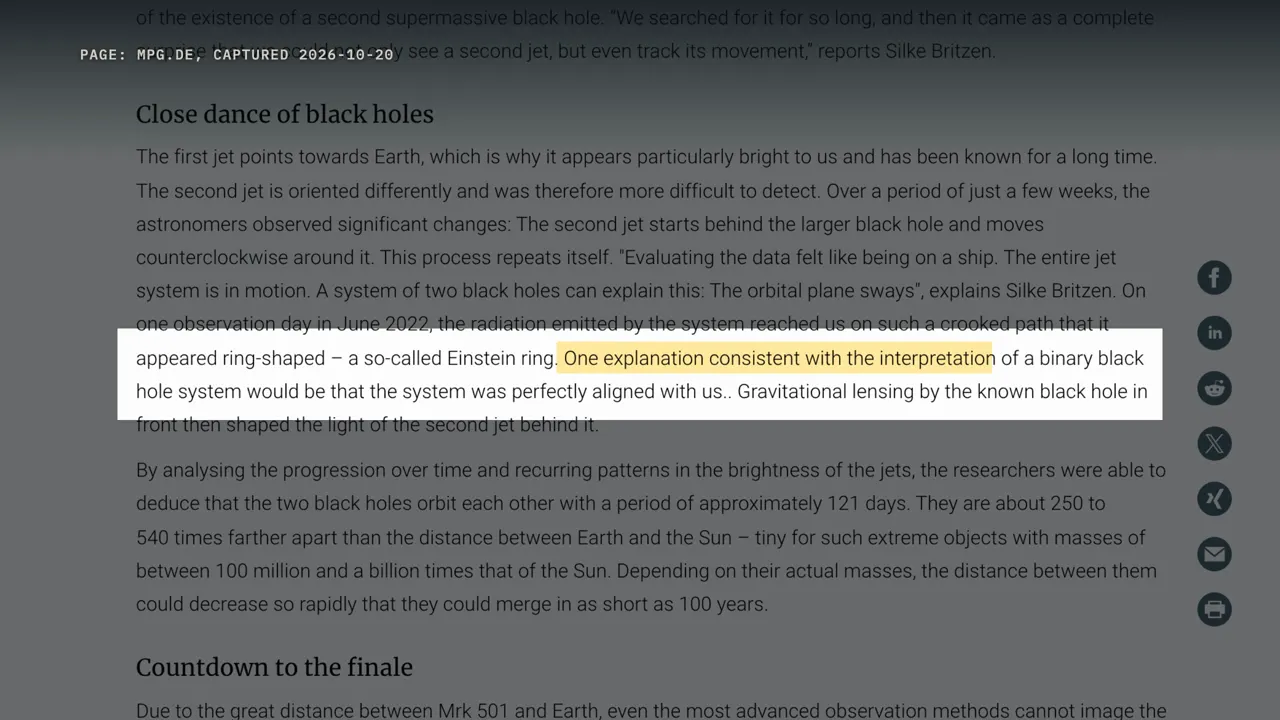
Hubble has photographed rings like this around whole galaxies. The press release's reading is that on that day the system lined up with Earth. The front black hole then bent the light of the second jet behind it. The Max Planck Society called the ring "one explanation consistent with" the binary.
But the paper's own arithmetic adds a twist. A black hole this heavy can only bend light into a ring that size if the light starts far behind it, about 10 to 100 parsecs. That is thousands of times the gap between the two black holes. So the authors suggest the ring is light from farther out along Jet 2, not light from right next to the second black hole.
If that is right, it is a striking clue. But it is one clear partial ring, with fainter arcs on a few other days, and its reading depends on the model. On its own, it is not an independent confirmation.
Where "100 years" comes from
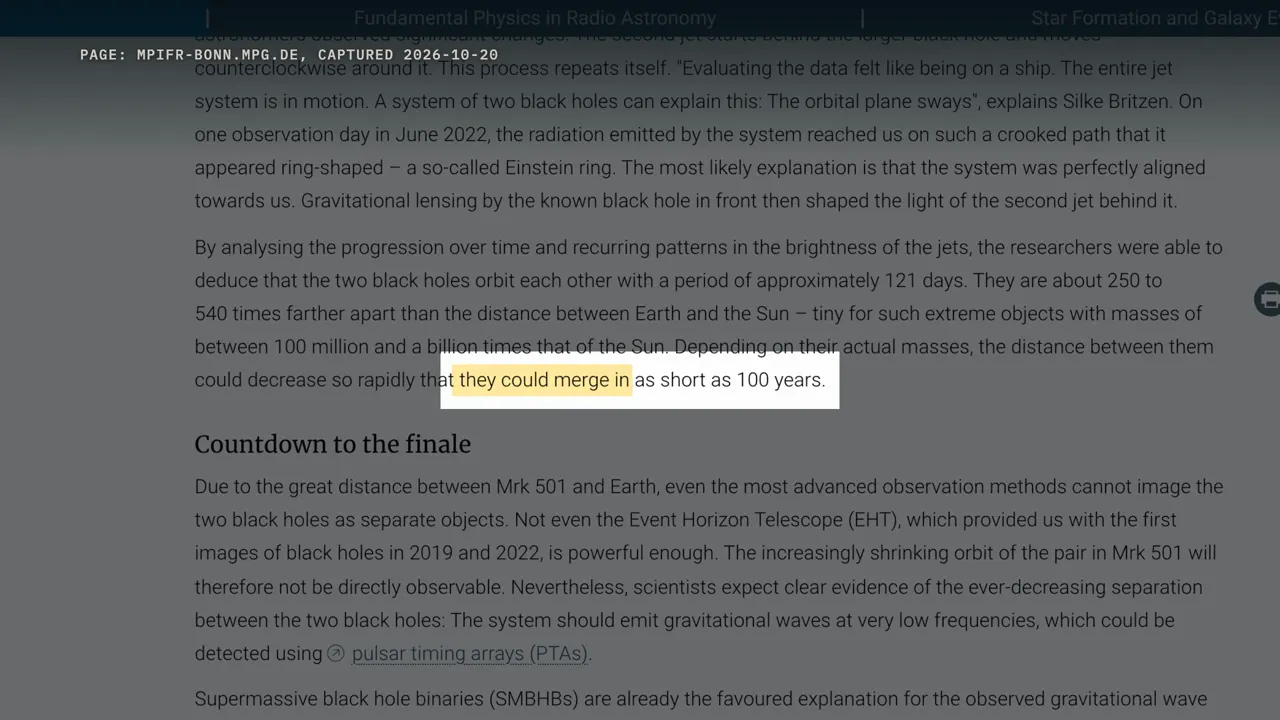
Now, the headline number. The press release said the pair could merge "in as short as 100 years", depending on the actual masses. One report spelled out the condition. If the black holes are close to a billion solar masses, the final merger "may be only a century away".
The paper shows its own route to that number. It borrows a mass from an earlier study: about 700 million Suns for the whole system. It takes the 146-day period from the jet's motion, about 141 days once the stretching of light by the universe's expansion is removed. Kepler's third law then gives the gap: how long an orbit takes tells you how far apart two bodies are, once you know their mass.
That puts the black holes about 470 astronomical units apart. Next comes a standard formula, first worked out by Philip Peters in 1964, for how fast gravitational waves drain a pair's orbit. Assuming equal masses and a circular orbit, the paper says the pair should last at least 250 more orbits. 250 orbits of 141 days is just under a hundred years.
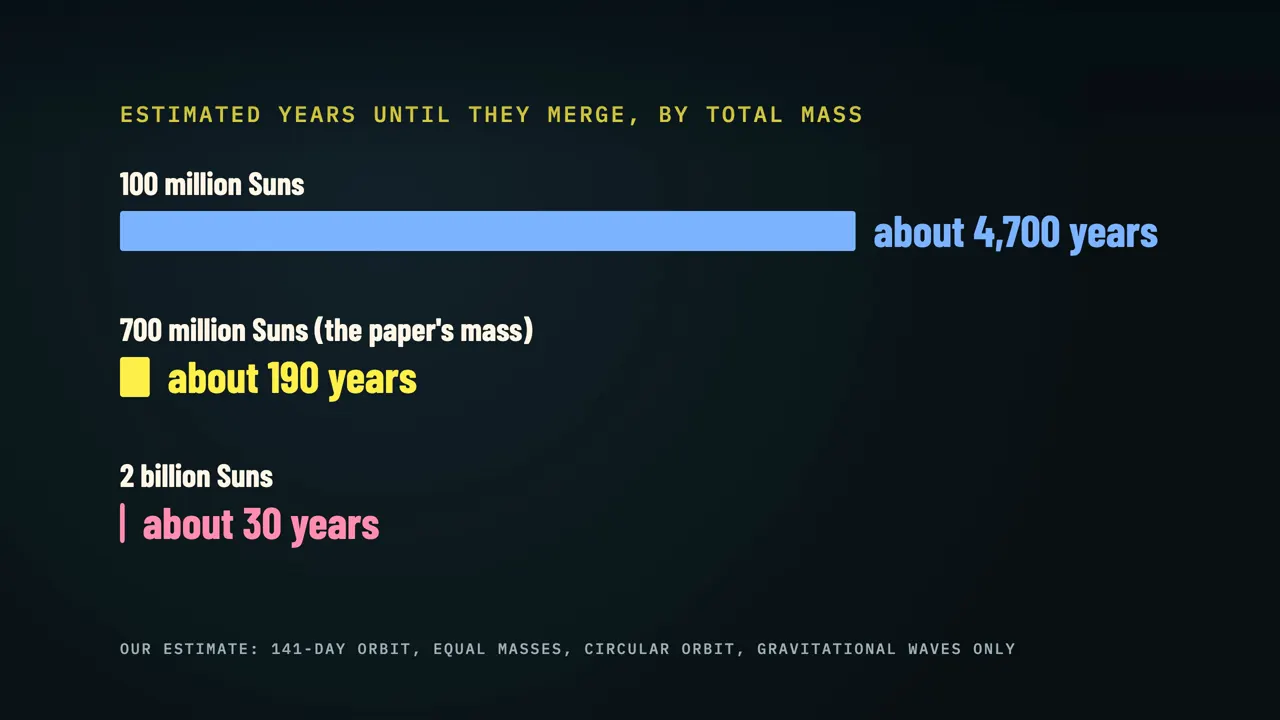
We ran the same setup ourselves. We also got about 470 astronomical units, but a lifetime closer to 190 years, nearly 480 orbits. That still fits "at least 250", but it makes 100 years the short end of the estimate. And the answer swings widely with the mass.
With 100 million Suns in total, the wait grows to nearly 5,000 years. With 2 billion Suns, the wait falls to about 30 years. If one black hole is ten times heavier than the other, the wait is about three times longer. If the 121-day rhythm is the real orbit, the wait is shorter, about 110 years at the paper's mass.
So "100 years" is not a firm forecast for this pair. And there is a catch inside the paper itself. In the authors' own sketch, matching the 7-year cycle calls for an orbit stretched into a very long oval, with an eccentricity of about 0.8 or more. Eccentricity measures how stretched an orbit is: zero is a circle, and values close to one are long, thin ovals.
The paper notes that an orbit like that would need a better estimate of the pair's lifetime. By our estimate with Peters' formula, at the paper's mass, an orbit that oval would shrink until the two merge in only about five years. That would be a very different story from 100 years. If the true orbit is half or twice the period they found, every number here changes again.
And if the 146-day pattern is not the orbit at all, it cannot give the period this calculation needs. The paper itself points to a weak spot in how they timed Jet 2. The telescope looked at irregular times, and the authors write that this uneven sampling hampers their method. 83 observations over about 12 years is about one every seven or eight weeks, while the rhythm they are chasing lasts only four to five months.
That is two or three looks per cycle, on average. For the brightness rhythm, they used a standard tool that searches uneven data for repeating cycles. It shows how likely a chance peak would be, but we found no test against random flickering that can mimic a cycle, a trap we will meet in the next chapter.
After checking eight news reports and major science sites, we found no quoted expert from outside the study team. ScienceAlert was one of the few to say plainly that this is "not a conclusive detection".
Earlier claims of black hole pairs
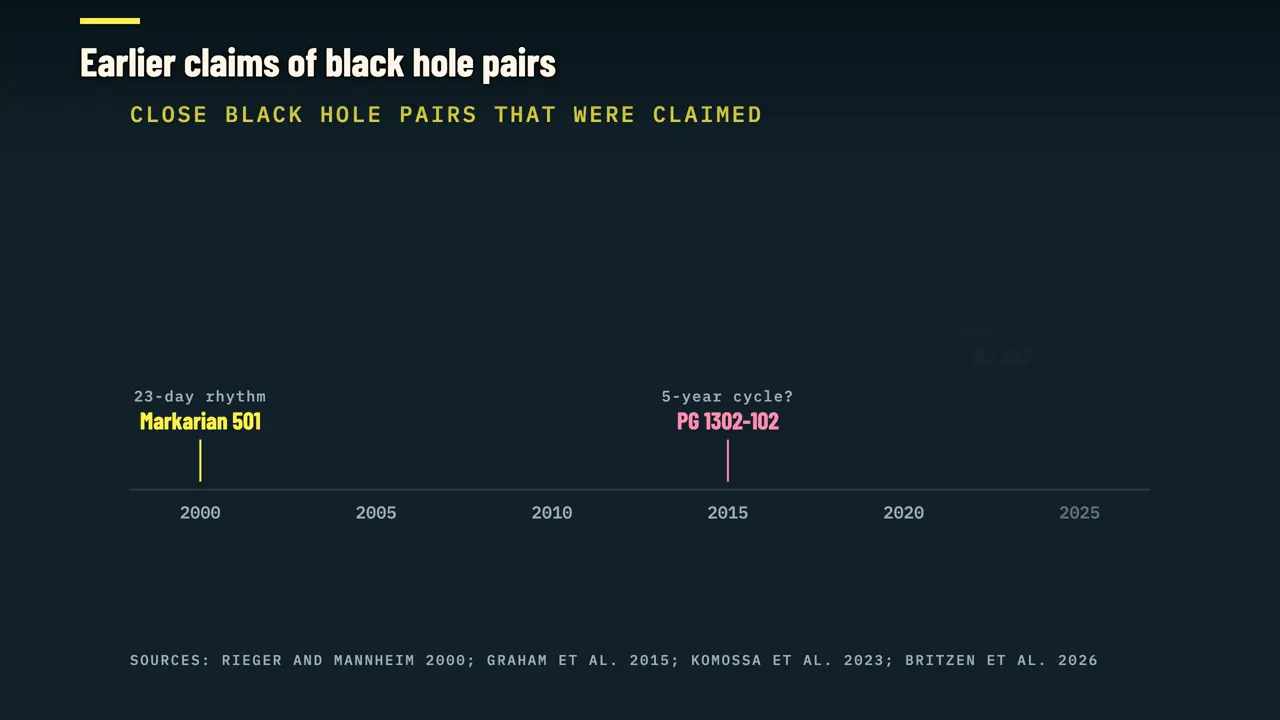
Markarian 501 is not the first close pair to be claimed, and the earlier stories are a useful warning. The most famous is OJ 287, a blazar that flares about every 12 years. In the binary model, a black hole of about 150 million Suns orbits one of about 18 billion every 12.06 years. That model predicted when outbursts would start in 1995, 2005, 2007 and 2015.
But in 2023, a team led by Stefanie Komossa reported that a flare predicted for October 2022 was not detected. They also estimated the main black hole at only about 100 million Suns, and favored other binary models. The model's author, Mauri Valtonen, replied that the flare came during the summer gap, when the source cannot be observed from the ground. In 2026, his team also reported a different kind of flare that October, and the argument is still going on.
Then there is PG 1302-102, a quasar whose brightness seemed to repeat about every five years. In 2016, Simon Vaughan and colleagues showed that random flickering, with bigger swings over longer times, can look periodic for a few cycles. Astronomers call that kind of flickering red noise. For PG 1302-102, they found a simple random process fit better than a steady wave.
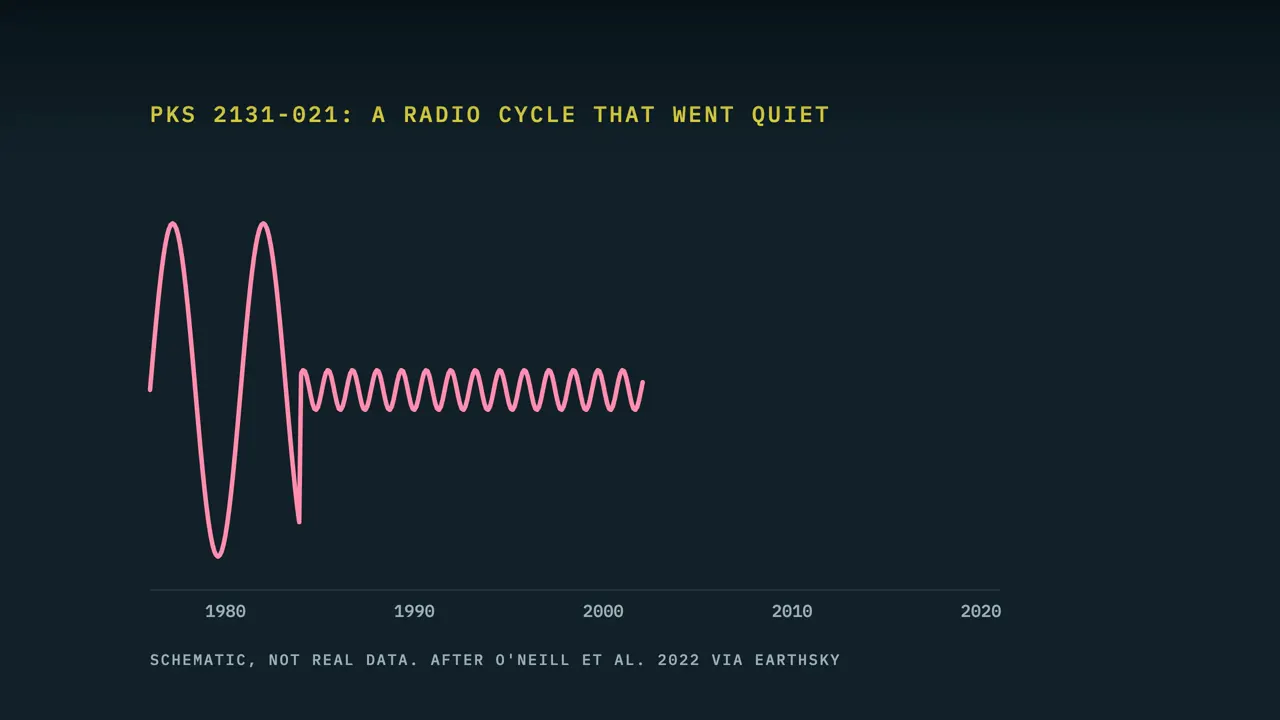
PKS 2131-021 is another candidate, with a radio cycle of about five years seen across 45 years of data. Its team's model suggests a two-year orbit and a merger in about 10,000 years. Yet that signal seemed to vanish for about two decades, from around 1984 to 2005. For a proposed pair in the galaxy 3C 66B, astronomers have timed pulses from
spinning dead stars, called pulsars, to limit the possible masses and orbits. A 2026 analysis ruled out part of what was still allowed. The strongest warning comes from M87, the galaxy whose black hole shadow the Event Horizon Telescope imaged. Its jet swings back and forth on a cycle of about 11 years, tracked over 22 years of radio data.
But that study explained it with a single spinning black hole. A spinning black hole drags space around with it, and that can make a tilted disk of gas wobble. Physicists call this Lense-Thirring precession. Britzen's own 2023 paper listed that same single-black-hole wobble as an option for Markarian 501.
The new paper weighs other explanations, including ripples that twist the jet, a shifting radio core, and shock waves, but finds each falls short. We did not find it testing the single spinning black hole that explained M87. So a wobbling jet alone does not prove two black holes. What makes Markarian 501 different is the second jet and the possible ring.
That is why it is a serious candidate, and also why it is still a candidate.
A gravitational-wave background
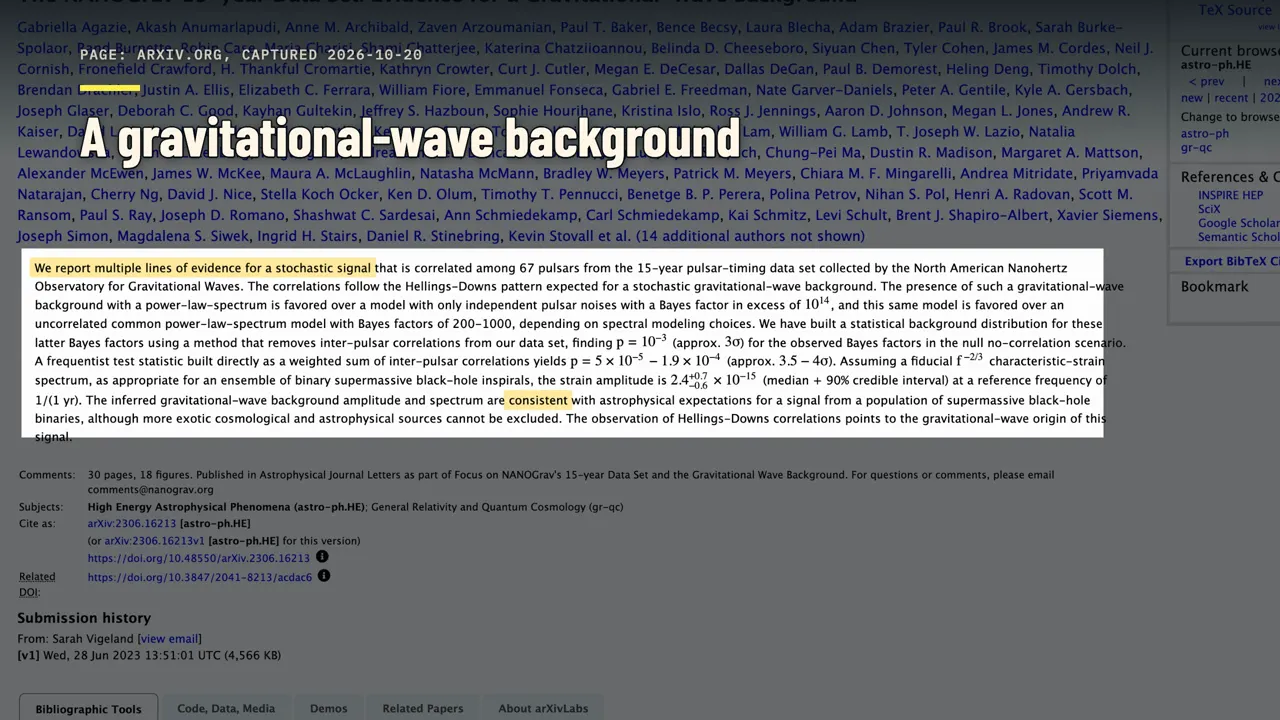
Even if we cannot see this pair directly, there may be another way to hear such pairs. In June 2023, the NANOGrav team announced evidence for a slow background of gravitational waves. They used pulsars: dead stars that spin hundreds of times a second and sweep a radio beam past Earth like a lighthouse. A passing gravitational wave stretches and squeezes the space between us and each pulsar.
So the pulses arrive a tiny bit early or late. Over 15 years, NANOGrav timed 67 pulsars and found linked shifts in pulse timing across the sky, in the pattern gravitational waves should make. The statistical strength was about 3.5 to 4 sigma. Sigma is a measure of how unlikely a result would be by pure chance; physicists usually call 5 sigma a discovery.
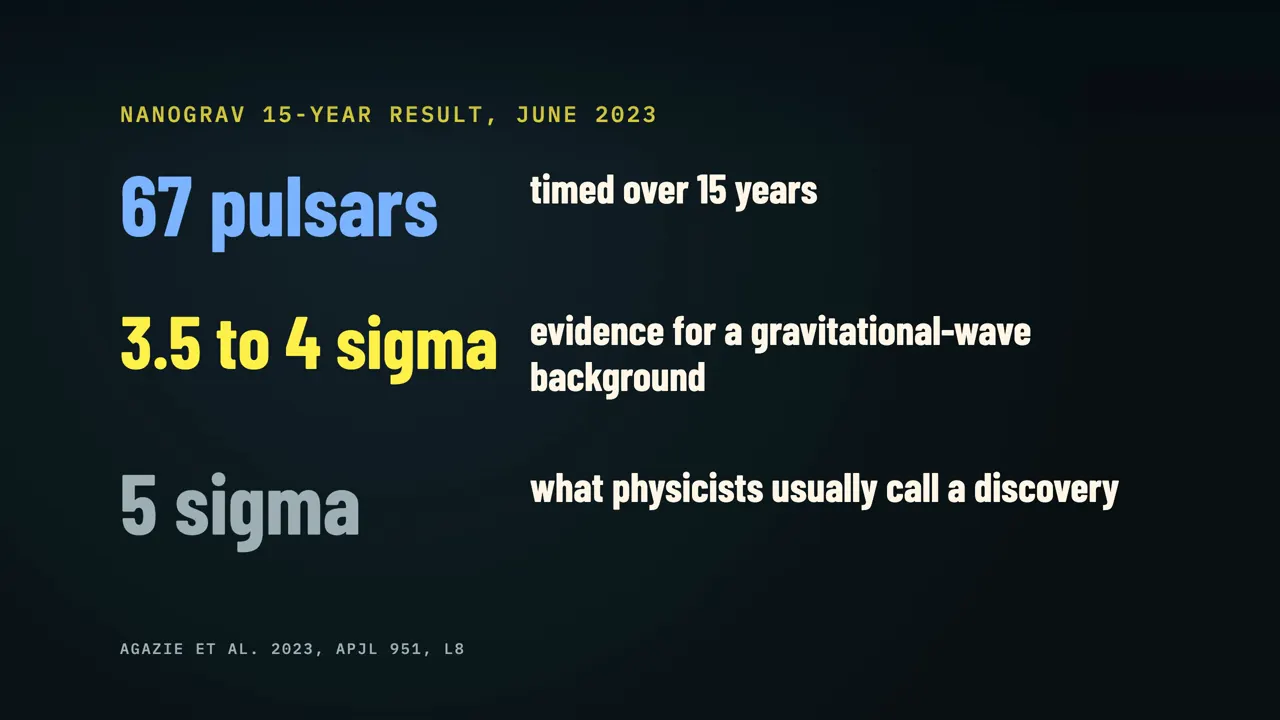
Teams in Europe, India, Australia and China reported similar results the same day. NANOGrav said the signal is consistent with many supermassive black hole pairs, without ruling out other sources. And no single pair has been picked out of that background yet. The press release calls Markarian 501 a prime candidate for tying those waves to one specific pair.
Co-author Hector Olivares put the hope this way: "we may even see their frequency steadily rise as the two giants spiral toward collision." By our calculation, at the paper's mass, that rise would be about 2 percent over ten years. With 100 million Suns in total it would be about a tenth of a percent, and with 2 billion, about 15 percent.
Could we detect them merging?
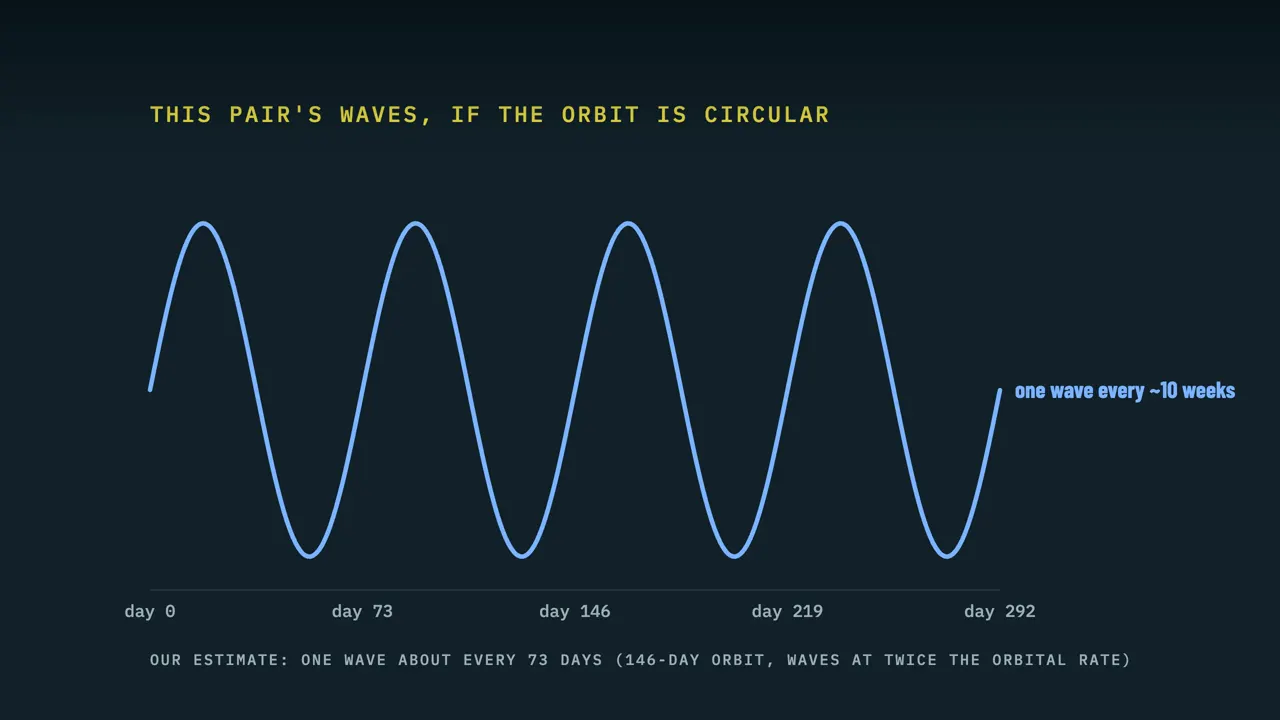
So, if they do merge, could anyone notice? A gravitational wave has a frequency, measured in hertz: one hertz is one wave per second. The paper puts this pair's signal at about 80 billionths of a hertz. It says a future pulsar timing program with the Square Kilometre Array could reach up
to 100 billionths of a hertz, after timing more than 20 pulsars for over ten years. The Square Kilometre Array is a giant radio observatory being built in South Africa and Australia. One detail: 80 billionths is the orbit's own rate, and a circular orbit sends out waves at twice that rate. By our calculation, that puts the signal near 160 billionths of a hertz, just above that range.
One wave would take about ten weeks to pass. The first collision LIGO caught, in 2015, swept from about 35 to 250 hertz, a pitch we can hear. To bring this pair's waves up to the lowest pitch we can hear, you would have to speed them up about a hundred million times. NANOGrav's search for single pairs was most sensitive near six billionths of a hertz.
The next big detector is LISA, a European Space Agency mission adopted in January 2024 and due to launch around 2035. It will be three spacecraft flying in a triangle about 2.5 million kilometers on a side, linked by lasers. LISA listens between about a ten-thousandth of a hertz and one hertz. That suits merging pairs of about 100 thousand to 10 million Suns.
By our rough estimate, at the paper's mass, this pair's final plunge would come at only about six millionths of a hertz. That falls in the microhertz gap, between what pulsar timing and LISA are built to catch. A 2021 study called this band "the largest gap" in coverage of the gravitational-wave sky. No detector now planned is designed for that gap.
The long, slow approach might leave clues in pulsar timing, or in jet rhythms that speed up, but no one has shown either can be detected.
Has it already happened?
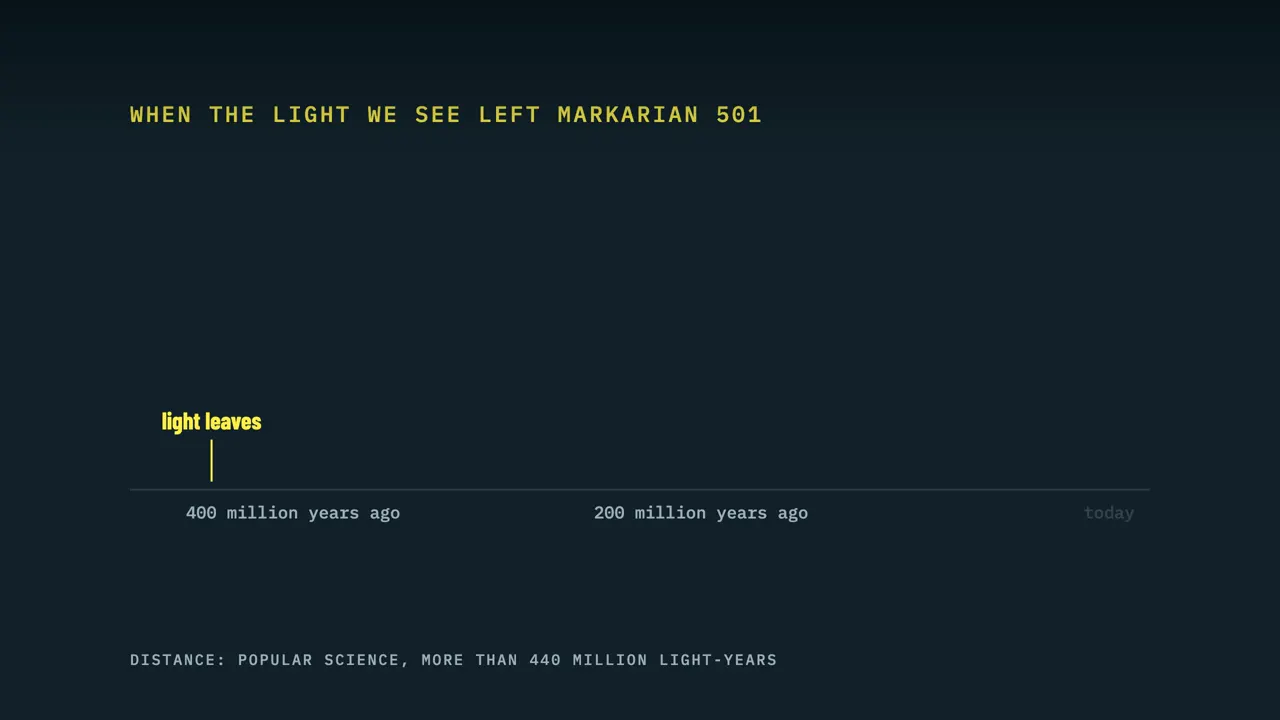
One last thing about that "100 years". The light we see from Markarian 501 left it hundreds of millions of years ago. So whatever is happening there now, we would only see it once its light reaches us. If the merger shows up in our sky a century from now, it happened there long before.
The news simply has not arrived. As Popular Science put it, no one will likely ever witness the actual grand finale. What can happen soon is a test. If the short rhythm keeps repeating in new, more frequent observations, the binary idea gets stronger.
If it fades, as signals in other candidates have, it gets weaker. And if the rhythm speeds up over the years, the pair is spiraling in. If the binary is confirmed, it would be strong evidence that nature really does get past the final parsec. Until then, Markarian 501 remains what the Max Planck Society's headline suggests.
A detection, with a question mark.
Watch on YouTube
Sources
- The study: Britzen et al. 2026, "Detection of a second jet within the nuclear core of Mrk 501", MNRAS 548, doi.org/10.1093/mnras/stag291 (CC BY 4.0)
- Max Planck Institute for Radio Astronomy press release, 7 Apr 2026; Max Planck Society newsroom, 7 Apr 2026
- Britzen et al. 2023, Universe 9, 115, doi.org/10.3390/universe9030115
- Rieger & Mannheim 2000, arXiv astro-ph/0011015
- Begelman, Blandford & Rees 1980, Nature 287, 307
- Vasiliev, Antonini & Merritt 2015, ApJ 810, 49; Milosavljevic & Merritt 2003
- Ryu et al., arXiv 1709.06501; Alonso-Alvarez, Cline & Dewar 2024, PRL 133, 021401
- Peters 1964, Phys. Rev. 136, B1224 (gravitational-wave inspiral time)
- Stanford News, June 2017 (0402+379); ESA/Hubble potw1520a (NGC 6240)
- OJ 287: Dey et al. 2019; Komossa et al. 2023, MNRAS Letters; Valtonen 2024, RNAAS; Valtonen et al. 2026, MNRAS 552
- PG 1302-102: Graham et al. 2015, Nature 518, 74; Vaughan et al. 2016, MNRAS
- PKS 2131-021: O'Neill et al. 2022, ApJL (via EarthSky)
- 3C 66B: Jenet et al. 2004; NANOGrav targeted search, Agarwal et al. 2026, ApJL 998, L11
- M87 jet precession: Cui et al. 2023, Nature 621, 711; EHT Collaboration 2019
- NANOGrav 15-year results: Agazie et al. 2023, ApJL 951, L8 and L50
- LIGO first detection: Abbott et al. 2016, PRL 116, 061102; MIT News, 5 Mar 2026 (catalog counts)
- LISA: ESA factsheet; NASA; arXiv 0909.0650
- Sesana et al. 2021, Experimental Astronomy 51, 1333 (the microhertz gap)
- The Debrief, ScienceAlert and Popular Science coverage, April 2026
- Numbers marked "our estimate" or "our calculation" are our own, from Kepler's third law and Peters' formula (circular orbit and equal masses unless stated), not the paper's.
- Figures, images and video credits
- Paper figures: Britzen et al. 2026 and Britzen et al. 2023, CC BY 4.0
- NASA Goddard Space Flight Center visualizations (SVS 13831, 13043, 13058, 14335) and NASA/JPL-Caltech (OJ 287 animation), public domain
- ESA/Hubble and NASA images (NGC 6240, Antennae, Hercules A, M87 jet, Einstein rings, eXtreme Deep Field), CC BY 4.0
- Event Horizon Telescope Collaboration (M87*), CC BY 4.0
- NRAO/AUI/NSF (Very Long Baseline Array), CC BY 4.0
- Illustrative stock footage from Pexels (Pexels License): Matthias Groeneveld, Luz Calor Som, Erhan Dayı, Stephen Martin, Batuhan Özmen, John Mackintosh. This footage is illustrative and does not show Markarian 501 or the telescopes that observed it.
- Narration is synthetic. Illustrations marked "Generated illustration" on screen are AI-generated, not images of Markarian 501. Earth is in no danger from this pair.