Why Fusion on Earth Must Be 10x Hotter Than the Sun

The most common fusion machines on Earth heat their fuel to about 150 million degrees Celsius, ten times hotter than the center of the Sun. Why do they need that much heat, and is that why fusion power is "always 30 years away"? This video starts in the Sun's core, where gravity packs the fuel tight enough for slow fusion, made possible by quantum tunneling. Then it follows the tokamak: the 1968 Soviet result that British scientists went to Moscow to test, the 1976 US fusion plan and its five funding paths, JET's records, the 2022 ignition at the National Ignition Facility, the remaining fuel and materials challenges, and the 2026 race in China, Europe, Korea and the United States.
This article is the full narration of the video. Watch on YouTube
Hotter than the Sun, and always 30 years away
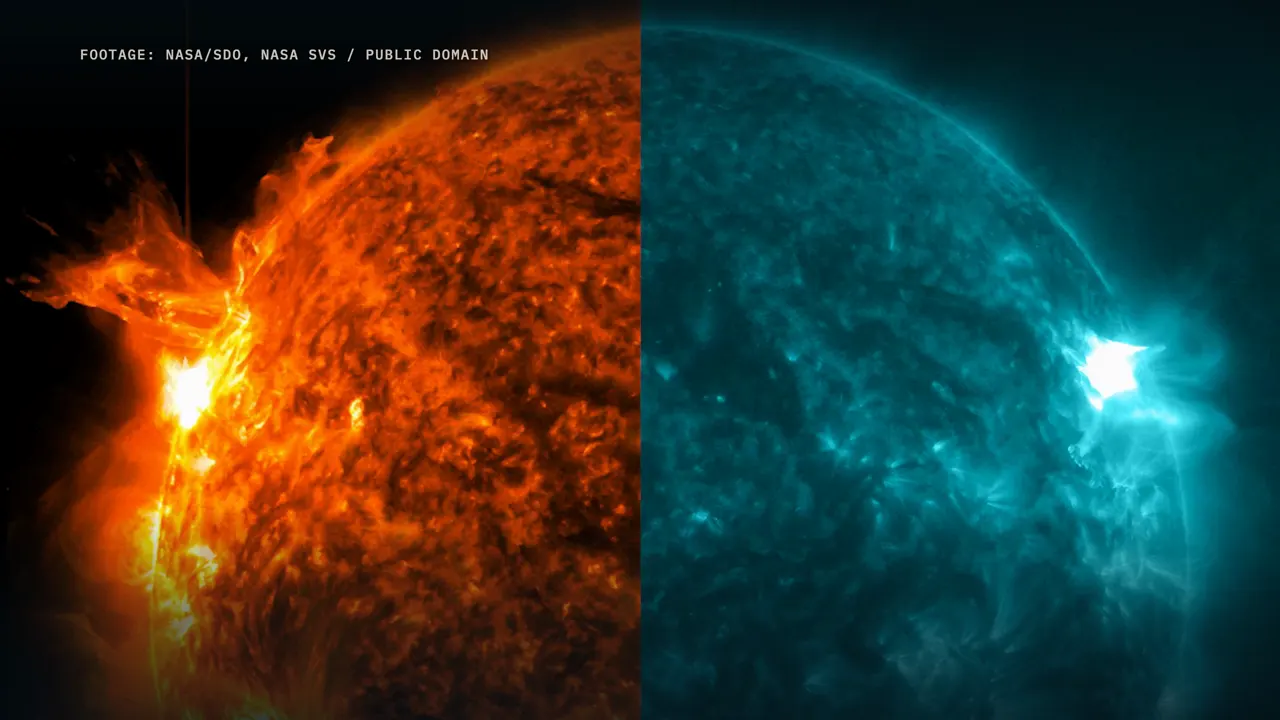
To make fusion work on Earth, we heat the fuel ten times hotter than the center of the Sun. The Sun's core is about 15 million degrees Celsius. The most common fusion machines on Earth heat their fuel to about 150 million degrees Celsius. Why would we need more heat than the Sun itself?
And there's an old joke among fusion scientists: fusion power is always thirty years away. Type "fusion is always" into Google, and "30 years away" pops right up. Nuclear fusion is how the Sun shines: light atomic nuclei join together and release energy. A fusion power plant would do the same thing here on Earth, turning that energy into electricity.
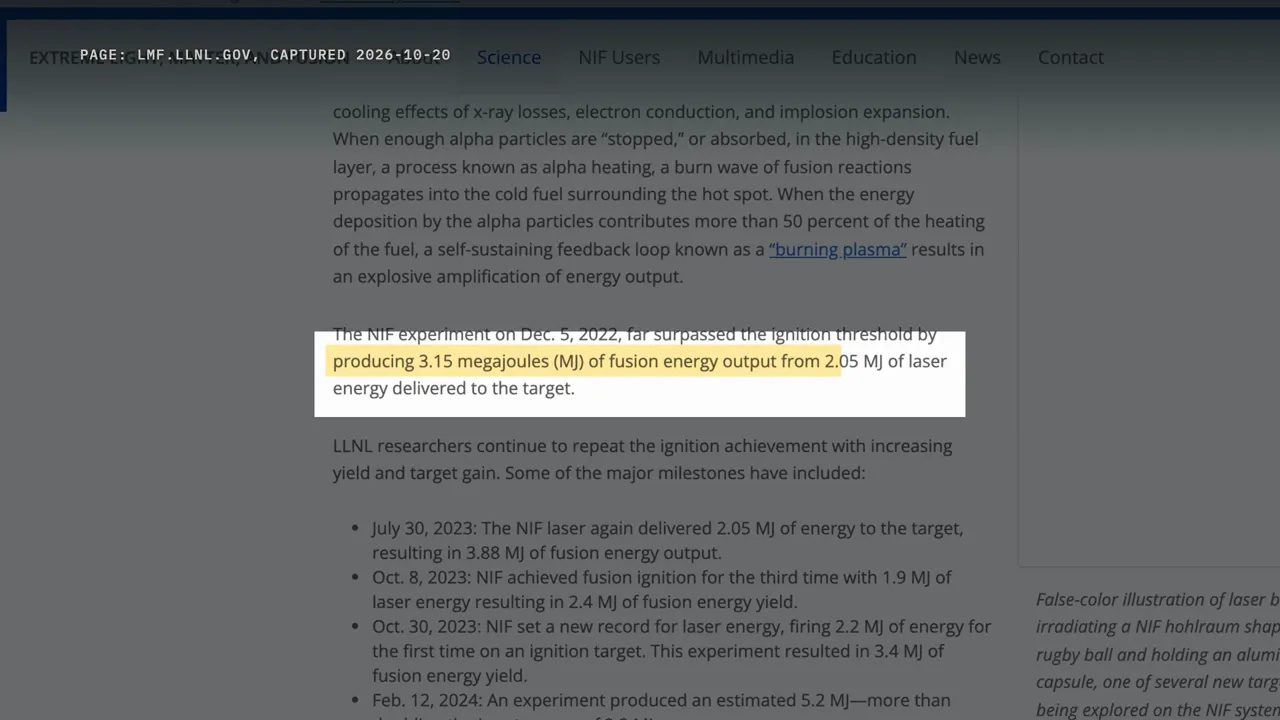
In December 2022, a laser lab in California announced that a fusion experiment had released more energy than its laser delivered to the fuel. Headlines around the world called it a breakthrough. Now, in 2026, China is building a machine it hopes will show that fusion can generate power around 2030. A US startup has a contract to connect a fusion plant to the grid by the end of 2028.
And the biggest fusion project on Earth, ITER in France, plans to start using real fusion fuel in 2039. So which is it? Is fusion almost here, or still thirty years away? And is the joke even fair? Does all that heat explain it? So start with a puzzle: if the Sun only needs 15 million degrees, why do we need 150?
The Sun only needs 15 million degrees

The problem is that atomic nuclei push each other away. Every nucleus has a positive electric charge, and like charges repel. To fuse, two nuclei have to get very close despite that push, and the hotter the fuel, the faster they move and the closer they get. By the rules of classical physics, the protons in the Sun's core are far too slow to ever get that close.
By those rules, the Sun shouldn't shine at all. What saves it is quantum tunneling. In the world of atoms, a particle without enough energy to climb over a barrier still has a tiny chance of turning up on the other side. It's as if a ball rolled too slowly to reach the top of a hill, and every so often appeared beyond it anyway.
Even the first step in the Sun's fusion chain needs another rare event: one of the two protons has to turn into a neutron at just the right moment. Put together, a typical proton in the core waits around ten billion years before it fuses. So how does the Sun shine so brightly? Gravity squeezes its core to a density of about 150 grams per cubic centimeter.
That's nearly eight times denser than gold. And the core is enormous, so even a very rare reaction happens an enormous number of times every second. In fact, a cubic meter of the Sun's core puts out only about 250 to 300 watts of heat. That's about what a heap of manure of the same size gives off, and less than a human body.
The Sun isn't a fierce furnace. It's a slow one, held together by gravity, with billions of years to spare. On Earth, we have none of that: no crushing gravity, no star-sized core, and no billions of years to wait. So we pay with temperature.
Why Earth needs 150 million degrees
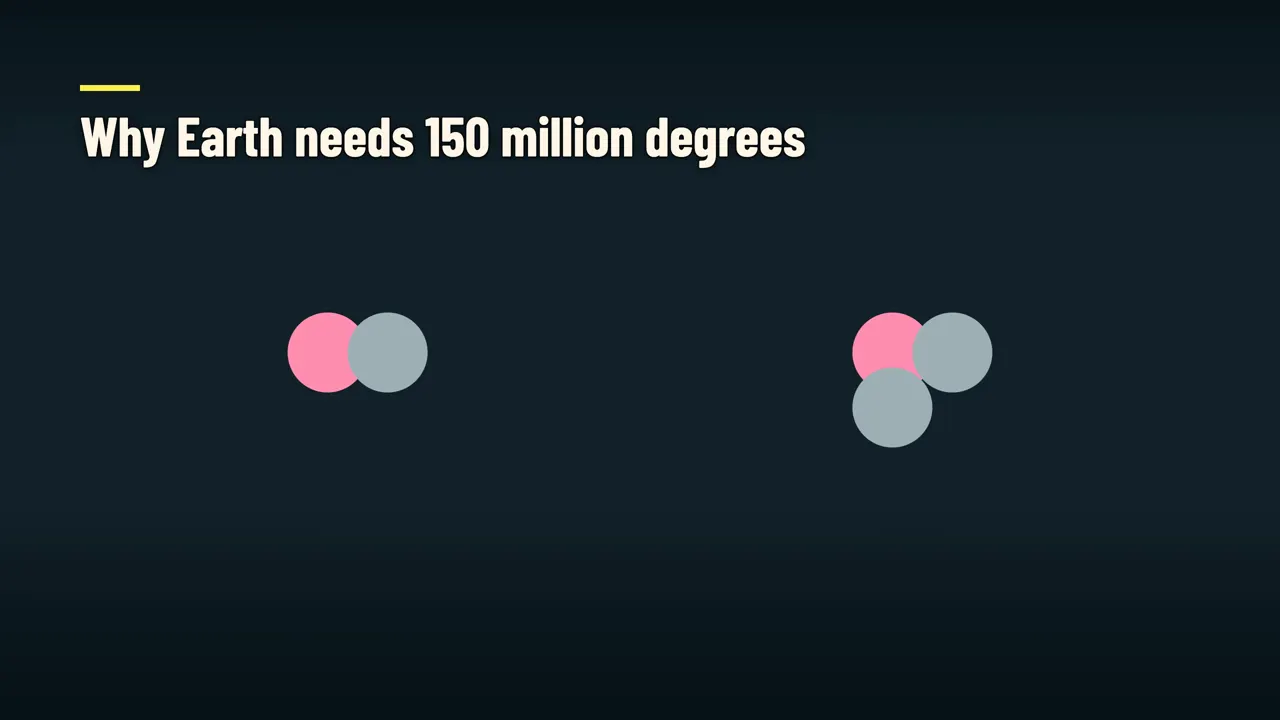
On Earth, the easiest fusion reaction to achieve is between two heavy forms of hydrogen. Deuterium is hydrogen with one extra neutron, and it can be extracted from water. Tritium has two extra neutrons, and there is very little of it in the world. When the two fuse, they make a helium nucleus and a neutron carrying a lot of energy.
To make that happen often enough, the fuel has to be heated to about 150 million degrees Celsius. At that heat, there's no ordinary gas left. The electrons break free of their atoms, leaving a hot soup of loose electrons and charged nuclei. That state is called plasma. You've seen plasma in lightning and in neon signs, but in a fusion machine it's far hotter, and the hydrogen is stripped down to bare nuclei.
But heat alone is not enough. In 1955, the physicist John Lawson worked out what the fuel needs for fusion to give out more energy than the heating puts in. His answer multiplies three things: how dense the fuel is, how hot it is, and how long it holds onto its heat. This three-part measure is called the triple product, and the minimum it has to reach is called the Lawson criterion.
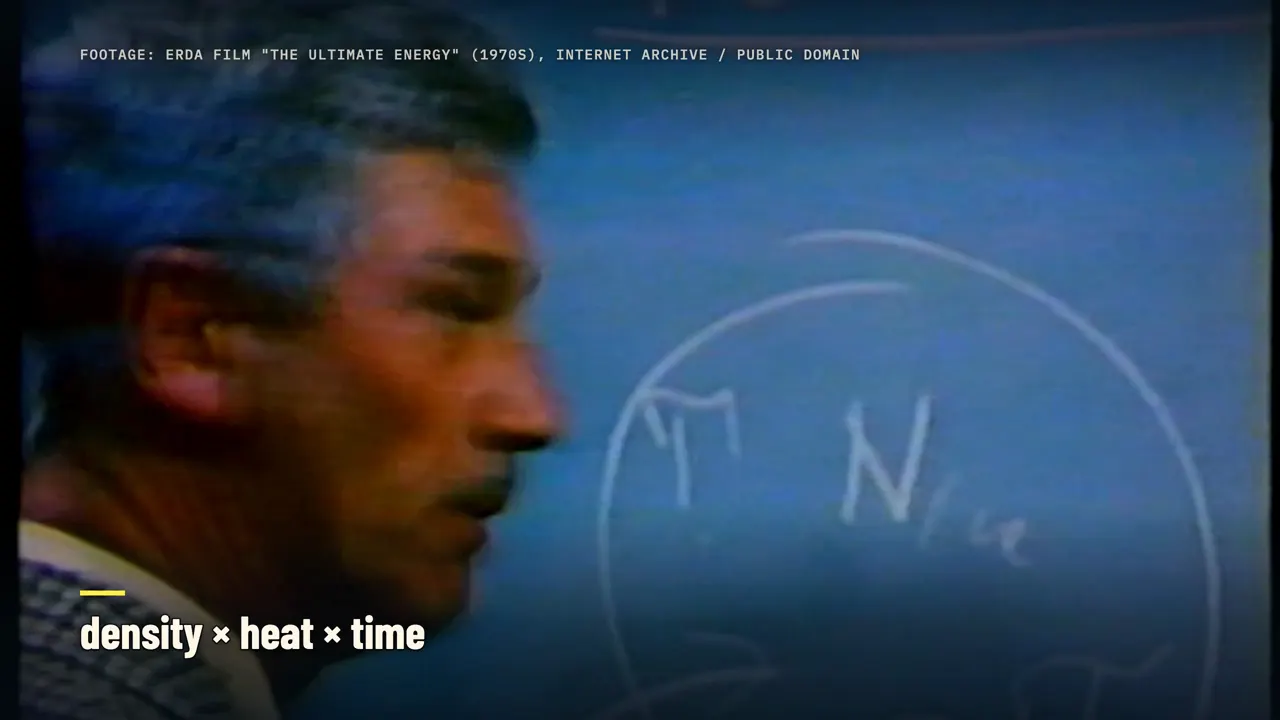
Think of a campfire: it keeps going only if it's hot enough, the wood is packed close enough, and it doesn't lose heat too fast. France's atomic energy agency, CEA, puts the best temperature for a tokamak, a doughnut-shaped fusion machine, at around 150 to 200 million degrees. And the plasma has to hold its energy for more than one second.
One second sounds short, until you remember that the fuel is ten times hotter than the Sun's core. In May 2025, Germany's Wendelstein 7-X set a world record for the triple product in a plasma it held for 43 seconds. Records like this are steps toward the target, not the target itself.
How do you hold 150 million degrees?
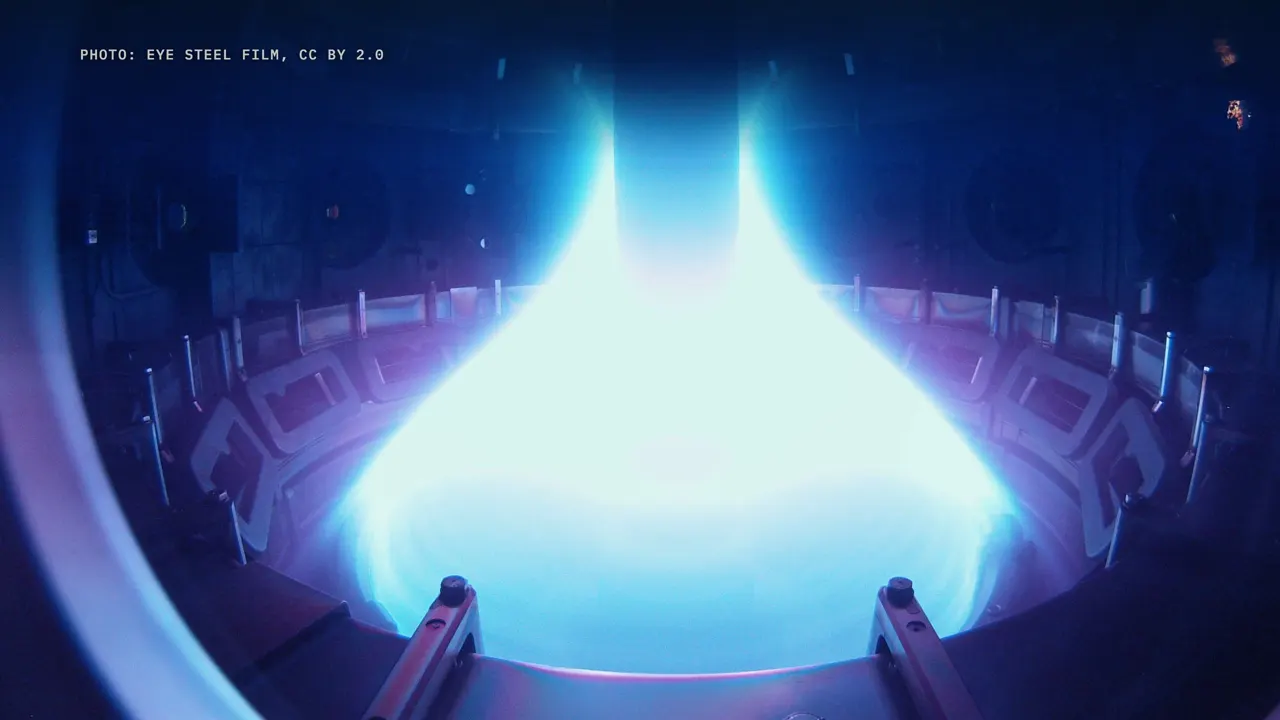
So how do you hold something at 150 million degrees? No material can touch it. The answer most labs chose is magnets. Plasma is made of charged particles, and charged particles follow magnetic field lines.
A tokamak is a doughnut-shaped vacuum chamber wrapped in powerful magnets, which keep the plasma floating away from the walls. The name comes from Russian, a short form of "toroidal chamber with magnetic coils." But plasma doesn't sit still. It twists, bulges and leaks, a bit like trying to hold jelly in your hand.
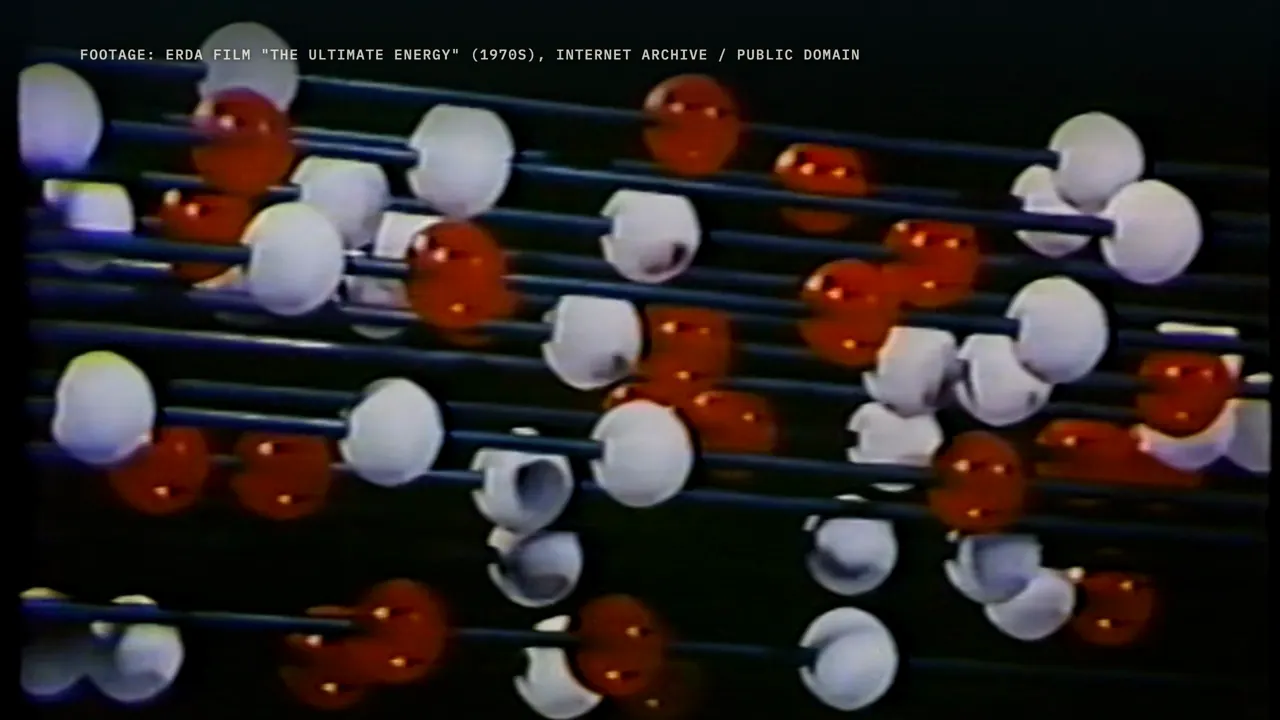
Swirls and sudden wobbles in the plasma, called turbulence and instabilities, carry heat out to the walls. In 1982, researchers at the ASDEX tokamak near Munich, in Germany, found a state that held heat much better. It's called high-confinement mode, or H-mode. But H-mode also brings bursts at the plasma's edge, called edge-localized modes, or ELMs.
In a machine as big as ITER, they could be strong enough to melt parts of the wall. There is a second way: skip the magnets, and crush a tiny fuel capsule with a laser so fast that it burns before it can fly apart. That's called inertial confinement, and we'll come back to it.
1968: the Soviet doughnut
For years, magnetic fusion struggled. At Princeton in the US, stellarators, another kind of magnetic fusion machine, couldn't get past about one million degrees, or hold their heat for more than a thousandth of a second. Then, in August 1968, fusion scientists from around the world met at a conference in Novosibirsk, in Siberia.
A Soviet team led by Lev Artsimovich reported that their tokamak, called T-3, had reached more than 10 million degrees. And it held its heat for tens of milliseconds. Many Western scientists didn't believe it. According to ITER's history pages, the head of the Princeton lab, Mel Gottlieb, told Artsimovich: "This is not possible!"
ITER's account calls the Soviet result a thunderclap. So, in the middle of the Cold War, a team of British scientists went to Moscow to measure it themselves. The UK Atomic Energy Authority calls it "an almost unprecedented breach of the 'Iron Curtain'." A small team from the Culham Laboratory in England arrived in the spring of 1969.
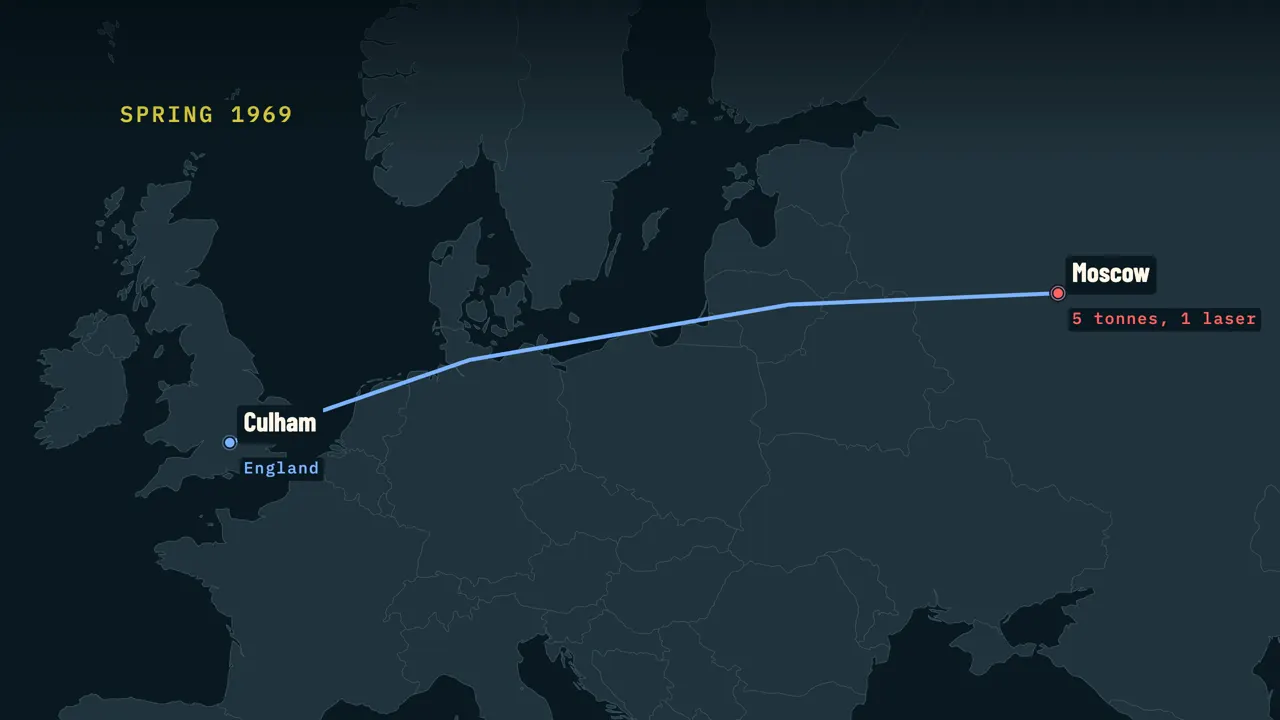
They brought about five tonnes of equipment, including their own laser. Their method was Thomson scattering: shine laser light into the plasma, and the way it scatters shows how hot the electrons are. By early August, they had about 88 shots. One of them, Mike Forrest, later said: "We were a bit scared."
The temperatures they measured were mostly in the 10-million-degree range. They published the results in Nature in 1969. The Soviet claim held up. Princeton rebuilt one of its stellarators as a tokamak, and matched the Soviet result about six months later.
Labs in the US, France, Japan and Germany turned to tokamaks. The doughnut won, and ITER is a tokamak too. With a design that worked, optimism grew. And so did the plans.
Where "30 years" really came from

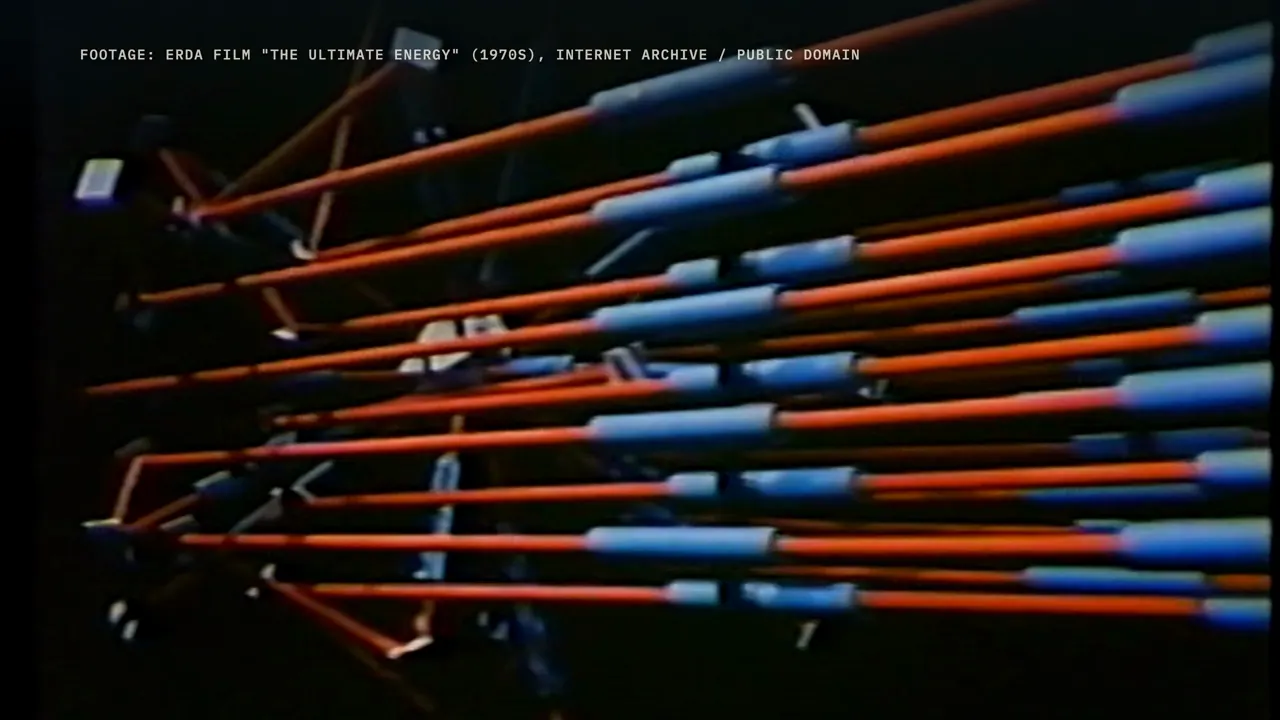
In July 1976, the US Energy Research and Development Administration, or ERDA, published a plan for fusion power. A year later, ERDA's work was folded into the new Department of Energy. The plan did not give one date. It gave five. It laid out five funding paths, called Logic One to Logic Five, and showed when each could lead to a demonstration reactor.
A demonstration reactor, or DEMO, is the step after experiments: a plant built to show fusion can really make power. At the top was Logic Five, "maximum effective effort," in which "all reasonable requests are honored immediately." That path aimed for a demonstration plant around 1990. Logic Four, "accelerated," aimed for the early to mid-1990s.
Logic Three, "aggressive," was the reference plan, with a demonstration reactor in 1998. The report put that path at about 15.5 billion dollars, from 1978 until the demonstration reactor started up, counted in 1978 dollars. Its total yearly spending would climb from about 160 million dollars in 1976 to about one billion dollars a year by the mid-1990s. Logic Two, "moderately expanding," said a demonstration reactor might operate in the early 21st century.
And then there was Logic One: research at a fixed level, "in order to develop basic understanding." For that path, the report gave no date at all. It said: "If this pace were continued, a practical fusion power system might never be built." So the 1976 plan wasn't one prediction. It was a menu, with a date next to each price.
Congress did reach for the faster path, at least on paper. In October 1980, the Magnetic Fusion Energy Engineering Act set a goal of a demonstration plant by the turn of the century. Dean later called it a 20-billion-dollar, 20-year effort. But a 2004 history of the US program, by Stephen Dean, says: "The provisions of the Act were never implemented."
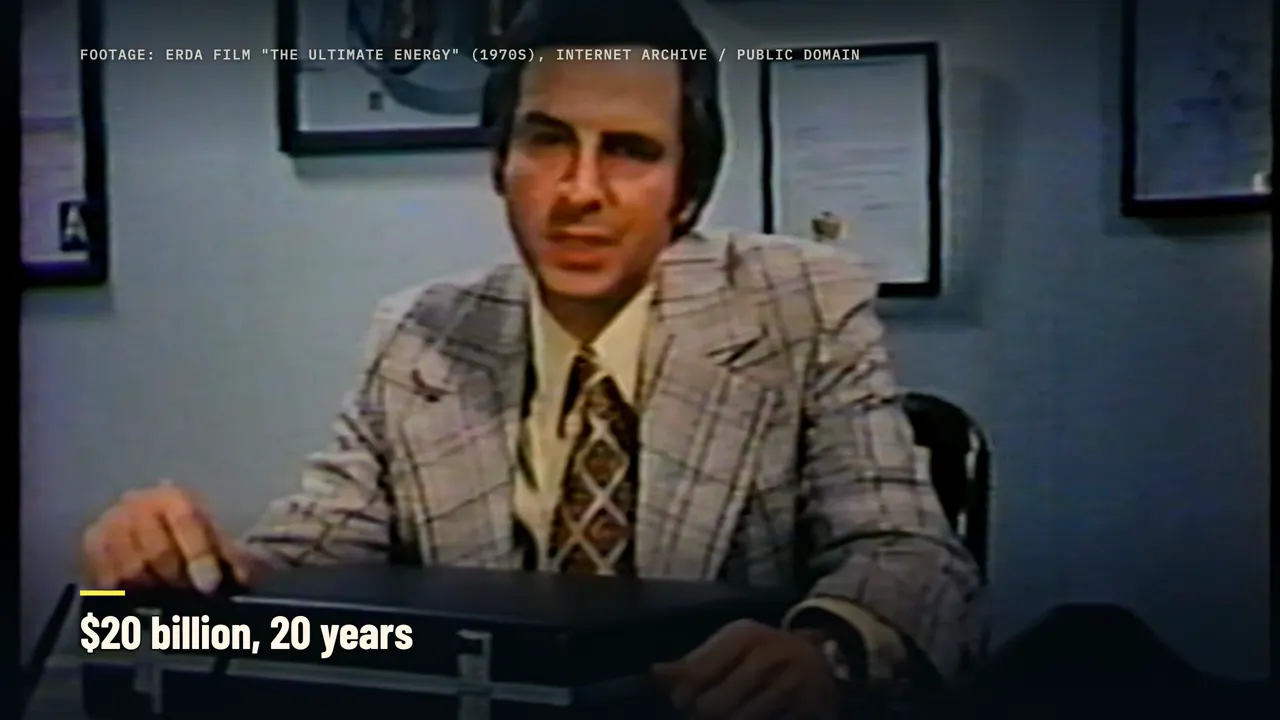
Dean describes a program "on a downhill slide since 1980." In the mid-1990s it was cut again, from 365 million dollars in 1995 to 225 million in 1997, in the money of those years. Dean's chart, in the same 1978 dollars, shows the plan calling for about a billion a year by the mid-1990s, and the real budget below a fifth of that. You may have seen a version of the 1976 chart online, with real budgets drawn in and a line labeled "fusion never."
That label isn't in the original figure. The report only says Logic One might never lead to a power system. So here it is, redrawn from the report's own tables. The popular chart does get one thing right. In the original figure, Logic One's operating budget alone is roughly 200 million a year, and from the late 1980s, Dean's chart puts the whole real budget for magnetic fusion below that line.
The dates in the 1976 plan came with a bill, and the bill was never paid in full. And the "always thirty years" part isn't quite right either. In 2023, three researchers in Japan gathered 45 published predictions, from 1985 to 2022, and fitted a trend through them. By that trend, fusion was said to be 19.3 years away thirty years ago, 28.3 years away twenty years ago, and 27.8 years away ten years ago.
And in 2022, that trend put fusion 17.8 years away. So the number moves. It just hasn't reached zero. But money is only part of the story. Even well-funded machines had to learn how hard this really is.
The records: from JET to NIF
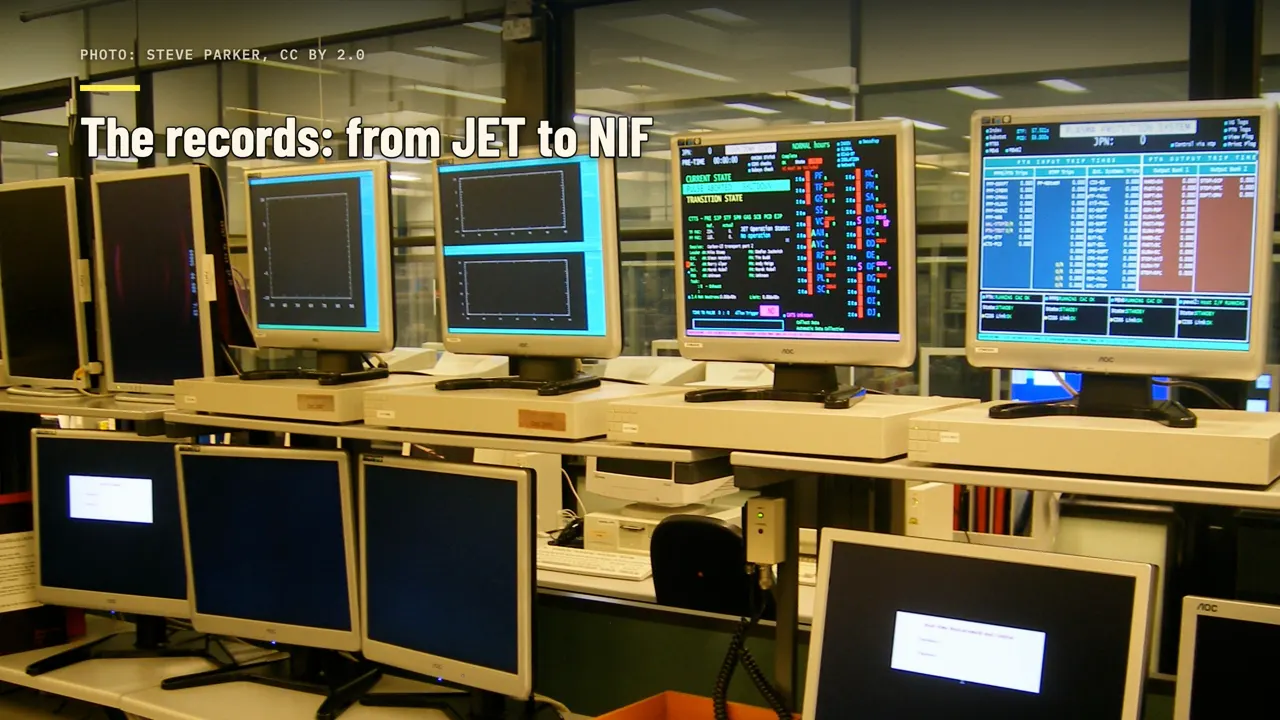
Europe's flagship tokamak was JET, the Joint European Torus, at Culham in England. In 1991, JET first ran on deuterium and tritium, and made 1.8 megawatts of fusion power. In 1997, it reached a peak of 16 megawatts for a moment, and in a separate, longer shot it released about 22 megajoules of energy. One megajoule is about what a 1,000-watt microwave oven uses in 17 minutes.
In December 2021, JET made 59 megajoules over a five-second pulse. Even then, the fusion power was only about a third of the heating power going in. In its final experiments in 2023, JET set one more record: 69 megajoules over about five seconds, from just 0.21 milligrams of fuel. At the end of 2023, it was switched off for good.
The laser route got further. The National Ignition Facility, or NIF, at Lawrence Livermore National Laboratory in California, fires a huge laser at a tiny capsule of fuel. On December 5, 2022, the laser delivered 2.05 megajoules to the target, and fusion gave out 3.15 megajoules. The lab calls this ignition: producing more fusion energy than the laser energy delivered to the target.
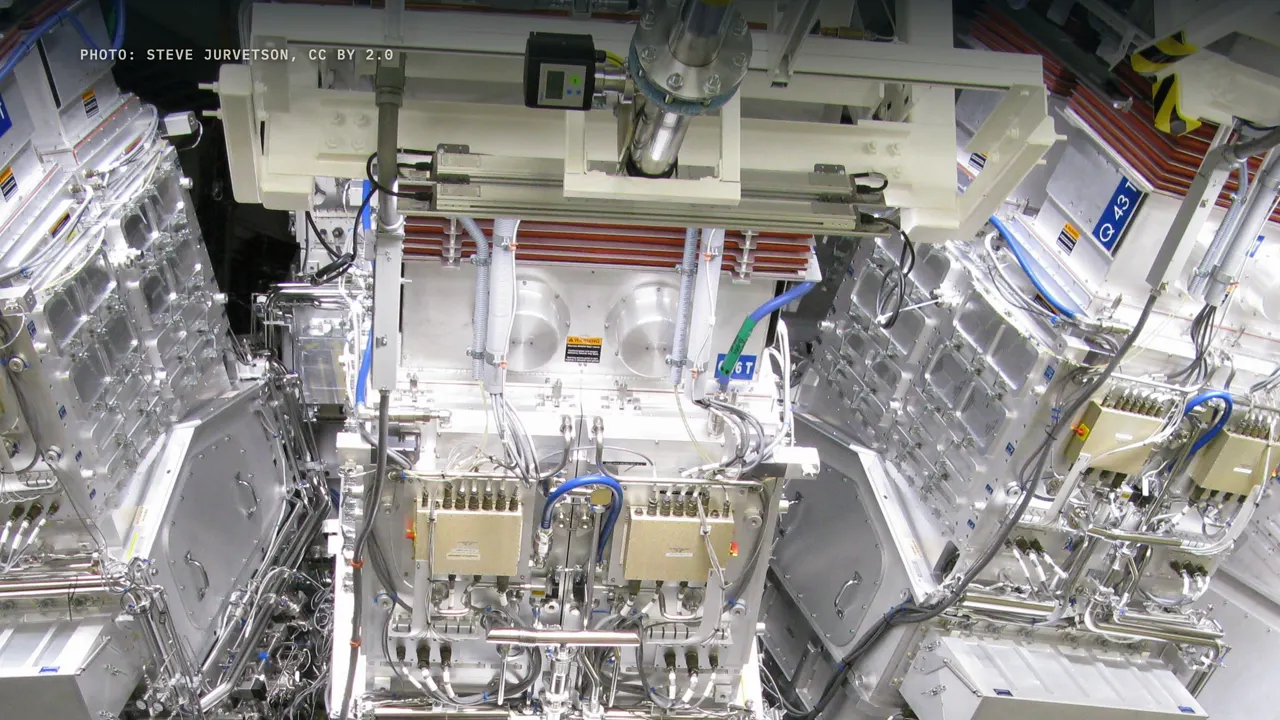
It wasn't a one-off. In April 2025, NIF got 8.6 megajoules from 2.08 megajoules of laser light, a gain of about four. By October 2026, it had reached ignition eleven times, and that April shot was still the record. It also came late. NIF had aimed for ignition by the end of 2012.
When that campaign ended in September 2012, it was still about ten times short of the goal. Ignition came ten years late. But it came.
Ignition is not electricity
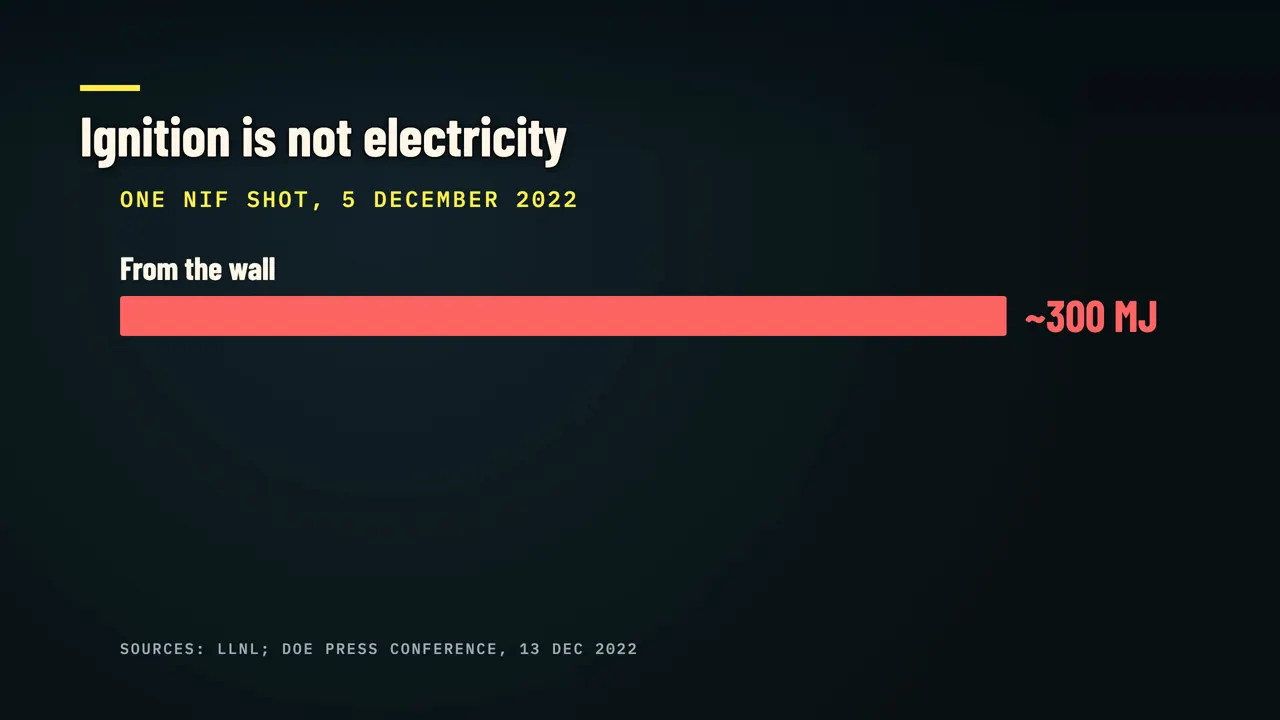
So did fusion finally make more energy than it used? Not quite. At the 2022 announcement, the lab's director said the laser takes about 300 megajoules from the wall to make two megajoules of laser light. That's roughly a hundred times more than the 3.15 megajoules the fusion gave out. Think of it as three steps on a staircase.
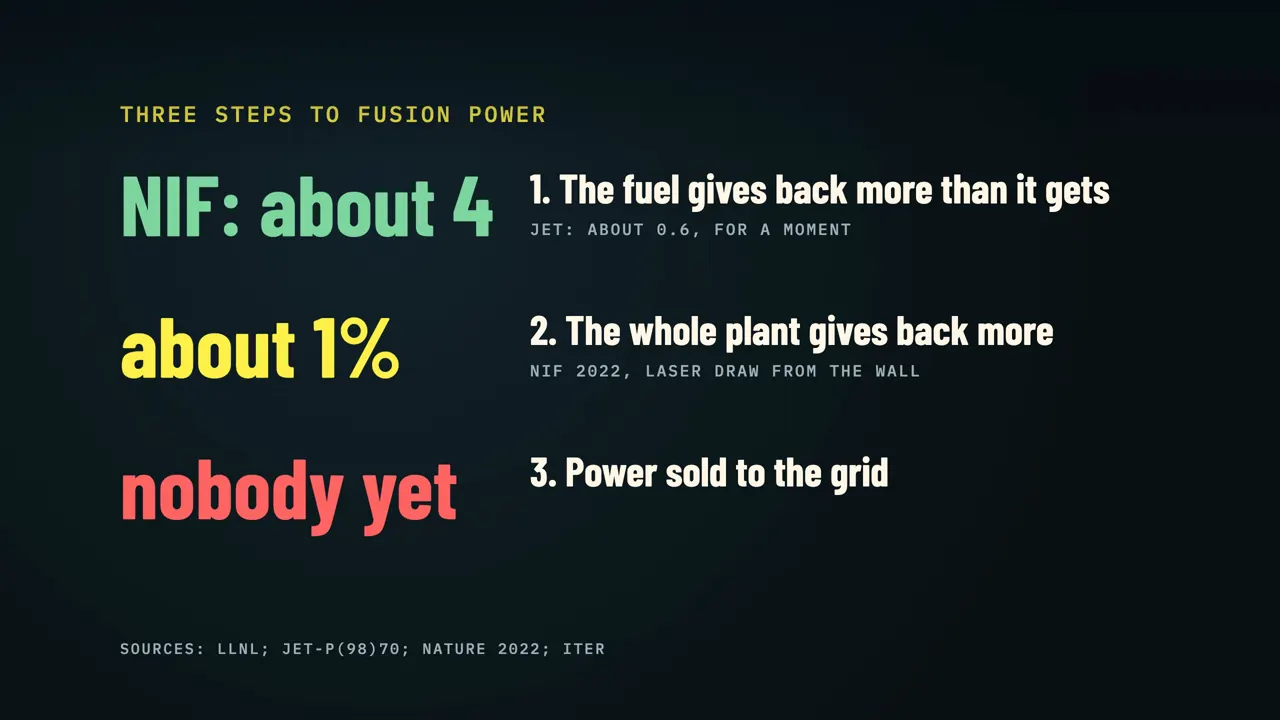
Step one is scientific gain: fusion energy out, divided by the energy delivered to the fuel. For NIF, that's the laser energy reaching the target. Above one, the target gives back more energy than it was given. NIF has passed step one, with a best gain of about four. Magnetic machines haven't yet. JET's best was about 0.6, for a moment in 1997. Its 2021 record pulse averaged about a third.
Step two is engineering gain: the electricity a whole plant sends out, divided by all the electricity it uses. That includes the lasers or magnets, the pumps, the cooling, everything. Counting the laser's draw from the wall, the 3.15 megajoules of fusion were about one percent of the 300 megajoules it used. No fusion machine has reached one on this step.
Step three is selling electricity to the grid, day after day. Nobody is there yet. Even ITER is a step-one machine. It's designed to make 500 megawatts of fusion power from 50 megawatts of heating, a gain of ten. In ITER's own words, it "will not convert the heating power it produces as electricity."
Even the words shift. The company Helion now says the term "net electricity," which it once used in a headline, "was not well defined within the fusion industry." So when a headline says "net energy," it's worth asking: net of what? Even the head of Lawrence Livermore at the time, Kim Budil, was careful in 2022.
Asked how long until a power plant, she said "probably decades," then added: "not six decades, I don't think, I think not five decades, which is what we used to say." With concerted effort and investment, she said, "a few decades of research on the underlying technologies could put us in a position to build a power plant."
A few decades. The joke, again.
The fuel and the wall
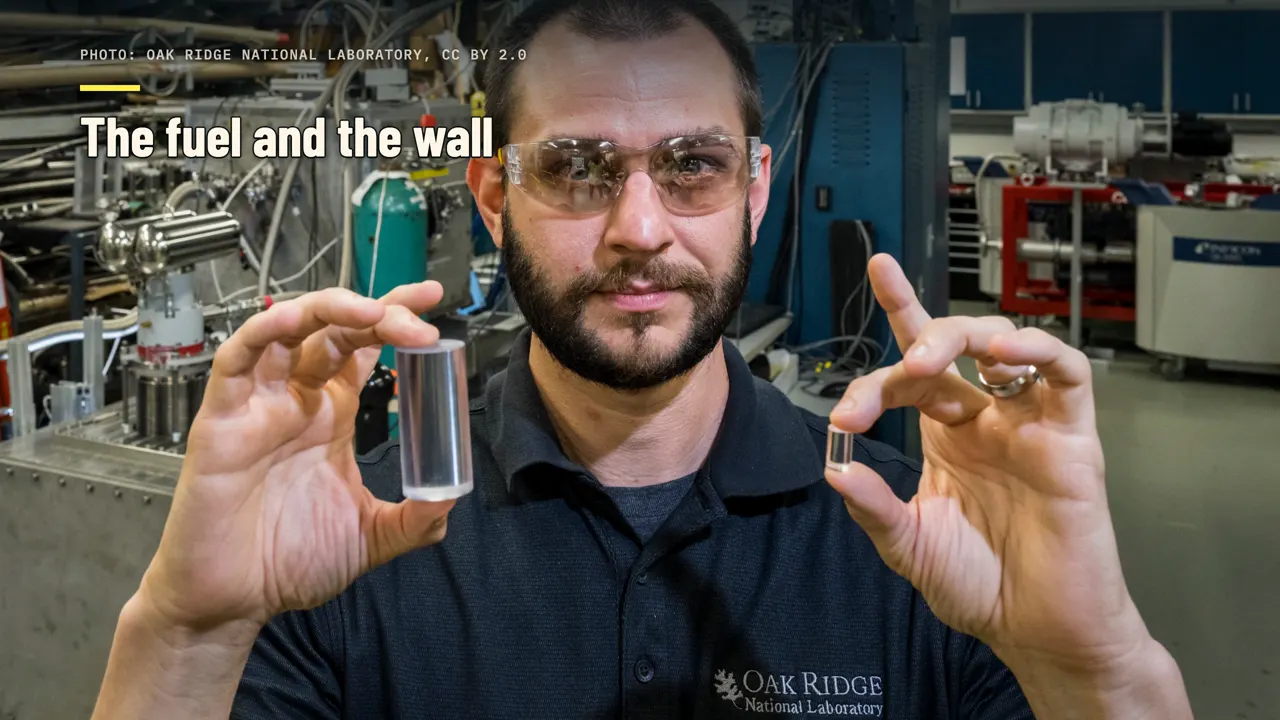
Even once a plasma gives out more energy than the heating puts in, two problems remain: the fuel, and the wall. You often hear that fusion fuel comes from seawater. Deuterium does, and so does lithium, the raw material for making tritium. But tritium itself is radioactive, with a half-life of 12.3 years.
So about half of any stockpile is gone after twelve years. It can't be saved up for long. ITER estimates the world's tritium stock at "a few dozen kilograms." The only readily available source is a type of fission reactor called CANDU. ITER says it will be "by and far the largest tritium consumer ever."
A 2008 ITER article estimated that a power plant would burn about 56 kilograms of tritium a year for every gigawatt of fusion heat. So a plant making one gigawatt of fusion heat would burn, in a single year, roughly as much tritium as the whole world holds. The plan is for plants to make their own. Neutrons from the reaction would hit lithium in a layer around the plasma, called a breeding blanket, and turn it into tritium and helium.
ITER will only test small blanket modules. No one has yet shown, at full scale, that a plant can breed all the tritium it burns. The second problem is the wall. Fusion neutrons carry so much energy that they slowly damage the materials around the plasma, and make them radioactive.
To test materials under those conditions, Europe is building a facility called IFMIF-DONES in Granada, Spain. Construction was underway by 2023, and is expected to take about ten years. In October 2025, the US Department of Energy published a fusion roadmap listing gaps still to close, including materials, the fuel cycle and blankets. It aims for fusion power on the grid by the mid-2030s, but the roadmap itself says it doesn't commit the department to any funding level.
These aren't questions about whether fusion works. They're questions about whether a plant can run for years.
The 2026 race

And now, private money is pouring in. By the industry association's count, fusion companies raised a record 4.5 billion dollars in the year to July 2026. In January 2025, China's EAST tokamak held a high-confinement plasma at 100 million degrees for 1,066 seconds, about 18 minutes. A few weeks later, France's WEST tokamak kept a cooler plasma going for 1,337 seconds, about 22 minutes. These are records for how long a plasma lasts, not for how much energy it makes.
In Hefei, China is building a new tokamak called BEST. By October 2026, Chinese state television reported that more than half of its assembly work was done, with completion planned for the end of 2027. Its goal is to demonstrate deuterium-tritium fusion power generation around 2030. The Chinese Academy of Sciences calls the goal the "world's first electricity generation from fusion power."
In July 2025, China's state nuclear company set up a fusion company in Shanghai, with 15 billion yuan of registered capital, about 2.1 billion US dollars. A US think tank, CSIS, cites an estimate that China put at least 6.5 billion dollars of public money into fusion from 2023 to 2025. Over the same years, the fusion science program of the US Department of Energy got about 2.3 billion.
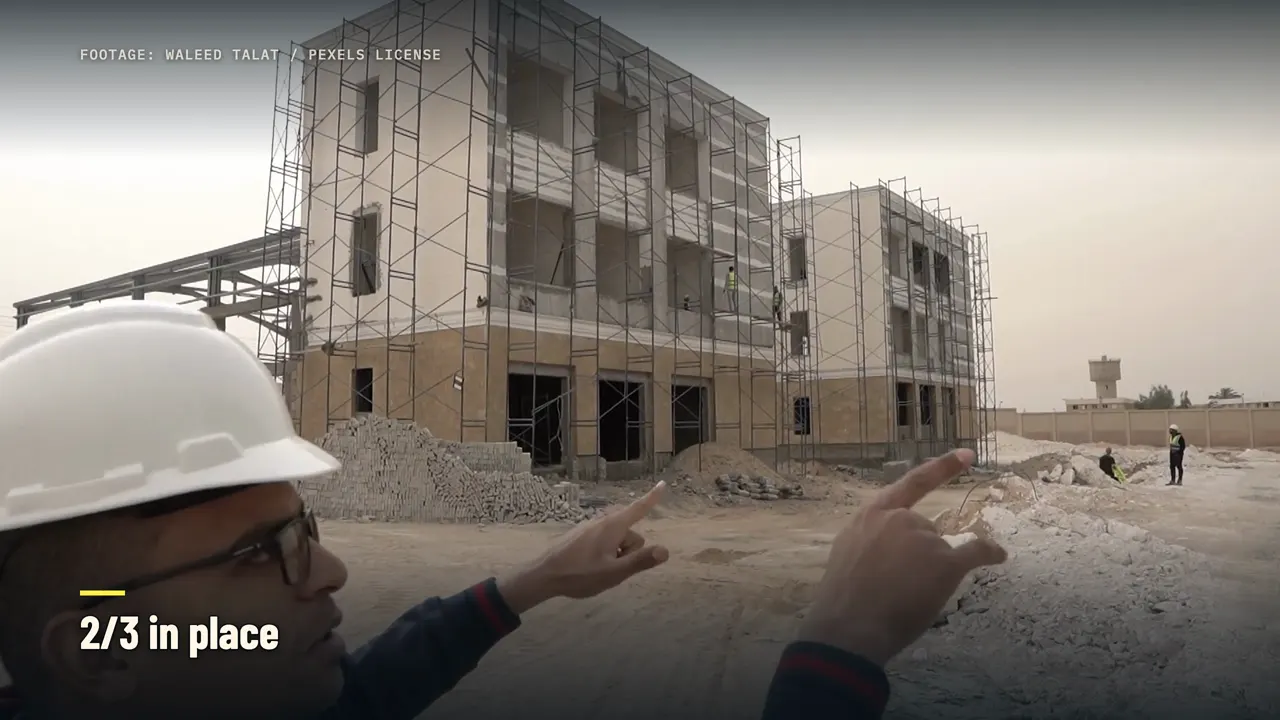
That's an outside estimate. China hasn't published an official total. ITER is moving too. On October 2, 2026, the last of ITER's nine vacuum vessel sectors arrived on site. Europe built five, and South Korea built four. By July 2026, six of the nine sector modules were in the tokamak pit, which ITER says means "two-thirds of the plasma chamber are now in place."
But in 2024, ITER pushed its schedule back. An earlier plan had first plasma in 2025. Now research operation starts in 2034, and ITER starts using deuterium-tritium fuel in 2039. Its director general put the delay's extra cost at about 5 billion euros. Physics World puts the total in the "tens of billions of euros." Private companies are in the race too.
In Devens, Massachusetts, Commonwealth Fusion Systems is assembling a compact tokamak called SPARC. It aims to produce more fusion energy than it takes to run the process, and the company says that will happen in 2027. In June 2025, Google agreed to buy 200 megawatts from the company's first power plant, called ARC, which it expects to put on Virginia's grid in the early 2030s.
Helion, in Washington state, uses a different design. In February 2026, it said its prototype had reached plasma temperatures of 150 million degrees and made measurable deuterium-tritium fusion. Its contract with Microsoft calls for its first plant to connect to the grid and begin operations by the end of 2028. TAE Technologies agreed in December 2025 to merge with Trump Media, in an all-stock deal valued at more than 6 billion dollars.
As of October 2026, that deal still hadn't closed. The companies now aim to finish it by the end of the year. South Korea's KSTAR kept ions at 100 million degrees for 48 seconds in early 2024. The stated goal then was 300 seconds by 2026. In 2026, Korean press coverage of the new national fusion plan put that goal in the mid-2030s.
Which brings us back to the question. Why do the dates keep moving?
Why the dates keep slipping
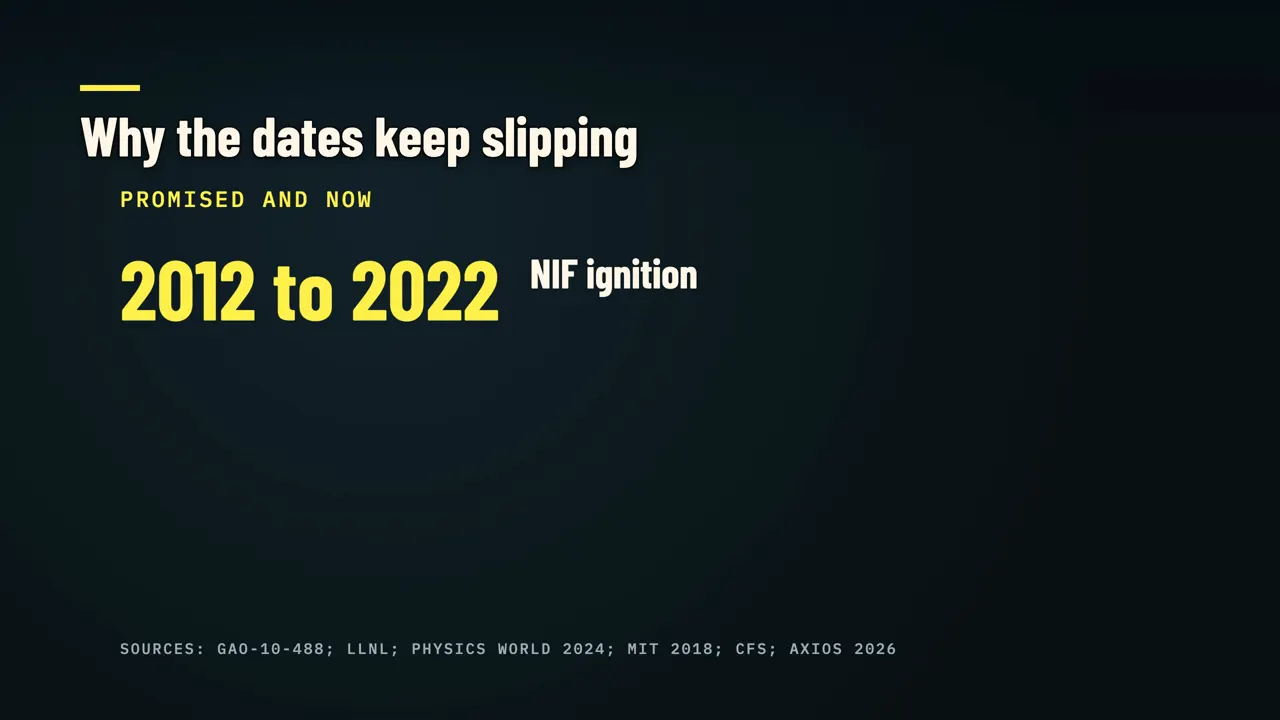
NIF: ignition planned for 2012, reached in 2022. ITER: first plasma planned for 2025, research operation now in 2034. SPARC: in 2018, MIT and Commonwealth Fusion Systems aimed for a working pilot plant within 15 years. Today, SPARC is still being assembled for a 2027 test.
Helion: its website once said its plant would produce electricity by 2028. In 2026, that wording changed to "begin initial operations in 2028." Its public affairs director said at a 2026 conference: "We will not, in no universe, have 50 megawatts hit full operation in 2028." She said full power would come in 2029 or 2030. Part of the reason is that each of these machines is the first of its kind.
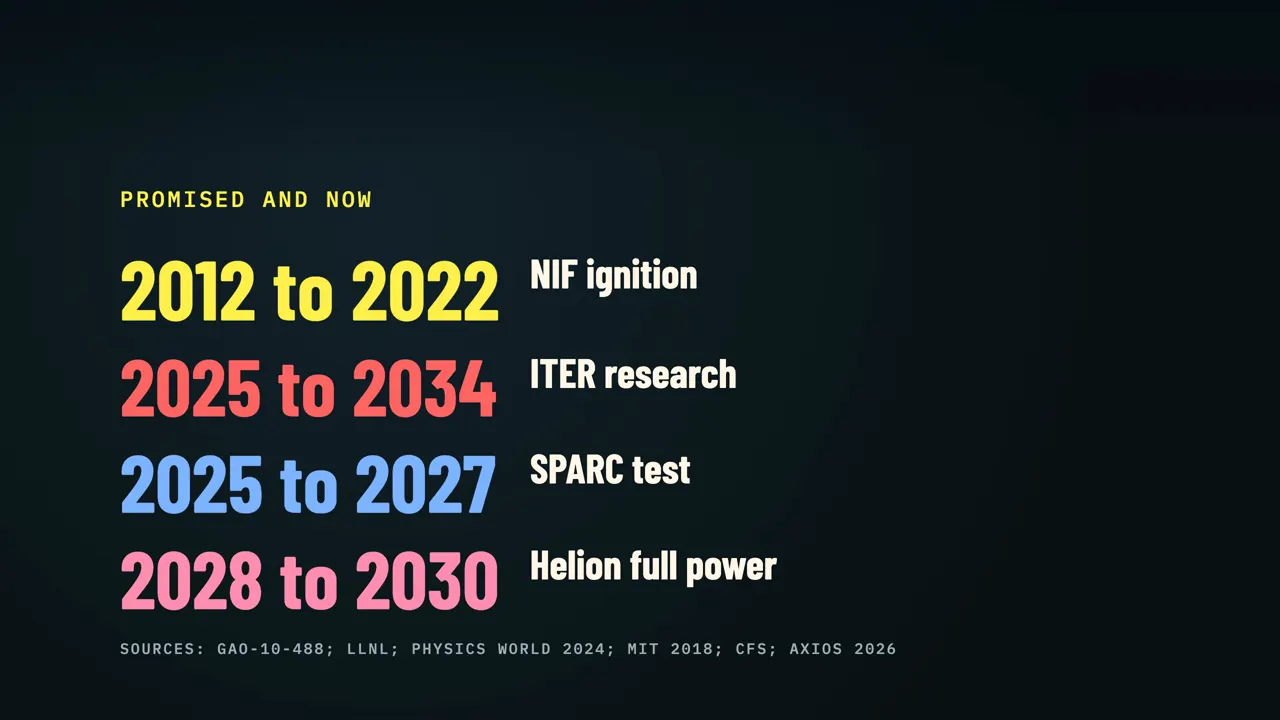
At ITER, one sector module is "on the critical path," which means a delay there delays everything after it. And some physics only shows itself once the machine is built and switched on. ITER's director general, Pietro Barabaschi, put it this way: "Fusion should be thought of as an innovation program." Innovation doesn't run on a train timetable.
And part of the reason goes back to 1976: the dates assumed money that didn't come.
Will fusion come when we need it?
So, is the joke fair? Half of it isn't. In 1976, every date came with a price, and the slowest, lowest-funded path said fusion power might never be built. And the forecasts haven't always said thirty years. The other half is fair. Fusion really is that hard: ten times hotter than the Sun's core, with fuel we have to make, and walls that have to survive.
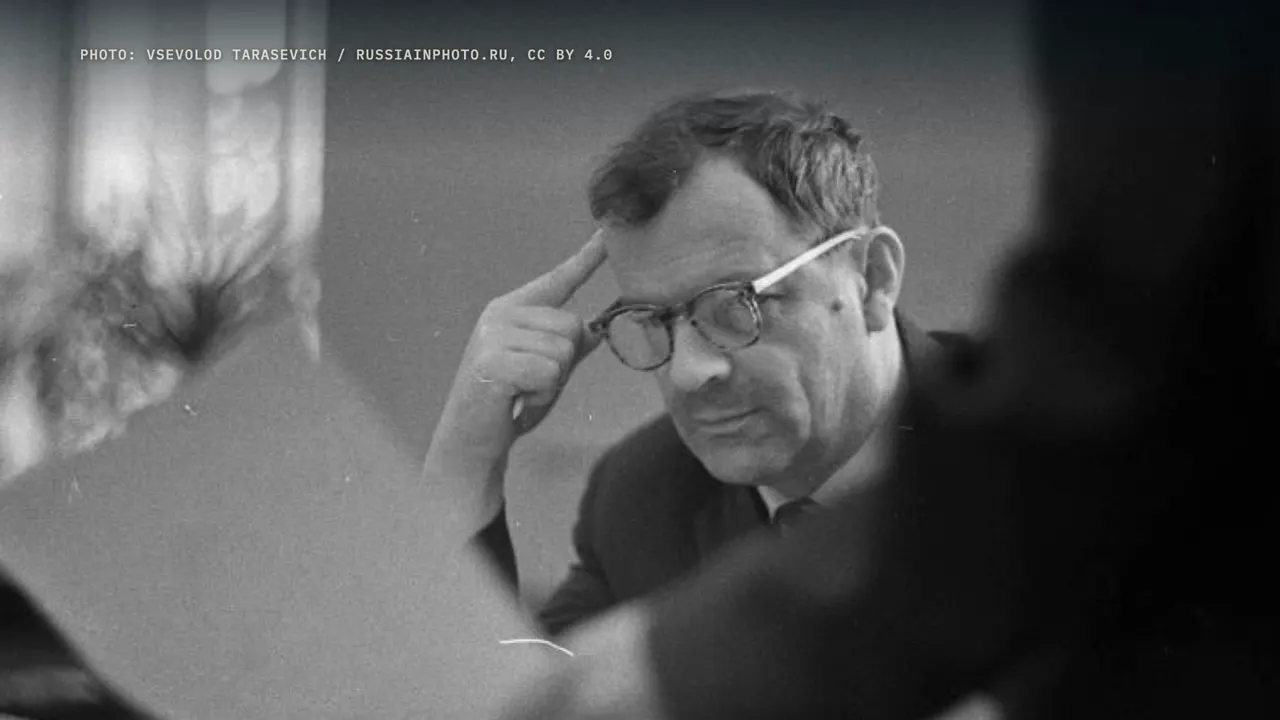
Lev Artsimovich, who led the T-3 team, is often credited with saying that fusion would arrive when humanity truly needed it. In 1976, the need was there on paper, but the money didn't follow. In 2026, governments and tech companies are putting in billions. What's left is the fuel, the materials, and turning fusion heat into electricity that people can buy.
Whether that takes ten years or thirty, you'll be able to check, because this time the dates are on the record. The Sun has been running its slow fusion for billions of years. Here on Earth, we're trying to do it ten times hotter, and on a deadline.
Watch on YouTube
Sources
- 1976 plan: ERDA-76/110/1, Fusion Power by Magnetic Confinement Program Plan, Vol. I (July 1976), read on the scan at fire.pppl.gov; S. O. Dean, Historical Perspective on the United States Fusion Program (2004); Magnetic Fusion Energy Engineering Act of 1980 (Public Law 96-386)
- Forecasts: Takeda, Keeley and Managi, How Many Years Away is Fusion Energy? A Review, Journal of Fusion Energy 42:16 (2023)
- Physics: NASA, Sun facts; J. N. Bahcall, How the Sun Shines (2000); Adelberger et al., Rev. Mod. Phys. 83, 195 (2011); Bertulani and Kajino (2016); ITER Newsline (2024); EUROfusion; CEA IRFM; DOE Explains Plasma; IPP; Wagner et al., PRL 49, 1408 (1982)
- 1968 to 1969: ITER Newsline (2008, 2009, 2011); UKAEA (2019); Peacock et al., Nature 224, 488 (1969)
- Records: JET-P(98)70; Nature (2022); EUROfusion (2024); LLNL, Achieving Fusion Ignition; GAO-10-488; Physics Today (2012); DOE and LLNL press conference, 13 Dec 2022
- Fuel and materials: ITER (2008, 2025); Delaporte-Mathurin et al., Nuclear Fusion (2025); EUROfusion, IFMIF-DONES (2023); US DOE Fusion Science and Technology Roadmap (2025)
- 2025 to 2026: CAS; CEA; CCTV via Science and Technology Daily (1 Oct 2026); ANS Nuclear Newswire; CSIS (2026); Fusion Industry Association via E&E News (2026); ITER Newsline (Oct 2026); Physics World (2024); CFS; Helion; Axios (2026); TAE and Trump Media filings with the SEC; Financial News and iNews24 (Korea); IAEA (2022)
Images and video
- Footage: ERDA film "The Ultimate Energy" (1970s), public domain, via Internet Archive; NASA/SDO and NASA Goddard SVS, public domain
- Stock footage (Pexels License): Altaf Shah; Ambient_Nature_ Atmosphere; ArtHouse Studio; Bonus Studio; Caleb Oquendo; cottonbro studio; Guidance Pillar Production; Jakub Zerdzicki; K; Kaboompics (karola-g); KoolShooters; Magda Ehlers; Mathias De Rivo; Mikael Blomkvist; Mike Sangma; Mikhail Nilov; Pressmaster; Ricky Esquivel; Rihard-Clement-Ciprian Diac; ROMAN ODINTSOV; Rosane Pavan; Waleed Talat; 정규송 Nui MALAMA; these are general scenes, not the machines or events described
- CC BY 4.0: Christophe Roux / CEA IRFM; Christopher Roux / EUROfusion; Clement Mahoudeau / European Union, 2026; EUROfusion; Oak Ridge National Laboratory; V. Savostyanov and E. Kassin / Glavarkhiv Moskvy (mos.ru); Vsevolod Tarasevich / russiainphoto.ru
- CC BY-SA 4.0: David Monniaux; IRFMfusion / Elodie Bernard / CEA IRFM
- CC BY-SA 3.0: Michel Maccagnan
- CC BY-SA 2.0: Nico Kaiser
- CC BY 3.0: Xiang Gao et al. 2017
- CC BY 2.0: Christopher Michel; Eye Steel Film; Oak Ridge National Laboratory; Steve Jurvetson; Steve Parker; U.S. Nuclear Regulatory Commission; US ITER
- Public domain: US Department of Energy and AEC archives; US Energy Research and Development Administration (1976 report); NASA/SDO
- Most images via Wikimedia Commons and Flickr; web pages are shown as captures with the site name and capture date on screen (axios.com, iter.org, lmf.llnl.gov, stdaily.com, tae.com, 20 Oct 2026)
- Narration is synthetic.