Can Birds See Earth's Magnetic Field?

For years, robins in a German university's bird lab could not pick their migration direction. The cause turned out to be the faint electrical noise of the city around them, and shielding their huts with grounded aluminium brought their compass back. This video follows how scientists worked out that migrating birds carry a magnetic compass: ink-pad funnels, robins that read the tilt of Earth's field instead of north and south, a compass that only works in light, radio waves that scramble it, a brain area that links it to vision, and the leading suspect, a protein in the eye called cryptochrome 4 whose chemistry may depend on quantum physics. Nobody has yet shown it working inside a living bird.
This article is the full narration of the video. Watch on YouTube
A compass that broke
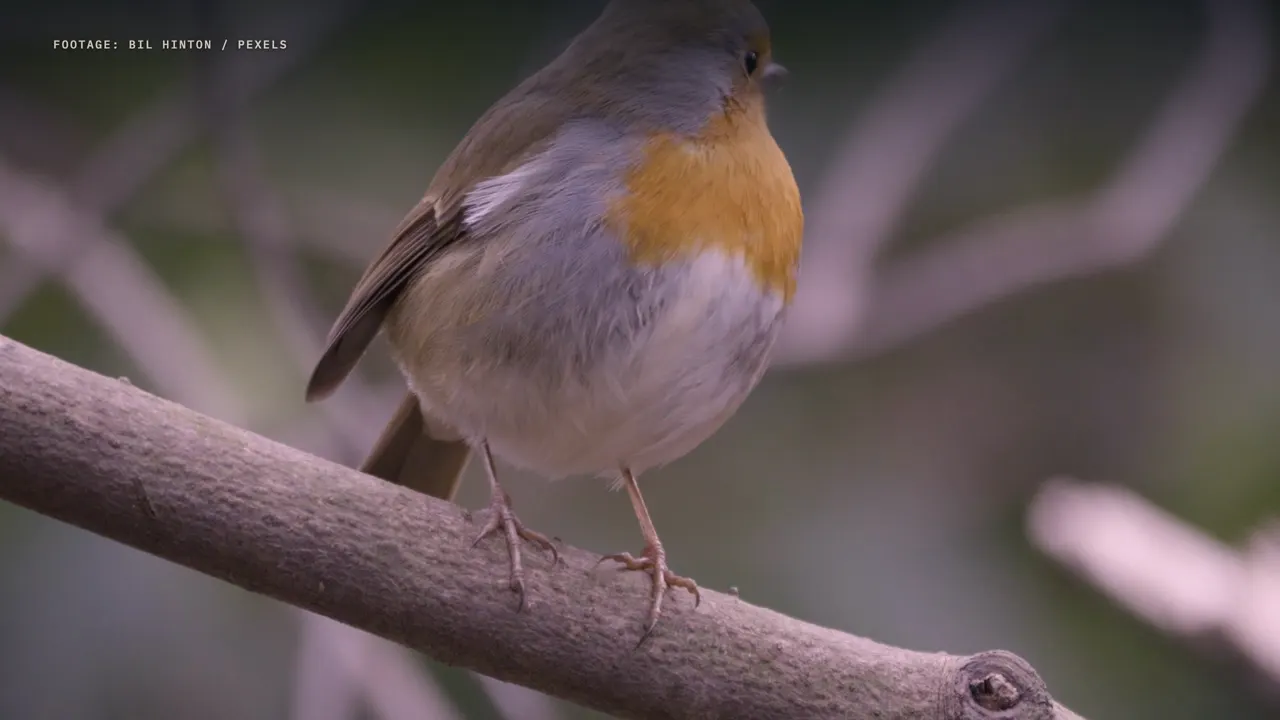
For years, the robins in a German university's bird lab could not find their way. They were restless migrants, ready to travel, but their headings were scattered in every direction. The cause turned out to be the faint electrical noise of the city around them, about a thousand times below what is considered safe for people. When the scientists lined the wooden huts with grounded aluminium, the robins knew the way again.
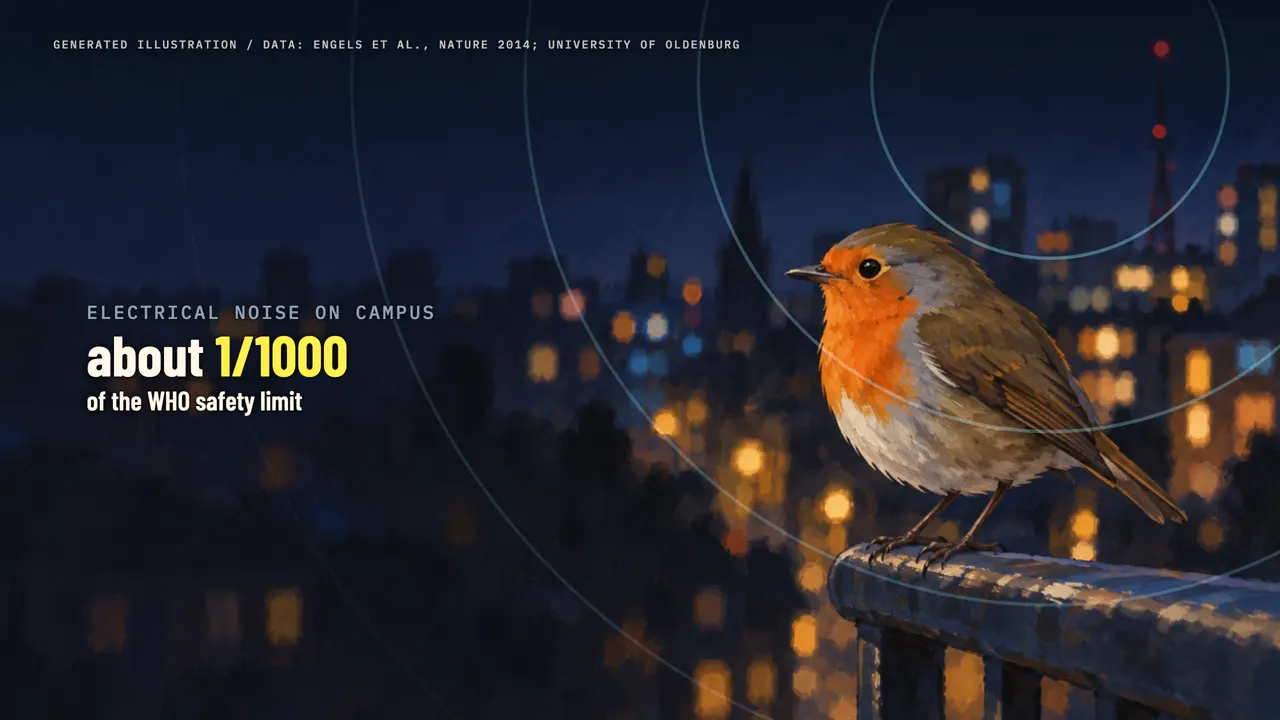
That weakness is one of the best clues to how a bird's compass works, and the answer may be a quantum reaction inside its eye.
Flying blind
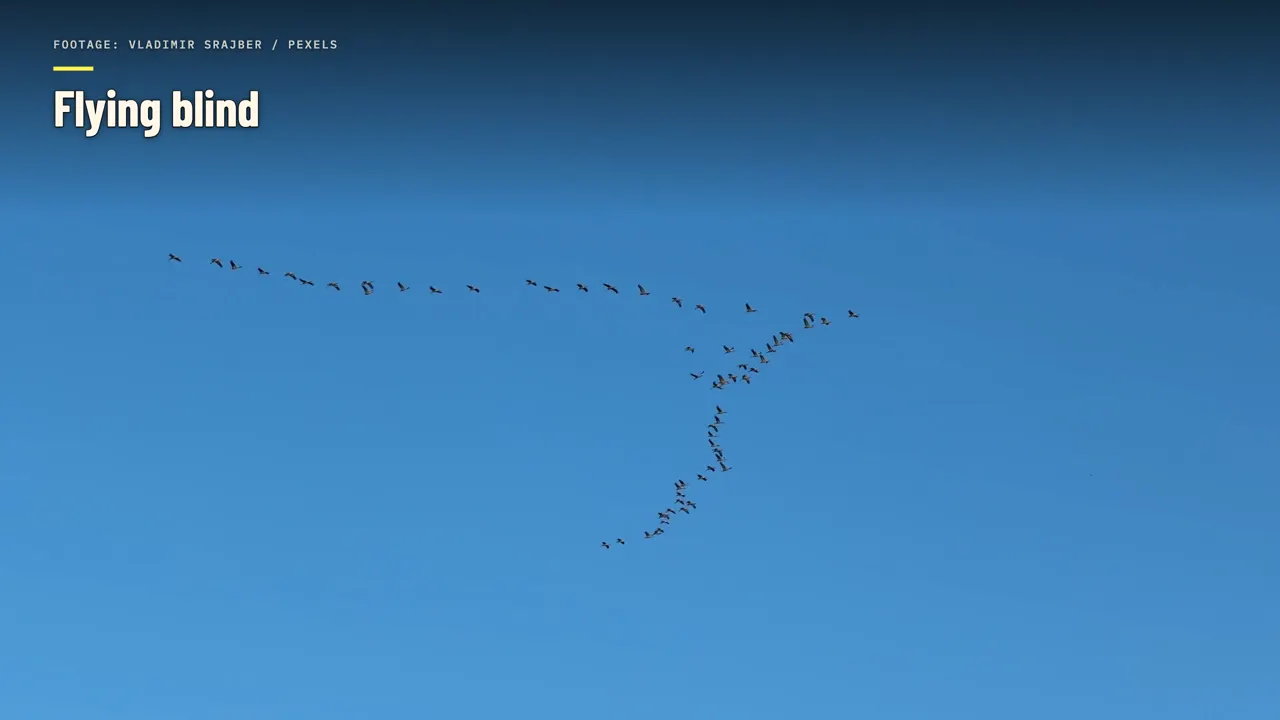
In North America alone, billions of birds migrate south every autumn. Many of the small ones travel in the dark. In a 2026 study that tracked 56 species of land birds on four continents, on average 82% of migration flights happened entirely at night. Some birds fly astonishing distances.
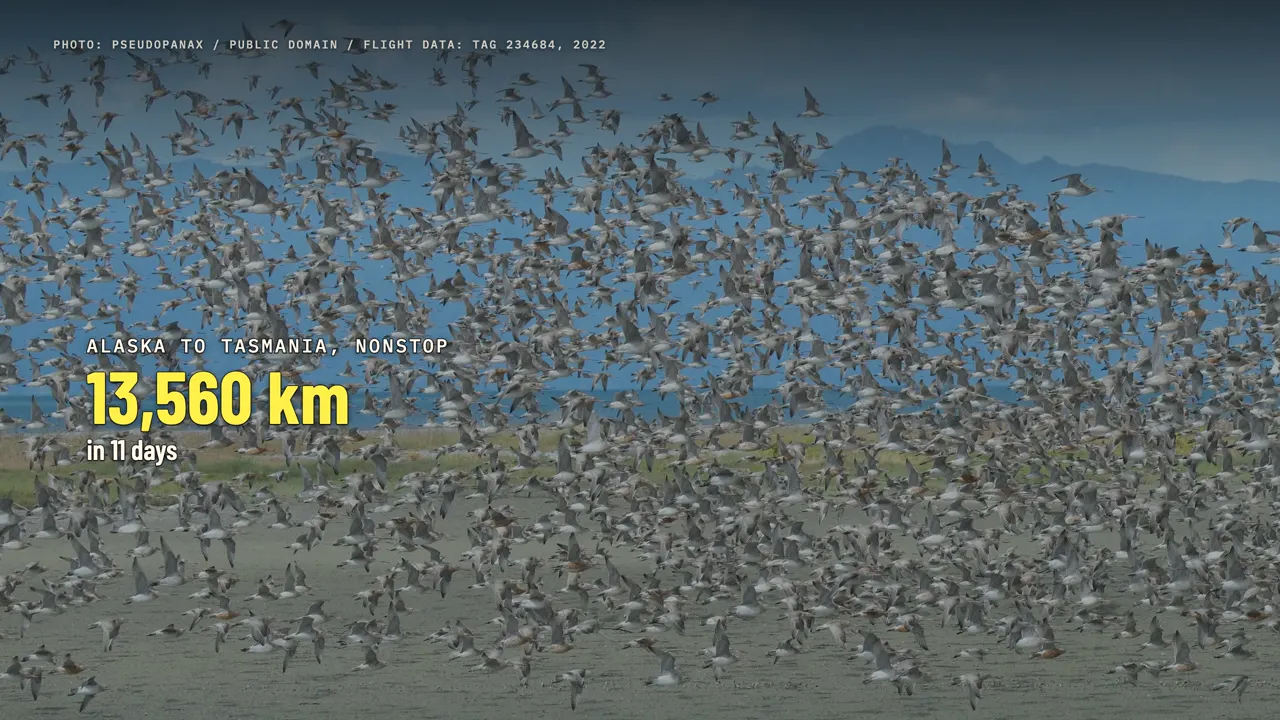
In 2022, a young shorebird called a bar-tailed godwit flew from Alaska to Tasmania in 11 days, about 13,560 kilometers without stopping. Many first-year migrants make the trip without an adult to follow. They can use the setting sun, the stars and landmarks along the way. But stars disappear behind clouds, and the open sea has no landmarks.
Earth's magnetic field is there all the time, day and night, in any weather. The question is whether a bird can feel it, and if so, how.
A funnel and an ink pad
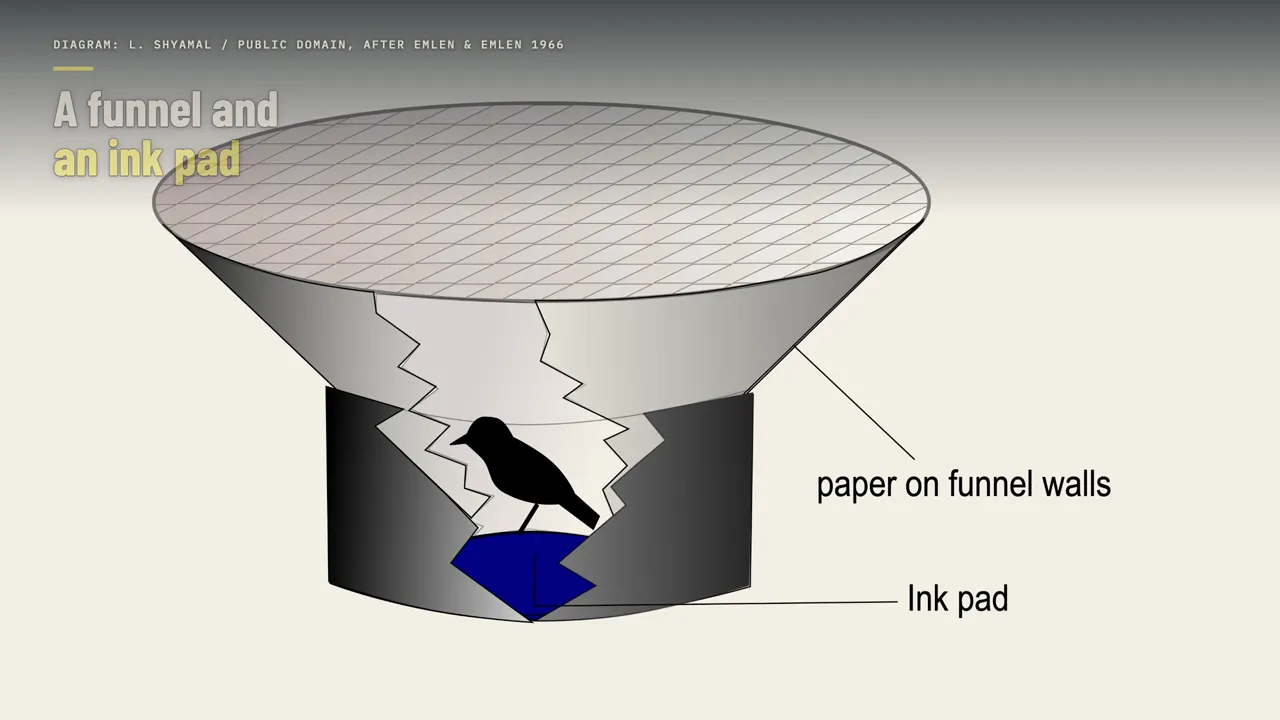
Testing that takes a surprisingly simple tool. In 1966, Stephen Emlen and his father John described a funnel made of white blotting paper, set over an ink pad. During migration season, a caged migrant gets restless at night and keeps hopping up the funnel walls. Every hop leaves an inky footprint, and by morning the footprints point the way the bird wanted to go.
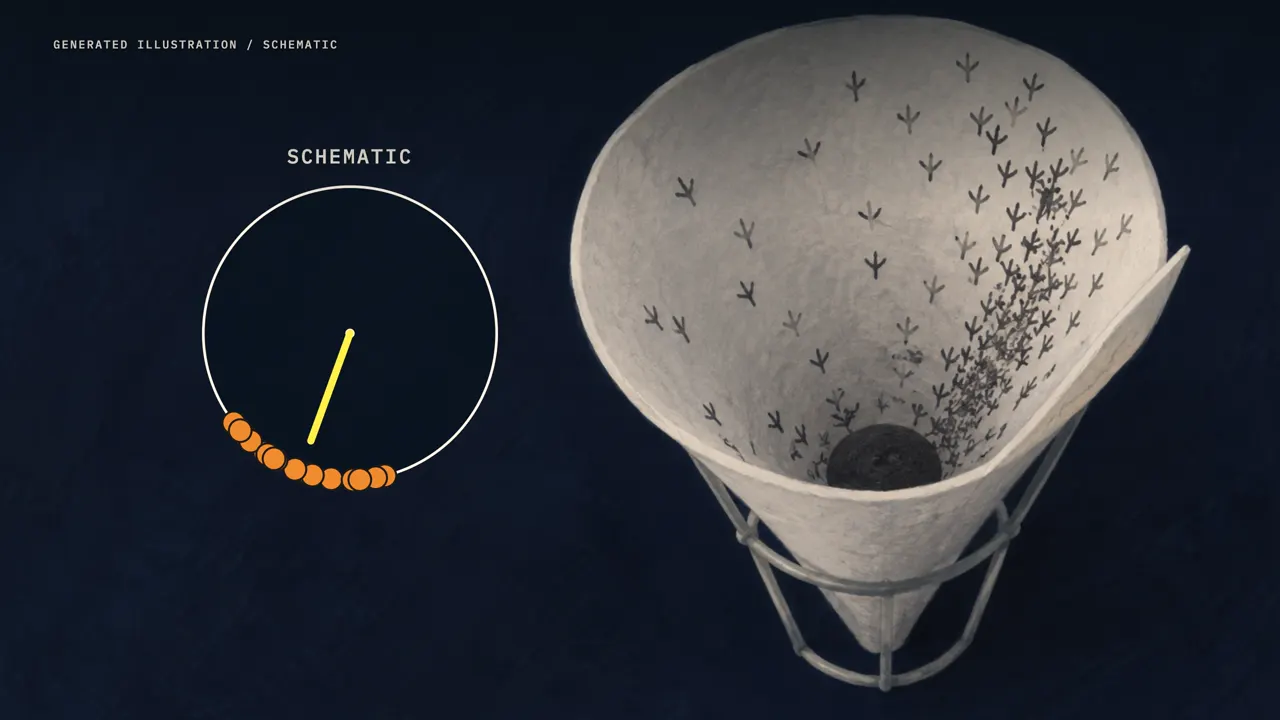
German researchers had already been testing European robins in closed rooms, where the birds could not see the sky. The robins still picked their seasonal direction. And when the magnetic field around the cage was turned with electric coils, the birds turned with it. So the field mattered, but the robin's compass turned out to be very different from ours.
A compass without north
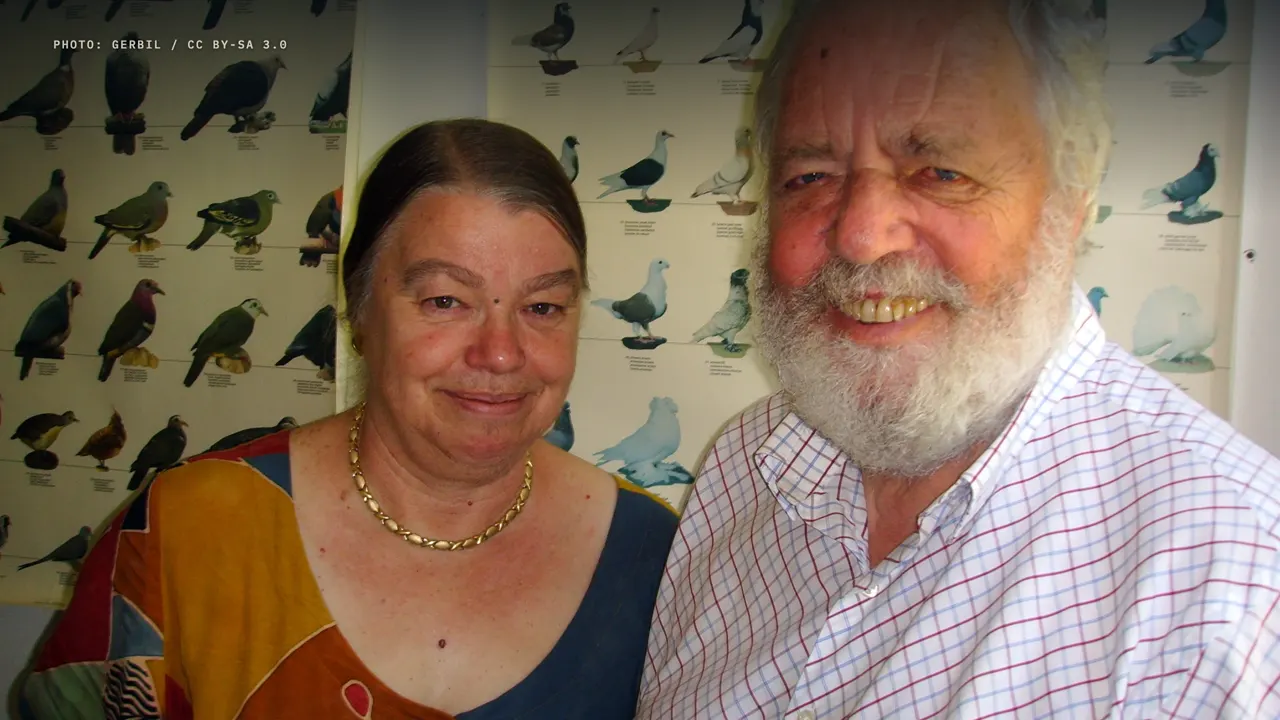
A hiking compass needle points to magnetic north. In 1972, Wolfgang and Roswitha Wiltschko showed that the robin's compass ignores magnetic north and south. Earth's field lines are not flat. Near the magnetic equator they run almost parallel to the ground, and near the magnetic poles they point steeply into the ground or out of it.
The robins were reading that tilt. When the researchers flipped only the up-and-down part of the field, the birds reversed their heading. When they flipped the whole field, so north became south but the tilt stayed the same, the birds kept going the same way. So the robin's compass doesn't say north or south.
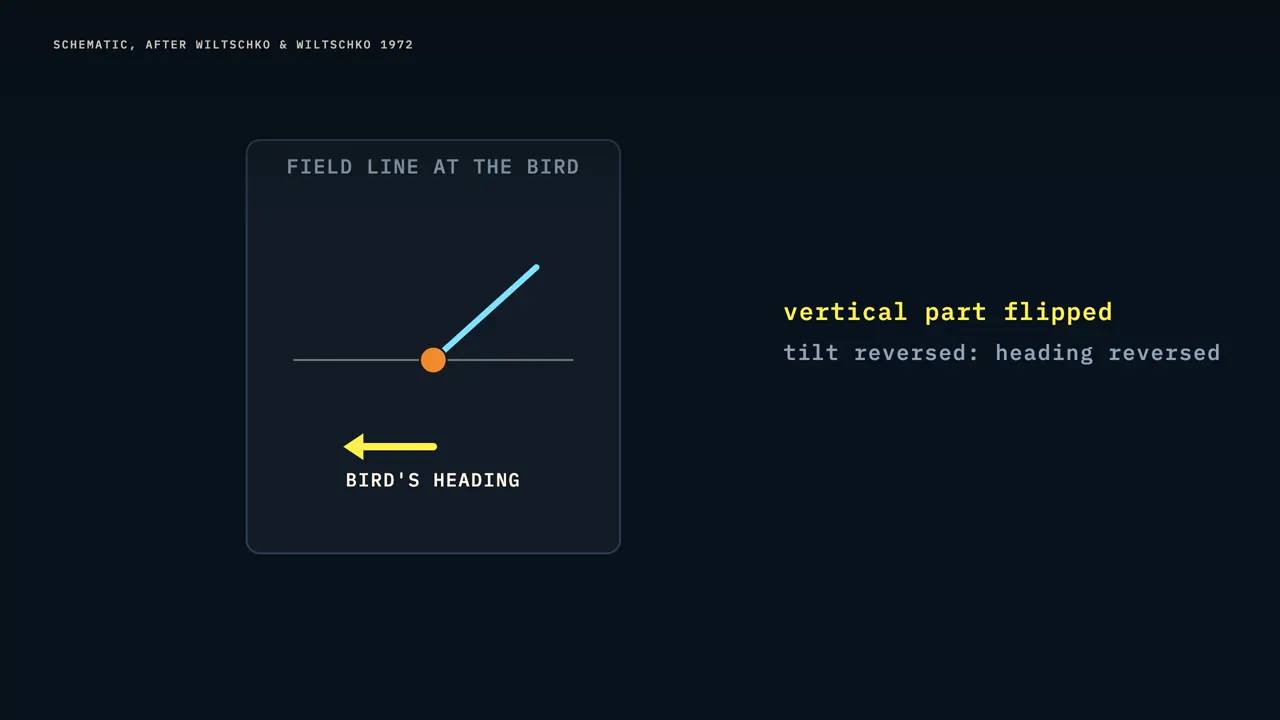
It says toward the pole or toward the equator, and that is enough to pick a migration direction. Then came a second surprise: the compass only worked when there was light.
It needs light
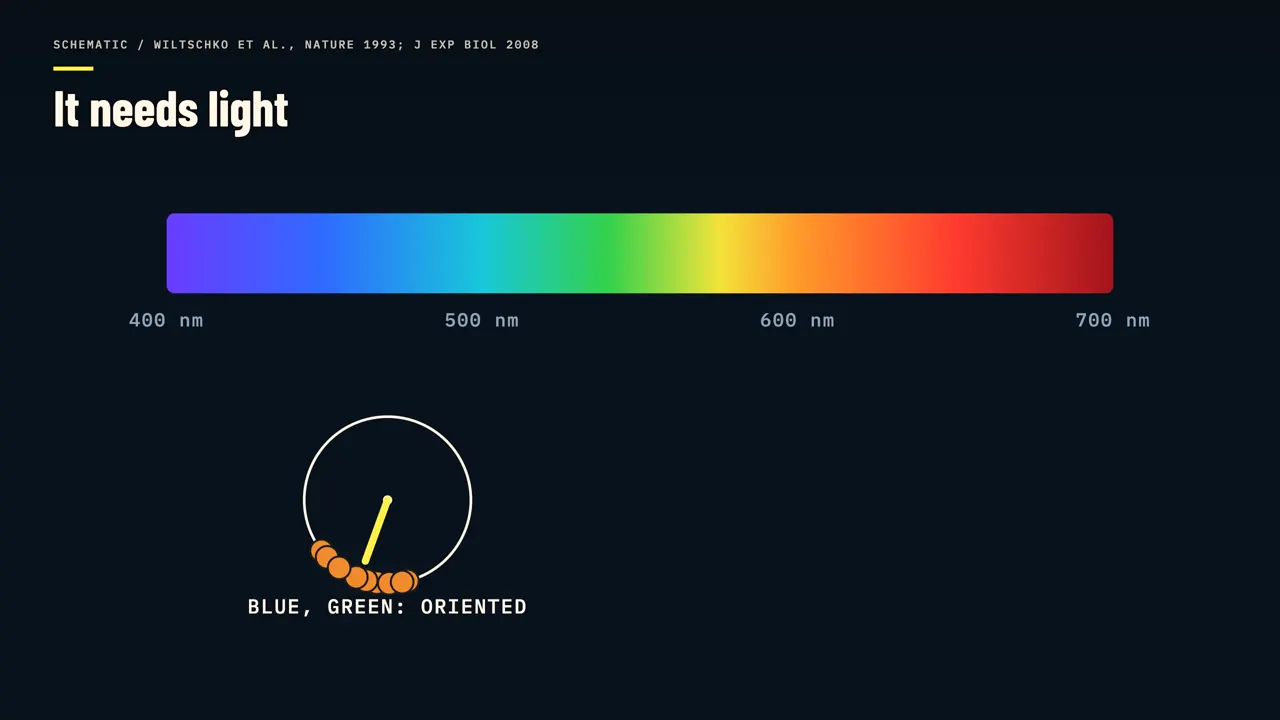
In a 1993 study, Australian silvereyes oriented well under blue or green light. Under red light, they lost their bearings. Later tests found it worked up to green light, around 565 nanometers, and failed from yellow light onward. A sense that depends on the color of light made the eye the obvious place to look.
A reaction that feels the field
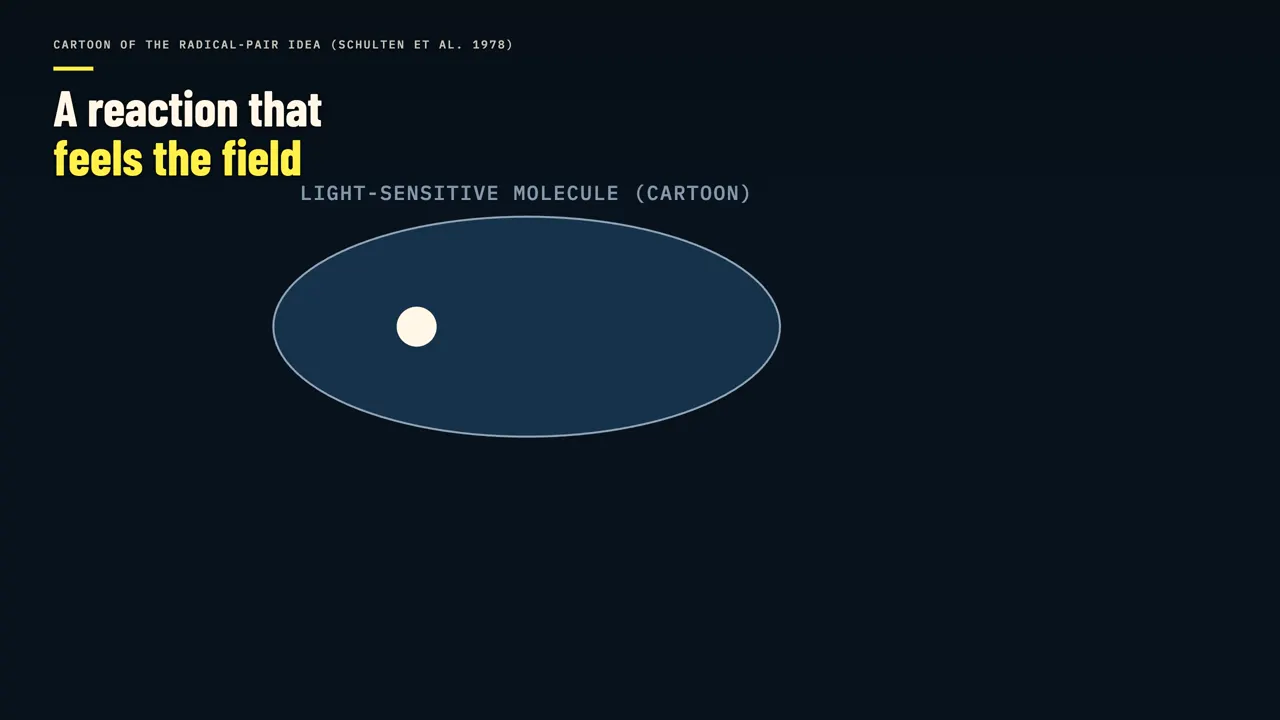
Long before that, in 1978, the physicist Klaus Schulten had proposed how a magnetic sense might work. His idea was a chemical reaction started by light. When light hits certain molecules, an electron jumps from one part to another, leaving each part with an unpaired electron, a setup chemists call a radical pair.
Each electron has a property called spin, which behaves like a tiny magnet. Before the reaction finishes, the pair keeps switching between two combined spin states. Which product the reaction makes depends on how much time it spends in each state. And a magnetic field changes that timing, depending on how the molecule sits in the field.
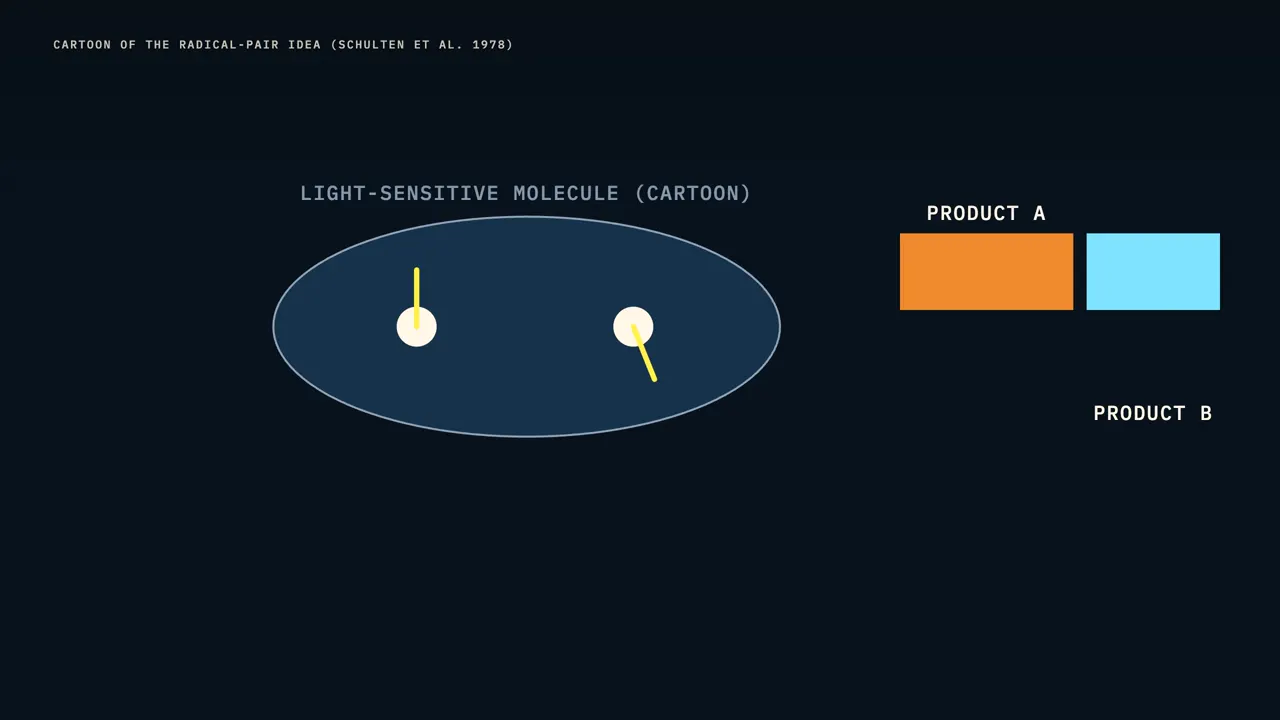
Earth's field is weak, between about 22 and 67 microtesla, and a fridge magnet is roughly a hundred times stronger. But in Schulten's model, even a field that weak could tip the balance. In 2000, Schulten, Thorsten Ritz and Salih Adem suggested the molecule could be cryptochrome, a light-sensitive protein found in the eye. If they were right, the reaction should have a strange weak spot: radio waves.
The noise on campus
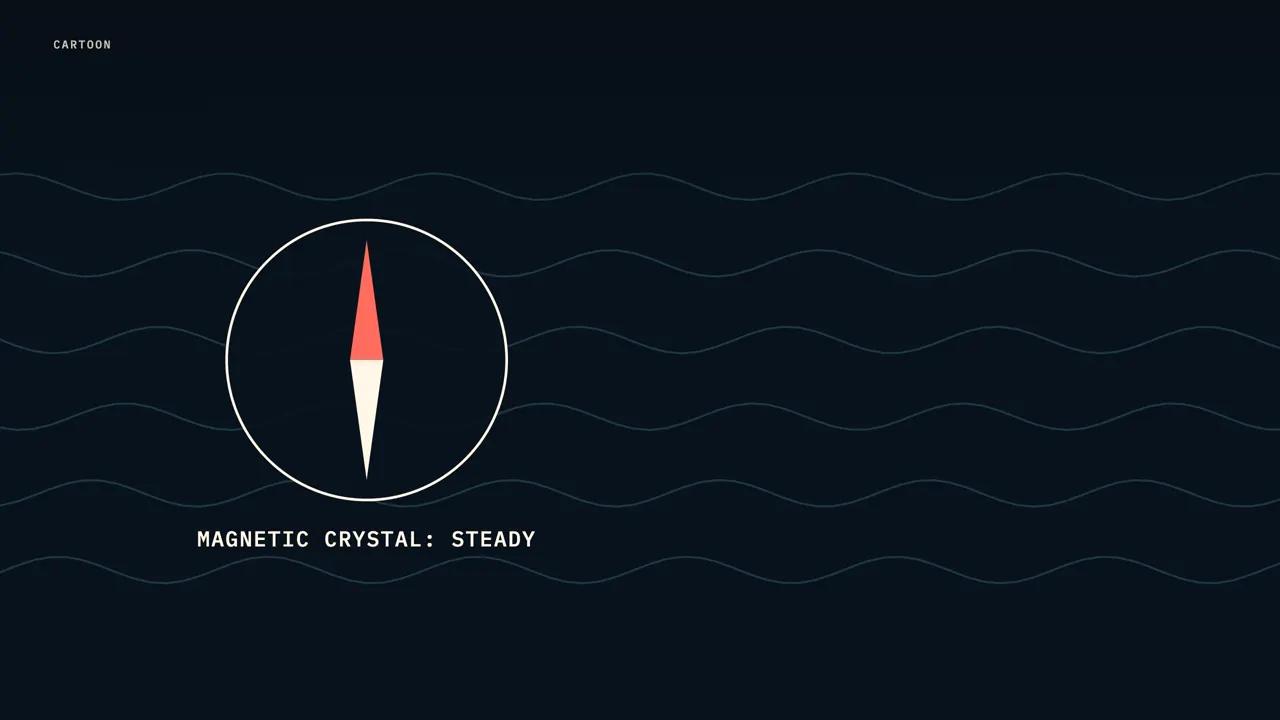
A magnetic crystal would hardly notice a faint radio signal. A radical pair should, because radio waves can push the electron spins around. In 2004, robins tested in Frankfurt were exposed to a weak radio-frequency field in the megahertz range, far too weak to heat anything. They lost their magnetic heading.
Ten years later came the strange result from Oldenburg, the one we started with. Henrik Mouritsen's team had tested robins in wooden huts on their campus, and for years the birds would not orient. When the huts were lined with aluminium and grounded, the noise from 50 kilohertz to 5 megahertz dropped about a hundredfold, and the robins oriented again.
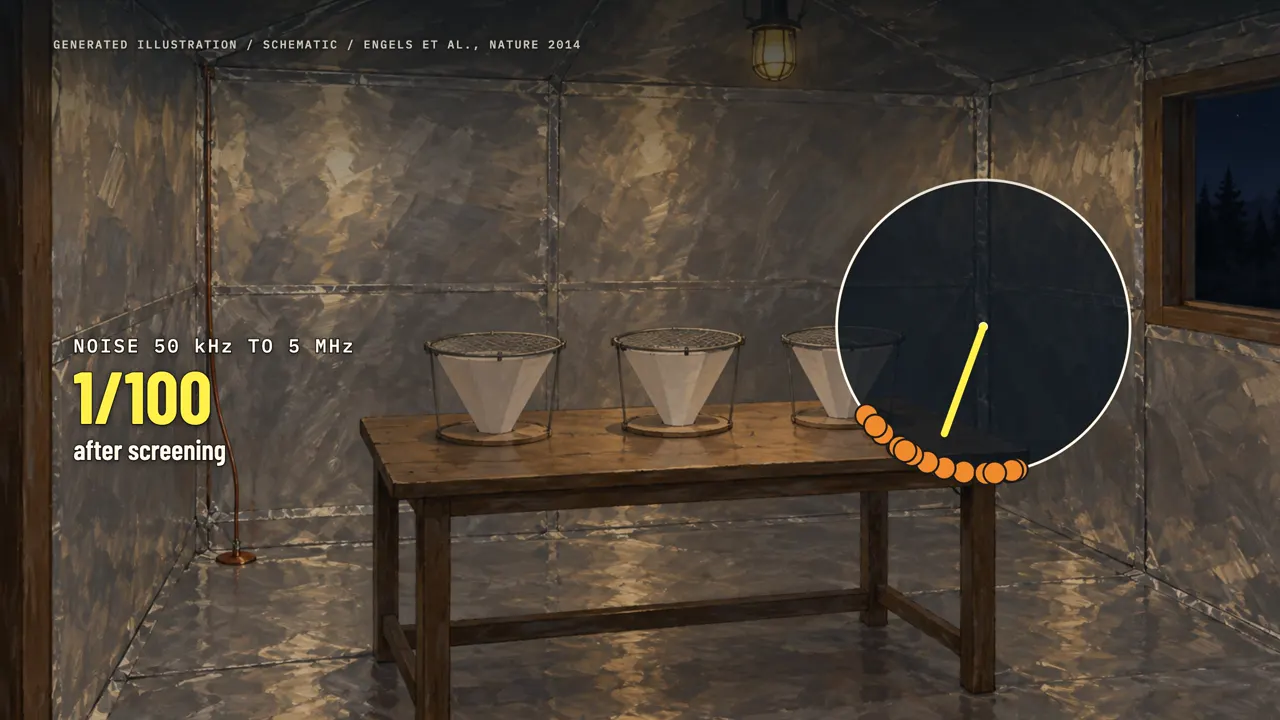
When the grounding was removed, or noise was added back inside the screen, they were lost again. The tests ran over seven years, and the people scoring the birds did not know whether the screen was grounded. Birds tested away from the city needed no screen at all. In 2023, the same group tested another songbird, the Eurasian blackcap, and
found where the effect stops: somewhere between about 80 and 145 megahertz. That is roughly where a radical pair in a protein like cryptochrome should stop responding.
Seeing the field
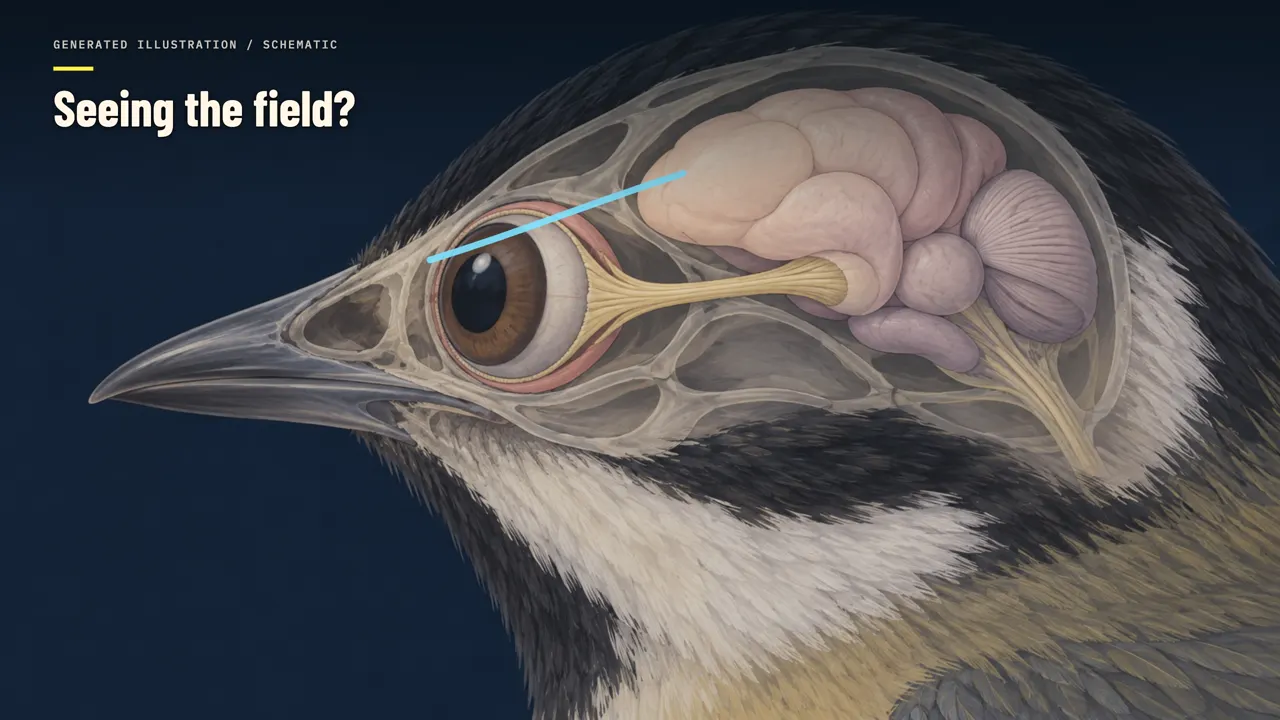
If the sensor is in the eye, the signal should travel along the visual pathway. In 2009, the Oldenburg group looked at a small area in the robin's forebrain called Cluster N. It processes visual input and is active at night, when the birds migrate. When Cluster N was destroyed on both sides, the robins lost their magnetic compass.
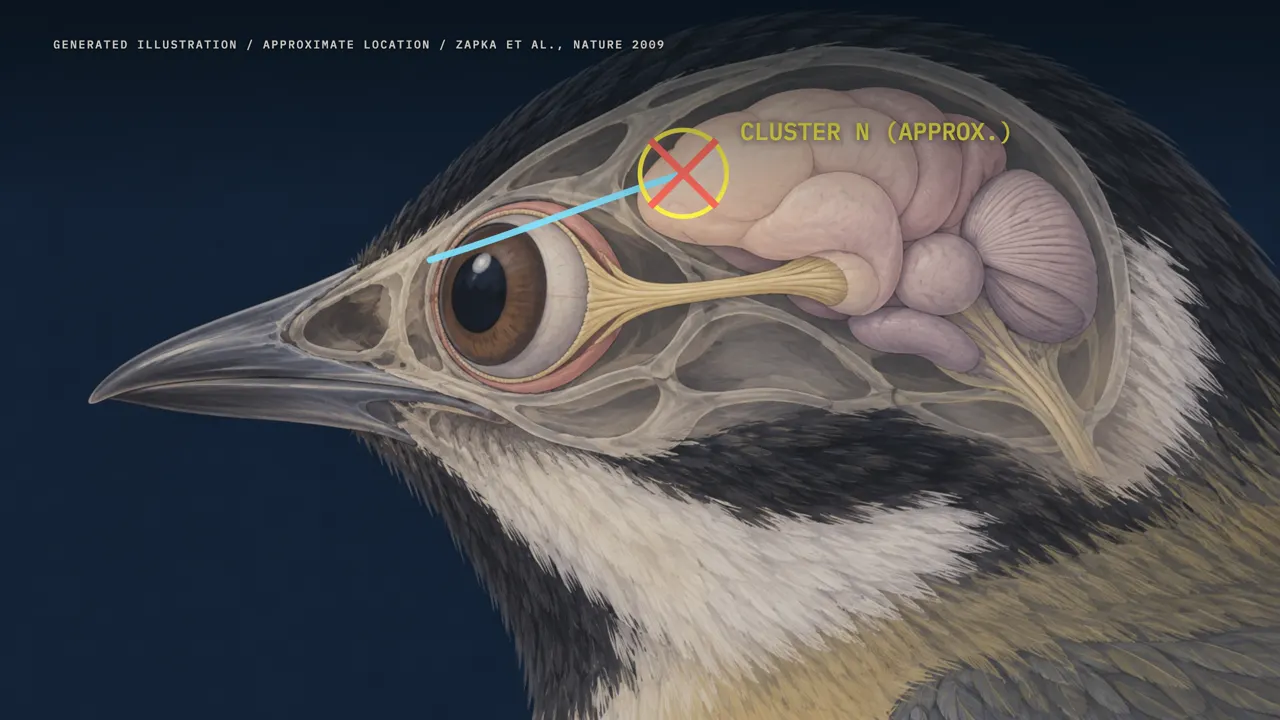
They could still steer by the sun and the stars. Cutting a nerve that carries signals from the beak changed nothing for the compass. So the compass seems to run through vision. It's possible that birds see the field as a faint pattern laid over what they see, but no one knows what it actually looks like to them.
The prime suspect
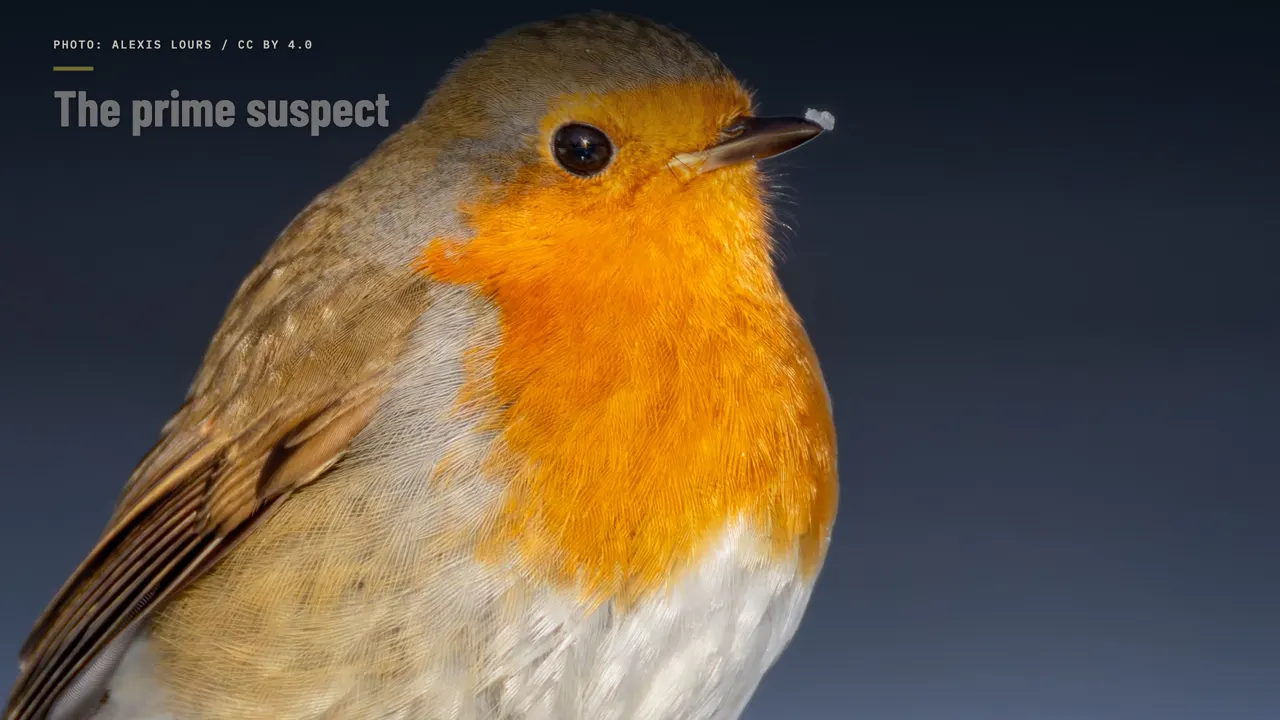
The leading suspect is a protein called cryptochrome 4. In the robin eye, it sits in the light-sensing parts of cone cells. And in robins, its gene becomes more active during the migration seasons, which doesn't happen in chickens. In 2021, a team from Oldenburg and Oxford produced robin cryptochrome 4 in bacteria and tested it in the lab.
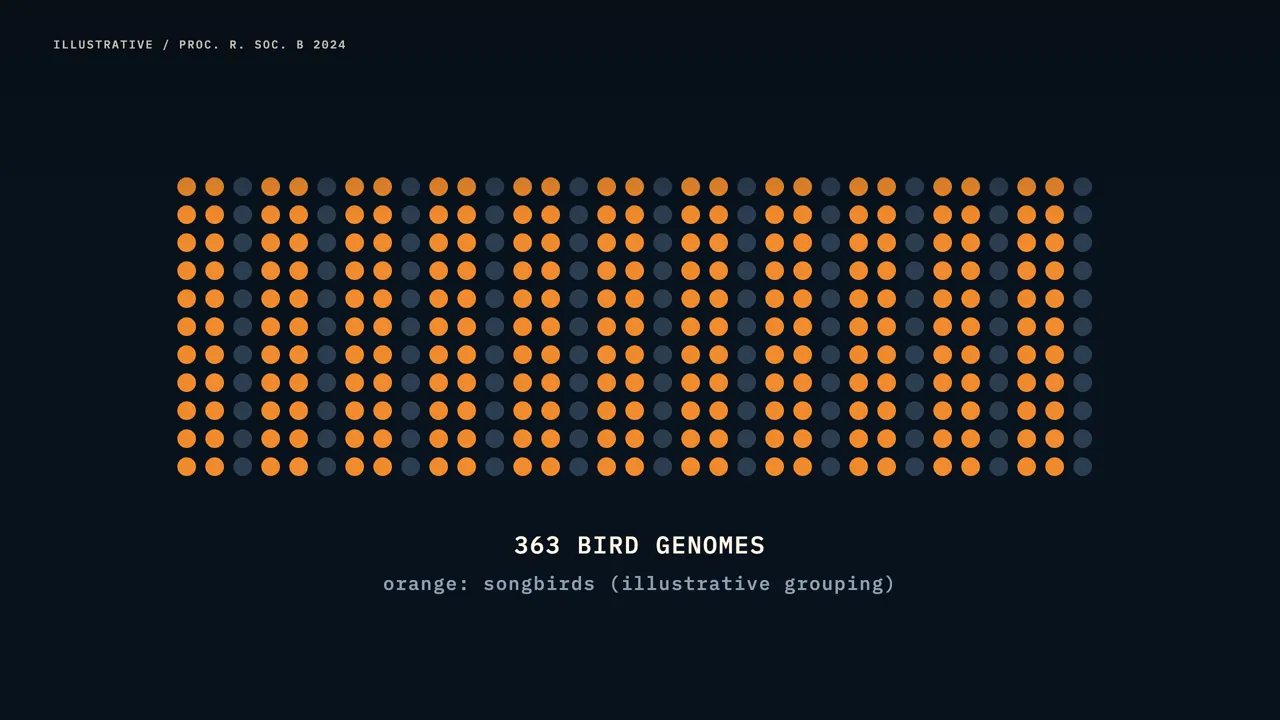
Its light-driven chemistry responded to a magnetic field, more strongly than the same protein from chickens or pigeons. Inside it, an electron hops along a chain of four amino acids to form the pair. A 2024 study of 363 bird genomes found signs that natural selection has favored changes in the cryptochrome 4 gene in songbirds. But the team behind the 2021 experiment was careful.
The protein was tested on its own, in fields stronger than Earth's. As Mouritsen put it, it still needs to be shown that this is happening in the eyes of birds. And the field is far from settled. In 2023, one study reported magnetic effects in fruit fly neurons, while another
tested more than 100,000 flies and found no magnetic effect on their behavior.
The iron that wasn't
There was also a rival idea: tiny iron crystals acting like compass needles. In 1971, William Keeton glued small magnets to the backs of homing pigeons. Released 27 to 50 kilometers away under a sunny sky, the experienced birds still oriented toward home. Under total overcast, they became disoriented, which suggests the sun compass had been making up for the magnet.
Later, scientists found iron-rich cells in pigeon beaks and thought they had found the needles. In 2012, those cells turned out to be macrophages, immune cells that recycle iron. But the nerve from the beak may still carry something magnetic, not for the compass but for the map.
A compass is not a map
A compass tells you which way you're facing. It doesn't tell you where you are. Between 1948 and 1957, the Dutch biologist Albert Perdeck caught migrating starlings in the Netherlands and moved more than 14,000 of them to Switzerland.
Numbered leg rings, recovered later, showed where the birds went. Adults corrected their course and headed for their usual winter grounds in northwest Europe. The young birds kept flying their inborn direction, west-southwest, and ended up in Spain and southern France. The adults had something the young birds did not yet have: a map.
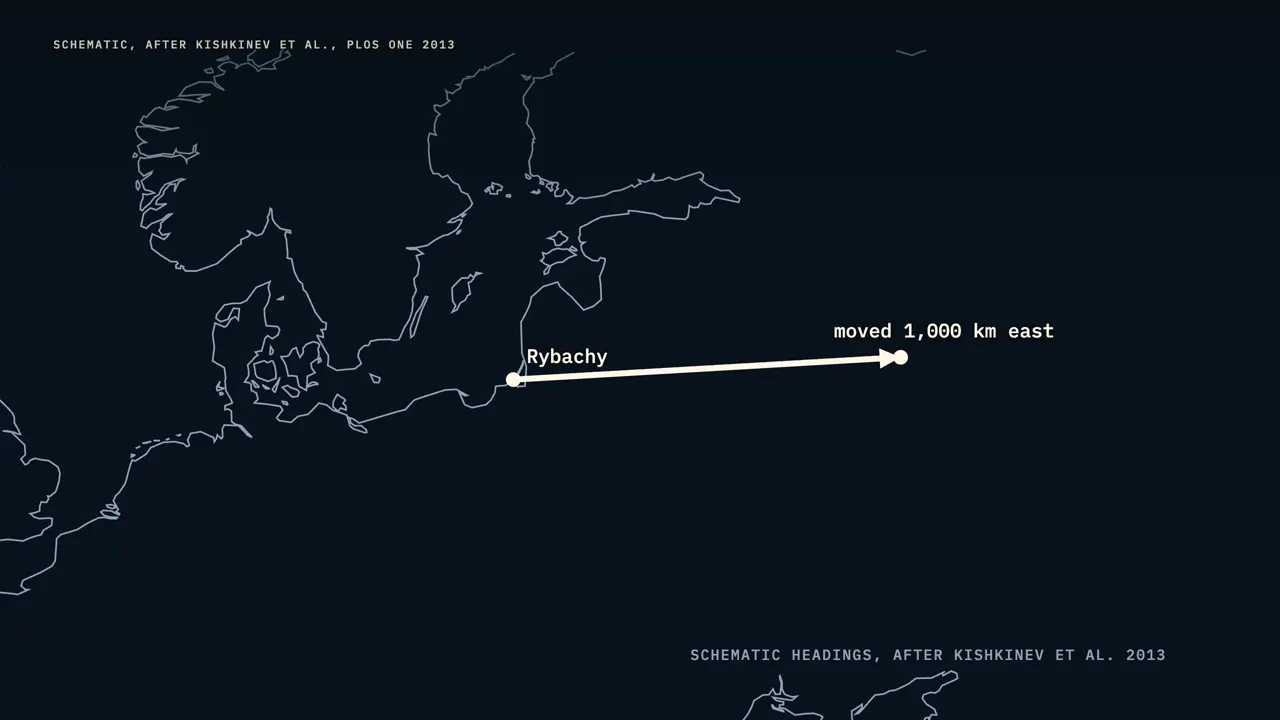
In a study published in 2013, reed warblers moved 1,000 kilometers east turned toward their breeding area when tested in funnels. Birds with the nerve branch from the beak cut kept choosing their old direction, as if they had never moved. Then in 2017, researchers in Russia turned magnetic north 8.5 degrees away from its usual direction, keeping the field's strength and tilt the same. That field exists near Scotland, not in Russia.
Adult reed warblers turned their heading by 151 degrees, as if they had been moved there. Not every displacement study agrees, and the map sense is even less understood than the compass.
Still unsolved
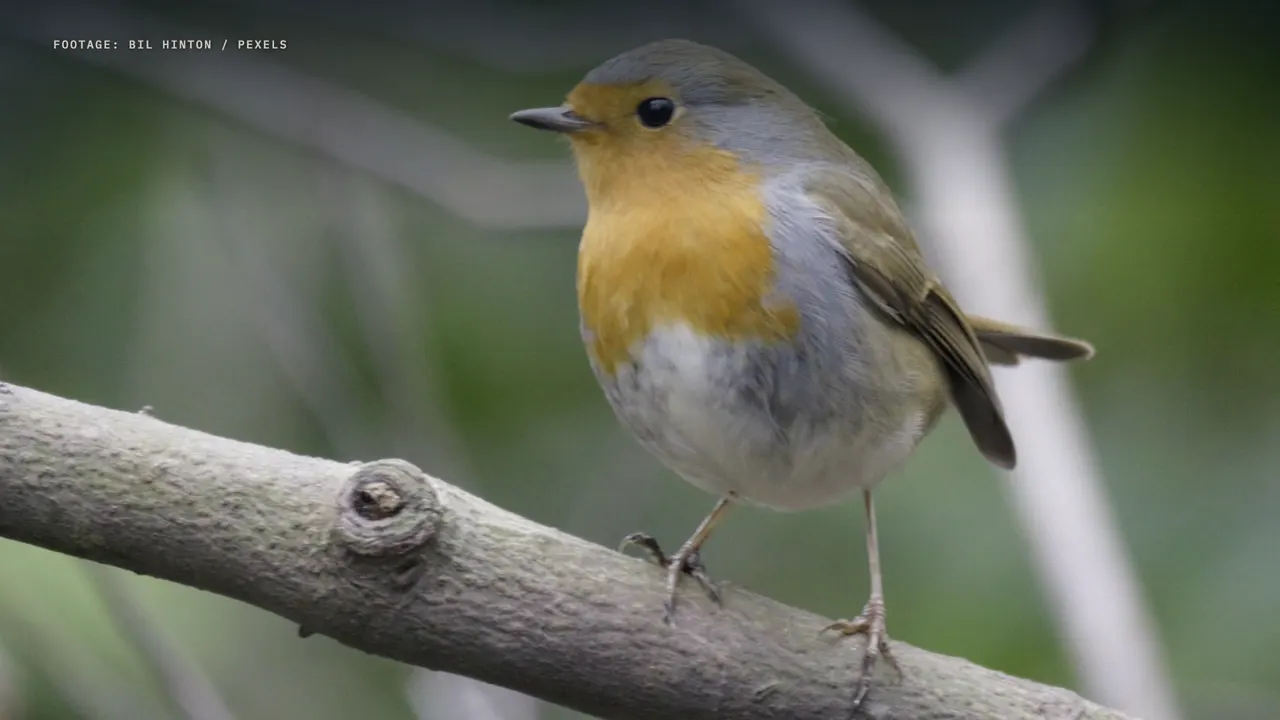
So here is where it stands. Experiments with robins and other songbirds show a magnetic compass that reads the tilt of the field, needs light and runs through vision. Weak radio noise can throw it off, the way a radical-pair reaction should. A protein in the robin eye behaves the right way in a test tube.
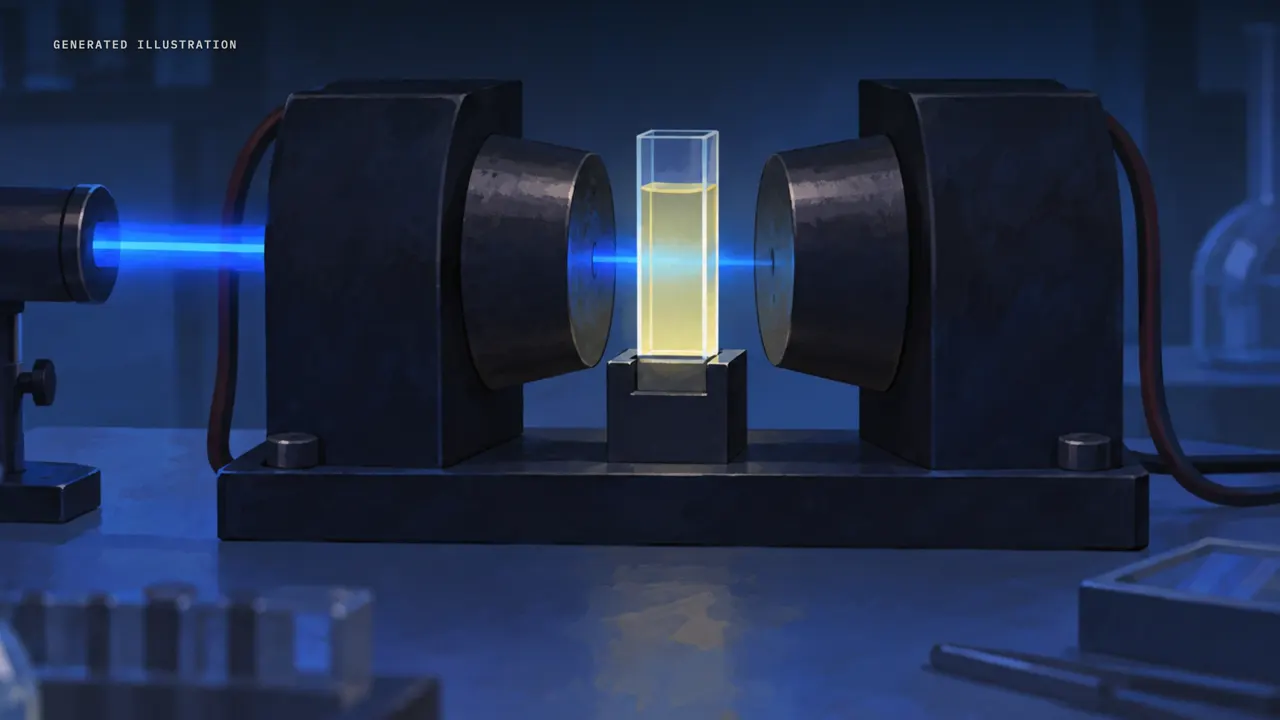
No one has yet watched it work inside a living bird. If it does, migrating birds are reading the planet with a reaction that depends on quantum physics. And the faint electrical noise of our cities may be enough to blur it.
Watch on YouTube
Sources
- Engels et al., Nature 2014: https://pubmed.ncbi.nlm.nih.gov/24805233/
- Dokter et al., Nat Ecol Evol 2018 (BirdCast summary): https://birdcast.org/research-seasonal-abundance-and-survival-of-north-americas-migratory-avifauna-determined-by-weather-radar/
- Dufour et al., Curr Biol 2026: https://doi.org/10.1016/j.cub.2026.06.030
- Godwit 234684 (AP): https://www.mtpr.org/2022-10-28/a-non-stop-flight-from-alaska-to-tasmania-may-be-for-the-birds-and-a-possible-record
- Emlen & Emlen, The Auk 1966: https://sora.unm.edu/sites/default/files/journals/auk/v083n03/p0361-p0367.pdf
- Wiltschko & Wiltschko, Science 1972: https://pubmed.ncbi.nlm.nih.gov/17784420/
- Wiltschko et al., Nature 1993; J Exp Biol 2008: https://journals.biologists.com/jeb/article/211/20/3344/17711/Light-dependent-magnetoreception-orientation
- Schulten, Swenberg & Weller, Z Phys Chem 1978
- Ritz, Adem & Schulten, Biophys J 2000: https://pmc.ncbi.nlm.nih.gov/articles/PMC1300674/
- British Geological Survey: https://geomag.bgs.ac.uk/education/earthmag.html
- Ritz et al., Nature 2004: https://pubmed.ncbi.nlm.nih.gov/15141211/
- Leberecht et al., PNAS 2023: https://doi.org/10.1073/pnas.2301153120
- Zapka et al., Nature 2009: https://pubmed.ncbi.nlm.nih.gov/19865170/
- Günther et al., Curr Biol 2018: https://doi.org/10.1016/j.cub.2017.12.003
- Xu et al., Nature 2021: https://pubmed.ncbi.nlm.nih.gov/34163056/
- Cry4 selection, Proc R Soc B 2024: https://doi.org/10.1098/rspb.2023.2308
- Bradlaugh et al., Nature 2023; Bassetto et al., Nature 2023
- Keeton, PNAS 1971: https://pubmed.ncbi.nlm.nih.gov/5276278/
- Treiber et al., Nature 2012: https://pubmed.ncbi.nlm.nih.gov/22495303/
- Perdeck, Ardea 1958; Pot et al., Biol Lett 2024: https://doi.org/10.1098/rsbl.2024.0217
- Kishkinev et al., PLoS One 2013: https://doi.org/10.1371/journal.pone.0065847
- Chernetsov et al., Curr Biol 2017: https://pubmed.ncbi.nlm.nih.gov/28823677/
- Kishkinev et al., Sci Rep 2016
Images and video
- Robins: Alexis Lours (CC BY 4.0), Chme82 (CC BY 4.0), Francis C. Franklin (CC BY-SA 4.0)
- Roswitha and Wolfgang Wiltschko: Gerbil (CC BY-SA 3.0)
- Emlen funnel diagram: L. Shyamal, public domain
- Godwits: USFWS Alaska, Pseudopanax, public domain
- Compass: Sneha G Gupta (CC BY-SA 4.0)
- Pigeons: Sundaramoorthy K (CC BY 4.0), Parizfranz (CC BY-SA 4.0), Anandjpanchal (CC0), Crocodile2020 (CC BY-SA 4.0)
- Starling: Rhododendrites; redstart: Charles J. Sharp; murmuration: Skander zarrad (all CC BY-SA 4.0)
- Magnetic field animations: NASA's Scientific Visualization Studio
- Pexels: Bil Hinton, Vladimir Srajber, Fatma Özel, Eren Ataselim, Mike M, Zulfugar Karimov, D. krishna, Zuzanna Musial, Arshad Ahamed; Pixabay: DeanMarston, adege, SugarDigitalMedia
- Wikimedia Commons files are used as published under the licences listed.
- The narration is a synthetic voice. The lab hut, funnel, bird head cutaway, cone cells, lab cuvette, fruit fly and the robin in the city are AI-generated illustrations, not records. Charts marked "schematic" show the shape of a published result, not the underlying data.