A New Kind of Magnet Promised 1,000x Faster Memory. How Close Is It?
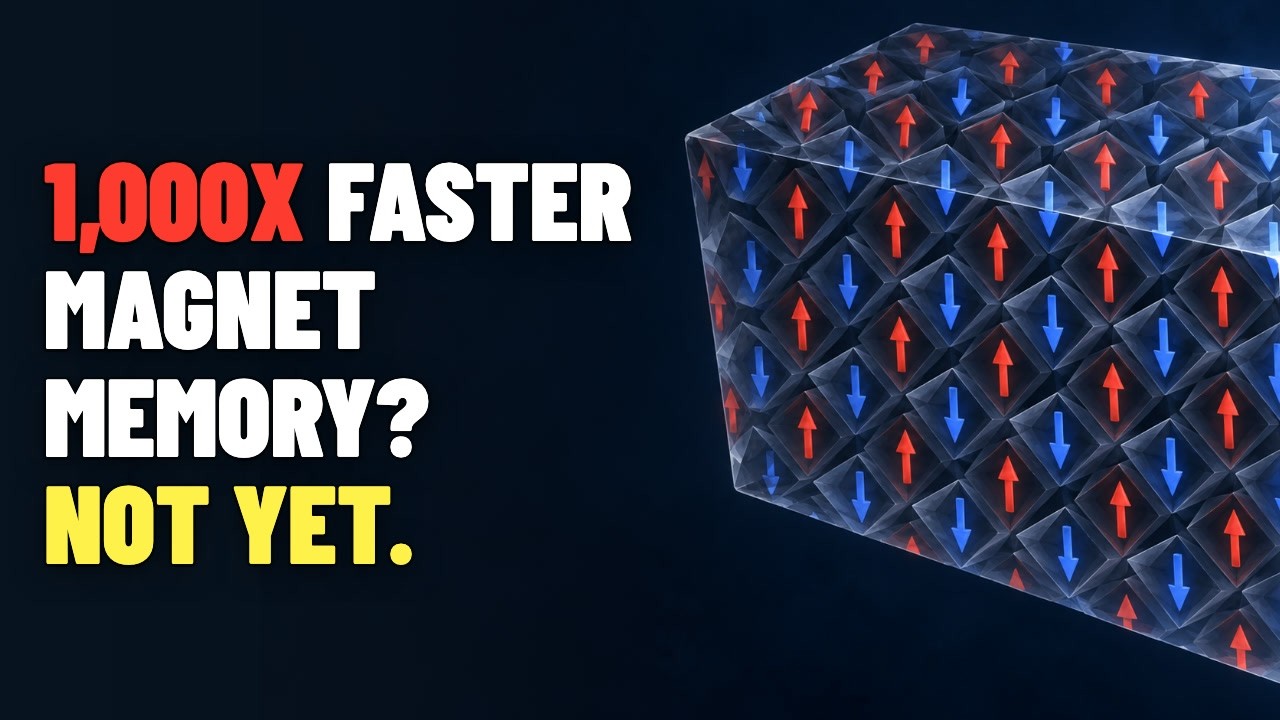
For almost a century, textbooks presented a simple split for magnets whose atomic moments point up or down: ferromagnets, where the atomic magnets line up, and antiferromagnets, where they alternate and cancel. In 2022, physicists working in Mainz and Prague proposed a third class: altermagnets, which cancel like antiferromagnets yet split electron energies by spin like ferromagnets. Experiments in 2024 reported spin splitting in manganese telluride and chromium antimonide. This video follows the idea from Louis Néel's hidden order and the first neutron experiments to the 2026 Europhysics Prize, asks who saw it first, and checks how far altermagnets are from a working memory chip. It also examines the "1,000 times faster" claims, the disputed ruthenium dioxide results, and the first electrical switching experiments reported in 2025 and 2026.
This article is the full narration of the video. Watch on YouTube
Types of magnetism
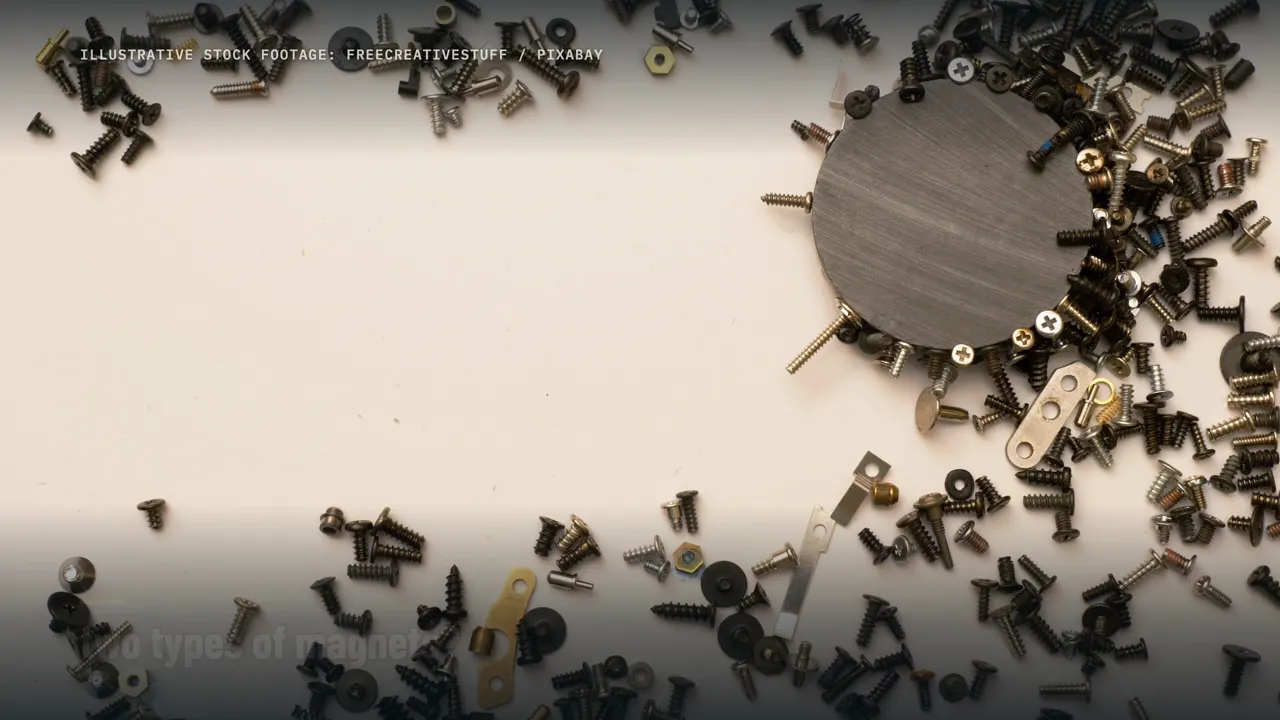
There are two types of magnets. Or so we thought. The first type you know: a fridge magnet sticks, and a compass needle swings to the north. The second type was described in the 1930s, and it doesn't stick to anything.
Its atoms are magnetized inside, but from the outside it looks like no magnet at all. In 2024, experiments confirmed that some of these quiet materials belong to a third type. Physicists call it altermagnetism: a hidden magnetic pattern that changes with direction through the crystal. In July 2026, the three physicists who defined it won the Europhysics Prize.
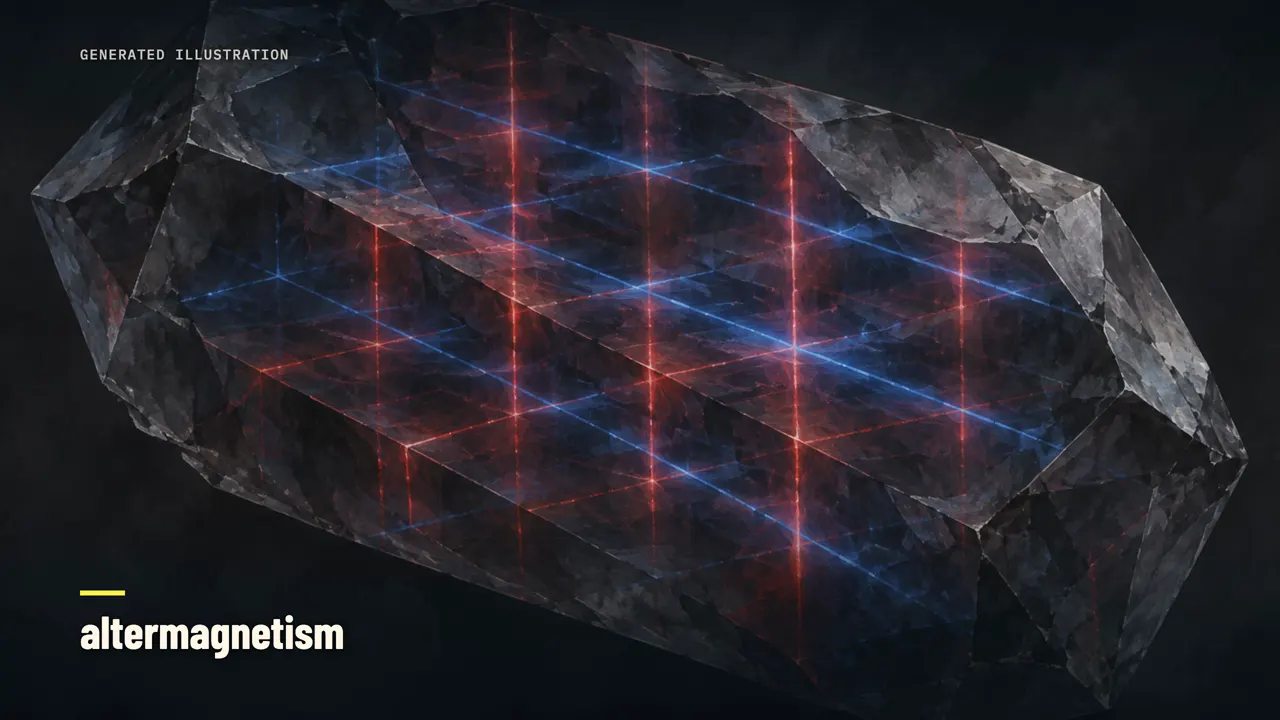
Some videos already promise that it will make electronics a thousand times faster. A thousand-fold figure does appear in a university press release, but it's a projection, not a measurement. So what is this third magnet, why did it take so long to name, and how close is it to being useful?
Magnetism comes from electrons
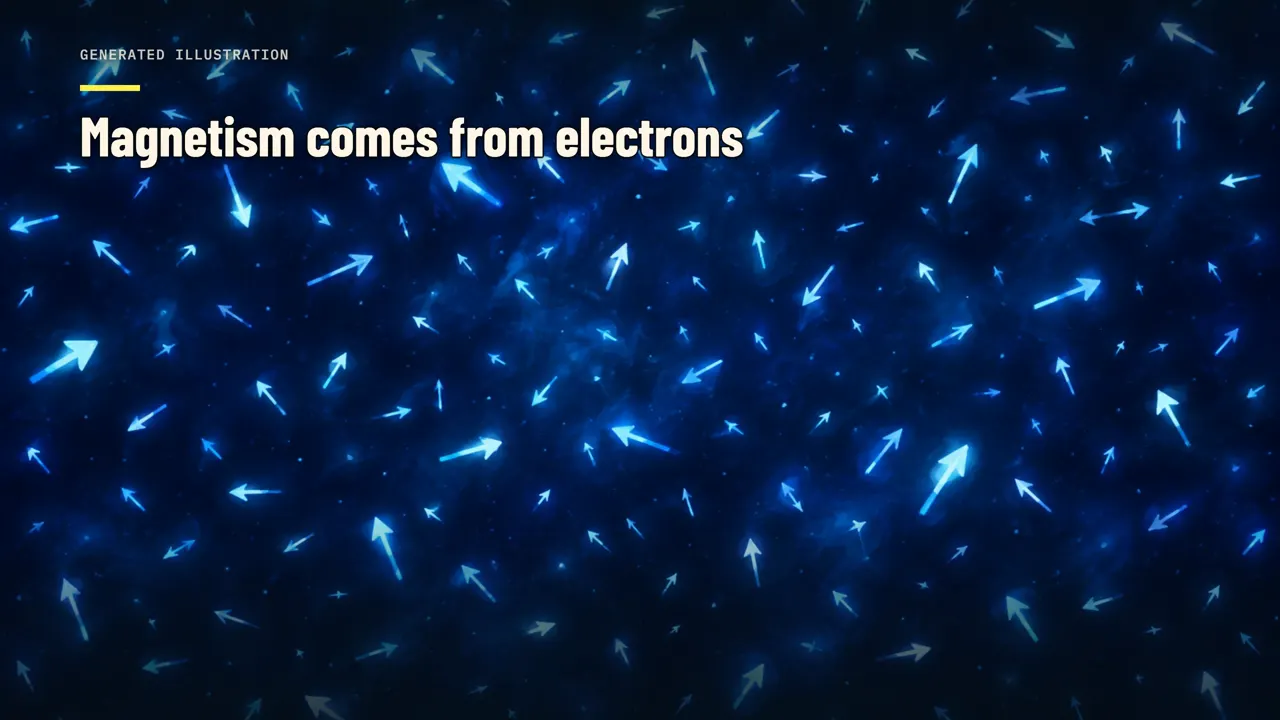
The magnetism we're talking about comes mainly from electrons. Each electron behaves like a tiny magnet, tied to a quantum property called spin. In most materials, these tiny magnets point every which way, and they cancel out. In iron, they line up the same way across huge numbers of atoms.
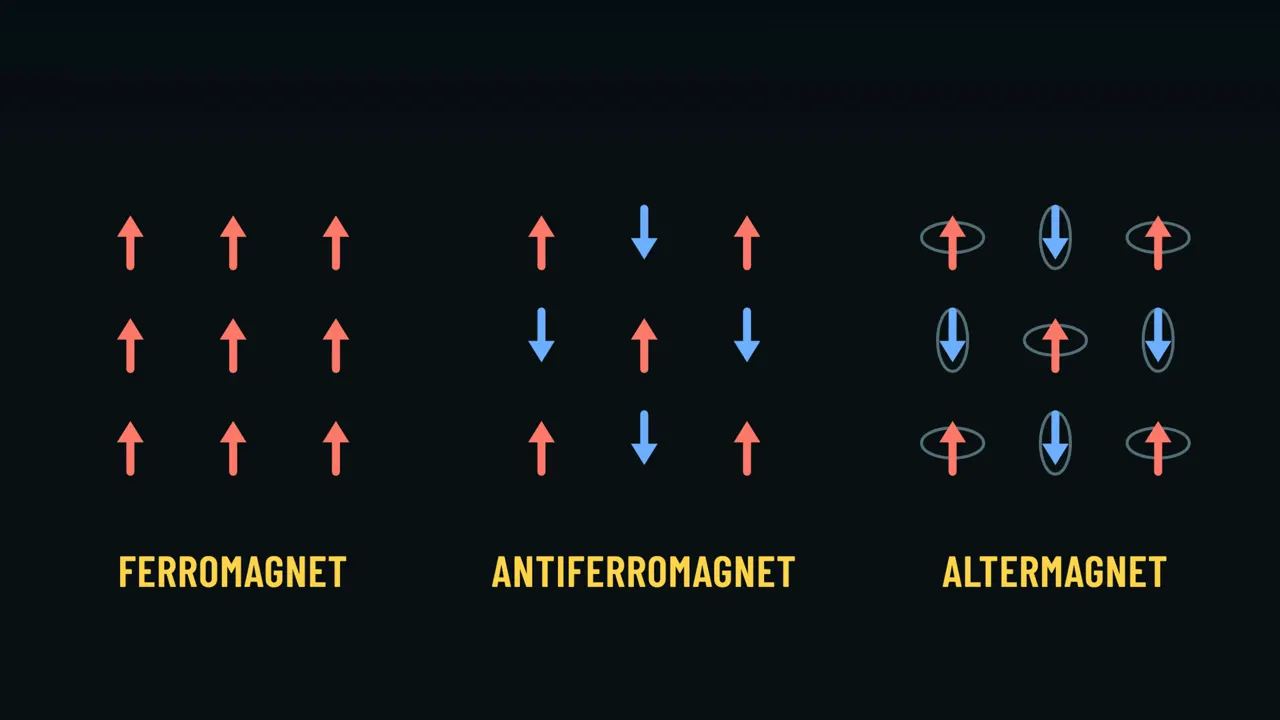
Those aligned atoms add up to a field you can feel, and a material like that is a ferromagnet. Physicists note that ferromagnets have been known for several thousand years. Picture a sports field full of people, all facing north. From the stands, you'd see one crowd facing one way.

Inside a ferromagnet, something else happens: spin-up and spin-down electrons end up with different energies. Physicists call this spin splitting. It's also why magnets can be read with electricity: in a layered device, changing how two magnetic layers line up changes the electrical resistance. So keep two features in mind: a field that reaches outside, and electron energies split by spin.
The third magnet keeps one of them and drops the other.
Néel's hidden order
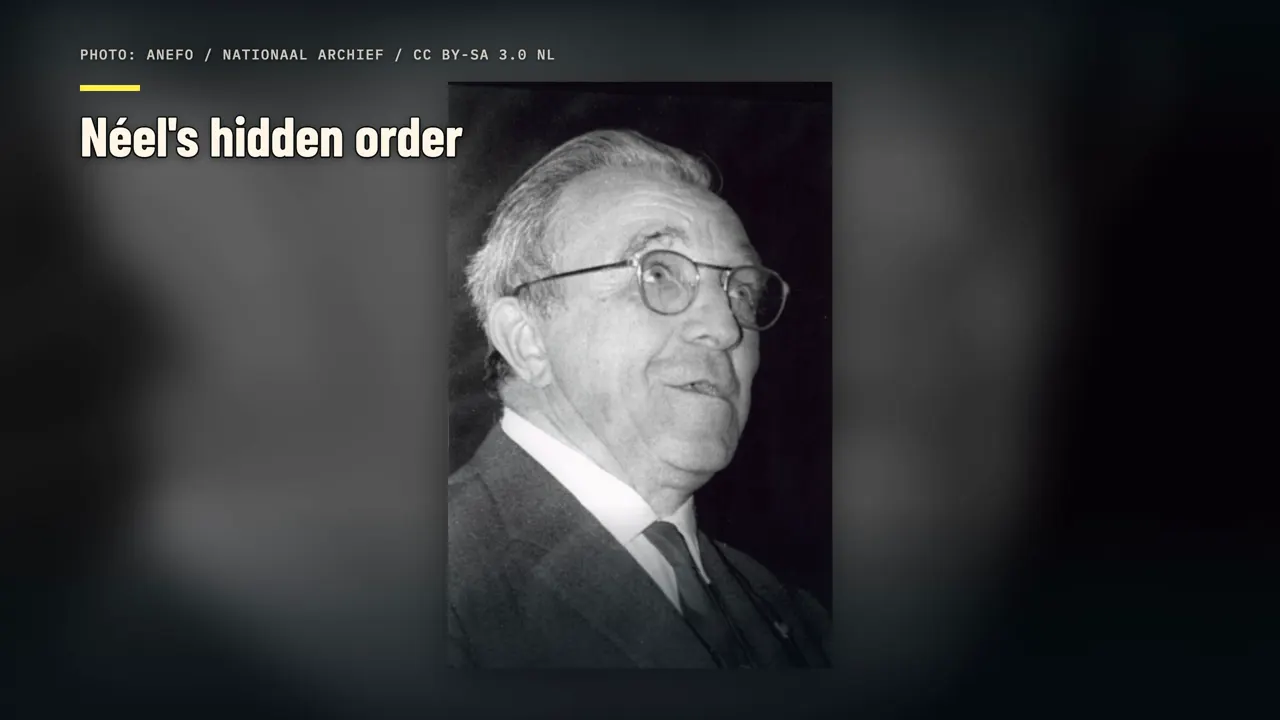
In his 1932 thesis, the French physicist Louis Néel proposed something different. Neighboring atomic magnets might tend to point in opposite directions. In 1936, he described a crystal made of two interleaved groups of atoms, one pointing up and one pointing down. The two groups cancel, so the total magnetization is zero.
This is antiferromagnetism. Think of a checkerboard: black and white squares alternate, and from far away it looks gray. Neutrons, which carry their own tiny magnets, gave physicists a direct way to see that hidden order. Ernest Wollan began neutron experiments at the Graphite Reactor in Oak Ridge in 1944, and Clifford Shull joined him in 1946.
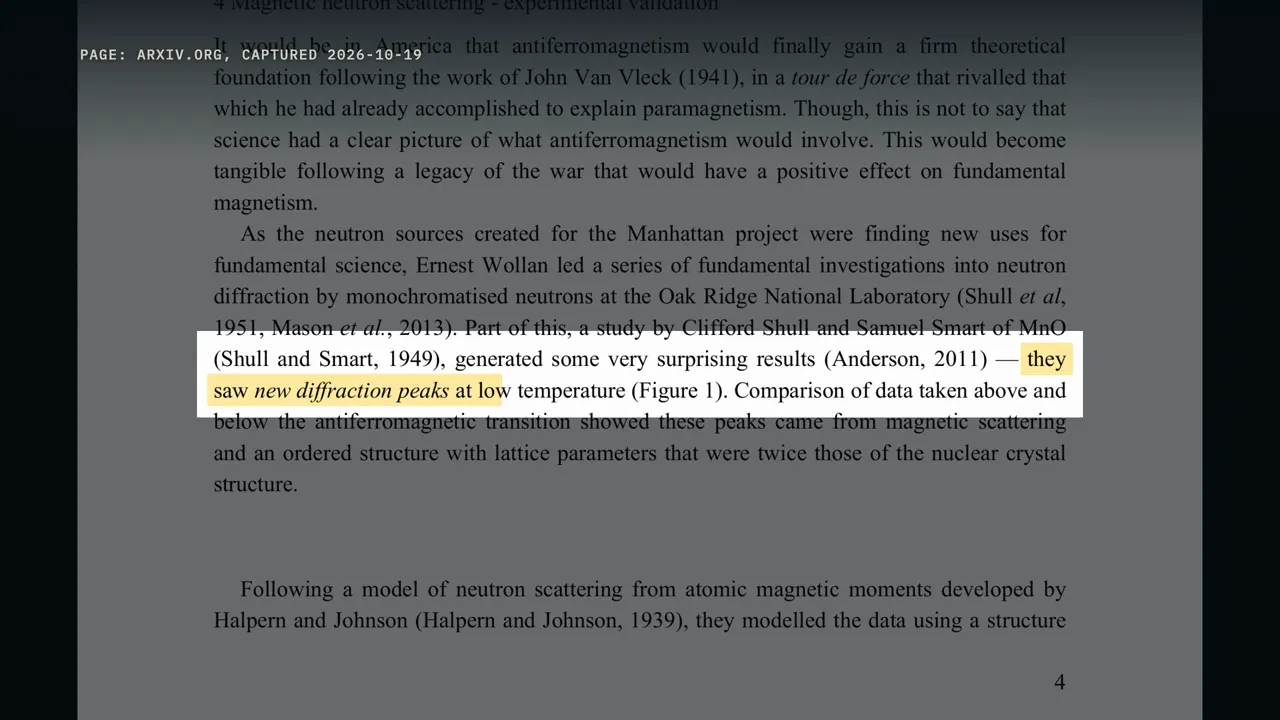
In 1949, Shull and his colleague Smart aimed neutrons at manganese oxide. They found new diffraction peaks from a magnetic pattern that repeats at twice the distance along each crystal axis. The hidden checkerboard was real. Louis Néel shared the 1970 Nobel Prize in Physics, for work on antiferromagnetism and ferrimagnetism.
Ferrimagnetism is a related case where the opposite atomic magnets have different sizes, so some magnetization is left over. So, strictly speaking, there were never just two types of magnets. Spirals, frozen glassy states where atomic magnets get stuck in a jumble, and other patterns in how those magnets point exist too. But for magnets whose atoms point straight up or straight down, textbooks kept a simple split.
All aligned is a ferromagnet. Alternating and cancelling is an antiferromagnet. In his Nobel lecture, Néel called antiferromagnets extremely interesting in theory, but said they didn't seem to have any applications. For decades, that looked about right.
Quiet, but hard to read
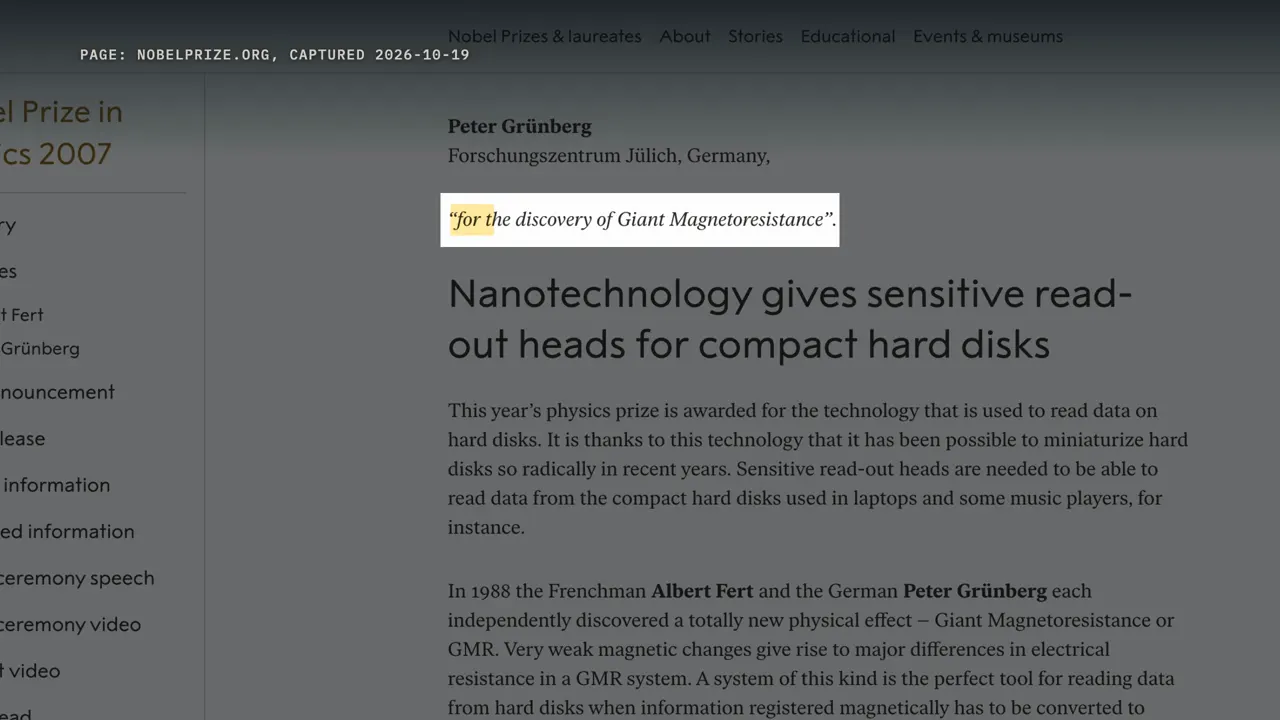
Then magnetic storage took off. In 1988, Albert Fert and Peter Grünberg independently discovered giant magnetoresistance. It turns very small magnetic changes into differences in electrical resistance. The first hard drive read heads using it arrived in 1997, and the discovery won the 2007 Nobel Prize in Physics.
Magnetic memory chips, called MRAM, also store bits as magnets, and the data stays when the power is off. But a ferromagnetic bit has a problem built in. Its field leaks outside the material as a stray field, so closely packed bits can disturb each other. An antiferromagnet has almost no stray field, which removes one way neighboring bits can disturb each other.
In one test, fields of up to 12 tesla, a unit of magnetic-field strength and more than a thousand times a fridge magnet's field, could not disturb antiferromagnetic memory bits. Antiferromagnets may also be faster. In 2018, a team wrote data to a memory made of copper, manganese and arsenic. They used 250-picosecond pulses,
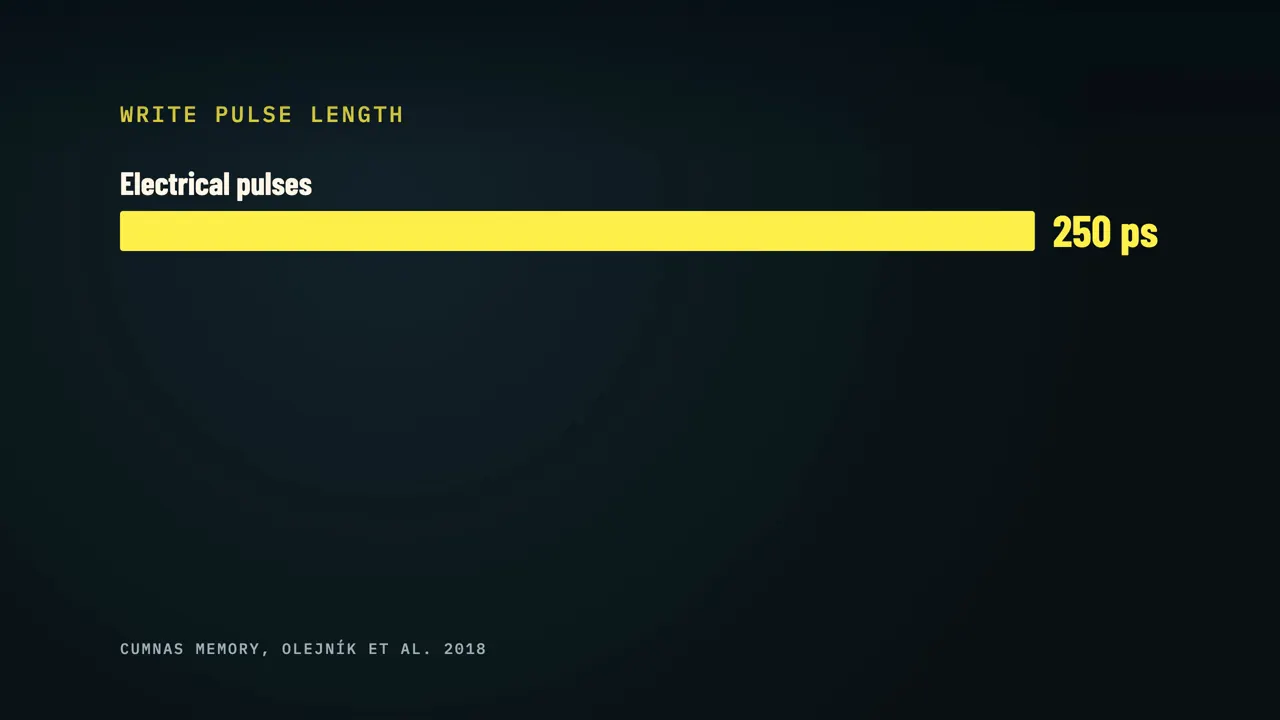
each lasting a quarter of a billionth of a second, at up to 4 gigahertz, or four billion cycles a second. Then they used terahertz pulses, bursts of light oscillating a trillion times a second. Each lasted about one picosecond, or a trillionth of a second. By their account, comparable switching in ferromagnets had not gone far beyond 5 gigahertz. They estimated that, compared with their antiferromagnet, a ferromagnet pushed to terahertz speeds would
need about 100 times the current squeezed through the same area, and roughly 1,000 times the energy. So antiferromagnets are stable, easy to pack, and fast. But getting a strong electrical signal out of them is harder. Physicist Libor Šmejkal called magnetization an "enemy" as well as a useful property.
Antiferromagnets can be read electrically, but they lack the strong spin splitting that ferromagnetic devices rely on. They're quiet enough to reduce magnetic crosstalk, where nearby bits disturb each other, but harder to read and control. What engineers wanted was a magnet as quiet as an antiferromagnet, with a ferromagnet's readable electrons.
The missing rotation
In January 2019, Šmejkal, Jairo Sinova, Tomáš Jungwirth and their colleague González-Hernández posted a prediction about some antiferromagnets. They argued that some of these magnets, despite their cancelling tiny atomic magnets, could produce a Hall signal: a voltage across the material at right angles to the current, of a kind usually linked to ferromagnets.
In 2022, Šmejkal, Sinova and Jungwirth, working in Mainz, Germany, and Prague, Czech Republic, published a full classification. They sorted magnets whose tiny atomic magnets cancel by asking one question about symmetry: which moves leave a pattern looking the same? What move turns the up-pointing atoms into the down-pointing atoms? In an ordinary antiferromagnet, a shift by one step, or a flip through a central point, maps the up atoms onto the down atoms.
And that move has to match the atoms around them, too. In the new class, no shift or flip works on its own, and matching the surrounding atoms takes a rotation. The team proposed the name altermagnetism. Science News borrowed an image from art: if an antiferromagnet is a checkerboard, an altermagnet

is like an M. C. Escher tessellation, a pattern of interlocking shapes with no gaps. Neighboring tiles don't just change color, they're also turned. The magnetic atom itself doesn't turn, but its surroundings do. Each magnetic atom sits in a little cage of neighboring atoms, such as oxygen or tellurium.
In an altermagnet, the cage around an up atom points one way, and the cage around a down atom is rotated. And altermagnetism, they wrote, can occur in crystals made of common light elements.
Electrons split by direction
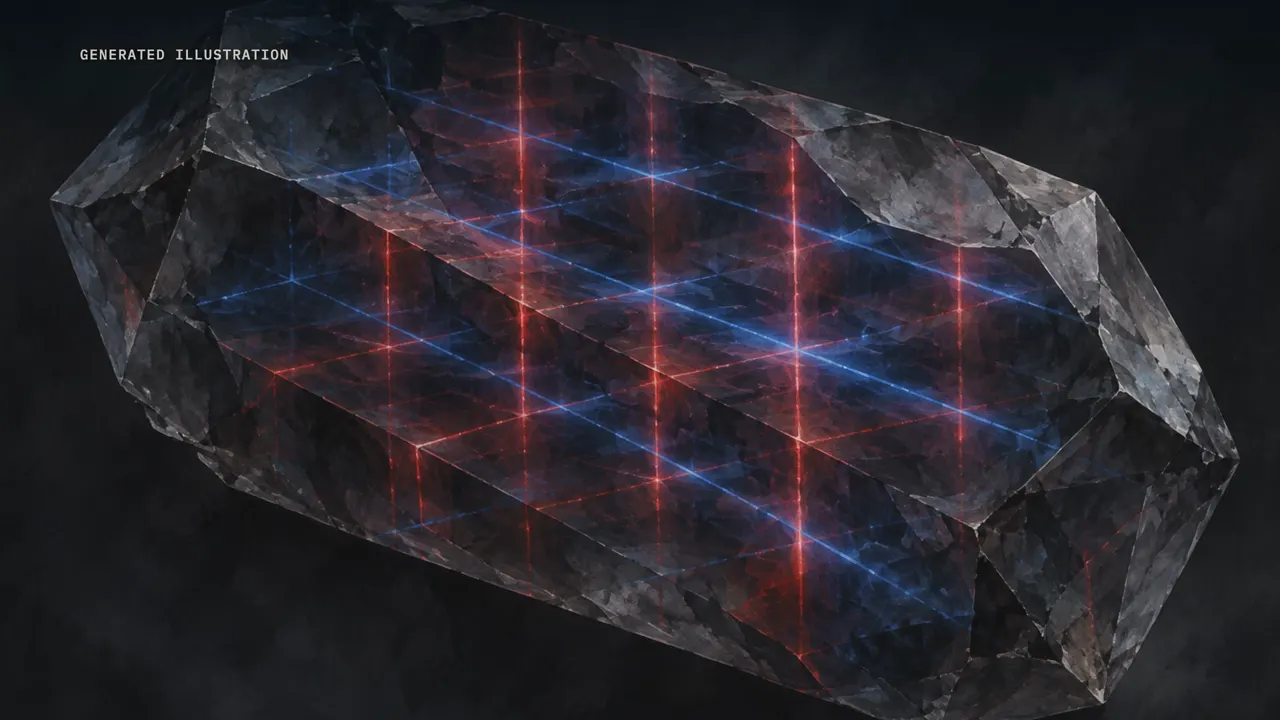
That rotated cage changes how electrons move. In an altermagnet, spin-up and spin-down electrons get different energies, as in a ferromagnet. But the difference depends on the direction the electron travels, and it flips sign as the direction turns. For a simple example, picture a four-way intersection.
On the north-south road, spin-up electrons get the fast lane. On the east-west road, spin-down electrons get it. Across the whole crystal, the opposite magnetic moments still cancel, so there's no outside field. But in this example, a current along one road can favor one spin.
That alternating sign is what the name altermagnet points to. In the simplest cases, the pattern looks like a four-leaf clover, which the authors compared with d-wave superconductors, where the way electrons pair has a similar four-lobed pattern. This effect doesn't need spin-orbit coupling, a link between an electron's spin and its motion that is strongest in heavy atoms.
In their calculations for ruthenium dioxide, the splitting reached about one electron volt for electrons moving in certain directions. In their 2022 comparison, that was about ten times the record splitting caused by relativity in bulk crystals, solid pieces rather than thin layers, with heavy elements. An electron volt is a tiny unit of energy, but for electrons in a crystal, one is a lot.
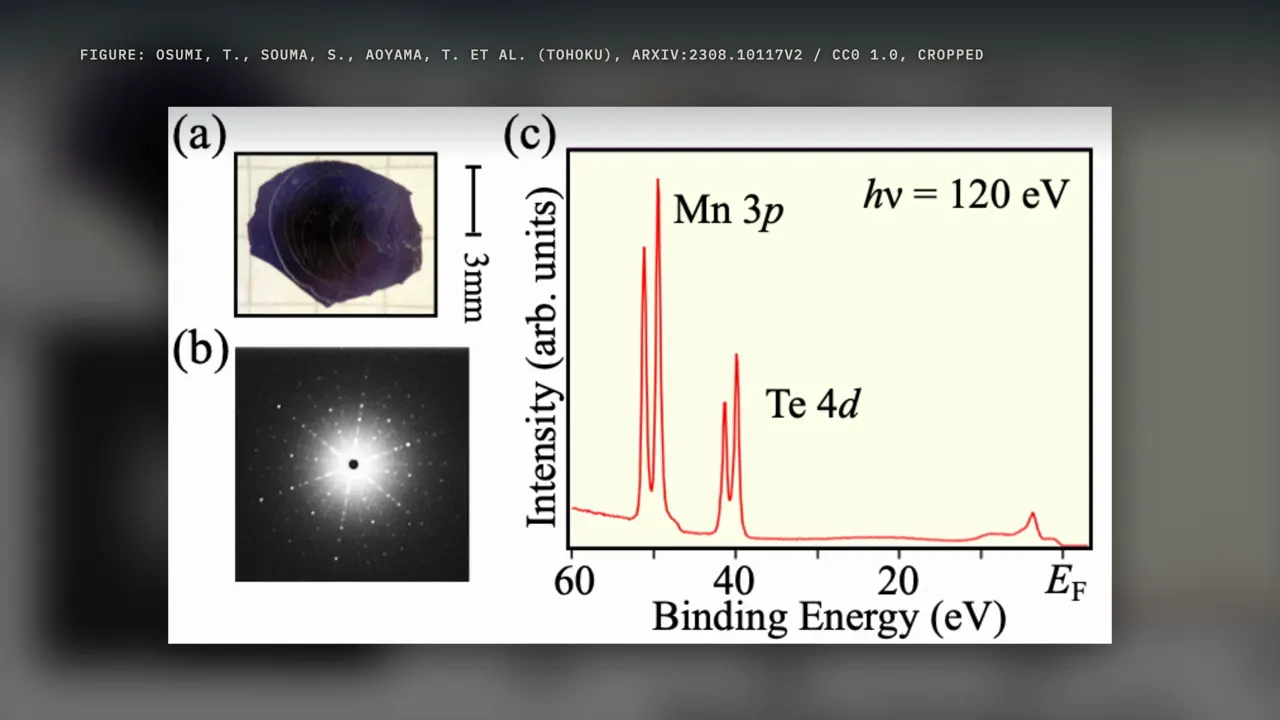
Then came the tests. In February 2024, an international team reported measurements of manganese telluride, MnTe, made at the Swiss Light Source of the Paul Scherrer Institute. MnTe had long been classified as an ordinary antiferromagnet.
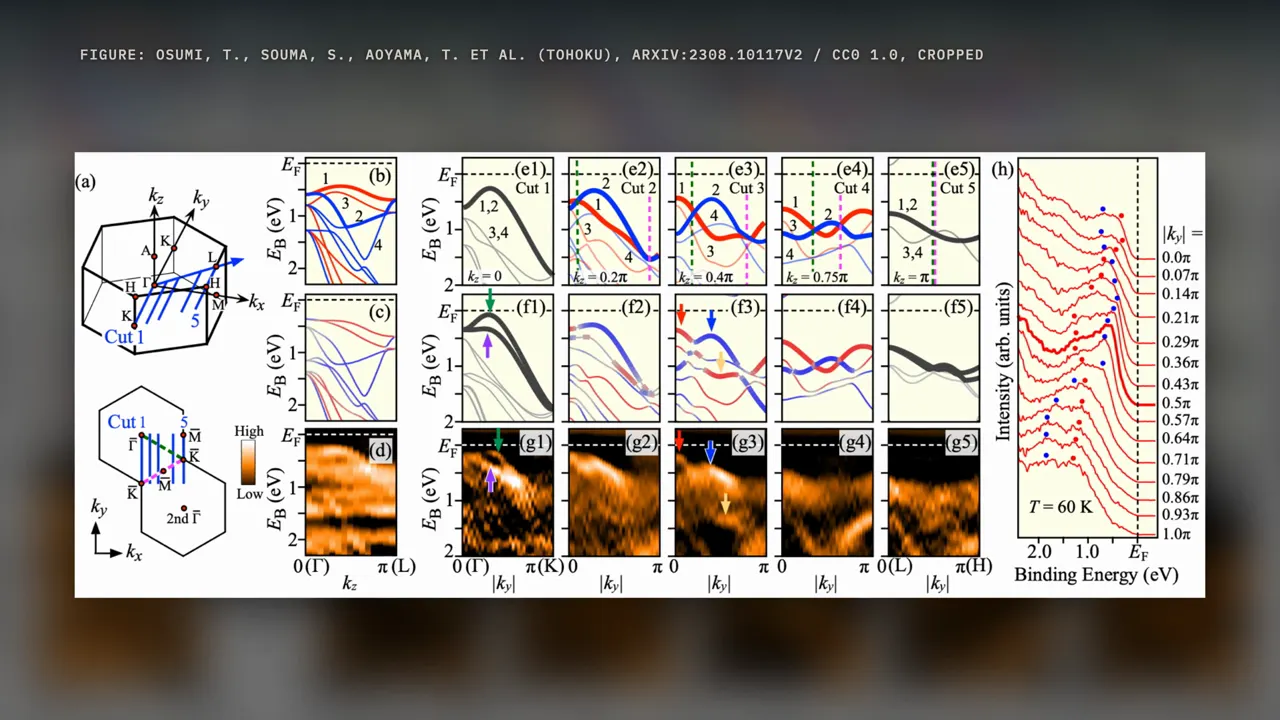
They used spin-resolved photoemission, which knocks electrons out with light and measures their energy, direction and spin. The split was there, and the result was published in Nature. A group at Tohoku University in Japan measured up to 0.8 electron volts of splitting in MnTe, along particular directions. MnTe keeps its magnetic order up to 307 kelvin, about 34 degrees Celsius.
In March 2024, a Mainz team reported the splitting in thin films, very thin layers, of chromium antimonide, a good-conducting material made of chromium and antimony, or CrSb. In 2025, another team mapped the splitting in CrSb in three dimensions. They found up to about 1.0 electron volt, near the energies of the electrons that carry current.
CrSb stays ordered up to about 705 kelvin, roughly 430 degrees Celsius. Its pattern is more complex than a clover, with more lobes, and physicists call it g-wave. Later in 2024, a team led from the University of Nottingham imaged MnTe with X-rays at the MAX IV laboratory in Sweden. In a film 30 nanometers thick, thousands of times thinner than a hair, at about minus 173 degrees Celsius,
they saw swirling patterns called vortices and antivortices, which wind in opposite directions. By patterning the film into shapes, or by cooling it in a magnetic field, they could set up the arrangements they wanted. Peter Wadley described it as "like antiferromagnetism with a twist." According to Mainz University, the journal Science listed altermagnetism among the breakthroughs of 2024.
One correction to the simple story: MnTe isn't perfectly cancelled. It keeps a tiny leftover magnetization, about one-thousandth of an electron's magnetic strength per manganese atom. That's tiny, though researchers can use it as a handle to control the magnetic order.
Hidden in the drawer
Tomáš Jungwirth said altermagnetism exists "in many crystals that people simply had in their drawers." One database estimate, reported by Science News, counted 232 altermagnet candidates. That's more than the 193 ferromagnet candidates, though far fewer than the 827 antiferromagnet candidates. Jairo Sinova spoke of a magnetic phase, a distinct magnetic state, that "had remained hidden for more than one hundred years."
That makes a good headline, but it isn't the whole story. A 2020 paper by Zunger, Rashba and colleagues traces the theory of magnetic spin splitting back to Pekar and Rashba in 1964. In August 2019, the Japanese physicists Hayami, Yanagi and Kusunose showed that some antiferromagnets can split electrons by spin without spin-orbit coupling.
In December 2019, Zunger's group predicted splittings of up to about 300 millielectron volts, about a third of an electron volt, in manganese fluoride, a material made of manganese and fluorine, also without spin-orbit coupling. Manganese fluoride only orders below 67 kelvin, about minus 206 degrees Celsius. Paolo Radaelli at Oxford noted that different authors use somewhat different definitions of altermagnetism.
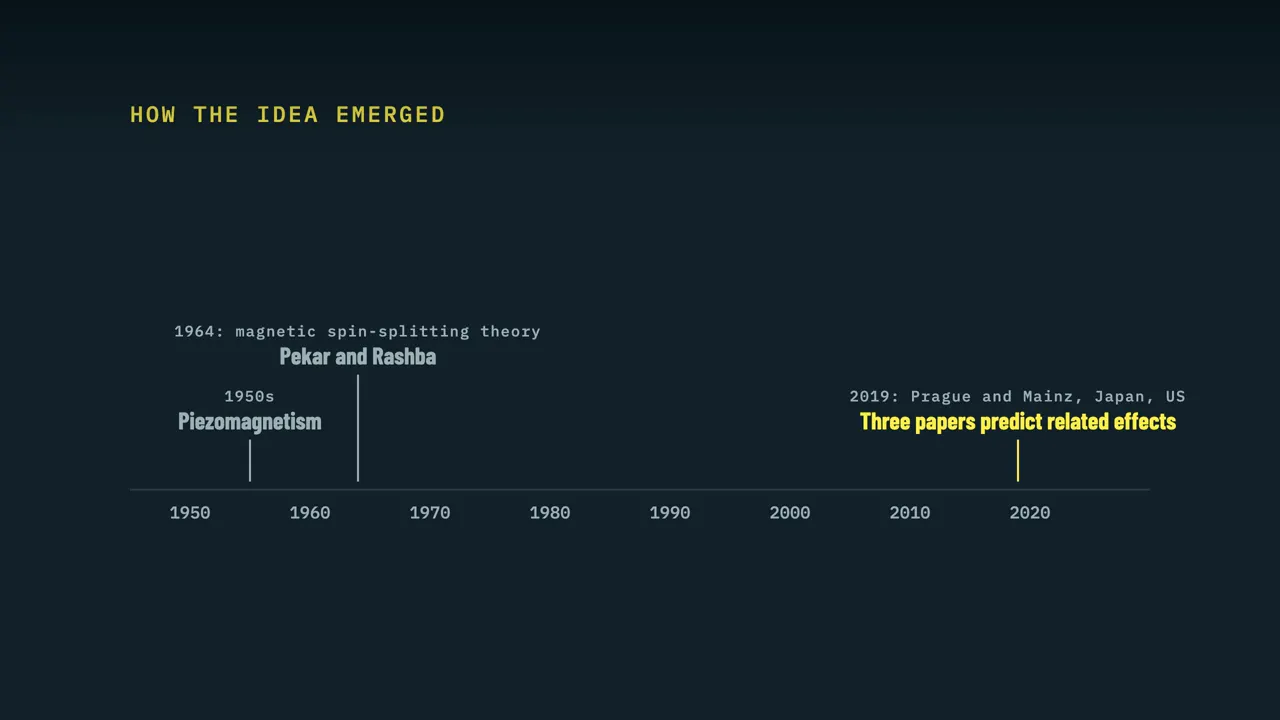
He also pointed out that piezomagnetism, where squeezing or stretching a crystal can change its magnetization, has been known since the 1950s. He credits Šmejkal and colleagues with coining the term. Even so, the theorist Igor Mazin told Science News that, somehow, "nobody thought about this possibility." The pieces existed for decades, scattered across papers.
What the Mainz and Prague team added was a full symmetry classification, a name, and predictions that guided experiments. According to their institute, the early theory was cited more than 1,000 times in 2025 alone. In July 2026, the European Physical Society gave Šmejkal, Sinova and Jungwirth its Europhysics Prize for discovering altermagnetism.
The memory dream
Why would any of this matter outside a lab? Because a lot of memory is already magnetic. In 2019, Samsung announced mass production of embedded MRAM, built into other chips, on a 28-nanometer chip-making process. It said writing was about a thousand times faster than embedded flash, and that the data stays without power.
In 2021, Everspin said its 256-kilobit MRAM chip was designed into the main powertrain system of the Lucid Air electric car. Notice that Samsung's thousand times compares two kinds of memory that already exist. It has nothing to do with altermagnets. An altermagnet promises both halves of the wish list.
Its electrons are split by spin, like a ferromagnet's, so in principle it can be read with electricity. Its net magnetization is essentially zero, like an antiferromagnet's, so bits could sit close together without leaking fields. Their institute says such a phase "can remove the scalability limitations of ferromagnets," the limits on how tightly bits can be packed. Nottingham's press release went further: replacing components could give "a thousand fold increase in speed."
That's a projection for future components, not a measured speedup. The 2018 terahertz writing was done in an ordinary antiferromagnet, not in an altermagnet. And as we'll see, the first switching experiments in altermagnets are very recent, and a memory chip is still a long way off.
How far there is to go
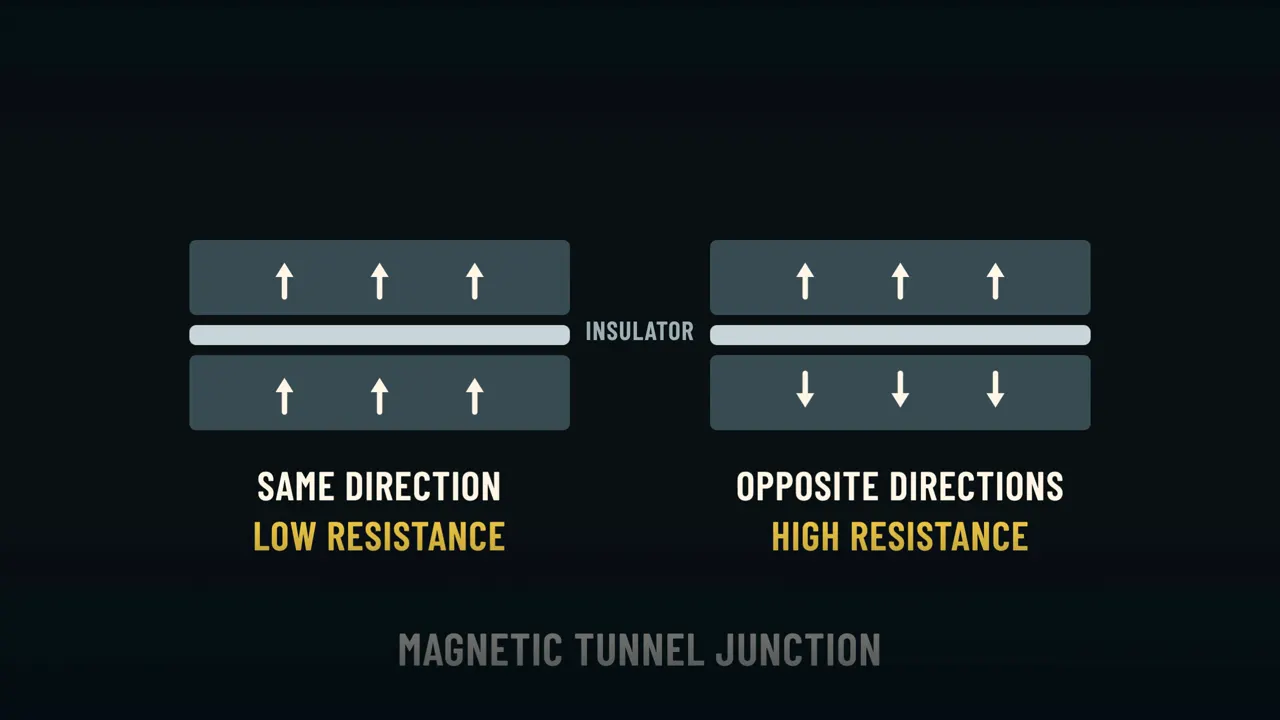
So where does the technology actually stand? The basic part of an MRAM cell is a magnetic tunnel junction. It's two magnetic layers with a very thin insulator, a layer that barely lets current through, between them. Its resistance is different when the two layers point the same way and when they point opposite ways.
That change is called tunneling magnetoresistance, or TMR. In ferromagnetic MRAM, TMR can reach hundreds of percent. In June 2025, a team at UNIST in South Korea reported a tunnel junction built on ruthenium dioxide, RuO2, and interpreted its signal as altermagnetism.
The other layers were titanium dioxide and an ordinary ferromagnet, cobalt iron boron. The tunneling magnetoresistance reached about 5 percent at 10 kelvin, or minus 263 degrees Celsius. Above about 50 kelvin, it almost disappeared. A 2025 review by Jungwirth and colleagues says researchers predict tunneling
magnetoresistance in altermagnets comparable to that of ferromagnets. It's predicted, not yet measured. The second problem is the material itself. Ruthenium dioxide was the early poster child.
In early 2024, a team at DESY in Germany used a momentum microscope, which maps electrons' energies and directions. They reported a telltale break in time-reversal symmetry, meaning the electron pattern changes if time runs backward. But that same year, experiments with muons, short-lived particles that act as tiny magnetic probes, and with neutrons found no detectable magnetic order in the crystals and films they tested.
In 2026, more measurements on bulk crystals found no order, while films only two nanometers thick, stretched or compressed by the crystal they were grown on, showed patterned magnetic directions. A 2026 review sums it up: ruthenium dioxide's magnetic ground state, its lowest-energy magnetic arrangement, "remains under debate." So the tunnel-junction signal is a real measurement, but whether the signal shows altermagnetism is still disputed.
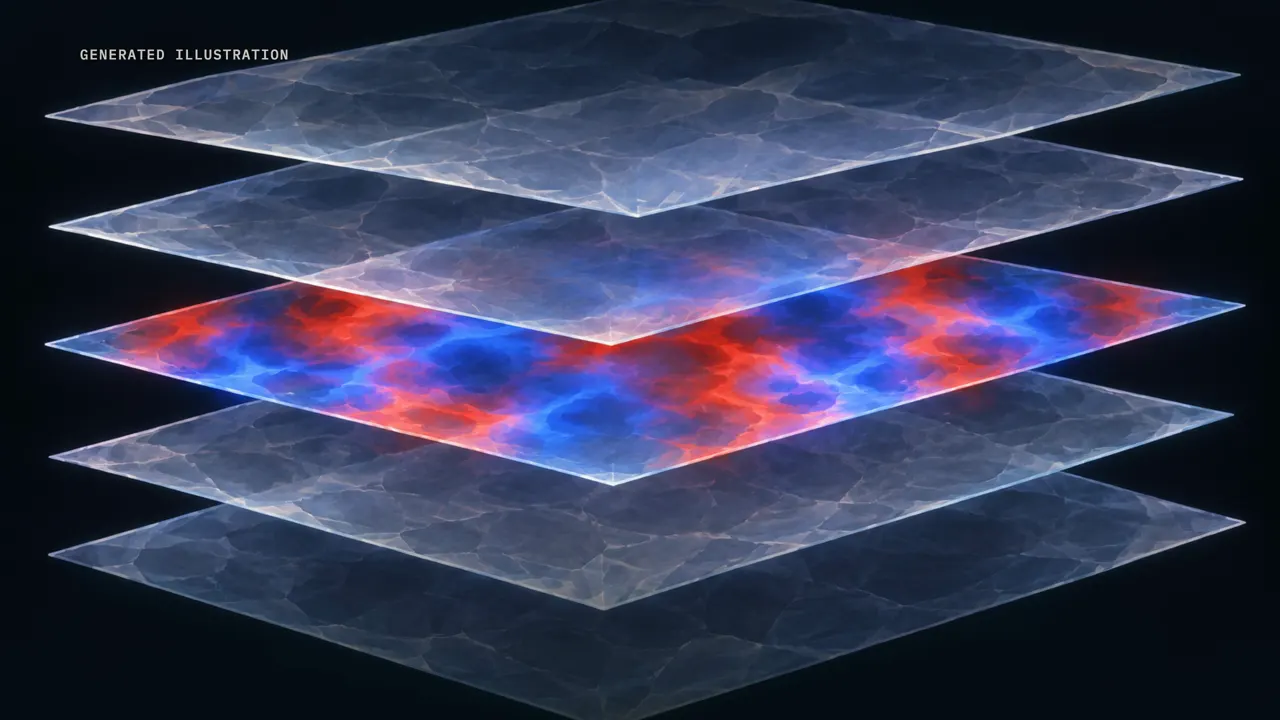
That's why this video leans on MnTe and CrSb. The third problem is switching. A memory has to flip its bits on command, and they have to stay put. Controlling the magnetic domains, regions where the pattern points the same way, is, in the review's words, "a key prerequisite."
An earlier experiment in thulium iron oxide reoriented the order only temporarily, and it didn't stay put without power. This is where CrSb has started to deliver. In February 2025, a team reported in Nature that electric currents could switch the altermagnetic order in CrSb films, and that the films gave a readable Hall signal at room temperature.
In August 2026, another team reported that they could read the order in chromium antimonide and switch it to a chosen state in a layered device that also contained platinum ditelluride, a material made of platinum and tellurium. They wrote that this could "pave the way for scalable altermagnetic memory." There's also good news on temperature.
MnTe, CrSb and two newer vanadium compounds all stay ordered above room temperature. So the scorecard reads like this. The physics is confirmed in several materials. Room-temperature order exists, and the first experiments that read and switch it with electricity have been reported.
What's still missing is a room-temperature memory cell that switches electrically and gives a readout as strong as today's MRAM, let alone a competitive chip.
More than two
Go back to the fridge magnet. It's the magnet everyone knows, and it's the loud one. Yet in that database count, magnets with cancelling moments outnumber ferromagnets by more than five to one. For almost a century, we filed most of those quiet ones under one heading.
Some of them were sorting their electrons into lanes the whole time. Nobody had to invent a new material to find them. MnTe was already in the drawer. What changed was the question physicists asked about symmetry.
Whether that question changes the memory in your devices is still open. Further experiments will show how far these materials can go. For now, the honest answer is that there are more than two types of magnets, and we're still sorting them.
Watch on YouTube
Sources
- Šmejkal, Sinova, Jungwirth, Phys. Rev. X 12, 031042 (2022) and 12, 040501 (2022)
- Krempaský et al., Nature 626, 517 (2024), doi.org/10.1038/s41586-023-06907-7
- Osumi et al., MnTe band splitting, arXiv 2308.10117
- Reimers et al., Nat. Commun. 15 (2024); Yang et al., Nat. Commun. 16, 1442 (2025)
- Amin et al., Nature 636, 348 (2024), doi.org/10.1038/s41586-024-08234-x
- Néel, Nobel lecture (1970), nobelprize.org; Shull and Smart (1949) via arXiv 1609.09666
- Fina and Marti, arXiv 1610.05615; Olejník et al., Science Advances 4, eaar3566 (2018)
- Nobel Prize in Physics 2007 press release (giant magnetoresistance)
- Šmejkal et al., Science Advances 6, eaaz8809 (2020); Hayami et al., arXiv 1908.08680; Yuan et al., PRB 102, 014422 (2020); Radaelli, arXiv 2407.13548
- Science News, 25 April 2024 (Emily Conover)
- Samsung Newsroom, 11 March 2019; Everspin via Business Wire, 16 June 2021
- Noh et al. (UNIST), PRL, June 2025; Jungwirth et al., "Altermagnetic spintronics", arXiv 2508.09748
- RuO2: Fedchenko et al., Sci. Adv. 10 (2024); Keßler et al., arXiv 2405.10820; Osumi et al., PRB 113, 085116 (2026); Nano Convergence review (2026)
- Switching: Zhou et al., Nature (2025), doi.org/10.1038/s41586-024-08436-3; Li et al., Nature Materials (2026), doi.org/10.1038/s41563-026-02721-4
- University of Mainz press releases (2024, 2025, 2026); FZU news (2020, 2026); University of Nottingham release via ScienceDaily (11 Dec 2024)
- Figures (CC BY 4.0, cropped): Krempaský et al. 2024; Amin et al. 2024; Yang et al. 2025. CC0: Osumi et al. (arXiv).
- Images and video
- Wikimedia Commons, CC BY 3.0: Oak Ridge National Laboratory (T. E. Mason et al. 2013), Schölla Schwarz
- CC BY 2.0: Johan Wessman / News Oresund, Oak Ridge National Laboratory
- CC BY-SA 4.0: Ponor
- CC BY-SA 3.0 NL: Anefo / Nationaal Archief
- CC BY-SA 3.0: Eric Gaba (Sting), Gorchy, Matthew Field, Pete Stephenson, Ra'ike
- CC BY-SA 2.0: Benjamin Crowell, Ryan Somma
- Public domain: Ed Westcott (Manhattan Engineer District), U.S. Geological Survey; CC0: AlfvanBeem, Daderot
- Pexels and Pixabay creators named on screen
- Narration is synthetic. Illustrations marked "Generated illustration" on screen are AI-generated, not records of real experiments.