How Noise-Cancelling Headphones Make Quiet

Noise-cancelling headphones do not silence the whole room. They shape sound pressure near your ears. Follow the cushion seal, microphones, processing and driver to see why fit matters, why steady low-frequency noise is easier to reduce, and how music and transparency modes fit into the picture.
This explainer combines rail footage, AI-generated fictional people and cabin scenes, and a photo-informed headphone model. Internal paths, driver sections and wave traces are simplified illustrations, not measured performance or precise CAD. The model is not a universal design for every headset.
This article is the full narration of the video. Watch on YouTube
The quiet is local
The train is moving, the ventilation is running, and a low cabin hum fills the space around this listener. She puts on one pair of noise-cancelling headphones, and the hum seems to step back. The headphones have not made the cabin silent, and they have not reached out to erase sound everywhere. They have changed the pressure pattern that reaches one small listening region near her ears.
To see how, keep your attention on the same listener and the same pair of headphones. First, notice the ordinary sound that arrives before the electronics do. A fan or engine makes nearby air move back and forth, passing a changing pressure disturbance through the cabin. The air does not carry one batch of particles all the way from the engine to the headphone.
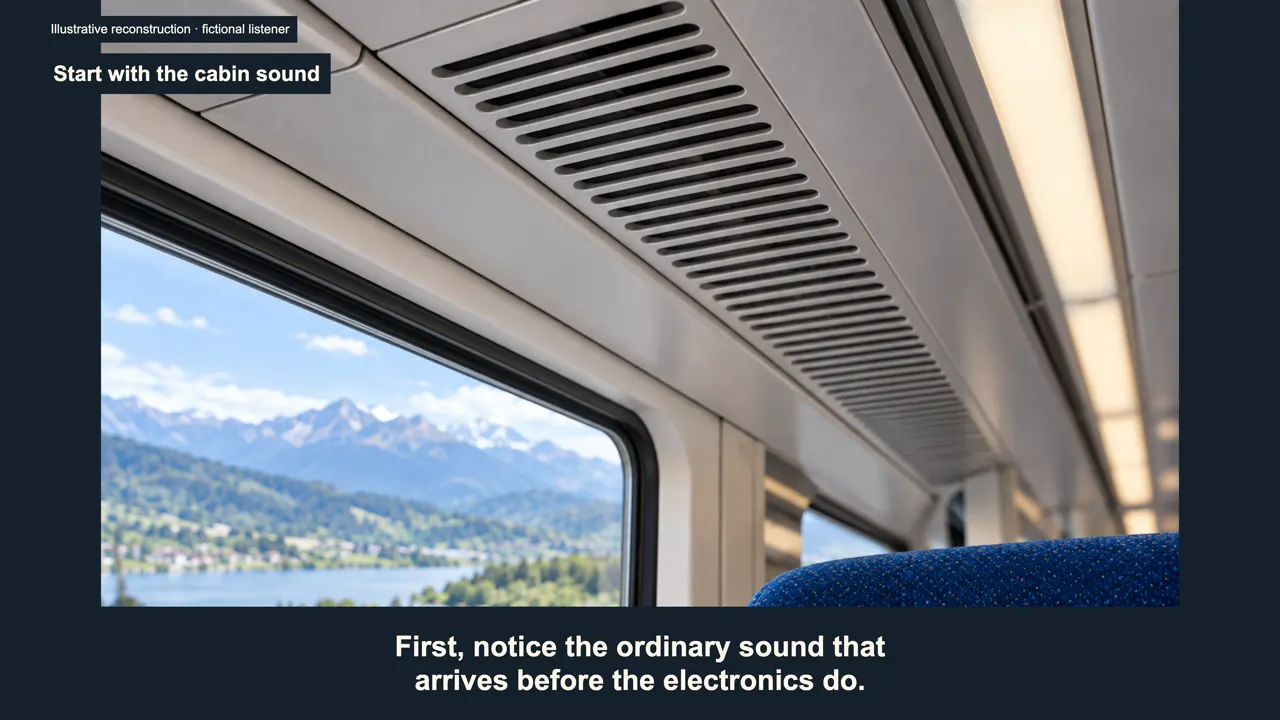
Each small group of particles oscillates near its resting position while the disturbance travels onward. That moving pattern is what the headphone must sense and influence at the listener's ear.
The first layer is a seal
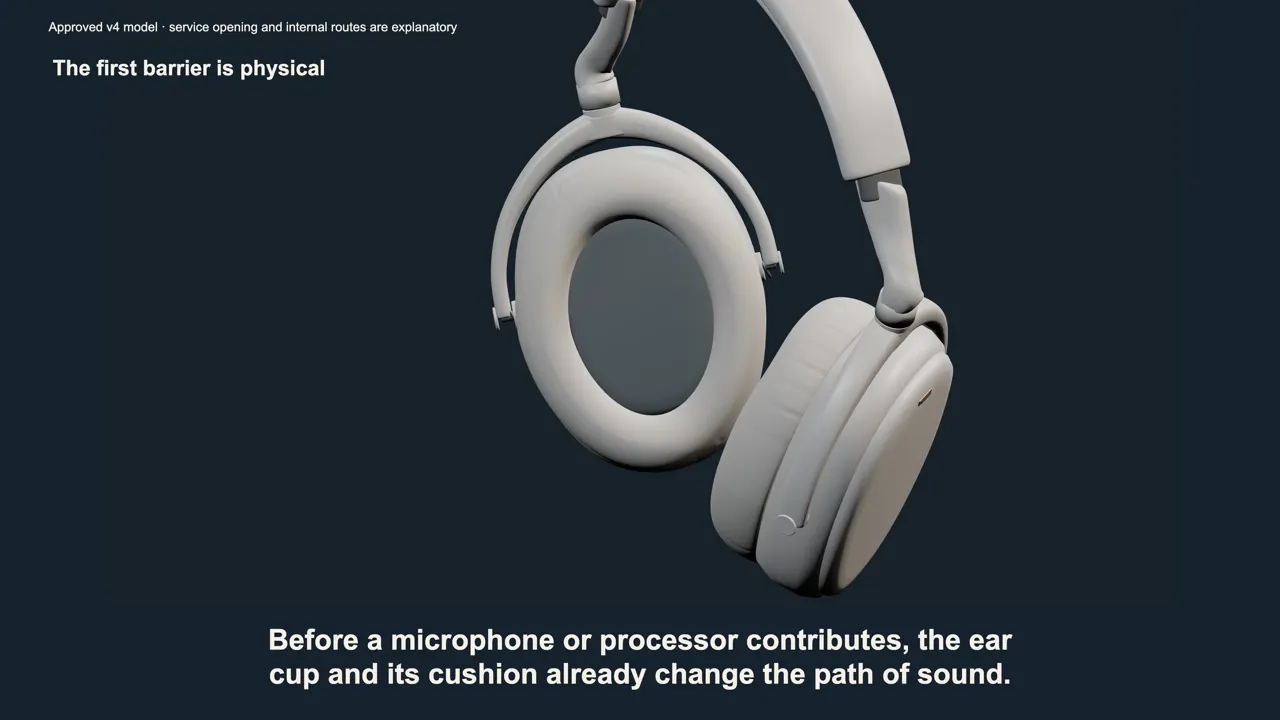
Before a microphone or processor contributes, the ear cup and its cushion already change the path of sound. The cushion presses around the ear and reduces how freely outside sound can enter. This is passive isolation: the physical fit does part of the work without generating a second sound wave. Now follow the same cup as its shell opens, while the headband, cushion and ear remain in the same positions.
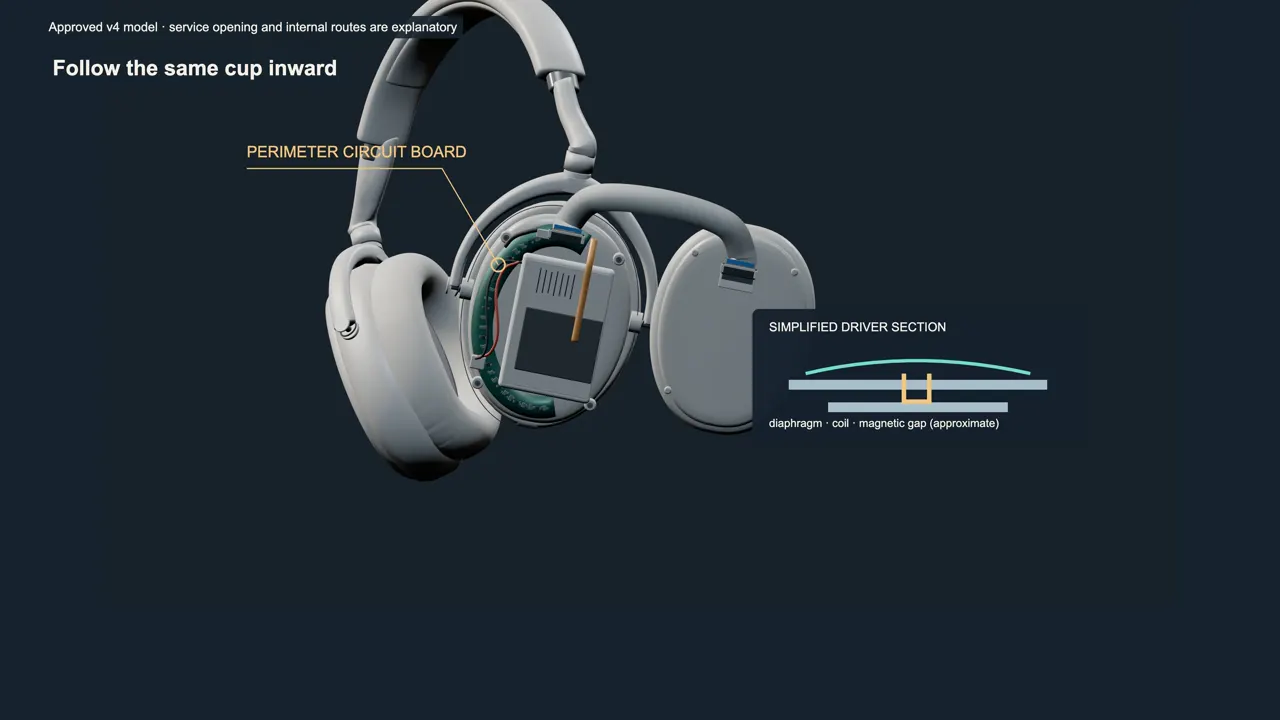
The opening reveals the baffle, driver and a sealed listening space around the ear. A good seal is never just an abstract setting; it depends on the shape of the head and how the pad sits. Slide a glasses temple under the cushion and a narrow leak appears at that contact. The gap gives some outside pressure a more direct route into the cup, especially where the passive barrier would otherwise help.
The active system can adapt to the sound it detects, but it cannot make every fit identical. The physical seal and active control therefore work as two layers with different jobs.
One target, not a room
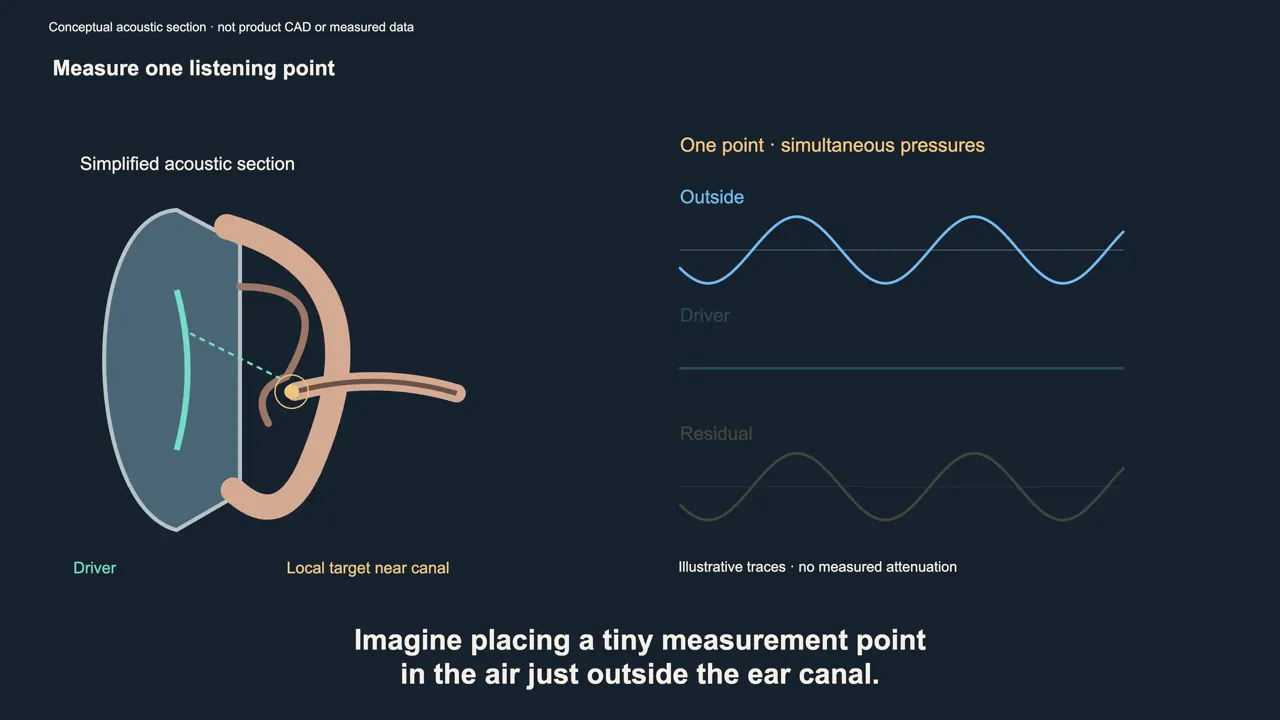
Imagine placing a tiny measurement point in the air just outside the ear canal. At that point, the arriving cabin sound has a pressure that changes over time. The driver can add another pressure variation to that same local air. When their timing and strength are suitably matched, the two contributions partly offset at the target.
The remaining pressure is the residual, and reducing that residual is the useful goal. The phrase opposite phase is a shortcut for a relationship that must be right at the listening point and at the frequencies being controlled. Simply choosing the opposite frequency is not enough, because cancellation depends on phase, amplitude, timing and the acoustic path. The waves do not annihilate the source, and their combination is not the same everywhere in a room.
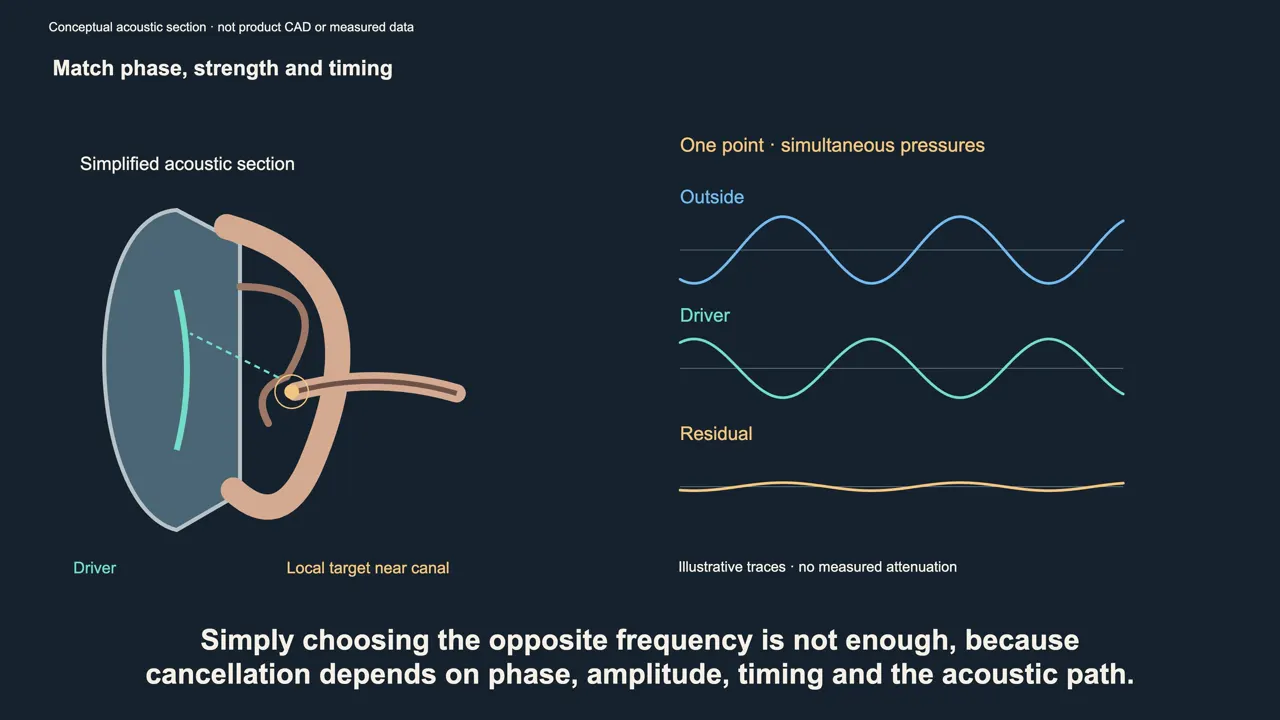
Move the target a short distance and the balance can change. This is why the demonstration stays focused on a small region near one ear rather than painting a whole cabin as silent. Listen for a brief educational comparison at a gentle level: the steady hum remains present, but its local residual is smaller. No startling sound is needed to make the principle visible.
A hybrid path through one cup
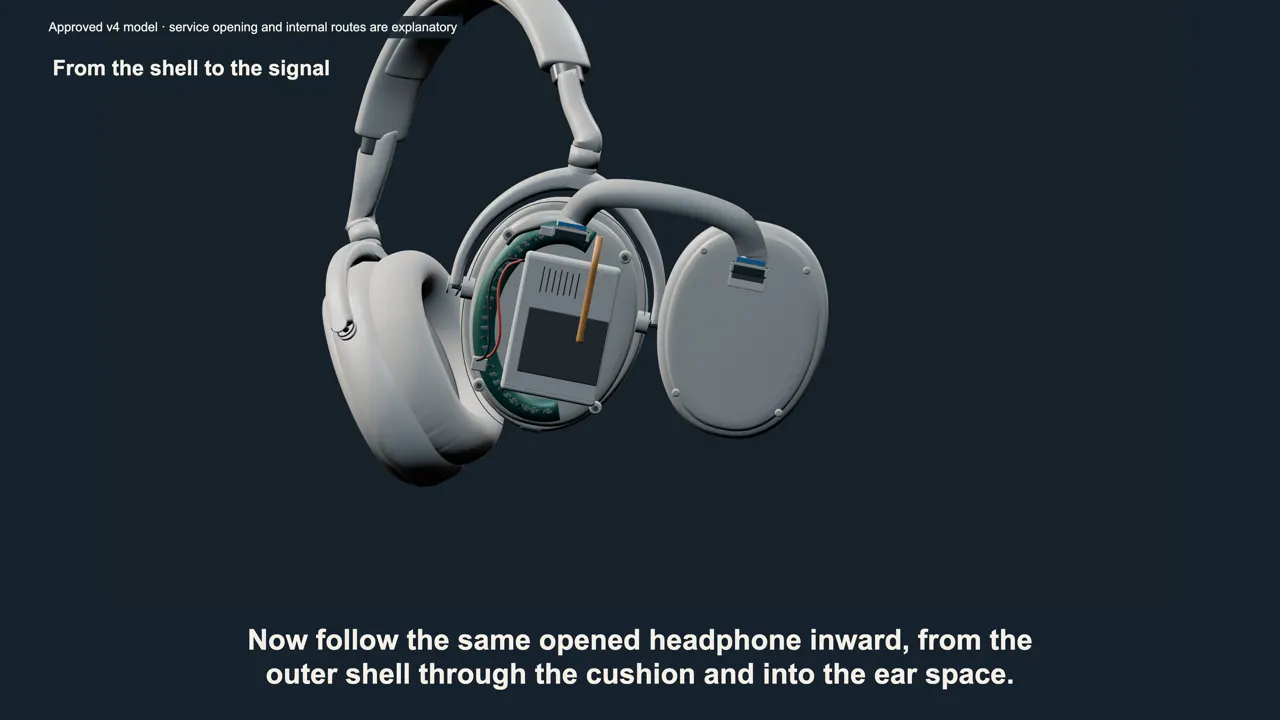
Now follow the same opened headphone inward, from the outer shell through the cushion and into the ear space. In this explanatory hybrid example, an outside microphone samples the approaching cabin noise. Its electrical signal travels to a processor mounted on the cup's inner circuit board. The processor estimates what correction can be sent through the driver after accounting for the headphone's acoustic path.
The driver moves its diaphragm and creates a controlled pressure variation inside the cup. An inward-facing microphone near the ear canal can observe the residual that remains after outside sound and driver output meet. That observation can feed back into the processor, closing a control loop in designs that use this arrangement. The outside microphone, processor, driver, ear canal residual microphone and return path now form one connected example.
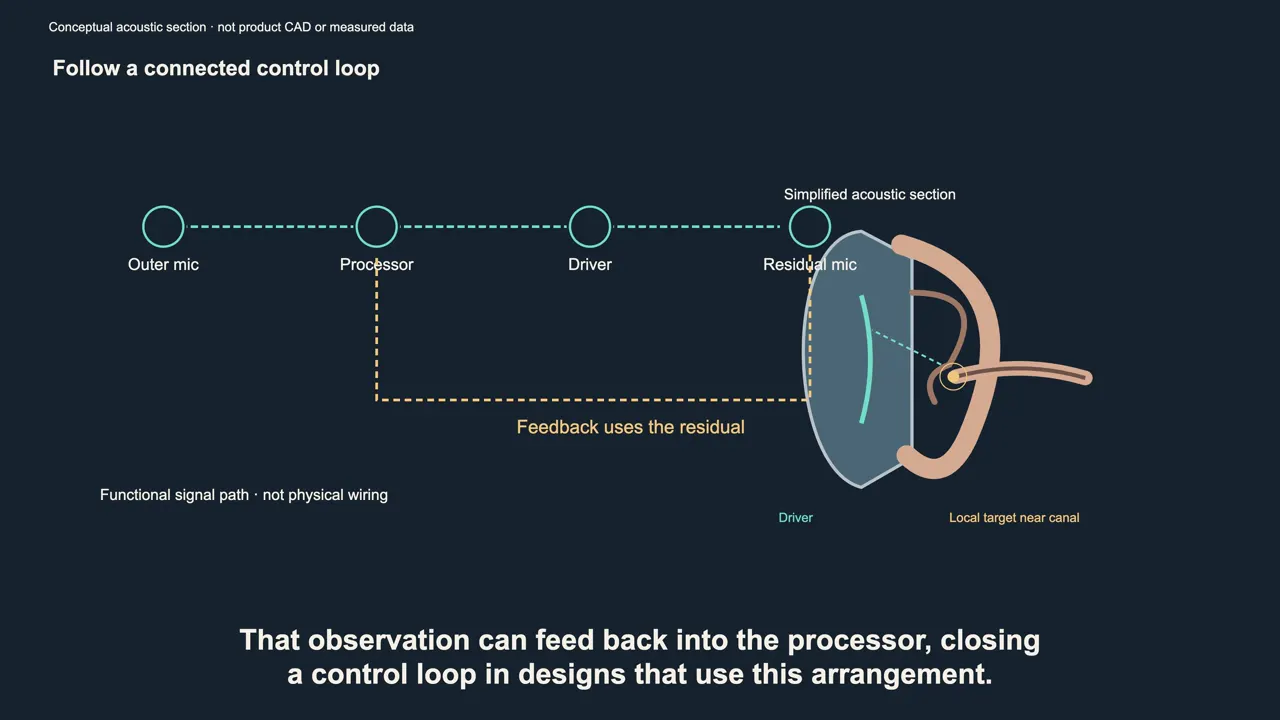
Real headphones differ: some use feedforward microphones, some use feedback microphones, and some combine strategies. The exact microphone count, placement, filtering and tuning belong to each product's acoustic design. A change to the cushion, shell or electronics can change that acoustic path and require new tuning. So the cutaway teaches a possible hybrid route, not a hidden blueprint shared by every brand.
Why some sounds yield sooner
Return to the train hum: it changes comparatively slowly and persists long enough for the system to follow. A fan, road rumble or aircraft cabin often contains this kind of steady low-frequency energy. The controller can measure a continuing pattern, predict its near-future shape and drive a suitable correction. A sudden clatter or nearby voice changes more quickly and less predictably.
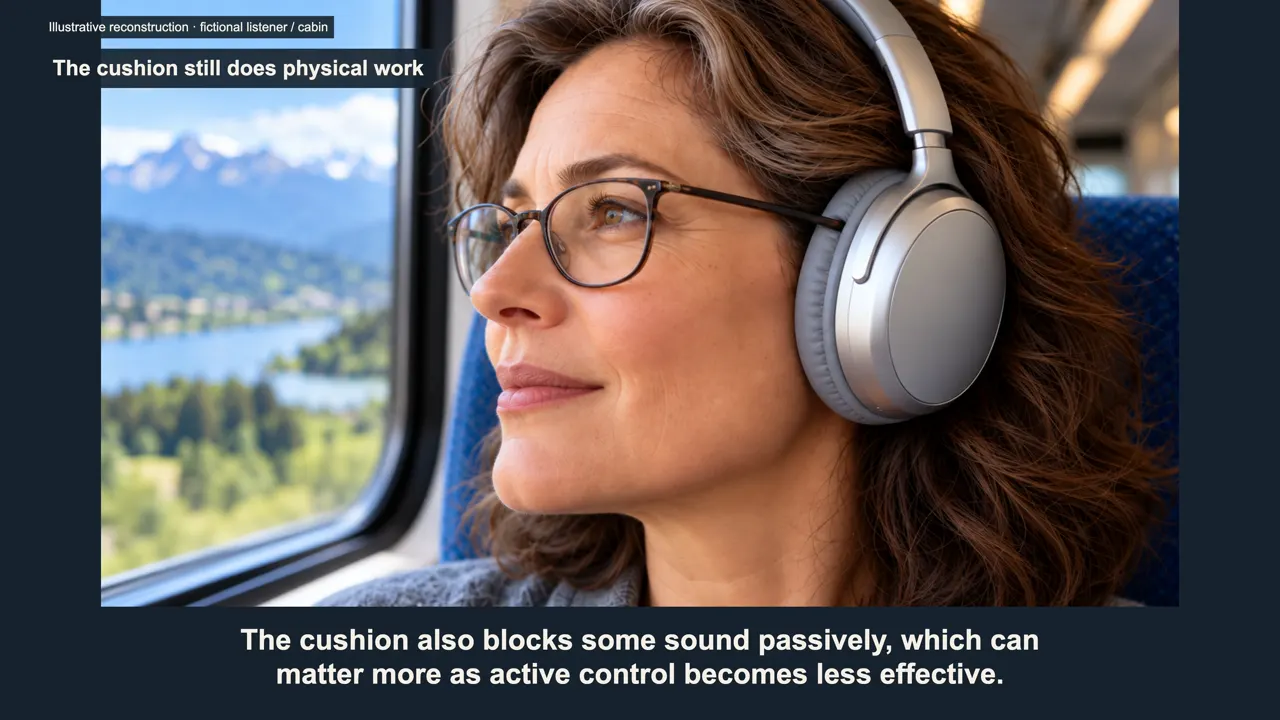
At higher frequencies, a small timing error corresponds to a larger shift in phase, so delay and fit become more consequential. The cushion also blocks some sound passively, which can matter more as active control becomes less effective. That combination helps explain why noise cancellation often reduces a low drone more clearly than conversation or sharp transient sounds. It is a tendency, not a promise that every low tone disappears or every high sound passes unchanged.
The headphone is balancing reduction, stability, power use and sound quality within its own tuned acoustic path. On the circuit view, the processed signal is frequency-selective and application-specific rather than one universal inverted copy.
Quiet, music and awareness

The cancellation path can keep working when no music is playing, because it is responding to outside sound. Now add a separate music signal to the same driver. The driver carries both the wanted program and the correction intended to reduce the cabin residual. These are distinct goals: one signal adds the song, while another manages part of the surrounding noise.
Turn the music off again and the cancellation function may continue, depending on the headphone and its mode. Transparency mode changes the goal: microphones and processing bring more of the outside scene into what the listener hears. It is not simply the opposite waveform played louder; the system may shape how voices and environmental sounds are passed through. A listener may choose more isolation for a steady commute or more awareness when conversation or surroundings matter.

Controls and available modes vary by manufacturer and model. The same microphones that support cancellation can also help a product make that choice feel adjustable.
The remaining sound
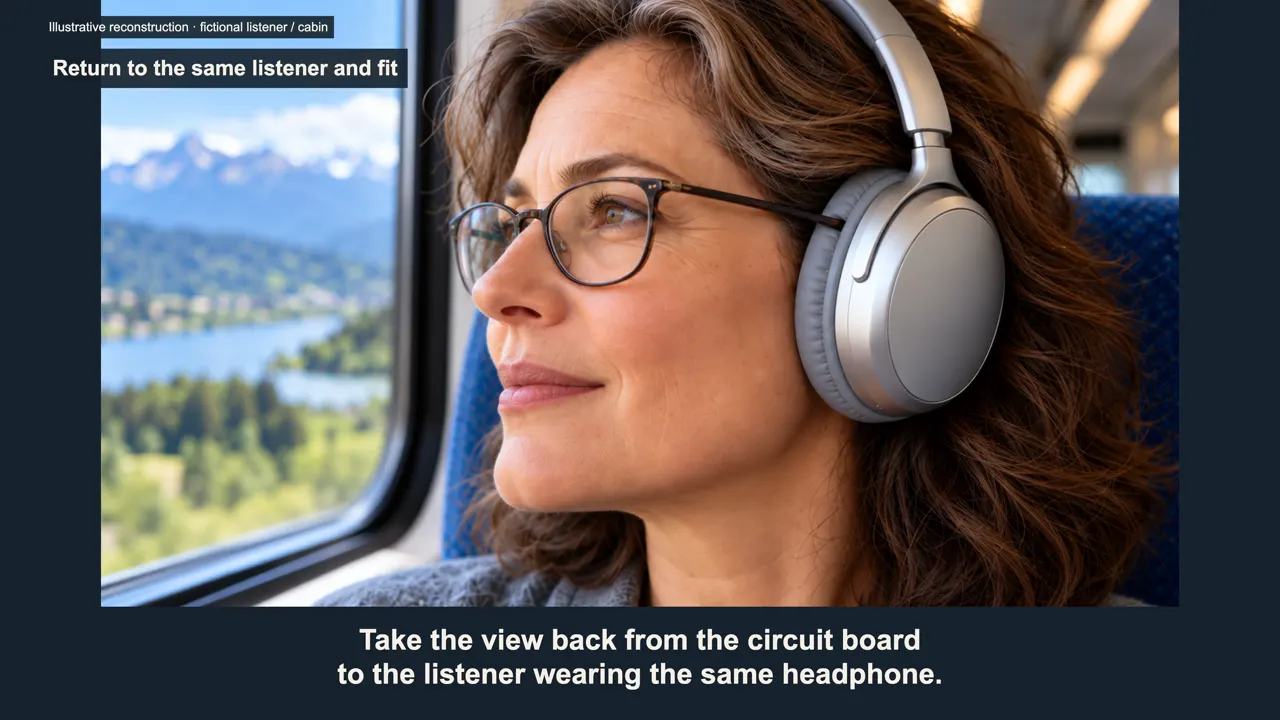
Take the view back from the circuit board to the listener wearing the same headphone. The cup's shape, cushion and fit still matter, including the small leak around her glasses. The microphone still samples only at its own location, and the processor still works within its design and timing limits. A changing voice, a sudden impact or sound entering through a gap can leave a clear residual.
Even Sony's product guide says noise is reduced rather than completely canceled and emphasizes low-frequency performance. Bose likewise notes that nearby speech is harder to reduce than steady background noise. These limits are not a flaw in the idea; they are consequences of controlling sound along a real path, in a real fit, at finite speed. The headphones do not stop the train from humming or remove pressure variations from the cabin.

They use passive isolation and active control to make the residual at a listener's ear smaller for selected parts of that sound. That is the useful meaning of quiet: local, conditional and shared between the physical cup and its electronics. The same air continues to oscillate, the driver continues to play music if asked, and the outside world remains available when awareness mode is chosen. The listener hears less of the steady hum, not a magical absence of sound.
Watch on YouTube
Sources
- Bose — how noise cancellation works: https://www.bose.com/stories/how-do-noise-cancelling-headphones-work
- Sony — noise cancellation and its limits (WH-XB900N guide): https://helpguide.sony.net/mdr/whxb900n/v1/en/contents/TP0002049996.html
- Analog Devices — Bowers & Wilkins case study: https://www.analog.com/en/signals/articles/bowers-wilkins-noise-canceling-headphones.html
- Analog Devices — audio algorithms and hybrid ANC: https://www.analog.com/en/solutions/lp/audio-algorithms-for-enhanced-conversation.html
- Cirrus Logic — CS47L85 datasheet, page 165: https://statics.cirrus.com/pubs/proDatasheet/CS47L85_v4.2.pdf
- FOOTAGE
- Mixkit — City train driving under a bridge (#1606): https://mixkit.co/free-stock-video/city-train-driving-under-a-bridge-1606/
- Mixkit — People getting into the subway train (#1623): https://mixkit.co/free-stock-video/people-getting-into-the-subway-train-1623/
- Used under the Mixkit Stock Video Free License: https://mixkit.co/license/modal/videoFree/
- Rail footage is illustrative montage, not footage of the fictional listener's journey. No manufacturer or rail operator endorsement is implied.